Rediscovering Fauvist Georgette Agutte in 10 Paintings
Georgette Agutte was one of the very few women who participated in the Parisian art scene at the turn of the 20th century. She was a sculptor and a...
Nikolina Konjevod 26 March 2026
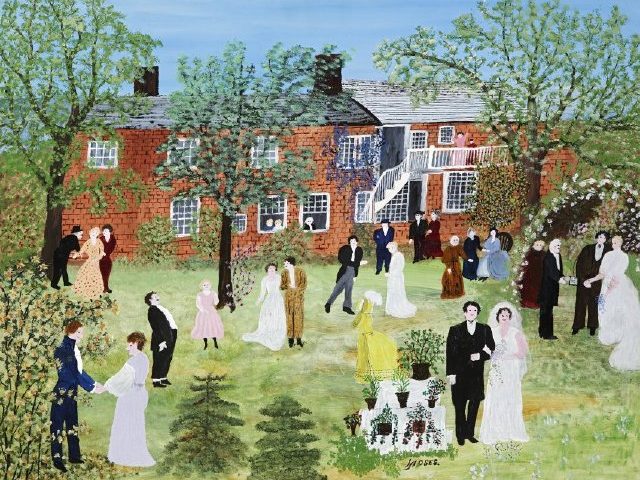
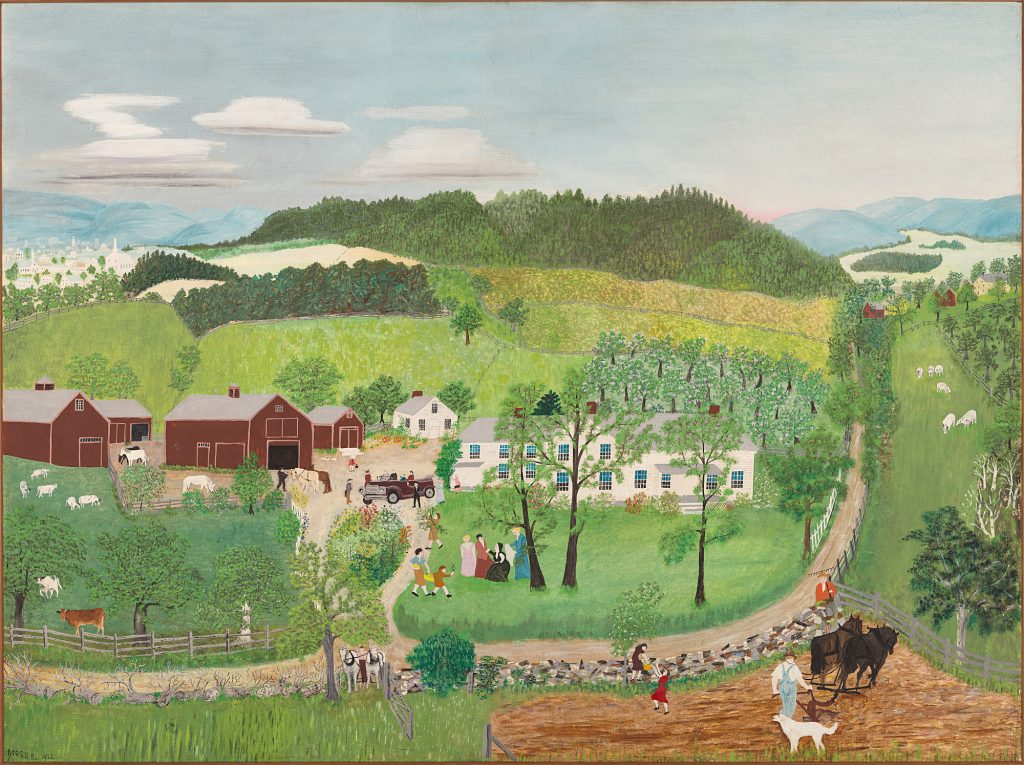
Grandma Moses, A Country Wedding, 1951, Bennington Museum, Bennington, Vermont, USA. Museum’s website. © Grandma Moses Properties, New York.
For most of her life, Grandma Moses was a wife, a mother, and a hardworking woman living on a farm. She began painting in her late seventies to keep herself occupied, capturing the countryside that surrounded her. When people were finally introduced to her work, they quickly started to appreciate it, and Moses soon became one of the most beloved American folk artists of the 20th century. Her story can inspire many, showing that art created from the heart and memories will eventually find recognition—no matter age or educational background.
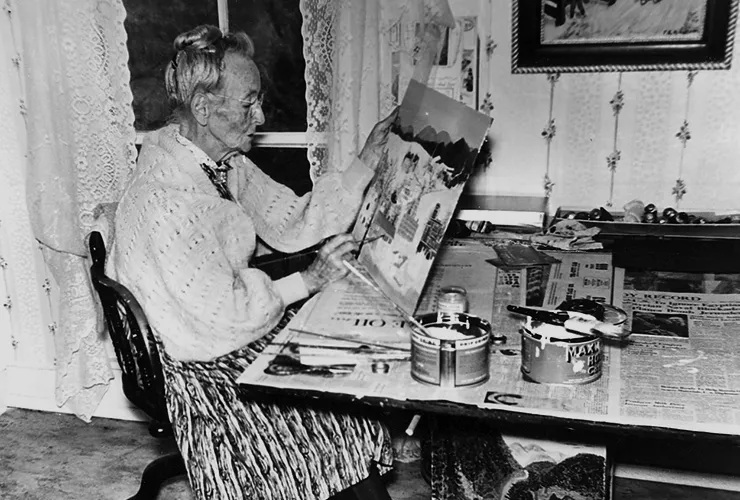
Grandma Moses. Photo by Ifor Thomas, National Museum of Women in the Arts, Washington, DC, USA. Museum’s website. © Grandma Moses Properties Co., New York.
Anna Mary Robertson, later known as Grandma Moses, was born on September 7, 1860 in Greenwich, New York, and grew up in a big family with nine siblings. Her parents valued hard work, and proper education was not even an option—she attended school only briefly.
When she was only 12, she began working on neighboring farms, helping with daily chores. Prints of Currier and Ives in the household where she worked caught her attention. Her employer, seeing her interest, gifted her drawing materials. Over the years, she learned to draw landscapes (especially winter landscapes) from those prints.
After about 15 years on the farm, Anna met Thomas Salmon Moses. They got married and continued working together. In 1905, when she was 45, they settled in Eagle Bridge, New York, which is not far from Moses’ hometown. They built their life together and had 10 children, but only five survived infancy.
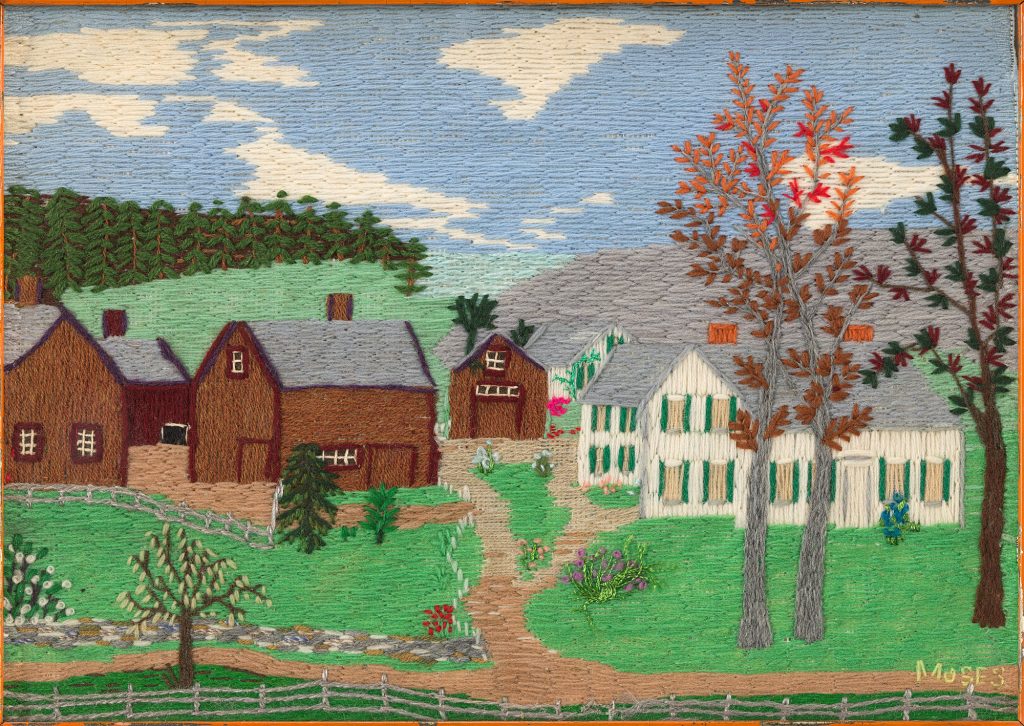
Grandma Moses, Mt. Nebo on the Hill, c. 1940, Smithsonian American Art Museum, Washington, DC, USA. Museum’s website. © Grandma Moses Properties Co., New York.
Even though Moses spent most of her life on her family and daily chores such as cooking, making fruit jams, or sewing—art was always a part of her life. She loved being surrounded by beautiful things, so she decorated objects like pillows or vases with paint and embroidery.
People were drawn to Grandma Moses’ story through her charming personality and the way her paintings complemented it. Her landscapes feel like they are viewed from a bird’s-eye perspective, showing forests, mountains, and rivers change as seasons change. There is always so much happening in a single painting, making it perfect for bringing your own stories to it. They compose an idyllic fairy tale, where people are happy and connected, where there is always a festive air and occasions like Christmas, Thanksgiving, and weddings, or where work on a farm is fulfilling with the company of dogs, cows, and horses. That was enough to win people’s hearts.
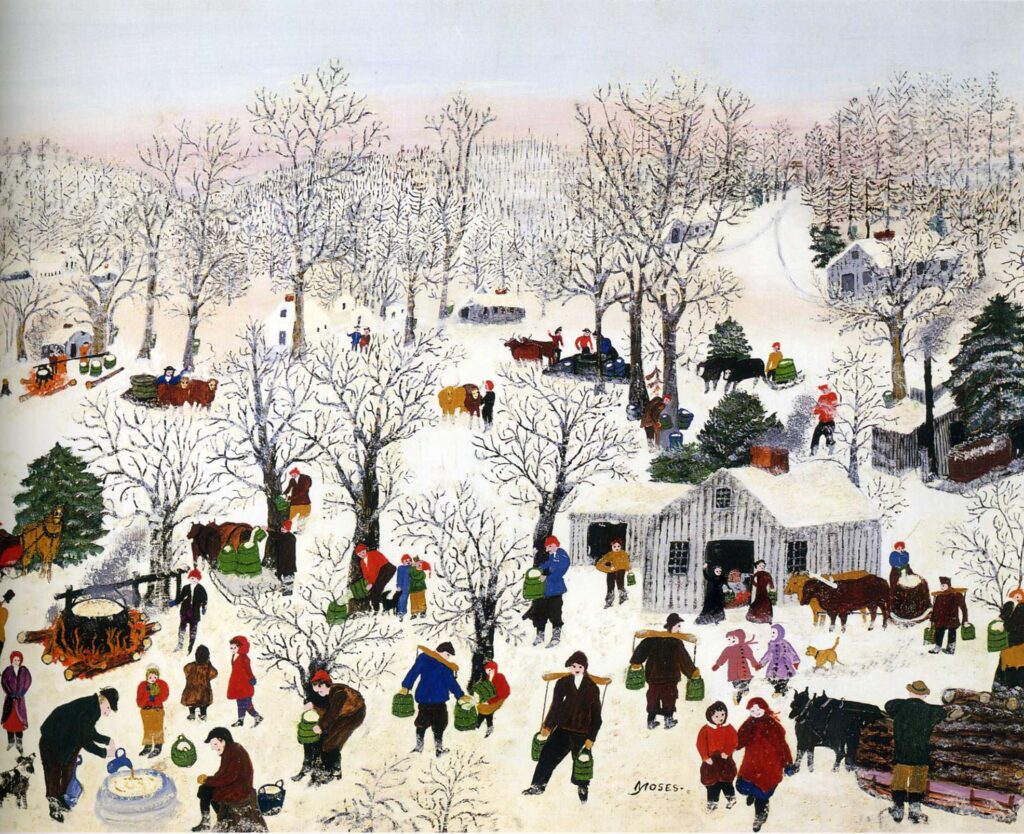
Grandma Moses, Sugaring Off, 1955, Bennington Museum, Bennington, VT, USA. Artchive.
One example is Sugaring Off, which shows families and friends making maple syrup. Even though it’s a depiction of work, it feels like a joyful moment shared with close ones. Kids run around, animals are present, and the scene feels like a moment straight out of a children’s book.
The story of Moses’ artistic career seems almost surreal, and many aspiring artists probably wish to be recognized the way she was. Around 1933, when Moses was already in her seventies, a new chapter began. She had to give up embroidery, as she couldn’t hold a needle any longer due to health conditions. Then, she decided to start painting, believing that a person should always stay occupied. At first, the pieces she created were gifts for friends and family, but, eventually, she produced so many that there were not enough people to give them to.
One day, Grandma Moses brought her paintings along with homemade jams to a local drugstore in Hoosick Falls as part of a Women’s Exchange. They mostly sat there and gathered dust until Easter Week came, when art collector and engineer Louis Caldor was passing through the villages. Caldor was always interested in local craft, and Moses’ work caught his eye. He liked the paintings so much that he bought every single one, including the ones Grandma Moses hung at home.
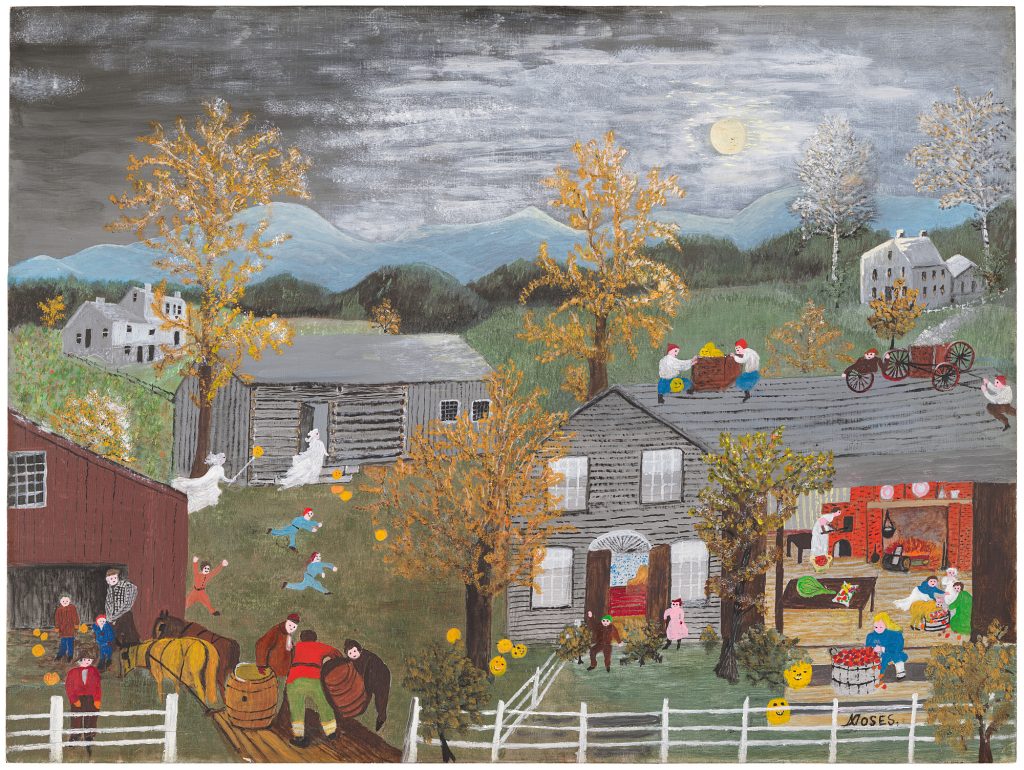
Grandma Moses, Halloween, 1955, Smithsonian American Art Museum, Washington, DC, USA. Museum’s website. © Grandma Moses Properties Co., New York.
Caldor then decided to show her art to the world. Most art galleries were hesitant once they found out the artist’s age. By 1938, Moses was already 78. However, Caldor convinced an art dealer to include some of her artwork in a private exhibition of lesser-known contemporary painters in 1939 at the Museum of Modern Art.
A year later, he managed to introduce Moses’ work to Otto Kallir, an Austrian art dealer who had an appreciation for self-taught painters. One of the artists he represented was Gustav Klimt. With Abstract Expressionism flourishing in New York, the environment made it easier to market the simplicity and soothing nature of Moses’ pieces. Kallir organized an exhibition dedicated to her at his gallery Galerie St. Etienne. The show, titled What a Farm Wife Painted, drew immediate attention. But one person was absent—Grandma Moses herself. Busy on the farm and having already seen all of her paintings, she decided there was no need to attend.
Grandma Moses, Grandma Moses Goes to the Big City, 1946, Smithsonian American Art Museum, Washington, DC, USA. Museum’s website. © Grandma Moses Properties Co., New York.
The turning point of Moses’ career was a special 1940 exhibition that was part of the Gimbels department store Thanksgiving Festival. This time, Moses actually arrived. She talked to journalists, and during her speech, she couldn’t resist mentioning her fruit jams.
And just like that, her career took off. Her work was soon exhibited in other galleries in European cities such as Paris and Vienna. She appeared in magazines like Time. With numerous interviews and even a meeting with the president, Grandma Moses became a national star. Her autobiography Grandma Moses: My Life’s History also became a bestseller.
I look back on my life like a good day’s work, it was done and I am satisfied with it. I was happy and contented, I knew nothing better and made the best out of what life offered. And life is what we make it, always has been, always will be.
My Life’s History, 1951.
Anna Mary Robertson Moses lived for 101 years. During the final 20 years of her life, she produced around 1500 paintings. Her work continues to charm viewers through its nostalgia, not to mention the inspiring reminder that it’s never too late.
Today, her paintings can be seen in museums across United States, including a current exhibition Grandma Moses: A Good Day’s Work at the Smithsonian American Art Museum, on view until July 2026.
Get your daily dose of art
Click and follow us on Google News to stay updated all the time

DailyArt Magazine needs your support. Every contribution, however big or small, is very valuable for our future. Thanks to it, we will be able to sustain and grow the Magazine. Thank you for your help!

Kinga is an art enthusiast, mainly interested in 19th-century art, especially Impressionism and Romanticism. She also appreciates classical art and architecture.

Georgette Agutte was one of the very few women who participated in the Parisian art scene at the turn of the 20th century. She was a sculptor and a...
Nikolina Konjevod 26 March 2026
Helene Schjerfbeck, famous in her native Finland, is not nearly as well known in the rest of the world. A genuine one-off, she studied in Paris and...
Catriona Miller 11 March 2026
If you are a frequent visitor to museum stores and bookshops, or a regular reader of The New Yorker, you have probably encountered the work of Maira...
Aniela Rybak-Vaganay 9 March 2026
Clementine Hunter taught herself to paint in her fifities and spent the rest of her life chronicling the Black Southern experience, not with slogans...
Wen Gu 23 February 2026