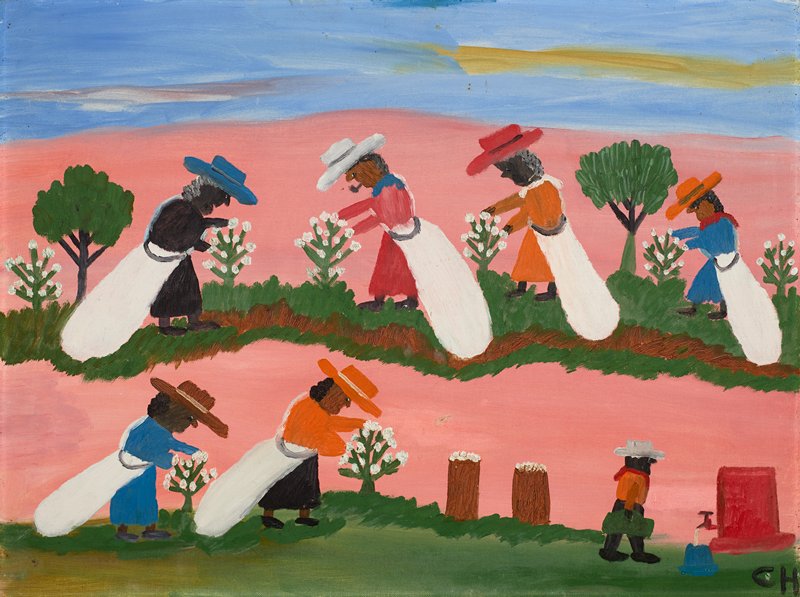
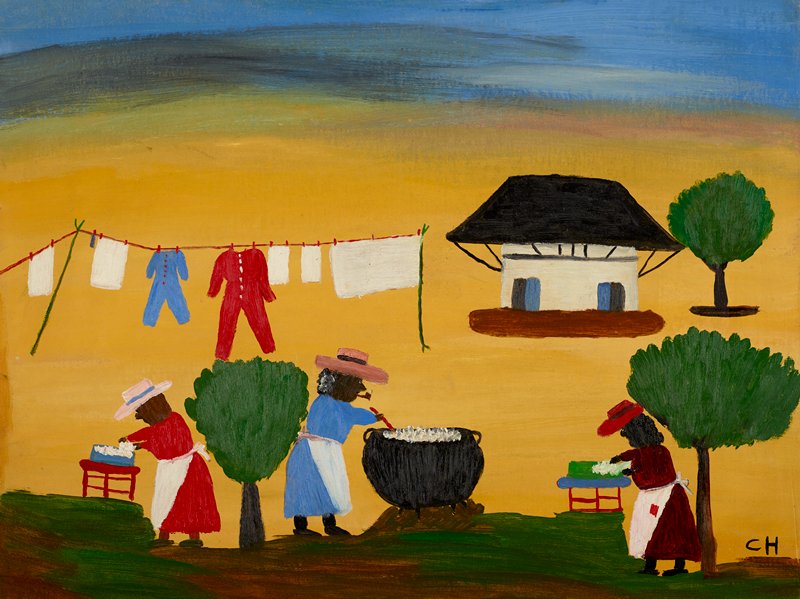
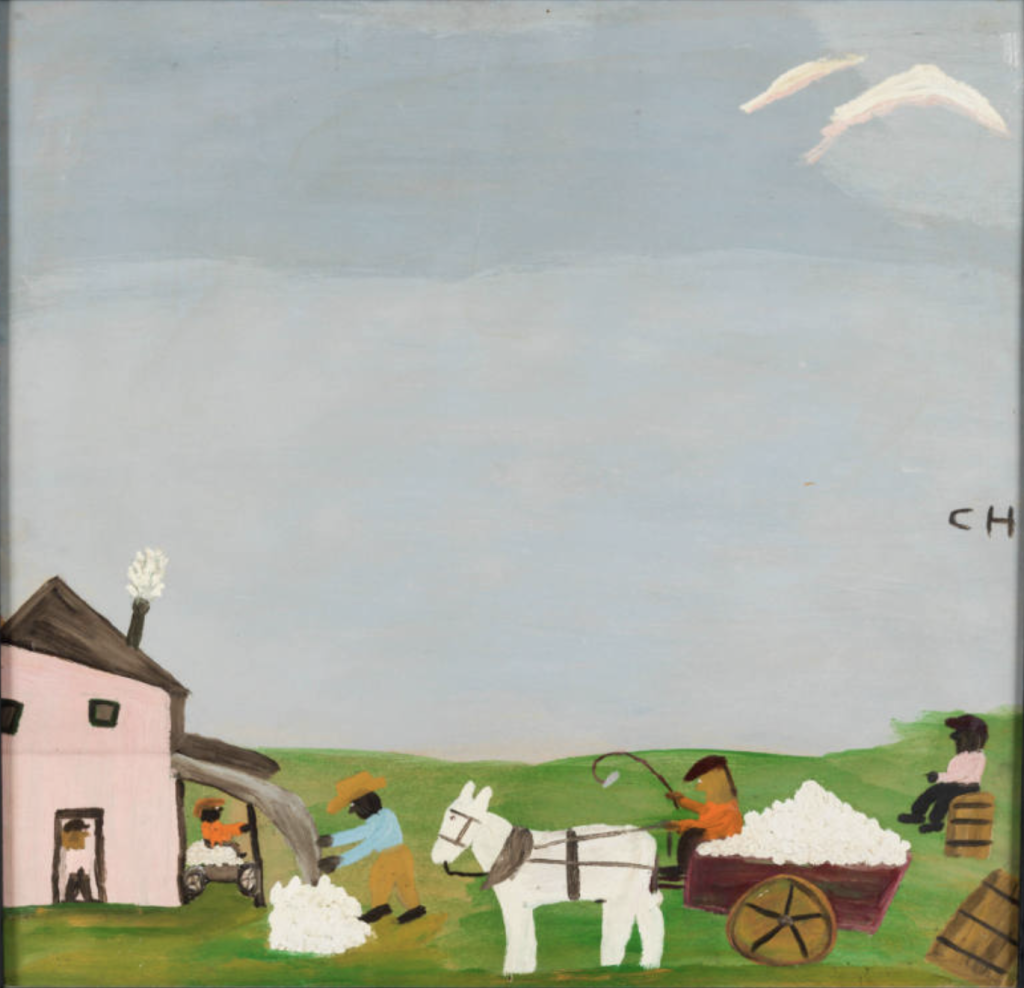
In Clementine Hunter’s Picking Cotton, everything feels simple at first: a flat pink sky, a strip of green ground, and women bent gently toward the plants. The figures line up across the canvas as if moving through a familiar routine, each gesture repeated with quiet care. There is no deep perspective, no dramatic spotlight, only the clear rhythm of work and the calm presence of daily life.
The scene feels less like a staged composition than a remembered one, like opening an old family album and realizing you have stepped into someone else’s world. You can almost hear the soft sounds of the field, the pause between movements, and the steadiness of people who have done this before.
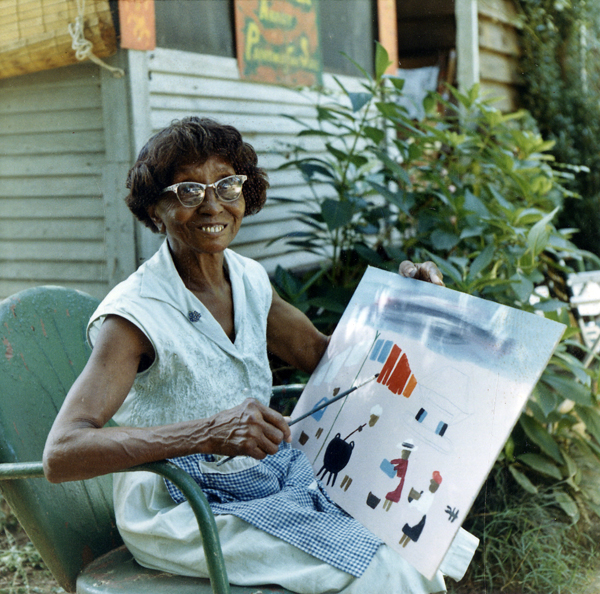
Hunter never studied in an academy, and she spent most of her life on Melrose Plantation in rural Louisiana. She began painting in her fifties, after decades of labor, turning the life around her into images that stay vivid and close.
She didn’t paint what she saw. She painted what she remembered.
Life Before Art: Melrose Plantation
Clementine Hunter spent nearly her entire life in Louisiana’s Cane River region, in a world shaped by plantation labor and the routines of survival. Born in the late 1880s, she rejected schooling and never learned to read or write. By the age of eight, she was already picking cotton alongside her family. As a teenager, she moved to Melrose Plantation, where life followed the rhythms of seasonal work, domestic service, and care labor.
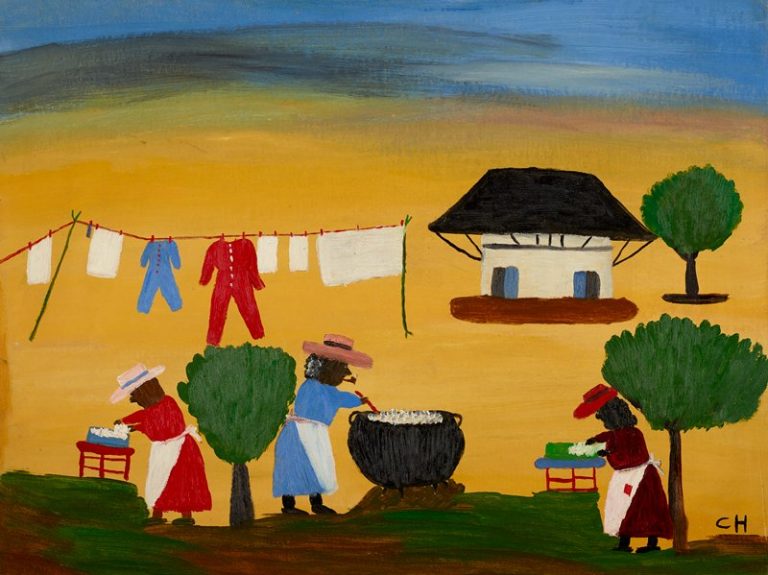
Though her daily life remained on the margins of history books, Hunter lived in a community rich with rituals, work, and quiet dignity. Melrose also became, somewhat unusually, a gathering place for visiting artists and writers in the early 20th century. While Hunter worked behind the scenes as a cook and housekeeper, she began saving leftover paint and cardboard scraps, turning them into vibrant scenes of the life she knew best. She didn’t paint from imagination, nor from distant study, but from memory—from harvests, baptisms, funerals, washdays, and Sunday afternoons.
She wasn’t meant to enter art history, and yet she wrote her own, one image at a time.
Memory as Practice: How She Started Painting
Hunter did not begin painting with any thought of becoming an artist. She began because something in her daily life needed a different shape. Long before she ever held a brush, she was already telling stories through her hands, in sewing, quilting, and the quiet creativity of domestic work. At Melrose Plantation, Hunter spent decades cooking, cleaning, and caring for others. Art belonged to another world, one she had never been trained to enter. Yet artists and writers sometimes passed through, and traces of that creative life lingered in small ways. When Hunter came across leftover paints and brushes, she did not pause for lessons or permission. She simply started.
Hunter painted on whatever was nearby: window shades, scraps of cardboard, bottles, bits of cloth. She worked at night after long days of labor, using humble materials to give form to what she carried inside her. The scenes came from memory, from a life watched and lived so many times that it could be summoned at will.
Painting became a steady practice, guided by instinct. Through repetition, she learned how to translate memory into color and rhythm. Ambition had little to do with it. What mattered was remembrance, and perhaps something close to love.
Painting Black Life from the Inside
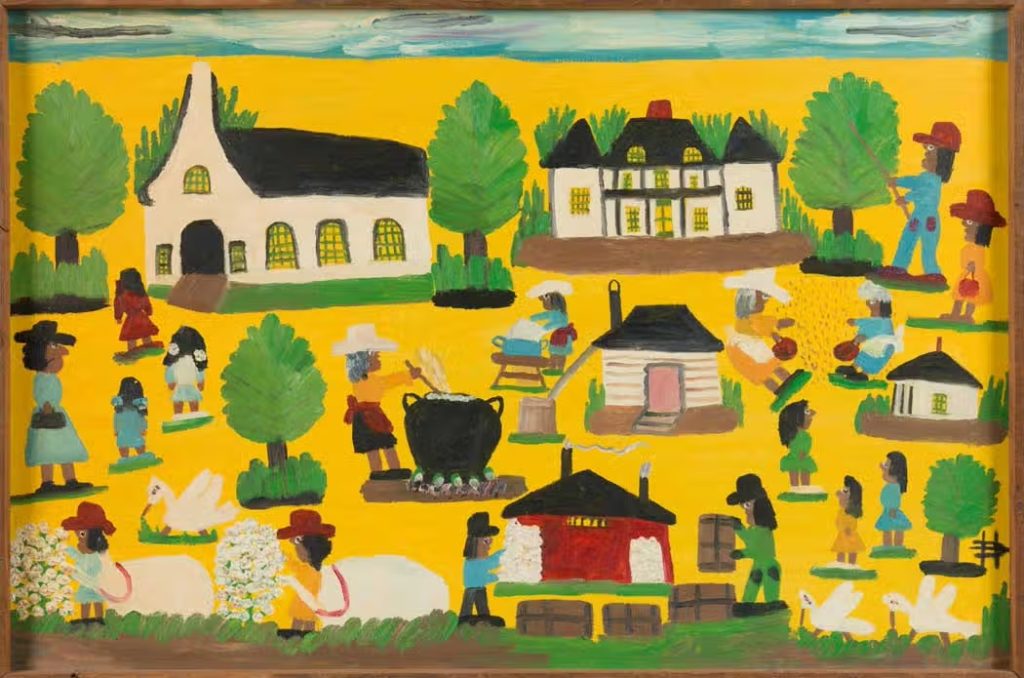
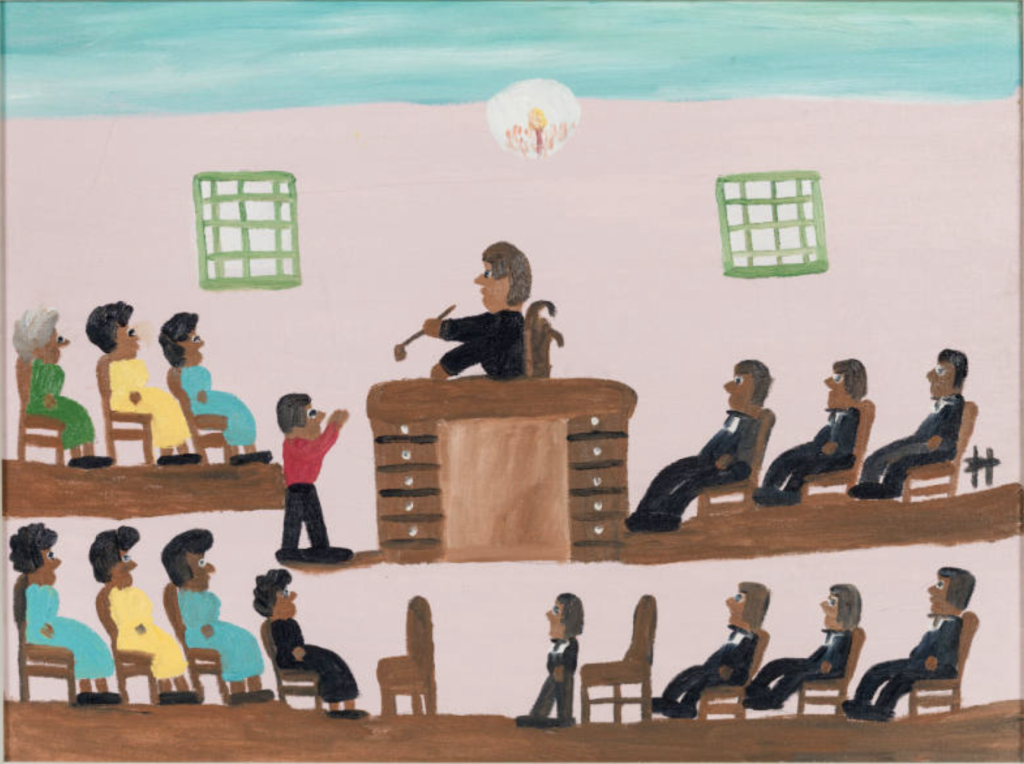
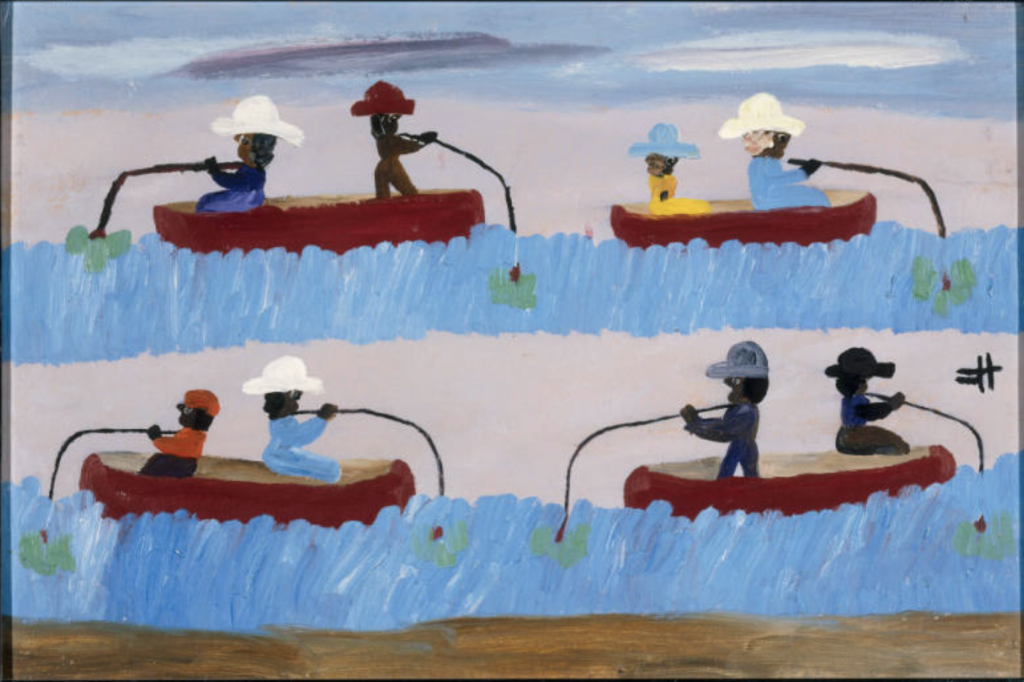
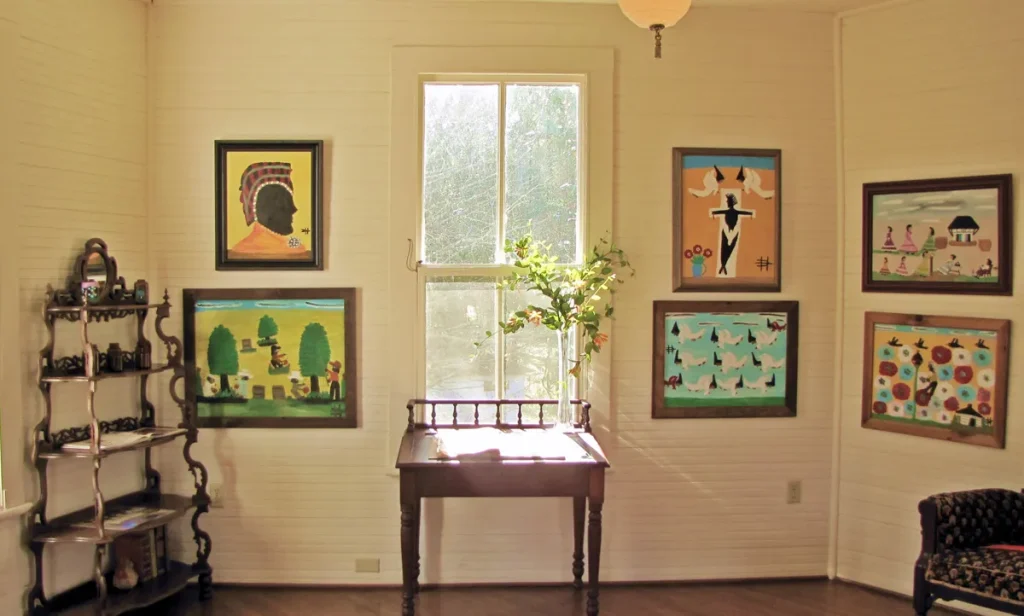
Hunter painted the life around her: cotton fields, washdays, weddings, funerals, card games, baptisms in the Cane River, and women at work in kitchens. These were everyday scenes she had seen countless times. Her images speak from within the community, rooted in memory rather than observation.
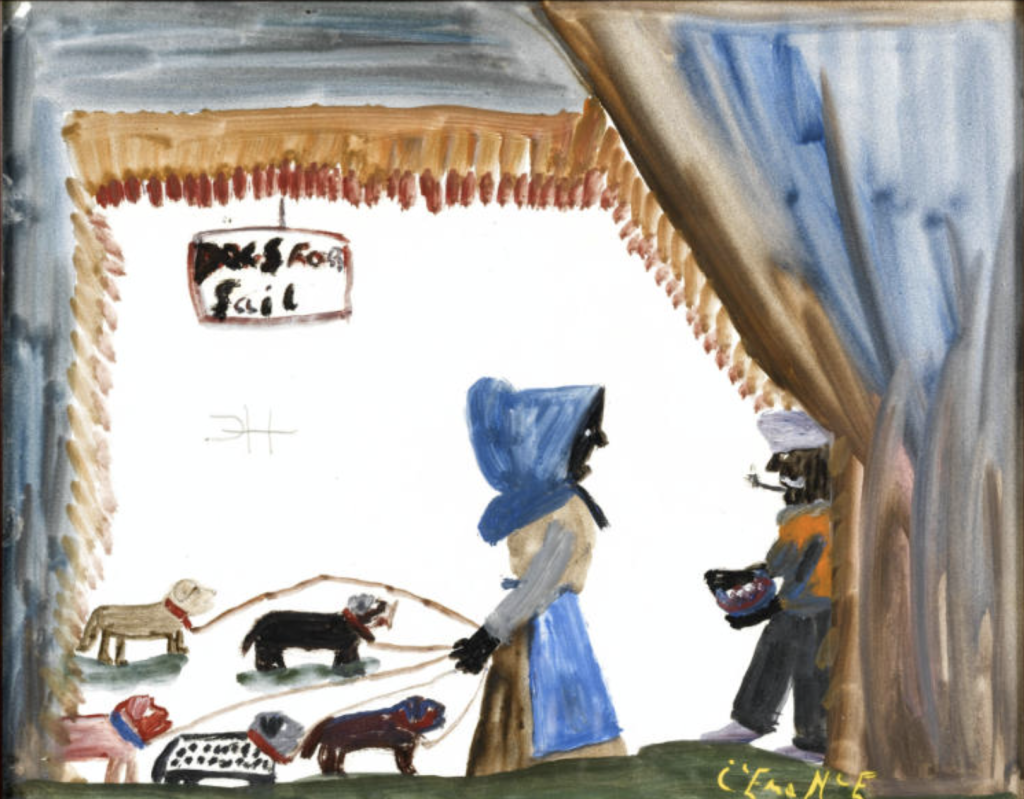
Her compositions flatten space. Hunter used donated oil paints in earthy tones. Her figures are shown in profile, often repeated in rows. This visual rhythm resembles quilt-making. Like the textiles she also created, her paintings rely on pattern, repetition, and balance.
“Quilt logic” shapes the scenes. In baptism paintings, people wade into the river, watched by others along the banks. In cotton-picking scenes, lines of workers bend across the field. Hunter once said she could pick 250 pounds in a day. In her paintings, the focus also stays on task and motion. Wedding and funeral paintings bring people together, not in drama but in ritual. Church scenes show rows of seated figures, echoing the order of Sunday services. What remains is a vision of Southern Black life shaped from within. These paintings feel like memory quilts. They are modest in means, steady in rhythm, and full of warmth carried across time.
What Her Paintings Remember
Hunter’s paintings are acts of memory: deep, structured, and insistent. They do more than reflect personal experience; they preserve what formal histories often omit. Her brush followed the rhythm of everyday life in the rural South: women picking cotton, washing clothes, gathering at church, preparing meals. These scenes were not observed in the moment but remembered through repetition, movements seen so many times that they became part of her body’s knowledge.
In Hunter’s work, memory moves beyond the individual. The gestures she rendered—bending, scrubbing, sitting side by side—belonged to many and were shared across generations. Her paintings pulse with the quiet tempo of labor and ritual, where kinship was a daily practice. Hunter arranged these motions like quilt patterns, building a visual language from structure and care.
These are not casual scenes. They are visual ethnographies created from within a life fully lived. Without formal schooling or access to written archives, Hunter built her own form of history, one that centers daily experience over official narrative. She used color and shape to preserve what others ignored: truths that lived in hands, in gestures, and in repetition.
Hunter’s paintings are built from memory, not from longing. She painted to retain what would otherwise disappear. The lives she recorded had rarely been documented, yet they formed the backbone of entire communities. Her memory served as a form of preservation, creating an archive where none had existed. Each brushstroke becomes a gesture of preservation. What her paintings remember, they insist on keeping.
From Cabin Walls to National Museums
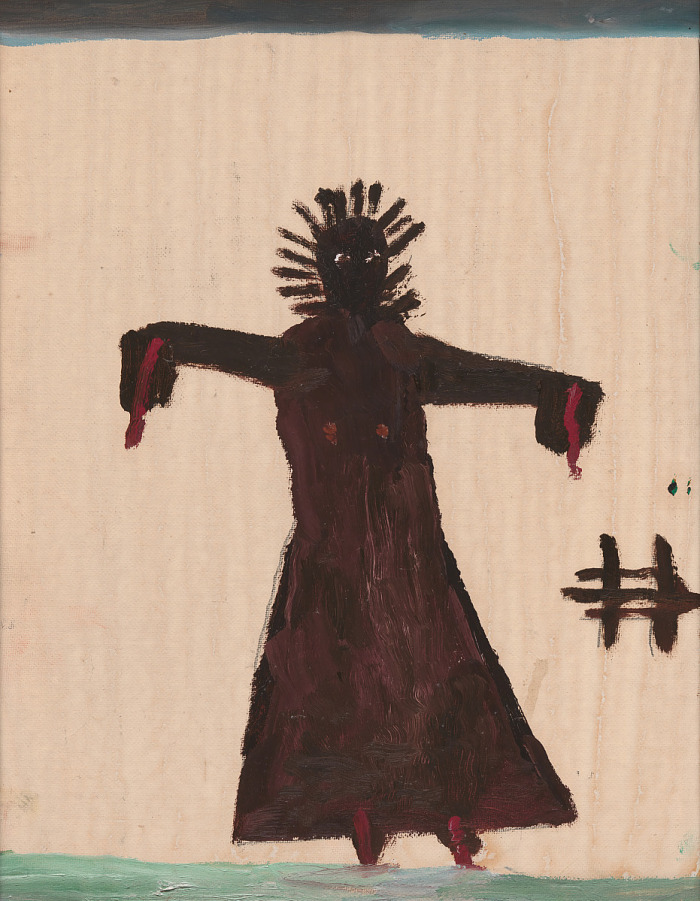
Hunter lived her entire life in Louisiana, rarely leaving the Natchitoches area. Her world was small, but her vision was far-reaching. She began selling her paintings for less than a dollar, often displaying them on the outer wall of her cabin or offering them at the local drugstore. Unable to spell her name, Hunter signed with a backwards “C” and “H” monogram. A hand-painted sign outside her studio once read: “Clementine Hunter, Artist. 50 cents a look.” Visitors could buy a homemade popsicle while browsing her paintings.
Despite these modest beginnings, Hunter’s works steadily made their way into galleries and museums. In 1945, her first exhibitions were held in Texas; by 1953, Look magazine featured her nationally. Two years later, she became the first African American artist to receive a solo show at the Delgado Museum (now the New Orleans Museum of Art). In 1966, Louisiana State University mounted a major exhibition of her work. Decades later, her paintings entered major public collections, including the Smithsonian and the National Gallery of Art, where they appeared in the landmark 2022 exhibition Afro-Atlantic Histories (including the one below).
Through it all, Hunter remained rooted in the place she painted. She often said that painting helped her buy a stove, a freezer, a bathroom, and a secondhand car—enough to transform her daily life. Yet even as her work traveled far beyond Melrose, she stayed where her stories had always unfolded.
The irony endures: her canvases crossed thresholds of race, class, and geography that she never did. They moved through universities and museums, witnessing a wider world their maker never saw.
Why She Belongs in Black History Month
Clementine Hunter deserves a place in Black History Month because she captured a world that few others thought to preserve. She didn’t speak through slogans; her art moved through the quiet rhythms of rinsing, bending, carrying, and gathering, gestures that shaped rural Black life. While official histories often focus on battles and speeches, Hunter built an archive rooted in everyday survival and joy. She painted church gatherings, washdays, wakes, and cotton fields as scenes filled with meaning. Though she never received a formal education, her work revealed what dignity looks like in motion. In her view, daily life held as much historical weight as any headline. She refused to let the lives around her disappear without a trace.
Looking at her paintings today means witnessing how one woman remembered the world she came from and how she ensured that memory would endure. In 2019, Louisiana declared October 1 as Clementine Hunter Day, honoring the artist whose quiet visions now stand at the heart of the state’s cultural memory.