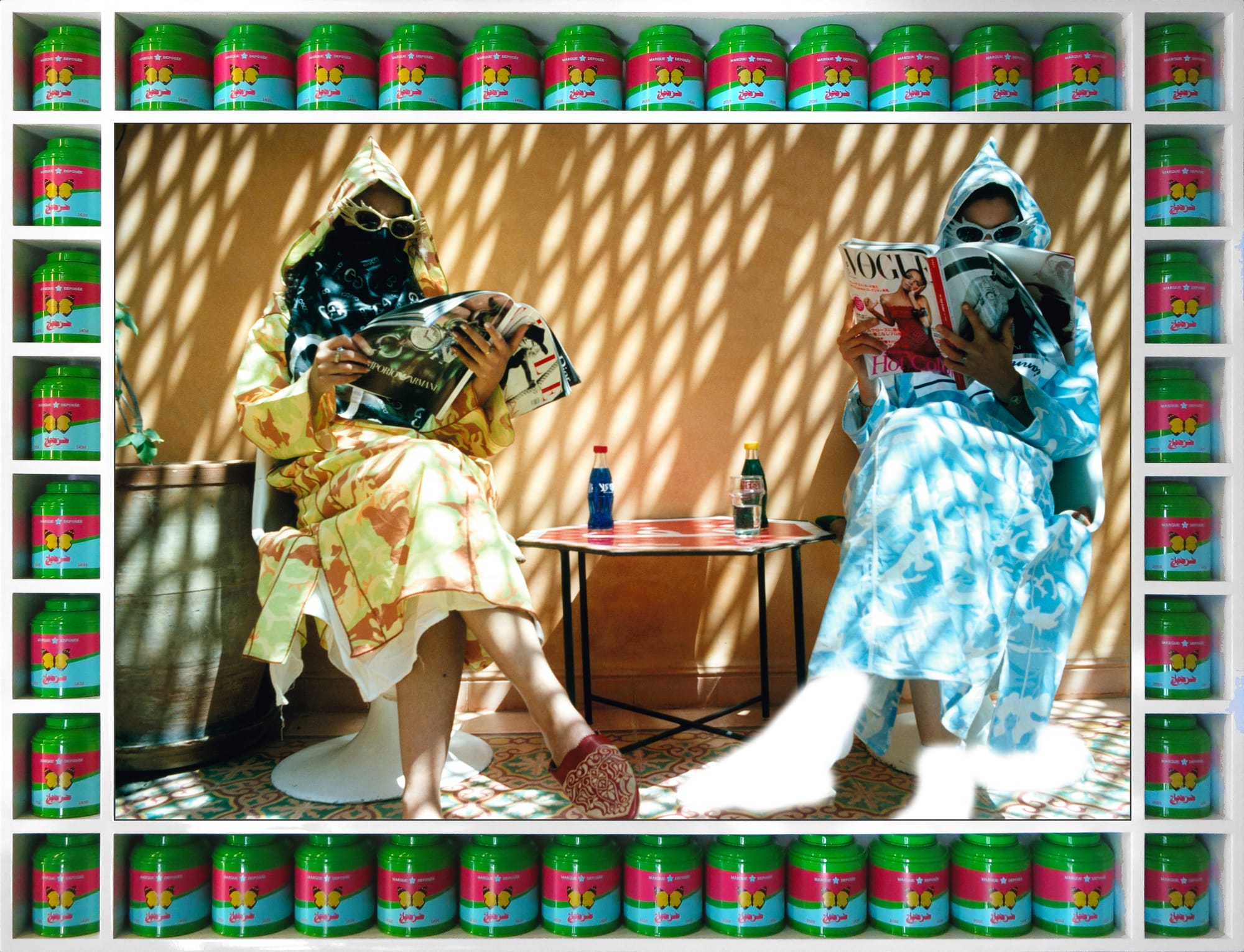
What happens when you mix bold street style, pop colors, and a unique way of referencing one’s Moroccan roots? You get the colorful, layered, and unmistakable photography of Hassan Hajjaj. His work is striking not just for its colors and composition, but even more for the many layers one can read in each image. There are the people, often friends and acquaintances of the artist, whose personalities take centre stage; the fashion, reflecting Hajjaj’s early involvement in London‘s streetwear scene; the everyday objects and consumer products that become integral elements of his distinctive three-dimensional frames; and, throughout, the cultural references drawn from Morocco and the many environments in which he has lived and worked.
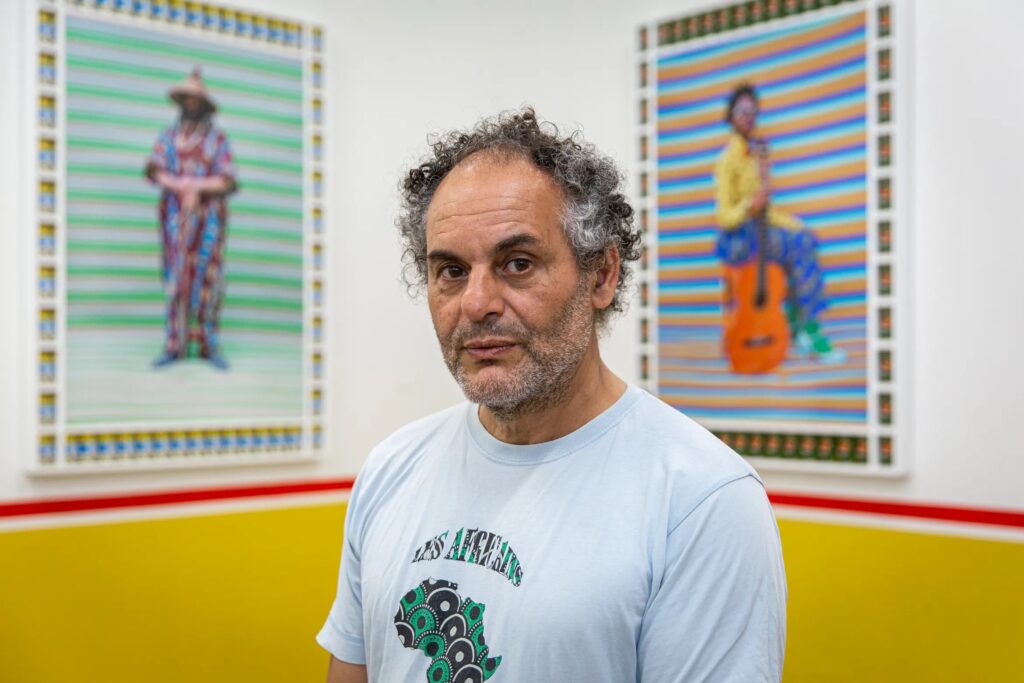
Hassan Hajjaj. Avant Arte.
Yet Hajjaj’s photography is neither an exercise in exoticism nor a straightforward documentation of everyday life in Morocco. Instead, it offers a personal and multifaceted perspective on cultural identity, shaped by movement, encounters, and the continuous exchange between different worlds.
Born in Morocco and raised in London, Hajjaj has spent over three decades building a body of work that sits at the intersection of fashion, music, and contemporary art, and that is now represented in museum collections around the world. In our conversation, he looks back at how it all began: a second-hand Polaroid camera, a shop in Covent Garden, and a photoshoot in Marrakech that helped shape his approach to representing Moroccan culture.
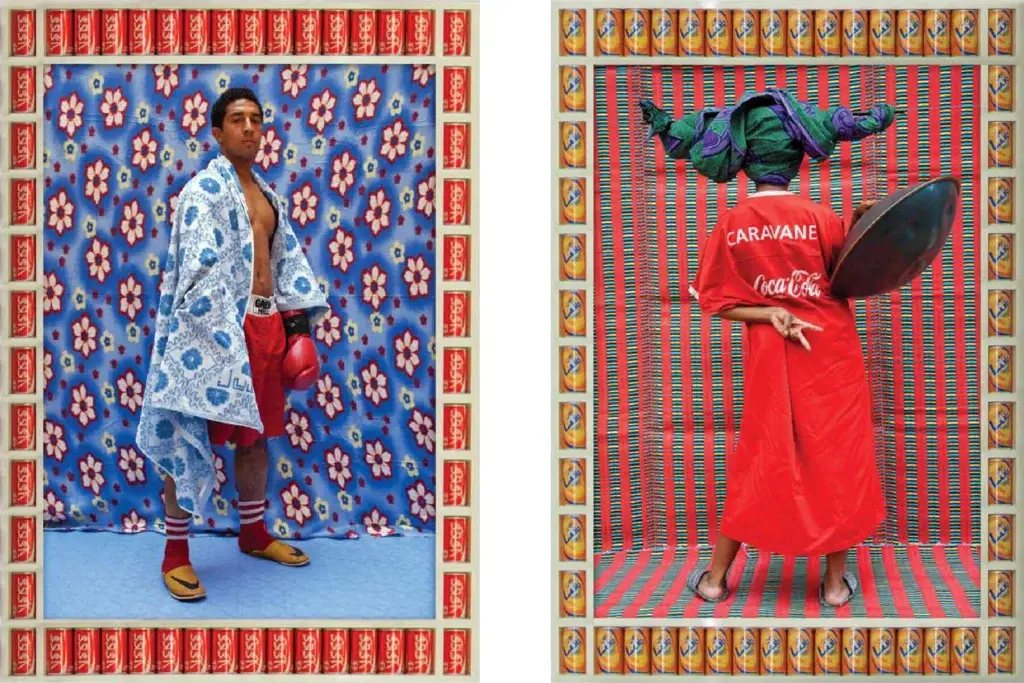
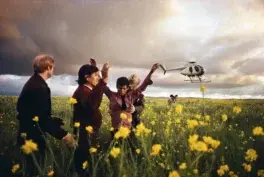
Left: Hassan Hajjaj, My Rock Stars, Zezo Tamsamani, 2010; Right: Hassan Hajjaj, My Rock Stars, Caravane, 2011. © Hassan Hajjaj. Tribe.
A Life Between Two Cultures
Born in Larache, Morocco, in 1961, Hassan Hajjaj moved to London at the age of 12, growing up between two markedly different cultural environments. The city’s club, music, and street culture scenes deeply influenced him, and that energy has remained central to his creative development. In 1984, aged just 22, he opened a streetwear shop in Covent Garden, which soon became a meeting point for friends, creatives, and musicians. Photography came later and on his own terms: a self-taught practice that developed naturally from photographing friends and the people around him.
His frequent returns to Morocco from the early 1990s gave him a renewed perspective on his birthplace and encouraged him to reconsider how the country was represented in Western visual culture. Today, Hajjaj divides his time between London and Marrakech, and his work is held in the collections of institutions including the Brooklyn Museum, the Los Angeles County Museum of Art (LACMA), the Victoria and Albert Museum, the British Museum, Guggenheim Abu Dhabi, and MAXXI in Rome, among others.
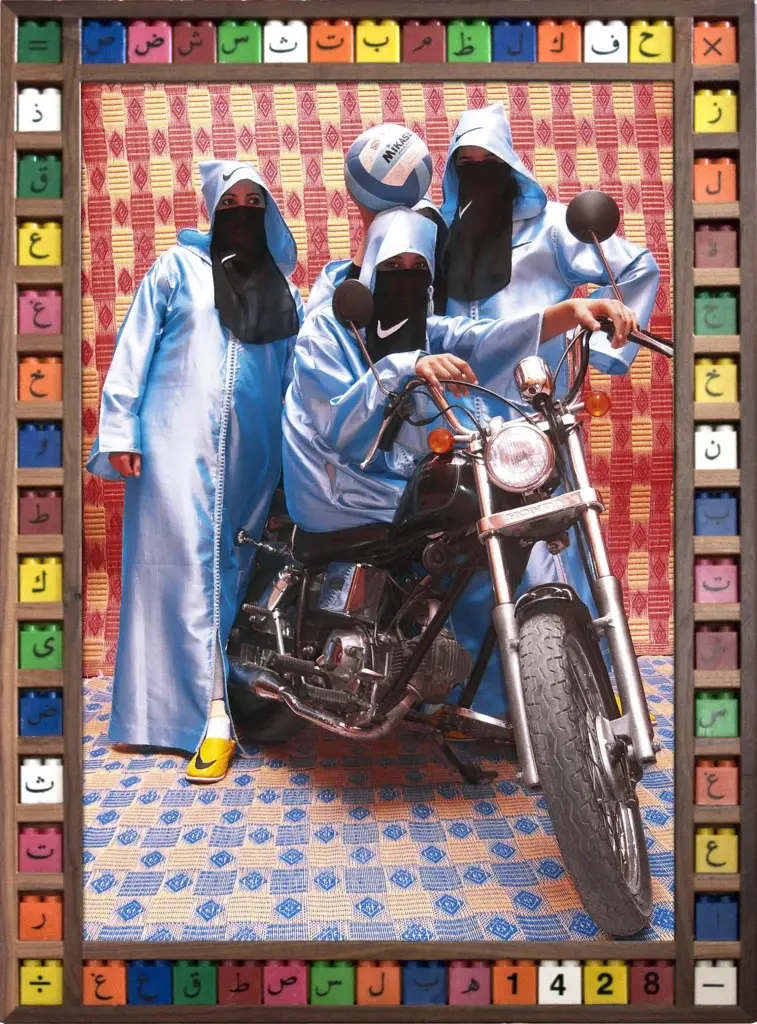
Hassan Hajjaj, Nikee Rider. © Hassan Hajjaj. Musée.
Hassan Hajjaj’s Photography: Style, Influences, and Artistic Practice
Working primarily with photography, but also extending into fashion, film, music, and design, Hajjaj has developed a visual language that brings together seemingly disparate cultural references. His portraits feature musicians, artists, friends, and distinctive personalities, photographed in carefully constructed settings and often dressed in outfits designed and styled by the artist himself. Traditional Moroccan garments and textiles meet contemporary streetwear, international fashion brands, and references to hip-hop culture, while temporary street studios transform everyday urban environments into vibrant photographic sets.
Equally distinctive are the frames, which extend beyond the conventional function of a border to become an integral, sculptural component of each work. Incorporating familiar consumer products such as Coca-Cola cans, tea tins, and other locally available objects, they create repetitive patterns that recall traditional Moroccan zellige tilework while introducing an unmistakable pop sensibility.
Through this interplay of photography, fashion, and everyday material culture, Hajjaj explores the fluidity of identity and the ways in which traditions evolve through cultural exchange. His images celebrate hybridity without reducing it to a simple opposition between East and West, traditional and contemporary, or local and global.
His work has been exhibited internationally at institutions including the Los Angeles County Museum of Art, Somerset House in London, the Maison Européenne de la Photographie in Paris, Arnolfini in Bristol, Fotografiska in Stockholm and New York, and the Aga Khan Museum in Toronto. His photographs have also reached an international fashion audience, notably through his contribution to the March 2020 issue of Vogue, for which he photographed Billie Eilish.
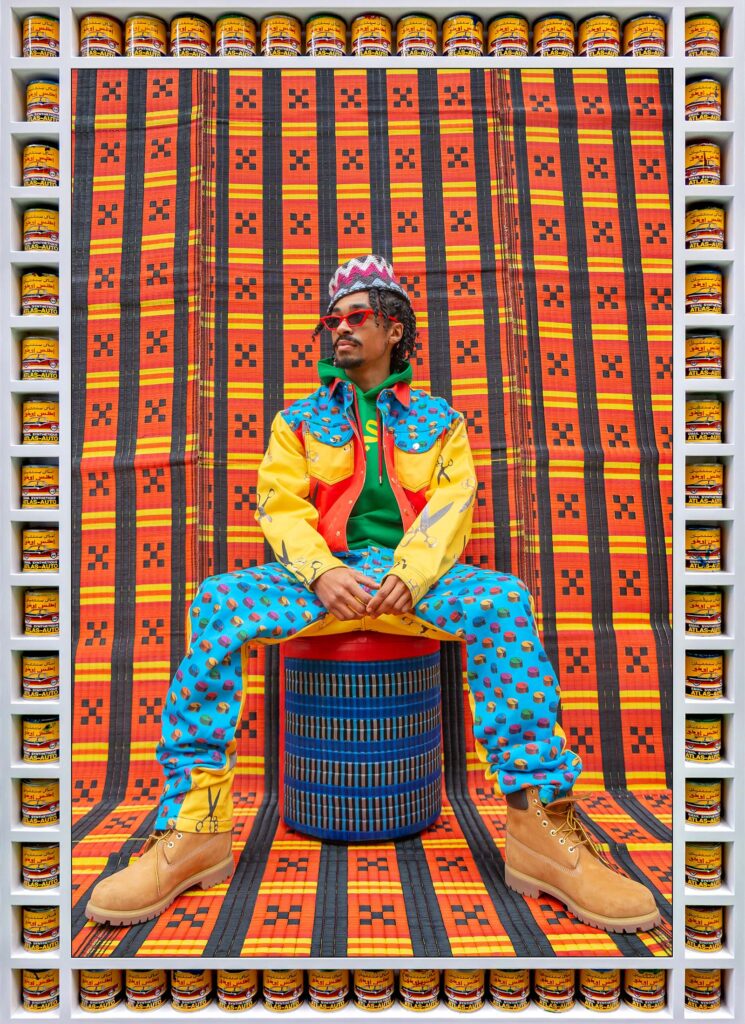
Hassan Hajjaj, Atlantic Johnson, 2023. © Hassan Hajjaj. Hyphen.
Carlotta Mazzoli: You are a self-trained photographer. How did you first get interested in photography, and why did you choose it as your primary medium?
Hassan Hajjaj: My interest in photography began purely out of love for the medium, I never initially planned to do it for work or to become an artist. My earliest memories of photography go back to my childhood in Morocco, where my family had portraits taken in a local studio with backdrops and lights. Downtown, there was also a photographer who took pictures of young children on plastic horses or racing cars and I was in one of those pictures. During the summer, local photographers would walk around the beach taking memory photos of people. This was the late 1960s, when cameras were not very common, and those experiences left a subconscious impact on me.
Later, when I arrived in London, I fell in love with photography and magazines like The Face and Arena. In 1989, I bought an old Polaroid camera from a close friend who was a professional photographer and started out using it to take portraits of my friends. He and a few other photographer friends taught me how to use it, and I began taking pictures from there. The process happened naturally and took time; it was probably seven or eight years before I even began sharing my work publicly, as I wasn’t doing it as a career or viewing myself as an artist at the time. It was an accidental, natural language born out of a love for photography.
CM: Your work seems heavily influenced by the environments you grew up in and found yourself in, whether through fashion or the people around you. What specific elements shaped your visual language?
HH: It is a combination of everything, starting with the transition between two very different spaces: moving from Morocco to London. London exposed me to a rich mix of cultures, art, music, fashion, and food. A major turning point occurred between 1984 and 1992, when I owned a streetwear shop on New Street in Covent Garden. I sold clothes sourced from New York, Paris, and London, as well as designs from friends who were graduating from fashion college. In the basement of my shop, a friend ran a record store. The shop became a hub where I learned about fashion, and at night, I ran underground parties. Managing the nightlife, booking DJs, finding and dressing up venues, and being responsible for the doormen, cashiers, and security, taught me how to work with people and manage a team.
I also hosted art, photography, film, and jewelry shows for my friends in the shop. Through this space, I met a stylist named Andy Blake and began assisting with styling, catwalk shows, and magazines. My friends were also making music videos, and I was working right behind the scenes. All of these experiences naturally integrated into my photography. When I started shooting, I would buy the fabrics, design the outfits, and dress the subjects myself without consciously thinking of it as “styling” or “designing”. The journeys of my life and the people I grew up with are directly reflected in my images.
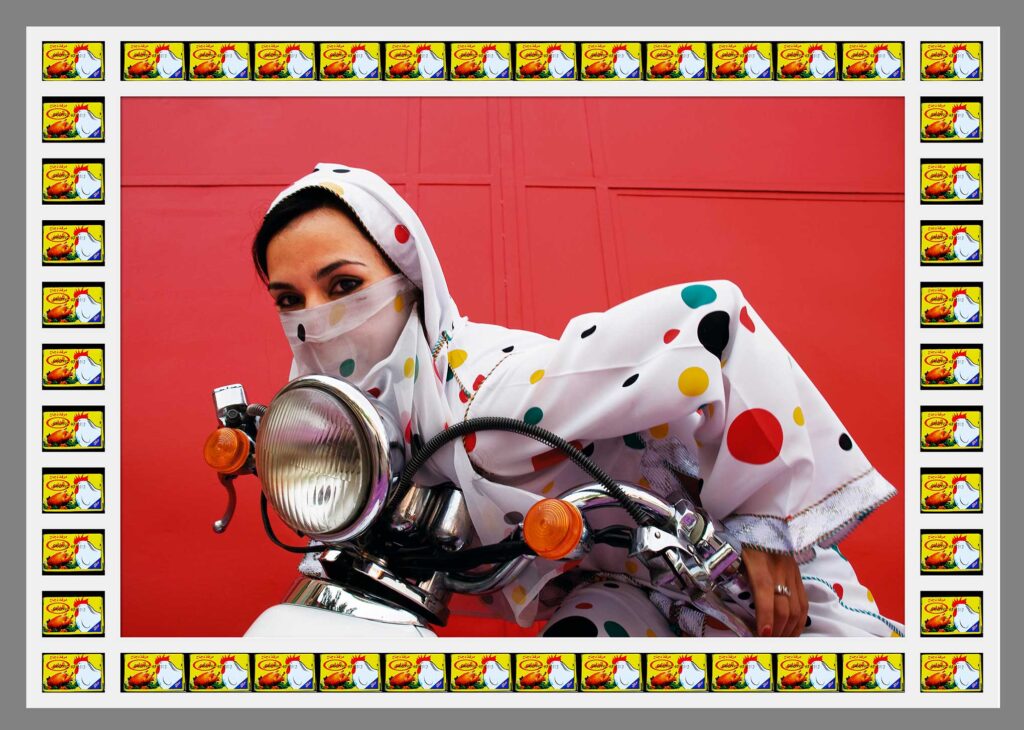
Hassan Hajjaj, Kesh Angels. © Hassan Hajjaj. The Economist.
CM: Operating a shop in Covent Garden during the 1980s and 1990s must have been an incredible experience. What was that scene like?
HH: I opened the shop on New Street in Covent Garden in 1984 when I was only 22 years old, making me the youngest shop owner in the area. At that time, everything happened in central London. If you wanted to go clubbing or listen to music, you had to come there. My shop became a major hangout spot where friends and friends of friends would meet daily. I ran that space for about eight or nine years. Being that young and having that energy at that specific time taught me a lot, and much of my work and life path grew directly out of that scene.
CM: On that note, people are central to your work. How do you choose your subjects, and is there a particular type of encounter that influences your practice?
HH: I started out shooting my friends. Having the shop and running parties allowed me to meet thousands of people from all over the world. I realized that certain people possess what I call a “musical note” or a unique fingerprint in whatever they do, whether they are a painter, a musician, a masseur, a local kid from the street, a poet, a rapper, a boxer, and so on. You can see when someone has that spirit in their blood, as if they were born with it. That is my primary attraction and the reason I want to photograph them.
Because I traveled frequently, I established my own “villages” of friends and connections in different cities like Paris and New York, which made finding and connecting with subjects very natural.
CM: Your photography also incorporates many traditional Moroccan elements. At what point did you decide to reconnect with your Moroccan roots?
HH: From the early 1990s, I began returning to Morocco frequently, splitting my time between London, Morocco, and other travel destinations for work. Around 1991 or 1992, I started a project called Graffix from the Souk, which focused on Arabic products and street objects like Coca-Cola crates, shop signs, and neon lights. I collected these items and turned them into an installation starting around 1993.
My photography of people began around 1994 or 1995, starting with my Moroccan friends. The catalyst for this direction occurred when I was in Marrakech. An English friend of mine who owned a riad was away, and the English edition of Elle magazine was using his property for a photoshoot. Because I spoke English, he asked me to be there to help coordinate between his staff and the magazine crew. As I sat and watched the shoot all day, I realized that the entire production, the models, the designs, the hair, and the makeup, was entirely European. They were simply using the Moroccan riad as an exotic backdrop.
That experience motivated me to take ownership of the narrative. I decided to photograph my friends in local settings, dressing them in local gear mixed with brand motifs to create my own fashion shoots. At the time, polka dots, animal prints, and camouflage were in fashion. I bought these fabrics, had djellabas made of each pattern, and set up scenes with my friends in the medina. Using film and a wide-angle lens, I created shoots that blended 1950s and 1960s Vogue-style with influences from martial arts films and Hype Williams’ hip-hop music videos.
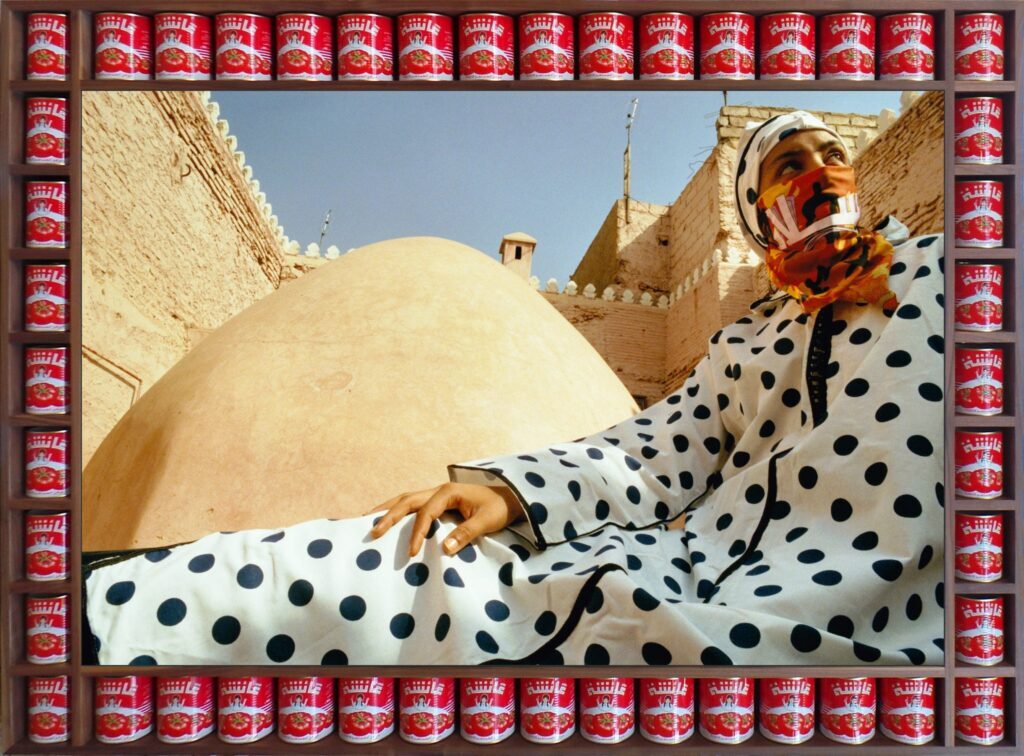
Hassan Hajjaj, Dotted Peace, 2000. © Hassan Hajjaj. The Bristol Cable.
CM: Another distinctive feature of your work is the frames, which often incorporate three-dimensional elements and everyday objects. How did you develop this approach, and what role do the frames play in the finished work?
HH: The idea evolved from my early 1990s project, Graphix from the Souk, where I photographed around 500 different local cans, drinks, teapots, and hats featuring Arabic fonts, and printed them on canvas to look like paintings.
Later, when I began exhibiting my portrait photography, I wanted the frame to be an active part of the artwork rather than just a border for the print. I wanted to bring those physical objects and cans into reality by placing them directly around the frame. This created a repeated rhythm. Furthermore, using recognizable local products and global logos like Coca-Cola made the work immediately accessible and easy on the viewer’s eye.
I was also inspired by visiting museums and seeing historical paintings from the 1600s and 1800s. Those works featured custom gold-leaf frames designed specifically for the paintings. Even if those paintings are sold at auction, the canvas is never separated from the frame because they are integrated artworks. I wanted my photographs and frames to have that same unified relationship.
Additionally, when I first entered the contemporary art world, photography was not yet fully understood or embraced by galleries, which were often hesitant about editions and printing. Creating these physical, sculptural frames was a way to bring something fresh and distinct to the contemporary art scene.
CM: Given that your work is so deeply rooted in your personal experiences in London and Morocco, how do international audiences react to it?
HH: I have been very fortunate. When I started out, there was no social media, which made the art world a much lonelier, emptier space. If you had a gallery show, perhaps only 300 to 500 people would see your work in a month. The internet completely propelled my work.
Over the years, I have learned that incorporating familiar Western brand logos (like Louis Vuitton, Gucci, Prada) and recognizable consumer goods (like Pepsi or Coca-Cola cans) into the frames makes the work non-threatening and highly accessible to viewers. It draws people in with familiarity, and once they look closer, they begin to discover the deeper layers of the work. I always get a wonderful response from everyday people, including the museum cleaners, gallery workers, and diverse crowds of kids. I have been fortunate to bridge different worlds, showing in Western galleries, African group exhibitions, and Arab group shows. It took 10 to 15 years of hard work to break those doors down.
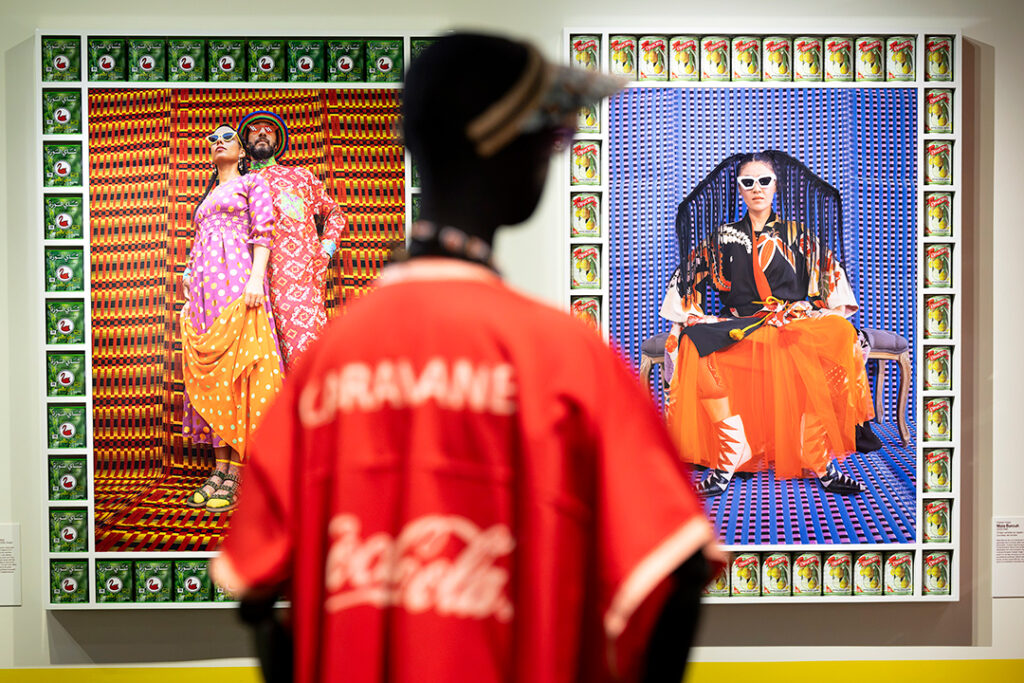
Exhibition view of Hassan Hajjaj: My Rock Stars, 2026, Musée de la Musique, Philharmonie de Paris, Paris, France. © Joachim Bertrand. Philharmonie de Paris.
CM: You currently divide your time between London and Marrakech. Over the past 15 years, there has been growing international interest in contemporary art from Africa and North Africa in particular. Have you observed this shift, and how do you think the art world has changed?
HH: Yes, there is a definitive shift happening, driven by several factors. There is a generation of young artists producing incredible work across the African continent, the Caribbean, and Brazil. Historically, the art world’s spotlight was strictly focused on the West, and artists had to conform to that world to be seen. Today, there is a dedicated, global audience for this work. There are more galleries, art fairs, magazines, and journalists from these regions writing about their own art scenes.
Artists no longer have to rely solely on making it in Western hubs like London, Paris, Rome, or New York. They are exhibiting in the Middle East, Iran, Asia, and South Korea. The internet and social media have completely expanded the landscape. The traditional gallery blueprint is changing, and many young artists now run their businesses directly through Instagram, connecting with collectors who bypass commercial galleries entirely. There is a major shift in the collector base as well, with a growing, active interest in collecting art from North Africa, Haiti, and beyond.
CM: And finally, what projects or exhibitions do you have coming up?
HH: I have a solo presentation at the 1-54 contemporary African Art fair. In January 2027, I have another solo booth at Art Basel Qatar. I also have an ongoing show in Paris that runs until April 2027. Additionally, I have a museum group show opening in Abu Dhabi in December 2026, and another group show opening in November 2026 at the Powerhouse Museum in Sydney, Australia.