Masterpiece Story: The Setting of the Sun by François Boucher
With sweet putti, handsome gods, beautiful nymphs, vibrant colors, and elaborate compositions, The Setting of the Sun is a testimony to François...
James W Singer 8 February 2026
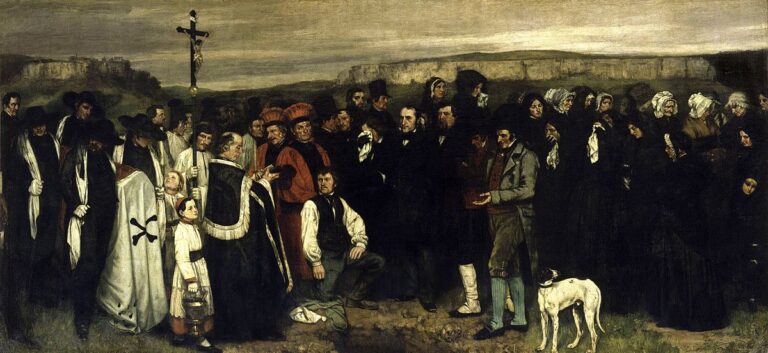
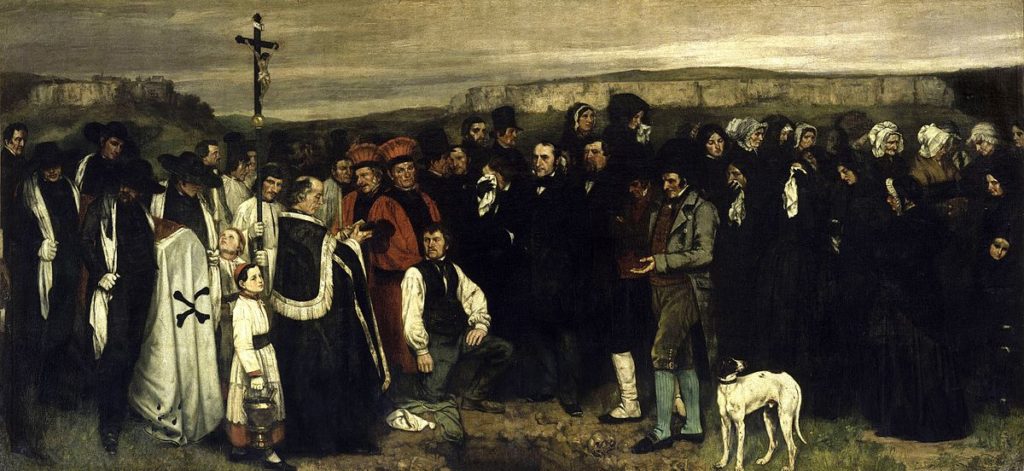
Gustave Courbet, A Burial at Ornans, 1850, Musee d’Orsay, Paris, France.
Who nowadays doesn’t appreciate Gustave Courbet‘s striking realism? We all do, but as happens with many geniuses, Courbet was not appreciated by his contemporaries, especially at the beginning of his career. In 1851 he presented this outstanding painting to the French Salon titled A Burial at Ornans.
…said Courbet when exhibiting this work, which he had been working on since 1849. Yet, what did he mean by his ‘principles’? He was referring to Realism, a new innovative direction in painting which he implemented in all of his following works. Realism was about capturing life the way it really was, without idealization, without escapism. He championed truth, which doesn’t mean that he didn’t imbue his works with meaning. On the contrary, he revealed to his audience that truth can be as symbolic as Jacques-Louis David’s Neoclassicism or Jean-Auguste-Dominique Ingres’ Orientalism. As he wrote, the purpose of his painting was to:
“(…) translate the customs, the ideas, the appearance of my epoch according to my own appreciation; in a word, to create living art, that is my goal.”
attr. Gustave Courbet, PBS.
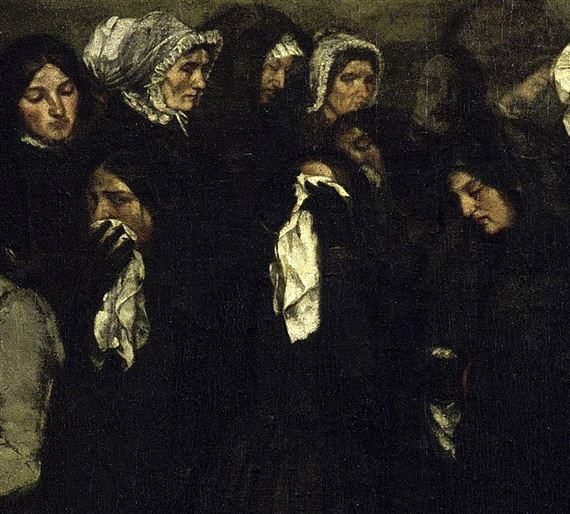
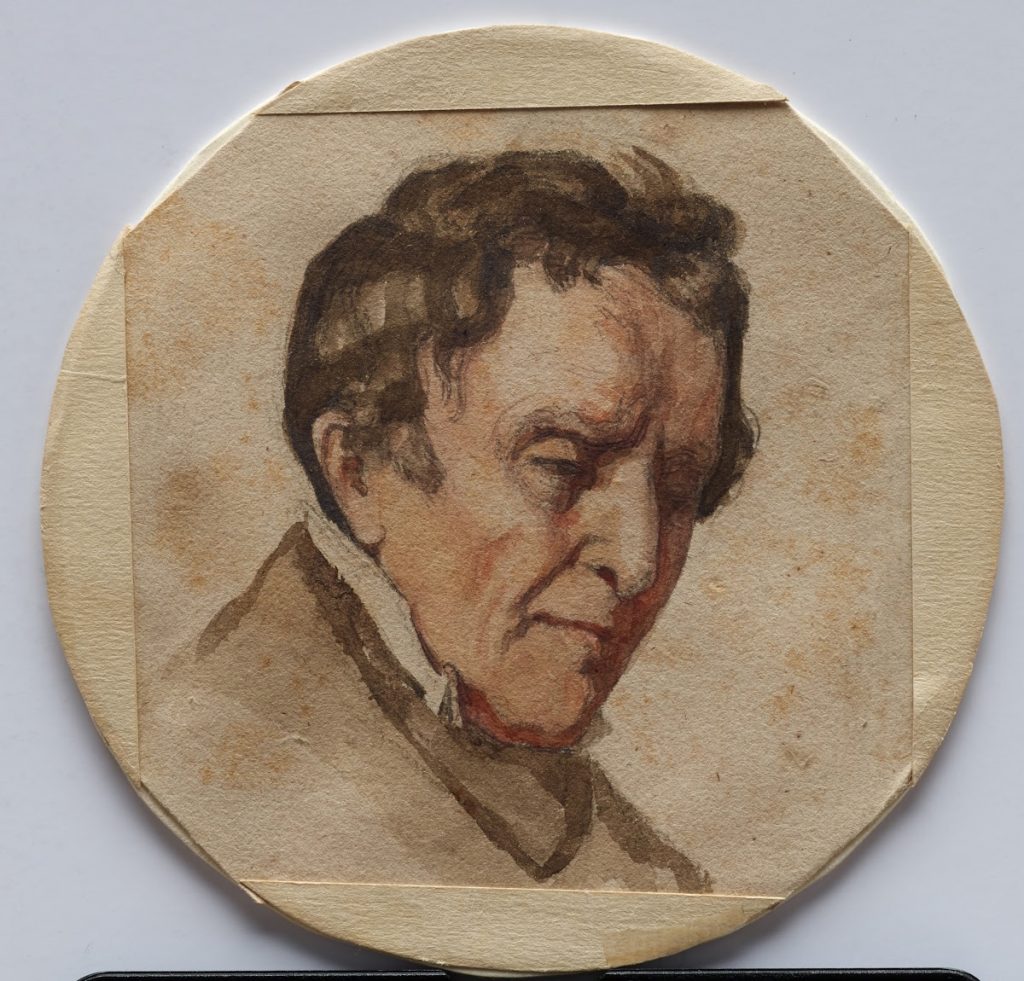
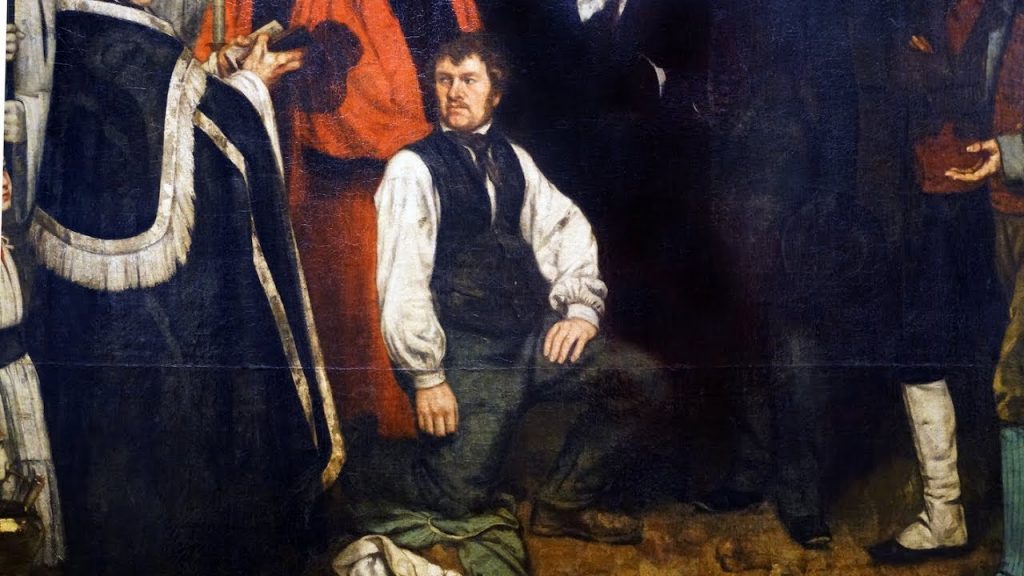
This scene is based on a real-life event, the funeral of Courbet’s great-maternal uncle, who was an important member of the small community of the French town of Ornans, located close to the Swiss border. Everyone wanted to pay their respects to him, from the important clergymen, and the mayor, to the butcher and the simple women, even a Masonic judge! How do we know that? Because Courbet painted them all as they really were in life, without any idealization or masking their features to make them anonymous – anyone from Ornans would recognize them, or even find themselves on the canvas. We can see Courbet’s mother and three sisters (Juliette covers her mouth, Zoé’s face is entirely covered by cloth, and Zélie is on the far right). Moreover, some claim that Courbet even included a portrait of the deceased as if he were alive and a spectator at his own funeral- pay attention to the gentleman on the extreme left!
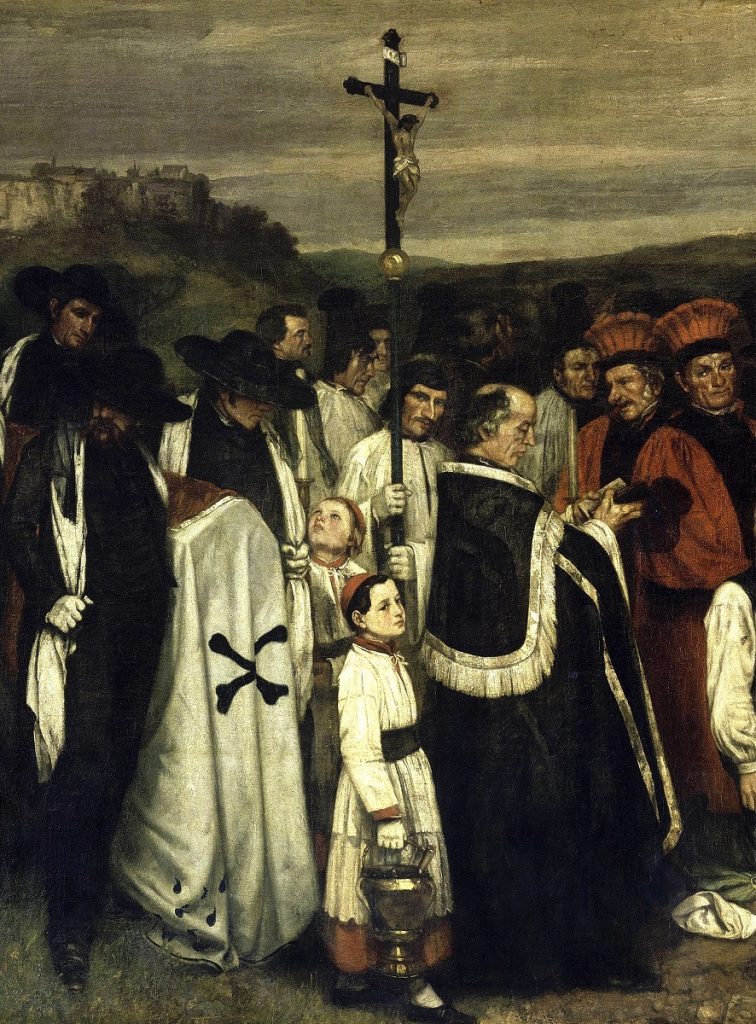
The critics hammered the work for several reasons. Firstly, for its size, (3,15 x 6,68 m) which should have heralded it as a history painting. Which according to the canon should present a solemn historical or religious theme, as only such genre scenes deserved such a grand scale. Courbet instead presented normal people at a funeral, many of which were of a lower class, which outraged the high-class critics and Salon-goers even more, as they couldn’t stand the characters’ ugliness and ordinariness. Secondly, the painting was initially interpreted as anticlerical, because even the clergy were depicted as ugly. Yet later, this interpretation was overturned – in the end, Christ on the cross towers over the entire scene, giving us solace and hope for salvation. Thirdly, viewers didn’t like Courbet’s technique, the thickly layered paint and the dark tones dominated the scene. Somebody said that Courbet painted pictures like somebody blacking their boots…
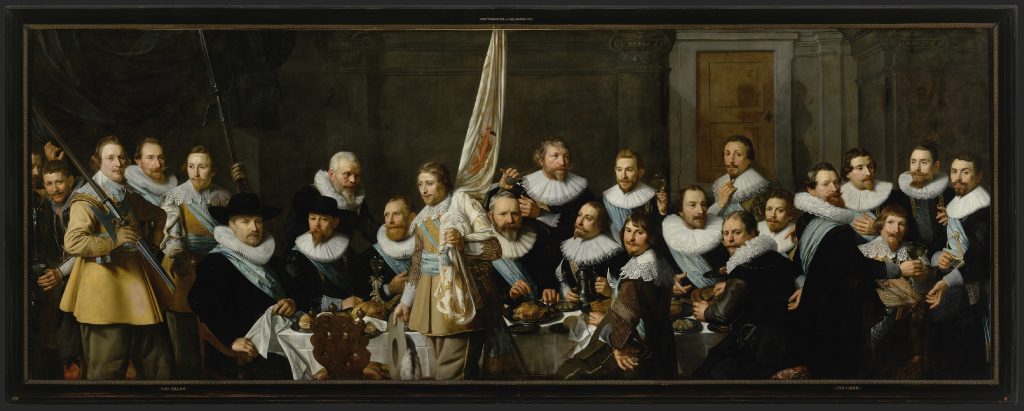
However, if one delved into the painting’s composition and style, one would see a few art historical references which definitely make this painting more noble than expected. The horizontal composition, spread from one edge of the canvas to another, recalls the Dutch 17th-century paintings presenting civic guards. Look below, doesn’t it look familiar?
The pervasive blacks and deep greens are a reference, too. Courbet looked up to the Spanish masters like Velázquez and Goya, and drew from them inspiration for his own color palette, which brings out the atmosphere present in All Saints: sadness, nostalgia, melancholy. Yet there is hope, ingeniously suggested by the lighter tones. This hope is life itself, its cyclical nature- life goes on no matter what. I find it very comforting. Talking about loss, I want to close today’s analysis with this video in which contemporary painter Yan Pei-Ming talks about the loss of his mother and A Burial at Ornans.
Get your daily dose of art
Click and follow us on Google News to stay updated all the time

DailyArt Magazine needs your support. Every contribution, however big or small, is very valuable for our future. Thanks to it, we will be able to sustain and grow the Magazine. Thank you for your help!

Magda, art historian and Italianist, she writes about art because she cannot make it herself. She loves committed and political artists like Ai Weiwei or the Futurists; like Joseph Beuys she believes that art can change us and we can change the world.
With sweet putti, handsome gods, beautiful nymphs, vibrant colors, and elaborate compositions, The Setting of the Sun is a testimony to François...
James W Singer 8 February 2026
Among the Sierra Nevada, California, by Albert Bierstadt, is a majestic mountainous landscape filled with wild beauty and blissful idealism. Its...
James W Singer 25 January 2026
The Cardsharps is an early masterpiece of Baroque art by Caravaggio that explores the revolutionary theme of crooked card playing. Let’s delve...
James W Singer 11 January 2026
As Europe burned during WWII, Wassily Kandinsky, who had fled Nazi Germany in 1933, lived as a recluse in his Neuilly-sur-Seine apartment. In that...
Javier Abel Miguel 8 January 2026