





Masterpiece Story: Opéra Garnier
When we talk about the beautiful sights of Paris, many first think of the obvious ones—the Eiffel Tower, the Louvre Museum, and the Notre-Dame...
Nikolina Konjevod 15 March 2026
14 September 2026 min Read
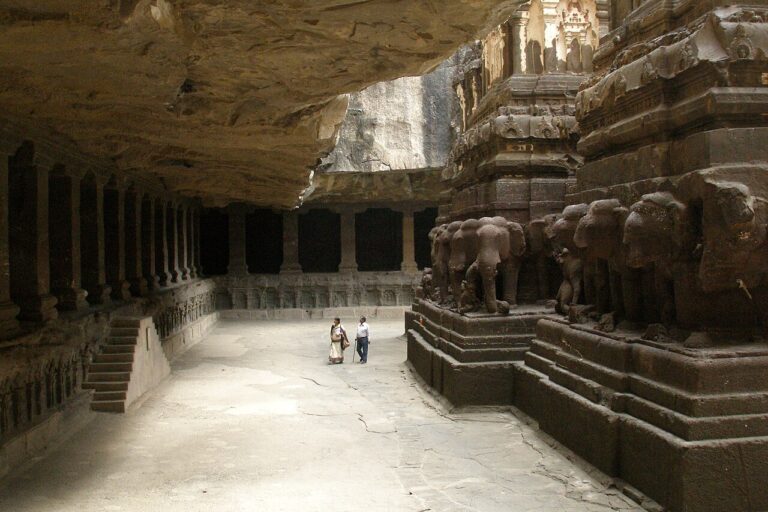
Ellora Caves, Maharashtra, India. Photograph by Vyacheslav Argenberg via Wikimedia Commons (CC-BY-4.0).
Carved into a nearly 1.2-mile stretch of basalt in Maharashtra, India, the Ellora Caves are an astonishing rock-cut architectural achievement and among the finest examples of stone carving in the world. Recognized as a UNESCO World Heritage Site, this vast complex is celebrated for its extraordinary combination of religious architecture, artistic vision, and engineering.
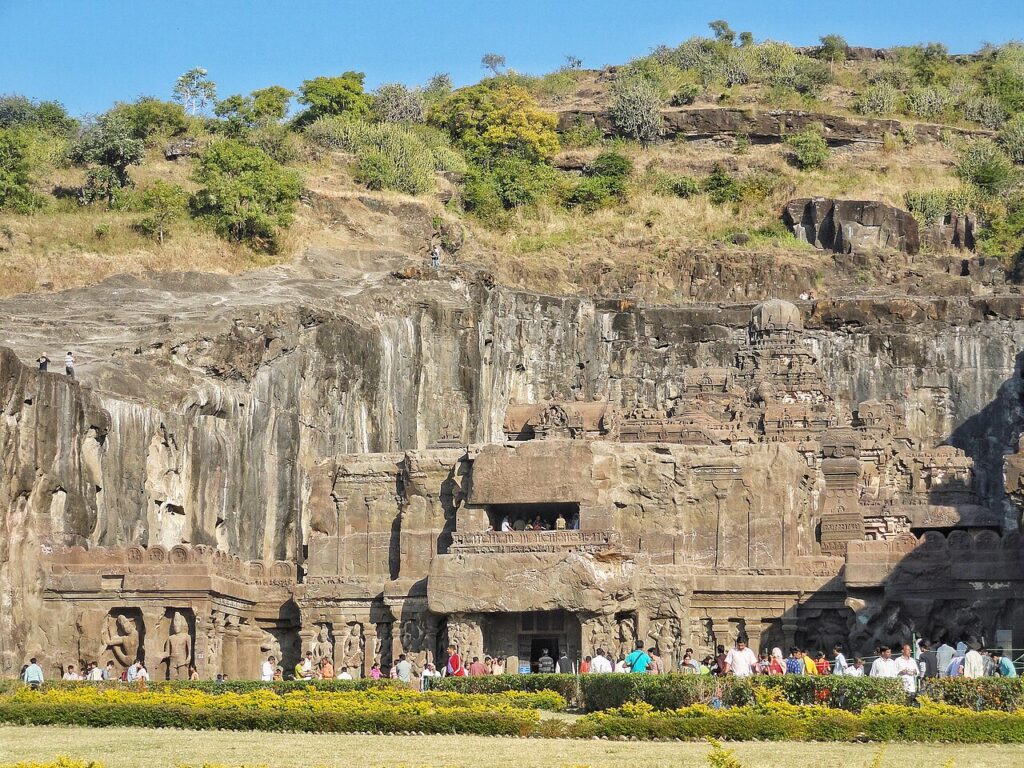
Ellora Caves, Maharashtra, India. Photograph by Tejas168 via Wikimedia Commons (CC-BY-SA-4.0).
34 major caves were excavated directly into the basalt hills of the Charanandri range. Unlike the more secluded Buddhist retreat at Ajanta, Ellora developed in a region connected to important routes across the Deccan. The complex is divided into three distinct religious groups carved side by side, featuring 12 Buddhist caves, 17 Hindu caves, and 5 Jain caves.
Construction and development spanned from approximately the 6th to the 10th century CE under the patronage of several ruling dynasties. The Rashtrakutas played a particularly important role in the later development of the site, including the monumental Kailasa Temple. The resulting complex provides remarkable evidence of Buddhist, Hindu, and Jain traditions flourishing in close proximity over several centuries.
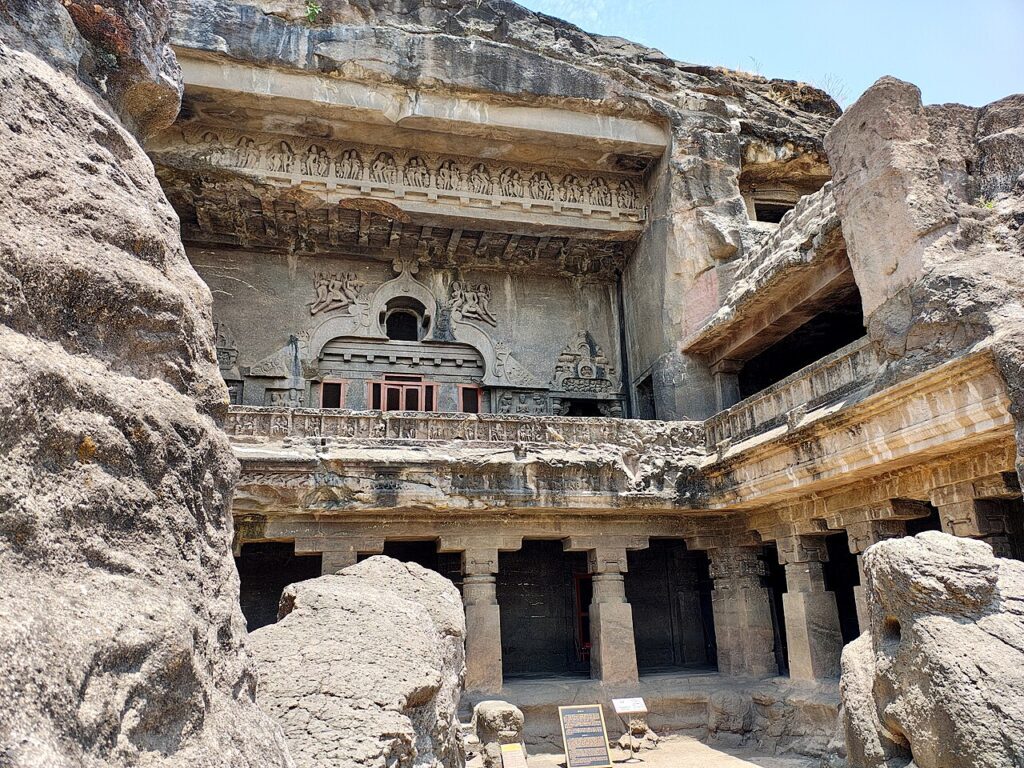
Cave 10, Ellora Caves, Maharashtra, India. Photograph by Shivashanky via Wikimedia Commons (CC-BY-SA-4.0).
The rock-cut architecture at Ellora reflects the distinct spiritual identities and artistic traditions of three major Indian religions that developed side by side.
The early Buddhist caves feature quiet, multi-story monasteries and grand prayer halls. Several of these preserve architectural details inspired by earlier wooden construction.
In contrast, the Hindu caves radiate a more dynamic energy, with large relief panels portraying scenes from Hindu mythology. Among the most famous are depictions of Shiva performing the Tandava and Ravana attempting to shake Mount Kailash.
Finally, the later Jain caves display extraordinary detail and refined ornamentation. Their sculptures include serene Tirthankaras, while surviving ceiling paintings and intricate carvings reflect the Jain emphasis on spiritual discipline, asceticism, and liberation.
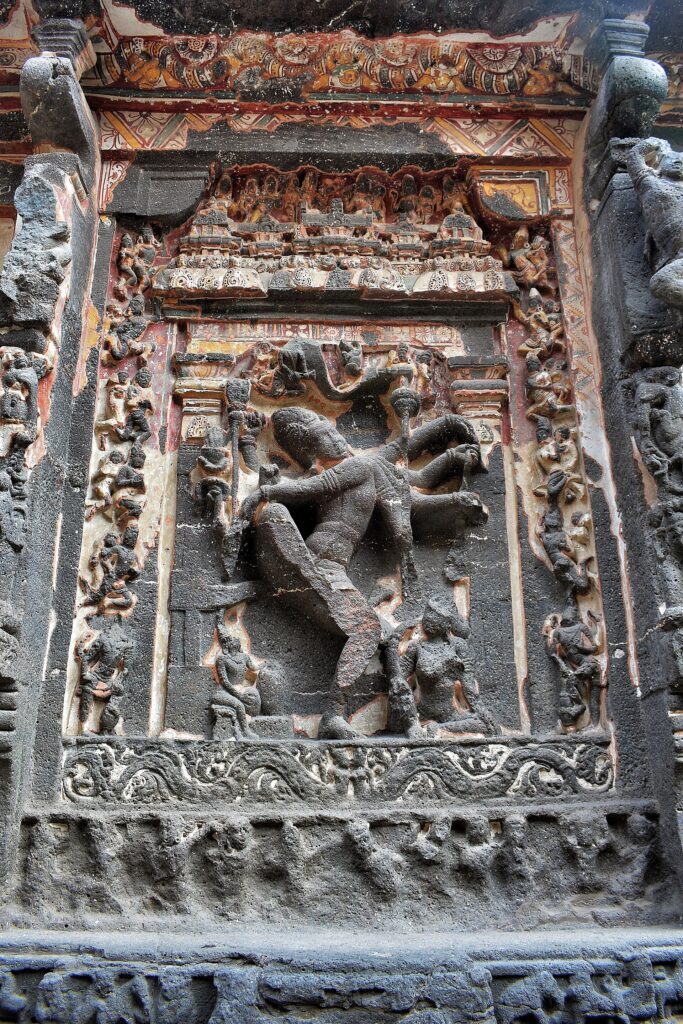
Cave 16, Ellora Caves, Maharashtra, India. Photograph by Abhideo21 via Wikimedia Commons (CC-BY-SA-4.0).
The Vishvakarma Cave, or Cave 10, is the most celebrated of Ellora’s Buddhist excavations. Dating to around the 7th century CE, it is a chaitya, or Buddhist prayer hall, rather than a monastery.
The cave is renowned for its vaulted ceiling, whose stone ribs were carved to imitate wooden beams, earning it the nickname “Carpenter’s Cave.” At the far end of the hall, a colossal seated Buddha, approximately 15 ft (4.5 m) tall, presides over the space in a teaching gesture. The cave also possesses remarkable acoustics, allowing voices and chanting to carry clearly through its vaulted interior.
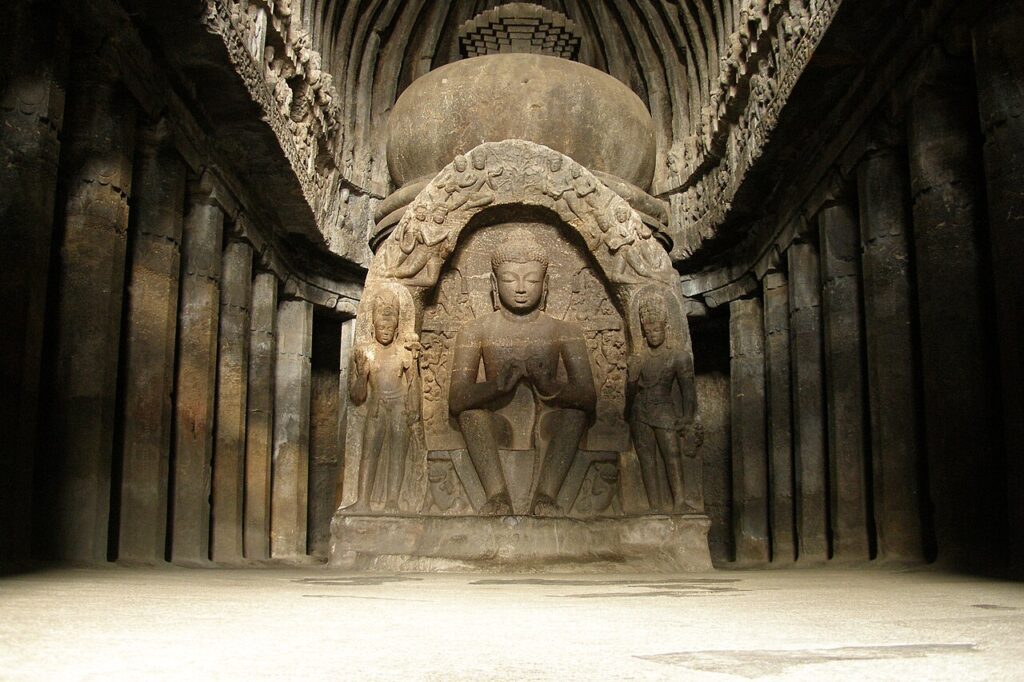
The Vishvakarma Cave, Ellora Caves, Maharashtra, India. Photograph by Vyacheslav Argenberg via Wikimedia Commons (CC-BY-4.0).
Located in Cave 16, the Kailasa Temple is the crown jewel of Ellora and one of the greatest achievements in the history of rock-cut architecture. Dedicated to Shiva, the temple is widely regarded as the largest monolithic rock-cut temple in the world.
Rather than being constructed from individual blocks of stone, the temple was excavated directly from the living basalt. Master sculptors worked from the top downward, progressively cutting away the surrounding rock to reveal the temple, courtyards, galleries, sculptures, and intricate relief panels within the mountain.
It is estimated that roughly 200,000 tons of rock were removed during the excavation. The scale of the undertaking is extraordinary: the finished monument includes a monumental temple complex, freestanding architectural elements, towering sculptures, and elaborate carvings, all emerging from a single mass of basalt.
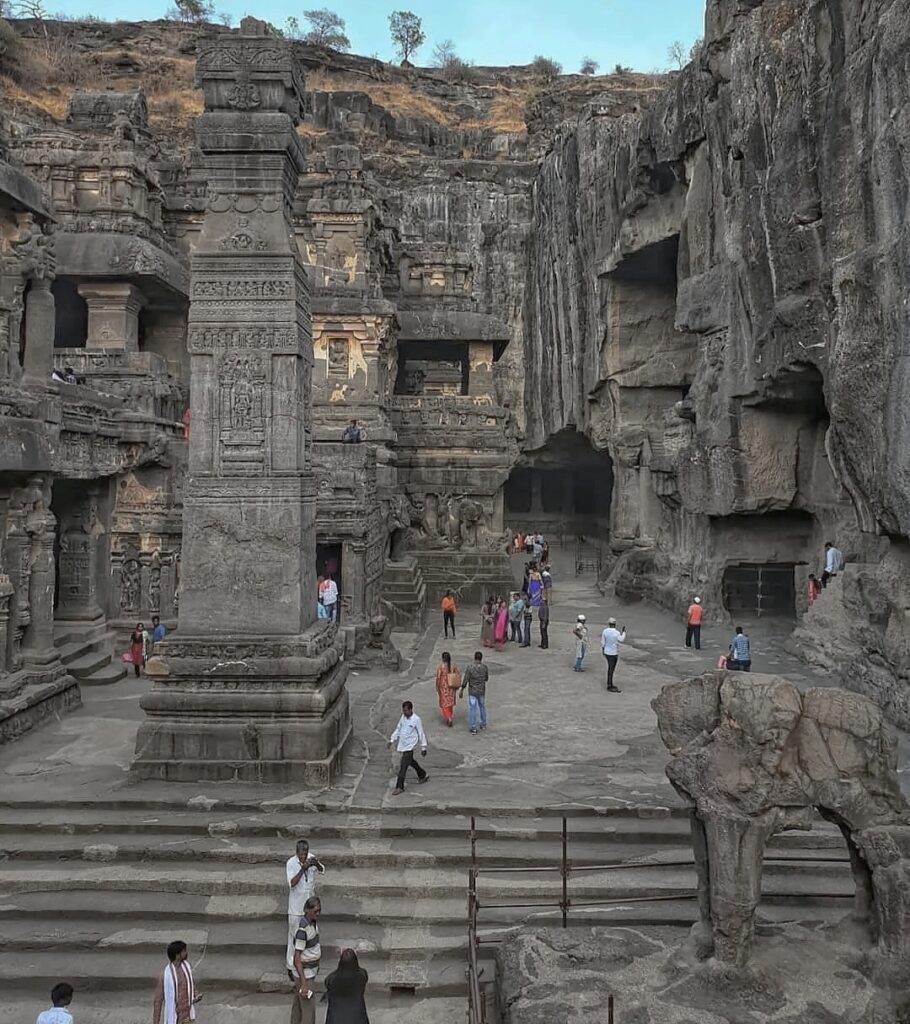
Kailasa Temple, Ellora Caves, Maharashtra, India. Photograph by Yashsawji via Wikimedia Commons (CC-BY-4.0).
The Indra Sabha, Cave 32, is among the finest monuments in Ellora’s Jain group. Its name, meaning “Hall of Indra,” is a later designation. The complex features a striking two-level arrangement carved into the rock, with the lower level remaining partly unfinished while the upper level contains elaborate architectural and sculptural decoration. The courtyard includes a monolithic pillar and a large stone elephant. The upper level features richly carved pillars, lotus motifs, Jain figures, and surviving traces of ceiling paintings.
Among the notable sculptures is Matanga, a Jain yaksha, or attendant deity, depicted seated upon an elephant beneath a banyan tree. The complex also contains representations of Jain Tirthankaras and other important figures from Jain religious tradition.
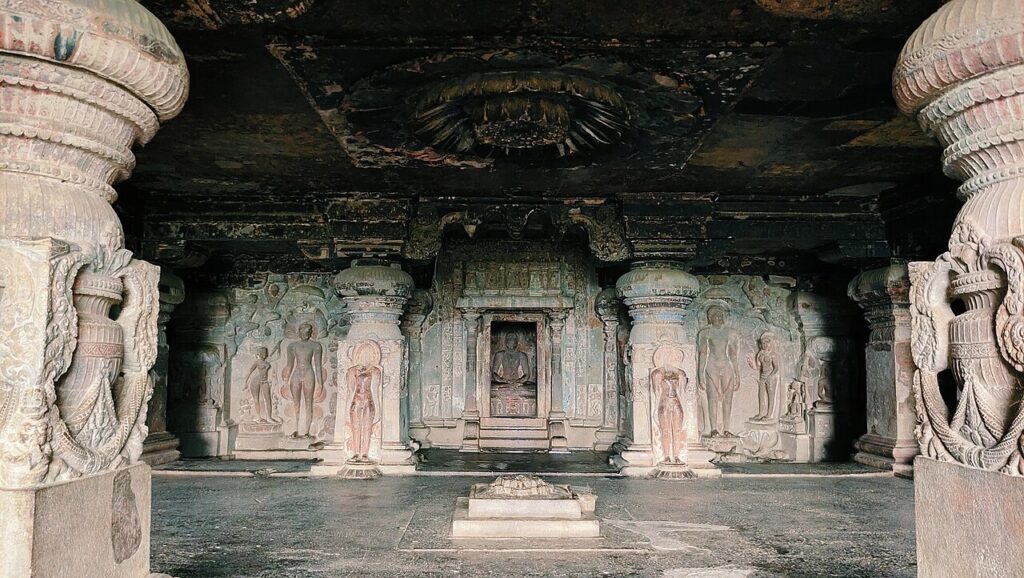
Indra Sabha, Ellora Caves, Maharashtra, India. Photograph by Memocap via Wikimedia Commons (CC-BY-SA-4.0).
While Ajanta captures the quiet, painted beauty of Buddhist devotion, Ellora represents a different kind of artistic ambition. More than a collection of religious monuments, Ellora offers a remarkable record of religious coexistence across centuries of Indian history. Buddhist, Hindu, and Jain traditions each left their own distinctive artistic and architectural imprint on the same landscape.
DailyArt Magazine needs your support. Every contribution, however big or small, is very valuable for our future. Thanks to it, we will be able to sustain and grow the Magazine. Thank you for your help!

Maya Tola is a Dallas-based attorney, with a zest for art history. A time traveler at heart, Maya often finds herself consumed in the contemplation of life in antiquity. She has been sharing her infectious enthusiasm for art and history since 2018 through her posts and articles for the DailyArt App and DailyArt Magazine. When she's not working or writing, you'll find Maya obsessing over plants, animals, and food (in no particular order).

Elizabeth Provost is a visual arts journalist, editor, and scholar of the Italian Renaissance based in New York City and Toronto. She is a PhD student at the Bard Graduate Center. Learn more about her on her website: www.elizabethprovost.com
When we talk about the beautiful sights of Paris, many first think of the obvious ones—the Eiffel Tower, the Louvre Museum, and the Notre-Dame...
Nikolina Konjevod 15 March 2026
American cities are renowned for their many architectural landmarks, featuring ornate domes, columns, and sculpted façades. Less widely recognized,...
Maya M. Tola 4 August 2025
Alvar Aalto (1898–1976) is one of the most famous Finnish architects of the 20th century connected with modernism. His style has been associated...
Catherine Razafindralambo 11 May 2026
In the heart of Delhi, surrounded by the city’s dense traffic and modern sprawl, stands Humayun’s Tomb, or Maqbara-i Humayun, a quiet...
Maya M. Tola 26 May 2025


.jpg#/media/File:ELLORA_CAVE_NO._16_(6).jpg)


