Summary
- Set in prosperous 15th-century Bruges, A Goldsmith in His Shop by Petrus Christus reflects the city’s respected craft of goldsmithing.
- Once thought to depict Saint Eligius, the painting was reinterpreted after conservation revealed that the halo was a later addition. The goldsmith may have been a real craftsman, and the ring and girdle (a belt) connect the scene to marriage and fidelity.
- The elegantly dressed couple represents Bruges elites, while the goldsmith’s workshop becomes a setting where commerce and social status intersect.
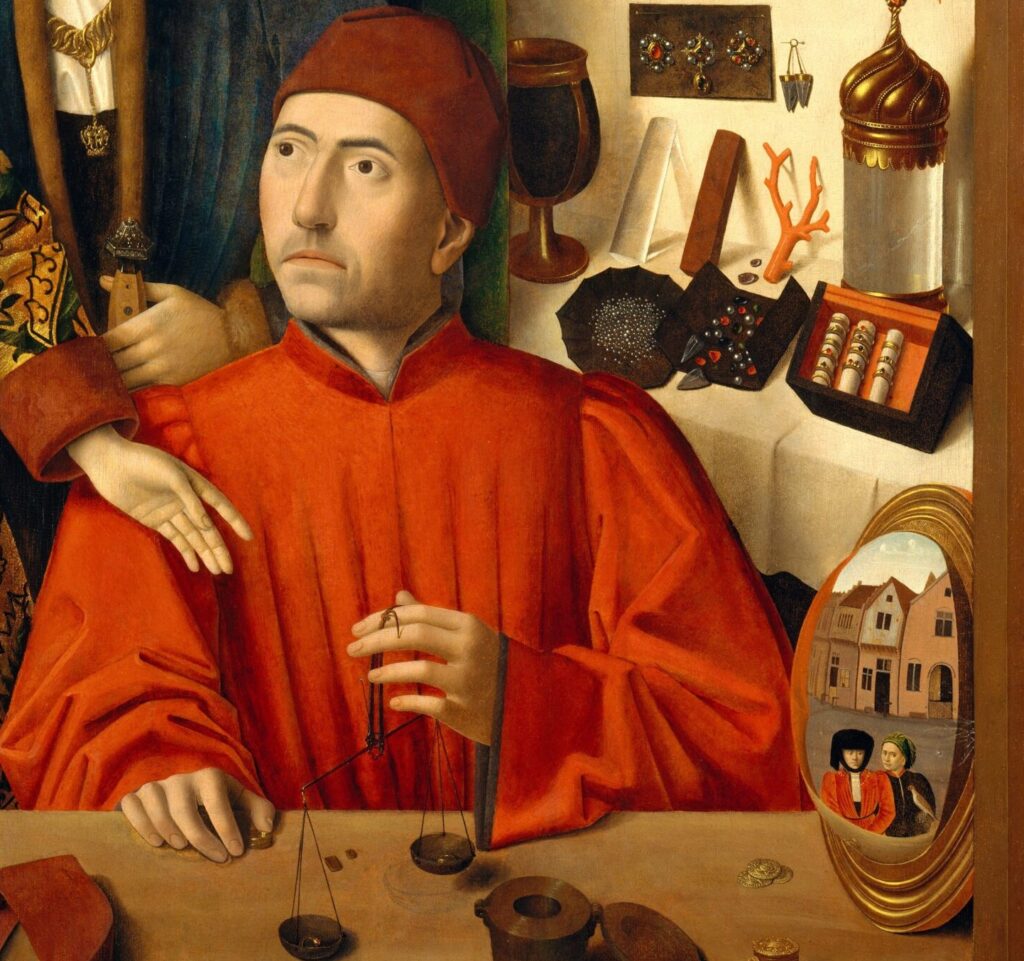
- The carefully arranged objects in the workshop embodies 15th-century Bruges and the growing confidence of the merchant class. The goldsmith’s balance symbolizes fairness and integrity, while the precious goods and foreign coins reveal the city’s diverse commercial world.
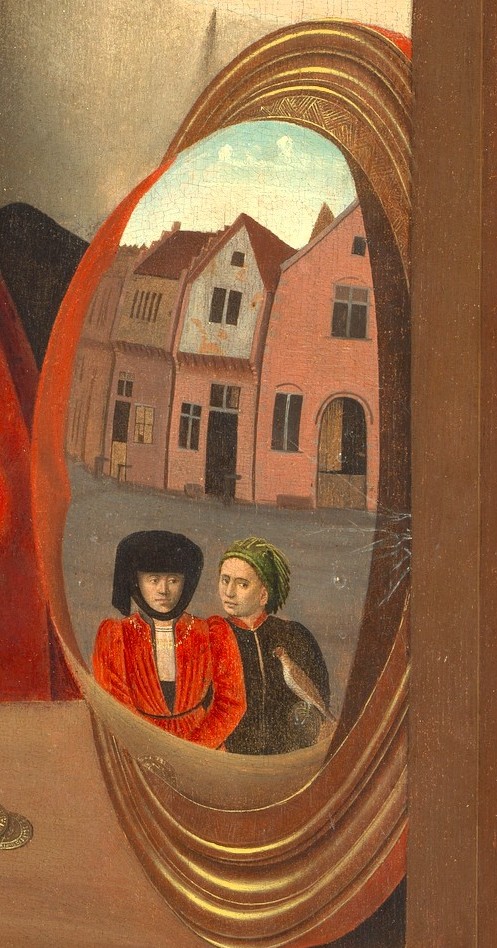
- The tiny convex mirror, as a symbol of truth, expands the workshop beyond its walls, blurring the boundary between the painted world and the viewer.
Petrus Christus and the World of Bruges
The world that Petrus Christus invites us into is not an imaginary one. To understand why this seemingly modest workshop mattered, it is worth stepping beyond its doors, into the city where it was painted. In 1449, Bruges (capital of West Flanders in northwest Belgium) was one of Europe’s great commercial capitals. Long before Antwerp or Amsterdam rose to prominence, Bruges stood at the centre of an international trading network that connected northern Europe with the Mediterranean.
Merchant ships arrived laden with English wool, Baltic timber and furs, Spanish wine, Italian silks, spices, and precious metals from the East. The city’s prosperity attracted bankers, merchants, diplomats, and skilled craftsmen, making it one of the wealthiest and most cosmopolitan centers of the 15th century. Luxury goods were not merely symbols of wealth. They were the foundation of the Bruges economy.
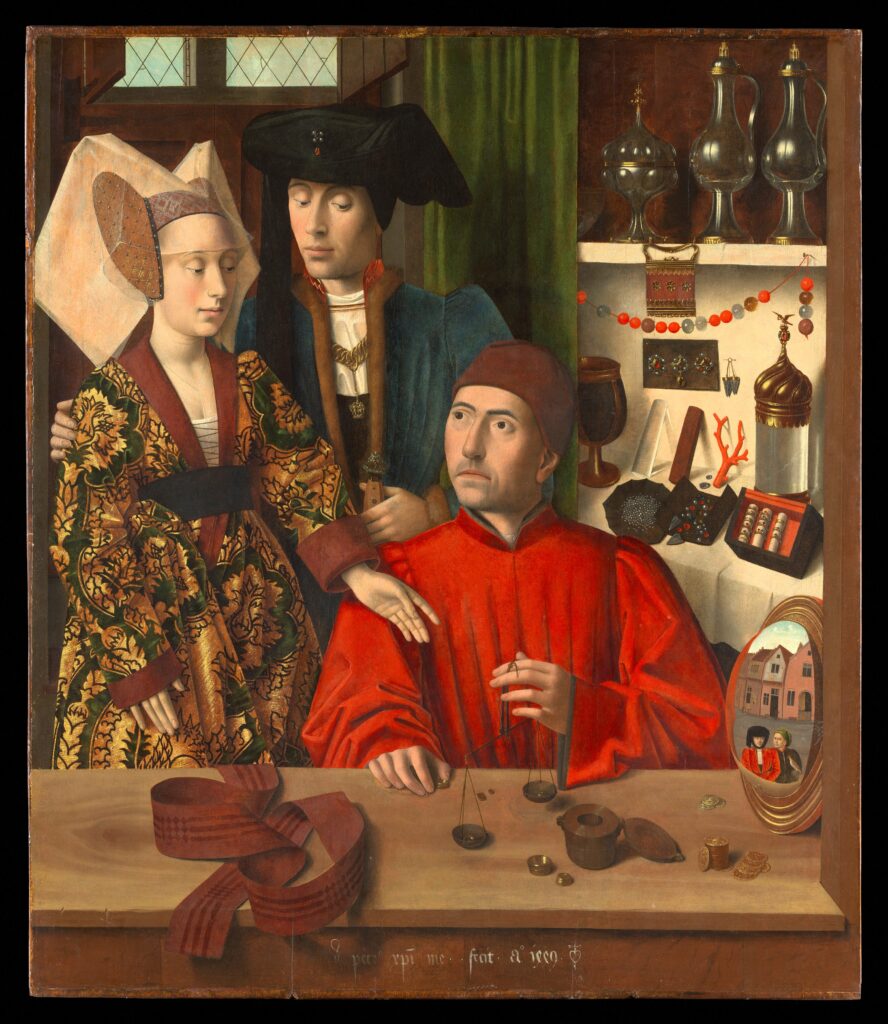
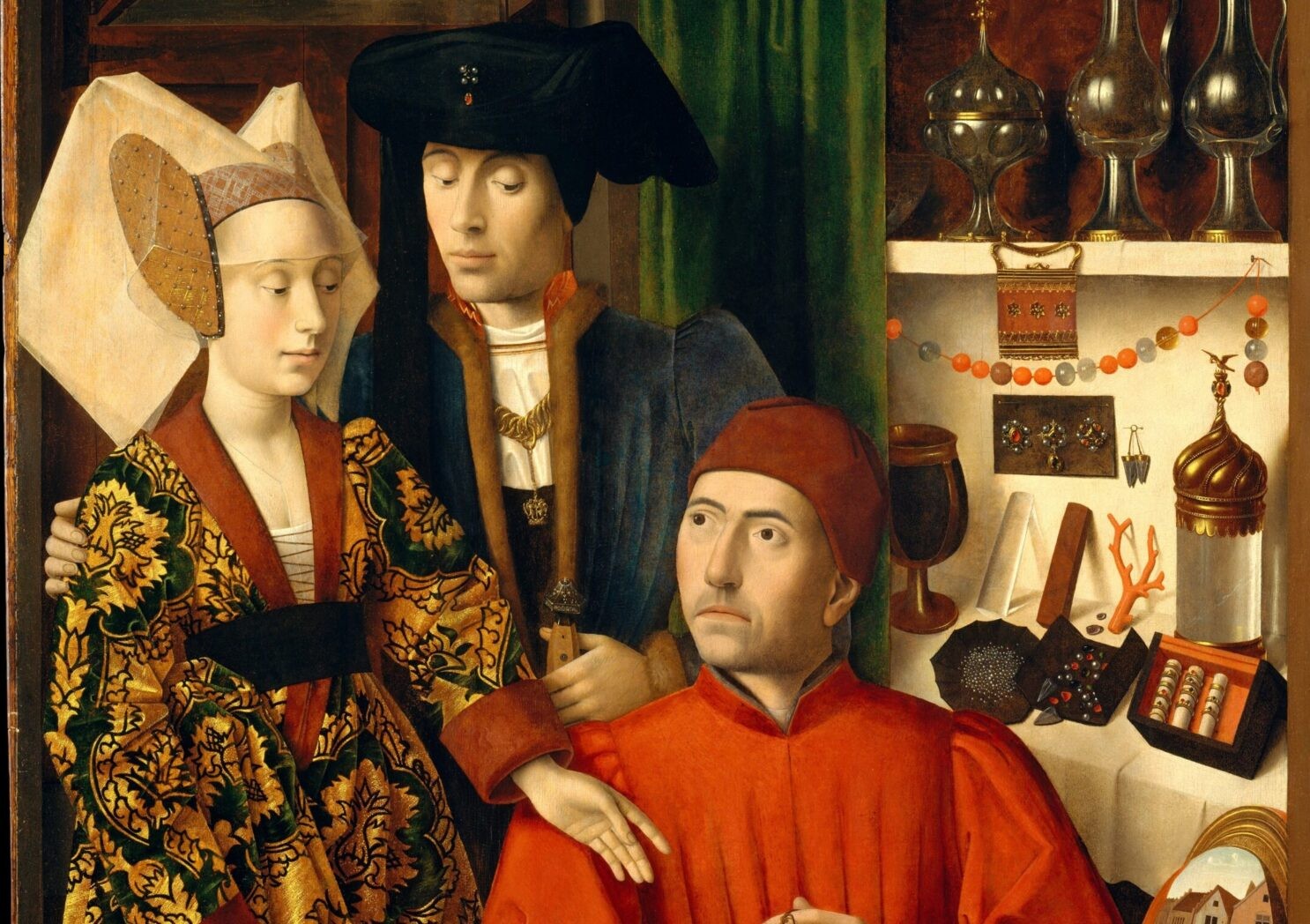
Petrus Christus, A Goldsmith in His Shop, 1449, Metropolitan Museum of Art, New York City, NY, USA.
Goldsmiths were among the most respected craftsmen in Bruges, transforming imported gold, silver, pearls, and gemstones into objects that adorned churches, princely courts, and wealthy merchants’ homes. The glittering objects displayed in Christus’s workshop reflect this thriving urban world, where craftsmanship and commerce were inseparable.
Petrus Christus (c. 1410/1420–c. 1475/1476) established his workshop in Bruges after acquiring citizenship in 1444, a legal requirement for opening an independent studio within the city. Although relatively little is known about his early life, he is generally associated with Jan van Eyck, either as a pupil, follower, or the artist who inherited aspects of Van Eyck’s workshop after the master’s death in 1441.
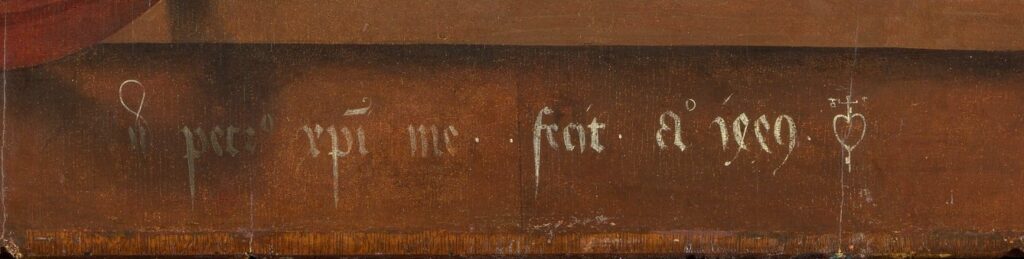
Petrus Christus, A Goldsmith in His Shop, 1449, Metropolitan Museum of Art, New York City, NY, USA. Detail.
Whether or not the two artists worked together, Christus clearly mastered the expressive possibilities of surface detail, the luminous layering of paint, and the effects of optical illusion. Yet he also developed a distinctive artistic voice, particularly in his careful construction of interior space and his interest in creating convincing, almost tangible environments, like those of his predecessors in Early Netherlandish painting. Rather than simply depicting figures against decorative backgrounds, Christus invited viewers to imagine themselves inhabiting the painted world.
His signature appears prominently along the lower frame of the painting: “Master Petrus Christus made me in the year 1449.” At a time when many artists remained anonymous, signing and dating a work was a confident assertion of artistic identity. It also reminds us that painters, like goldsmiths, belonged to organized guilds whose members relied on reputation and public trust to secure commissions.
A Goldsmith—or Saint Eligius?
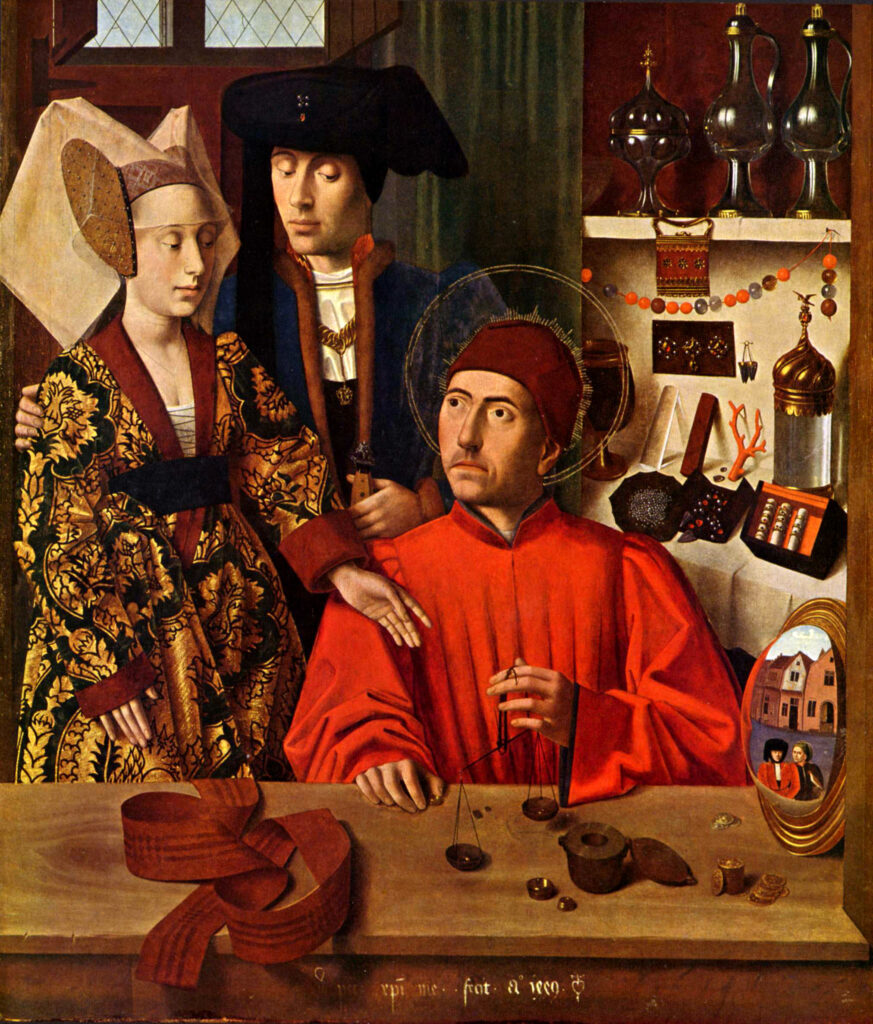
Petrus Christus, A Goldsmith in His Shop, 1449, Metropolitan Museum of Art, New York City, NY, USA. Painting before removing the halo. Wikimedia Commons (public domain).
For centuries, the man seated behind the workbench was identified as Saint Eligius, the 7th-century bishop of Noyon and the patron saint of goldsmiths, metalworkers, and money changers because he appeared with a halo. The painting was therefore widely known as Saint Eligius in His Shop, and generations of viewers interpreted it as a devotional image celebrating the virtues of honest craftsmanship. The identification seemed convincing. The goldsmith wears a vivid red robe, his gaze is directed slightly upward rather than fixed on the scales before him, and he appears calm and contemplative amid the bustle of the workshop.
According to a famous legend, Eligius made two golden thrones from the gold provided for one and returned the extra instead of keeping it, earning a reputation for integrity. Medieval accounts describe Eligius presenting a ring to Saint Godeberta, dedicating her to a spiritual rather than earthly union. The painting also shows an elegantly dressed young couple and a ring being weighed, with a richly embroidered girdle (or a belt) resting prominently on the counter. Earlier scholars therefore regarded the painting as both a celebration of the sacrament of marriage and an invocation of the saint’s blessing upon the union.
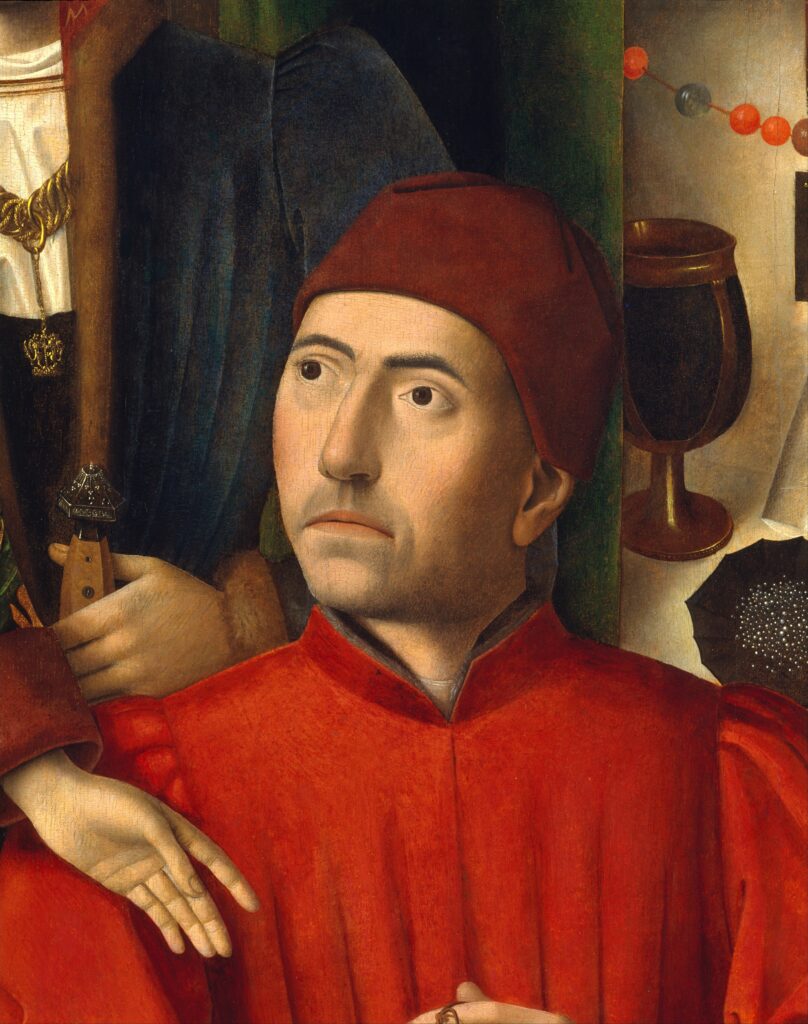
Petrus Christus, A Goldsmith in His Shop, 1449, Metropolitan Museum of Art, New York City, NY, USA. Detail.
However, modern research has changed this view. During conservation at the Metropolitan Museum of Art in the 1990s, experts discovered that the halo was not painted by Christus but added later, probably in the 16th century, when viewers sought to emphasize the figure’s sanctity. Once this overpaint was removed, the man appeared not as a saint distinguished by a divine attribute but as a vocational portrait celebrating the profession of goldsmithing itself. As a result, many scholars now call the painting A Goldsmith in His Shop.
Technical studies have also revealed that the goldsmith’s face was painted with exceptional care, suggesting that he may be a real person rather than an imaginary figure. Some historians believe he could be Willem van Vleuten, a well-known goldsmith who worked for Philip the Good, Duke of Burgundy. Records show that in 1449 Van Vleuten made a wedding gift for Mary of Guelders and James II of Scotland, leading some scholars to suggest that the royal couple in the painting may represent the royal bride and groom purchasing or receiving a wedding ring.
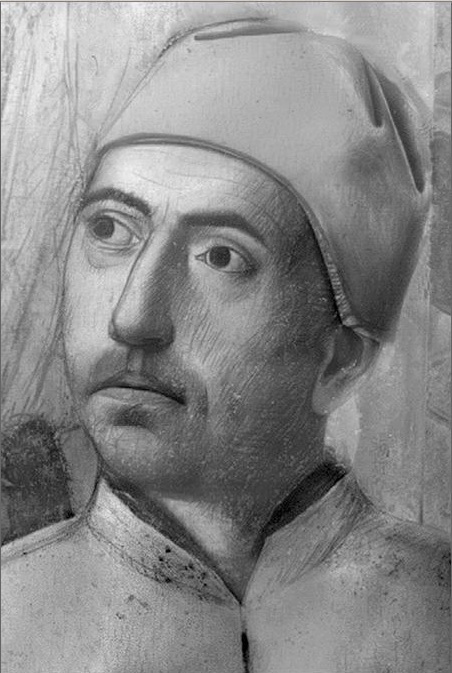
Petrus Christus, A Goldsmith in His Shop, 1449, Metropolitan Museum of Art, New York City, NY, USA. Underlying drawing. Detail.
Although this identification cannot be proven, it lends fresh significance to several details within the composition. The ring carefully balanced on the scales, together with the girdle extending over the edge of the counter into the viewer’s space, reinforces the painting’s biblical associations with marriage and fidelity. Whether portraying a specific historical event or an idealized scene of courtly patronage, Christus transforms an everyday workshop into a sophisticated reflection on craftsmanship, civic pride, as well as one of life’s most important ceremonies.
Marriage, Wealth, and Burgundian Luxury
Whether the couple represents specific individuals—as in Jan van Eyck’s Arnolfini Portrait—or an idealized pair remains unknown. Their refined attire clearly identifies them as members of the wealthy urban elite or the Burgundian court. The young woman wears a luxurious gold brocade gown decorated with a pomegranate pattern probably from Italy, while her elaborate headdress is embroidered with pearls. Beside her, the young man is dressed in fashionable black and adorned with a heavy gold chain and an ornate brooch on his hat, reflecting the Burgundian taste for lavish jewelry encouraged by Duke Philip the Good (1419–1467).
Their refined appearance immediately signals prosperity, social prestige, and participation in the sophisticated courtly culture of 15th-century Bruges. Rather than dramatizing luxury, the painting celebrates the civilised rituals of commerce, a quiet confidence that exists between skilled artisan and discerning patron.
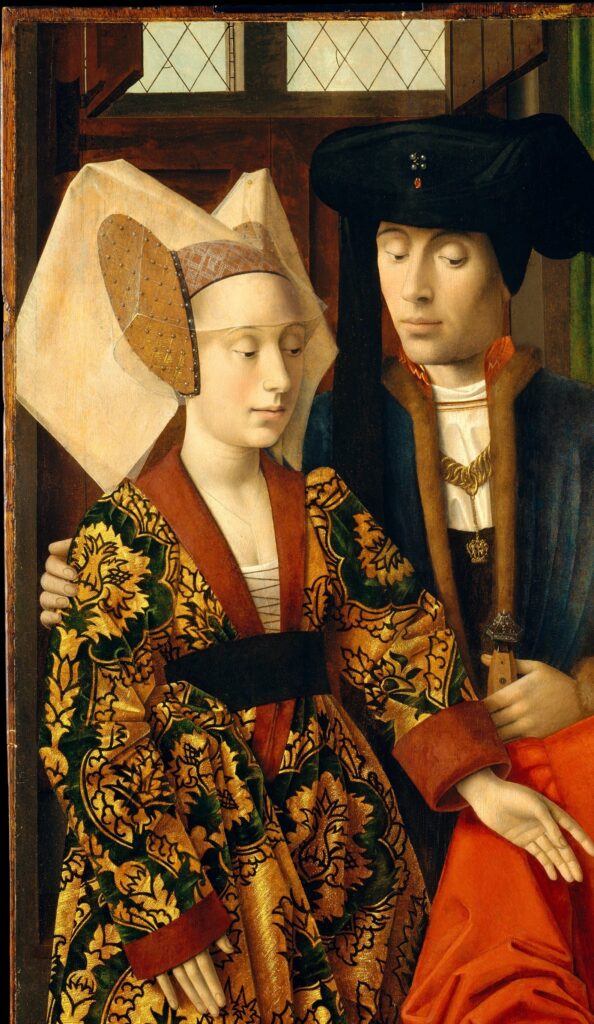
Petrus Christus, A Goldsmith in His Shop, 1449, Metropolitan Museum of Art, New York City, NY, USA. Detail.
Marriage provides another layer of meaning. The ring being carefully weighed, together with the girdle displayed on the counter, naturally evokes the institution of matrimony, one of the most significant social and religious ceremonies of the medieval world. These objects also recall the medieval legend of Saint Eligius presenting a ring to Saint Godeberta, dedicating her to a spiritual union with Christ. Rather than illustrating the legend itself, Christus uses these familiar associations to emphasize the goldsmith’s role in one of life’s most important ceremonies.
Whether the couple is purchasing an engagement ring or simply commissioning jewelry cannot be known with certainty, but Christus carefully positions them within a visual language associated with union, prosperity, and domestic stability. Wedding rings were among the most significant products of the goldsmith’s trade, symbolizing not only love but also legal commitment, family alliances, and economic security.
The painting quietly celebrates this new civic identity, presenting successful citizens as worthy subjects of sophisticated art, under Philip the Good, one of Europe’s richest rulers and an important patron of goldsmiths. In the Burgundian Netherlands, jewelry and precious metalwork were far more than decorative luxuries. They proclaimed status, served as portable wealth, and were frequently exchanged as diplomatic gifts or rewards for loyal service. By bringing together an accomplished goldsmith and affluent patrons, Christus transforms a routine commercial transaction into a celebration of craftsmanship, commerce, marriage, and the growing confidence of the prosperous merchant class.
Reading the Objects: Every Detail Matters
The longer one looks at A Goldsmith in His Shop, the more it reveals itself as a carefully orchestrated display of precious objects. Petrus invites viewers to examine the workshop much as a customer would, moving from one finely crafted object to another with extraordinary precision, demonstrating not only the artist’s technical mastery but Bruges’s reputation as a centre of luxury craftsmanship.
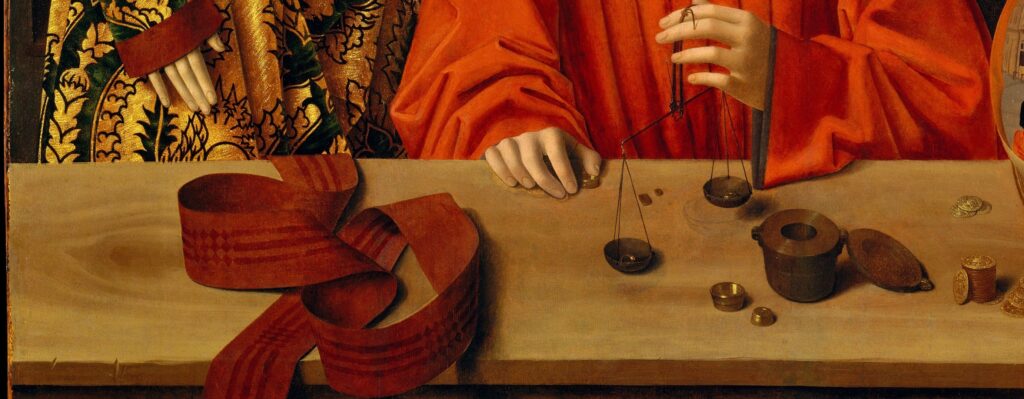
Petrus Christus, A Goldsmith in His Shop, 1449, Metropolitan Museum of Art, New York City, NY, USA. Detail.
At the heart of the composition is the goldsmith’s balance, the instrument upon which the entire scene resolves. In the medieval world, the value of gold and silver depended on their weight and purity, making accuracy and honesty essential to the profession. The scales therefore become much more than a practical tool. They symbolize fairness, integrity, and the ethical responsibilities of the craftsman. Guild regulations even required goldsmiths to keep their workshops open to the street so customers could witness transactions and trust the fairness of the exchange.
The shelves behind the goldsmith function like a luxurious showroom, displaying silver pitchers, crystal vessels, pearls, chains, brooches, and other finely crafted objects that advertise the workshop’s expertise. Alongside these are objects believed to possess protective powers, including red coral, thought to prevent illness, and fossilized shark teeth or “adder’s tongues,” believed to detect poison by changing color when placed in food or drink. Precious stones were similarly credited with remarkable powers: rubies guarded against corruption, sapphires promoted healing, and exotic materials such as coconut-shell goblets were valued not only for their rarity but also for their supposed ability to counteract poison.
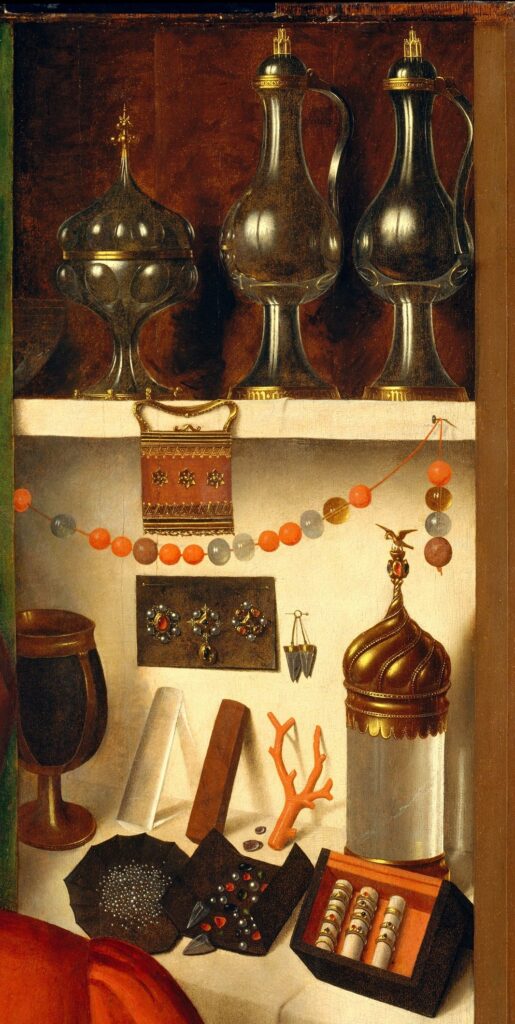
Petrus Christus, A Goldsmith in His Shop, 1449, Metropolitan Museum of Art, New York City, NY, USA. Detail.
To modern eyes, these beliefs may appear superstitious, but for medieval patrons they reflected a worldview in which religion, medicine, and the natural properties of materials were deeply interconnected. Even the coins scattered across the counter deserve attention. Gold coins from England, Burgundy, Mainz, and other regions circulated freely through the city, reflecting its status as an international financial centre. For a goldsmith, familiarity with different currencies was an essential professional skill.
Together, these carefully observed objects transform the workshop into more than a place of business. It becomes a portrait of 15th-century Bruges itself—a city where craftsmanship, international trade, wealth, beliefs, and civic pride converged. Every detail contributes to this rich visual narrative, culminating in the tiny convex mirror that expands both the physical and symbolic space of the painting.
The Convex Mirror and the Art of Seeing
Petrus Christus, A Goldsmith in His Shop, 1449, Metropolitan Museum of Art, New York City, NY, USA. Detail.
If there is one detail that has fascinated viewers for centuries, it is the tiny convex mirror hanging on the right side of the workshop. Small enough to be overlooked, it is nevertheless the painting’s most ingenious feature. More than a decorative object, the mirror expands the world beyond the shop into sophisticated explorations of vision and perception.
Reflected in its polished surface are two elegantly dressed men standing outside the workshop, one apparently carrying a falcon, together with the red-brick streets of Bruges. Positioned where a real viewer might stand, these figures blur the boundary between the painted world and our own, inviting us to become participants rather than passive observers. The mirror reveals both the interior and exterior at once, creating a remarkably convincing illusion of space.
The device inevitably recalls Jan van Eyck’s Arnolfini Portrait, whose famous convex mirror reflects figures who stand outside the main scene. Whether Petrus consciously borrowed the motif or adapted a familiar artistic convention remains uncertain, but he uses it differently. Instead of reinforcing the intimacy of a domestic interior, Christus connects the goldsmith’s workshop to the bustling commercial life of Bruges, emphasizing the relationship between skilled craftsmanship and the wider urban world.
Petrus Christus, A Goldsmith in His Shop, 1449, Metropolitan Museum of Art, New York City, NY, USA. Detail.
The mirror also demonstrates Christus’s technical skill. Its tiny surface accurately reflects buildings, figures, and sky while capturing the subtle distortions. Such passages showcased the extraordinary possibilities of oil painting and the Northern Renaissance fascination with optics, light, and natural observation. At the same time, the carefully constructed workshop reveals Christus’s growing interest in creating a believable, inhabitable space through observation.
Some scholars have even suggested that the figure carrying the falcon may be Christus himself. Although this remains speculative, it reflects the increasing confidence of Renaissance artists, who were beginning to assert their individuality in their craftsmanship.
Beyond its technical brilliance, the convex mirror carries a deeper meaning. Like the goldsmith’s balance, it is an instrument of truth. While the scales measure the value of precious metals, the mirror tests the reliability of vision, reminding viewers that appearances require careful scrutiny. By drawing us into the workshop and encouraging us to linger over its many details, Petrus Christus presents a meditation on observation, honesty, and the art of seeing itself. The smallest details often contain the richest stories.