
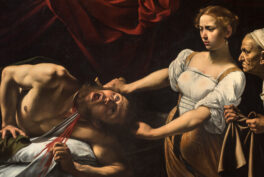
Masterpiece Story: Judith and Holofernes by Caravaggio
Judith and Holofernes is a Caravaggio masterpiece that captures Biblical murder and drama. Rarely has death been captured so intensely and violently...
James W Singer 13 September 2026
1 October 2026 min Read
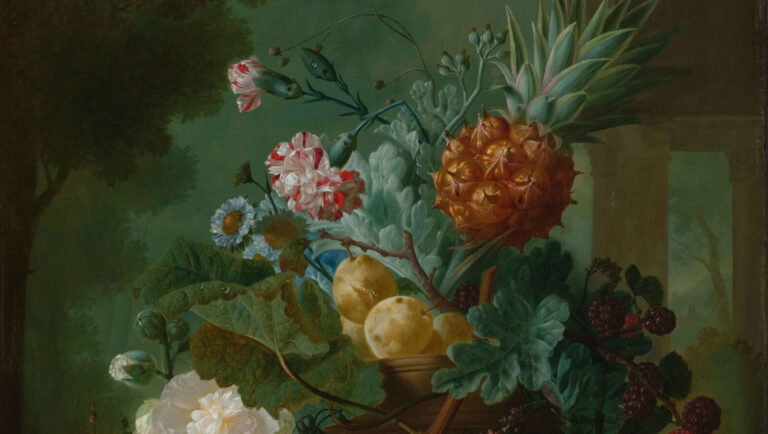
Jan van Os, Still Life with Carnations and Exotic Fruit, ca. 1770s, Virginia Museum of Fine Arts, Richmond, VA, USA. Detail.
Jan van Os’s Still Life with Carnations and Exotic Fruit is a celebration of summer in its most luxurious form, filled with carefully arranged flowers and exotic fruit. But what lies beneath this beautiful surface?
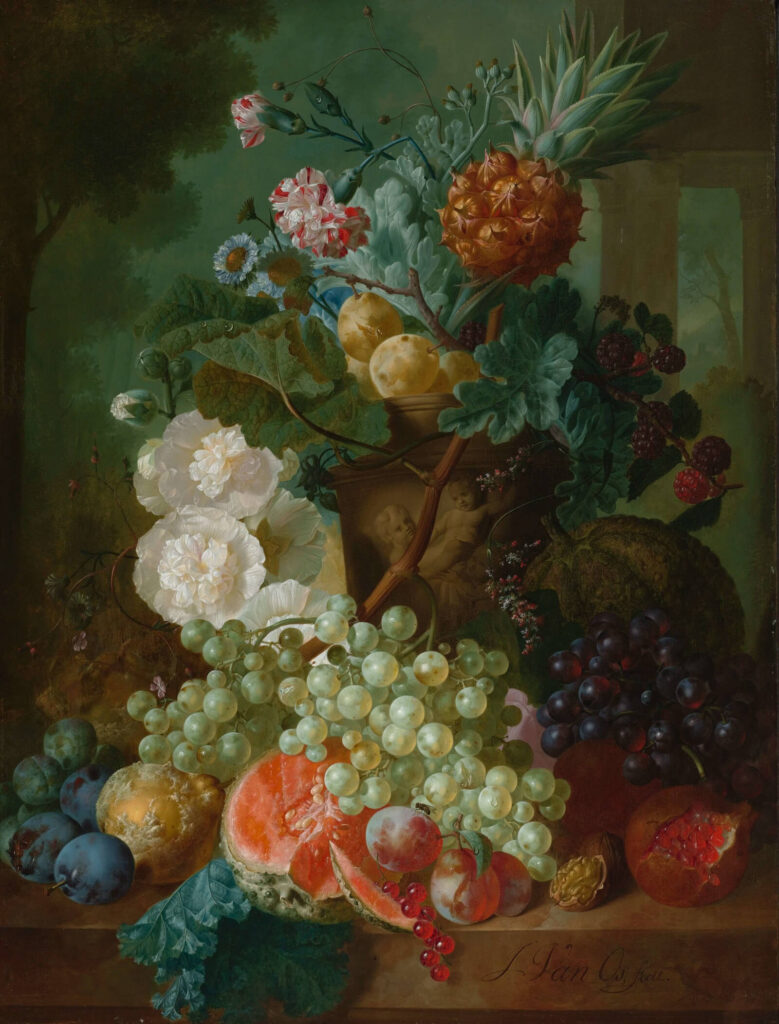
Jan van Os, Still Life with Carnations and Exotic Fruit, ca. 1770s, Virginia Museum of Fine Arts, Richmond, VA, USA.
Jan van Os (1744–1808) was one of the last great Dutch painters of fruit and floral still lifes. He continued the painterly tradition established during the Dutch Golden Age of the 17th century well into the late 18th century. Van Os was deeply inspired by his predecessor, Jan van Huysum, and built upon his technique of thinly layered oil paints to express subtle colors and reflective surfaces.
Van Os lived and worked in The Hague, where he sold and exported works to English, French, and German collectors. Therefore, while he remained in the Dutch Republic (modern-day Netherlands), he enjoyed a successful international reputation and patronage. One of his most beautiful images, and a recognized masterpiece, is Still Life with Carnations and Exotic Fruit, now on display at the Virginia Museum of Fine Arts in Richmond.
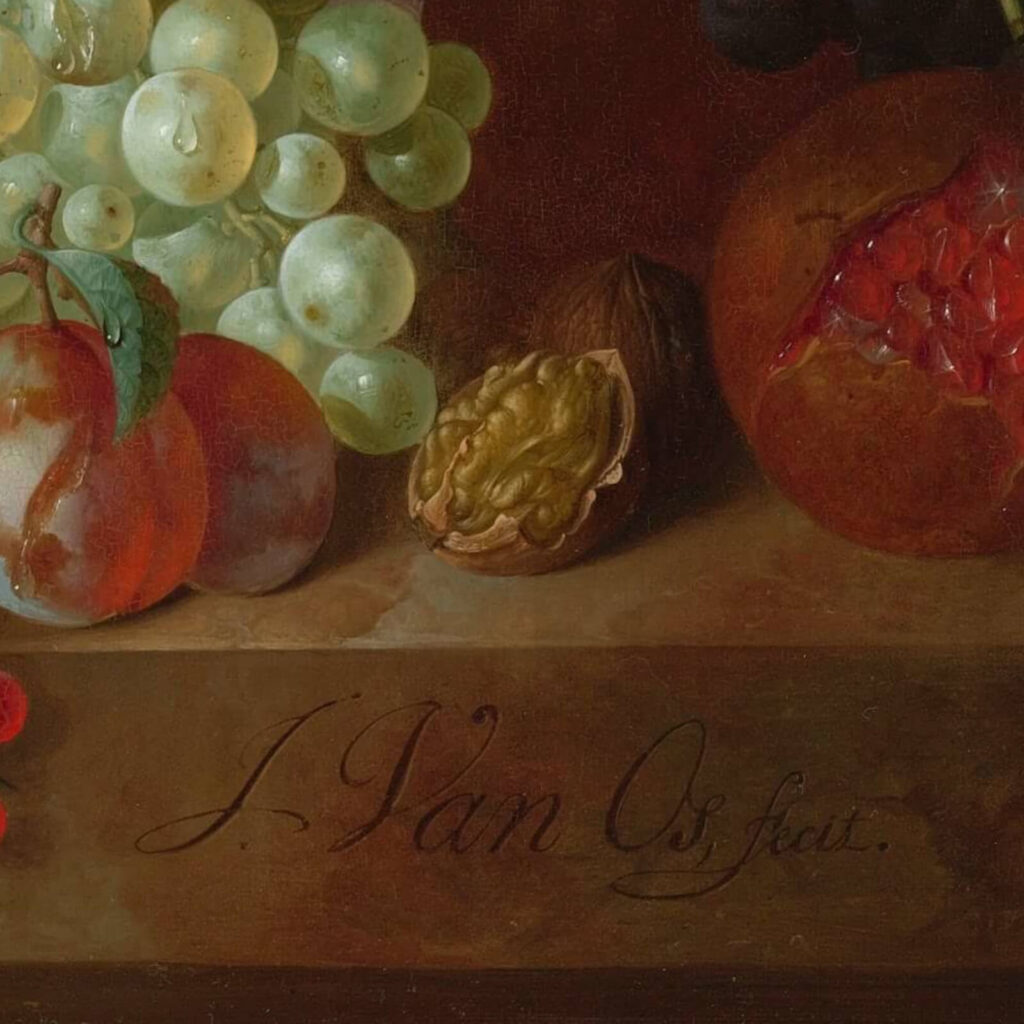
Jan van Os, Still Life with Carnations and Exotic Fruit, ca. 1770s, Virginia Museum of Fine Arts, Richmond, VA, USA. Detail.
Still Life with Carnations and Exotic Fruit is an oil on wood measuring 68.26 × 52.07 cm (26 7/8 × 20 1/2 in.). It presents a visually stunning arrangement of fruit and flowers. The delicious still life is set outdoors with natural sunlight illuminating the composition from the upper-left corner.
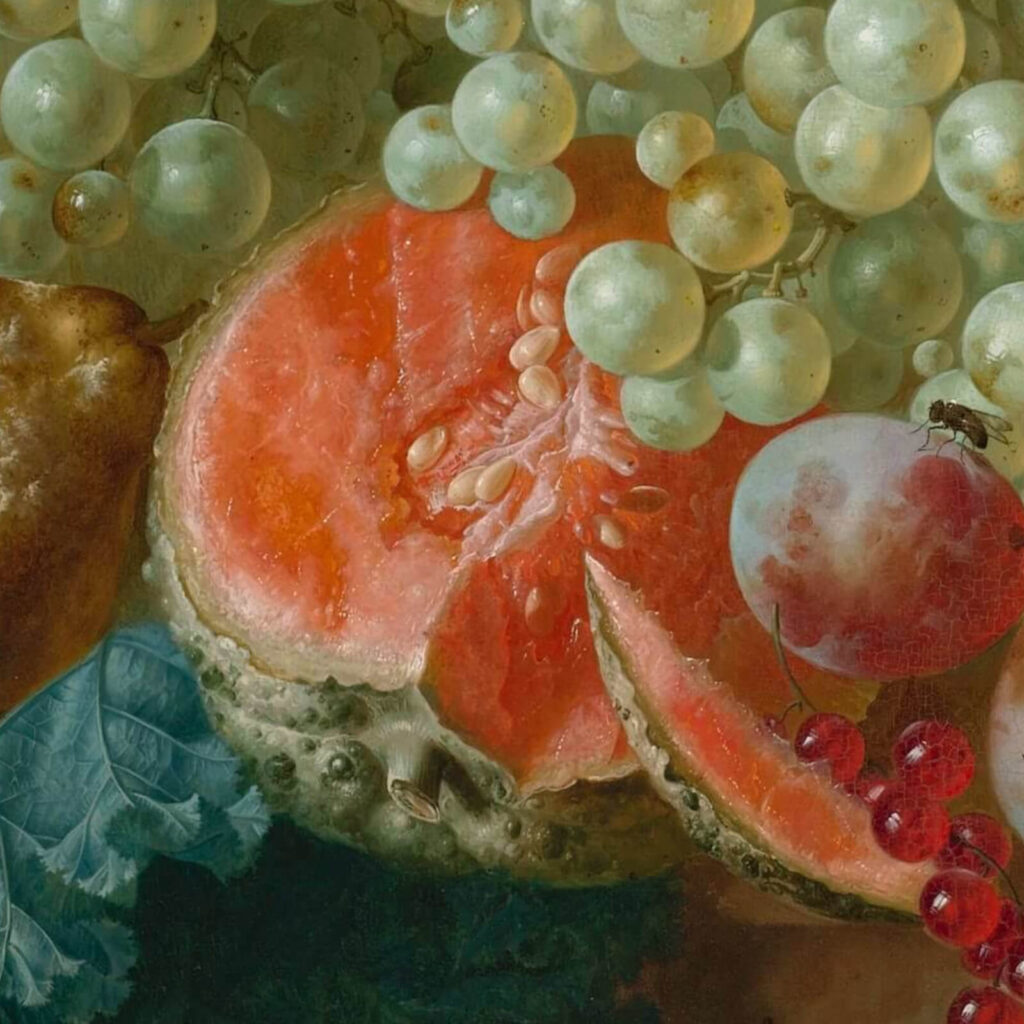
Jan van Os, Still Life with Carnations and Exotic Fruit, ca. 1770s, Virginia Museum of Fine Arts, Richmond, VA, USA. Detail.
The background is an aristocratic garden with neoclassical columns on the right and manicured trees on the left.
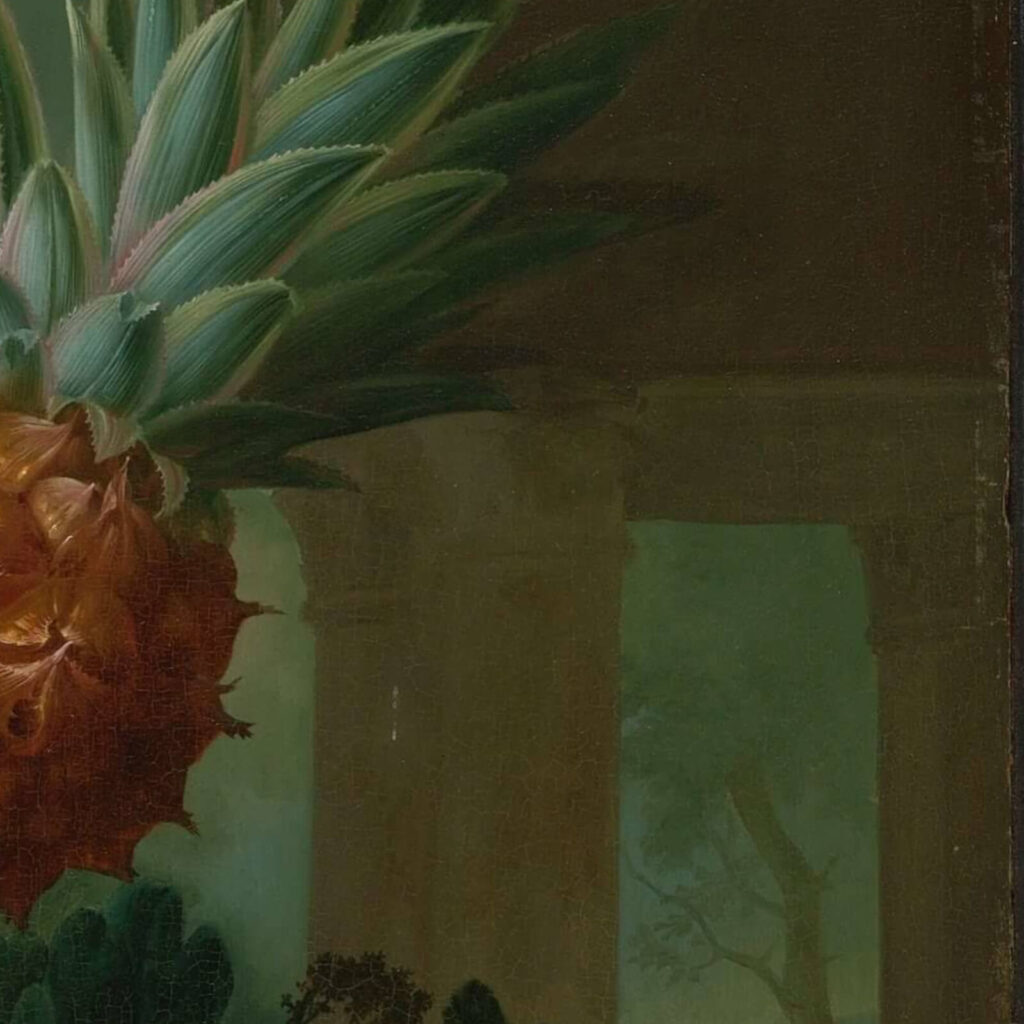
Jan van Os, Still Life with Carnations and Exotic Fruit, ca. 1770s, Virginia Museum of Fine Arts, Richmond, VA, USA. Detail.
The overall scene presents a feeling of refinement, luxury, and opulence.
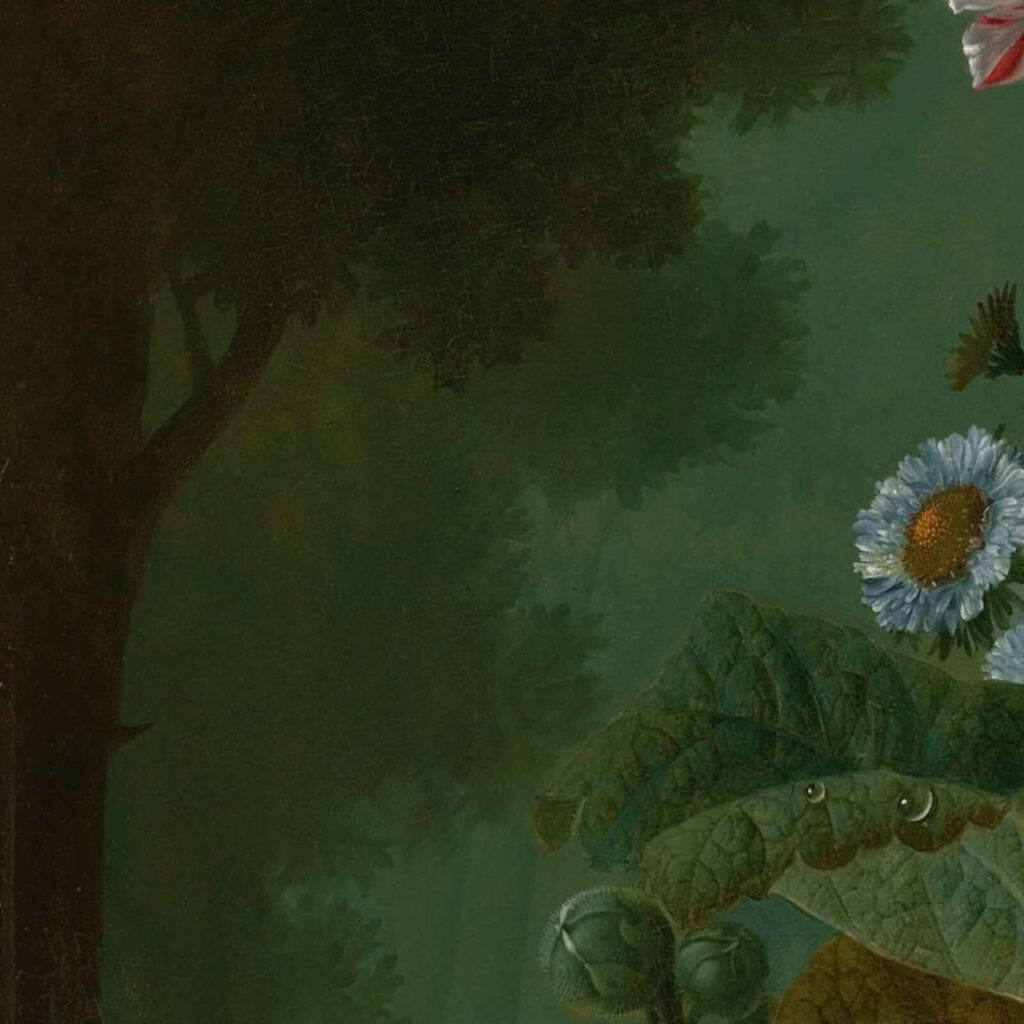
Jan van Os, Still Life with Carnations and Exotic Fruit, ca. 1770s, Virginia Museum of Fine Arts, Richmond, VA, USA. Detail.
Fruits largely dominate the composition and give a sense of palatable desire. Their soft textures and dewy surfaces are a feast for the eyes. Most of the fruits are available in the summer season, lending the painting a distinctly summery ambiance.
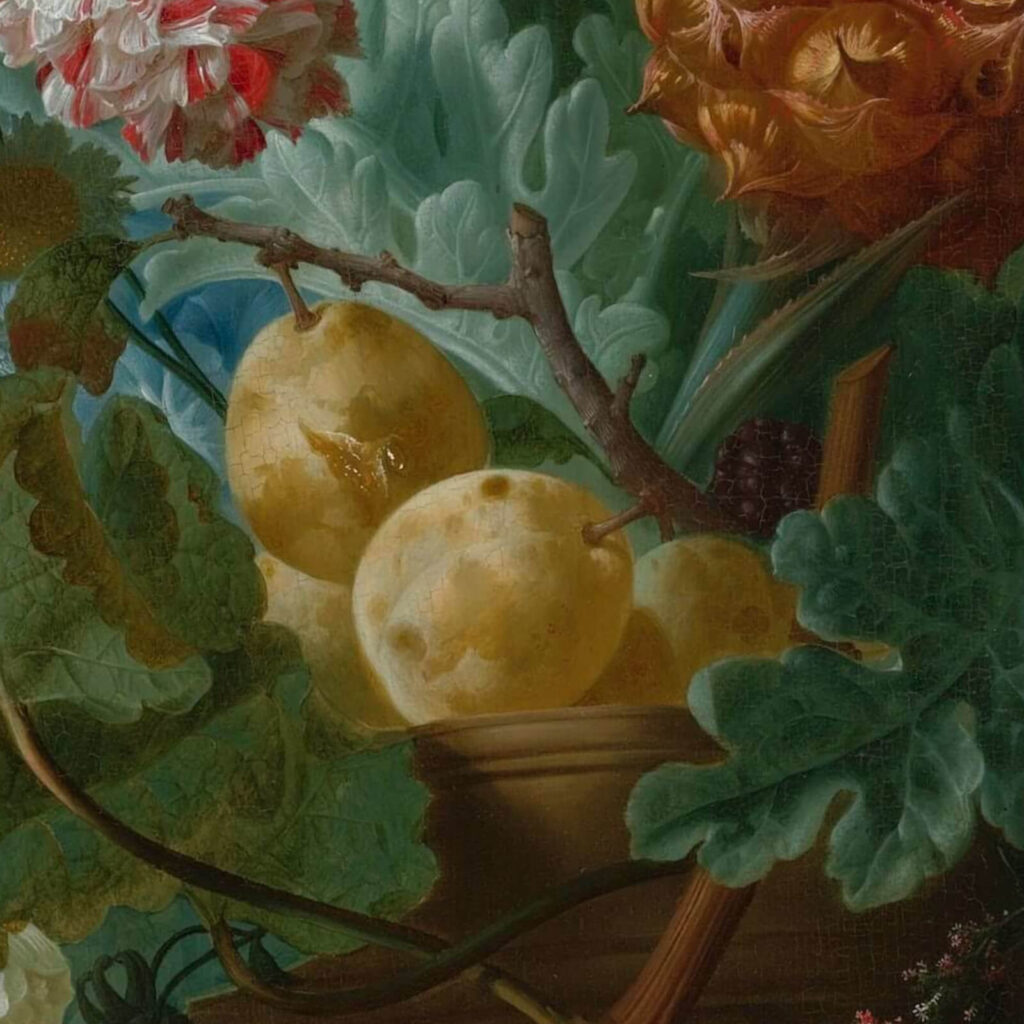
Jan van Os, Still Life with Carnations and Exotic Fruit, ca. 1770s, Virginia Museum of Fine Arts, Richmond, VA, USA. Detail.
However, some of the fruits are only available in the autumn. Therefore, while the image appears to represent a day’s abundance from nature, it could not have occurred naturally in a single moment. It is an artificial arrangement that remains believable. This masterful combination of elements from different seasons is part of the magic—and perhaps the allure—of Dutch still lifes. They present an impossible version of nature, yet one that remains visually convincing.
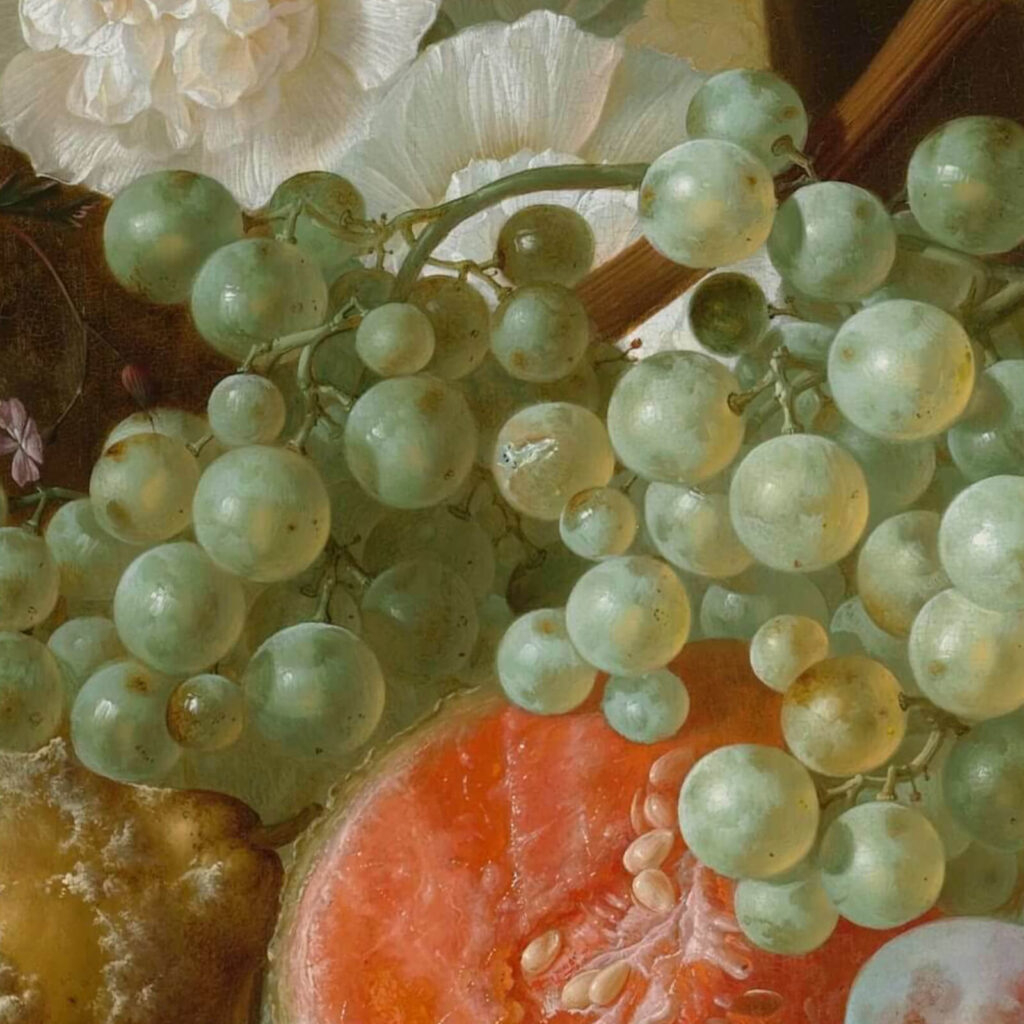
Jan van Os, Still Life with Carnations and Exotic Fruit, ca. 1770s, Virginia Museum of Fine Arts, Richmond, VA, USA. Detail.
The most prized element of the composition is the crowning pineapple. It dominates the upper arrangement with its prickly skin and bold leaves. During the 17th and 18th centuries, pineapples were a luxury item—a status symbol of high society. They were expensive to acquire, and without the convenience of modern refrigeration, they were quick to perish. Therefore, they were an expensive, ephemeral possession.
Many wealthy owners simply showcased their pineapples on fireplace mantels, in fruit arrangements, and as table centerpieces. The pineapples’ value lay in their presence, not their taste. Hence, Van Os intimates that this fruity-floral arrangement is for an aristocratic patron or an aspiring social climber.
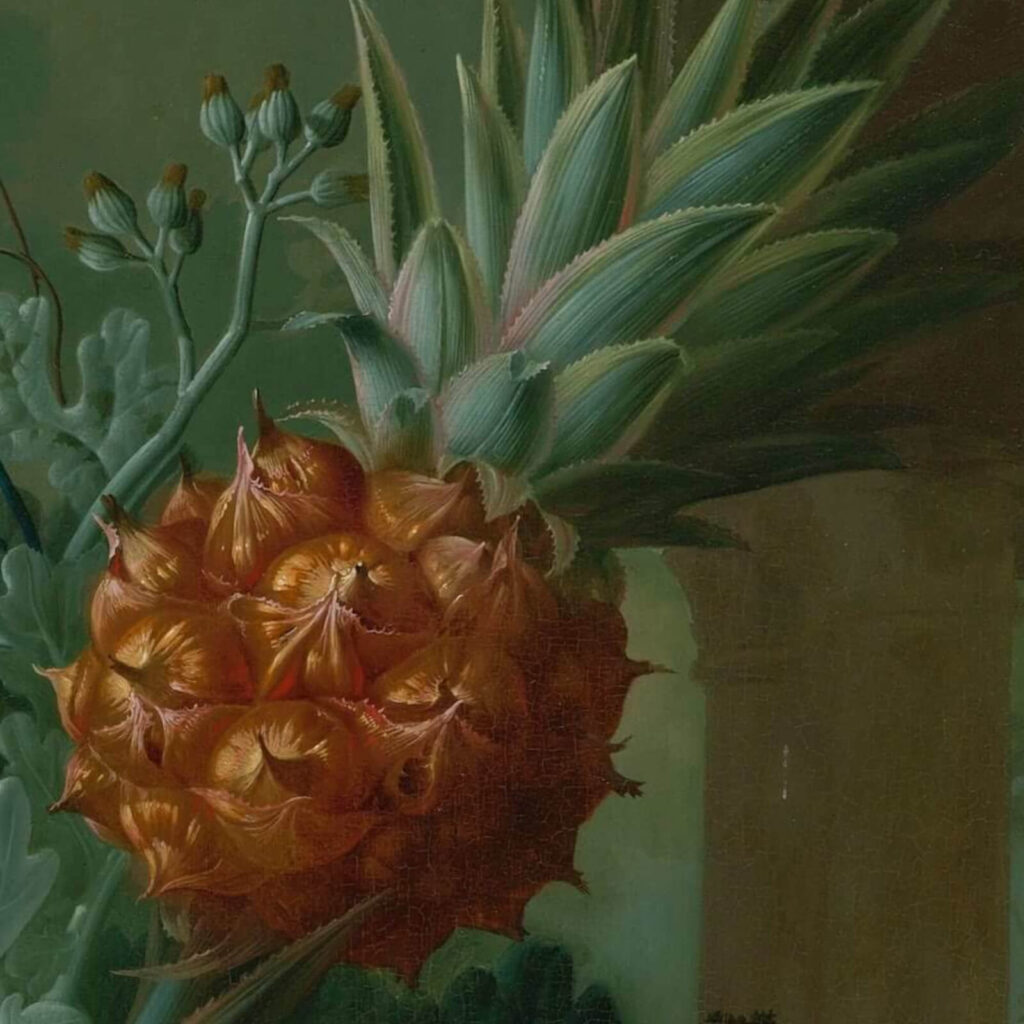
Jan van Os, Still Life with Carnations and Exotic Fruit, ca. 1770s, Virginia Museum of Fine Arts, Richmond, VA, USA. Detail.
To the left of the pineapple are red and white variegated carnations. The stem of the larger bloom is broken, and its head dips at a sharp angle. Variegated flowers were highly prized and pricey in the 17th and 18th centuries. One flower variety, for example, Semper Augustus, was a variegated tulip that was the most expensive flower in recorded history during tulip mania (1634–1637). Speculators traded these tulip bulbs for the equivalent price of houses. Imagine trading a tulip bulb for a house!
Therefore, while this variegated carnation would not have cost a house in the 1770s, when this image was created, the lingering social desire for variegated flowers would still have held strong. They were much rarer than today; hence, flower connoisseurs desired them. Consequently, Van Os reflects another prizeworthy element in his composition.
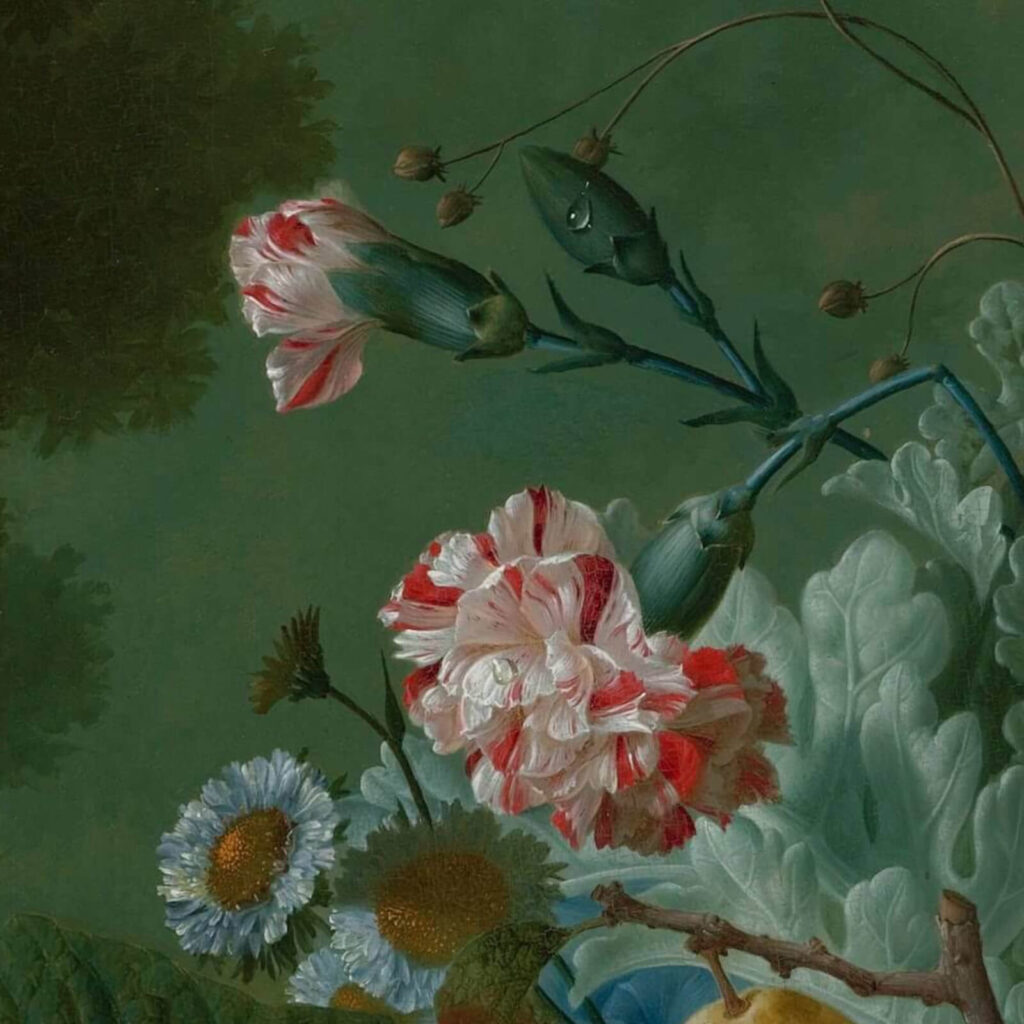
Jan van Os, Still Life with Carnations and Exotic Fruit, ca. 1770s, Virginia Museum of Fine Arts, Richmond, VA, USA. Detail.
It is interesting to note that white carnations traditionally symbolize pure love and good luck, while striped (variegated) carnations traditionally represent unrequited love—that awful feeling of loving someone without reciprocity. Perhaps Van Os is expressing a frustrating love situation through the carnation’s colors and broken stem? Perhaps it is an artistic motif of lost hope in love?
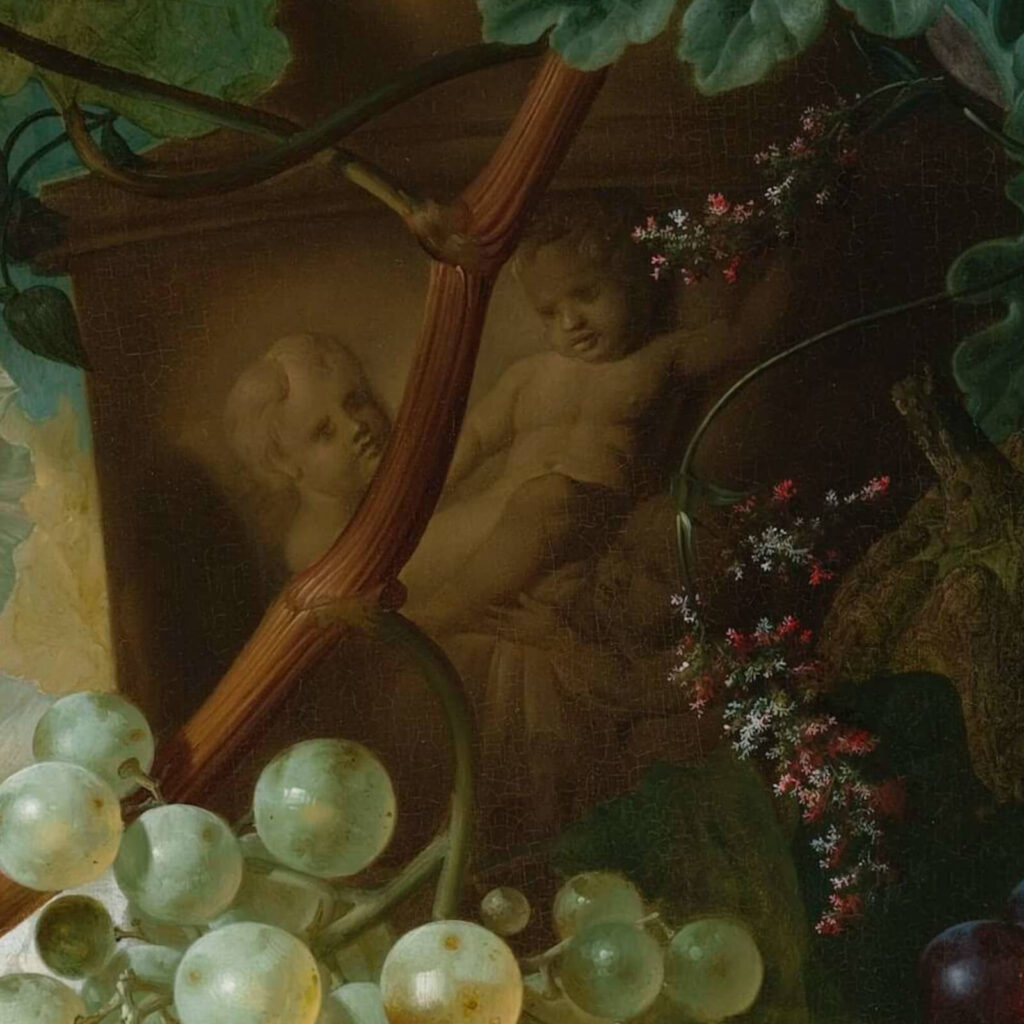
Jan van Os, Still Life with Carnations and Exotic Fruit, ca. 1770s, Virginia Museum of Fine Arts, Richmond, VA, USA. Detail.
Below the variegated carnations are white roses. These flowers traditionally symbolize purity, innocence, and new beginnings. However, they can also represent respect, reverence, and remembrance. If the viewer uses the second level of symbolism, this further aligns with the sense of loss conveyed by the carnations. Perhaps Van Os is truly trying to communicate something? Perhaps memories of a lost love?
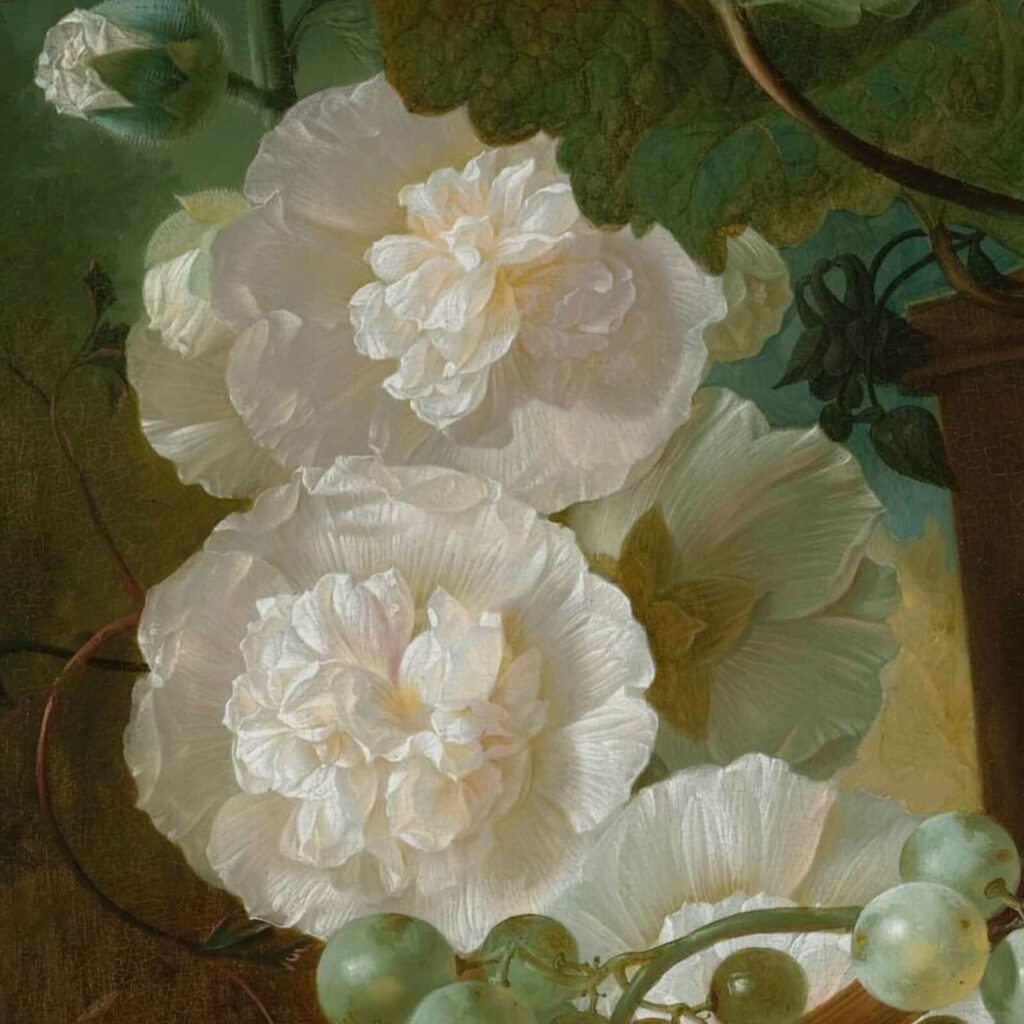
Jan van Os, Still Life with Carnations and Exotic Fruit, ca. 1770s, Virginia Museum of Fine Arts, Richmond, VA, USA. Detail.
Dominating the lower composition are three bunches of grapes: a large group of green grapes, a smaller bunch of black grapes to the right, and three large red grapes in the center. Grapes are a late-summer, early-autumn fruit, adding to the bright summer aesthetic. Within art, they also represent lust and decadence, but also abundance and fertility. Therefore, this overall composition of fruits and flowers really explores the hidden emotions of love’s turmoil.
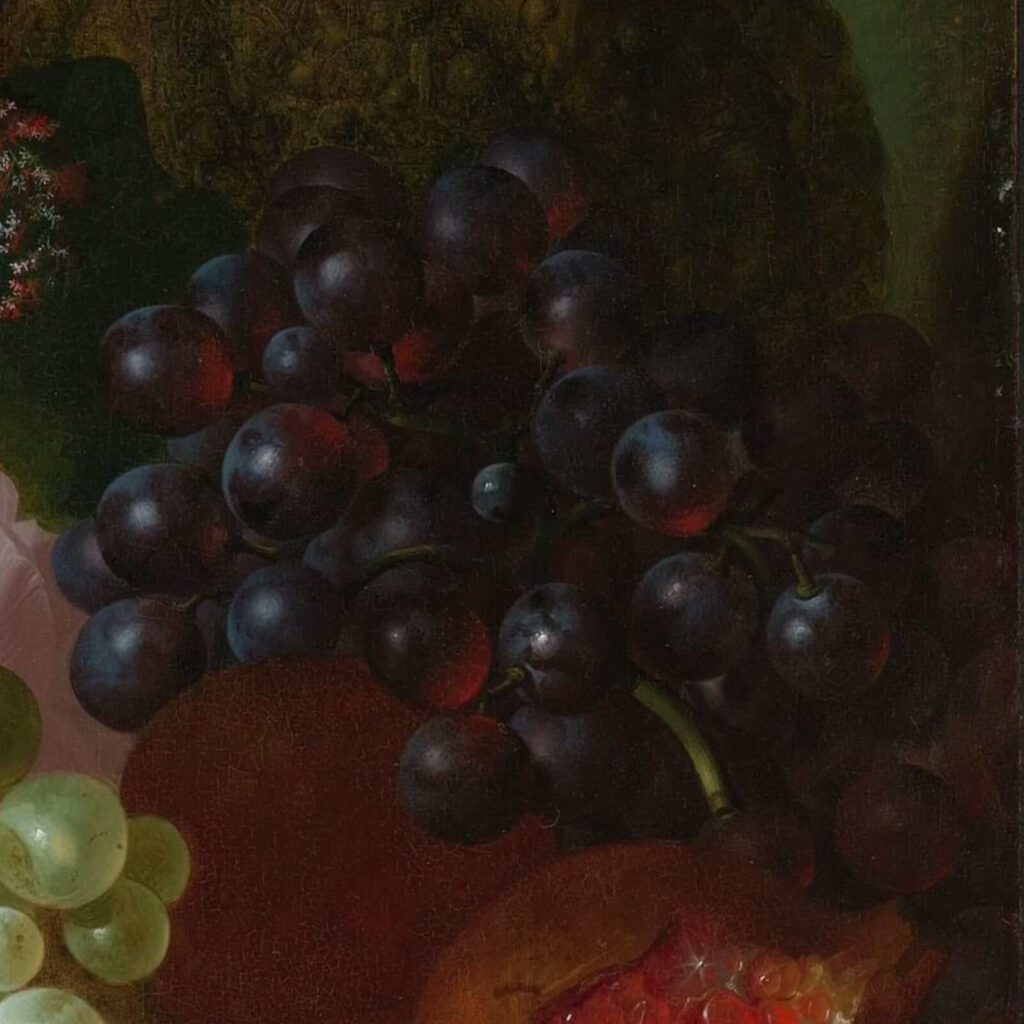
Jan van Os, Still Life with Carnations and Exotic Fruit, ca. 1770s, Virginia Museum of Fine Arts, Richmond, VA, USA. Detail.
A black fly is perched on one of the central red grapes. Van Os depicts the insect with a realism bordering on scientific exploration of insect anatomy. The late 18th century was a period of great scientific development, especially in fields such as entomology (the study of insects). With advances in light microscopy during the 17th century, observing the anatomical details of insects was possible by the 1770s, when Van Os captured this fly’s image.
Since the artist was a keen observer of nature, it is entirely possible that he owned a microscope and studied a common housefly to realistically depict its wiry legs and veil-like wings. Notice how the thin and transparent wings catch the light against the green grapes. Despite modern germ-revulsion to flies, the creature does add a natural outdoor element to the scene.
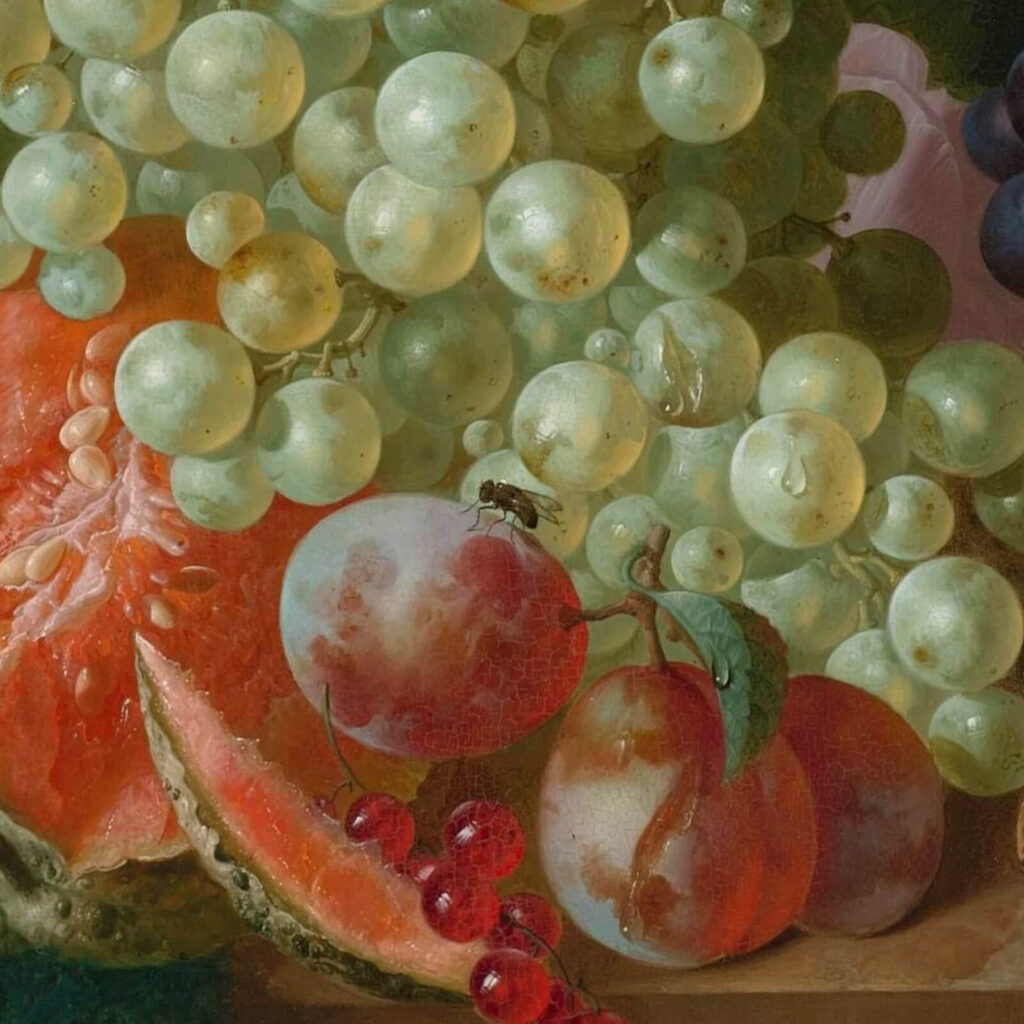
Jan van Os, Still Life with Carnations and Exotic Fruit, ca. 1770s, Virginia Museum of Fine Arts, Richmond, VA, USA. Detail.
Various other fruits in the bottom foreground add to the sensory experience. There are ripe blueberries to the left, followed by some yellow pears, and an open, ripe, and juicy melon. Perhaps this is a cantaloupe? Farther to the right are two walnuts, which are late-autumn and early-winter delicacies. To the far right is a pomegranate, a winter fruit, with split skin and bursting seeds.
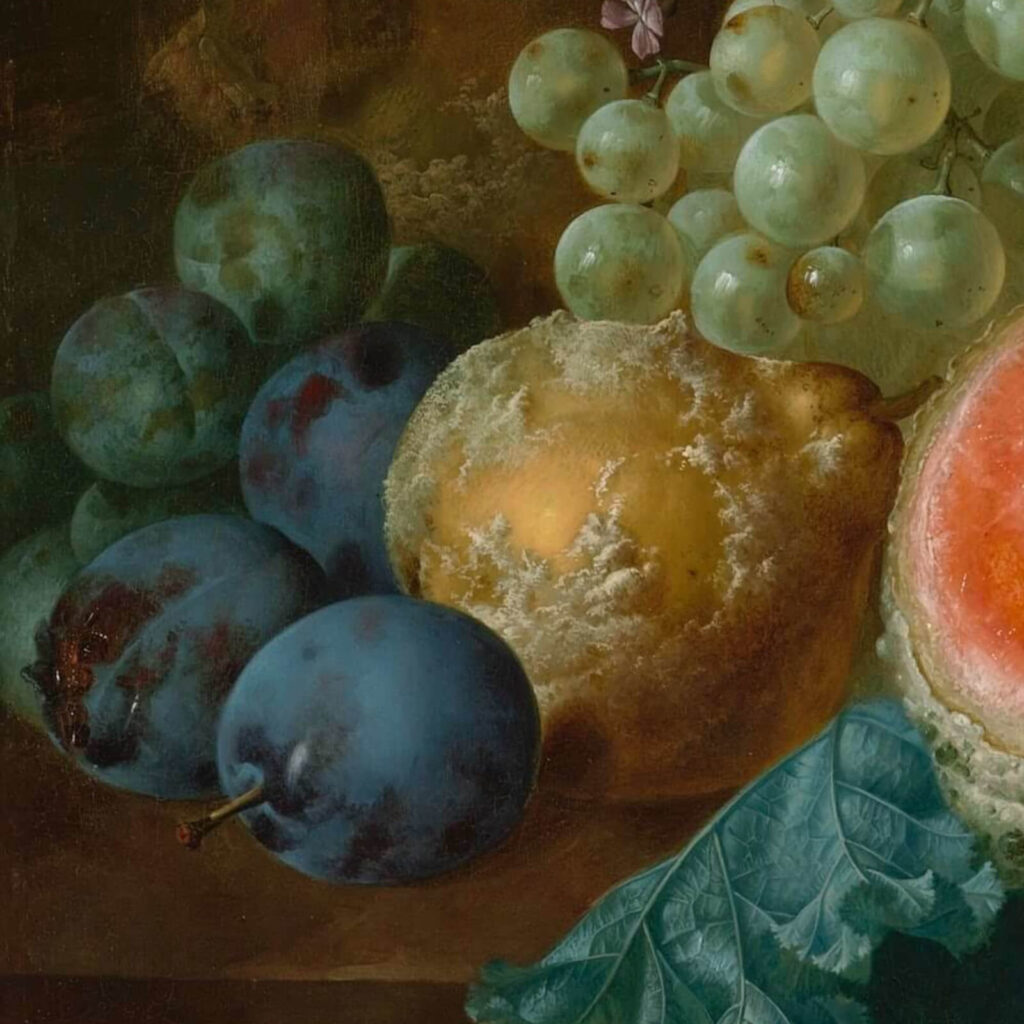
Jan van Os, Still Life with Carnations and Exotic Fruit, ca. 1770s, Virginia Museum of Fine Arts, Richmond, VA, USA. Detail.
The different colors, shapes, and textures create a visual buffet that spans time and seasons, tempting the viewer’s taste buds. However, most of the displayed fruits are from the summer. Who does not enjoy a cool, crisp piece of fruit on a hot, sunny day? It is a refreshing and healthy treat.
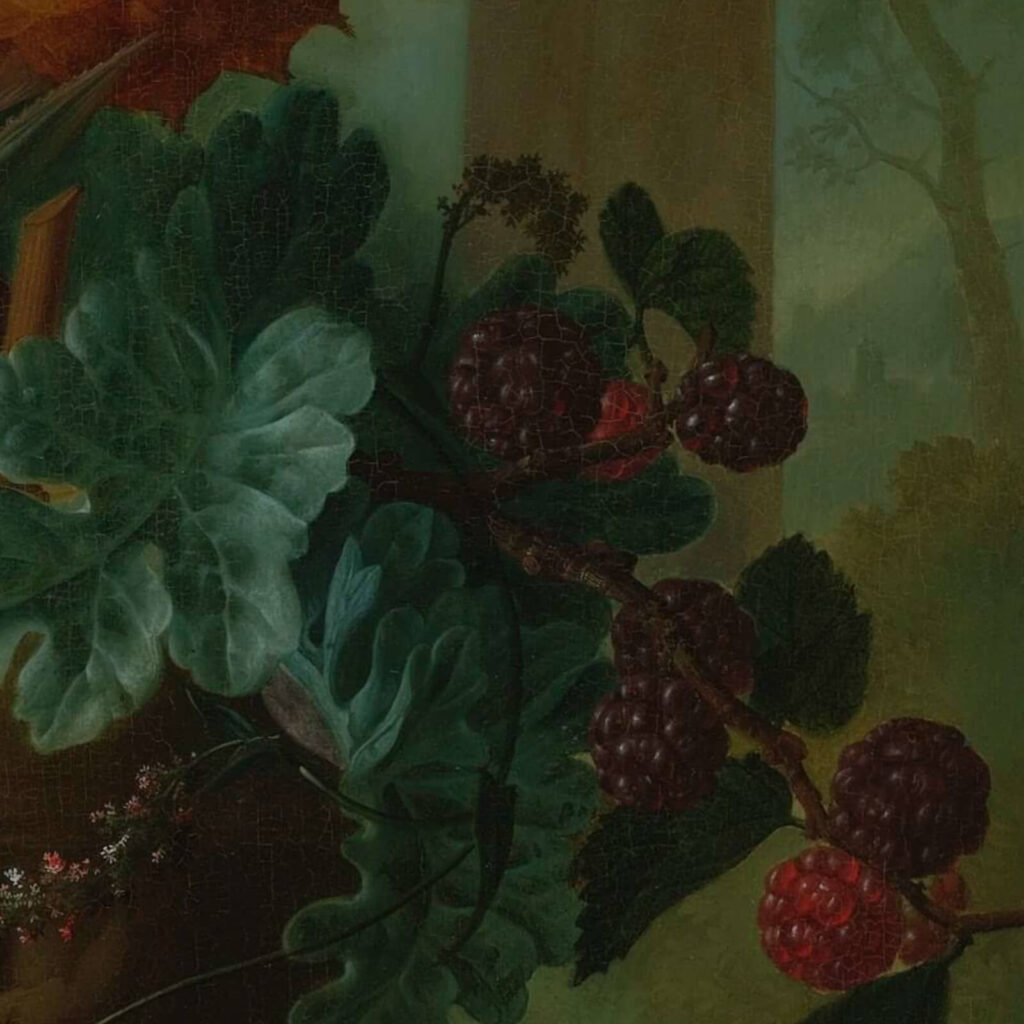
Jan van Os, Still Life with Carnations and Exotic Fruit, ca. 1770s, Virginia Museum of Fine Arts, Richmond, VA, USA. Detail.
Behind the relaxed elements of the scene is a strong hidden geometry. Van Os masterfully combines various fruits and flowers into a triangle, creating a sense of compositional stability. The apex is formed by the carnation and pineapple, the lower-left point by a blueberry, and the lower-right point by the pomegranate. The viewer’s eyes move around the scene while gathering and collecting details. It is a pathway to be read and reflected on.
Jan van Os has not merely painted fruits and flowers. He has created a celebration of nature through his artful arrangement of exquisite flowers and exotic fruit. It is a celebration of summer. And perhaps, just perhaps, it is a reflection on lost summer love?
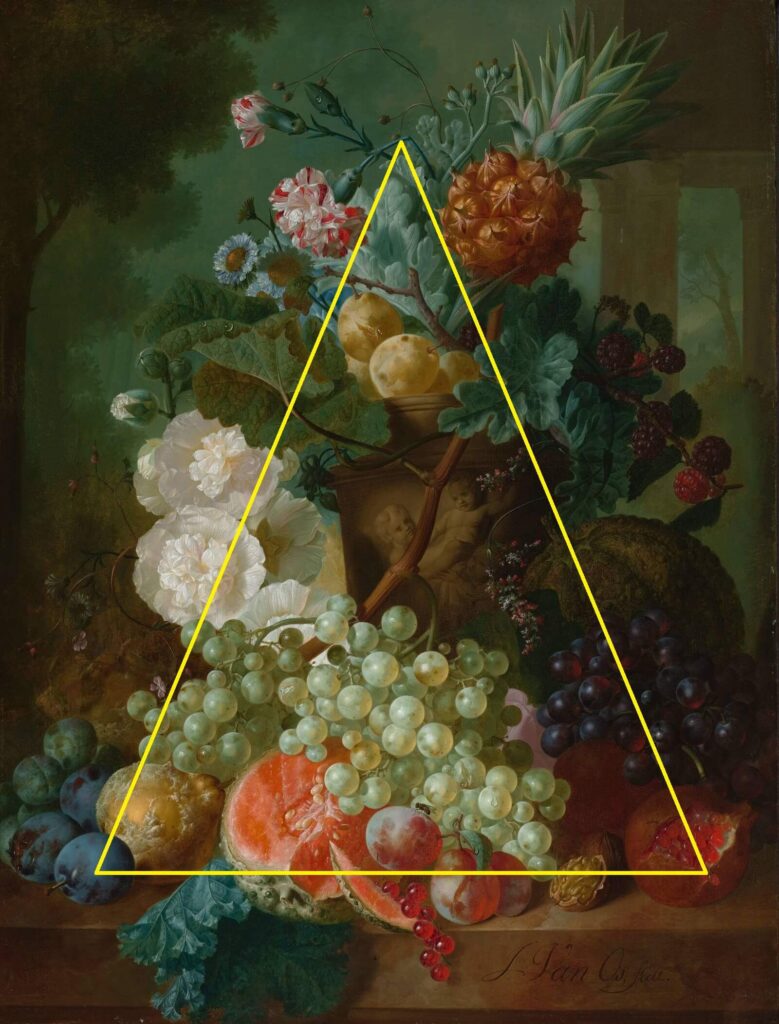
Triangle composition overlay of Jan van Os, Still Life with Carnations and Exotic Fruit, ca. 1770s, Virginia Museum of Fine Arts, Richmond, VA, USA.
P.S. If you enjoyed the exploration of this magnificent painting, be sure to check out our Flowers in Art and Food & Drinks postcard sets, filled with spectacular still lifes from various periods of art history!
Fruit and Flowers in a Terracotta Vase, National Gallery Online Collection. Retrieved June 11, 2026.
Jan van Os, National Gallery. Retrieved June 11, 2026.
Still Life with Carnations and Exotic Fruit, Virginia Museum of Fine Arts Online Collection. Retrieved June 11, 2026.
DailyArt Magazine needs your support. Every contribution, however big or small, is very valuable for our future. Thanks to it, we will be able to sustain and grow the Magazine. Thank you for your help!

James W. Singer is an art historian and fine art photographer. He earned a Bachelor of Arts in Art History from the University of Florida. He later moved to Paris, France. He currently writes “Masterpiece” articles for DailyArt Magazine.

Coffee-fueled writer, artist, and daydreamer.
Judith and Holofernes is a Caravaggio masterpiece that captures Biblical murder and drama. Rarely has death been captured so intensely and violently...
James W Singer 13 September 2026
Explore an astonishing 1915 nude self portrait by American modernist painter Florine Stettheimer.
Candy Bedworth 21 September 2026
Winslow Homer (1836–1910) was one of the leading American Realist painters. His painting The Veteran in a New Field is a masterpiece of late...
James W Singer 30 August 2026
At first glance, A Goldsmith in His Shop (1449) appears to depict an ordinary visit to a jeweller. Yet Petrus Christus transformed an ordinary...
Shivani Gupta 23 August 2026