

Discovering the Netherlands with James McNeill Whistler
American artist James Abbott McNeill Whistler trained in Paris, lived in London, and fled to Venice after his infamous libel trial. He is much less...
Catriona Miller 16 October 2026
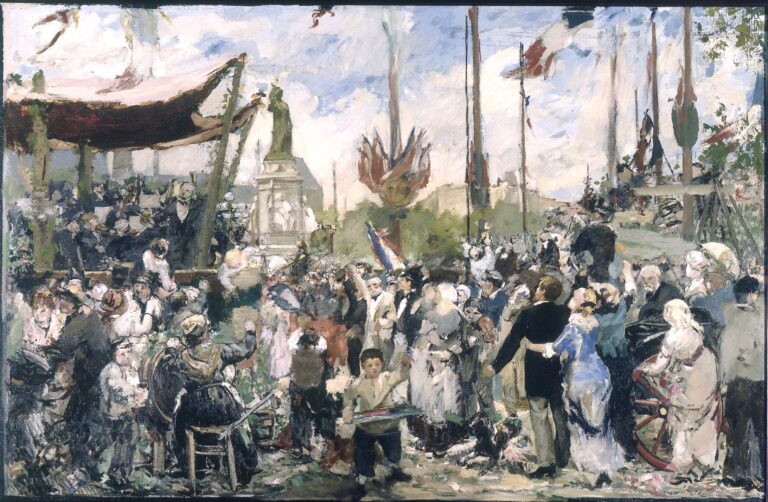
Alfred-Philippe Roll, Bastille Day, 1880, Inauguration of the Monument to the Republic, 1882, Petit Palais, Paris, France.
Fête nationale or 14 Juillet are the official names of Bastille Day in France. This national French holiday commemorates the beginning of the French Revolution of 1789. Let’s see how French artists have celebrated it in their paintings.
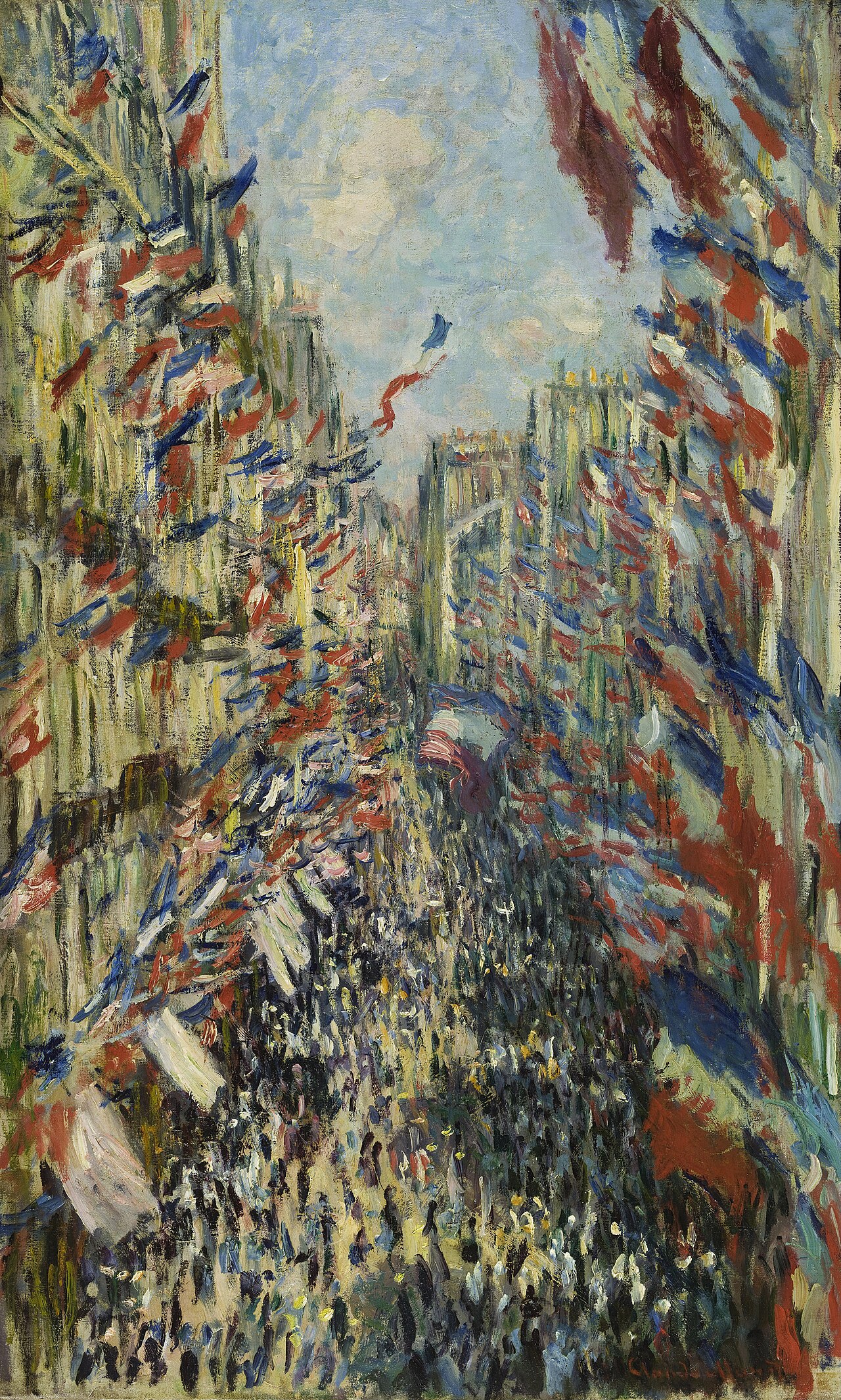
This masterpiece is often shared during Bastille Day, and many people think that it documents a July 14 celebration, but actually, July 14 was proclaimed as the French National Day in 1880, two years after this work had been painted. Hence, it documents a different occasion. A festival which occurred on June 30, 1878, during the 3rd Universal Exhibition in Paris.
Celebrating “peace and work”, the event was meant to demonstrate France’s recovery from its defeat in the Franco-Prussian War of 1870. Claude Monet‘s impressionistic brush perfectly renders the vibrancy of the moment, capturing the movement of the flags and the people. One can almost hear the whirring sounds.
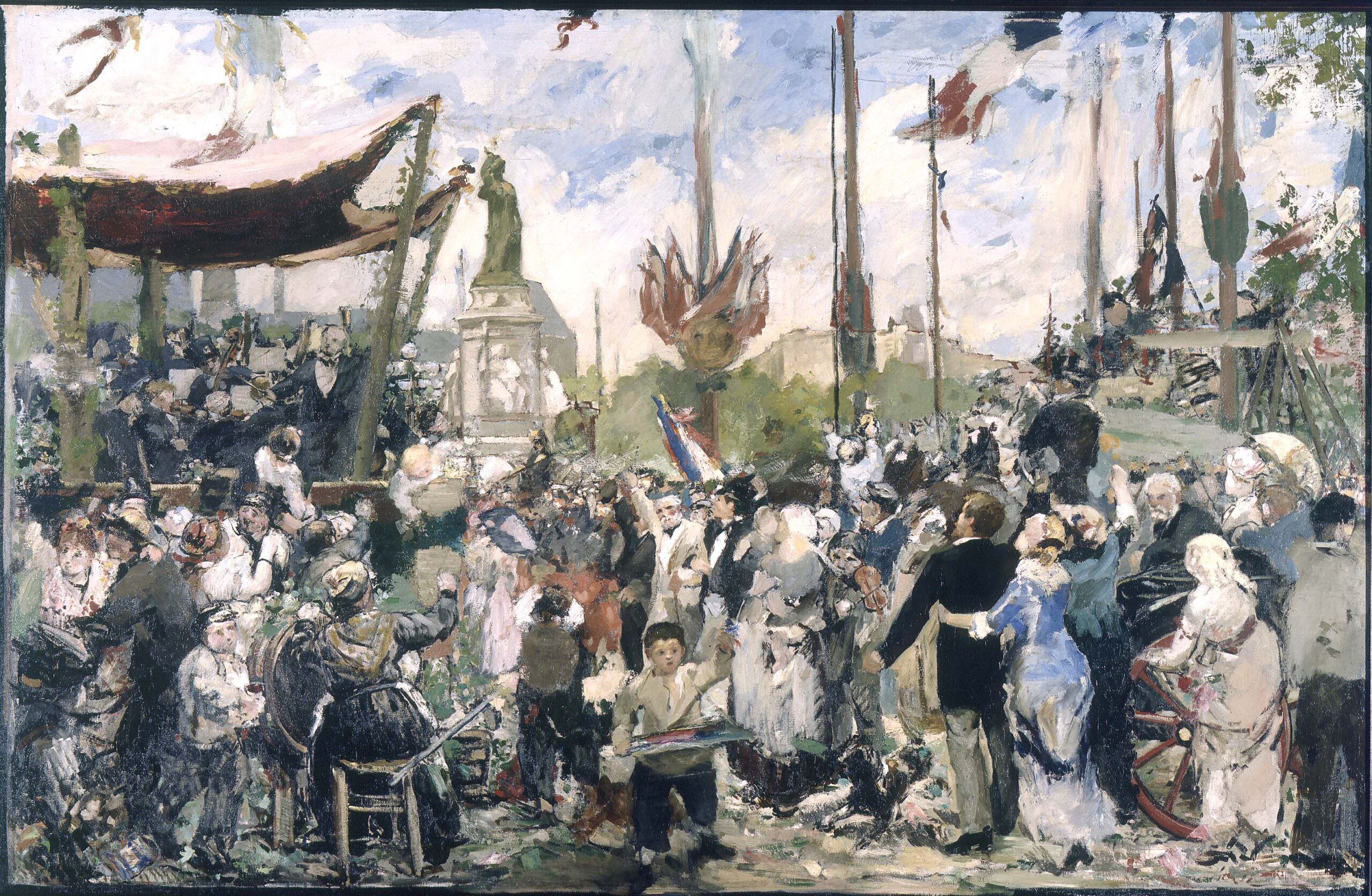
The date of July 14 also marked another important event, the Fête de la Fédération, which took place a year after the fall of the Bastille prison. It was created to show the unity of the French nation and mark the constitutional monarchy in France. In order to ingrain the newly established holiday, the Government commissioned various artists to create new national symbols.
One of them was a sculpture of Marianne, a female figure personifying the values for which France stood: liberty, fraternity, reason, and equality. Her sculpture, entitled the Statue of the Republic, was created by Léopold Morice in 1880 and erected on the Place de la République the same year (although it was not the final version but a plaster model, which you can see in the painting).
The Government wanted to document this historic moment, hence they commissioned a canvas from Alfred-Philippe Roll. He did an impressive job, painting a huge panorama (63 m²) that captured working-class joy. He completed the work for the Salon of 1882, subsequently donating it to the City of Paris in 1884.
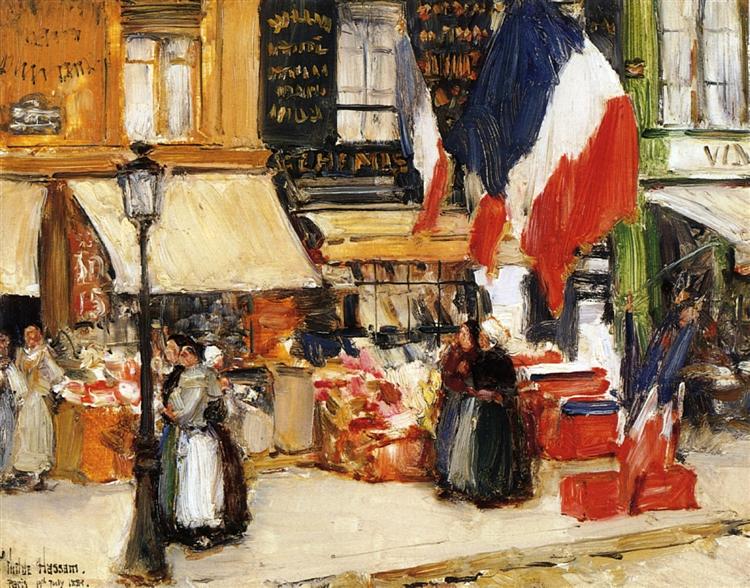
Frederick Childe Hassam was American, but he spent a lot of time touring Europe. He and his wife eventually moved to Paris for a couple of years. She ran the household, and he found an occupation in illustration. They rented a studio flat near Place Pigalle, which back then was the heart of the art boheme. Hassam’s Parisian works were mostly street scenes in browns, which he often sent back to Boston for sale. In this work, we can see how these omnipresent browns make the patriotic tricolor stand out even more.
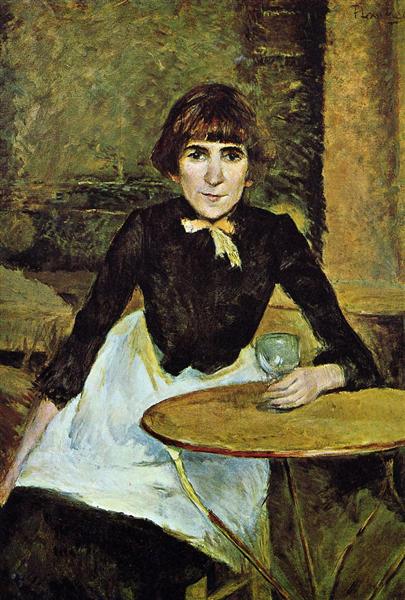
Bastille has its own square, and many bars and bakeries are named after the famous prison. At the time of Henri de Toulouse-Lautrec, there was a famous bar, La Bastille, which inspired the famous Parisian chansonnier Aristide Bruant to write a song. It told a story of a waitress (femme de brasserie) with large brown eyes, who served drinks there every evening. Lautrec cast his friend Jeanne Wenz in the role of the waitress and depicted the loneliness and rather tragic fate of the song’s heroine.
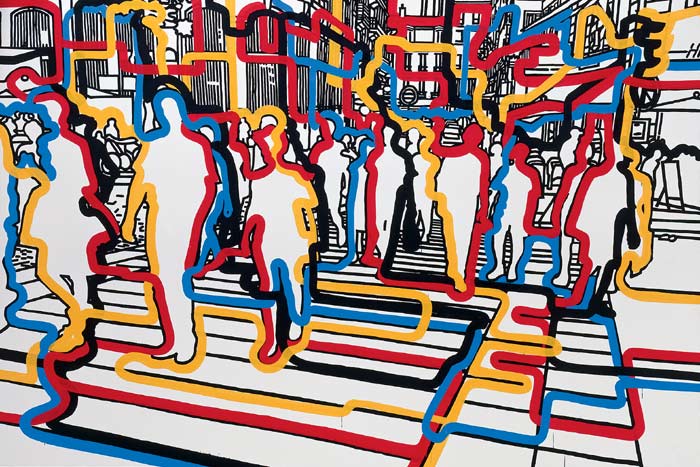
Just a short note on why Bastille has become such an iconic place and name. Built in the 14th century, the Bastille had been a fortress that had witnessed the Hundred Years’ War, the French wars of religion, the Fronde (a series of civil wars), and ultimately the French Revolution. It had always represented royal authority and power, and at a time of growing social unrest during the 18th century, it naturally came to symbolize the abuse of power by the monarchy. Hence, on July 14, 1789, the partisans stormed the prison (which at the time contained only seven inmates). Once the prison had fallen into the hands of the revolutionaries, the French Revolution had begun!
DailyArt Magazine needs your support. Every contribution, however big or small, is very valuable for our future. Thanks to it, we will be able to sustain and grow the Magazine. Thank you for your help!

Magda, art historian and Italianist, she writes about art because she cannot make it herself. She loves committed and political artists like Ai Weiwei or the Futurists; like Joseph Beuys she believes that art can change us and we can change the world.
American artist James Abbott McNeill Whistler trained in Paris, lived in London, and fled to Venice after his infamous libel trial. He is much less...
Catriona Miller 16 October 2026
The gavel falls, and the Sotheby’s auction room in New York explodes into applause. Gustav Klimt’s Portrait of Elisabeth Lederer has just shaken...
Javier Abel Miguel 11 June 2026
Three figures hover in the air, their bodies angled downward as they descend upon a limp man below. His arms stretch outward, his body slack, as if...
Frank Schildiner 28 May 2026
Every Old Master canvas speaks in two registers at once: one for the eye, one for those who know how to read the flowers. Artists used flower...
Errika Gerakiti 18 May 2026