



Masterpiece Story: Judith and Holofernes by Caravaggio
Judith and Holofernes is a Caravaggio masterpiece that captures Biblical murder and drama. Rarely has death been captured so intensely and violently...
James W Singer 13 September 2026
8 July 2026 min Read
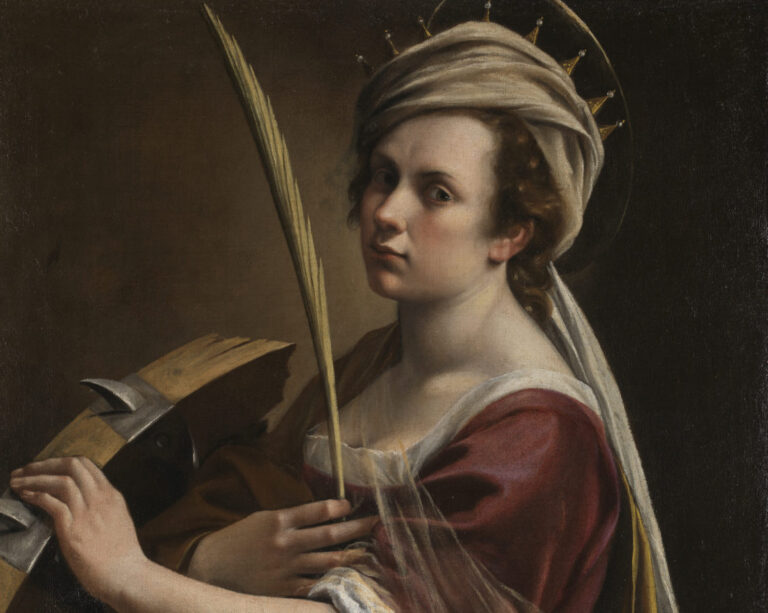
Artemisia Gentileschi, Self-Portrait as Saint Catherine of Alexandria, 1615–1617, National Gallery, London, UK. Detail.
Artemisia Gentileschi (1593–c. 1656) was “one of the best Italian Baroque painters.” Despite this, you won’t find any of her works in the National Gallery of Art in Washington, DC, nor in the Louvre in Paris. Like so many women in history, Gentileschi has long been marginalized.
But not anymore. In 2018, the National Gallery in London purchased her Self Portrait as Saint Catherine of Alexandria (1615-1617) for £3.6 million (around $4.5 million). This might sound like a lot, but it was certainly worth it, with The Guardian art critic Jonathan Jones describing it as “one of the most important purchases the National Gallery has ever made.”1 It’s not hard to see why: in a collection of over 2300 works, there were only 20 female artists featured before the purchase of Gentileschi’s striking self-portrait, which was the first work by a female artist to be acquired by the National Gallery since 1991.
Gentileschi’s importance in the history of art should not be reduced to her gender, however; she was immeasurably talented, with Hannah Rothschild, the current Chair of the National Gallery’s Board of Trustees, describing her as “a pioneer, a master storyteller, and one of the most progressive and expressive painters of the period.”2 Her career spanned more than 40 years and she became the first female member of Florence’s Academy of Fine Arts.
The intensity of her works is second only to those of Caravaggio, whom she may have met as a child. Caravaggio’s influence on her can be seen in, for instance, Judith Slaying Holofernes (1611–1612, Uffizi Gallery, Florence). Our masterpiece is, however, a recently discovered Self Portrait as Saint Catherine of Alexandria, as it provides a window not only into the art scene in which she lived, but also her own life and struggles.
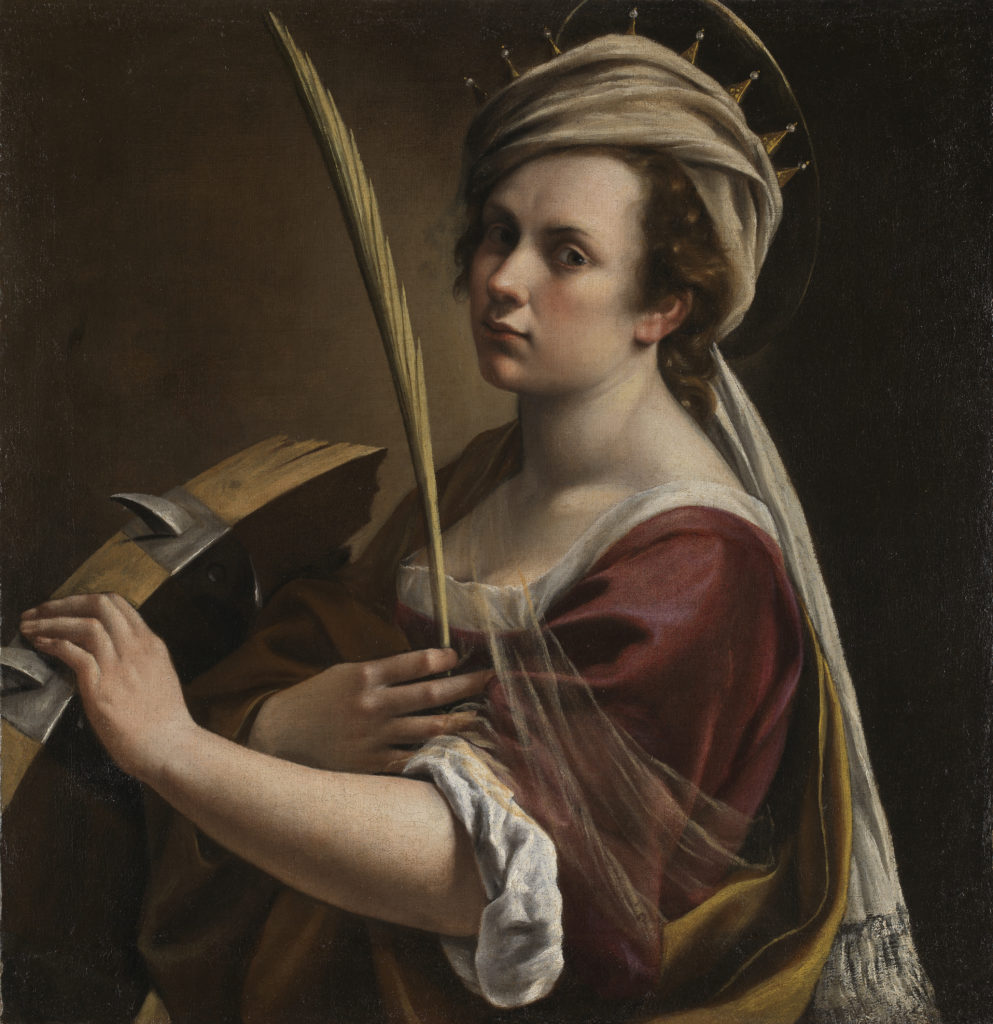
The painting underwent extensive restoration; restored to its former glory. The work went on tour in 2019 around the UK as part of Artemisia Visits. The first stop on this tour was Glasgow Women’s Library, the UK’s only accredited museum dedicated to women’s history. Then, the painting went on a tour through unusual and unexpected locations throughout the UK, including a school in Newcastle, a GP’s surgery in Pocklington, and a prison in Surrey.
I had a chance to visit the Glasgow Women’s Library and to see the portrait, which was truly captivating, especially since it was the only painting on display there, allowing the viewer to dedicate all of their attention to it. As its name indicates, Self Portrait as Saint Catherine of Alexandria is essentially two works in one. It displays on the one hand Saint Catherine, whom the Roman Emperor Maxentius in the early 4th century sentenced to death on a spiked breaking wheel which, according to legend, shattered at her touch. In the painting, we can see the broken wheel, which incidentally is where the name for the Catherine Wheel firework comes from.
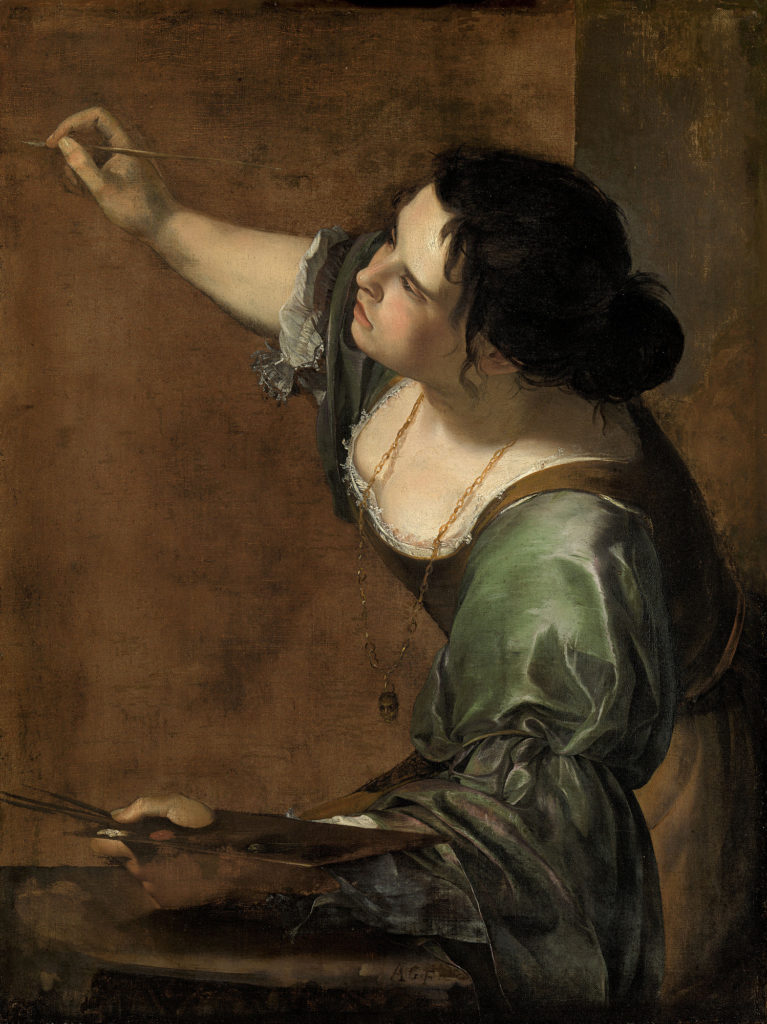
Despite its Biblical theme (indicated by the halo over Catherine’s head), this is also a self-portrait. It is Gentileschi looking out at us with those confident, searching eyes, and the palm frond in her hand serves not only as the symbol for Catherine’s martyrdom but also for the paintbrush of Gentileschi the artist. We can draw obvious parallels between this and Gentileschi’s later work, Self-Portrait as the Allegory of Painting (1638–1639, Royal Collection, Windsor, UK), which depicts Gentileschi in the process of painting.
In this light, the broken wheel in Catherine’s hand is also symbolic of the suffering Gentileschi herself endured. After being raped at the age of 17 by the artist Agostino Tassi, who worked in her father’s studio, she was subsequently tortured during Tassi’s trial, which was ostensibly done to ensure that she told the truth. Despite all of this, her powerful stare in this self-portrait attests to her unbroken spirit.
Her right hand is pressed to her chest, emphasizing her femininity, and the painting is striking for its beauty. The crown on her head, meanwhile, turns her almost into a Christ-figure. Today, at a time when more and more women are speaking out about the injustices they face on a daily basis, there is surely no better symbol for the strength of women than Artemisia Gentileschi’s Self Portrait as Saint Catherine of Alexandria.
Jonathan Jones, “National Gallery buys Artemisia Gentileschi masterpiece for £3.6m,” Guardian 6 Jul 2018. Accessed: 16 Oct 2024.
Eileen Kinsella, London’s National Gallery (Finally) Buys a Painting by Artemisia Gentileschi, Pioneering Female Artist of the Italian Renaissance, Artnet, 6 Jul 2018. Accessed: 16 Oct 2024.
DailyArt Magazine needs your support. Every contribution, however big or small, is very valuable for our future. Thanks to it, we will be able to sustain and grow the Magazine. Thank you for your help!

Chris Dobson was born in Preston, UK. He likes to play chess, visit museums and model for art classes in Amsterdam. He can be followed on Instagram @litterarum_magister.

Judith and Holofernes is a Caravaggio masterpiece that captures Biblical murder and drama. Rarely has death been captured so intensely and violently...
James W Singer 13 September 2026
Explore an astonishing 1915 nude self portrait by American modernist painter Florine Stettheimer.
Candy Bedworth 21 September 2026
Winslow Homer (1836–1910) was one of the leading American Realist painters. His painting The Veteran in a New Field is a masterpiece of late...
James W Singer 30 August 2026
At first glance, A Goldsmith in His Shop (1449) appears to depict an ordinary visit to a jeweller. Yet Petrus Christus transformed an ordinary...
Shivani Gupta 23 August 2026