

Clementine Hunter: Painting Black Life from Memory
Clementine Hunter taught herself to paint in her fifities and spent the rest of her life chronicling the Black Southern experience, not with slogans...
Wen Gu 23 February 2026
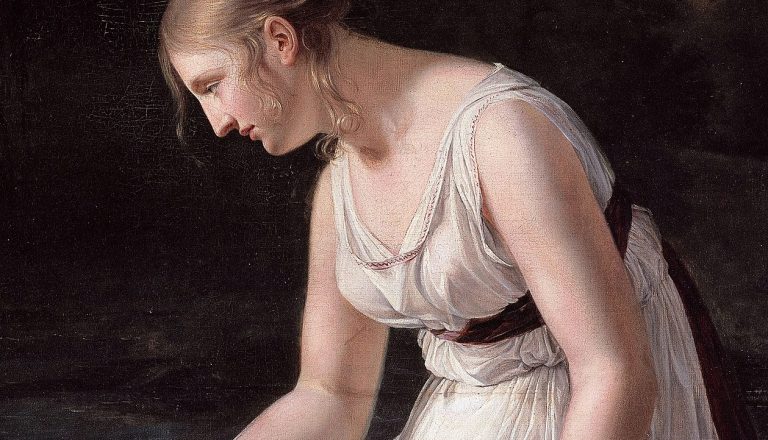
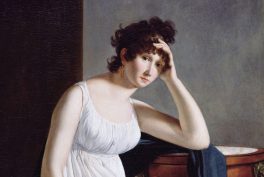
Constance Marie Charpentier, Melancholy, 1801, Musée de Picardie, Amiens, France. Detail.
Constance Marie Charpentier (1767–1849) was a French painter celebrated for her refined portraits and genre scenes, often infused with sensitivity and emotional depth. A student of prominent artists of her time, she gained recognition at the Paris Salon for her skillful use of light and delicate rendering of character. Today, her work offers a window into the artistic tastes and cultural ideals of late 18th- and early 19th-century France.

Constance Marie Charpentier, also known as Constance Marie Blondelu (she changed her name upon marriage), was a trained painter. The details are unclear, but she is typically believed to have studied with the acclaimed French painter Jacques-Louis David, but may also have been a pupil of François Gérard, Pierre Bouillon, Louis Lafitte, and either Johann Georg Wille or his son, Pierre-Alexandre Wille.
Regarding Jacques-Louis David—it is believed that some of Charpentier’s works were incorrectly attributed to him. But it is a very typical situation for this epoch. For example, the well-known painting Young Woman Drawing (1801) was incorrectly attributed first to David, then from the 1950s to Charpentier, and is now believed to be the work of Marie-Denise Villers. Whoever painted this work of art, it is still one of the most popular and most enthralling paintings in the Metropolitan Museum of Art. And it’s proof that great pieces created by female artists were incorrectly attributed to their famous teachers.
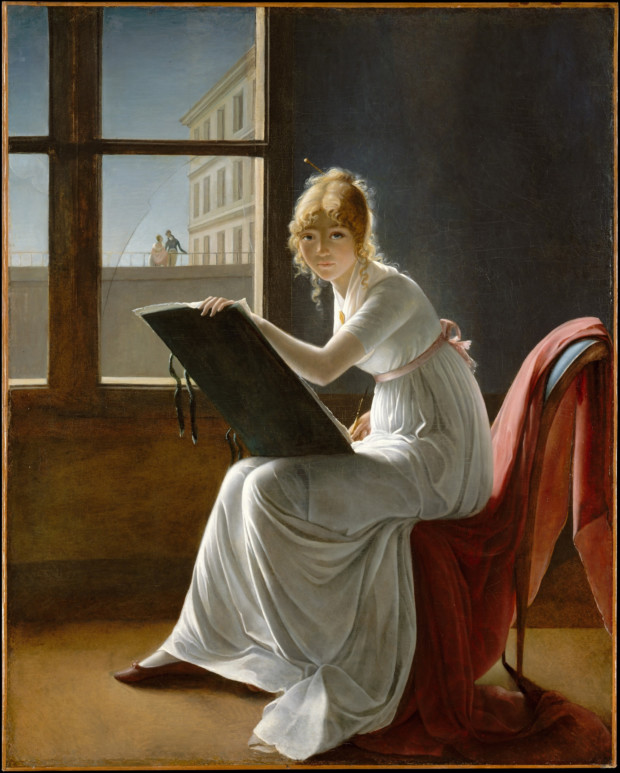
P.S. You can admire this beautiful work on the cover of DailyArt’s Women Artists Notebook!
Based on surviving, positively identified works by Constance Marie Charpentier, she is considered one of the finest portrait painters of her era. But she was also specialized in genre scenes.
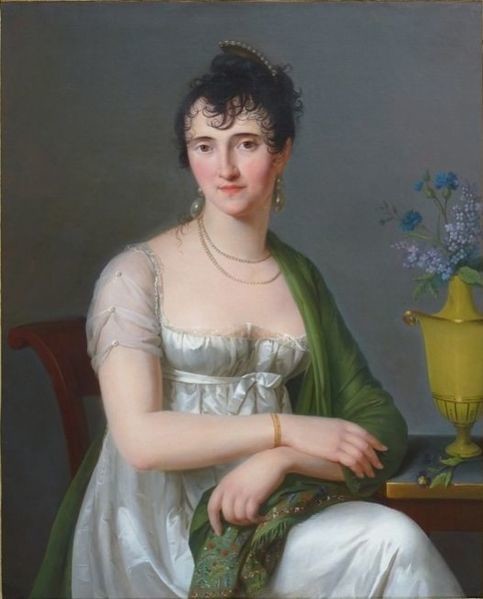
In 1798, her pendant paintings, Widow of a Day and Widow of a Year, earned her a Prix d’encouragement, a commission for a painting to be purchased by the state for 1,500 francs. From 1795 to 1819, she exhibited approximately 30 paintings at various Salons, winning a gold medal in 1814 at the Paris Salon and a silver medal in 1821 at the Salon in Douai. She was truly a star.
It’s very hard to find her works on the internet. Only Melancholy pops up with ease—Charpentier’s only known history painting, fulfilled this commission, and its appearance at the 1801 Salon prompted an admiring poet to declare: “this painting lets us discover / Charm in melancholy.”
Although she ceased to exhibit after 1821, she was still teaching 10 years later when a dictionary of artists announced that she “receives, three times a week, young women who wish to follow her advice on drawing and painting” at her residence on the rue du Pot de fer Saint-Sulpice (part of the modern-day rue Bonaparte, in the sixth arrondissement of Paris).
Get your daily dose of art
Click and follow us on Google News to stay updated all the time

DailyArt Magazine needs your support. Every contribution, however big or small, is very valuable for our future. Thanks to it, we will be able to sustain and grow the Magazine. Thank you for your help!

Art Historian, founder and CEO of DailyArtMagazine.com and DailyArt mobile app. But to be honest, her greatest accomplishment is being the owner of Pimpek the Cat.

Clementine Hunter taught herself to paint in her fifities and spent the rest of her life chronicling the Black Southern experience, not with slogans...
Wen Gu 23 February 2026
Élisabeth Vigée Le Brun was one of the most accomplished portraitists of her generation. At the peak of her fame, the doors of the highest European...
Edoardo Cesarino 2 March 2026
Anna Ancher, a local born and bred, became one of the leading artists of the Danish town of Skagen. She knew and painted her family, the inhabitants,...
Catriona Miller 29 January 2026
With the publication of Tar Beach in 1991, Faith Ringgold launched her career as a picture book author and illustrator. Her interest in picture books...
Guest Author 17 December 2025