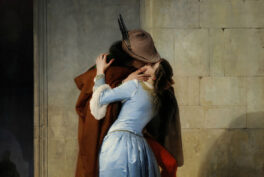
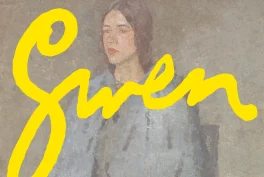
The book consists of some 30 short essays on 27 pairs of lovers and three love triangles, with two or three paintings to go along with each story. Many of the relationships we know of: Rembrandt and Hendrickje Stoffels, Georgia O’Keeffe and Alfred Stieglitz, and Frida Kahlo and Diego Rivera, but many were unknown to this reader.
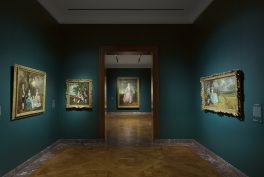
Mr. Trend got his inspiration from a painting in the National Gallery in London:
Here are a few examples of the stories he shared with us:
Jan & Margriet Steen—A Wonderful Flirt
Jan Steen is well known for his raucous scenes of taverns and chaotic households. He included himself in many of the scenes and showcased his wife Margriet as a flirtatious figure in even more of them, including Girl Offering Oysters.
Here she is serving up a helping of the classic aphrodisiac, oysters, while flashing us one of the most flirtatious smiles in all of Western art. She has the wine jug and a glass at the table, ready to help move things along, if needed. Another couple seen through the door, warmed by a fireplace, are perhaps further along in their seduction.
Who hasn’t wanted to be in the midst of a flirt like this one?
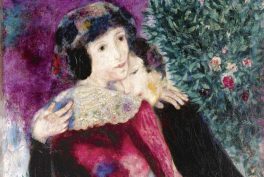
Marc & Bella Chagall—A Flight of Fancy
Marc Chagall shows us a glimpse of that impossible, fanciful, dreamy love that escapes reality but that we secretly desire.
Bella holds a bouquet of flowers and gently levitates off the floor. Chagall is completely enraptured with her. His love has allowed him to escape reality—his arms are missing, and his long neck is impossibly curled around to kiss Bella. Her eyes are wide open in startled surprise, but his are closed in a moment of ecstasy. He has been transported into a different realm by his love for Bella.
Mr. Trend shows us the many ways in which the painting is not aiming to depict reality, just as Chagall’s kiss is disconnected from reality: the walls and floors seem to merge inexplicably; edges of tables and rugs do not align correctly; the perspective of the items on the table are misinformed. The whole scene is unreal, framing the fantasy love that Marc Chagall has for Bella.
Who among us has not pined for that ethereal, ineffable sort of love?
Niki de Saint Phalle—Resentment in an Imperfect Love
Niki de Saint Phalle’s life and her intersections with love were complicated and included a teenage elopement to escape the sexual abuse of her father, violence and infidelity in that marriage, mental illness, and more. It is not surprising that her depictions of love show a bit of ambivalence, to say the least.
The artist shows her lover’s body as a paint-splattered shirt affixed to a blackboard, with his head replaced by a dartboard target. Have we not all had those moments in love when we have just about had it with the other person? I’m glad that Niki found a way to manage her feelings, and to clarify my own, without resorting to weaponry!
Valentine’s Day, 2026
Mr. Trend’s book doesn’t have to be read from beginning to end. Instead, it can be opened to a random page, and the reader will find a story that is recognizable and say, “Ah yes, I have felt that way too.” The reader does not have to be an art aficionado to appreciate the book—one only need to have a modicum of experience in relationships and in love. Our own perspectives are enhanced by our new understanding of the backstories of the artists’ lives and how they express their views on various forms of love through their art.
It is unfortunate that the book was not published in February. Its pink cover adorned with a picture of Frida Kahlo in her finery with Diego Rivera on her mind makes it a perfect Valentine’s Day gift for someone who is enamored of love and art—which includes all of us. Fortunately, there will be Valentine’s Day again next year!
What Art Can Tell Us About Love by Nick Trend was published in March 2025 by Lawrence King Publishing. You can order a copy through the publisher’s website.