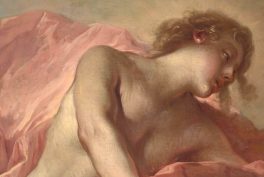
Masterpiece Story: The Setting of the Sun by François Boucher
With sweet putti, handsome gods, beautiful nymphs, vibrant colors, and elaborate compositions, The Setting of the Sun is a testimony to François...
James W Singer 8 February 2026
10 November 2025 min Read

Phoebe Anna Traquair, The Progress of a Soul: The Victory, 1895–1902, National Galleries of Scotland, Edinburgh, UK. Museum’s website. Detail.
Luminous and larger than life, The Progress of a Soul by Phoebe Anna Traquair elevated embroidery into the modern era. It also helped put the Scottish Arts and Crafts Movement on the map. Glimmering golden threads, kaleidoscopic colors, and meticulous handiwork animate the human experience in this turn-of-the-century polyptych.
Phoebe Anna Traquair (1852–1936) was an Irish-born superstar of the Scottish Arts and Crafts movement. She studied art in her native Dublin and relocated to Edinburgh after marrying Ramsay Heatley Traquair, a Scottish paleontologist and professor. There, she raised three children and supported her husband’s career by illustrating his scientific papers.

Phoebe Anna Traquair, Artist (Self-Portrait), 1911, National Galleries of Scotland, Edinburgh, UK.
Despite the heavy demands of domestic life, Traquair always made time and space for her own artistic practice. She won prestigious commissions and mastered a remarkable variety of materials, from illuminated manuscripts and enameled jewelry to textile art and mural painting. A proud proponent of the Celtic Revival and Arts and Crafts philosophy, she believed these historic crafts had deteriorated in the wake of the Industrial Revolution.
Traquair is especially celebrated for her exquisite embroidery. Naturally, her first forays were small decorative domestic pieces. Not one to confine herself to convention, however, Traquair eventually expanded the scope of her embroidery. Her monumental multi-panel narrative series, for which she creatively reimagined traditional hand-stitching techniques, gained international renown during her lifetime. These works—chief among them The Progress of a Soul—also helped establish embroidery as a fine art medium fit for the modern age.

Phoebe Anna Traquair, The Progress of a Soul, 1895–1902, National Galleries of Scotland, Edinburgh, UK. Museum’s website.
Phoebe Anna Traquair spent nearly a decade embroidering The Progress of a Soul (1895–1902), dedicating at least two years to each of the four panels. The resulting larger-than-life polyptych, widely considered to be the artist’s magnum opus, charts the spiritual journey of a human soul through life on Earth. Traquair conceived The Progress of a Soul to hang in the stairwell of her home, functioning as a practical draught screen and as a work of art, with each panel signed and dated as such.
Across the four panels, the human soul is allegorized by a young man. Traquair was inspired by the character of Denys L’Auxerrois in Imaginary Portraits, an 1887 collection of fictional sketches by Walter Pater, who popularized the phrase “art for art’s sake” in 19th-century Britain.

Phoebe Anna Traquair, The Progress of a Soul: The Stress, 1895–1902, National Galleries of Scotland, Edinburgh, UK. Museum’s website. Detail.
Pater’s story of Denys explores the religious awakening of a Dionysian character. Alongside its impressive narrative complexity, The Progress of a Soul exemplifies Traquair’s mastery and modernization of her craft. The innovative interplay of centuries-old stitches and traditional techniques heightens the panels’ sensory and emotional impact. Golden threads, incorporated throughout the luxurious silk-on-linen composition, catch natural light and create the illusion of three dimensions.

Phoebe Anna Traquair, The Progress of a Soul: The Entrance, 1895–1902, National Galleries of Scotland, Edinburgh, UK. Museum’s website.
We are first introduced to Denys in The Entrance, which Traquair completed in 1895. Confident and carefree, he is in perfect harmony with the new natural world around him. The rising sun illuminates his Apollonian figure and bright orange hair. He wears an animal skin, the layered stitches of which authentically mimic the material’s real-life texture.
Denys’s harp connects him to the Celtic bard tradition. The suggestion of music also alludes to the passage of time and hints at the thin line between harmony and discord. The lifelike rabbit in the foreground is borrowed from the 15th-century Unicorn Tapestries in the Musée de Cluny in Paris. Its inclusion highlights the innocent pleasures of Denys’s new beginning.

Phoebe Anna Traquair, The Progress of a Soul: The Stress, 1895–1902, National Galleries of Scotland, Edinburgh, UK. Museum’s website.
The Stress, which Traquair made between 1895 and 1897, casts cool shadows over Denys, who must inevitably begin to face the harsh realities of life. Tree branches bend and break, and the rabbit, now dead, hangs from the beak of a large bird. Hauntingly disembodied hands claw at Denys’s clothing. Each of these details is a symbol of innocence lost.
A scaly serpent stops Denys in his tracks as he clutches the harp to his bleeding chest. The wound is The Progress of a Soul‘s first Christian reference, alluding to the suffering of Jesus Christ on the cross, as well as the Biblical story of doubting Thomas. As in Pater’s telling of Denys’s journey, this marks the story’s shift from its secular start toward its spiritual endpoint.

Phoebe Anna Traquair, The Progress of a Soul: Despair, 1895–1902, National Galleries of Scotland, Edinburgh, UK. Museum’s website.
Hanging limply from gnarled branches, Denys has arrived at death’s door in Despair (1897–1899). The once idyllic landscape has grown congested and chaotic. The fruit has ripened and the leaves have deadened since The Stress, a solemn seasonal shift. Fangs bared, the serpent tightens its hold around Denys’s now pallid body. His beloved harp breaks as discord fully eclipses harmony.
The thick tangle of briar thorns at Denys’s feet is another allusion to Christ. It also references the Grimm fairy tale of Briar Rose, or Sleeping Beauty, who is awakened from the curse of eternal sleep with a loving kiss. These associations—simultaneously omens of death and promises of rebirth—foreshadow the final scene of The Progress of a Soul.

Phoebe Anna Traquair, The Progress of a Soul: The Victory, 1895–1902, National Galleries of Scotland, Edinburgh, UK. Museum’s website.
Embroidered at the turn of the century, The Victory (1899–1902) is the climactic finale of The Progress of a Soul. The most elaborate and colorful of the series, The Victory became especially famous during Phoebe Anna Traquair’s lifetime.
Denys, at last, emerges triumphant from the reptilian jaws of death and disillusionment. An angel with fiery red wings embraces and kisses him, welcoming his spirit into a heavenly afterlife. The contours of Denys’s figure are more naturalistic and intricately rendered than in previous panels. This not only illustrates the glorious rebirth of his long-suffering soul. It also charts the evolution of Traquair’s embroidery over the course of nearly a decade.
To add dimension and dynamism to the regrown leaves and swirling clouds, Traquair used contrasting colors and alternating stitch patterns. Toward the bottom, the rainbow is rendered with convincing translucence, hinting at the natural forms behind its dazzling glow.
The Progress of a Soul demonstrates that an embroidered work can be as multifaceted and awe-inspiring as a painting—or, thanks to the medium’s inherent tactility and utility, perhaps even more so. Today, all four panels are on permanent view in the National Galleries of Scotland in Edinburgh.
Get your daily dose of art
Click and follow us on Google News to stay updated all the time

DailyArt Magazine needs your support. Every contribution, however big or small, is very valuable for our future. Thanks to it, we will be able to sustain and grow the Magazine. Thank you for your help!

An art writer in the high desert of Utah who loves knitting, herbalism, her calico cat, and everything Victorian.

Leigh is a writer, reader, art lover, radio nerd and herbalist based in Nashville, TN.
With sweet putti, handsome gods, beautiful nymphs, vibrant colors, and elaborate compositions, The Setting of the Sun is a testimony to François...
James W Singer 8 February 2026
Among the Sierra Nevada, California, by Albert Bierstadt, is a majestic mountainous landscape filled with wild beauty and blissful idealism. Its...
James W Singer 25 January 2026
The Cardsharps is an early masterpiece of Baroque art by Caravaggio that explores the revolutionary theme of crooked card playing. Let’s delve...
James W Singer 11 January 2026
As Europe burned during WWII, Wassily Kandinsky, who had fled Nazi Germany in 1933, lived as a recluse in his Neuilly-sur-Seine apartment. In that...
Javier Abel Miguel 8 January 2026