

Fanny Eaton—Pre-Raphaelite Muse from Jamaica
Fanny Eaton was a regular model for the Pre-Raphaelites during the 1860s and features in a number of famous works. Yet for most of the last century,...
Catriona Miller 19 February 2026
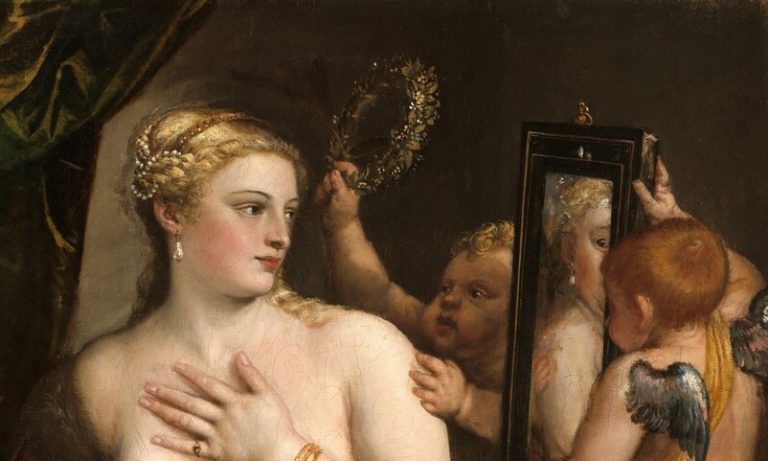
Titian, Venus with a Mirror, 1555, National Gallery, London, UK. Detail.
Throughout the centuries, women’s bodies have consistently been staged for display rather than simply allowed to exist. John Berger’s observation, “men act, and women appear,” reveals who is perceived as a subject and who as an object1. Berger’s distinction between nakedness and nudity is crucial to understanding the difference between: nakedness represents a natural state—a body existing on its own. In contrast, nudity is to be seen through someone else’s eyes, stripped of autonomy and turned into a mere spectacle.
This distinction is illustrated in the biblical story of Adam and Eve as well: nakedness is initially a neutral, natural state, yet once the gaze of God and of each other is introduced, self-consciousness and shame eventually emerge. Likewise, in art, nakedness often turns into nudity when framed for spectatorship. An example is the secret portrait of Nell Gwynne commissioned by Charles II. Her body is posed to serve the King’s authority.
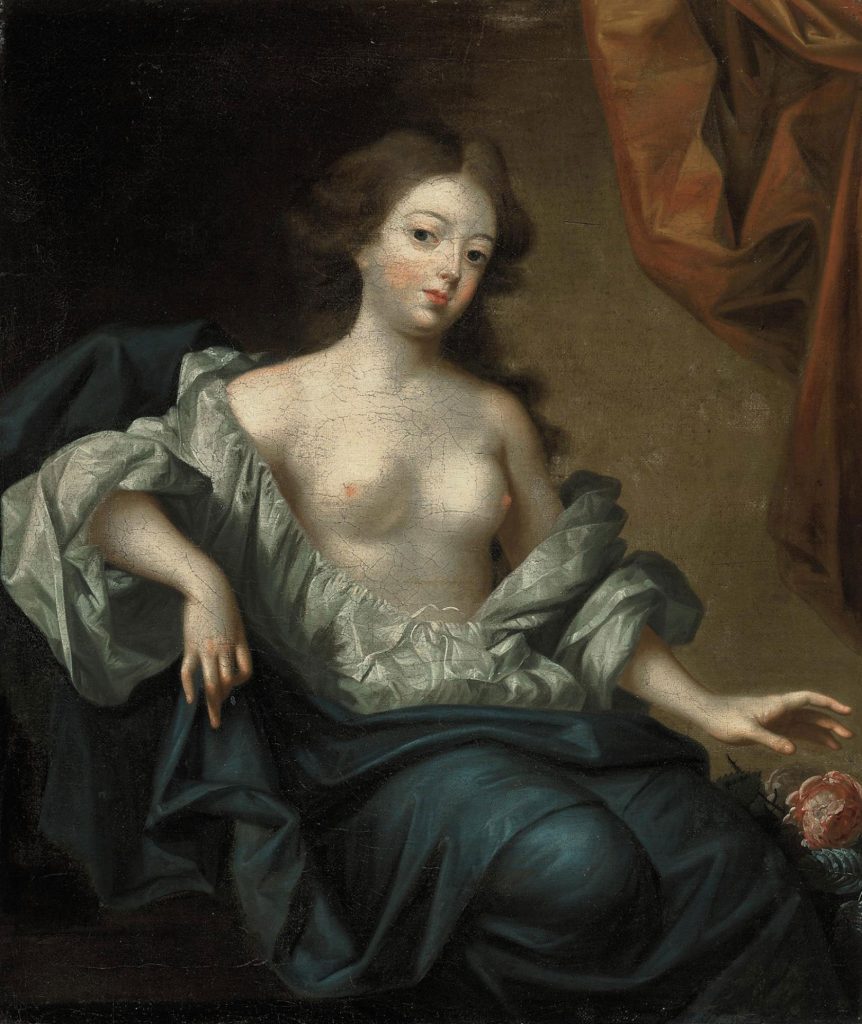
Simon Verelst, Portrait of Nell Gwyn, 1644–1721, private collection. Christie’s.
This framework surfaces again in Titian’s Venus of Urbino, where she greets us with a direct, inviting gaze. Venus’s posture depicts her as intimate and accessible, framed to satisfy the spectator’s gaze with her softness, without intimidation.
The positioning of her limbs, softly resting on her body, and the relaxed yet provocative tilt of her torso transform her body into a visual performance, in which the pleasure and desire of the spectator dominate over any indication of Venus’s selfhood. Her sexuality is staged and her body curated to function as an object to be possessed rather than as a self-expressive subject.
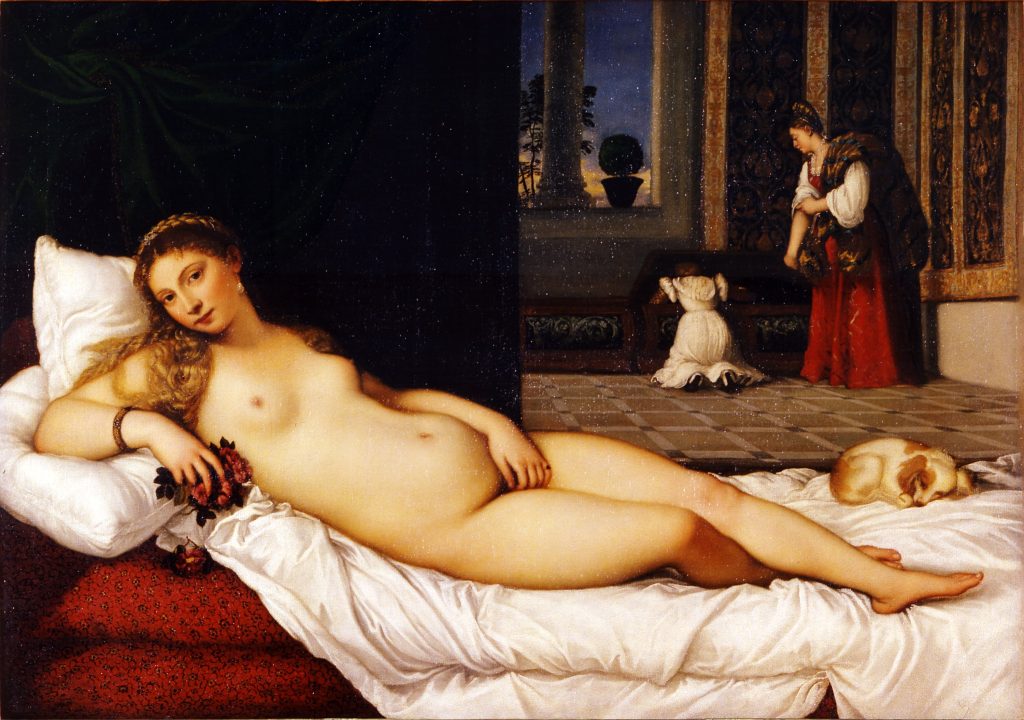
Titian, Venus of Urbino, 1538, Gallerie degli Uffizi, Florence, Italy.
The logic of nudity and self-surveillance reaches its height in Bronzino’s Allegory of Venus and Cupid, a painting that epitomizes how women’s sexuality is staged for spectatorship. At first glance, the work depicts an intimate moment between the goddess and Cupid, whereas the arrangement of Venus’s body reveals another side of the canvas. Her body is posed theatratically for an imagined viewer, cut off from any sense of agency in the positioning of her limbs. She does not engage with Cupid; instead, she looks out of the frame, as if trapped within it.
Minimizing the depiction of female passion hands the active erotic power to the viewer and renders her a passive object of possession. This posits the painting as being more about ownership and control than divine myth. Additionally, the canvas, which was gifted by the Grand Duke of Florence to the King of France, demonstrates how Venus, and by extension women, could be exchanged like commodities between powerful men.
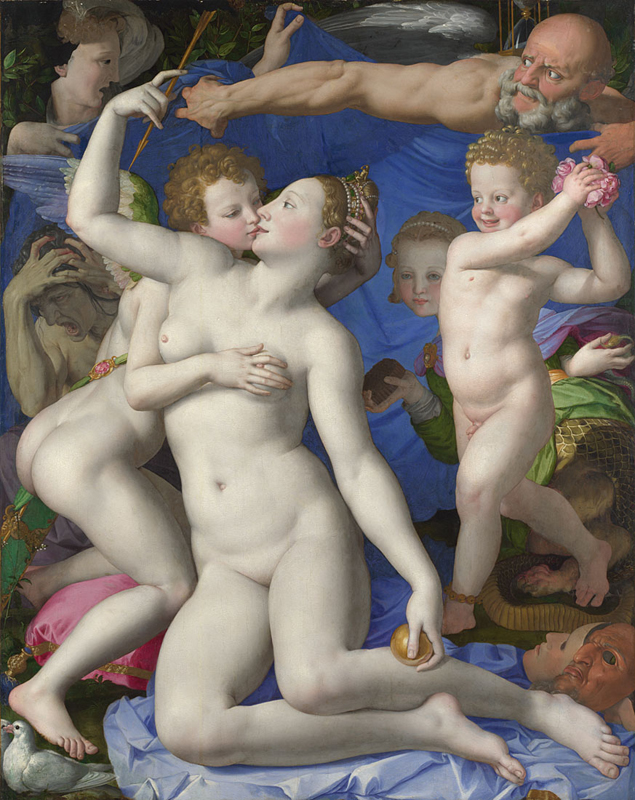
Agnolo Bronzino, Allegory with Venus and Cupid, c. 1545, National Gallery, London, UK.
This is not limited to the Renaissance and reappears in Manet’s Olympia. In traditional Renaissance works, the nude was often disguised as mythological—like Venus or Aphrodite—allowing erotic display to be socially and culturally accepted. Manet strips away that protective veil, presenting Olympia as a contemporary figure: a courtesan whose body is explicitly tied to economic exchange and consumption, especially by men.
The carefully arranged details, such as the flowers delivered by a servant, the orchid in her hair, and her confrontational, direct, yet cold gaze reveals her role as a paid mistress and the transactional nature of her body. However, unlike mythological nudes, her nudity is not abstracted or idealized. It is socially situated and historically accurate.
Nevertheless, it continues to function as a site of possession rather than self-expression. The female body is once again disciplined, staged, and owned for control and authority, demonstrating that even with changes in historical and social context, the mechanisms of objectification and surveillance remain indifferent.
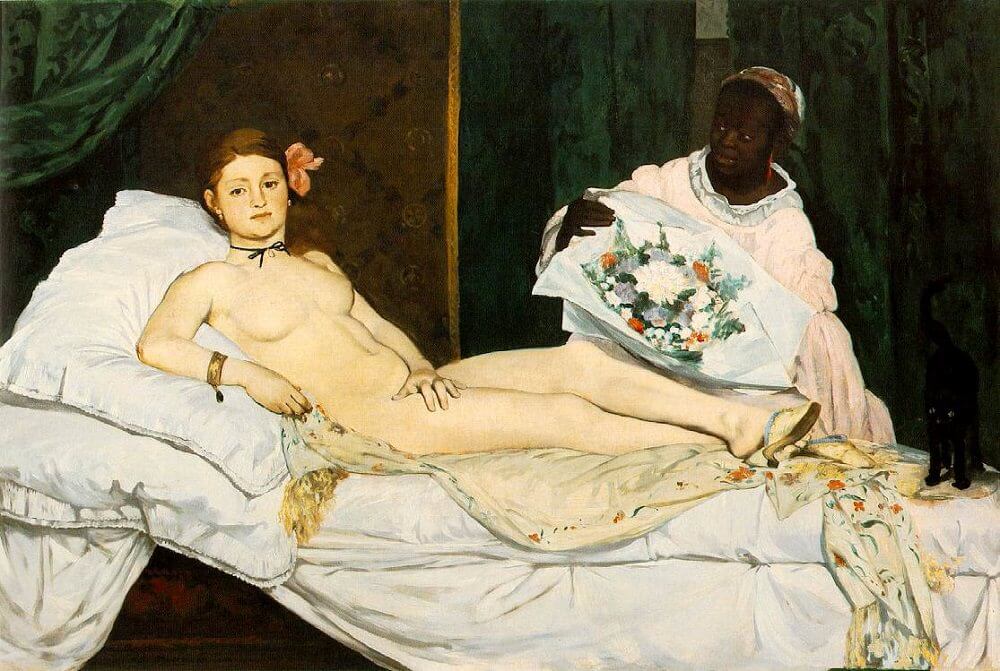
Édouard Manet, Olympia, 1863, Musée d’Orsay, Paris, France.
In European art, the mirror usually symbolizes women’s vanity, framing them as egoistic. But Titian’s Venus with a Mirror reveals a binary dynamic: the woman admires her reflection while simultaneously offering herself to the viewer’s gaze. Similarly, Diego Velázquez’s Rokeby Venus uses the mirror to allow the spectator’s view of the goddess’s face.
Venus lies on her side, her back to the viewer, while her reflection is visible in the mirror, inspecting her own body. The mirror doubles her visibility, signaling that her image is controlled and surveyed both by the spectator and by herself. In this way, the mirror becomes a tool for self-objectification, encouraging women to perform even when no one is seemingly watching.
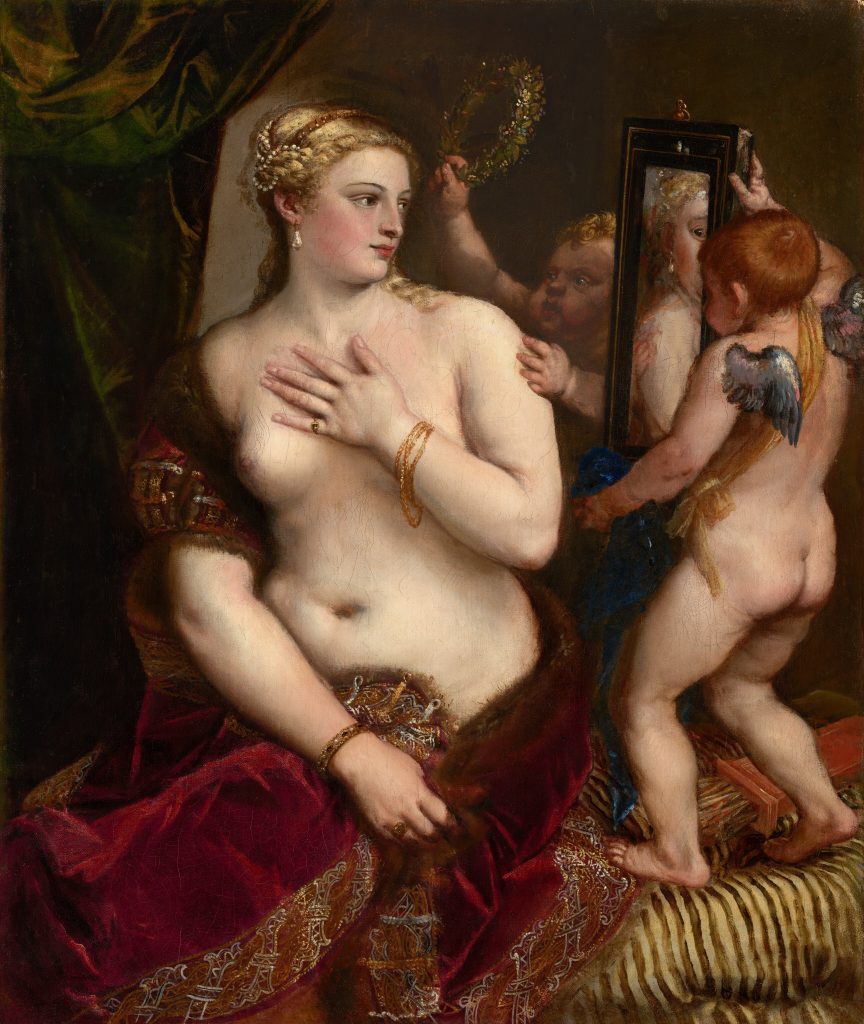
Titian, Venus with a Mirror, 1555, National Gallery, London, UK.
Self-objectification reinforces the idea that a woman’s value is based on how she appears, rather than who she is. What begins as an external gaze gets internalized, shaping surveillance into self-discipline.
This reveals a deeper understanding of gender performance: it is not simply an appeal for male validation, but a means of securing acceptance—both within society and in one’s own self-perception. To fail to perform gender in an outwardly intelligible way is to risk punishment through social norms and institutions, such as confusion and dismissal, exclusion, and, in extreme cases, even violence.
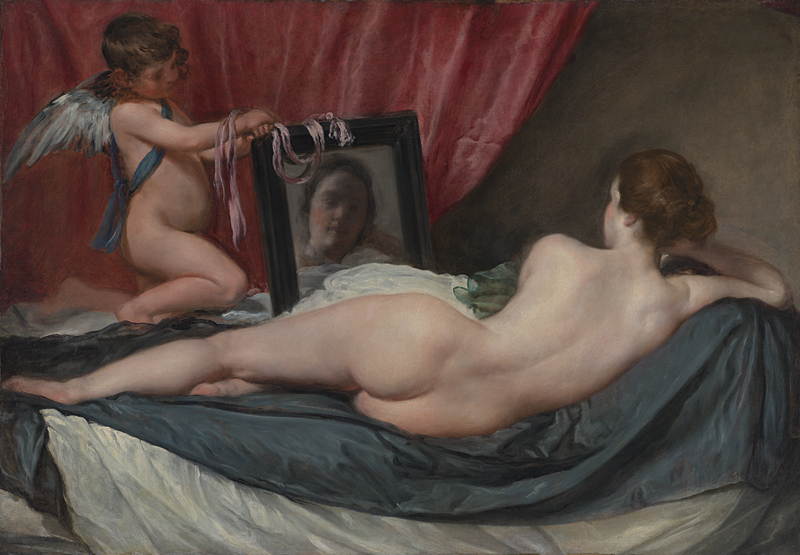
Diego Velázquez, Rokeby Venus, 1647–1651, National Gallery, London, UK.
This framework makes visible how femininity has been continuously judged, regulated, and staged throughout centuries. What appears at first sight as an aesthetic in the paintings turns into a way of surveillance, expectancy, and control in society. Art history plays a crucial role in reproducing and teaching these norms and actively shaping our perception of what femininity should look like—often at a subconscious level. To acknowledge this influence is a necessary step toward recognizing how gender norms are deeply ingrained in our psyche.
Author’s bio:
Pelin Yılmaz is an architecture student exploring art, politics, time, and space. Writes on unexpected topics, diving into intriguing rabbit holes, and uncovering fresh perspectives.
John Berger, Ways of Seeing, Penguin Books 1972.
Get your daily dose of art
Click and follow us on Google News to stay updated all the time

DailyArt Magazine needs your support. Every contribution, however big or small, is very valuable for our future. Thanks to it, we will be able to sustain and grow the Magazine. Thank you for your help!

This is our guest profile for occasional authors. If you have an interesting story about art to tell, send it to our Editor-in-chief Kate at [email protected]. You might be the next here!

An admirer of antiquity, art, and architecture. An avid reader and amateur photographer. Always curious, always on an adventure.
Fanny Eaton was a regular model for the Pre-Raphaelites during the 1860s and features in a number of famous works. Yet for most of the last century,...
Catriona Miller 19 February 2026
From van Gogh’s sunflowers, through golden dresses, to tranquil landscapes—yellow lights up the scene. It is the color of the sun, associated...
Kinga Dobosz 26 February 2026
For centuries, artists interpreted the biblical story of Salome and turned it into a lasting theme in art. But where did this fascination come from?...
Edoardo Cesarino 22 January 2026
Florine Stettheimer (1871–1944) was an American painter, designer, and poet, as well as a prominent member of New York City’s high society...
Sam Malone 2 March 2026