Historical Background
Vincent van Gogh (1853–1890) is one of the most famous, popular, and revered artists in our 21st-century world. His images grace umbrellas, scarves, tote bags, and every imaginable souvenir under the sun. This popularity stands in sharp contrast to his experience during the 19th century, when Van Gogh achieved little commercial success, selling only one painting publicly during his lifetime. He felt like a marginalized artist—someone who felt pushed to the edges of self-worth, who felt rejected, and who experienced extreme depression. Sadly, the emotional and mental challenges Van Gogh faced eventually overcame his will to live. Historically, Van Gogh’s death is said to have resulted from a self-inflicted gunshot wound.
However, his tragic ending should not overshadow the positivity and passion that he experienced during his life. He lived a vibrant life, filled with travel and a view of the world through an artistic lens that many people today would still envy. It is easily arguable that the last two years of Van Gogh’s life were the most prolific and expressive years of his career. He mastered the signature style that typifies his work—rich impasto, dynamic brushstrokes, and bold colors. Green Wheat Fields, Auvers is one of his many masterpieces capturing this artistic essence.
Pure Landscape
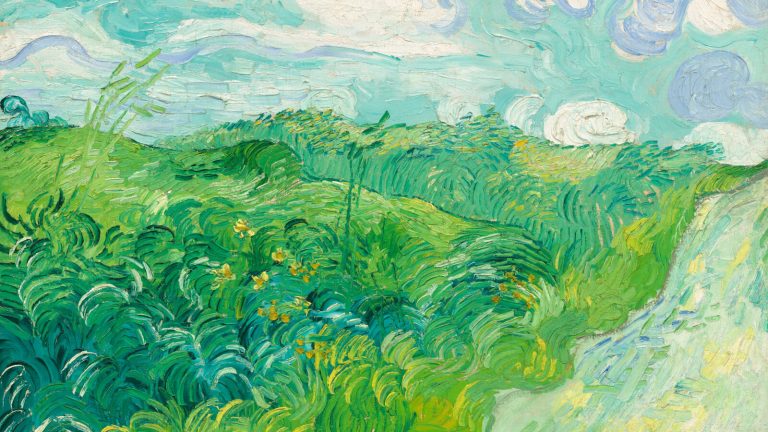
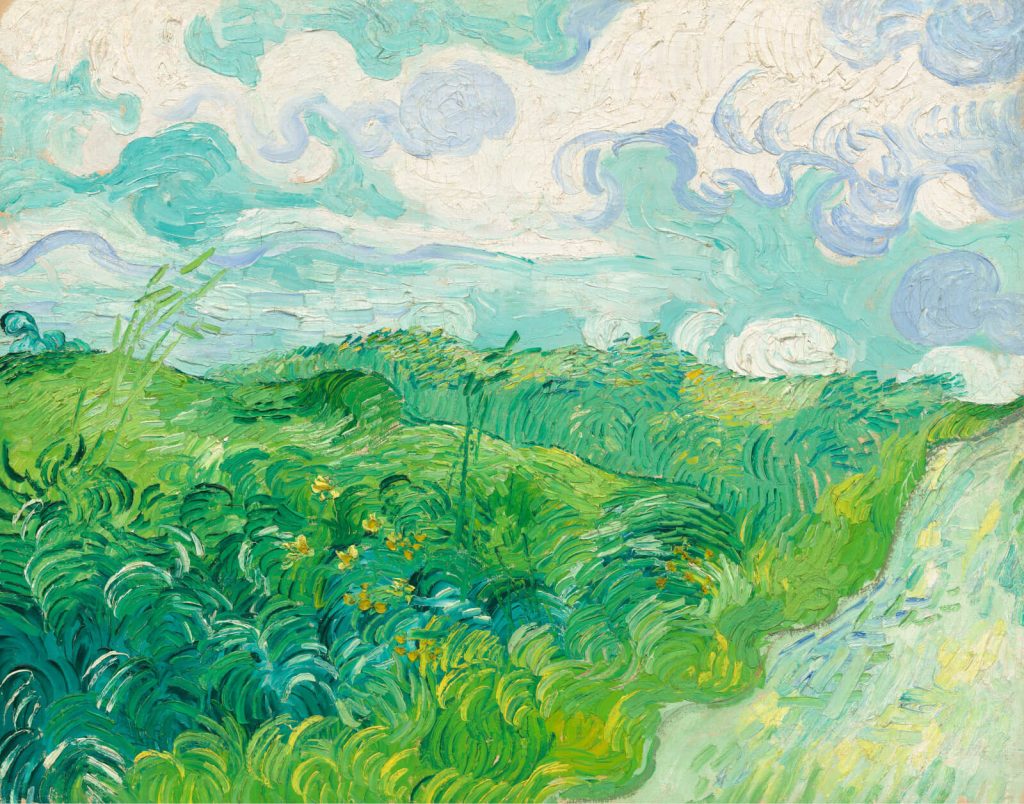
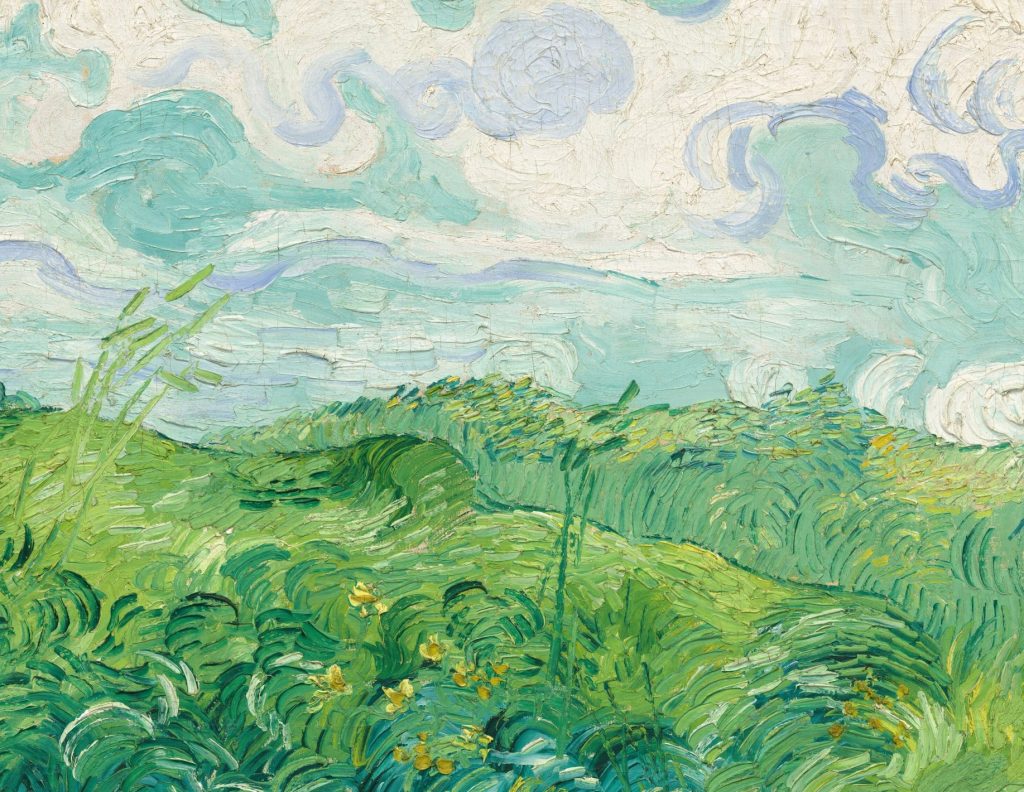
Green Wheat Fields, Auvers is an oil on canvas measuring 72.39 × 91.44 cm (28 1/2 × 36 in.). It is considered a pure landscape because it excludes people, animals, and human-made structures from its composition. At first glance, the arrangement is quite simple. It features a green wheat field dominating the bottom two-thirds of the landscape, a cloudy sky filling the upper third, and an unpaved country road slipping along the bottom-right corner. However, this unassuming simplicity, filtered through the prism of Van Gogh’s expressive perspective and raw emotional intensity, projects nature’s vibrant energy.
Dark Green Foliage
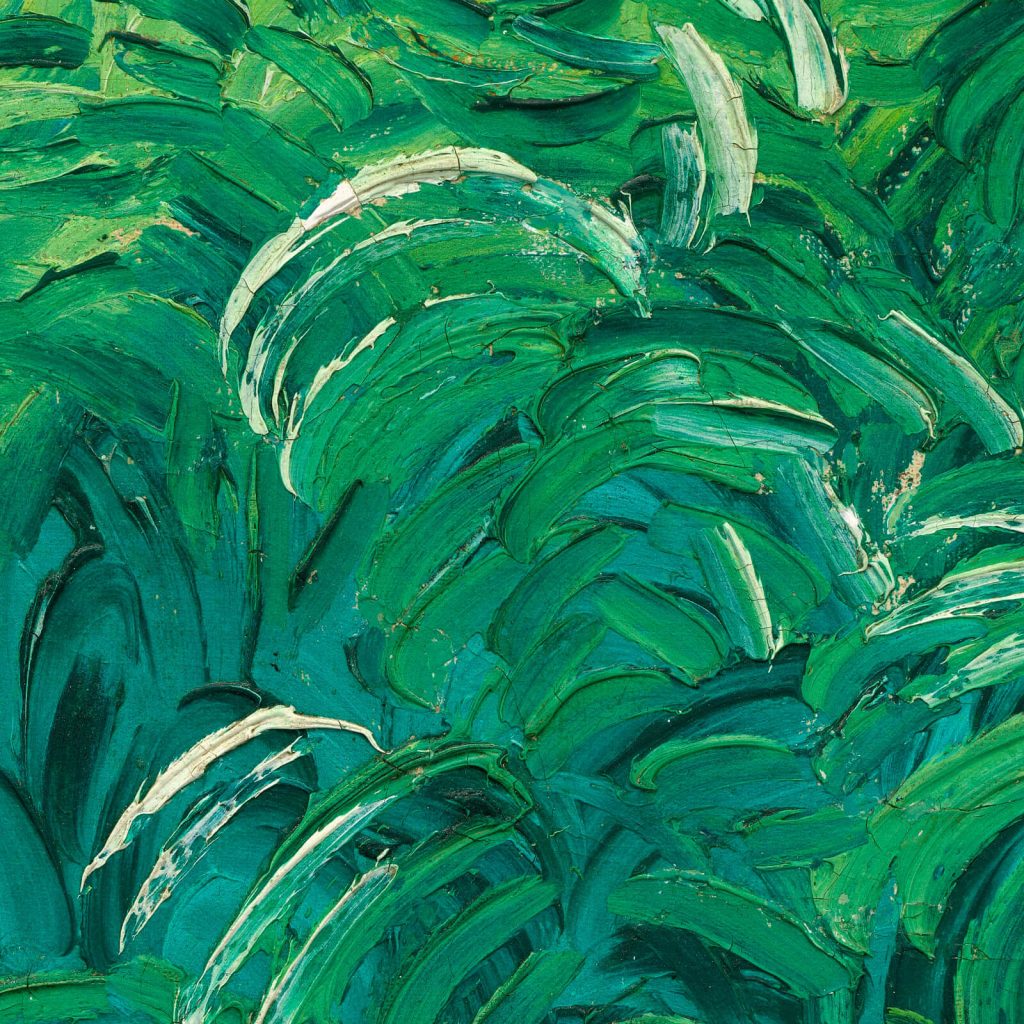
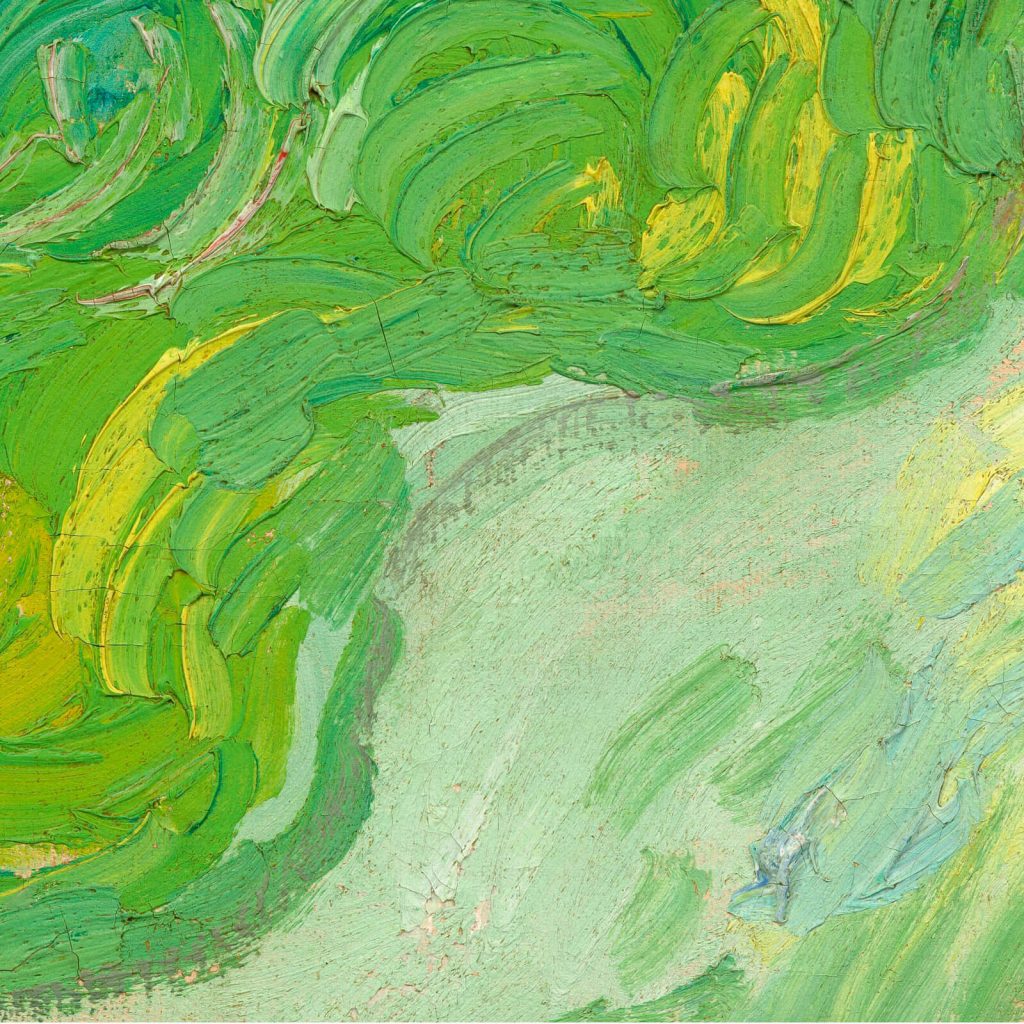
A multitude of large, deep-green leaves dominates the bottom-left foreground. Mallard green shades overlap with olive green shades, but are highlighted with almost pure white. The brushstrokes are very regular and repetitive, creating a visually interesting uniform pattern. There is an impression of a dense cluster of dark green foliage.
Yellow Flowers
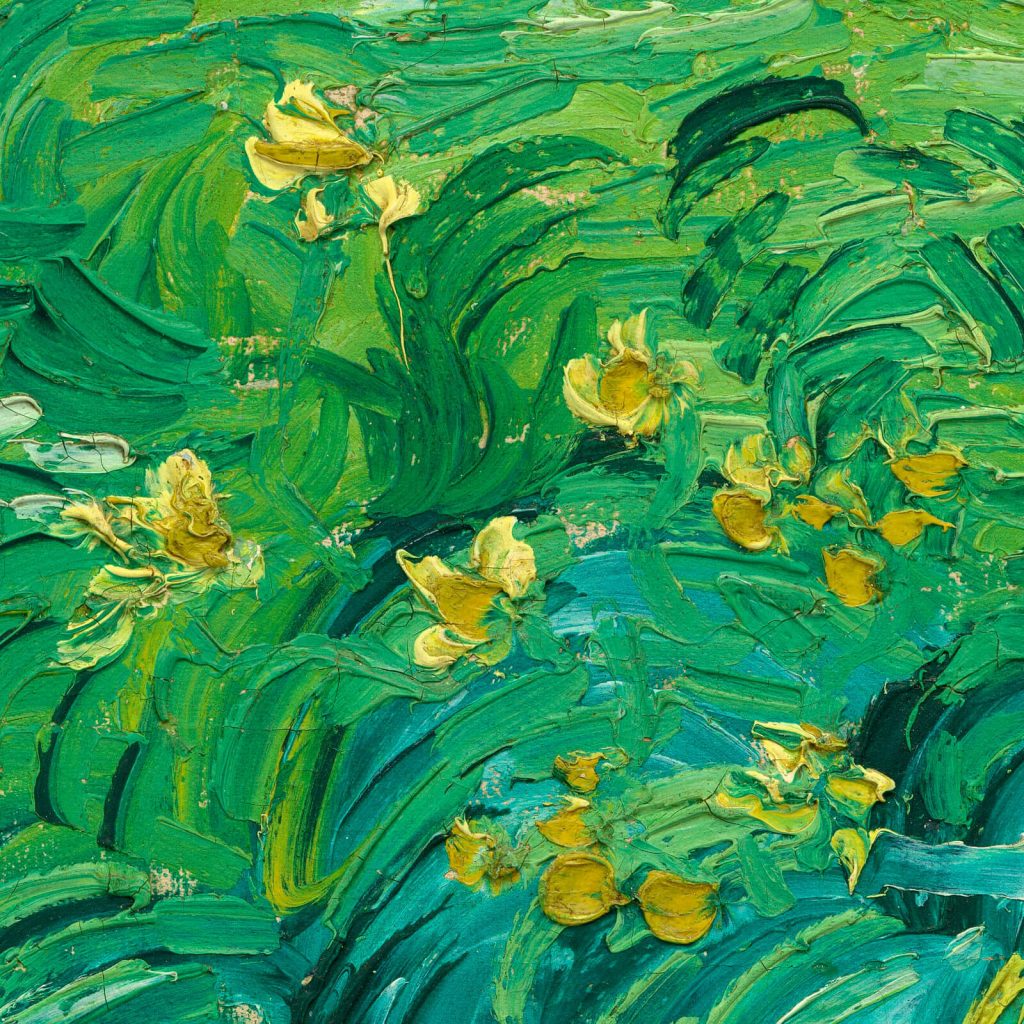
Along the right edge of this greenery, several small yellow blossoms emerge, providing a striking contrast against the dark leaves. Van Gogh has implied their presence with rapid, oblique brushstrokes that suggest swaying petals in the wind. Upon closer examination, they are messy blobs, but surprisingly capture the vitality and energy of these pert yellow flowers.
Green Wheat Fields
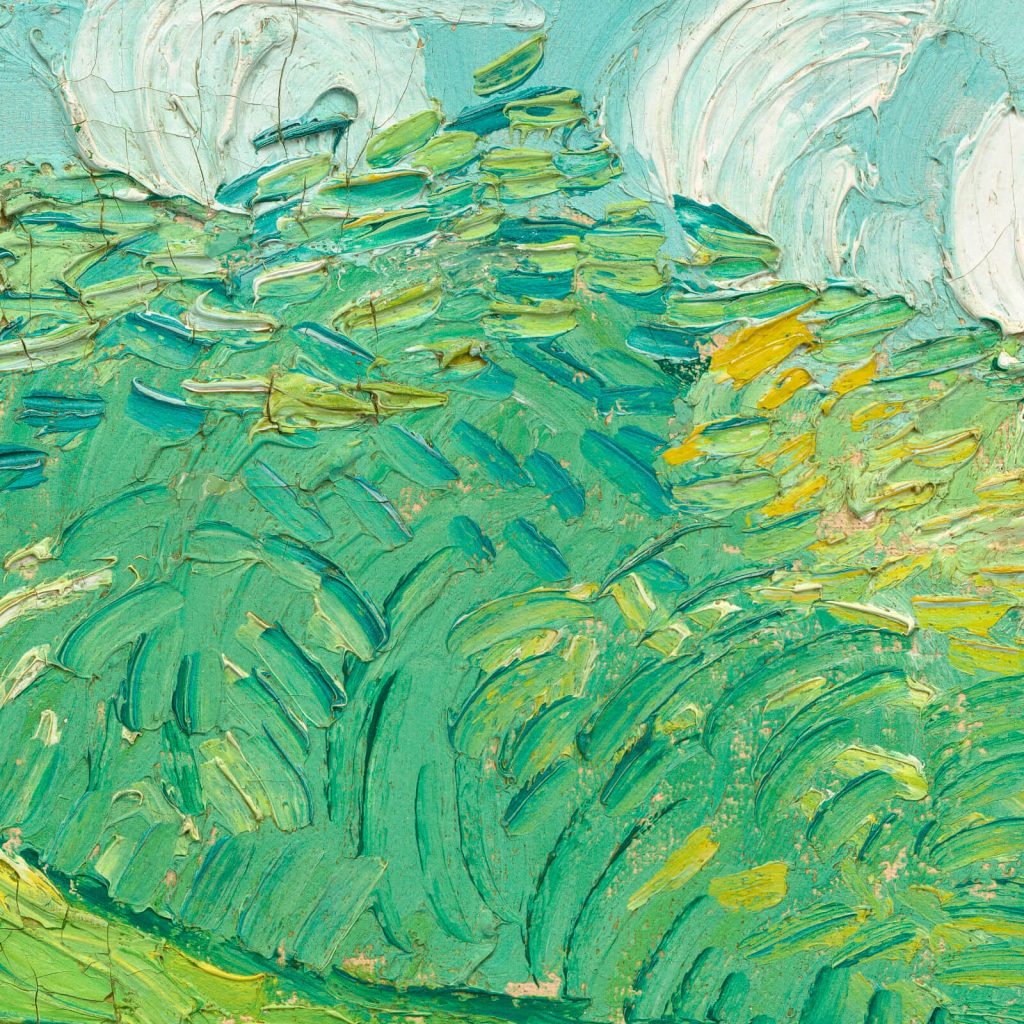
Green wheat fields dominate the central midground of the landscape. Their primary location implies their importance to the composition and gives their name to the painting’s title. Like the dense foliage in the foreground, they possess the patterned regularity of brushstrokes. The vertical brush strokes of the wheat stalks adjoin each other, forming almost a fence along the horizon.
However, Van Gogh injects a sense of movement by tipping the grain heads to the upper right. Like a river of wheat grains, the multitude of brush strokes flows toward the right.
Unpaved Country Road
The bottom-right foreground presents an unpaved country road. It is a composite of light pastel shades of green with flecks of yellow and white. It gives the impression of a flattened field pathway, or perhaps a dusty lane with patches of resistant plant growth.
Cumulus Clouds
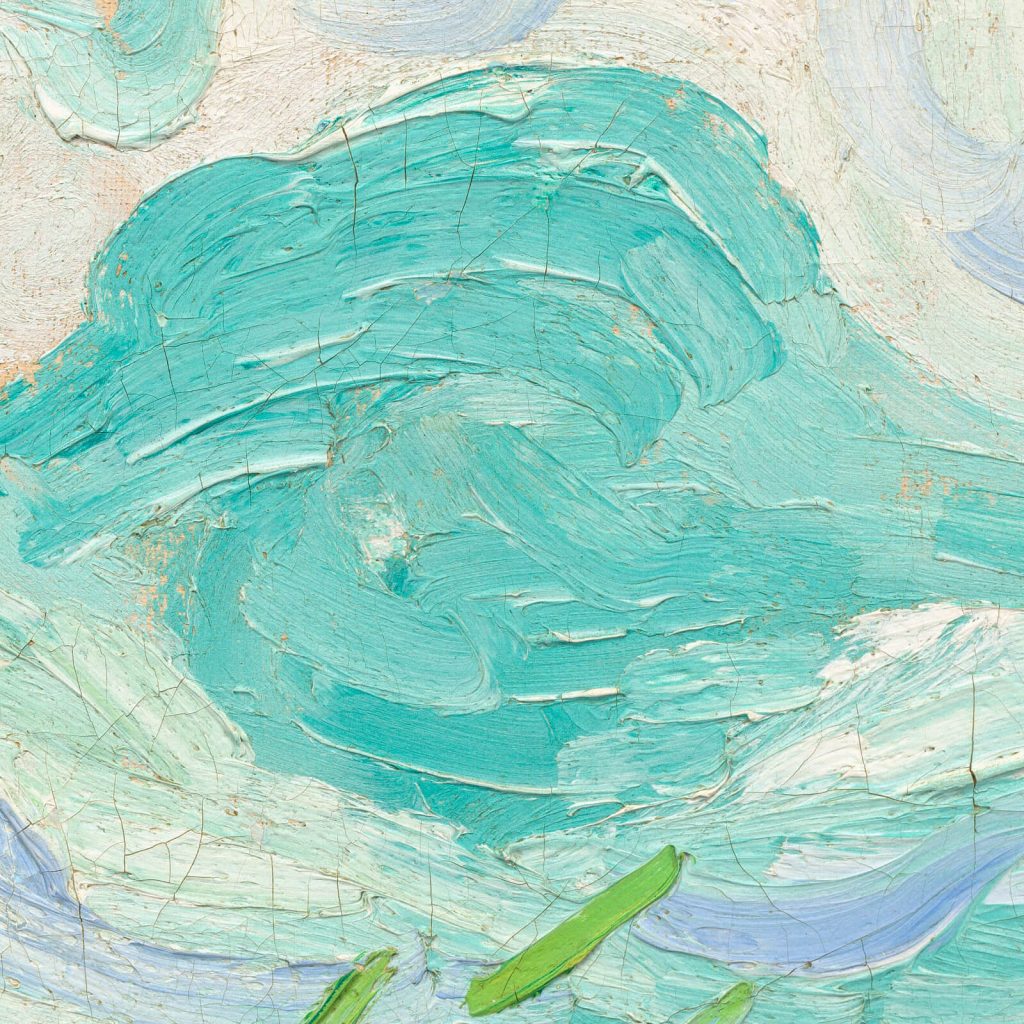
A swirling patchwork of white clouds, gray shadows, and blue sky fills the upper third of the sky. Van Gogh was a keen observer of weather and how it affected the light in his perspectives and landscapes. Within this masterpiece, he captures cumulus clouds swaying across the painting’s sky. Cumulus clouds are characterized by their fluffy, almost cotton-ball form, which easily reflects sunlight above but creates dense shadows beneath. Van Gogh expertly captures an assemblage of windswept cumulus clouds as they float toward the right.
As they cluster and disperse, they reveal patches of turquoise blue sky. The overall effect is a harmonious but energetic interpretation of cloud viewing. Daydreaming has rarely looked so interesting.
Convergent Point
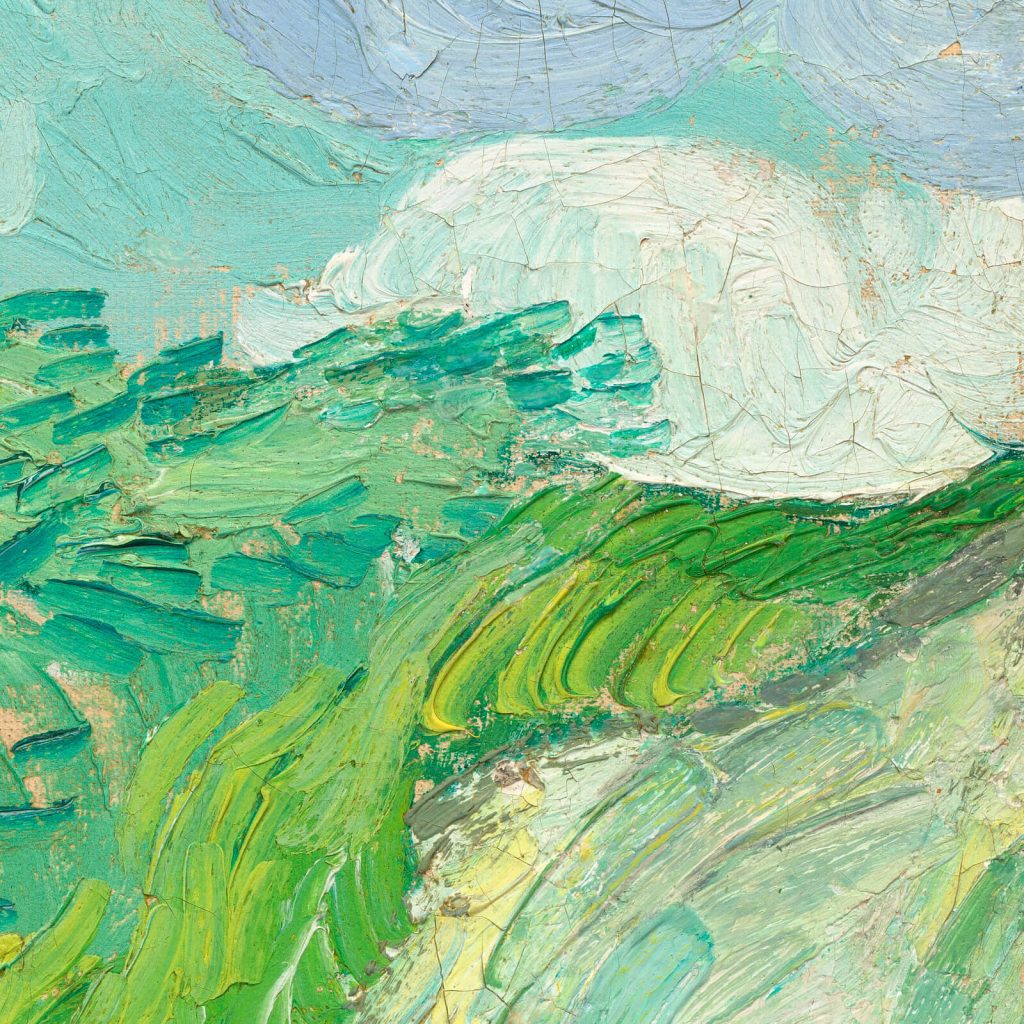
On the far right horizon line, the three elements of sky, field, and road converge into a single point. It is an interesting moment because it draws the eye into a sense of deep perspective. It gives the painting the impression of depth and of a rolling landscape. Without this conversion point, this masterpiece might have appeared relatively flat and one-dimensional, and closer in composition to the Japanese prints popular in 19th-century France. It is a beautiful moment of implied linear perspective.
Bipolar Disorder
Green Wheat Fields, Auvers was painted in the small village of Auvers-sur-Oise, just north of Paris, in May 1890. It was therefore created just two months before Van Gogh’s untimely death on July 29, 1890. Hence, it likely captures some of the emotional and expressive turmoil he was feeling in the last few months of his life. Some historians believe that Van Gogh had bipolar disorder, which would have caused great moments of depression followed by great moments of euphoria. This belief remains a subject of scholarly debate.
With its bright color palette, high tactility, and energetic brushstrokes, it is comforting to think that Green Wheat Fields, Auvers might reflect a happy moment for the artist. Perhaps this image captures a particular afternoon in May 1890 that gave him a sense of comfort and belonging. The feelings may have been fleeting for Van Gogh, but he captured them so effectively that they became a positive, beloved legacy of his life. It is a happy painting that captures a beautiful moment in nature.