

Marvellous Moomin Madness
Explore the world of Tove Jansson's Moomins, where adventure, friendship and a love of nature create a delightful narrative for readers of all ages.
Candy Bedworth 2 April 2026
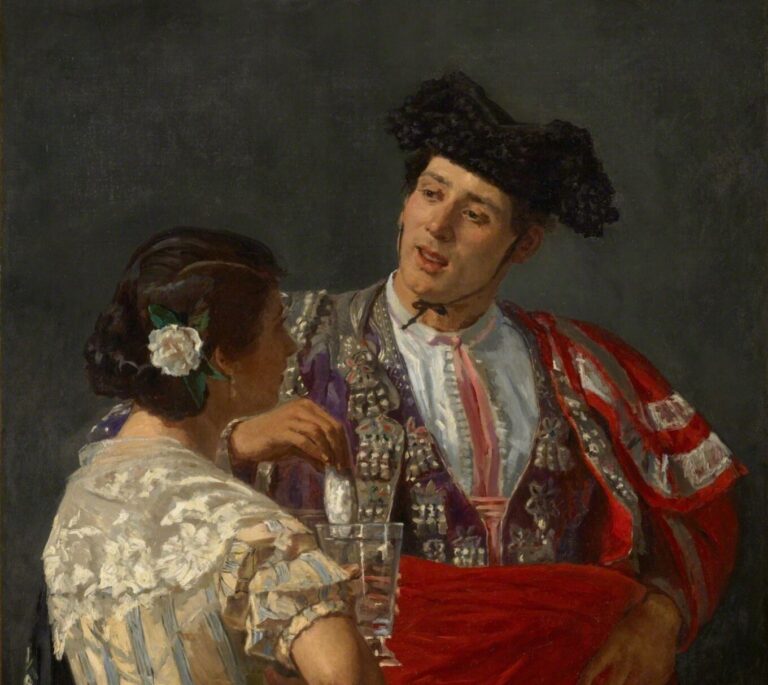
Mary Cassatt, Offering the Panal to the Bullfighter, 1873, Clark Art Institute, Williamstown, MA, USA. Detail.
Mary Cassatt is one of the most exciting artists of the 19th century, but little is known of her trip to Spain between 1872 and 1873. During her short stay in a country known for its deep traditions, Cassatt interpreted some of Spain’s machismo and majismo themes—characterized by flamboyant, traditionalist outfits and proud attitude—from a unique perspective.
Mary Cassatt’s trip to Spain led to the production of a handful of unique masterpieces by any expatriate artist visiting the so-called “Black Country”—as Spain was sometimes referred to based on the Black Legend. Mary Cassatt was an American woman who took the unorthodox route of becoming an artist. The decision led to strong criticism, not least from her own mother who described her as a woman “intent on fame and money.” Cassatt’s visit to Spain where she attended bullfights, led to a fascinating coming together of femininity and machismo that is unique in the history of art.
By this point in her career Cassatt had not yet met Edgar Degas and the other Impressionists, so her style was still in its early maturity (as was she, being only in her late twenties at the time). As she wrote to her friend Emily Sartain, she intended to introduce the male figure in her Spanish paintings. These works indeed contain far more male figures than the rest of her oeuvre.

Bartolomé Esteban Murillo, The Immaculate Conception of El Escorial, 1660–1665, Museo del Prado, Madrid, Spain.
Cassatt’s reason for visiting Spain was fairly ordinary for 19th-century artists: she intended to study the Old Spanish Masters like Velázquez, Murillo, and Goya. Cassatt stayed in the Grand Hôtel de París on the Puerta del Sol, a short distance from Museo del Prado which she visited daily. In the Prado she was most impressed by Murillo’s The Immaculate Conception of El Escorial and Velázquez’s portrait of the child prince Balthasar Charles.
Three weeks into her stay, not content to restrict her studies to the Old Masters, she travelled alone south to Seville. She was impressed by the feeling of the city, as you can tell from her description: “full of color, gay lively, the Cathedral magnificent, orange trees growing in the streets and squares.”
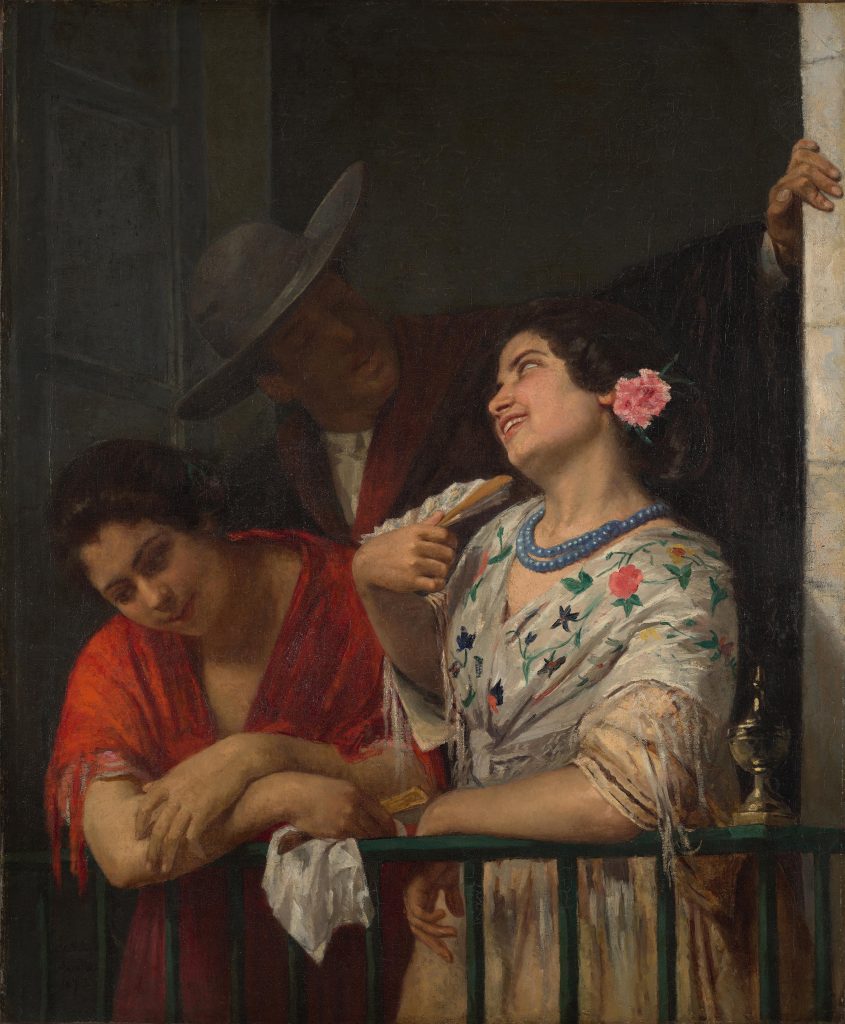
Mary Cassatt, A Balcony in Seville, 1873, Philadelphia Museum of Art, Philadelphia, PA, USA.
It was in Seville where she began working on her first Spanish painting, A Balcony in Seville. In this masterpiece, she already shows what appealed to her most in Spain—the three figures chatting, the male figure flirting with the two women, the scene set on an open balcony—a feeling of secretive, Mediterranean illicitness. The women are dressed in bright, colorful dresses, the woman leaning on the balcony rail wears a bright red mantilla. The male figure is wearing a wide-brimmed hat typically seen in Spanish traditional fashion.
The balcony itself carries romantic associations in Spain, as Federico García Lorca later captured in a poem: “If I die/Leave the balcony open.” Similarly, Francisco Goya painted Majas on a Balcony, alluding to flirtation and shadowy figures. Close resemblances between the two works are likely not coincidental: in her letters Cassatt wrote of her knowledge of Goya’s masterpiece, which he produced in more than one version. The painting had also been a source of inspiration for Édouard Manet’s own version of The Balcony painted three years earlier.
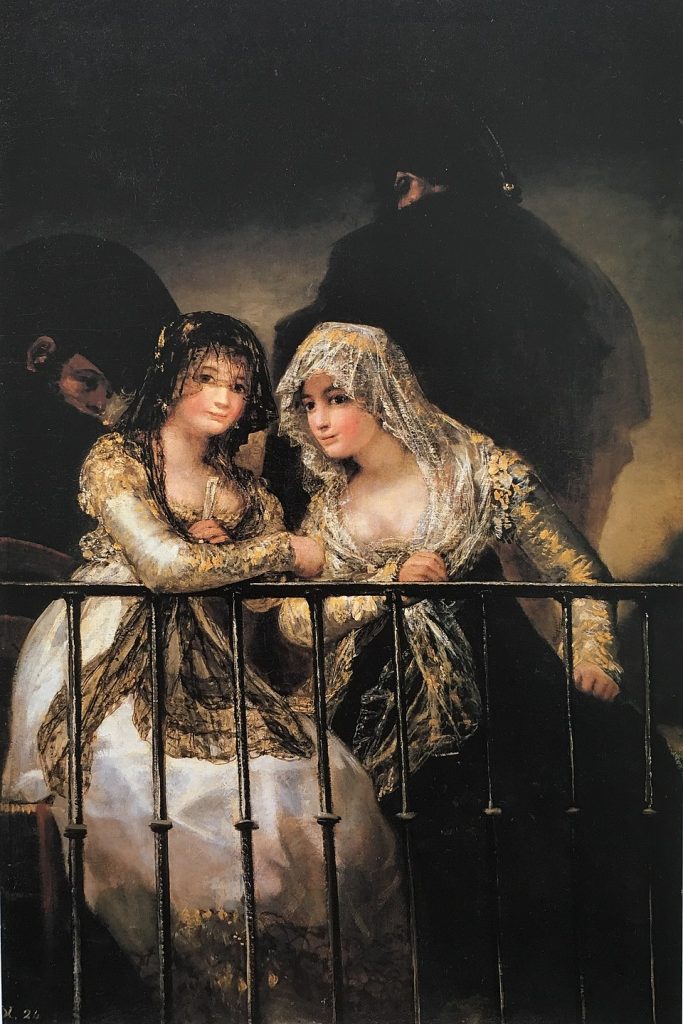
Francisco Goya, Majas on a Balcony, 1808–1814, private collection. Wikimedia Commons (public domain).
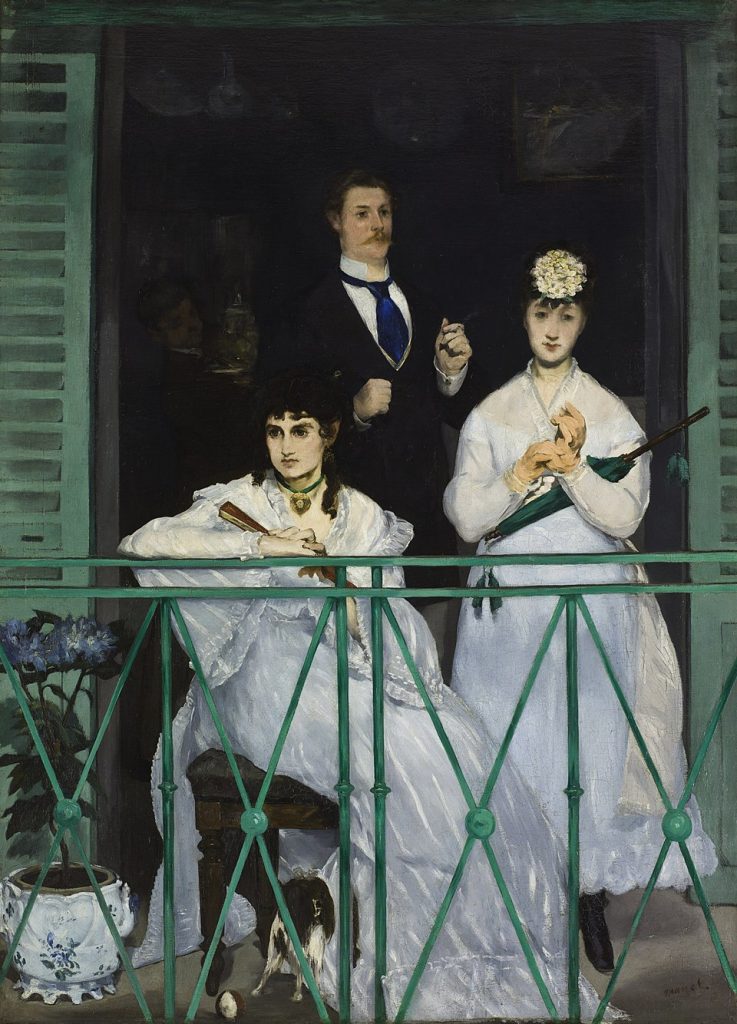
Édouard Manet, The Balcony, 1868–1869, Musée d’Orsay, Paris, France.


Mary Cassatt was likely inspired by Goya’s famous Majas on a Balcony, as she mentioned it in her letters.
Manet’s painting is another famous interpretations of the theme.
Cassatt did not usually portray the subject of flirtation (the painting was originally exhibited with the title The Flirtation: A Balcony in Seville). She was reacting not only to the influence of her contemporaries but to the overall myth of Black Spain. The Black Legend of Spain attracted Romantically-minded artists and writers who sought out, as Immanuel Kant described it, the Spaniard who is “…of a romantic quality of spirit, as the bullfight shows; he is cruel, as the former auto-da-fé shows; and he displays in his taste an origin that is partly non-European.” This essentially racist perspective of the country and its traditions served as an artistic spur to artists like Manet, Degas, and others.
But Cassatt came with different perspectives. Cassatt’s two other major Spanish paintings dealt with the most Romantic of Spanish customs: the bullfight. Édouard Manet visited Spain in 1865 and was enamoured with the violence of the bullfight. His painting Bullfight captures the moment the bull gores the horse in the picador phase of the corrida. Manet’s interest in depicting the violence of the bullfight echoes Goya’s La Tauromaquia prints that charted the myth of the bullfight and depicted brutal scenes such as the goring of the matador Pepe Illo.
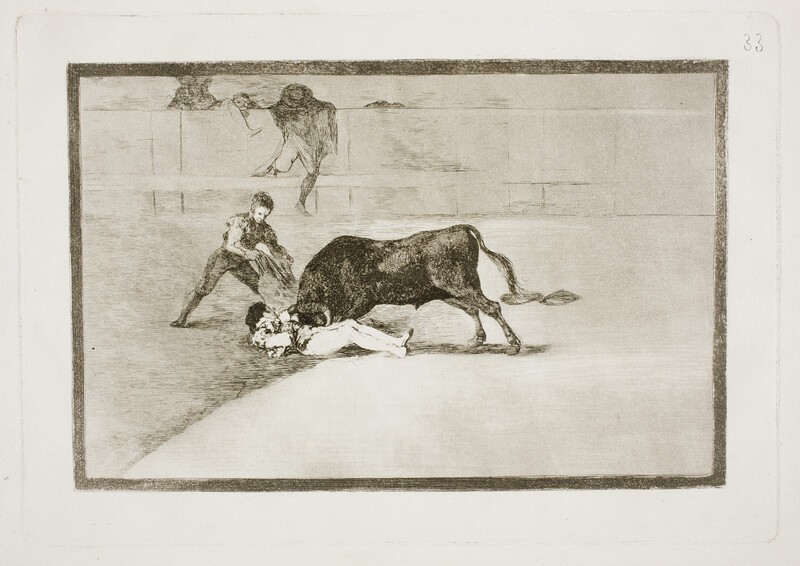
Francisco Goya, The Unlucky Death of Pepe Illo in the Ring at Madrid, Plate 33 of La Tauromaquia, c. 1816, National Gallery of Art, Washington, DC, USA.
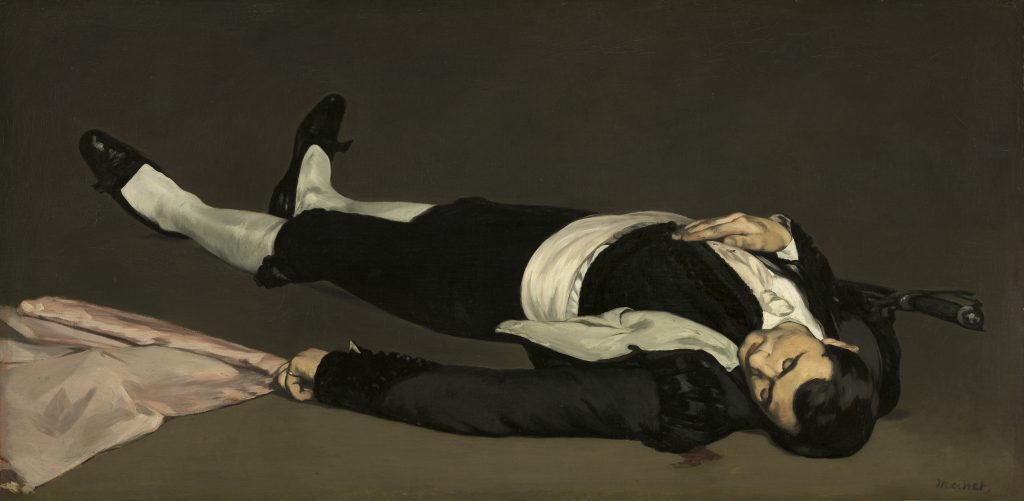
Édouard Manet, The Dead Man (The Dead Toreador), 1864–1865, National Gallery of Art, Washington, DC, USA.
Francisco Goya’s series of prints La Tauromaquia depict the brutality of Spanish bullfights.
Édouard Manet presents the bullfighter as a heroic and tragic figure.
These works emphasize the machismo that is inherent in the corrida. The bullfighter is a heroic, tragic figure, as Manet shows in his painting The Dead Toreador, where the bullfighter’s death is depicted with the elegance of a Renaissance painting. Goya highlights the bullfighter’s bravado and courage in prints like The Daring of Martincho in the Ring at Zaragoza.
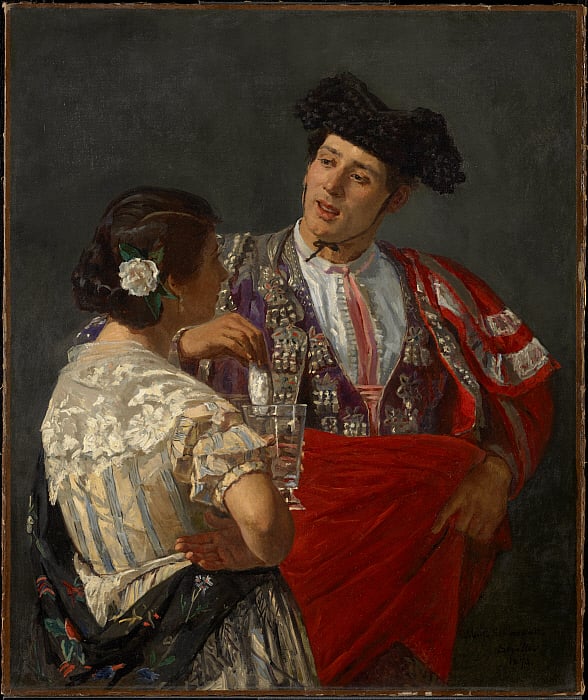
Mary Cassatt, Offering the Panal to the Bullfighter, 1873, Clark Art Institute, Williamstown, MA, USA.
Cassatt never explicitly depicts the bullfight itself, nor its violence or bravado. Instead, her paintings After the Bullfight and Offering the Panal to the Bullfighter reflect on her interest in human relationships and drama. In the latter, she shows the matador in a relaxed posture, chatting with a woman, partially giving the viewer her back, dressed in an elegant, traditional lace dress. The dark background and elegant brushwork reflect her studies of Velazquez’s paintings at the Prado.
Closest to Cassatt’s Offering the Panal to the Bullfighter is a painting by Germán Álvarez Algeciras, Pelando la pava en la cantina (1873). Here, similarly, the bullfighter is seen relaxed, outside the ring, chatting with a woman behind a bar, the scene is set in a Romantic Mediterranean backdrop. These kinds of paintings, as well as those by Mariano Fortuny, romanticized Spanish customs and lifestyles, with the intention of selling to wealthy tourists.
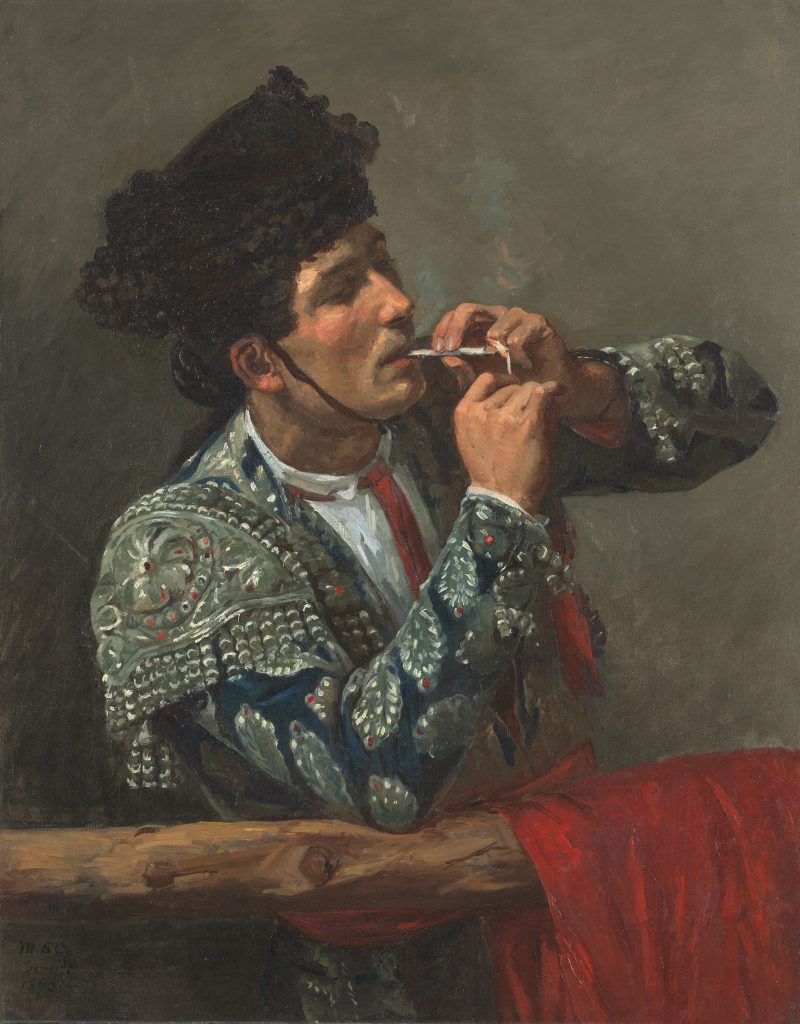
Mary Cassatt, After the Bullfight, 1873, Art Institute of Chicago, Chicago, IL, USA.
Cassatt’s painting After the Bullfight, reverts to the solitary portrayal of a bullfighter, once again outside of the ring and the context of violence. Stylistically the painting is a transitional piece of Realism that shows nascent Impressionist inclinations, especially with the rigorous brushstrokes. Once again, the figure is portrayed against a muted background, and overall the painting lacks the colorful hues associated with Spanish costumbrismo—depictions of local everyday life. The painting has the feel more of a Velázquez painting than a work contemporary to Cassatt.
The bullfighter is shown lighting a cigarette, leaning his elbow against a wooden railing, his red muleta, or cape, hanging over it to the side of the scene. He is still dressed in his traje de luces or “suit of lights,” but there is not the same bravado and machismo as in contemporary depictions of bullfighters—compare it with Manet’s elegant but triumphant The Matador Saluting. Cassatt’s matador is captured in an intimate, voyeuristic moment. Ready to risk his life before an audience, he is here in retreat, relaxing after the bullfight. Cassatt slips in after him like a modern paparazzi, observing him in a quiet, unguarded moment far from the drama of the arena.
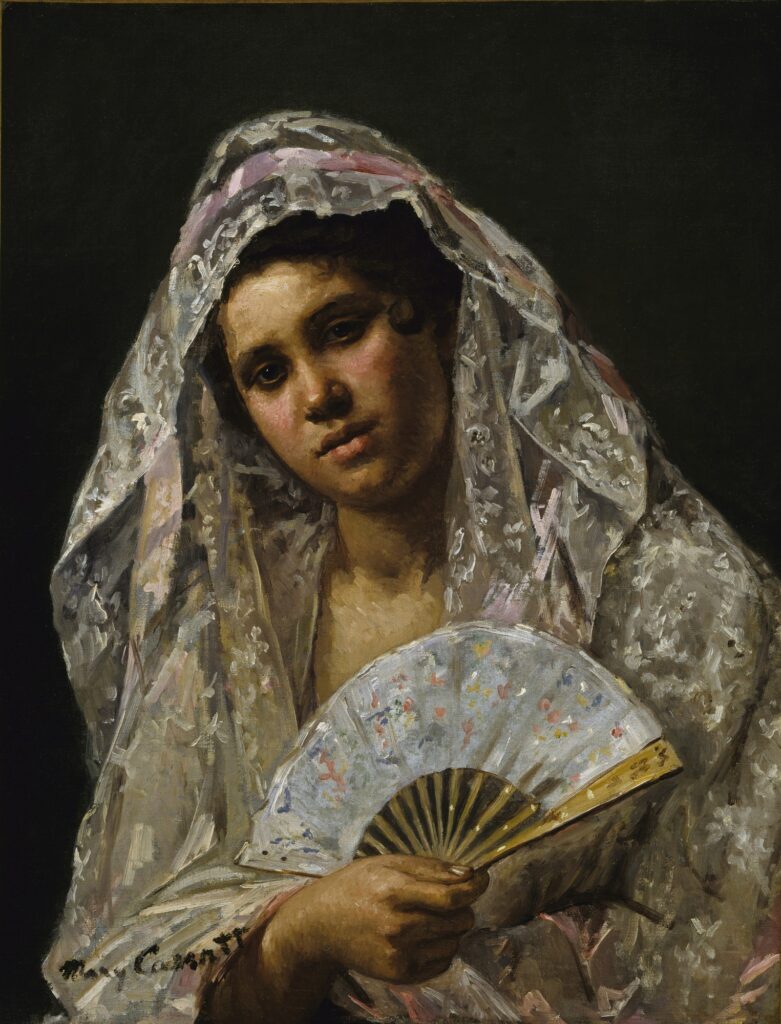
Mary Cassatt, Spanish Dancer Wearing a Lace Mantilla, 1873, Smithsonian American Art Museum, Washington, DC, USA.
In Spain Cassatt was perhaps at her freest. Away from the familiar circles of Paris and America, she could indulge in subject matter that, in truth, she would seldom revisit later in her career—scenes of flirtation and male figures. However, Cassatt’s view of Spain aligned with that of many 19th-century visitors. The Black Legend may have celebrated the exotic Spanish past, but at the expense of viewing the Spanish present as one filled with decay.
As Cassatt wrote to Sartain: “The great thing [in Spain] is the odd types and peculiar rich dark coloring of the models, if it were not for that I should not stay, the artists here are perhaps more flattering than they were in Parma, but I think the Spaniards infinitely inferior in education and breeding to the Italians.”
Spain saw Cassatt at her most daring. As a tourist, an outsider, she allowed herself to become an observer, peeking into places she normally wouldn’t. Her paintings created immediately after her visit in Spain retained some of the interest in flirtatious scenes, as can be seen in A Musical Party (1874) and Ida (1874). She soon, however, began to paint more refined, contemplative depictions of women, such as The Young Bride (1875) and Impressionistic The Reader (1877).
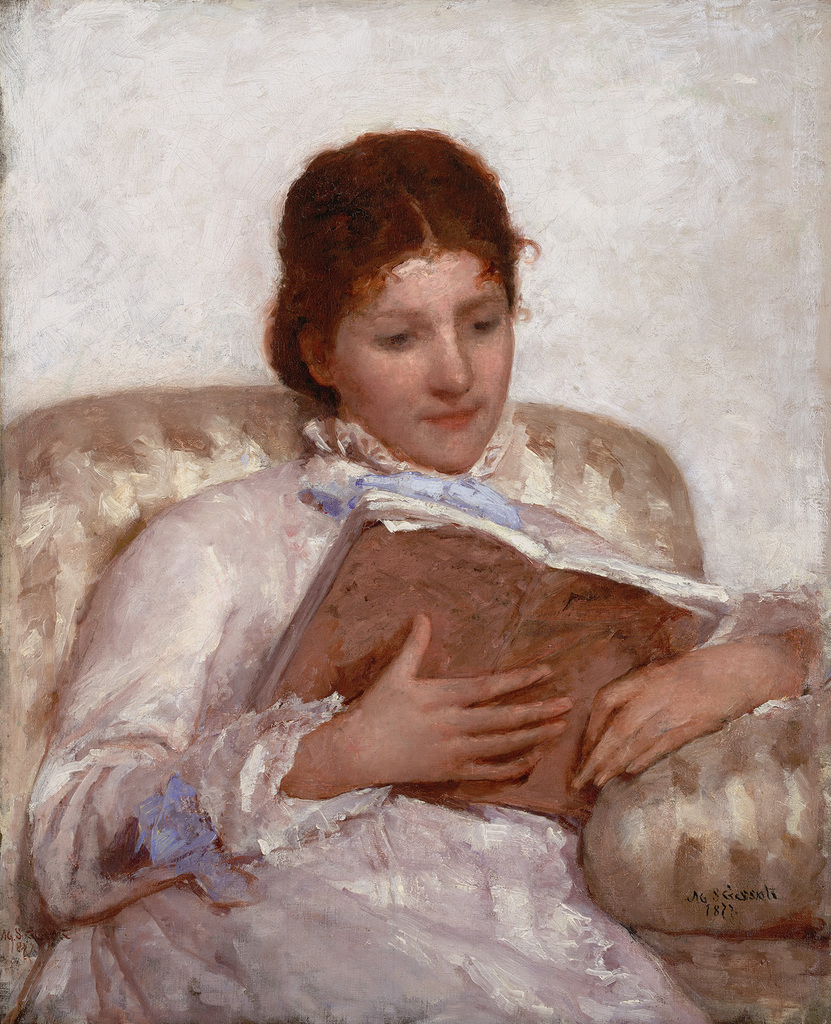
Mary Cassatt, The Reader, 1877, Crystal Bridges Museum of American Art, Bentonville, AR, USA.
Interestingly, other women artists also engaged with the subject of bullfighting in their art, to fascinating effect. Elaine de Kooning’s Bullfight (1959) is a striking Abstract Expressionist canvas that captures the dynamism of the bullfight, reducing it to pure movement and expression. While not strictly dealing with bullfighting, the image of the bull was wonderfully reimagined by Maltese artist Isabelle Borg in her Lovers in the Bull (1984). It presents a couple embedded inside the body of a bull painted as something ancient and primordial.
Mary Cassatt’s Spanish journey, while not long, and not as influential as Manet’s, was an interesting moment in the history of art. It saw a young woman artist finding her style, absorbing the bravura of the Old Spanish Masters while allowing herself to be more daring in her subject matter. Her interpretation of Spain and its traditions remain among the most unique, even in a time when Spain influence on modern art became stronger than ever.
Get your daily dose of art
Click and follow us on Google News to stay updated all the time

DailyArt Magazine needs your support. Every contribution, however big or small, is very valuable for our future. Thanks to it, we will be able to sustain and grow the Magazine. Thank you for your help!

Art history author, communicator and lecturer from Malta. Author of novels Too Many Sparrows in Zaragoza and Lost in the Midlands, short story author and art history author specialising in Maltese Modern art and the Baroque. Lover of video games, comic books, proud father and traveller of the Mediterranean.
Explore the world of Tove Jansson's Moomins, where adventure, friendship and a love of nature create a delightful narrative for readers of all ages.
Candy Bedworth 2 April 2026
Eleanor Fortescue-Brickdale’s paintings are full of rich, opulent color and detail, and her subjects range from Arthurian legends to fairies to the...
Theodore Carter 23 March 2026
Men have been waging war for the longest time. But when we look closely, we find women fighting gallantly in bloody battles, who also commanded...
Jimena Escoto 6 March 2026
Mystic, warrior, and martyr, Joan of Arc has inspired art, culture, and politics for almost six centuries. The list is innumerable but includes:...
Candy Bedworth 6 March 2026
.jpg)