
Salvador Dalí Artworks Through Time: A Look at 10 Iconic Pieces
Salvador Dalí (1904–1989) is celebrated as one of the most imaginative and influential artists of the 20th century. His unique vision extended...
Errika Gerakiti 1 January 2026
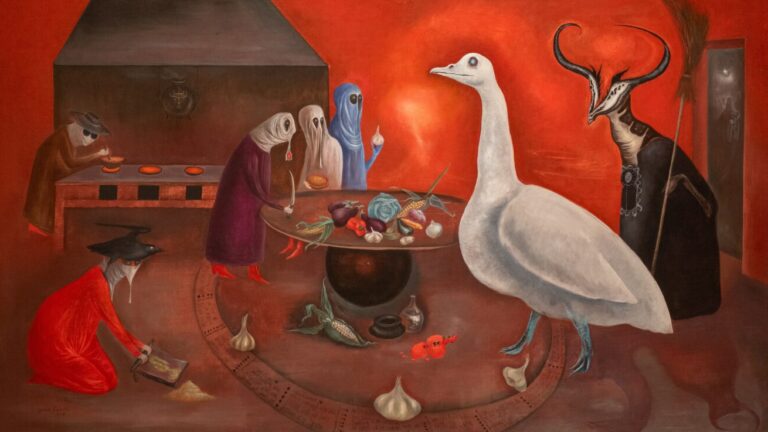
Leonora Carrington, Grandmother Moorhead’s Aromatic Kitchen, 1974, The Charles B. Goddard Center for Visual and Performing Arts, Ardmore, OK, USA. © Estate of Leonora Carrington, by SIAE 2025. Juliet. Detail..
Kin in the creative arts and in the occult, Leonora Carrington and Remedios Varo fled a war-torn Europe and found friendship and freedom in Mexico City. These renegade refugees became two of the most influential artists in the male-dominated Surrealist movement.
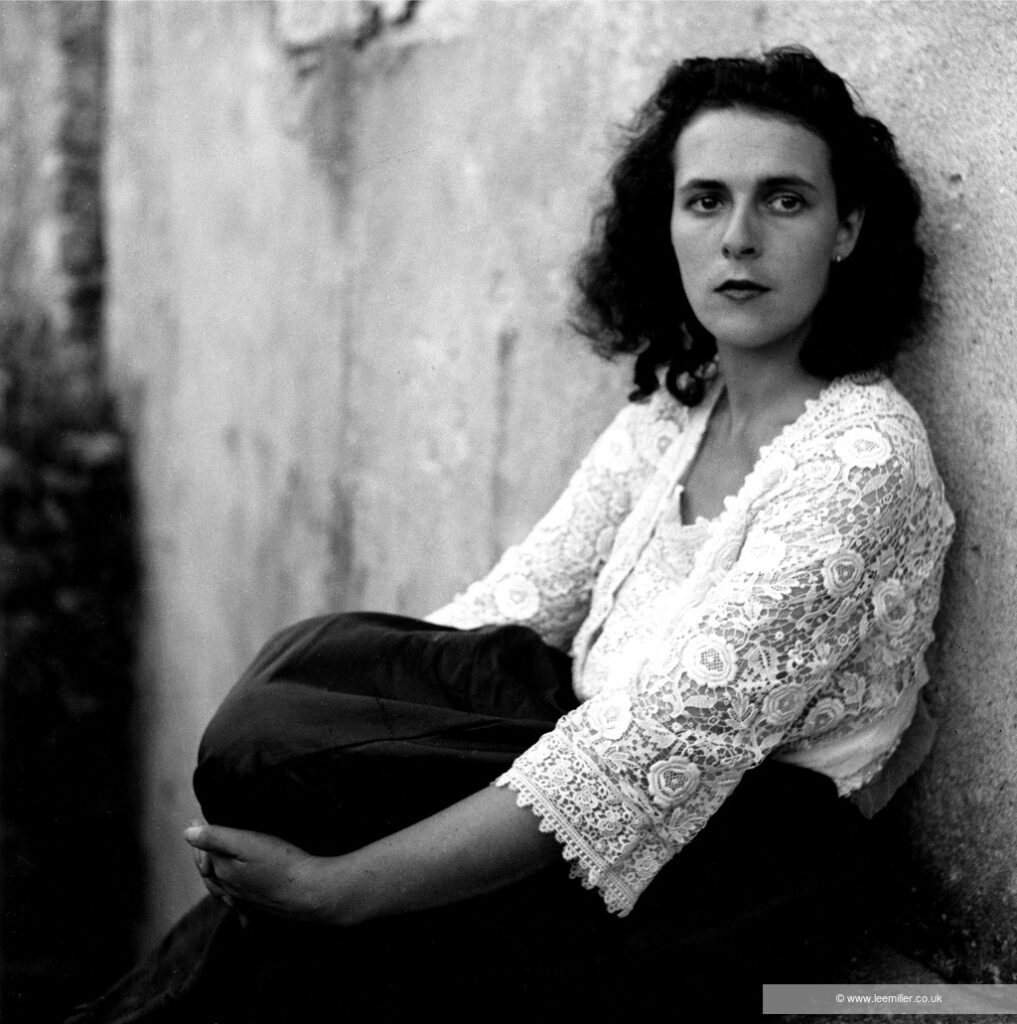
Lee Miller, Portrait of Leonora Carrington. Photograph by Theo’s Little Bot via Wikimedia Commons (CC BY-SA 4.0).
Though born of privilege, both Carrington and Varo eschewed the confines of social expectations dictated by class and gender. Carrington, born in Lancashire, England, and rebellious since her youth, was kicked out of two different Catholic schools. She had a propensity for writing with both hands simultaneously in different directions on the page, a practice nuns found unnerving. Once, she pulled up her dress in front of a priest and asked, “Now what do you think of that?”
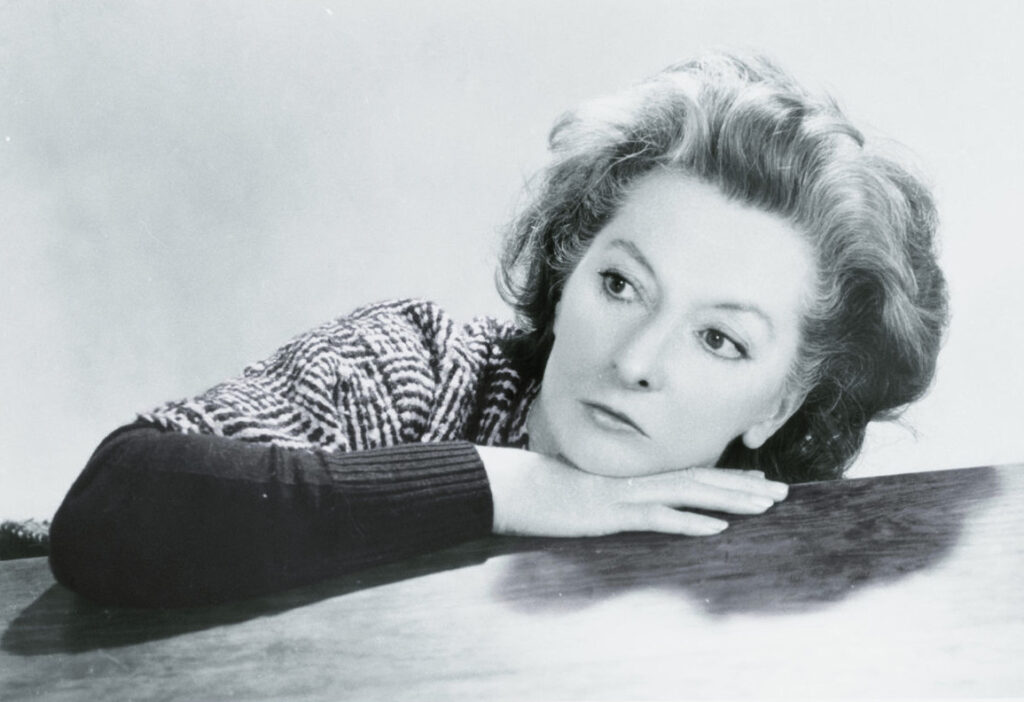
Portrait of Remedios Varo. Aware.
Remedios Varo was born in Catalonia, Spain, and her father’s work as a hydraulic engineer took the family all over Spain and into North Africa. Like Carrington, she attended Catholic schools, though with more success. Her father supported her art, and she trained in technical drawing. While a teenager living in Barcelona, she visited the Prado Museum and drew inspiration from Hieronymus Bosch and Francisco Goya. Varo attended school at Real Academia de Bellas Artes de San Fernando. While Varo more gracefully endured her Catholic school experience when compared to Carrington, her 1961 triptych shows a clear disdain for the institution and a yearning to escape from it.
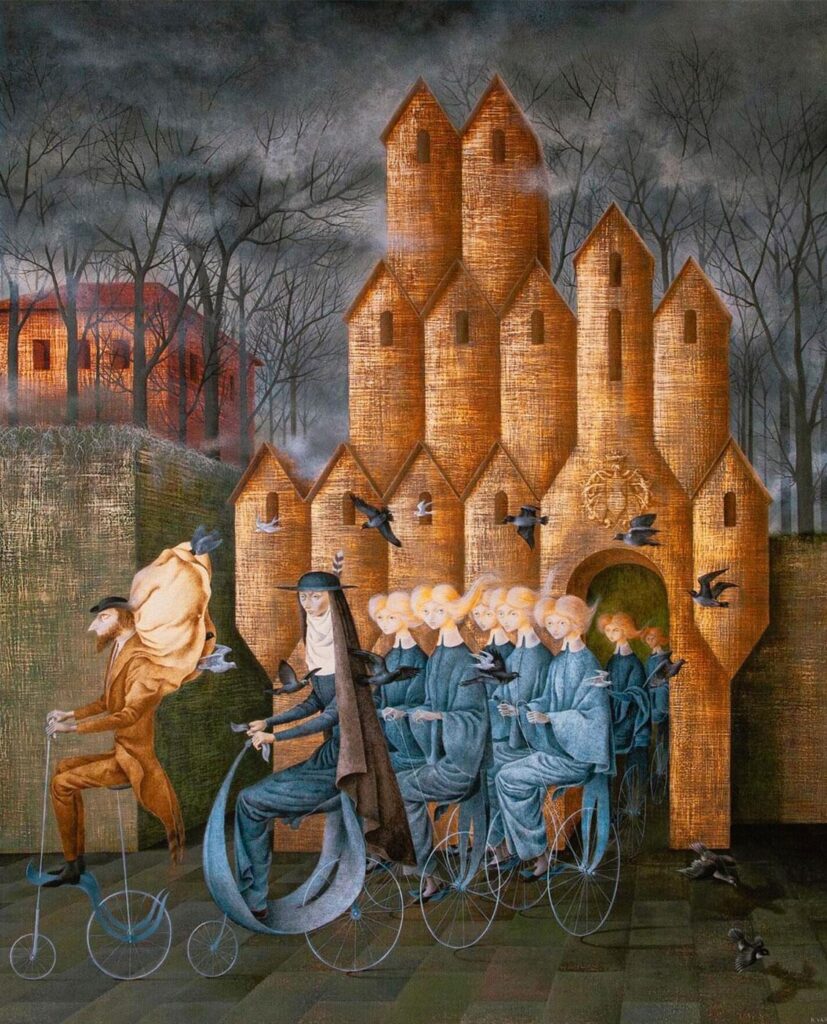
Remedios Varo, Towards the Tower, 1960, private collection. MutualArt.
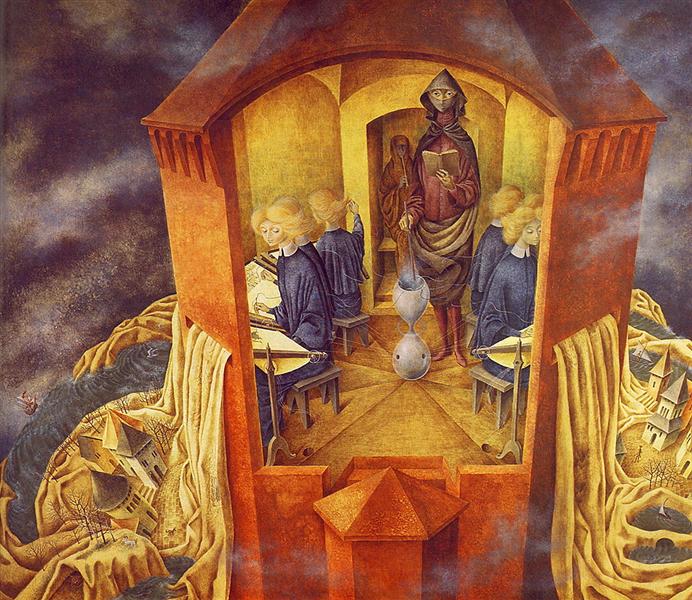
Remedios Varo, Embroidering the Earth’s Mantle, 1961, private collection. WikiArt.
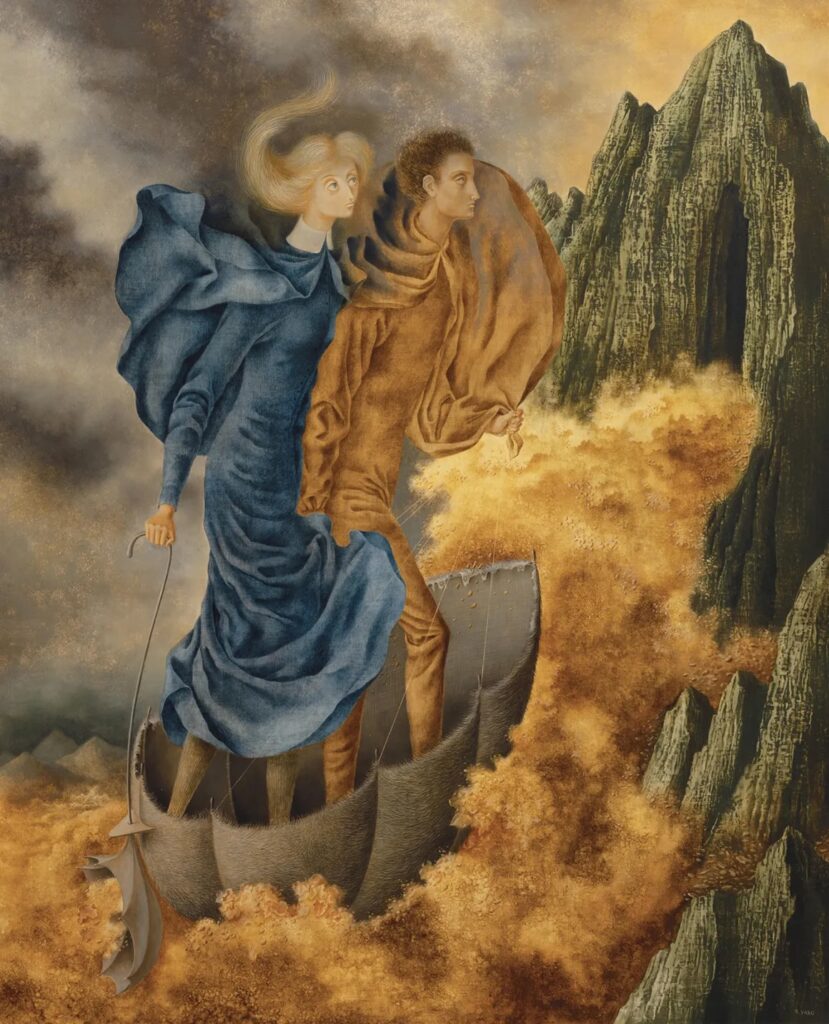
Remedios Varo, The Escape, 1961, Museo de Arte Moderno, Mexico City, Mexico. Remedios Varo, Artists Rights Society (ARS), New York/VEGAP, Madrid. Art Forum.


In the first panel of the triptych, uniformed young women follow an nun-like figure.
In the second panel of, the young women toil at a mysterious task in a secluded tower.
In the final panel of the triptych, one of the girls from the group escapes with the help of a young man.
Carrington agreed to come out as a debutante in London, England, an event she fictionalized in her short story The Debutante, in which a young woman convinces a hyena to apply makeup and pose as her at the ball.
In exchange for Carrington’s acquiescence to come out, her family agreed to send her to art school. This led her to London, then Paris when she was nineteen. There, she met Max Ernst. Despite being 26 years older than Carrington and married, Ernst became her lover, and she followed him to the southern part of France, creating a rift with her family that never healed.
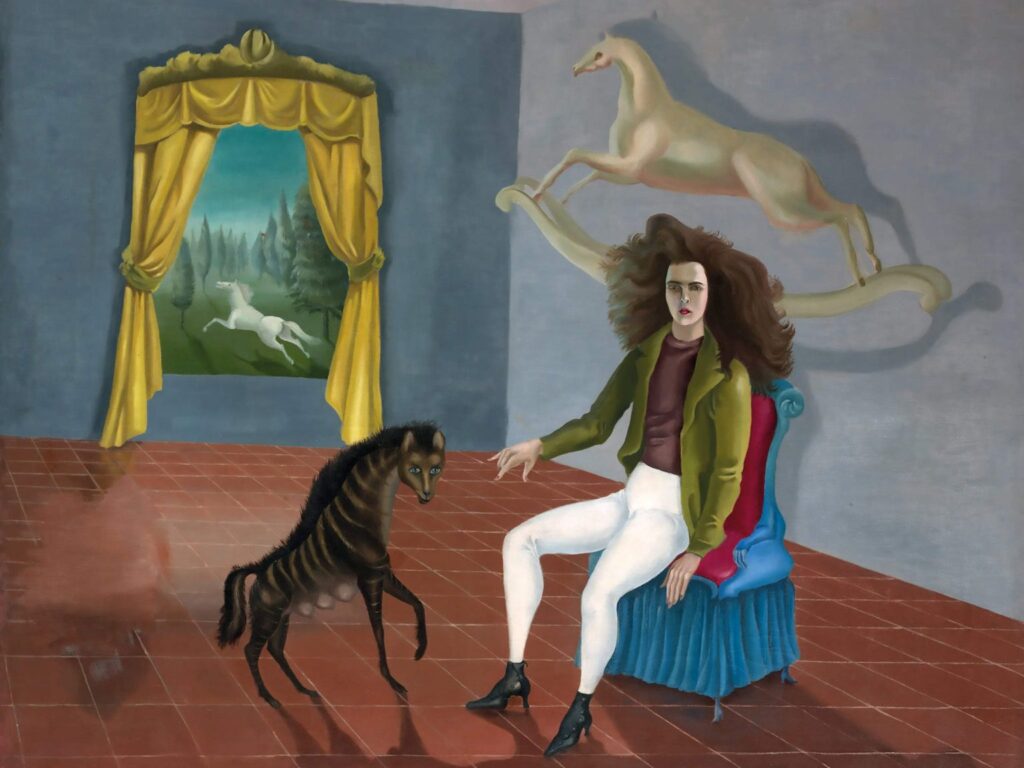
Leonora Carrington, Self-Portrait, 1938–1939, Metropolitan Museum of Art, New York City, NY, USA. Detail. Museum’s website.
Like Carrington, Varo’s romantic relationships did not abide by convention. In 1930, she married Gerardo Lizarraga, a classmate of hers from Madrid. By 1932, Varo, still married to Lizarraga, moved in with surrealist Esteban Francés. By 1937, with the Spanish Civil War underway, Varo fled to Paris with poet Benjamin Péret.
In Paris, Carrington met Varo and they exhibited and published work together-along with Max Ernst, Benjamin Péret, and other Surrealists. In 1938, André Breton, author of the surrealist manifesto and the unofficial arbiter of the true Surrealists, included Varo and Carrington in Exposition Internationale du Surréalisme, granting them both admission to a largely male club.
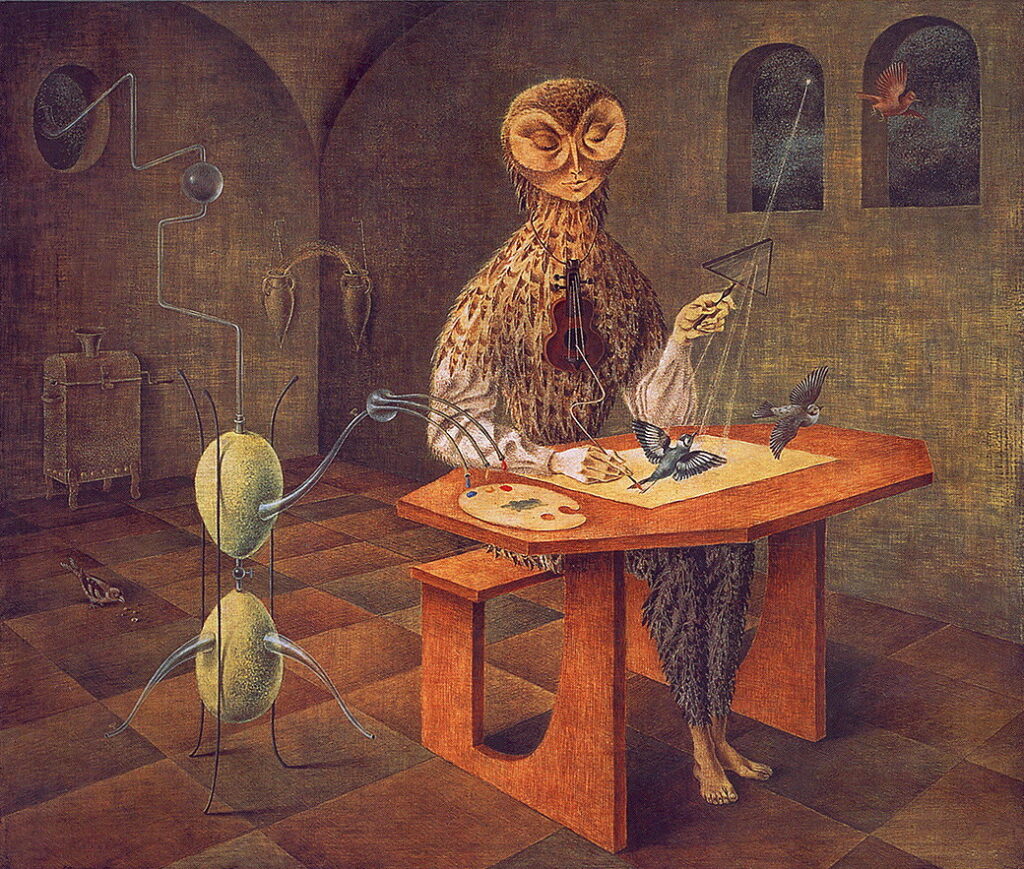
Remedios Varo, Creation of the Birds, 1957, Museo de Arte Moderno, Mexico City, Mexico. © Artists Rights Society (ARS), New York / VEGAP, Madrid. WikiArt.
The Nazi invasion tore up Paris and its surrealist movement. Max Ernst, a German National, was arrested by the French as an enemy alien. Later, in Nazi-occupied France, he was arrested by the Gestapo for being a degenerate artist. Péret was also arrested for his leftist politics, and later, so was Varo. Eventually, Varo and Péret, denied entry into the US, fled to Mexico on the SS Serpa Pinto. Varo wrote, “… since the ship carried four times as many travelers as would normally fit, they packed us into the holds.”
Carrington’s route to Mexico was more circuitous. After Ernst’s arrest, she suffered a mental break, was institutionalized, escaped, then married Renato Leduc, a diplomat, as a means of safe passage to Mexico. She recounts this unstable period in her memoir Down Below, which, while containing verifiable biographical facts, also includes passages like “I was transforming my blood into comprehensive energy–masculine and feminine, microcosmic and macrocosmic–and into a wine that was drunk by the moon and the sun.”
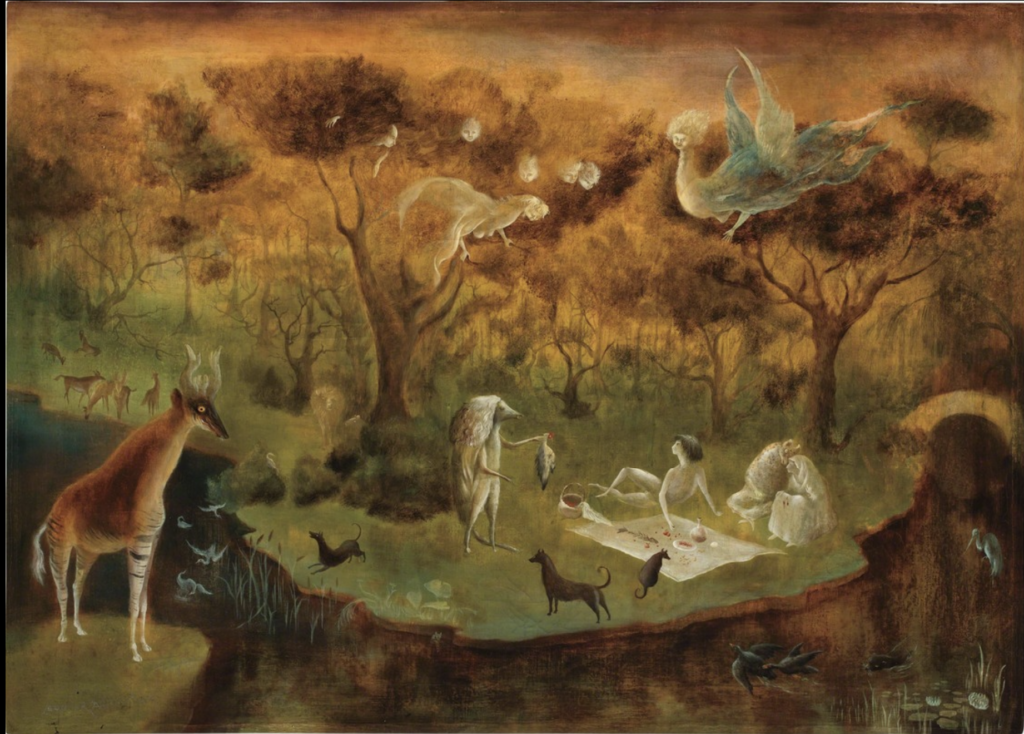
Leonora Carrington, Pastoral, 1950, private collection. Artsy.
It was in Mexico, in 1942, that Carrington and Varo reconnected through a rag-tag group of refugee European artists. They lived only blocks apart and saw each other almost daily. Surrealist photographer Kati Horna was another friend, neighbor, and creative partner.
A translation of the placard below from the Mexican Museum of Modern Art about ex-pat Surrealists reads, “Their lives were simple: they drank little, smoked a great deal, and gathered in one another’s homes—most of which were located in the Colonia Roma neighborhood.”
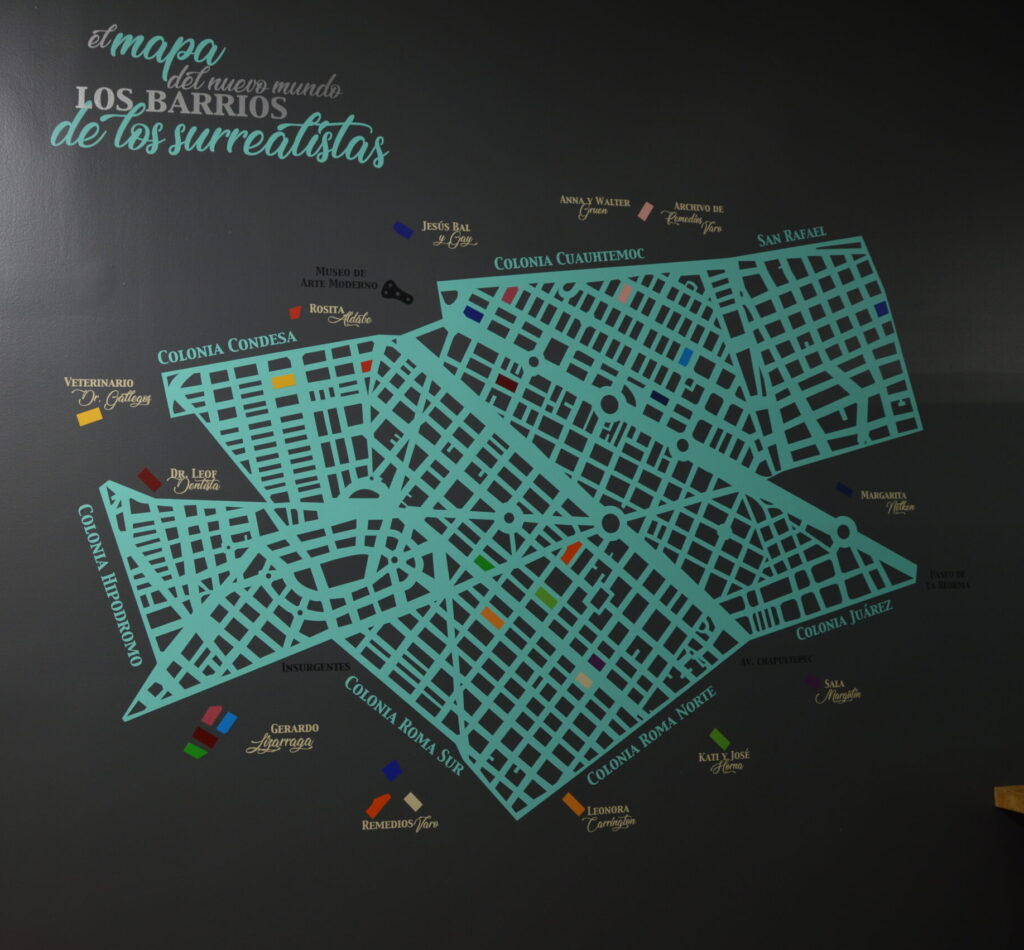
The Map of the New World: The Neighborhoods of the Surrealists, Historical Archive of the Museum of Modern Art, INBAL/ Ministry of Culture, Series: International Traveling Exhibitions, Addicted to Remedios Varo. New Legacy, Exp. No. 539.01.01.02.04/1/2018. Detail.
Gallery owner Wendi Norris told The New York Times, “Varo and Carrington would see each other almost every day, either in the middle of the day to go to the market or later in the evening for dinner, and they would discuss what they were working on.”
Because Varo’s first language was Spanish and Carrington’s English, they spoke in French or sometimes a mix of the three languages. They wrote together, sometimes playing intellectual “exquisite corpse” surrealist games where one would continue on with the other’s idea.
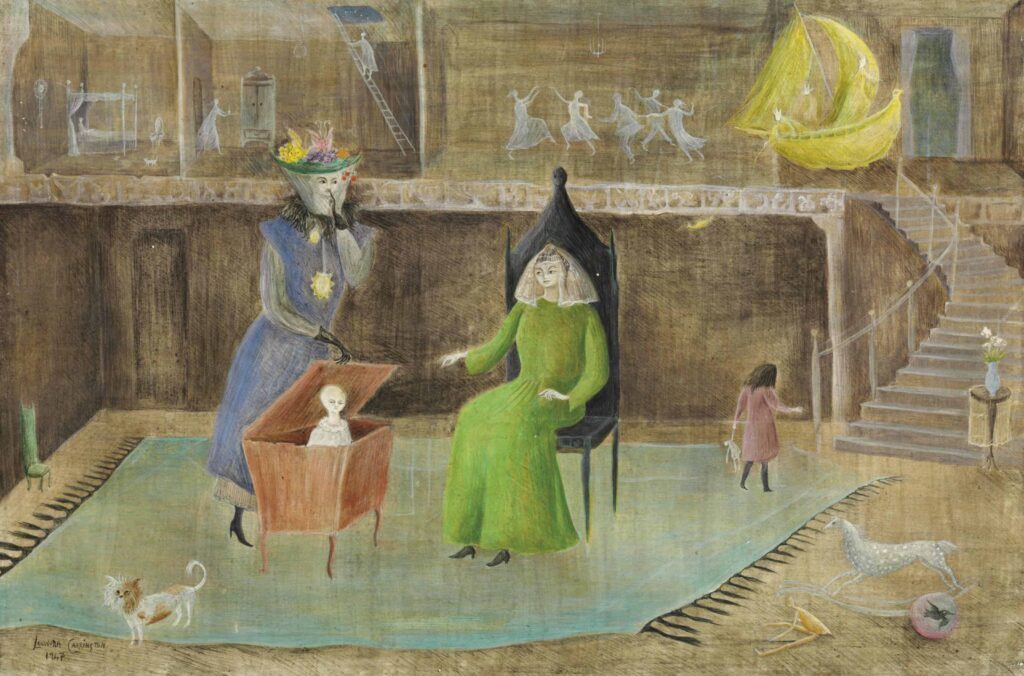
Leonora Carrington, Neighbourly Advice, 1947, private collection. Christie’s.
Carrington and Varo’s friendship stretched beyond canvases and even beyond the physical world, into an amorphous existence including art, magic, and mysticism. They shared writing, recipes, and spells. Carrington designed a tarot deck, and many of these tarot figures appeared in Varo’s work.
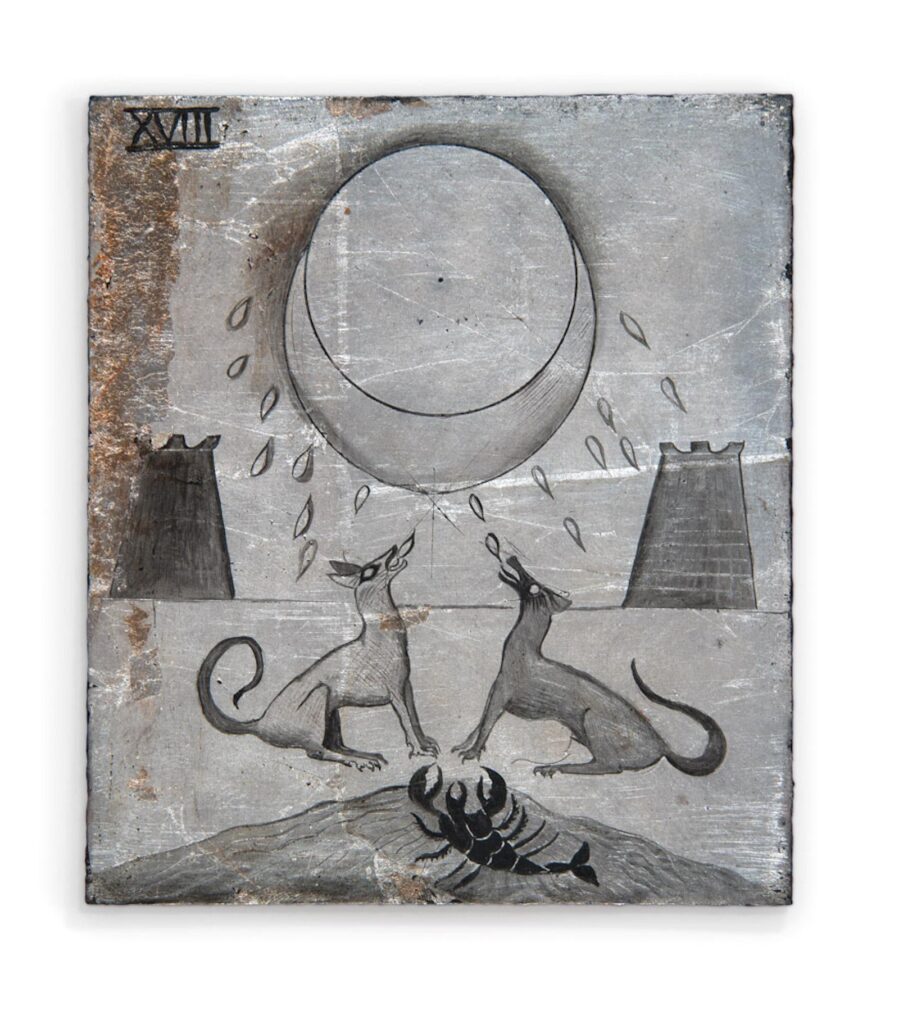
Leonora Carrington, The Moon, 1955. © Estate of Leonora Carrington/ARS, New York. Art and Object.
Varo’s background in technical drawing and interest in science is evident in her paintings. Often, her figures engage in sorcery, a harnessing of nature outside the rules of the physical world. Carrington’s work is also filled with creatures, both real and fantastical, creating a cross-species community that makes sense only in a dream state.
Whether undertaken with true belief or in the spirit of surrealist playfulness, the two engaged in spell-making and sorcery. In a letter to André Breton, Carrington wrote, “Remedios and I have timidly dipped our fingers into practical witchcraft, at times with palpable results.”
Varo’s outlandish spell “To Provoke Erotic Dreams” includes things like honey and garlic, but also false mustaches and a whalebone corset. The instructions for preparations are just as absurd as the list of ingredients.
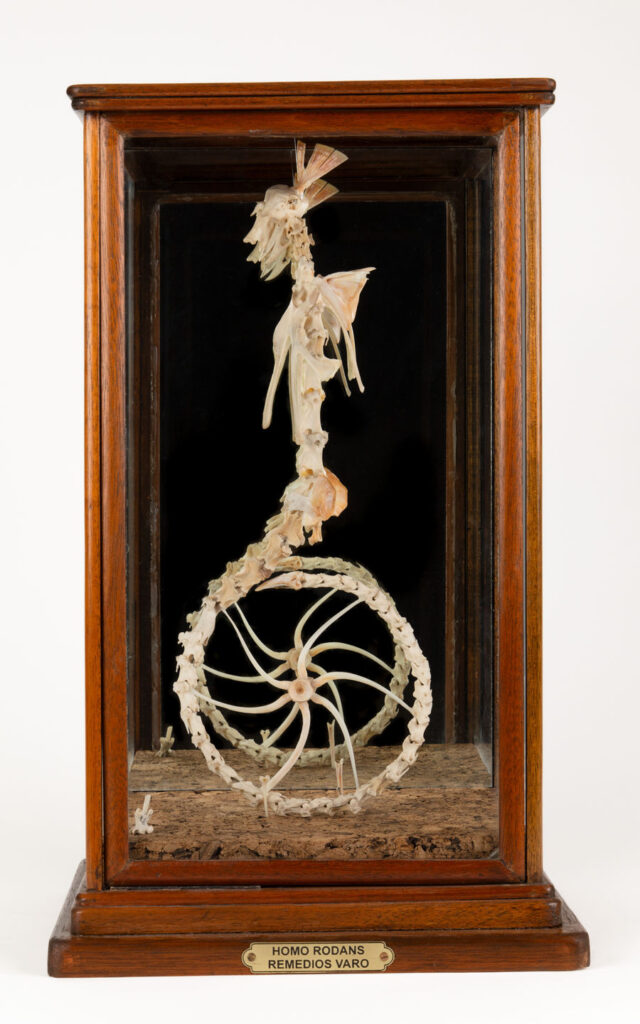
Remedios Varo, Homo Rodan, 1959, private collection. Wendi Norris Gallery.
Both women embraced a variety of religions and myths. In Mexico, the Catholicism they’d grown up with bent and shifted to incorporate pre-colonial religion. Varo once wrote a letter, translated into English by Carrington, to Gerald B. Gardner, a prominent British Wiccan. In the letter, she wrote, “Mrs. Carrington and some other people—have devoted ourselves to searching for facts and data that are still preserved in remote areas that participate in the true practice of witchcraft.”
Carrington studied religion and mythologies and took a particular interest in Buddhism. In a The New York Times interview, when asked if she believed in God, she said, “Of course. Which one?”
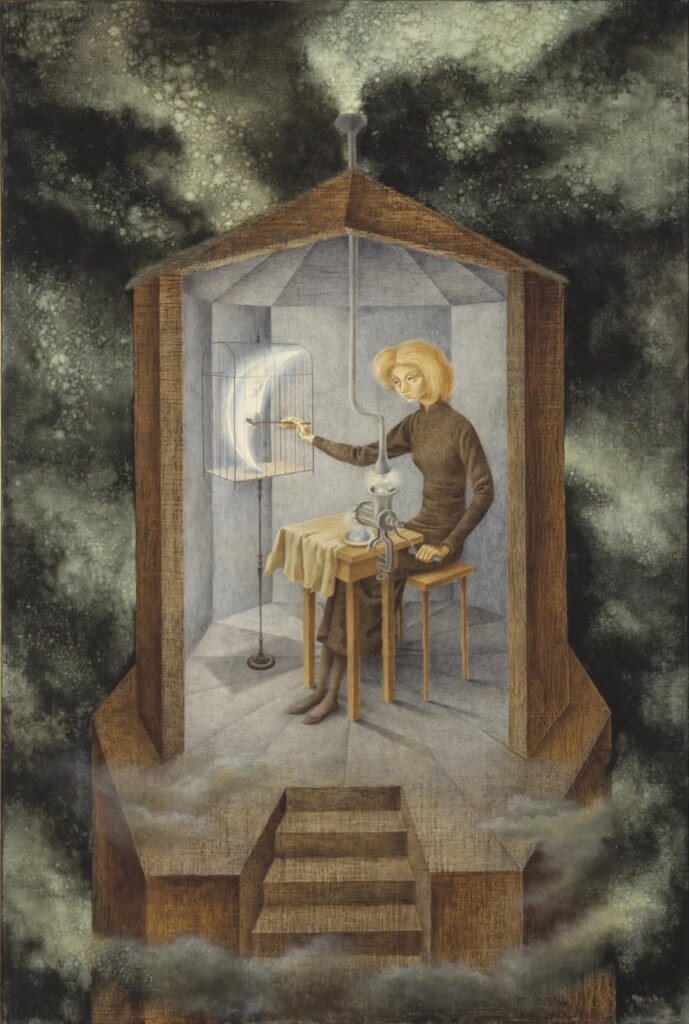
Remedios Varo, Papilla Estelar, 1958, FEMSA Collection, Mexico City, Mexico. Wendi Norris Gallery.
In Mexico, a new brand of ex-pat Surrealism was growing. For Carrington, Varo, and Horna, this meant leaving behind some of the male-centric ideas born out of the European movement. Max Ernst, André Breton, and other male Surrealists espoused the importance of the “femme-enfant,” a child-like beautiful woman who inspires creativity. It’s likely this was what Ernst and others saw in Carrington when she arrived in Paris at age 19. Ernst called her his “Bride of the Wind.”
Carrington herself said, “I didn’t have time to be anyone’s muse…I was too busy rebelling against my family and learning to be an artist.” With Varo, Carrington didn’t have to be a muse; she was a collaborator, a conspirator. Likewise, Varo, in 1957, acknowledged the profound impact of the European Surrealists, but then said, “Today I do not belong to any group; I paint what occurs to me, and that is all.”
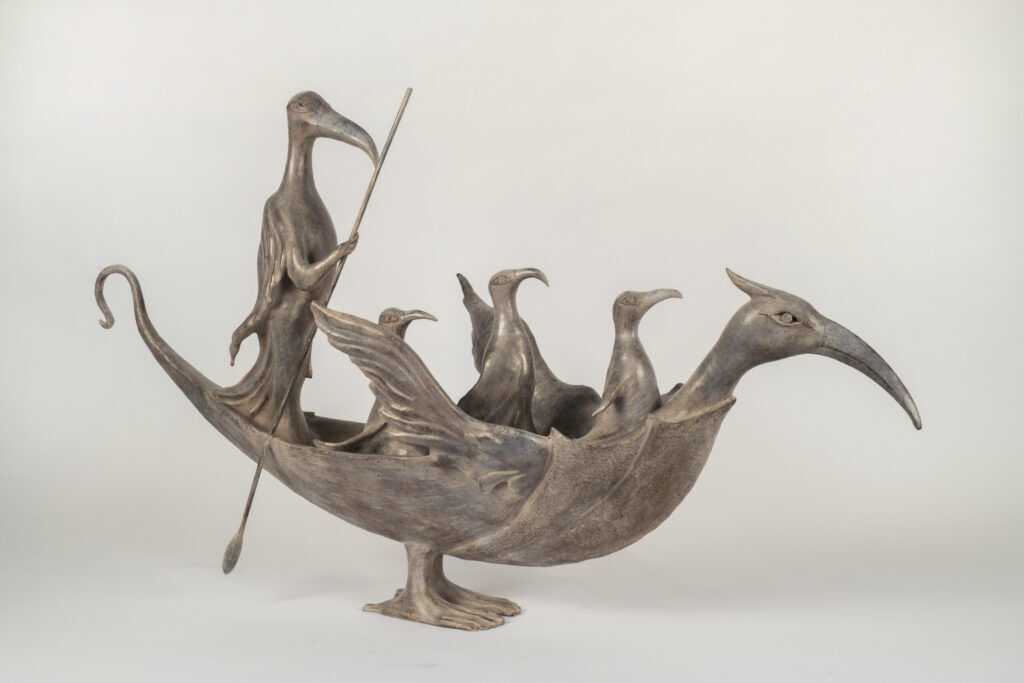
Leonora Carrington, Ship of Cranes, 2010, National Museum of Women in the Arts, Washington, DC, USA. © Leonora Carrington/Artists Rights Society (ARS), New York. Photograph by Lee Stalsworth via The Art Newspaper.
Their work blossomed in Mexico, and both found partners who supported their work. Carrington married refugee photographer Chiki Weisz in 1946, and the couple had two sons. In 1952, Varo married Walter Gruen, who would become instrumental in building her artistic legacy.
Varo died suddenly of a heart attack at age 54. André Breton, forever placing himself at the head of the surrealist movement, eulogized her by saying, “Surrealism claims totally the work of the enchantress too soon gone.” Longtime friend, surrealist painter Óscar Domínguez, had already given her a nickname more suited to her independent streak when he called her “The Lioness of Madrid.”
As if foreseeing her death and legacy, she titled her last painting Still Life Reviving. Carrington would later say, “Remedios’s presence in Mexico changed my life.”
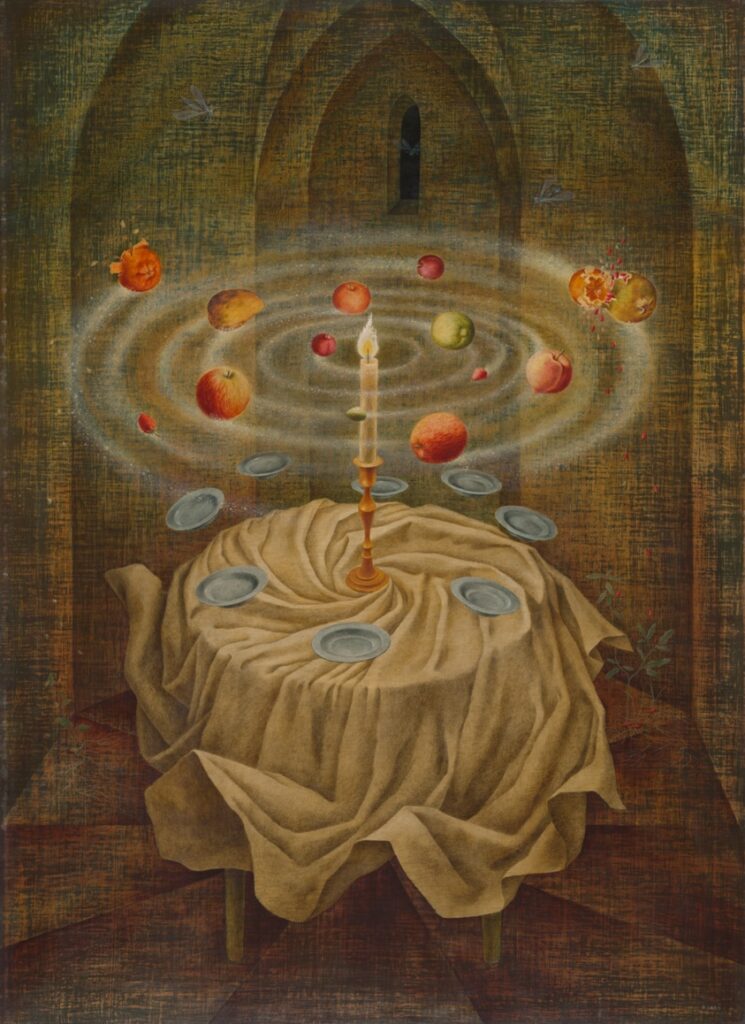
Remedios Varo, Still Life Reviving, 1963, Art Institute of Chicago, Chicago, IL, USA. Museum’s website.
Leonora Carrington remained in Mexico City. In 1974, she published The Hearing Trumpet, a novel in which she imagines a friendship between two women in their nineties based on herself and Varo. Carrington lived to age 94 and continued to work, paint, and give enigmatic interviews about her life and place in art history.
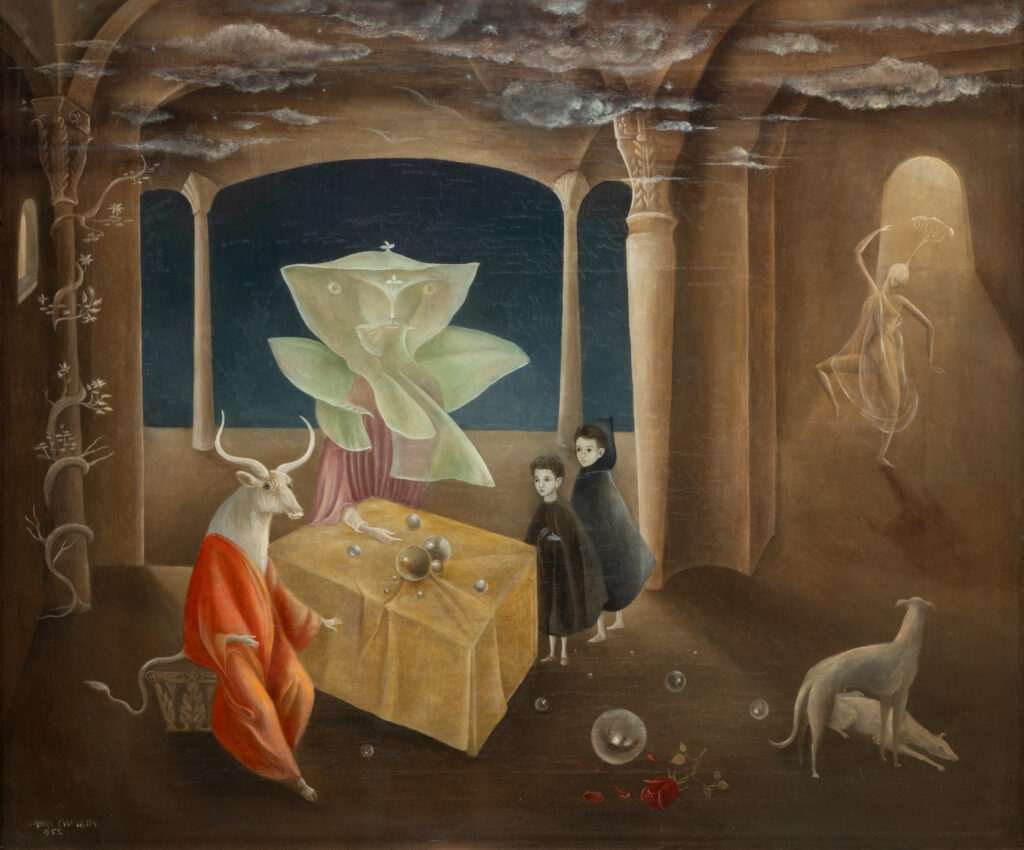
Leonora Carrington, And Then We Saw the Daughter of the Minotaur,1953, Museum of Modern Art, New York City, NY, USA. Museum’s website.
In a 1992 documentary, she sits at a table next to Chiki Weisz, drips a potion into a cup with an eyedropper, and says, “One has to protect one’s soul against demons,” and drinks it.
Thrown together as refugees in Mexico, Remedios Varo and Leonora Carrington created their own branch of Surrealism. Born from the European movement, they stood out in style and philosophy. In a recent traveling exhibit, Dreamworld: Surrealism at 100, the Philadelphia Museum of Art placed Varo and Carrington together in the exhibit’s final room, calling it “magic art.” There, Carrington and Varo’s work created a whimsical and narrative finale to the complex amalgamation of surrealist art.
DailyArt Magazine needs your support. Every contribution, however big or small, is very valuable for our future. Thanks to it, we will be able to sustain and grow the Magazine. Thank you for your help!

Theodore Carter is the author of several books including "Stealing The Scream" and "Frida Sex Dreams and Other Unnerving Disruptions". You can see his art out in the streets of Washington, DC, and on his website: https://theodorecarter.com.

Leigh is a writer, reader, art lover, radio nerd and herbalist based in Nashville, TN.
Salvador Dalí (1904–1989) is celebrated as one of the most imaginative and influential artists of the 20th century. His unique vision extended...
Errika Gerakiti 1 January 2026
Gertrude Abercrombie’s barren landscapes, cats, female figures in long dresses, and other repeated imagery built a complex body of haunting...
Theodore Carter 5 June 2025
Edward James saw himself as more than just a patron of Surrealism—he considered himself intimately connected with the movement and the ideas it...
Nikolina Konjevod 24 November 2026
Exploring five works by female Surrealist Meret Oppenheim
Candy Bedworth 3 November 2026


