
A Beginner’s Guide to Icons in Eastern Christianity
Icons are among the oldest image traditions, yet they often remain misunderstood, especially in the West. They belong to a visual culture that...
Catherine Razafindralambo 27 April 2026

Gustav Klimt, The Maiden, 1913, National Gallery in Prague, Prague, Czechia. Detail.
The Vienna Secession rebelled against the established order of art in Austria in the 19th century. Art Nouveau and other movements across Europe inspired the Secessionists to bring modern art to the country. Members of the Vienna Secession included artists and designers such as Gustav Klimt, Koloman Moser, Josef Hoffmann, and Joseph Maria Olbrich. Although the movement was short-lived, it has a lasting impact on art and design to this day.
The Vienna Secession developed as a reaction to what its artists felt was stagnation in the Viennese art world at the time. Architecture and art in Vienna at the end of the 19th century were a mishmash of recycled classical styles. It was not yet embracing modernist movements that were popping up in other parts of Europe. The Academy of Fine Arts and the Künstlerhaus Genossenschaft (the Association of Austrian Artists) were the gatekeepers of visual art in the city. These institutions favored art in conventional, realist styles. The Künstlerhaus was even an example of Neo-Renaissance architecture, inspired by Italian Renaissance villas.
At the time, any established artist in Vienna had to be a member of the Künstlerhaus if they wanted to participate in exhibitions. It was not uncommon for the juries of Künstlerhaus exhibitions to reject impressionist or modernist works and they typically chose naturalist or academic pieces instead.
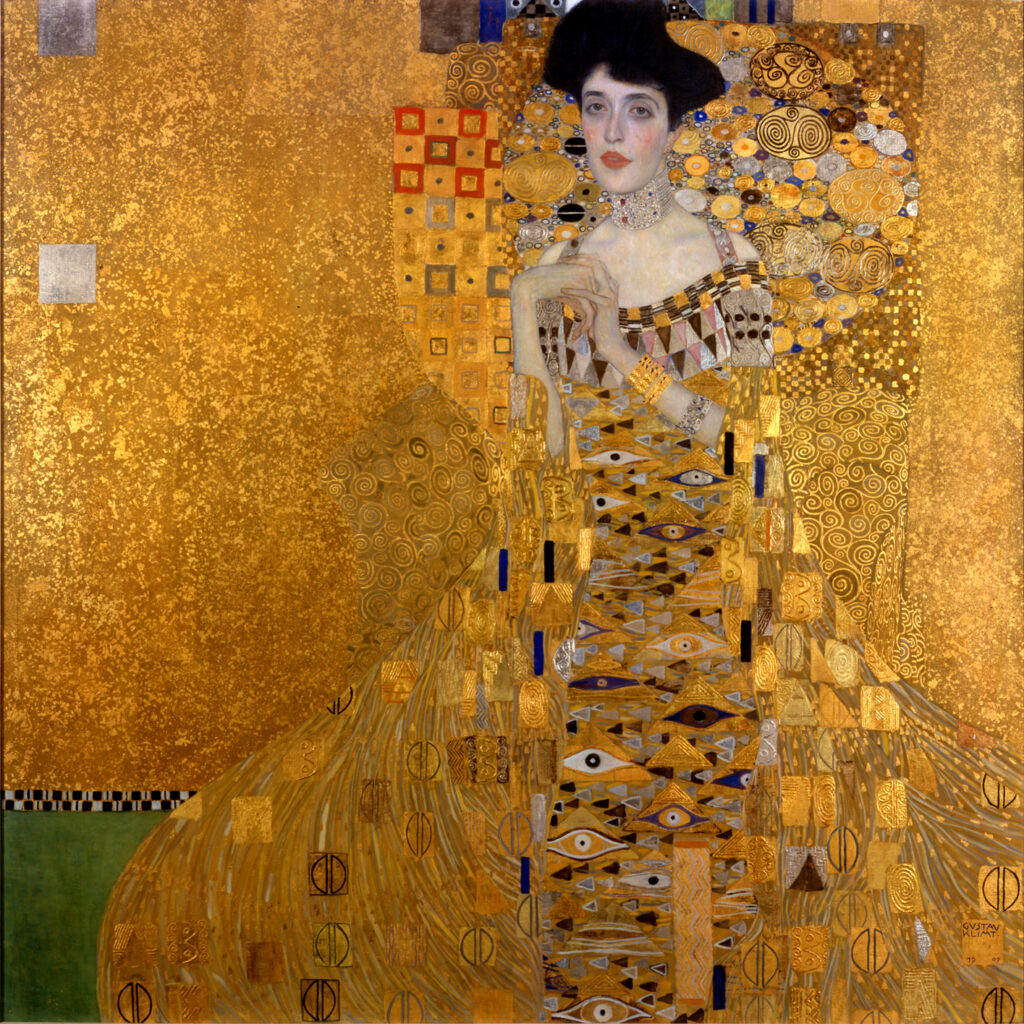
Gustav Klimt, Portrait of Adele Bloch-Bauer I, 1904–1907, Neue Galerie New York, New York City, NY, USA.
In reaction to this very limited view of what constituted art, modern-thinking artists began meeting regularly to discuss works by new artists in other parts of Europe and to exchange ideas. Then, in 1896, the very conservative artist Eugen Felix was re-elected president of the Künstlerhaus. Members, many of whom had been left out of exhibitions in the past, voiced their opposition. Gustav Klimt, at the peak of his fame at the time, quickly became the leader of a new group that decided to form a new society of artists based on German secessionist groups.
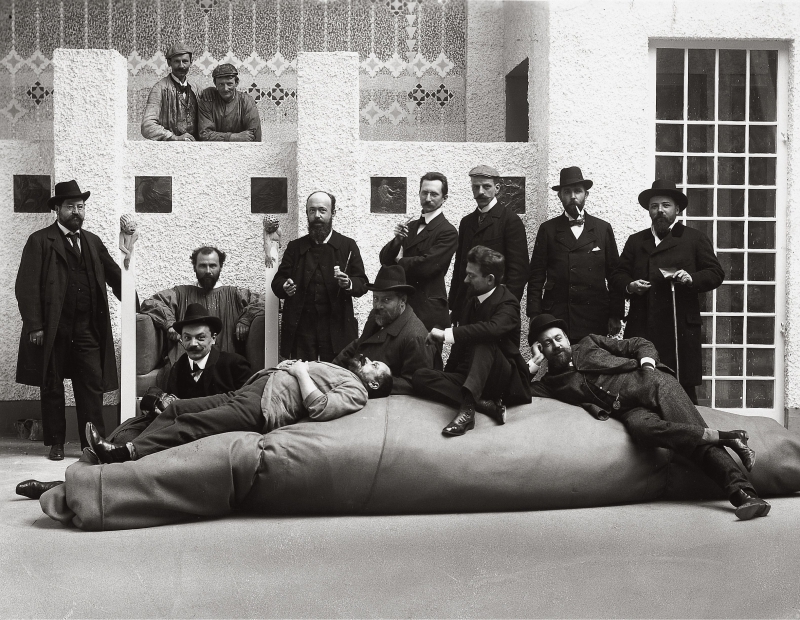
14th exhibition at the Vienna Secession, 1902. Photograph by Moritz Nähr. Leopold Museum.
On April 3, 1897, Klimt’s group sent a letter to the Künstlerhaus announcing their formation and listing Klimt as president. Of the 40 signatories to the letter, 23 were Künstlerhaus members. They actually intended to stay part of the association, but on May 22 everything changed. The Künstlerhaus board of directors put forth a motion to censure Klimt’s group during an assembly. Klimt and his followers were thus forced to leave the meeting in silence. Two days later, 12 artists submitted an official letter of resignation to the Künstlerhaus, even more artists resigned over the following two years. Thus the Vienna Secession was born.
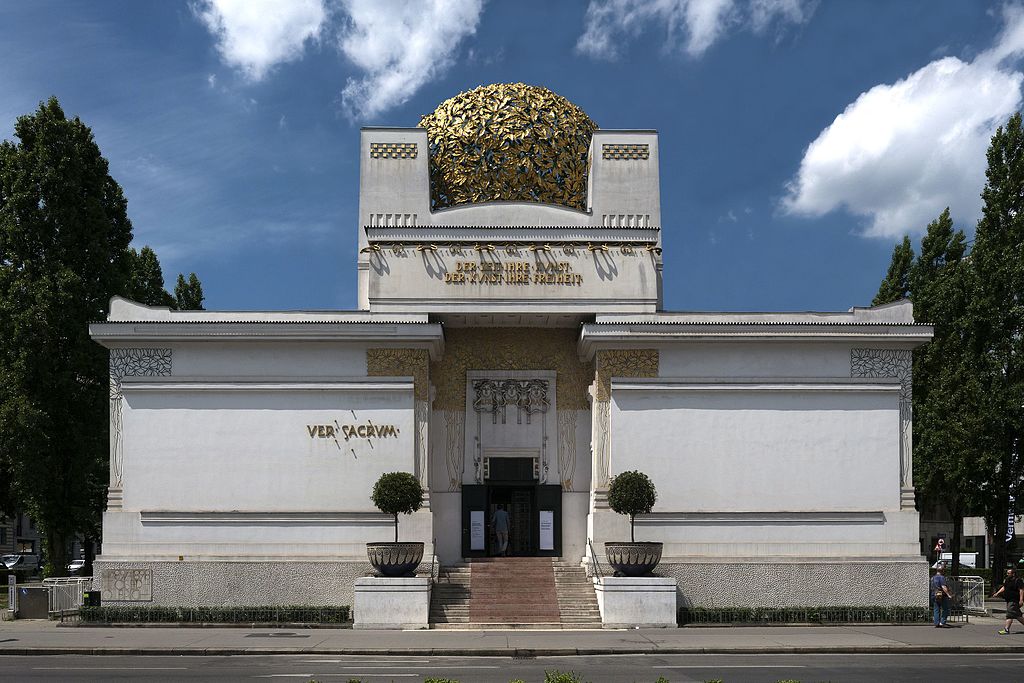
Josef Maria Olbrich, Vienna Secession Building, 1898. Photograph by Thomas Ledl via Wikimedia Commons (CC BY-SA 4.0).
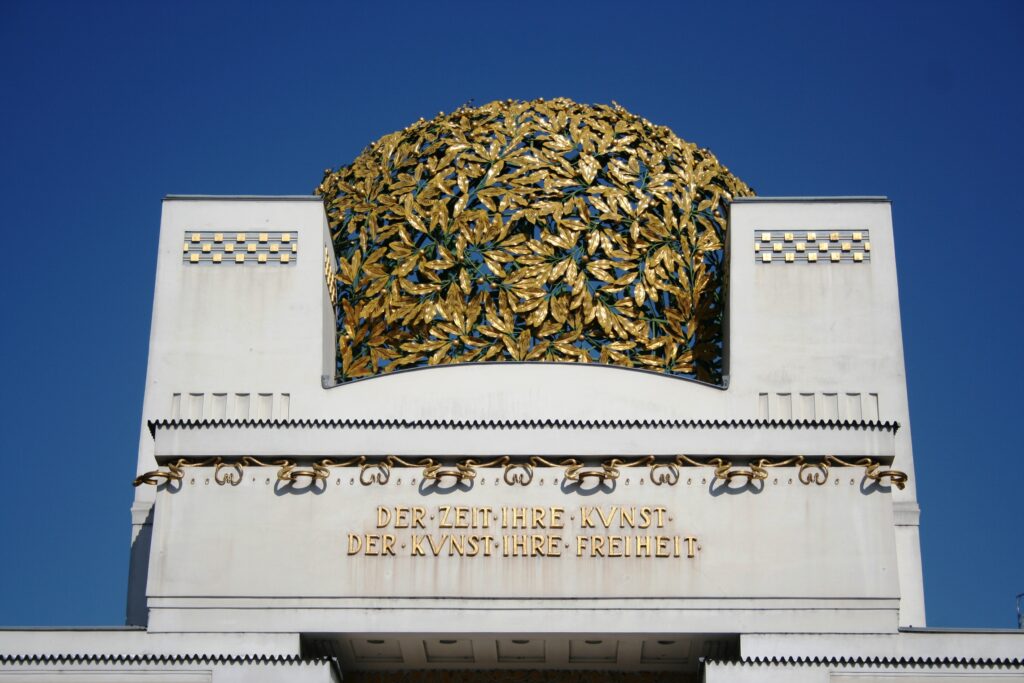
Josef Maria Olbrich, Vienna Secession Building, 1898. Photograph by Greymouser via Wikimedia Commons (CC BY-SA 3.0 at).
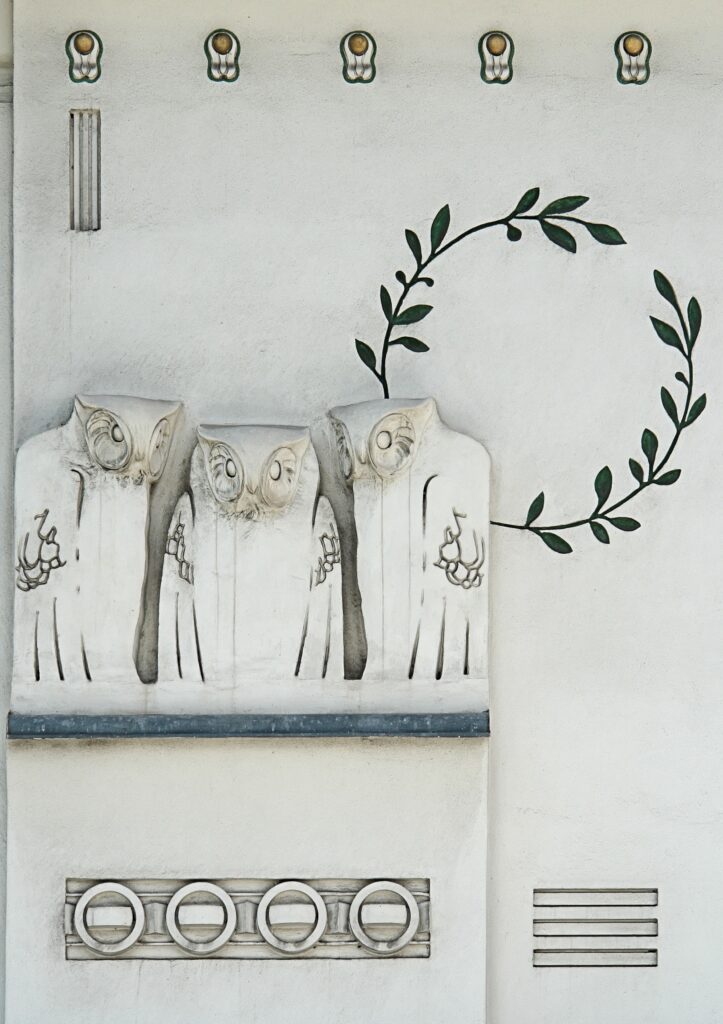
Josef Maria Olbrich, Decoration of the Vienna Secession Building, 1898. Photograph by Alberto Fernandez Fernandez via Wikimedia Commons (CC BY 2.5).
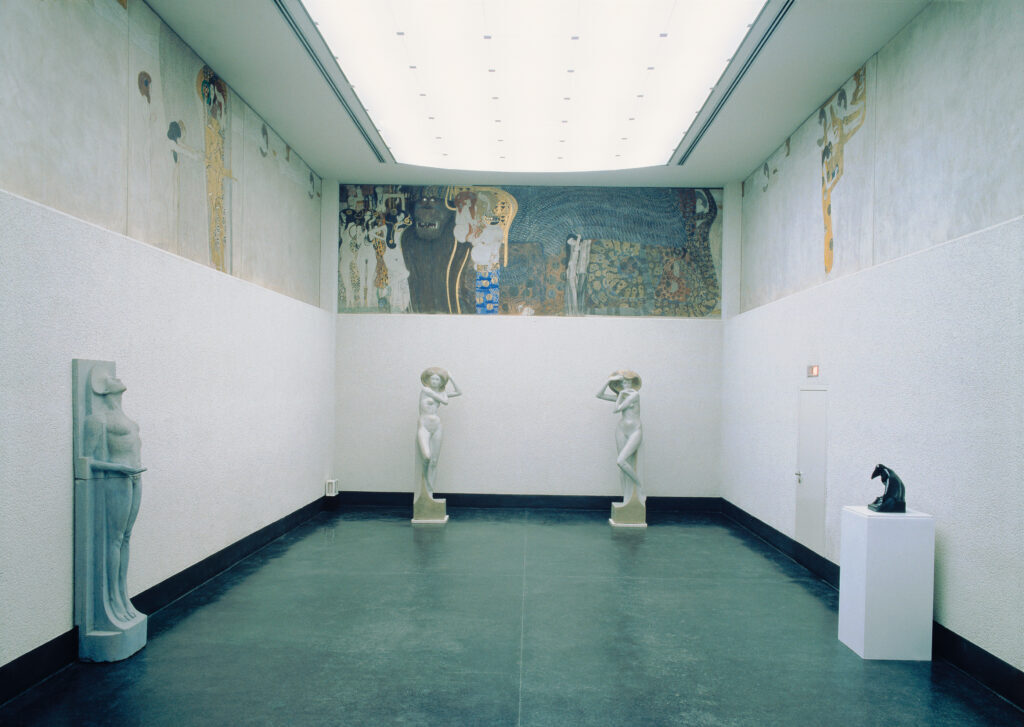
Josef Maria Olbrich, Interior of the Vienna Secession Building detail, 1898. Wikimedia Commons (public domain).


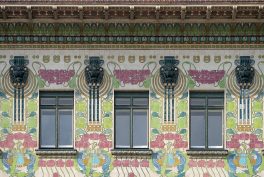
The facade of the Secession Building exemplifies the movement’s style—symmetry, geometric shapes, and Art Nouveau-inspired leaf motifs are all on display.
The motto over the main entrance reads: “Der Zeit Ihre Kunst Der Kunst Ihre Freiheit” (To Every Age Its Art, To Every Art Its Freedom).
These delightful owls by Moser show the Secessionists’ simplified approach to motifs from nature.
On the far wall we can see Klimt’s Beethoven Frieze.
The first exhibition by the Vienna Secession was held in the Horticultural Society building, which charged rather high rates to rent. Subsequently, architect Josef Maria Olbrich designed a space specifically to host Secessionist shows. Olbrich was responsible for arrangement and hanging of the first exhibition, so he saw the need for the group to have a versatile space.
The architect incorporated movable partitions so each exhibition could have a unique layout and accommodate all disciplines simultaneously. In fact, it was the first gallery dedicated entirely to contemporary art in Vienna and soon became a symbol of the Secessionist movement. Emblazoned over the main entrance was the motto: “To every age its art, to every art its freedom”. Sadly, the original building was destroyed by the Nazis during the Second World War as “degenerate art” but was reconstructed after the war ended.
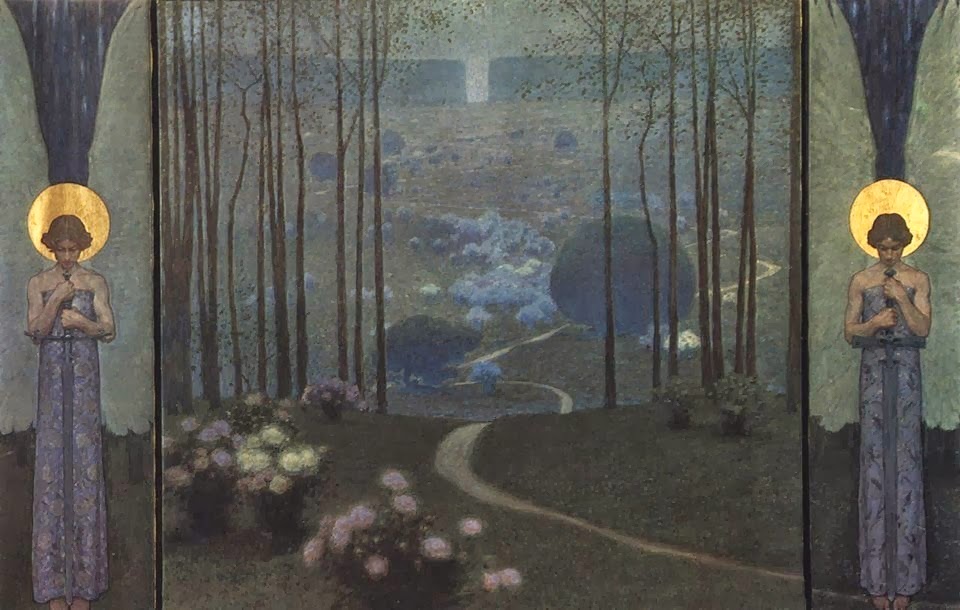
Wilhelm Bernatzik, Eingang zum Paradies (Entrance to Paradise), 1906.
The Vienna Secession didn’t have a concise manifesto or direction like other modernist movements of the era. Truly, they were a loosely associated group of artists who collectively aimed to bring change to an artistically stagnant Vienna. Subsequently, each Secessionist artist had their own style and approach. However, certain art movements and trends in other parts of Europe influenced the group.
On the one hand, Secessionists incorporated elements of Jugendstil and Art Nouveau. On the other hand, their works tended more towards symmetry and repetition. Secessionist works also often incorporated squares and grids, a nod to the Arts and Crafts movement. Finally, the concept of Gesamtkunstwerk or total work of art, in which all elements of design harmonize to create the whole, was very popular with the Vienna Secession.
Another major influence on the Vienna Secession, and other art movements of the time, was Japonisme. The Secession exhibit of 1903 was even devoted to Japanese art. The preference for natural materials and handiwork seen in Japanese art is reflected in the tendencies of Secessionist artists and designers. Also, most evident in graphic design, is the influence of Japanese woodblock prints. Strong colors, bold outlines, flat visual planes, and patterned surfaces in the style of Japanese works can be seen in both Secession fine art works as well as graphic designs.
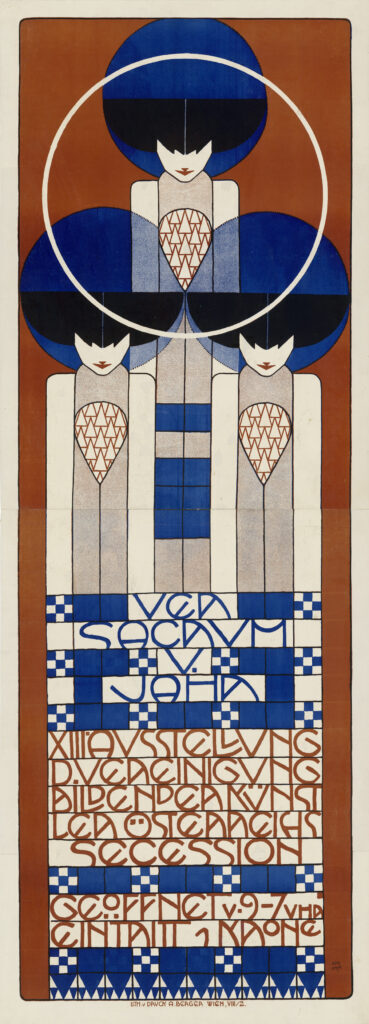
Koloman Moser, Ver Sacrum, poster for the 13th Secession exhibition, 1902, Kunstbibliothek Berlin, Berlin, Germany.
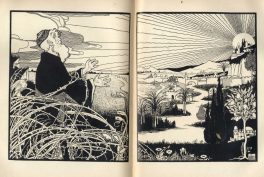
From 1898–1903, the Vienna Secession published a magazine, Ver Sacrum (Latin for “Sacred Spring”). Initially it was published monthly and each issue was dedicated to a particular artist. The highlighted artist also designed the cover for their issue. The first issue was released a whole 11 months before the Secession building opened and three months before the group’s inaugural exhibition at the Horticultural Society. Koloman Moser was the magazine’s principal designer. He was very creative with the layouts, which changed constantly from one issue to the next.
Ver Sacrum also made advances in typography, illustration, and graphic design that continue to influence book and magazine design today. For example, the magazine was published in a unique square format which was a radical innovation at the time.
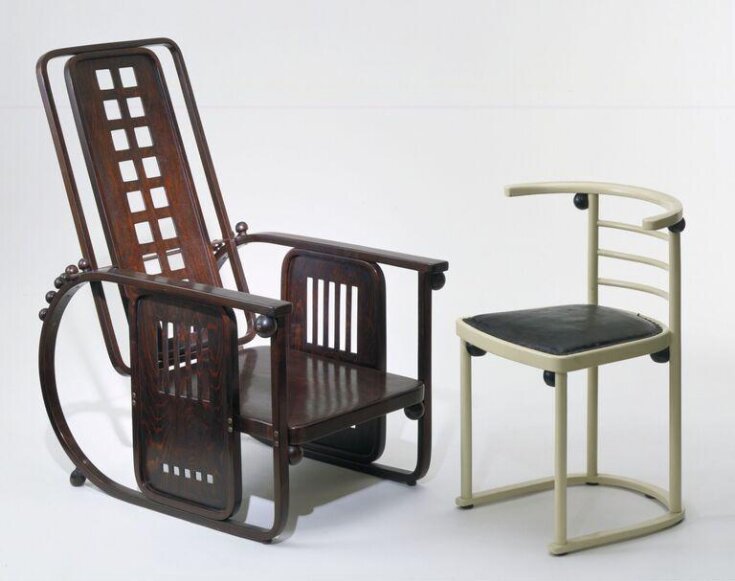
Josef Hoffman, Adjustable armchair (left) and chair (right), ca. 1907, Victoria and Albert Museum, London, UK.
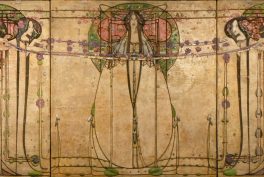
Vienna Secession designers established the Wiener Werkstätte in 1903 as a workshop to produce their designs. Their furniture exemplifies simplicity and elegance, beauty and practicality. They also emphasized craftsmanship and quality while integrating innovative techniques and materials. For example, bentwood was a relatively new process at the time and is often seen in Secession furniture. Influences from Art Nouveau as well as the Arts and Crafts movements are clearly visible in these pieces. In particular, the use of geometric shapes and minimal ornamentation perfectly reflects furniture by the Arts and Crafts designer, Charles Rennie Mackintosh.
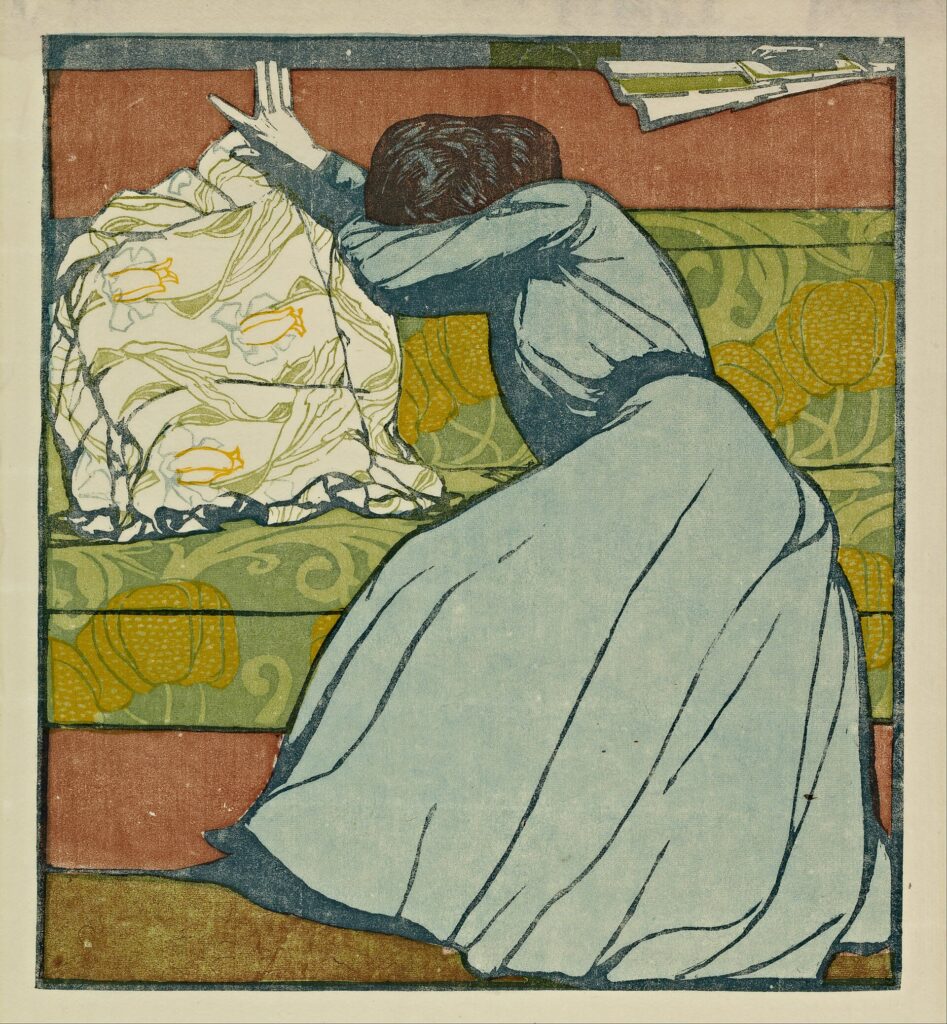
Max Kurzweil, Der Polster (The Cushion), 1903, National Gallery of Art, Washington, DC, USA.
Over time, rifts appeared within the Vienna Secession and the group eventually divided into two camps. Unsurprisingly, Klimt led one group which promoted inclusion of the applied arts. They felt designers and architects should be a part of the Secessionist movement. Meanwhile, Josef Engelhart led a second group that believed the Secessionist movement should only include painters.
This rift came to a head in the spring of 1905 when the Galerie Miethke entered talks with Carl Moll. Moll wanted to use the gallery to sell Secessionist artworks. Klimt saw this as a conflict of interest and a commercialization of the group. The Secessionists voted on whether or not to work with the gallery and Klimt’s group lost by one vote. Subsequently, Klimt and his followers resigned en masse. The remaining Secession members continued the group for another 13 years but never at the same level of innovation and creativity than in the earlier years.
P.S. The amazing art of the Vienna Secession has inspired our Undated Weekly Planner. Be sure to check it out!
DailyArt Magazine needs your support. Every contribution, however big or small, is very valuable for our future. Thanks to it, we will be able to sustain and grow the Magazine. Thank you for your help!

Bec is an art nerd, bicycle enthusiast, cat mom, artist/crafter/maker from sunny Toronto, Canada.


Chris Dobson was born in Preston, UK. He likes to play chess, visit museums and model for art classes in Amsterdam. He can be followed on Instagram @litterarum_magister.
Icons are among the oldest image traditions, yet they often remain misunderstood, especially in the West. They belong to a visual culture that...
Catherine Razafindralambo 27 April 2026
As one of the most enduring symbols in world mythology, the sphinx embodies a fascination with mystery, power, and transformation. From its origins...
Martha Teverson 10 November 2025
Color theory has played a central role in art throughout history, shaping how viewers respond to images even before they consciously think about the...
Jimena Aullet 12 January 2026
The Northern Renaissance took place in Europe north of the Alps, primarily in regions like the Netherlands, Germany, France, and England. Artists...
Anna Ingram 27 July 2026



_-_5987_-_%C3%96sterreichische_Galerie_Belvedere.jpg)