
Masterpiece Story: Judith and Holofernes by Caravaggio
Judith and Holofernes is a Caravaggio masterpiece that captures Biblical murder and drama. Rarely has death been captured so intensely and violently...
James W Singer 13 September 2026
13 July 2026 min Read
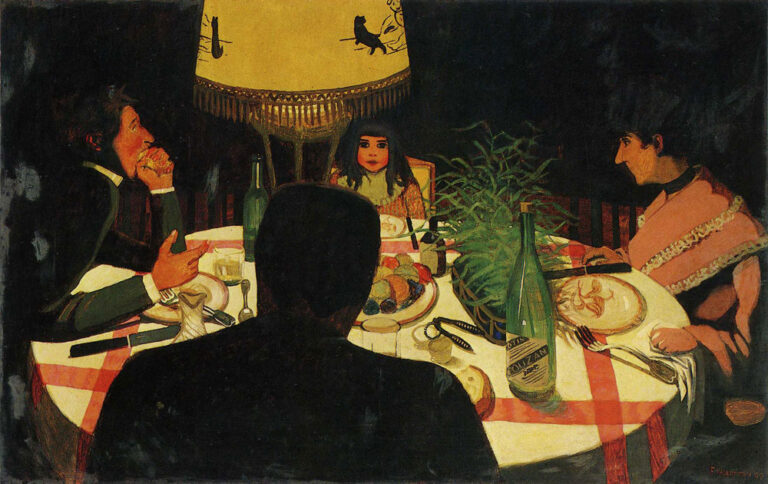
Félix Vallotton, Dinner, by Lamplight (Le Dîner, effet de lampe), 1899, Musée d’Orsay, Paris, France.
Félix Vallotton, a Swiss-French painter, is often called the “painter of disquiet.” His works carry tension, mystery, and psychological unease. The almost cinematic paintings, with their high contrast and shadows, place you in the corner of the room as an observer of a secret scene, just like Vallotton’s Dinner, by Lamplight.
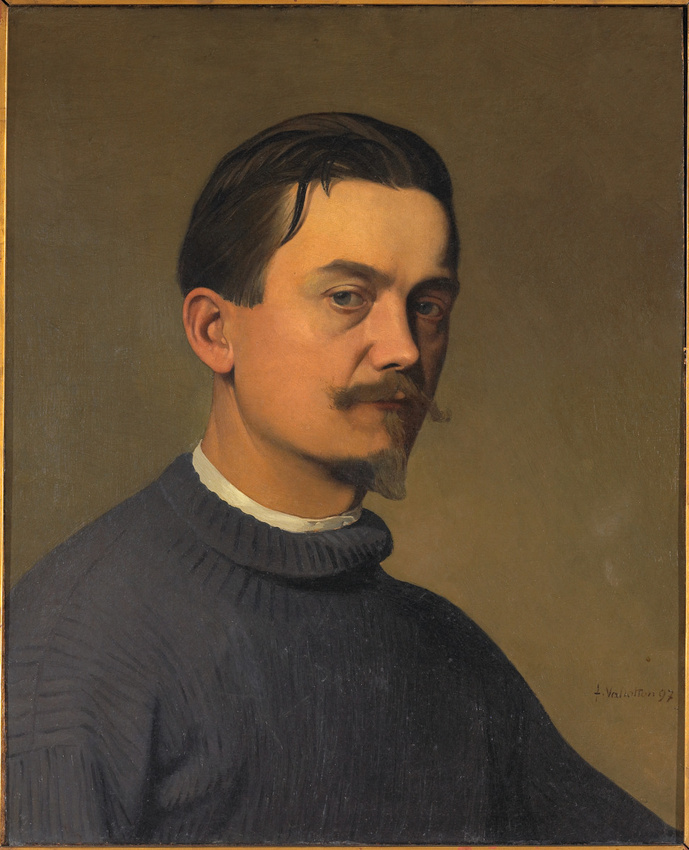
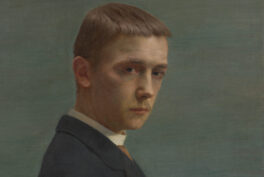
Félix Vallotton, Self-Portrait, 1897, Musée d’Orsay, Paris, France. Museum’s website.
Félix Vallotton (1865–1925) was born in Switzerland, but spent most of his life in Paris, where he moved to study art. Vallotton was an individualist and a dramatic storyteller through his art. In his paintings of interiors, he used strong shadows and striking color choices that created a theatrical composition. He painted people sitting in corners, slipping through rooms, or giving the impression that they are hiding something. The scenes are filled with tension and at the same time, they leave us with curiosity to find out more about each figure’s story. Besides indoor scenes, he painted portraits, nature, and created black-and-white woodcuts.
In 1892, he became a member of the Nabis—a group that moved away from academic painting to focus on bold contour rather than Impressionist fleetingness. Even after joining the group, Vallotton always walked his own path. In 1899, he left the movement and married Gabrielle Rodrigues-Henrigues, a wealthy widow with children. This choice brought some controversy within his circle, since Vallotton had lived a rather modest life, despising excess.
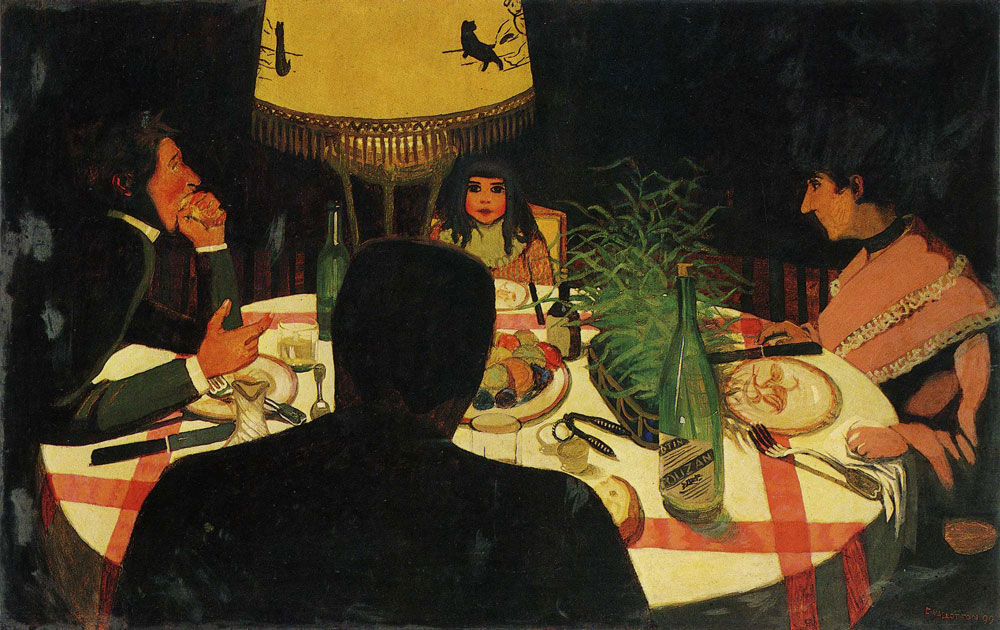
Félix Vallotton, Dinner, by Lamplight (Le Dîner, effet de lampe), 1899, Musée d’Orsay, Paris, France. PubHist.
Dinner, by Lamplight is one of those paintings that becomes more uneasy the longer you look at it. Painted in 1899, the same year Vallotton married into a new family, it shows how he stepped into a life he didn’t belong to. Early marriage is expected to be warm and hopeful—and here, Vallotton turns a family dinner into something disturbing. With the use of a strong palette—pitch black mixed with the intense yellow—it just deepens the heavy atmosphere.
His new role as a stepfather feels uncomfortable for both sides, especially for him and for Gabrielle’s daughter. She sits across from him with a piercing gaze, trying to understand who this man, who suddenly entered their lives, is. Gabrielle, on the right, gives her a steady look, as if trying to keep everything calm. The man sitting on the left, either Gabrielle’s oldest son or another relative, observes everyone else while devouring his food.
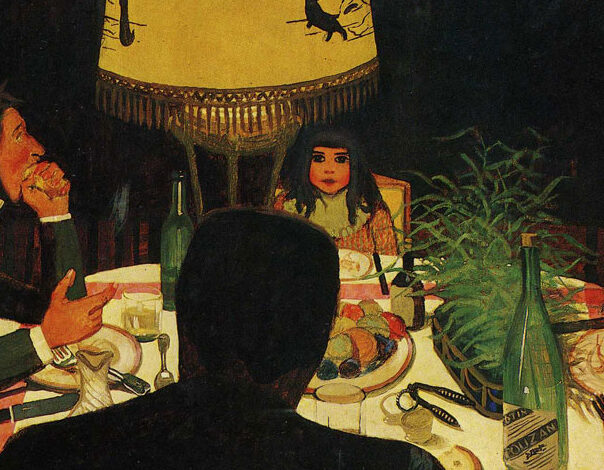
Félix Vallotton, Dinner, by Lamplight (Le Dîner, effet de lampe), 1899, Musée d’Orsay, Paris, France. Detail.
By placing himself right in the center, Vallotton makes us experience this family gathering from his perspective. By peeking over his shoulder, whether we want to or not, our eyes meet his stepdaughter Madeleine’s unsettling stare. Vallotton’s body is completely absorbed by the darkness, turning him into an intruder and making us feel like one too.
If Vallotton portrayed this new life in such a cold way, why did he get himself into this at all? He knew that the marriage would secure him, both financially and professionally, thanks to Gabrielle’s connections with art dealers. Vallotton also genuinely cared for her. The real shock came from stepping into a life he had always criticized before—the high society. On one hand, many of his earlier paintings mocked the bourgeoisie. On the other hand, marrying a woman like Gabrielle gave him the stability he needed, even if he felt out of place most of the time.
Ultimately, Vallotton lived for his art. He strongly believed that any time spent on anything other than painting was wasted. In the end, this new life became the source of those intriguing interior scenes.
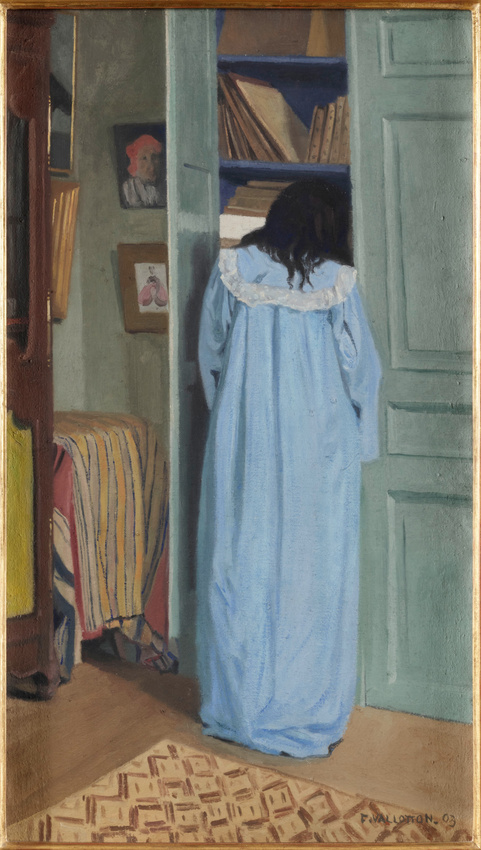
Félix Vallotton, Interior, Woman in Blue Searching in a Cupboard (Intérieur, femme en bleu fouillant dans une armoire), 1903, Musée d’Orsay, Paris, France. Museum’s website.
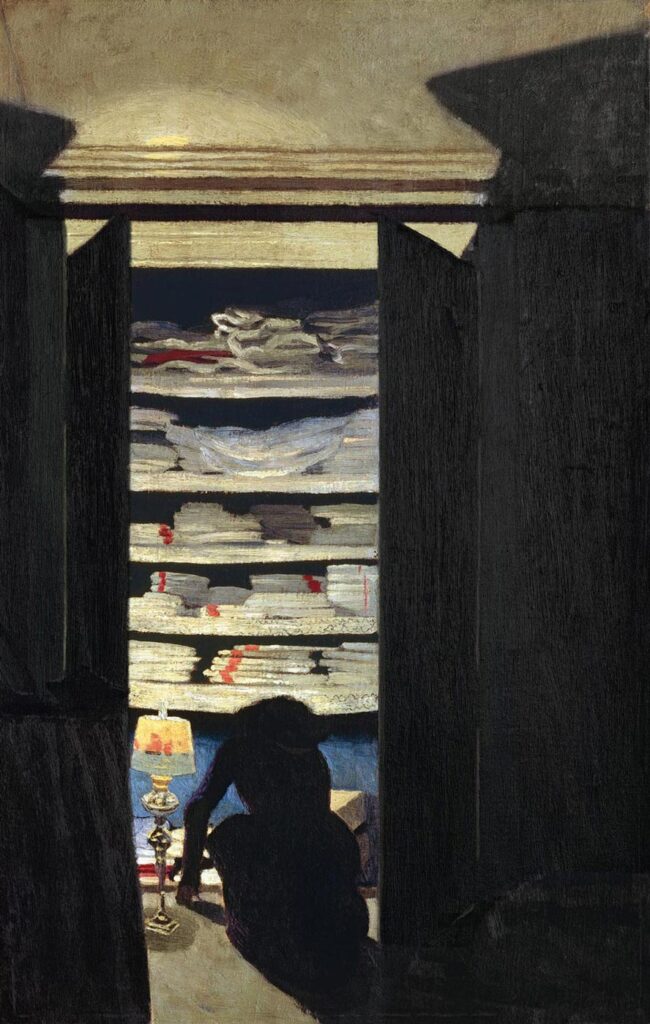
Félix Vallotton, Woman Searching Through a Cupboard (Femme fouillant dans un placard), 1901, Private collection. Wikimedia Commons (public domain).
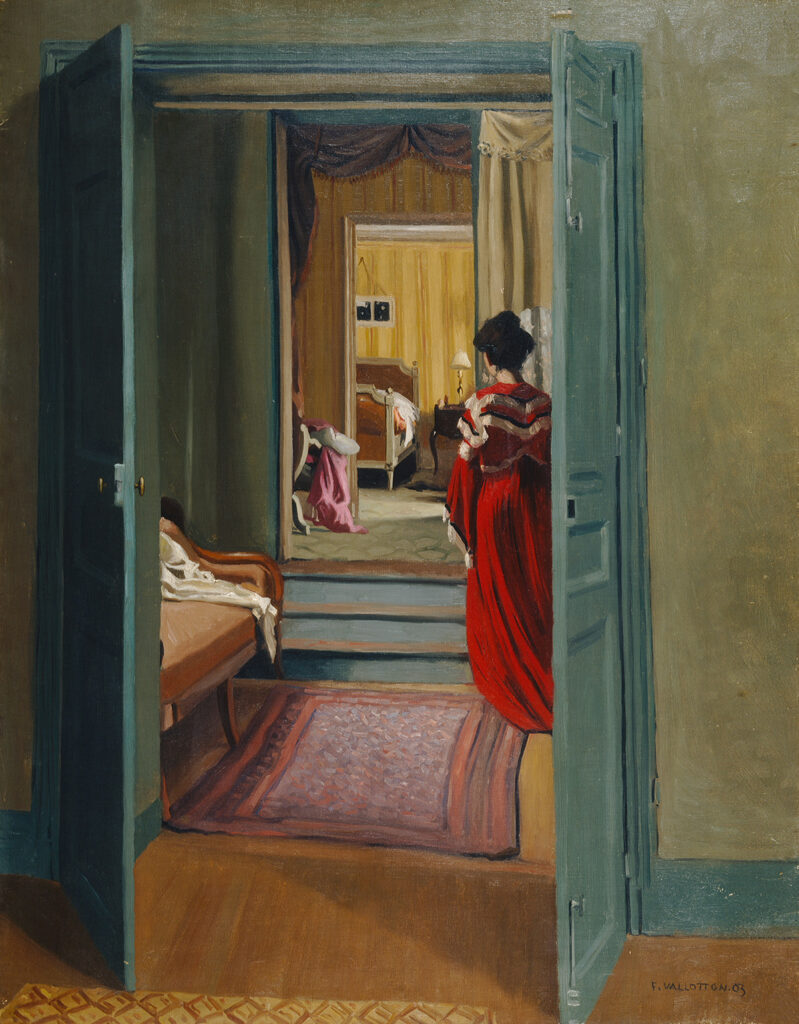
Félix Vallotton, Interior with Woman in Red (Intérieur avec femme en rouge de dos), 1903, Kunsthaus Zürich, Switzerland. Wikimedia Commons (public domain).


In this interior from 1903, Vallotton portrayed Gabrielle with her back turned. He often captured her from behind or from the side, absorbed in a domestic task. Here, she stands in a long blue dress, searching through the cupboard.
Here, the woman, likely Gabrielle, is crouching by the wardrobe. The dark frames of the doors and her silhouette in the shadows, contrasting with the warm light from the lamp, create a mysterious evening scene.
This painting confirms Vallotton’s ability to turn a home scene into a theatrical one. The space already looks like a stage—the rooms visible through the open door and the drapes in the back looking almost like a curtain.
Gabrielle moves through these rooms in a long dress trailing on the floor. In some way, it resembles his life as a stage.
DailyArt Magazine needs your support. Every contribution, however big or small, is very valuable for our future. Thanks to it, we will be able to sustain and grow the Magazine. Thank you for your help!

Kinga is an art enthusiast, mainly interested in 19th-century art, especially Impressionism and Romanticism. She also appreciates classical art and architecture.

Judith and Holofernes is a Caravaggio masterpiece that captures Biblical murder and drama. Rarely has death been captured so intensely and violently...
James W Singer 13 September 2026
Explore an astonishing 1915 nude self portrait by American modernist painter Florine Stettheimer.
Candy Bedworth 21 September 2026
Winslow Homer (1836–1910) was one of the leading American Realist painters. His painting The Veteran in a New Field is a masterpiece of late...
James W Singer 30 August 2026
At first glance, A Goldsmith in His Shop (1449) appears to depict an ordinary visit to a jeweller. Yet Petrus Christus transformed an ordinary...
Shivani Gupta 23 August 2026