Are you tired of summer vibes and high temperatures? Is autumn one of your favorite seasons? If for any of these questions, your answer is “yes” (or you just simply love rainy days!), you should check out these 5 beautiful pieces of art that feature rain and slightly colder weather.
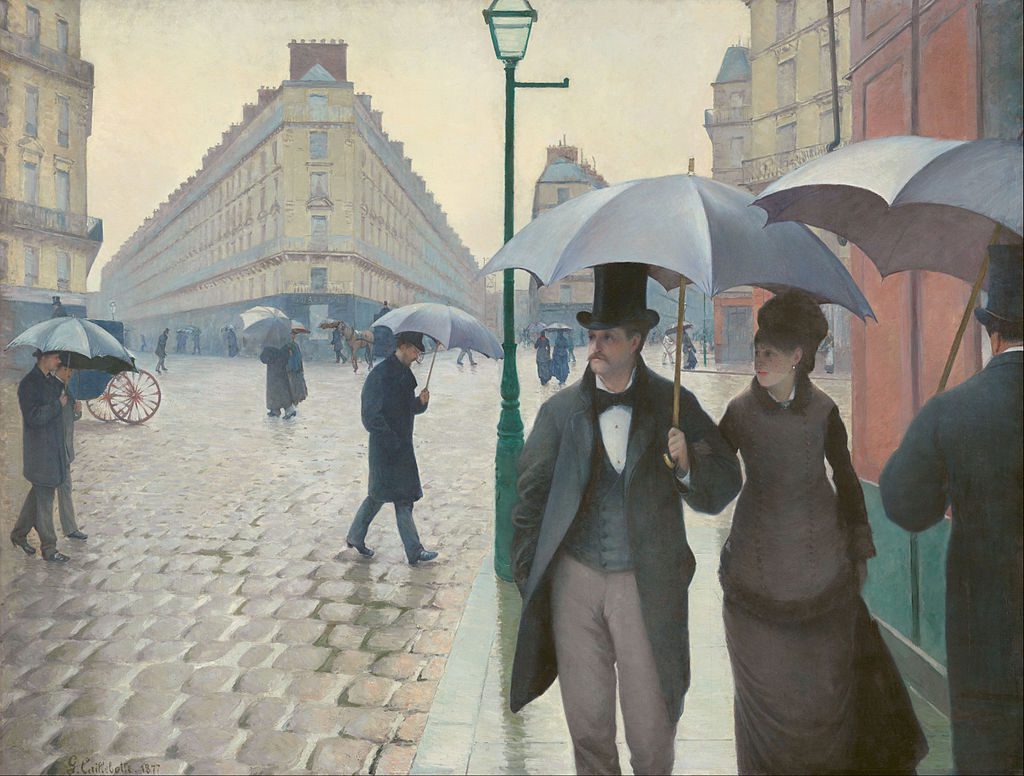
1. Gustave Caillebotte, Paris Street, Rainy Day, 1877
Gustave Caillebotte, Paris Street, Rainy Day, 1877, Art Institute of Chicago, Chicago, IL, USA.
This is probably the most famous work of Gustave Caillebotte. He depicted a street, newly enlarged under Haussmann’s remodernization of Paris, which would become filled with flâneurs and flâneuses that are the observers of modern life. Caillebotte’s symmetrical and extremely detailed technique made the street look almost choreographed as if everything there was synchronized and uniformed, creating the atmosphere of anonymity.
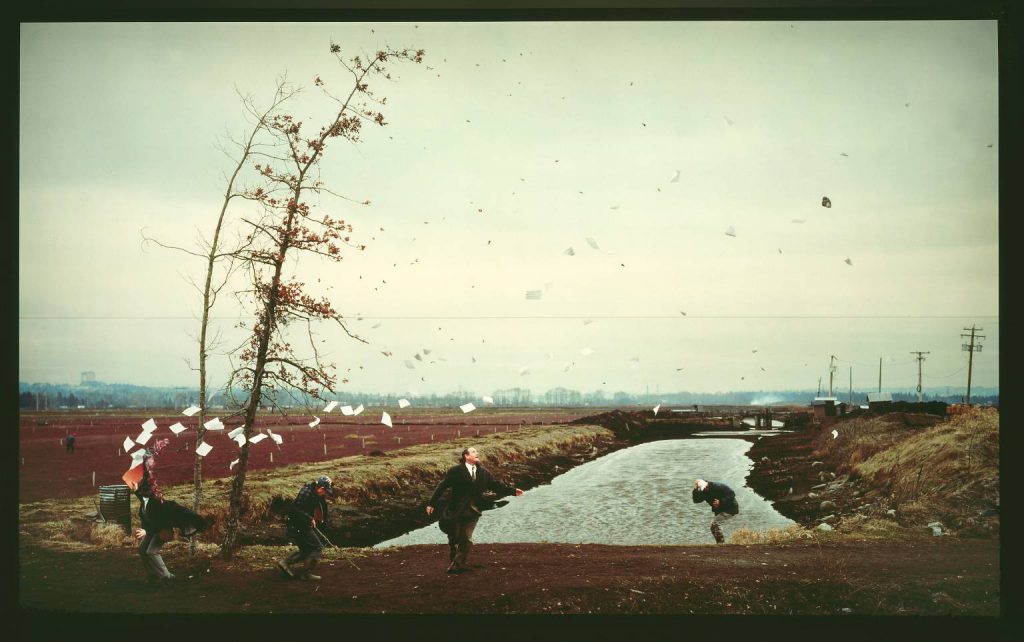
2. Jeff Wall, A Sudden Gust of Wind (after Hokusai), 1993
Jeff Wall, A Sudden Gust of Wind (after Hokusai), 1993, Tate Gallery, London, UK.
Jeff Wall’s photograph is staged to remind us of Hokusai’s beautiful woodblock print Yejiri Station, Province of Surug. Wall called it a ‘cinematographic photograph’ because he used actors, props, and special effects in order to achieve the wanted result. It took him over a year to produce this stunning recreation of a Japanese scene in British Columbia.
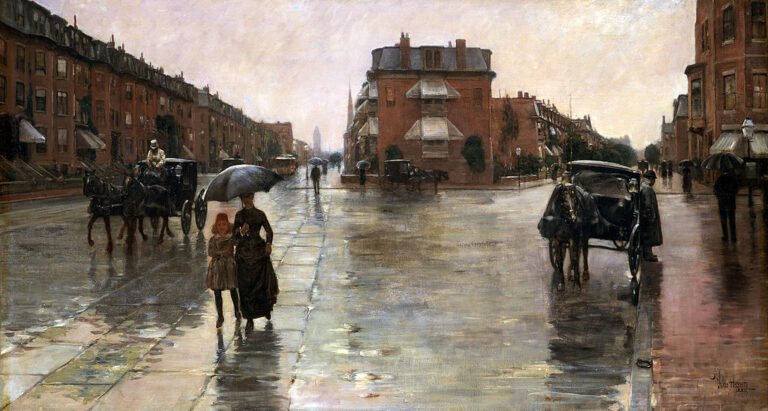
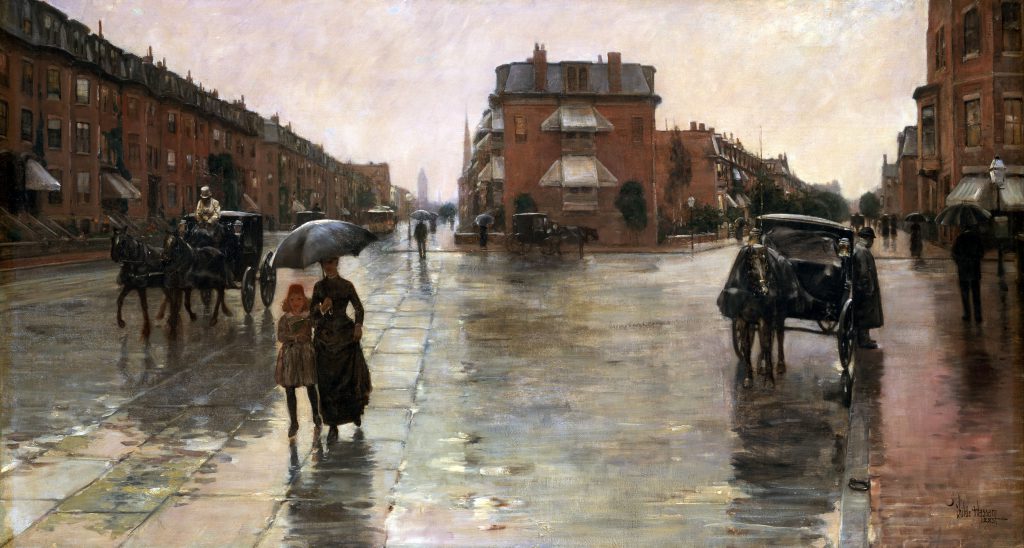
3. Childe Hassam, Rainy Day, Boston, 1885
Childe Hassam, Rainy Day, Boston, 1885, Toledo Museum of Art in Ohio, OH, USA.
Childe Hassam was, together with Mary Cassatt and John Henry Twachtman, a main representative of American Impressionism. In mid-1880 he began painting cityscapes of his native city of Boston, despite the critics’ opinion that his works were “very pleasant but not art”. Soon after, he moved to Paris with his wife where he saw many Impressionist works, yet he didn’t meet any of the artists himself. However, I can see quite a few similarities to Caillebotte’s Paris street here, can you?)
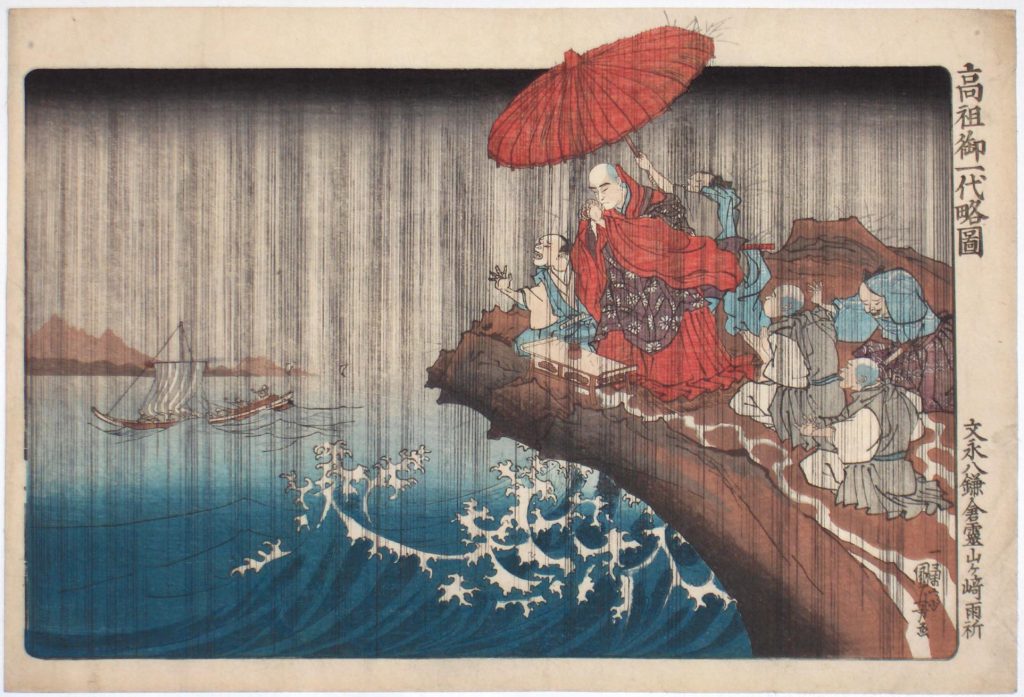
4. Utagawa Kuniyoshi, Nichiren Praying for Rain at Ryôzengasaki in Kamakura in 1271
Utagawa Kuniyoshi, Nichiren Praying for Rain at Ryôzengasaki in Kamakura in 1271, John J. Burns Library, Boston College, MA, USA.
The most recognized woodblock prints were produced in Edo, Japan between the 17th and 18th centuries. Utagawa together with Hokusai was one of the most sold printmakers. When in 1853 Japan opened for international trade, Europe fell for many Japanese products, including prints. The Impressionists loved them and Vincent van Gogh amassed quite a big collection for himself. He was also the one to coin the term japonaiserie which describes the style inspired by Japanese motifs and subjects.
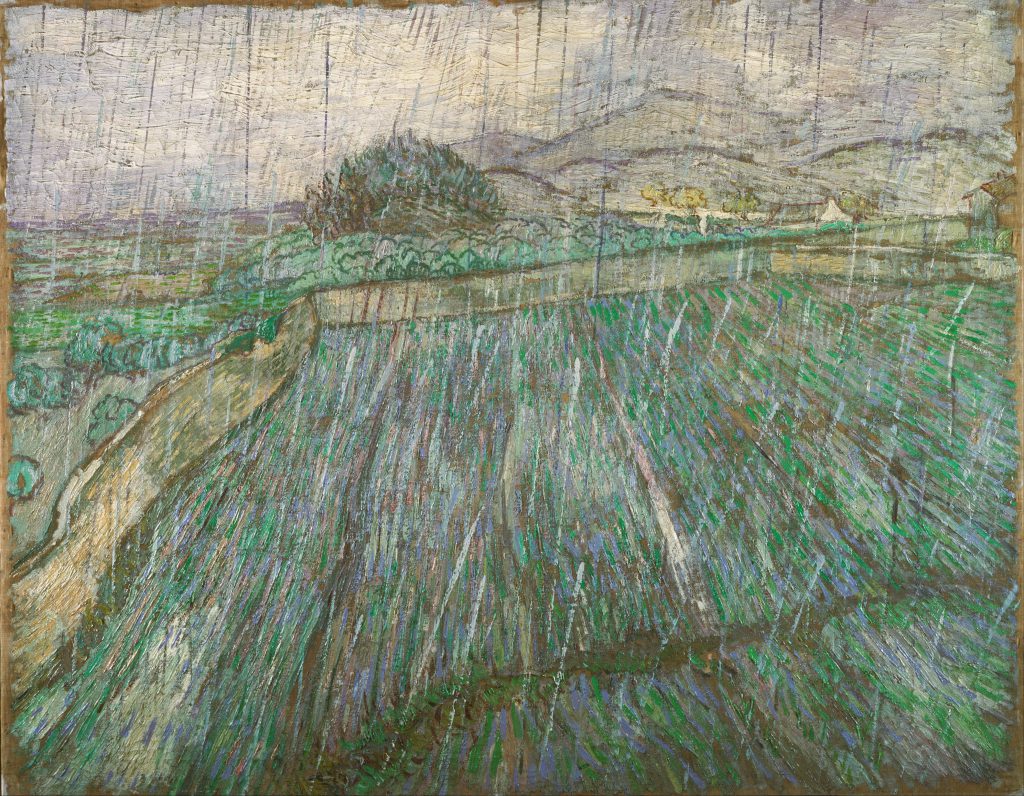
5. Van Gogh, Rain or Enclosed Wheat Field in the Rain, 1889
Vincenct van Gogh, Rain or Enclosed Wheat Field in the Rain, 1889, Philadelphia Museum of Art, Philadelphia, PA, USA.
When Vincent was staying in a clinic of Saint-Paul-de-Mausolée in southern France, the view from his workroom was of a field of wheat, which Van Gogh would paint over twelve times. The rain scene, however, is the only of its kind and the diagonal lines representing rainfall refer closely to the Japanese prints which considerably influenced Vincent’s style.
We love art history and writing about it. Your support helps us to sustain DailyArt Magazine and keep it running.
DailyArt Magazine needs your support. Every contribution, however big or small, is very valuable for our future. Thanks to it, we will be able to sustain and grow the Magazine. Thank you for your help!
Magda, art historian and Italianist, she writes about art because she cannot make it herself. She loves committed and political artists like Ai Weiwei or the Futurists; like Joseph Beuys she believes that art can change us and we can change the world.