Fanny Eaton—Pre-Raphaelite Muse from Jamaica
Fanny Eaton was a regular model for the Pre-Raphaelites during the 1860s and features in a number of famous works. Yet for most of the last century,...
Catriona Miller 19 February 2026
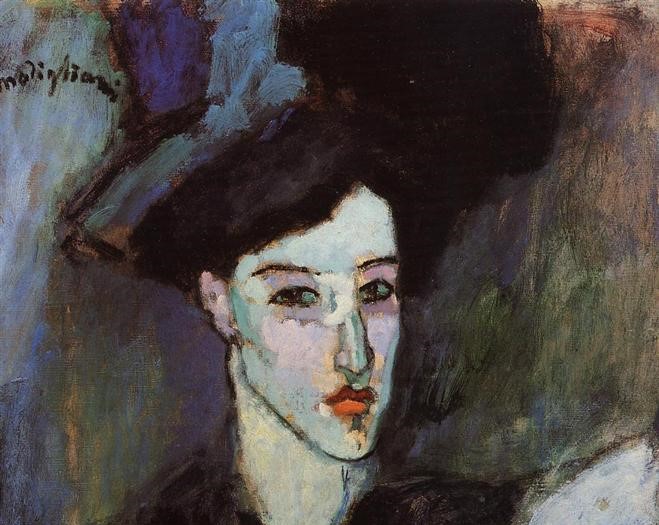
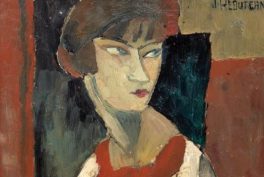
Amedeo Modigliani, The Jewess, 1908, private collection. Detail. Wikimedia Commons (public domain).
Amedeo Modigliani’s paintings radiate with uniqueness due to his specific way of portraying the subjects. A long oval head with small facial features, and specifically almond-shaped empty eyes, along with an elongated body and somber tones, make his works instantly recognizable. Although he was an Italian-Jewish artist, he spent most of his career in France, where his art was often linked to Cubism and related to the stylized masks of African, Egyptian, and Asian cultures. He struggled to gain recognition during his lifetime, but after his death in 1920, his work found the fame and admiration it had long been denied.
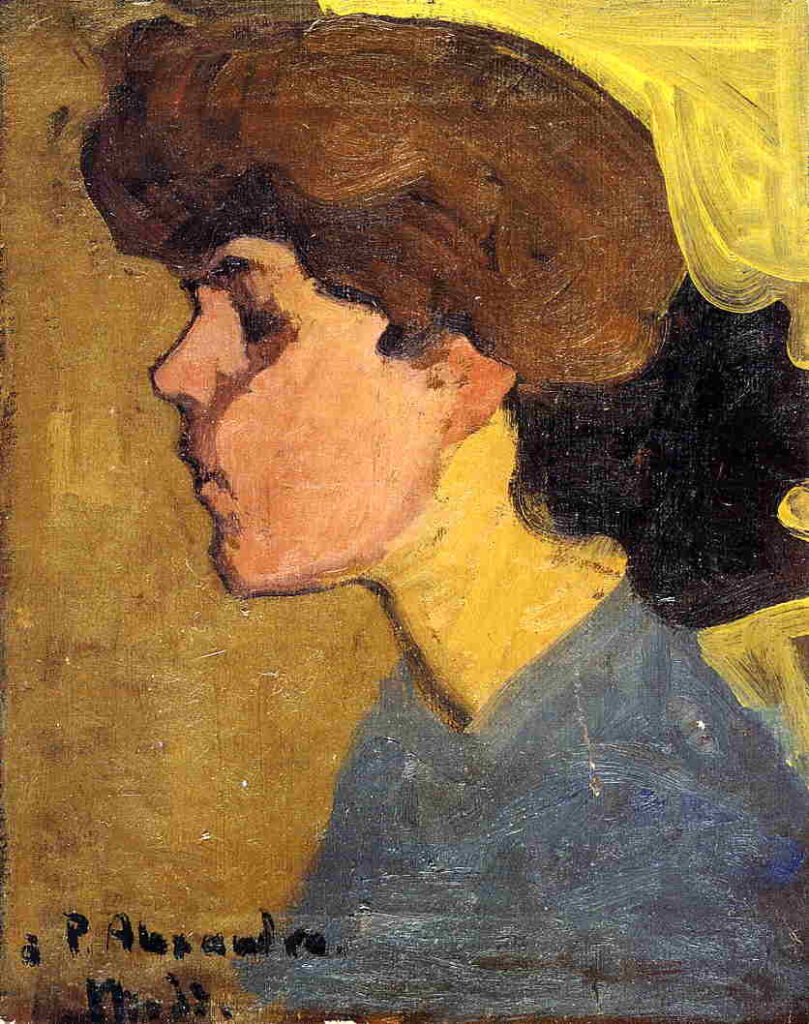
Amedeo Modigliani, Woman’s Head in Profile, 1906–1907, private collection. Quidmagazine.
At the age of 22, Amedeo Modigliani left his hometown of Livorno, Italy, and moved to Paris—a vibrant and up-and-coming artistic center at the time. He got a studio at the Bateau-Lavoir in Montmartre, where he soon shed his image as an academic artist and took on the life of a struggling bohemian. There, he became interested in the Post-Impressionist work of Paul Cézanne and began forming important connections in the art world. He met poets André Salmon and Max Jacob, as well as artist Pablo Picasso. Though Modigliani painted intensely during his short life, only a handful of his early Paris paintings survive. Just 11 are known from the years 1906 to 1908.
Even in his early paintings, Modigliani’s distinct style starts to show through his use of somber tones and expressive brushstrokes. This piece, as the title suggests, features a woman’s head in profile. Varying shades of yellow differentiate her head, neck, and hair from the background.
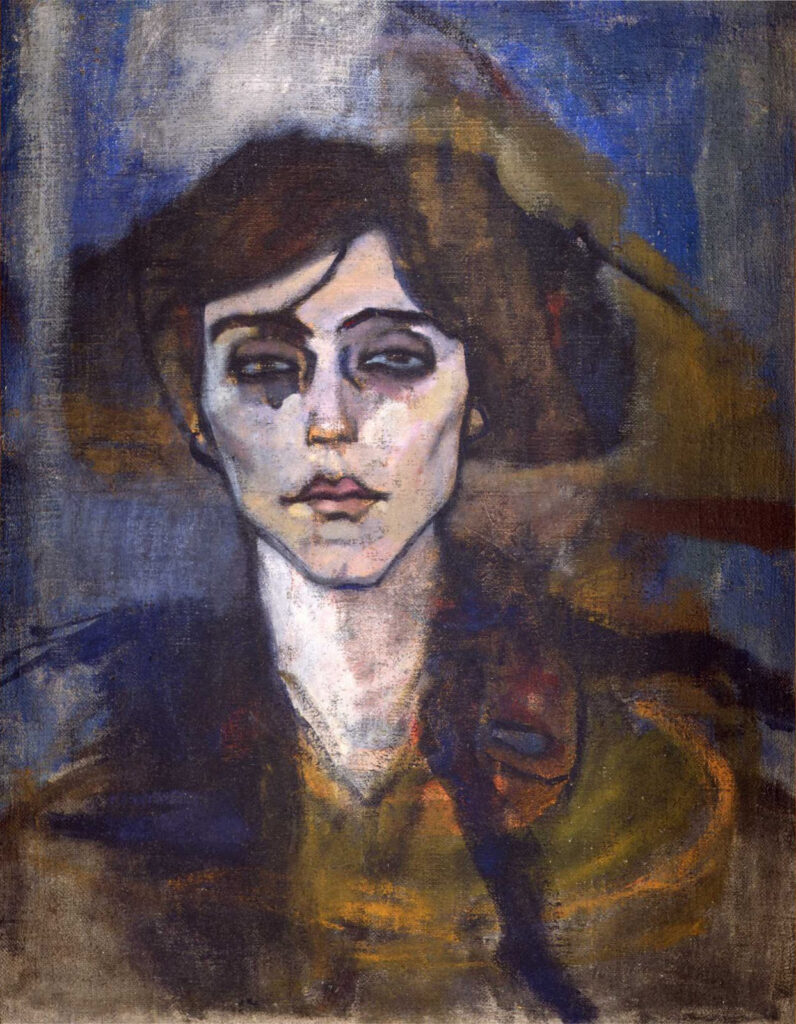
Amedeo Modigliani, Portrait of Maude Abrantes, 1907, Hecht Museum, University of Haifa, Haifa, Israel. Wikimedia Commons (public domain).
The Portrait of Maude Abrantes is another earlier work by Modigliani. It already shows signs of the style that would define his career, such as the elongated neck and melancholic atmosphere of the piece. This raw, emotional tone is most evidently expressed through her dark, seemingly hollow eyes, as well as the textured brushstrokes. A background of muted blues and browns highlights the figure’s depth and isolation, adding to the melancholic mood. Unlike his later works, this painting and other earlier works show more detail in the face and clothing.
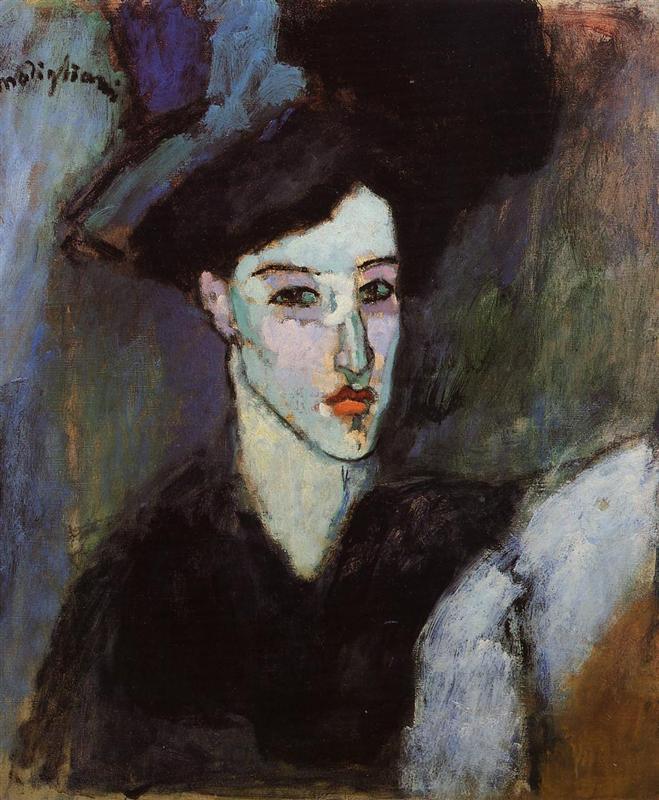
Amedeo Modigliani, The Jewess, 1908, private collection. Wikimedia Commons (public domain).
This painting shows another woman in a similar manner. She is portrayed in a half profile with a staring gaze and pursed red lips. There is a strong contrast between the unnatural whiteness of her skin and the darker hues of the background. In addition, the thick contour of her facial features separates her from the surroundings.
The title of the painting describes the woman as the Jewess, although nothing overtly marks her to be one. However, it is noticeable that Modigliani subtly draws attention to the woman’s curved nose—a feature often tied to Jewish stereotypes. While Modigliani was open about his Jewish heritage, this painting is one of the few that touch on the subject. He moved away from exploring identity and instead focused on stylized, almost mask-like portraits of the human form—featuring long necks, blank almond eyes, and simplified shapes that became his signature.
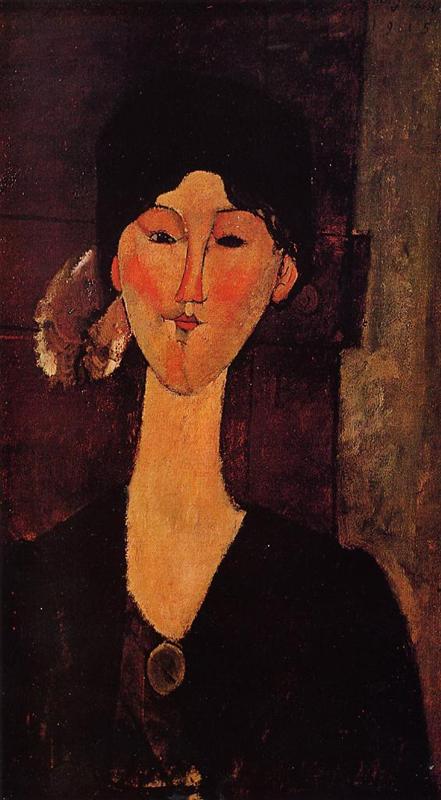
Amedeo Modigliani, Portrait of Beatrice Hastings, 1915, private collection. Wikiart.
In the Portrait of Beatrice Hastings, it is possible to spot all the characteristic features of Modigliani’s unique style. The subject is a long-necked woman, dressed in dark monochrome clothing. Her face is showing mask-like features with almond-shaped, empty eyes and small, pursed lips. In this portrait, muted browns and greens in the background let the warm tones of the subject’s face stand out. Bold lines and expressive colors give the painting a quiet emotional power, reflecting Modigliani’s unique blend of abstraction and feeling.
Though the subject, Beatrice Hastings, was a poet, journalist, and art critic, Modigliani offers no clues to her identity. There are no props, no hints of her profession—just a woman, captured simply and directly. During their relationship from 1914 to 1916, Modigliani painted some of his most focused and emotive works. For Hastings, too, it was a time of creative energy and personal significance.
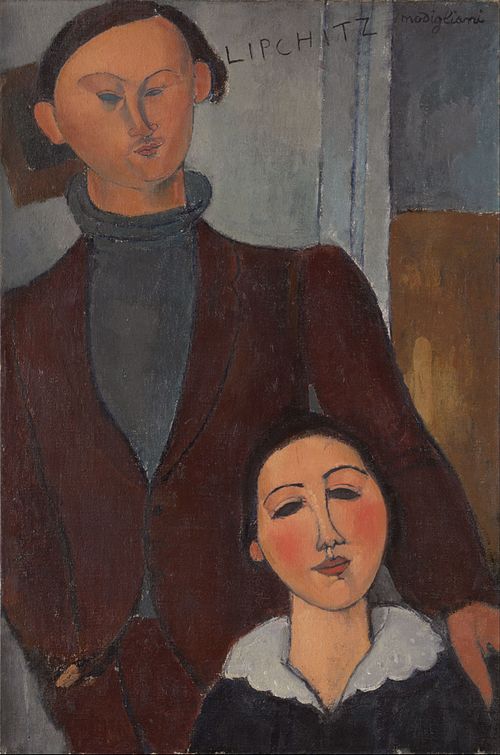
Amedeo Modigliani, Jacques and Berthe Lipchitz, 1916, Art Institute of Chicago, Chicago, IL, USA. Wikimedia Commons (public domain).
Many artists lived in the neighborhood of Montparnasse at the time, and several—including Modigliani and sculptor Jacques Lipchitz—shared Jewish roots. When Lipchitz married Russian poet Berthe Kitrosser, he asked Modigliani to paint their portrait, partly to support his struggling friend financially.
This is one of only three double portraits Modigliani ever created. Interestingly, it was mostly finished in just two days. Modigliani sketched around 20 drawings on the first day and called it done the next. But for “10 francs a sitting and a little alcohol,” Lipchitz convinced him to keep working on it for two more weeks, simply to help him earn a bit more.
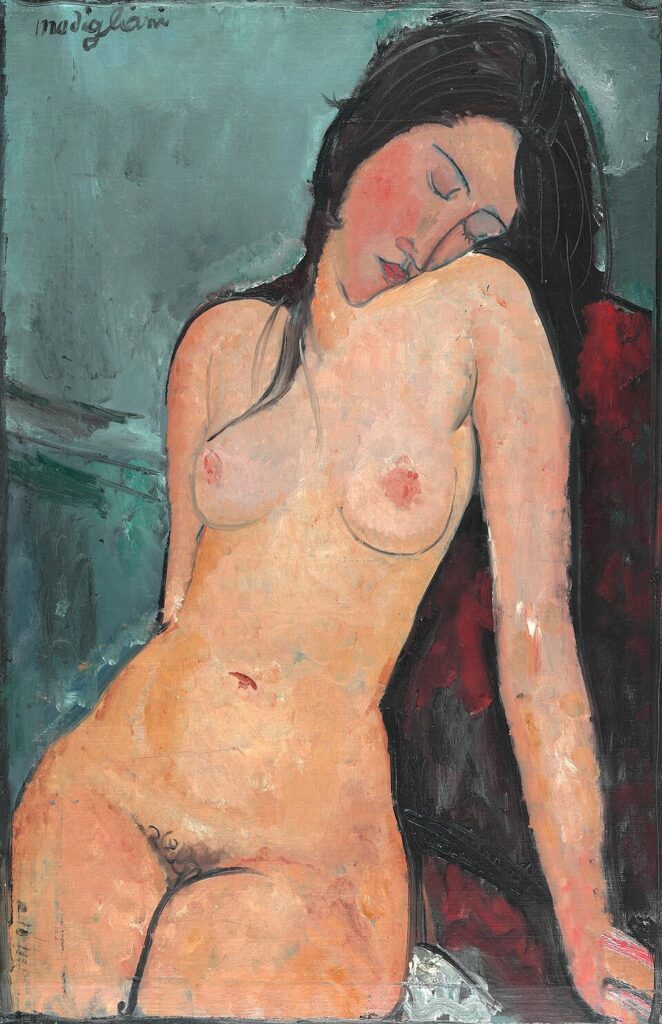
Amedeo Modigliani, Iris Tree, 1916, Courtauld Institute of Art, London, England, UK. Wikimedia Commons (public domain).
Modigliani created a series of about 30 large female nudes that would become some of his most celebrated works. This nude, and the one below, were some of the works from the series commissioned by his friend and art dealer Léopold Zborowski, who supported Modigliani by offering his apartment, paying for models and supplies, and giving the artist a daily wage of 15 to 20 francs.
Unlike Modigliani’s earlier portraits of friends and lovers, these works were created with a commercial goal in mind. The series debuted at Modigliani’s only solo exhibition during his lifetime—a Paris show that caused an uproar. Police shut it down on opening day due to claims of obscenity, but it soon reopened, likely after the most provocative works were removed from the window display.
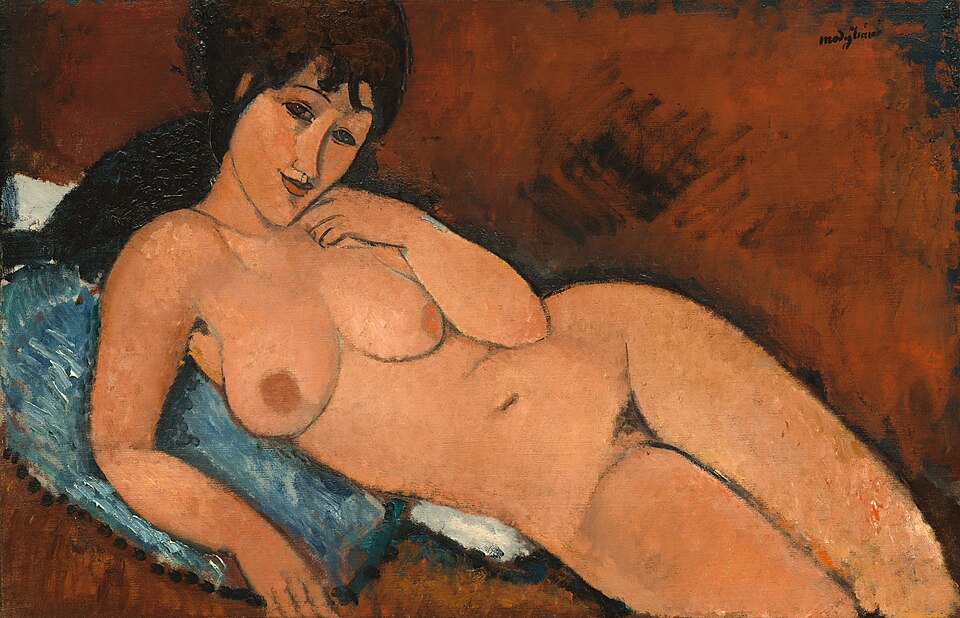
Amedeo Modigliani, Nude on a Blue Cushion, 1917, National Gallery of Art, Washington, DC, USA.
This is another of Modigliani’s nude portraits. The painting shows a woman reclining on a blue cushion with a warm-red background. Her body is stylized, with elongated lines and stretched proportions characteristic of his work. The model’s face is expressive and her interaction with the viewer creates an intimate mood. The painting conveys both sensuality and calm, capturing the beauty and emotional resonance of the human form.
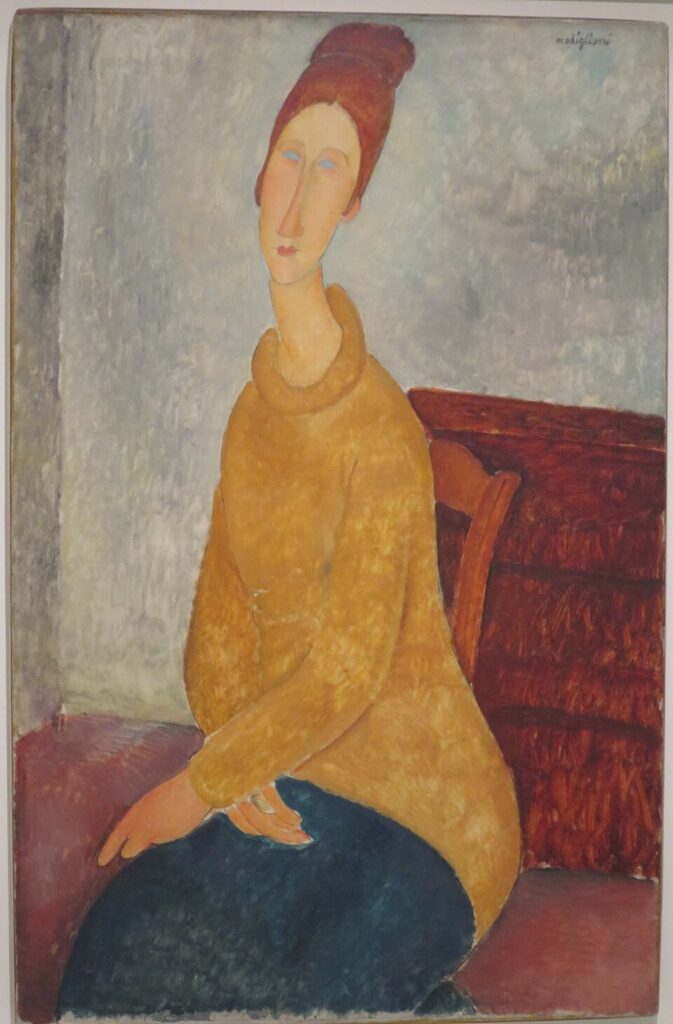
Amedeo Modigliani, Jeanne Hébuterne with Yellow Sweater, 1918, Solomon R. Guggenheim Museum, New York City, NY, USA. Wikimedia Commons (public domain).
Jeanne Hébuterne is best remembered as Amedeo Modigliani’s partner and frequent model. Introduced to the Montparnasse art scene by her brother, Jeanne was already known in Parisian art circles and had ambitions of her own. She studied at the Académie Colarossi to become an artist. There she met Modigliani in the spring of 1917. You can read more about their complicated and tragic love story here.
In Jeanne Hébuterne with Yellow Sweater, Modigliani painted her with the grace and presence of a fertility goddess. Her narrow face, blank eyes, and strong hips reflect his sculptural style. Moreover, these features also indicate influences from African art and ancient symbols of womanhood.
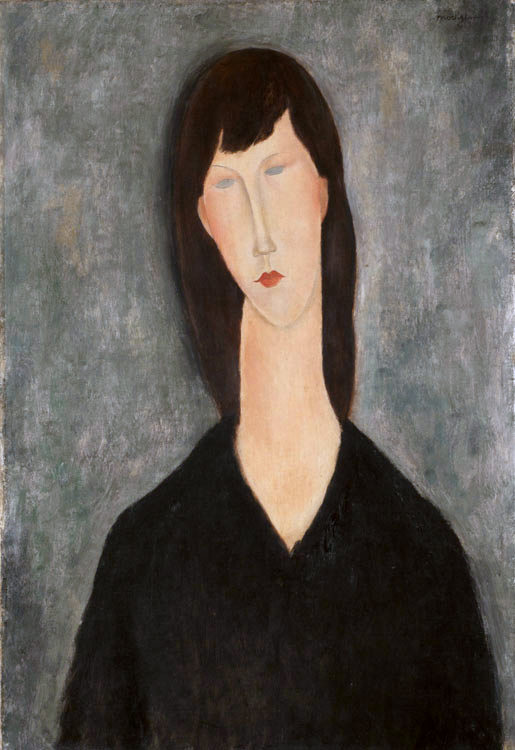
Amedeo Modigliani, Buste de Femme, before 1919, Museo Nacional de Bellas Artes, Buenos Aires, Argentina. Wikimedia Commons (public domain).
In many of his portraits, like Buste de Femme, Modigliani painted blank, pupil-less eyes, avoiding any direct gaze between subject and viewer. This creates a sense of distance, making the subject feel lost in thought and emotionally removed. The tension in Modigliani’s portraits arises from the dual impulse to reveal the subject’s identity, while also shaping them to fit his own unique artistic style.
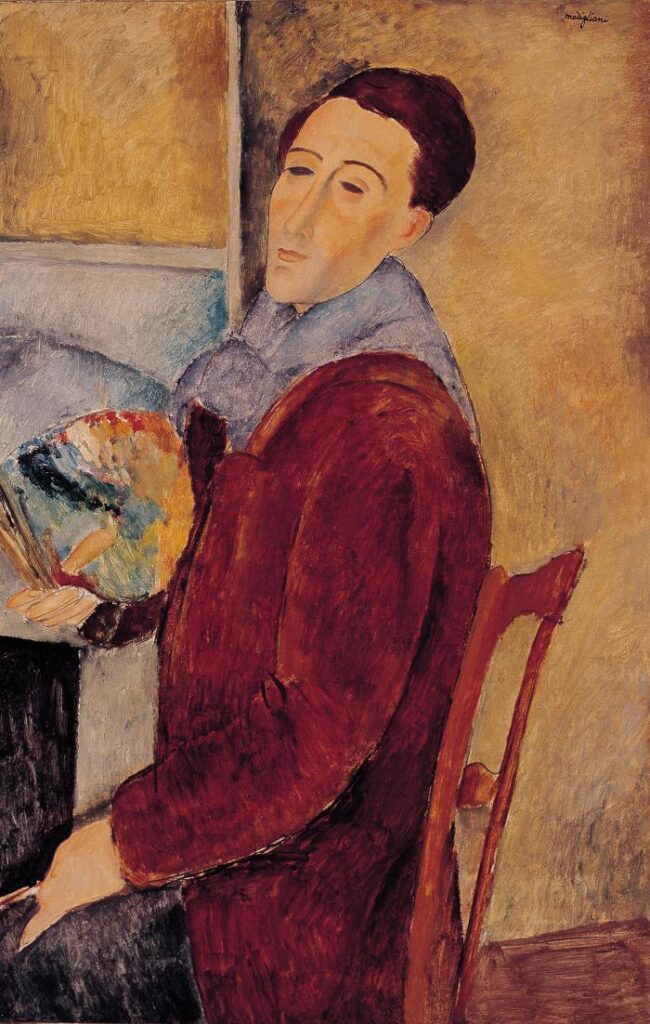
Amedeo Modigliani, Self-Portrait, 1919, Museum of Contemporary Art, University of São Paulo, São Paulo, Brasil. Wikimedia Commons (public domain).
This painting was made close to the end of Modigliani’s short life. In May 1919, he moved back to Paris from Nice, together with Jeanne Hébuterne and their child. Soon, they got married, although at that stage, he was already diagnosed with a severe form of tuberculosis. Perhaps with this self-portrait, where he presents himself first and foremost as a painter, he hoped to shape his legacy and leave behind the image by which he would be remembered.
Throughout his artistic career, Amedeo Modigliani developed a remarkable style, distinctive for several features—long oval face tilted slightly, blank almond-shaped eyes, a thin nose, a small pursed mouth, and a long, curved neck. Interest in Modigliani’s personal life has often overshadowed his work as an artist. Modigliani lived and died in poverty, but interest in his work grew quickly after his death. As prices rose, many questionable paintings started to appear, since no one had properly managed his estate. The problem got worse because his two main art dealers both died in the 1930s, leaving behind little documentation.
Even today, there are serious disagreements over which paintings are truly his. Still, he is now seen as one of the leading figurative artists of the 20th century, with his paintings and sculptures highly valued by museums, collectors, and art lovers. One of his nudes sold for $170.4 million at a Christie’s auction, which is a record for a Modigliani and one of the highest prices ever paid for a painting.
Get your daily dose of art
Click and follow us on Google News to stay updated all the time

DailyArt Magazine needs your support. Every contribution, however big or small, is very valuable for our future. Thanks to it, we will be able to sustain and grow the Magazine. Thank you for your help!

History of art graduate and enthusiastic appreciator of anything art and culture-related. Currently very interested in Catalan Modernism and Postmodernism, Surrealist artist-designer Elsa Schiaparelli, and 15th-century Florentine art.

Fanny Eaton was a regular model for the Pre-Raphaelites during the 1860s and features in a number of famous works. Yet for most of the last century,...
Catriona Miller 19 February 2026
From van Gogh’s sunflowers, through golden dresses, to tranquil landscapes—yellow lights up the scene. It is the color of the sun, associated...
Kinga Dobosz 26 February 2026
For centuries, artists interpreted the biblical story of Salome and turned it into a lasting theme in art. But where did this fascination come from?...
Edoardo Cesarino 22 January 2026
Florine Stettheimer (1871–1944) was an American painter, designer, and poet, as well as a prominent member of New York City’s high society...
Sam Malone 2 March 2026