




Pierre-Auguste Renoir in 10 Paintings: A Glimpse into French Summer
Light-filled moments in nature—Pierre-Auguste Renoir’s Impressionist paintings are a reminder of how simple and beautiful summer can feel.
Kinga Dobosz 9 July 2026
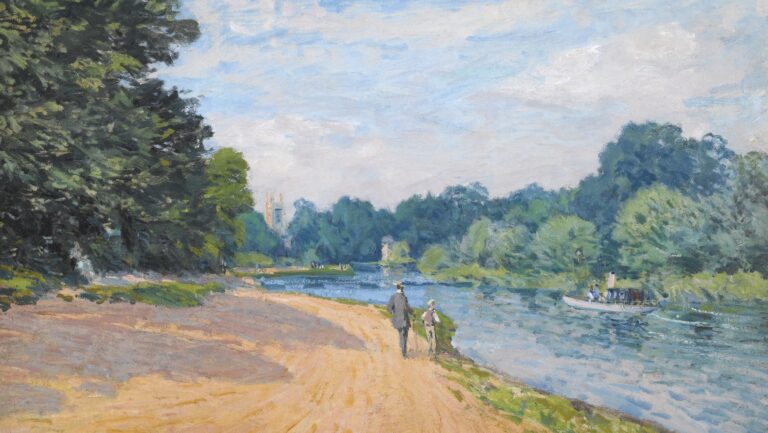
Alfred Sisley, La Tamise avec Hampton Church, 1874, private collection. Sotheby’s. Detail.
The names of the French Impressionists are among the most familiar in art history. But what about the English-French artist Alfred Sisley? This rich boy turned poverty-stricken painter has a fascinating story and produced some of the most “impressionist” landscape paintings ever! Let’s explore the life of Alfred Sisley, the French Impressionist who lived and died an Englishman.
Born in Paris to wealthy English merchants, Sisley’s first language was French. His father had wanted his son to become part of the family firm, but Alfred was an artist at heart. He spent time in England, learning the language and trying his hand at commerce. However, his preference was for visiting art galleries to study the works of J. M. W. Turner and John Constable. Sisley’s family money meant that he could abandon business and turn towards the arts.
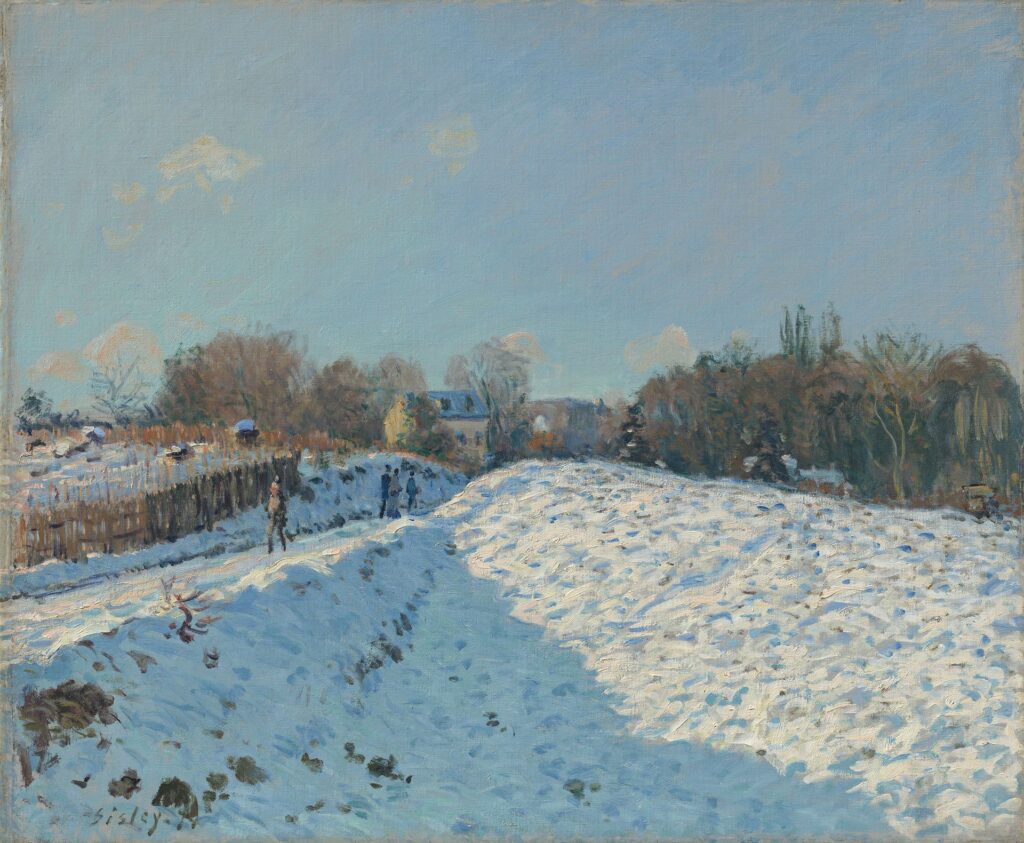
Alfred Sisley, Snow Effect in Louveciennes, 1874, Museum Barberini, Potsdam, Germany.
Sisley trained as an artist in Paris and became firm friends with the Impressionist gang—painters like Claude Monet and Pierre-Auguste Renoir. Becoming bored with traditional studio practice, and inspired by the Barbizon School, they rebelled and headed out into the landscape, capturing the weather, sunshine, clouds, fog, and snow. This revolutionary style changed painting forever.

Alfred Sisley, The “Trou d’Enfer” Farm, Autumn Morning, 1877, High Museum of Art, Atlanta, GA, USA
Often considered an outsider because of his English citizenship, Sisley was, in fact, one of the finest landscape artists of his time and a crucial part of the Impressionism movement. His dedication to painting en plein air (out in the open) was lifelong, and he produced over 1,000 works, including 900 paintings and 100 drawings.

Alfred Sisley, Snow at Louveciennes, 1878, Musee d’Orsay, Paris, France.
Sisley’s landscapes were atmospheric and quiet—they rarely centered human activity. This might explain why his paintings did not sell as well as his contemporaries. But Sisley continued to work on his meditative landscapes until his comfortable and artistic existence came to an abrupt end. When the Franco-Prussian War broke out in 1870, his family’s business crashed. Sisley fell from a life of financial comfort into permanent, grinding poverty. He now had to rely solely on selling paintings to make a living. This changed everything. He became reserved and depressed, consumed by money worries.

Alfred Sisley, Le Bois des Roches, Veneux-Nadon, 1880, Louvre, Paris, France.
In 1897 a large retrospective of Sisley’s work was organized, supported by his artist friends. But the public and critical response was lukewarm, and Sisley did not sell a single painting. Desperately disappointed, he did, however, find support from the art dealer Paul Durand-Ruel, who regularly bought Sisley’s artwork. Durand-Ruel described Sisley as “the purest and most poetic of the Impressionists.”
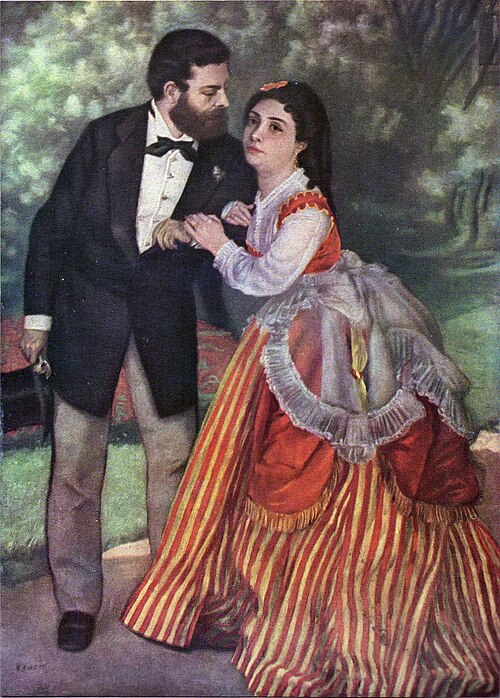
Pierre-Auguste Renoir, A Couple (Alfred Sisley and His Wife), c. 1868, Wallraf-Richartz-Museum, Cologne, Germany.
And yet, despite his desperate financial troubles, Sisley could always find solace with the great love of his life, Eugénie Lescouezec (sometimes known as Marie). They met in 1866 when she was working as an artist’s model and florist. They lived together for over 30 years, although they married much later.
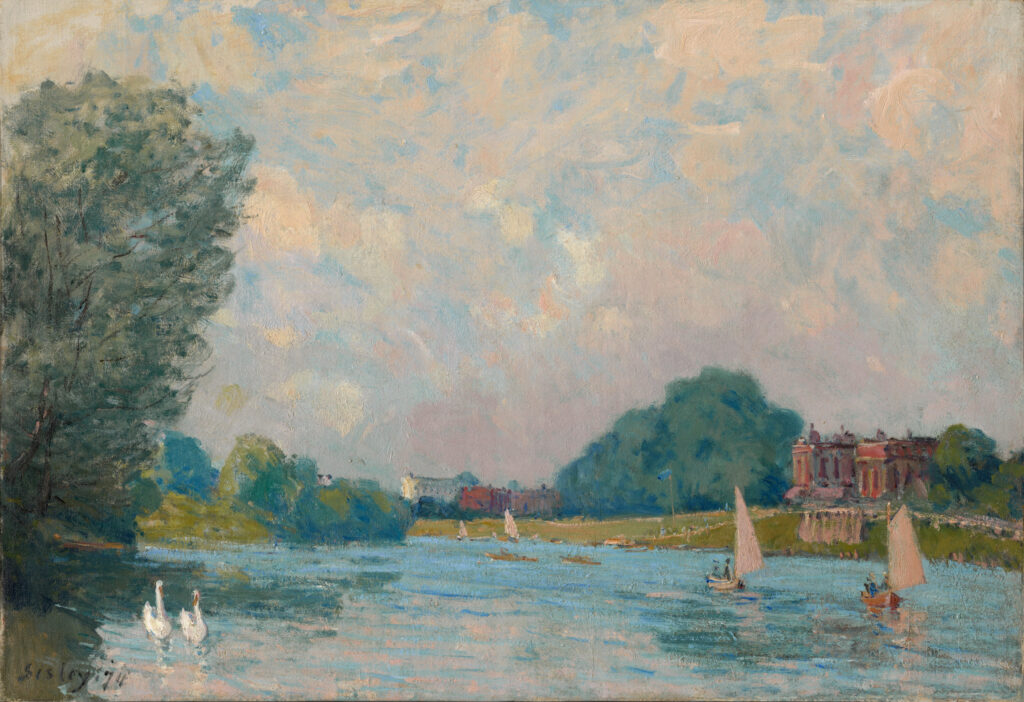
Alfred Sisley, The Thames at Hampton Court, 1874, Clark Art Institute, Williamstown, MA, USA.
Steadfastly loyal to his French roots, Sisley did visit England several times (where he painted the River Thames, shown above). In fact, he was the only Impressionist artist to paint in Wales. In August 1897 Alfred and Eugénie travelled to Penarth in South Wales, with Alfred’s patron François Depeaux. They stayed with the wife of a coal merchant. It was there, in a long, hot summer, that Sisley painted his only seascapes.
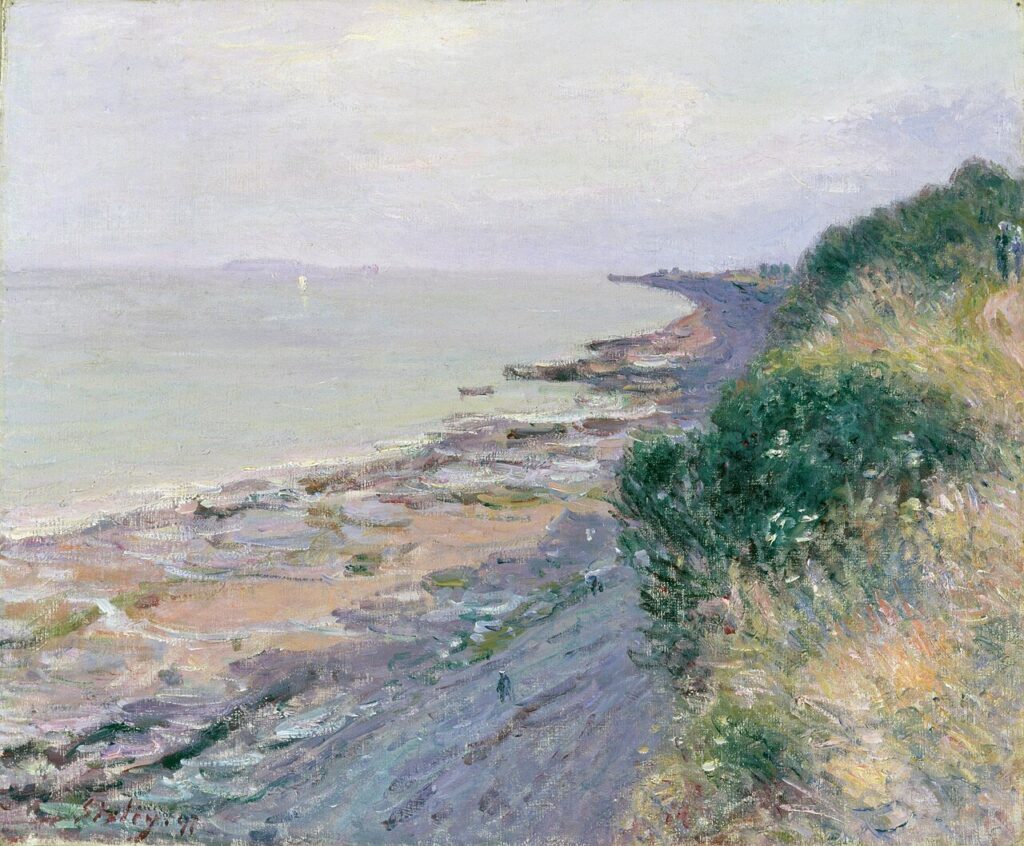
Alfred Sisley, The Cliff at Penarth, Evening, Low Tide, 1897, Amgueddfa Cymru—Museum of Wales, Cardiff, UK.
Both Alfred and Eugénie were ill at this point—both would go on to develop throat cancer. They were heavy smokers, a fashionable habit at this period in France, but as a result, throat cancer was on the rise. Perhaps they knew they had little time left. During their Welsh holiday, they married in Cardiff Town Hall, mainly to legitimize their two children, Pierre and Jeanne, and ensure any inheritance was secure.
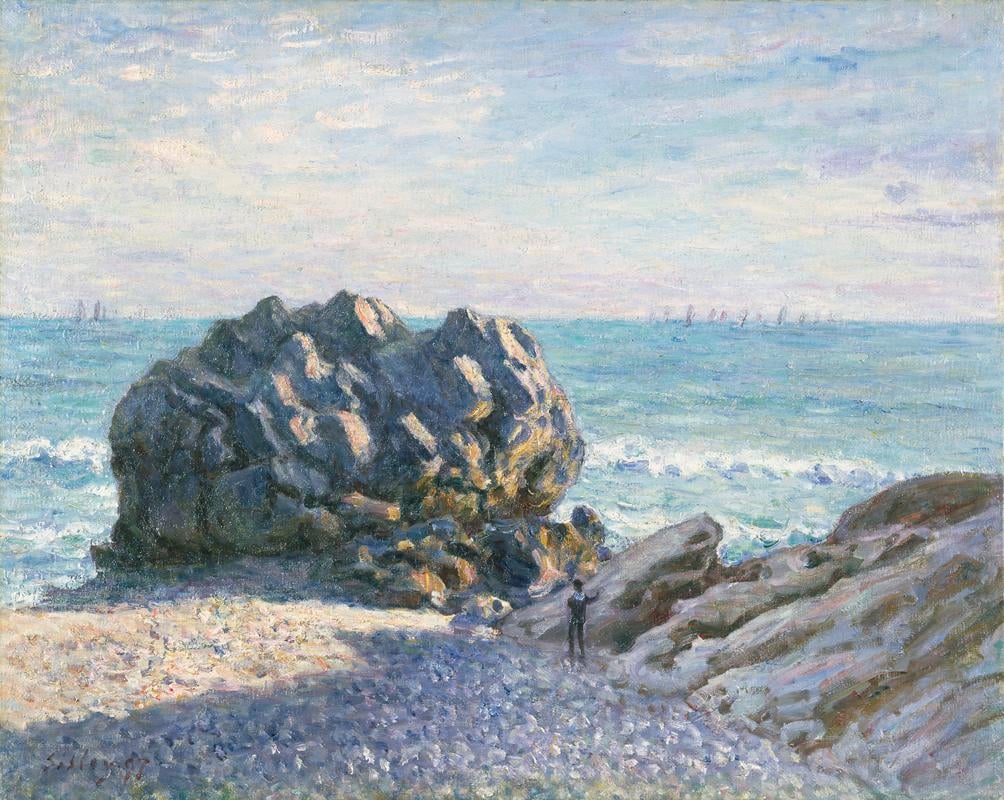
Alfred Sisley, Storr Rock, Lady’s Cove, Le Soir, 1897, Amgueddfa Cymru—Museum of Wales, Cardiff, UK.
Unmarried cohabitation was very common at this point in history; in fact, it was known colloquially as mariage à la parisienne! Sometimes that might be an intentional anti-bourgeois lifestyle choice, sometimes it was simply the high cost of gathering the necessary documents and paying notary fees. But cohabitation left a family with zero rights under the law, hence, the hasty marriage in Wales. Sisley begged his friend Claude Monet to offer assistance to his bereaved adult children. Monet, true to his word, organized a benefit auction to secure an inheritance for the family.
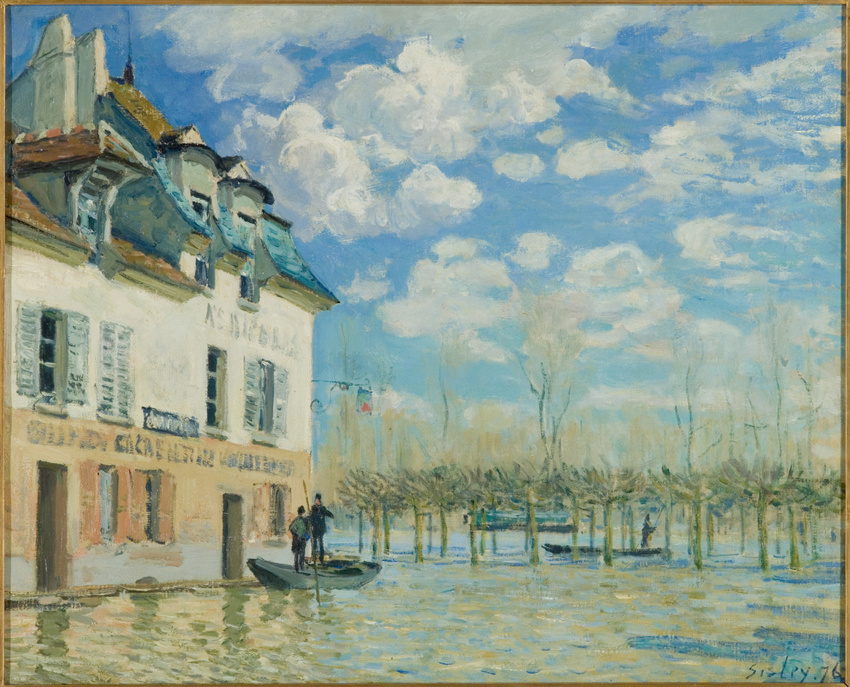
Alfred Sisley, Boat in the Flood at Port-Marly, 1876, Musee d’Orsay, Paris, France.
In October 1898, one year after their Welsh trip, Eugénie died. Alfred was too ill to attend her funeral. He died broken-hearted, ravaged by the same disease that took his beloved, just three months later. This grand master of Impressionism died in January 1899, aged 59. A British subject in a French world, he was twice denied citizenship, but was buried next to his beloved Eugénie in Moret-sur-Loing cemetery, beneath an imposing cypress tree.
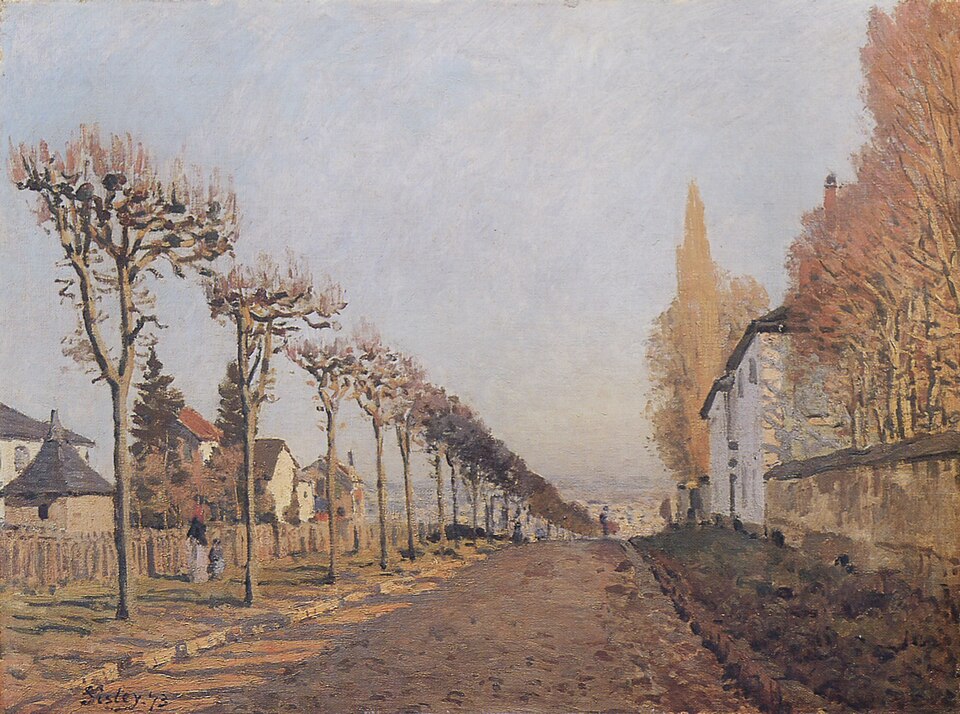
Alfred Sisley, Chemin de la Machine, Louveciennes, 1873, Musee d’Orsay, Paris, France.
Sisley received very little critical recognition during his lifetime, but his work has received posthumous critical acclaim and market re-appraisal. Finally, the world has recognized Sisley’s vital contribution to Impressionism and to French landscape painting. Just for today, slow down and take a moment inside a quiet, beautiful Sisley painting.
DailyArt Magazine needs your support. Every contribution, however big or small, is very valuable for our future. Thanks to it, we will be able to sustain and grow the Magazine. Thank you for your help!

Candy's remote, rain-soaked farmhouse clings to a steep-sided valley in rural Wales. She raises cats, chickens, and children with varying degrees of success. Art, literature, and Lakrids licorice save her sanity on a daily basis.

Light-filled moments in nature—Pierre-Auguste Renoir’s Impressionist paintings are a reminder of how simple and beautiful summer can feel.
Kinga Dobosz 9 July 2026
Autumn is such a colorful season! Here are 10 activities inspired by Impressionist autumn paintings to enjoy during this time of year.
Andra Patricia Ritisan 25 September 2026
Summer has arrived! It is time to enjoy some deserved vacations, rest, go to the beach, enjoy the sunshine, and have fun. Here are 10 Impressionist...
Jimena Escoto 28 August 2025
The sun is shining, the flowers are blooming. It is officially spring! And what style captures spring’s delicate essence better than Impressionism?...
Sandra Juszczyk 20 March 2026


