




Fashion Is Art: 13 Beautiful Dresses in Art History
“Who Wore What” has fascinated artists for centuries because few things convey status, identity, and history as effectively as fashion.
MJ Rivera 18 June 2026
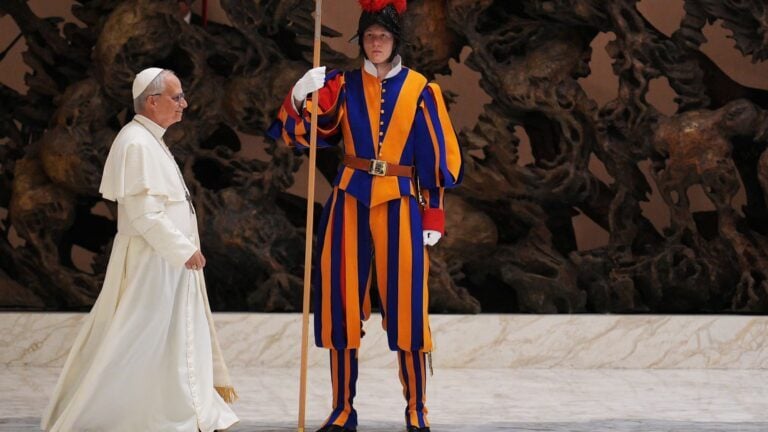
Pope Leon XVI under the Swiss Guard watch. Christopher Furlong/Getty Images. Süddeutsche Zeitung.
The Pontifical Swiss Guard has served as the pope’s personal bodyguards and as the primary security force of Vatican City since 1506. Pope Julius II established the service described as both the smallest and the oldest active standing army in the world today. You may not know their name, but you’ve probably seen the Swiss Guard’s colorful uniforms.
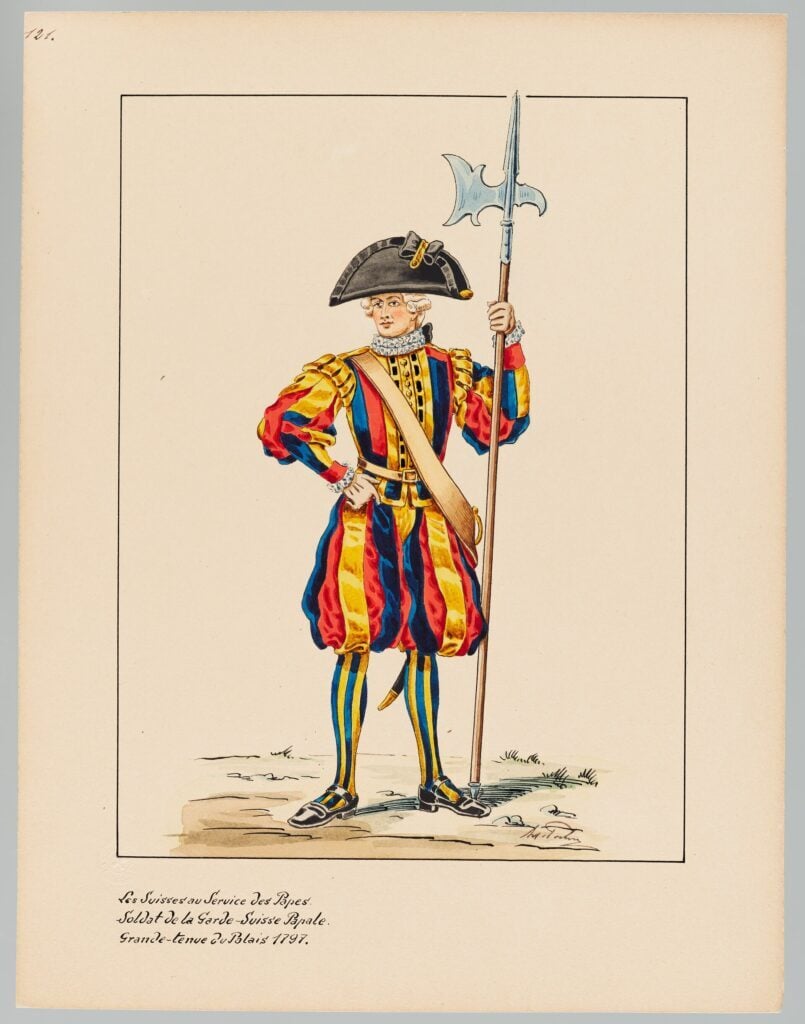
Adolf Pochon, Soldier of the Papal Swiss Guard, 1797, ca. 1890–1931, Swiss National Library, Bern, Switzerland. Wikimedia Commons (public domain).
In the early 1500s, Swiss mercenaries were considered the finest soldiers in Europe, and the business of soldiers-for-hire to foreign rulers was a vital source of Swiss income. Royal courts across the continent employed Swiss guards for their own protection, and “the Warrior Pope,” Pope Julius II, was no exception. Determined to strengthen the Church’s power, the pope sought their courage and loyalty and requested a contingent of his own.
Although Switzerland has long banned its citizens from serving in foreign armies, the Papal Swiss Guard remains the one exception. More than five centuries later, this tradition endures at the Vatican.
Recruits to the Pontifical Swiss Guard must still be Swiss, Catholic, and unmarried men between 19 and 30, at least 174 cm (5 ft 8.5 in.) tall, with an unimpeachable reputation, who completed Swiss military training. The minimum required commitment is 26 months of service in a corps that is a mere 135 men strong.
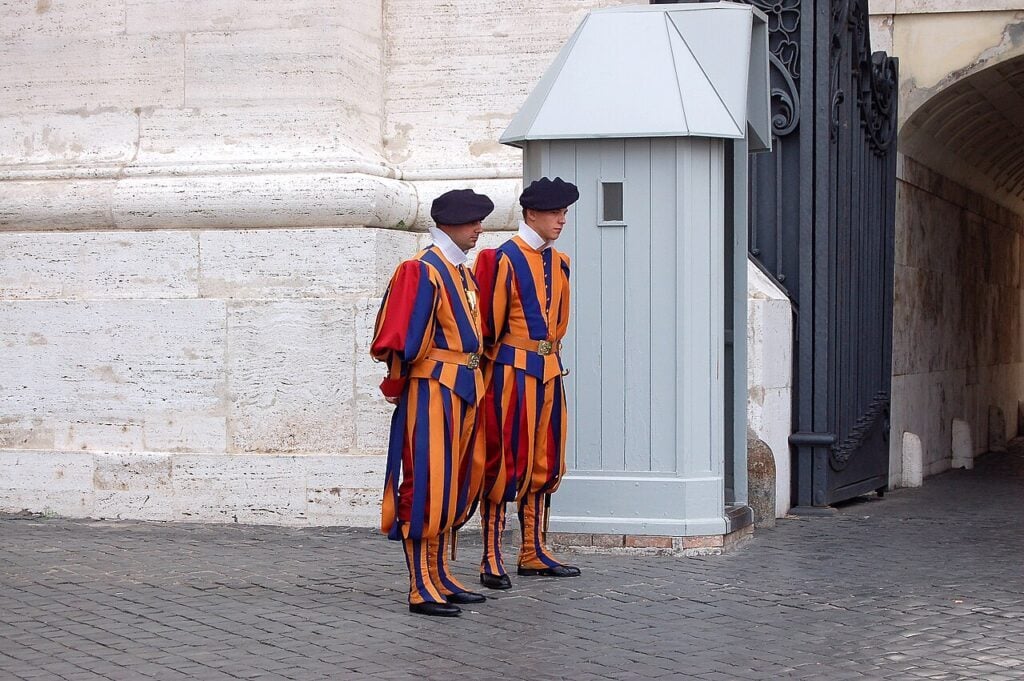
Swiss Guard, 2006, Vatican City. Photograph by Michael Paraskevas via Wikimedia Commons (CC-BY-SA-3.0)
A persistent urban legend endures, claiming that Renaissance master Michelangelo designed the colorful ensemble worn by the guards today. In reality, Michelangelo had no hand in its creation. Guard Commander Jules Repond, who drew visual inspiration from the attire depicted in 16th-century Raphael frescoes, introduced the modern look in 1914.
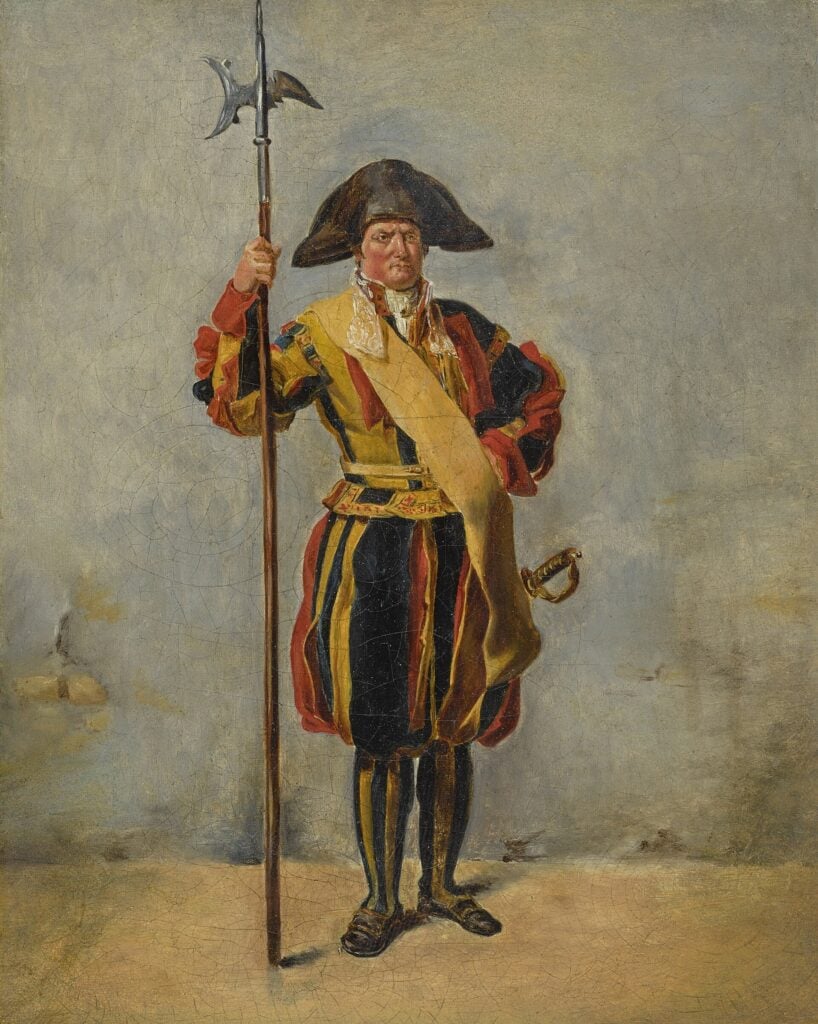
Hortense Haudebourt-Lescot, A Swiss Guard, ca. 1810–1812. Wikimedia Commons (public domain).
The Swiss Guard’s uniform’s iconic palette is traditionally said to combine the blue and yellow of Pope Julius II’s origins, the esteemed Della Rovere family, with the Medici red of Pope Leo X. The distinct cut echoes the dress of 16th-century Swiss mercenaries.
Made of 154 individual pieces of fabric, each gala uniform requires roughly 32 to 39 hours of work and several fittings by the Guard’s in-house tailor shop to complete. These tailor-made garments are reportedly destroyed upon the termination of service to prevent unauthorized use or imitation.
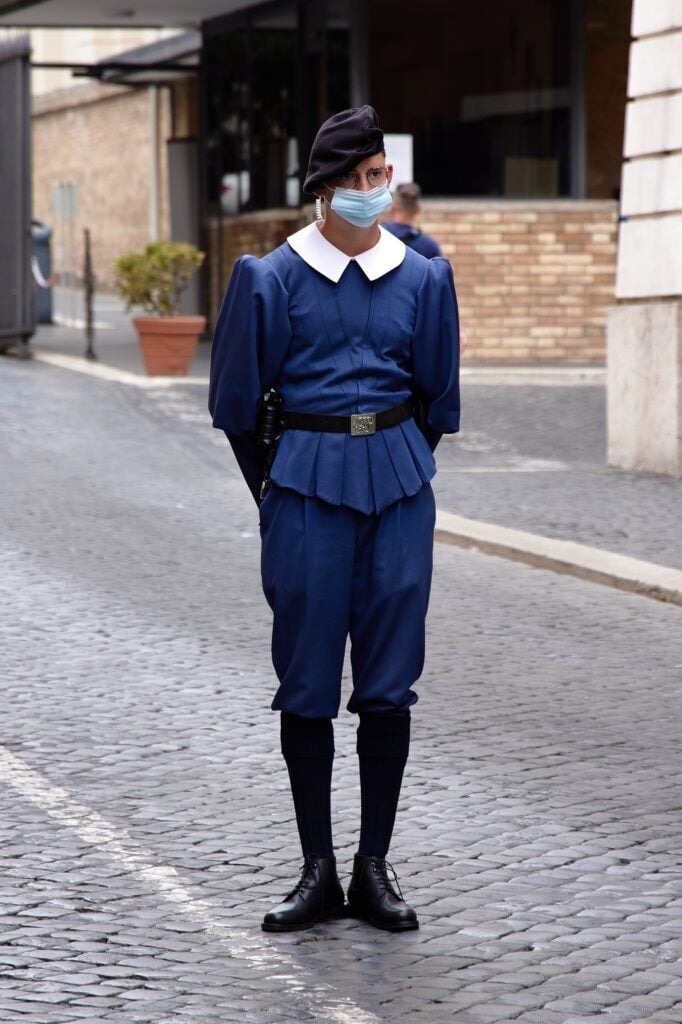
Masked Swiss Guardsman in regular duty uniform during the COVID-19 pandemic, 2021, Vatican City. Photograph by D. Benjamin Miller via Wikimedia Commons (CC0).
The appearance of a Swiss Guard shifts depending on the duties of the day, the weather, and the solemnity of the occasion. The famous tricolor set is the Gala Uniform, worn for public posts and official duties. For training, night watch, work in the barracks, and busy checkpoints, guards wear a simpler dark blue Exercise Uniform with a white collar.
For formal occasions outside the Vatican, such as diplomatic receptions and official dinners, they wear a black wool suit, a pre-1976 design that was recently revived. In cold or rainy weather, guards may add dark blue capes.
On solemn occasions, guards wear a steel cuirass over the tunic along with white gloves. For ceremonial duty, they wear a 16th-century style morion helmet. Since 2019, the standard black morion has been a lightweight, UV-resistant, 3D-printed PVC version in place of the heavier metal original, while a silver morion is reserved for the highest occasions, such as the annual swearing in. The ostrich plumes crowning these helmets denote rank and role, with the different colors signifying the role of the wearer.
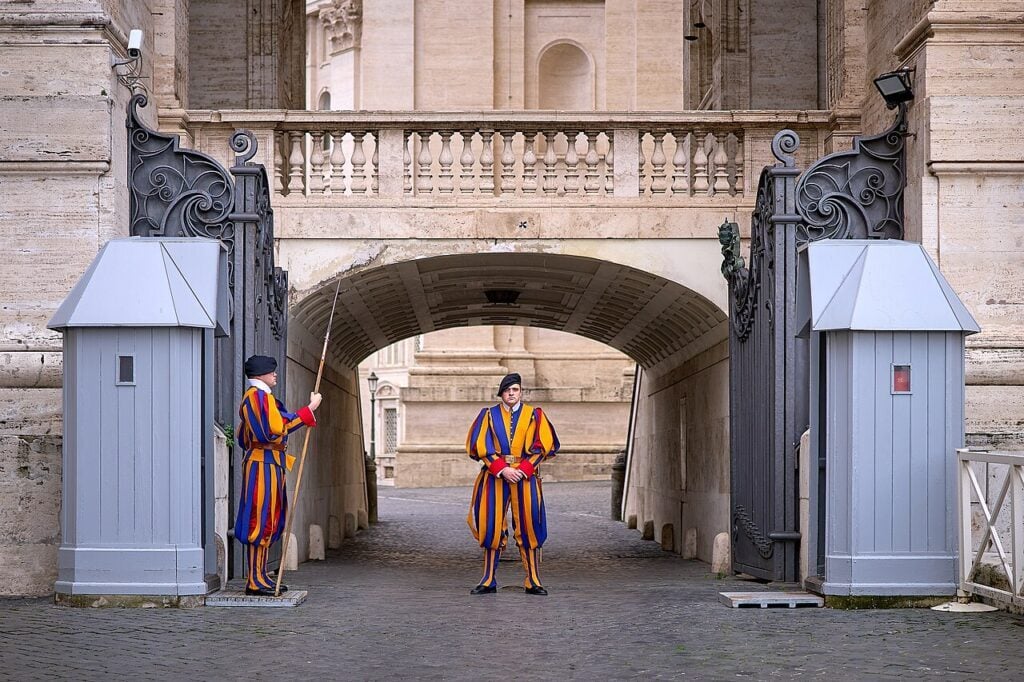
Swiss Guard in the Gala Uniform, 2026, Vatican City. Photograph by Radek Kucharski via Wikimedia Commons (CC-BY-4.0).
Despite the historical origins and ties that honor over five centuries of tradition and evoke an inspiring connection with rich papal and broader Italian history, the new Swiss Guard has fully adapted to modern security demands. Ceremonially, the Guards may carry traditional halberds and swords; beneath the Renaissance splendor, they are highly trained security professionals, equipped with modern defensive tools, including firearms, to protect the pope.
DailyArt Magazine needs your support. Every contribution, however big or small, is very valuable for our future. Thanks to it, we will be able to sustain and grow the Magazine. Thank you for your help!

Maya Tola is a Dallas-based attorney, with a zest for art history. A time traveler at heart, Maya often finds herself consumed in the contemplation of life in antiquity. She has been sharing her infectious enthusiasm for art and history since 2018 through her posts and articles for the DailyArt App and DailyArt Magazine. When she's not working or writing, you'll find Maya obsessing over plants, animals, and food (in no particular order).

Melanie is a freelance editor, proofreader, and writer within humanities fields. Follow her on Twitter @melaniesdemmer.
“Who Wore What” has fascinated artists for centuries because few things convey status, identity, and history as effectively as fashion.
MJ Rivera 18 June 2026
Art historian Elizabeth L. Block turns her scholarly gaze again to the intersection of fashion, society, and cultural identity in her latest...
Errika Gerakiti 30 March 2026
Gabrielle “Coco” Chanel did not just design clothes. She rewrote the rules of what women could wear, feel, and demand from fashion. All of the...
Errika Gerakiti 19 March 2026
Fashioning the Crown: A Story of Power, Conflict, and Couture is Justine Picardie’s latest book. She explores all the ways haute couture and...
Errika Gerakiti 23 February 2026