

Expressionism in 10 Paintings
In 1905, four German artists in Dresden formed a group called Die Brücke (The Bridge), which ultimately shaped what we know today as Expressionism.
Sam Malone 17 August 2026
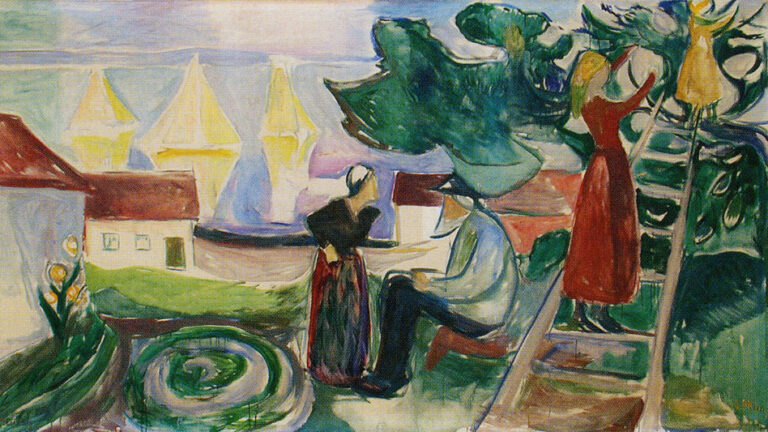
Edvard Munch, Harvesting the Tree (The Freia Frieze V), 1922, Freia Hall, Oslo, Norway. Wikimedia Commons (public domain), Detail.
For over 100 years, 12 large Edvard Munch paintings have graced the walls of the Freia chocolate factory, making the workers’ lunch hall a place of artistic importance on par with a great art museum. Now, due to a factory renovation, the Freia Frieze, as the 12 paintings are known, has been restored and temporarily moved to the Munch Museum (MUNCH). The exhibit, Edvard Munch and the Chocolate Factory, showcases this series of paintings as well as other works that highlight Munch’s wider connection to labor.
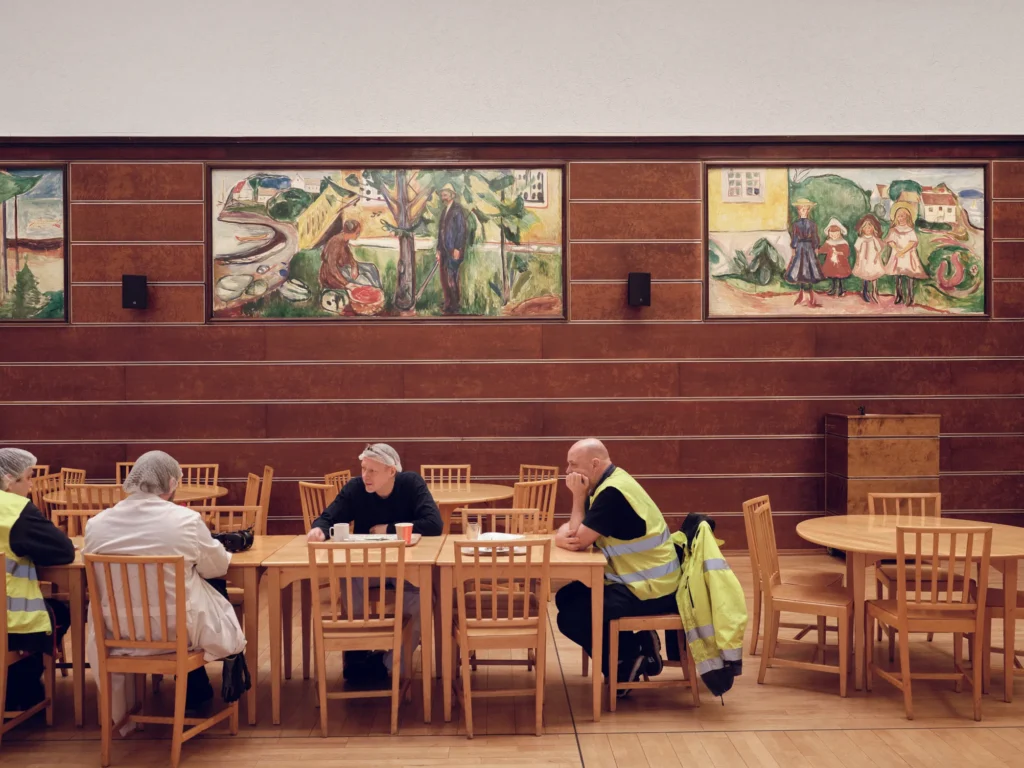
Inside the Freia cafeteria. Photograph by Julie Hrnčířová and Jan Khür. World of Interiors.
In 1922, Johan Throne Holst, head of the Freia company, commissioned Edvard Munch to create 12 paintings to commemorate the company’s 25th anniversary. At a time when two-thirds of Freia workers were women, the paintings first hung in the women’s canteen, but later, the company moved them to a common employee space. Munch earned 80,000 kroner for the project, the equivalent of around 2.6 million kroner or 250,000 US dollars today.
Edvard Munch was well established as an important, groundbreaking artist when he received the Freia commission. 20 years earlier, he’d exhibited his Frieze of Life in Berlin, an ambitious series of paintings portraying the uncertainty and anguish for which he is most famous today. The Scream, of course, is the most famous of these paintings.
In 1916, Munch completed a series of 11 paintings for the University of Oslo, including The Sun, perhaps his most vibrant and hopeful work. The painting is 780 cm (nearly 26 ft.) long, and while the original still hangs at the University, a draft version of the painting proved so large that it had to be transported by barge and hoisted by crane through a side wall to its current place in MUNCH.
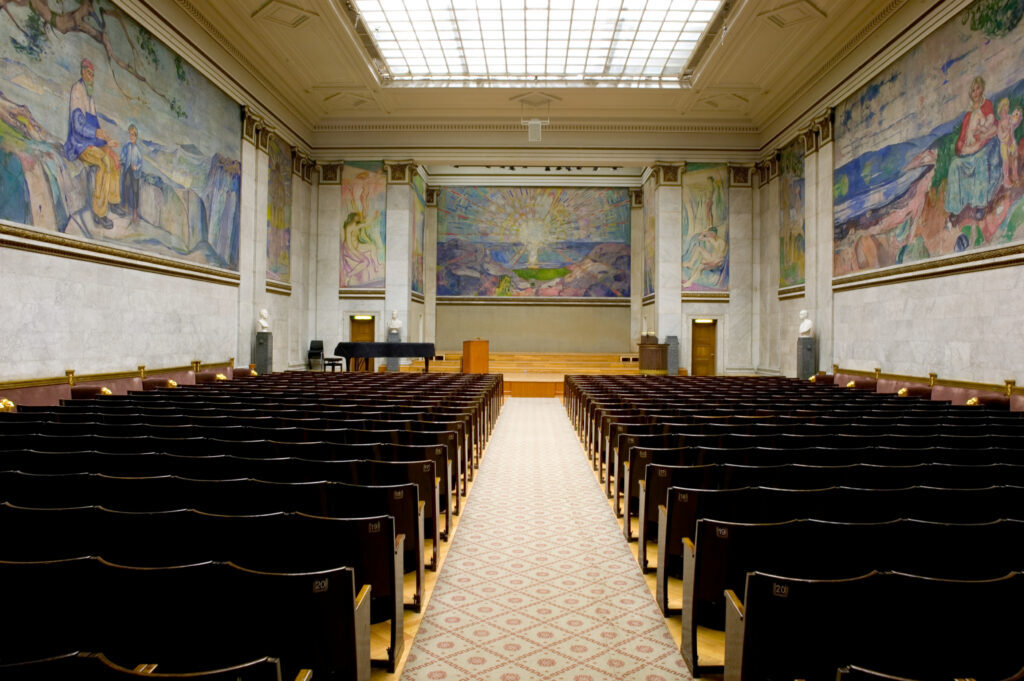
The Aula of the University of Oslo, Oslo, Norway. Photograph by Jaro Hollan. Munch Museum.
Munch was also contemplating the role of his artwork in the greater public consciousness around that time. Just six years after the unveiling of the Freia Frieze, Munch wrote, “I wonder if small-scale paintings will soon be pushed aside. With their large frames, they are merely a bourgeois art form designed for sitting rooms. It is an art dealer’s art, a product of the French Revolution, that gained strength after the victory of the bourgeoisie. Now it is the time of the workers. Do you not suppose that art should again become the property of everyone, and resume its rightful place on the spacious walls of public buildings?”
In the 1920s, Europe reeled in the wake of the 1917 Russian Revolution, and Norway was experiencing its own unrest among the working class. In the summer of 1921, an estimated 120,000 Norwegian workers went on strike in protest of a pay reduction for seamen. The Freia Frieze painting Farewell shows a woman holding a child and waving to a boat, perhaps an homage to these same seamen.
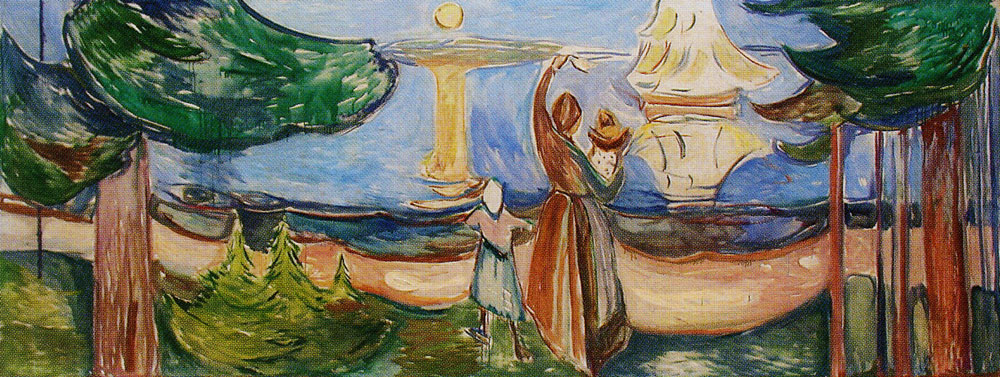
Edvard Munch, Farewell (The Freia Frieze III), 1922, Freia, Oslo, Norway. Wikimedia Commons (public domain).
As Norwegian laborers were fighting to take back power, the Freia chocolate factory took strides to treat its labor force well. The company supported a 48-hour work week, provided an on-site doctor, and included a park on the factory grounds. Also, with the Munch commission, an employee lunch room would house paintings by the nation’s most famous artist.
This lavish commission invited criticism, however. According to a MUNCH publication, shortly after the unveiling of the Freia Frieze, a pro-labor newspaper published an article reading, “While workers are paid starvation wages, large sums of money are invested in expensive paintings which can be sold at a considerable profit over time.”
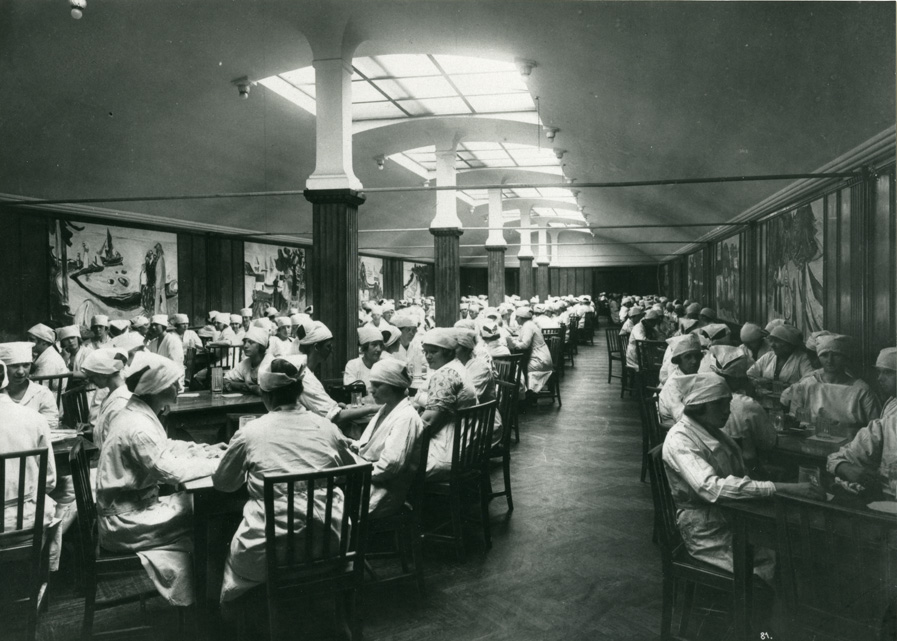
Women’s dining room in Freia in 1923. Wikimedia Commons (public domain).
In several of the Freia paintings, women and children are prominent subjects. Women pick fruit in Harvesting the Tree and in Girls Harvesting Fruit, and care for gardens in Girls Watering Flowers. Children head off for adventure in The Fairytale Forest. Often, the shoreline looms in the background, a reflection of the nation’s geography, and the constant backdrop for scenes of common people in daily life.
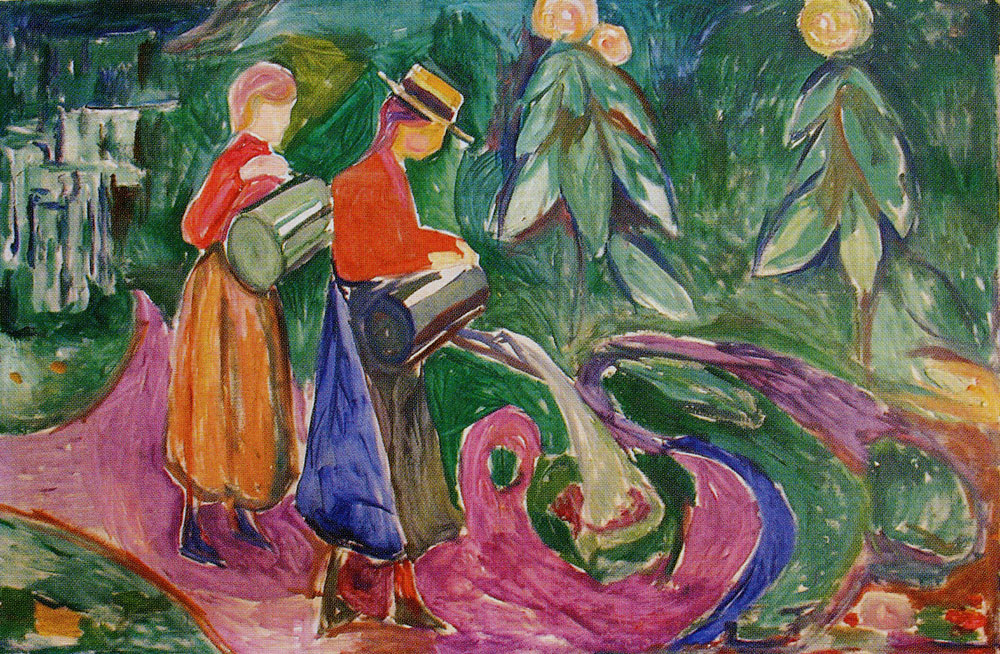
Edvard Munch, Girls Watering Flowers (The Freia Frieze IV), 1922, Freia, Oslo, Norway. Wikimedia Commons (public domain).
The Freia Frieze bears some resemblance to Munch’s Frieze of Life, both in the creation of a narrative arc and in the repetition of themes and iconography. For instance, the 7th painting in the Freia Frieze, Dance on the Beach, is similar to his Dance on the Beach from the 1900 Frieze of Life, as well as his Dance on the Beach from a 1904 Linde Frieze. Youths on the Beach, the 12th panel, bears a resemblance to Melancholy, painted in 1894 and included in the Frieze of Life.
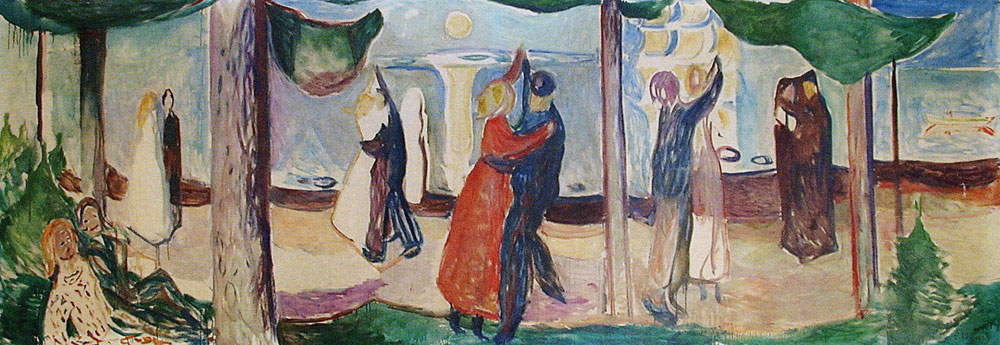
Edvard Munch, Dance on the Beach (The Freia Frieze VII), 1922, Freia, Oslo, Norway. Wikimedia Commons (public domain).
MUNCH publications point to the artist’s “…fascination with workers, women and children,” in several works. This includes sketches for more paintings at the Freia factory, which never came to be. MUNCH also owns Workers on the Building Site, an enormous 570 cm (nearly 18 ft.) long unfinished painting at one time destined for Oslo’s city hall. Munch often painted outside, and this work-in-progress was discovered balled up in ice and snow at the artist’s property after he died in 1944.
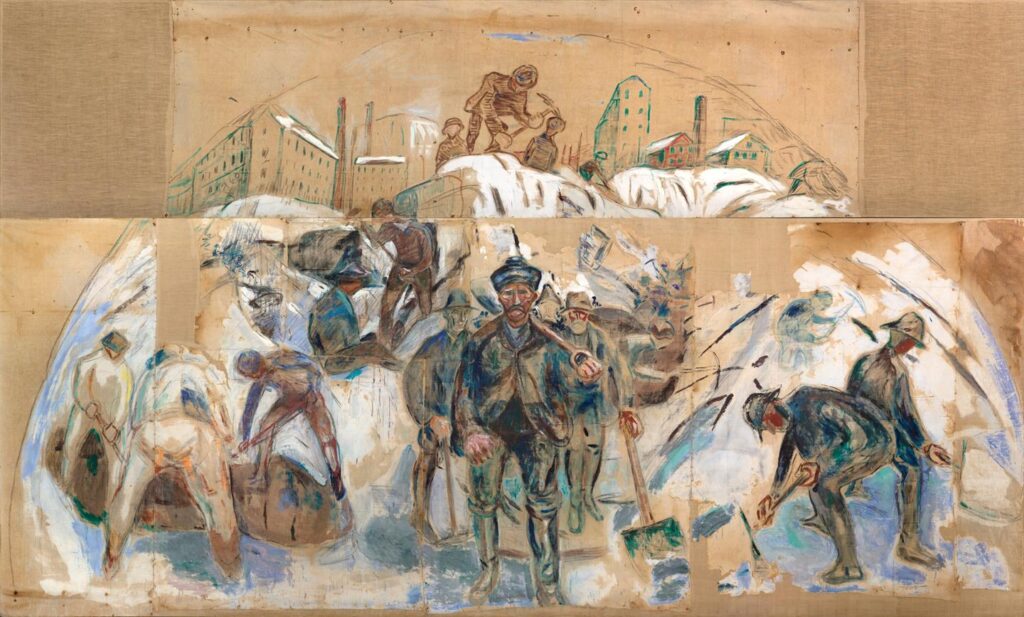
Edvard Munch, Workers on the Building Site, draft for a decoration of Oslo City Hall, 1931–1933, Munch Museum, Oslo, Norway.
The history of Edvard Munch and the Chocolate Factory is actually a story that intertwines his artistic practice with monumental projects, but also the history of chocolate and women’s emancipation.
The Lost Munch Paintings Hidden in a Chocolate Factory. YouTube.
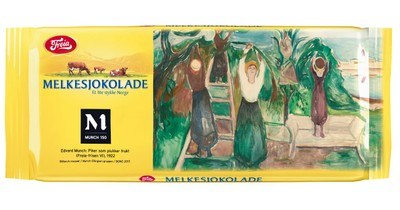
Freia Melkesjokolade (milk chocolate) wrapper. Nordic Labor Journal.
The Freia Frieze has long been a point of pride for the Norwegian chocolate company. The paintings are a stop on the Freia factory tour, and at one point, several paintings made their way onto chocolate bar wrappers.
The temporary relocation of the Freia Frieze paintings and the exhibit at MUNCH is supported by the Mondelez/Freia company, the Norwegian Labour Movement Archives and Library, the National Library of Norway, and the National Archives of Norway.
Edvard Munch and the Chocolate Factory is on view at the Munch Museum (MUNCH), Oslo, Norway, until October 11, 2026.
DailyArt Magazine needs your support. Every contribution, however big or small, is very valuable for our future. Thanks to it, we will be able to sustain and grow the Magazine. Thank you for your help!

Theodore Carter is the author of several books including "Stealing The Scream" and "Frida Sex Dreams and Other Unnerving Disruptions". You can see his art out in the streets of Washington, DC, and on his website: https://theodorecarter.com.

An admirer of antiquity, art, and architecture. An avid reader and amateur photographer. Always curious, always on an adventure.
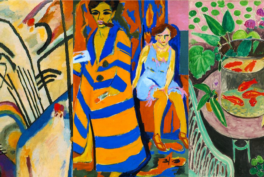
In 1905, four German artists in Dresden formed a group called Die Brücke (The Bridge), which ultimately shaped what we know today as Expressionism.
Sam Malone 17 August 2026
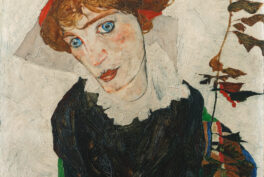
Egon Schiele lived for 28 years and painted as though he knew exactly how many years he had. Few bodies of work in modern art carry the biographical...
Errika Gerakiti 1 June 2026
Examining Franz Marc’s most iconic animal paintings reveals how the German Expressionist used color and form to convey the spiritual essence of...
Lisa Scalone 15 May 2025
The purpose of art for a group of avant-garde individuals at the turn of the 20th century was no longer the realistic rendition of the natural world,...
Guest Author 29 February 2024


.jpg)
.jpg)
.jpg)
.jpg)
.jpg)