


Sliman Mansour, Painter of Palestinian Resistance, Dies at 79
Sliman Mansour, one of the leading figures in Palestinian art, died yesterday at the age of 79. Mansour’s practice was profoundly intertwined...
Martha Teverson 25 August 2026
25 May 2026 min Read
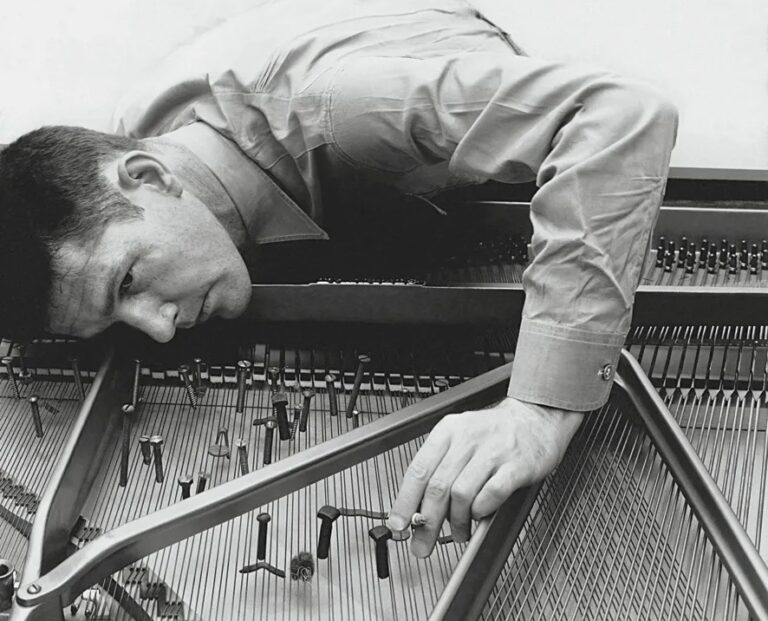
John Cage preparing a piano, 1947.Photograph by Irving Penn / © 1947 (Renewed 1975) Condé Nast Publications Inc. New Yorker. Detail.
In 1952, a pianist sat before a waiting audience and played not a single note. Six years later in Paris, visitors entered a gallery expecting art and found an empty white room. Both moments seemed to offer nothing, yet they revealed one of modern art’s boldest questions: can absence become full when someone is there to listen, look, and understand?
Let us begin in a concert hall.
The year is 1952. The audience enters the Maverick Concert Hall in Woodstock, New York, takes its seats, and waits for the music to begin. On stage, there is a piano. The performer is David Tudor. He is about to premiere a new work by the American composer John Cage.
Everything looks familiar: a musician, an instrument, an audience, a performance. Then something strange happens.
Tudor sits at the piano, but he does not play a single note. He marks the beginning and end of the movements, but the keyboard remains silent. Seconds pass. Then minutes. People begin to cough, shift in their seats, breathe more loudly, perhaps even wonder whether they are being mocked. But this discomfort is not outside the work. It is the work.
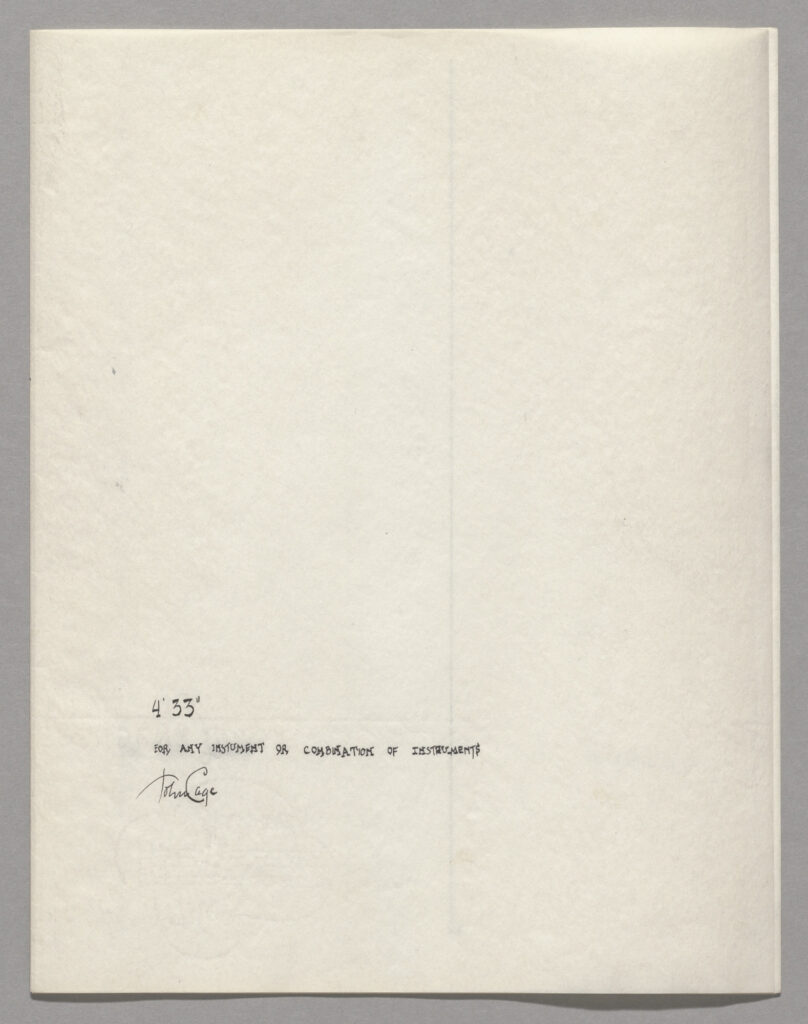
Absence in Art: John Cage, 4’33” (In Proportional Notation), 1952/1953, Museum of Modern Art, New York City, NY, USA.
The piece is called 4’33” because it lasts 4 minutes and 33 seconds. During that time, the performer produces no intentional musical sound. Yet the hall is not silent. It is full of small, accidental sounds: a chair creaking, a program rustling, a nervous laugh, the movement of bodies, the atmosphere of that room. Cage’s radical gesture was not to remove sound, but to reveal it. Many listeners expected music to come from the artist, the instrument, or the written score. Cage quietly changed the frame: when the piano remained silent, the world entered the music.
This is why 4’33” is still so often misunderstood. At first, it may look like a provocation or even a joke. “Nothing happened,” one might say. But Cage’s answer might be: Are you sure? Did nothing happen, or did you simply begin to hear what you usually ignore?
The point is more subtle: attention changes experience. A cough treated as an interruption becomes part of the event. The border between music and noise suddenly becomes unstable.
Now, let us move from a concert hall to a gallery.
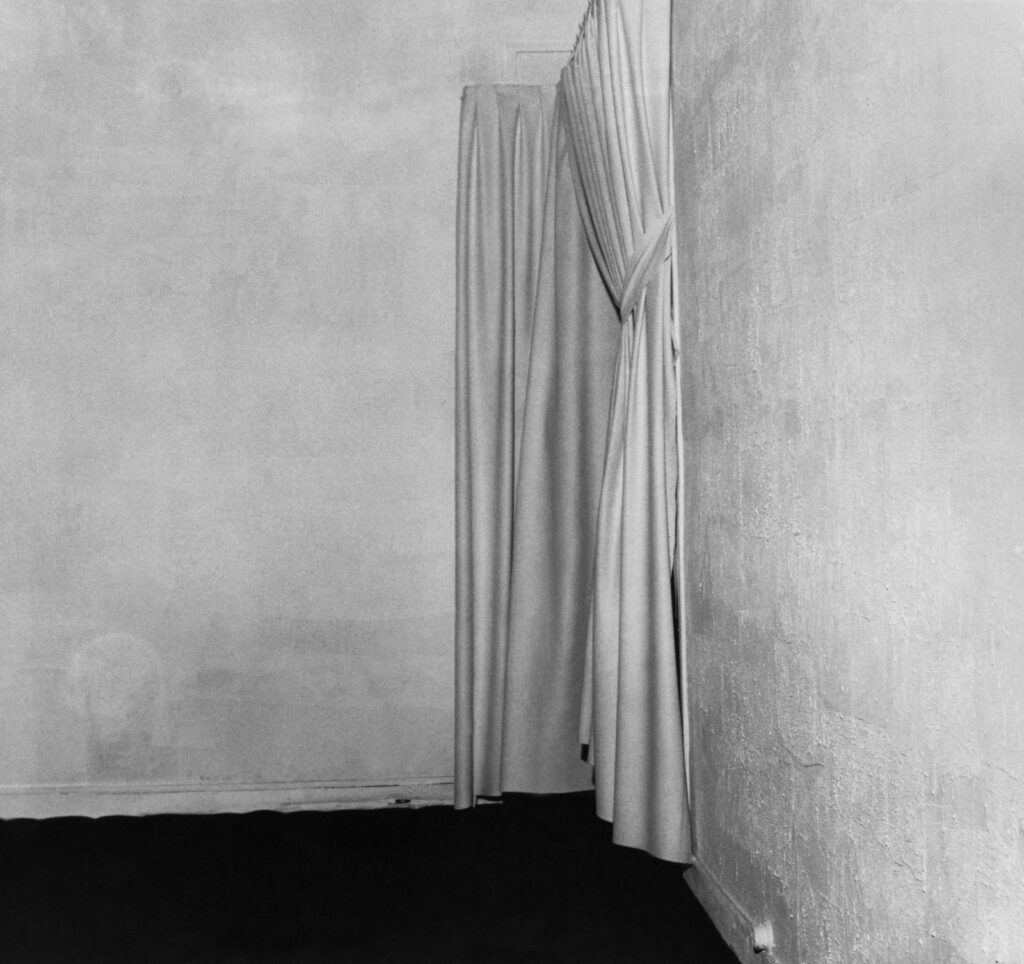
Absence in Art: Yves Klein, La spécialisation de la sensibilité à l’état de matière première en sensibilité picturale stabilisée, better known as Le Vide, 1958, Galerie Iris Clert, Paris, France. © The Estate of Yves Klein c/o ADAGP, Paris. Socks.
Paris, 1958. Visitors arrive at Galerie Iris Clert for an exhibition by Yves Klein, already known for his intense blue monochromes and his fascination with immaterial experience. They come expecting paintings, objects, perhaps something astonishing. Instead, they enter an apparently empty space.
The exhibition carried a long formal title about “pictorial sensibility,” but it became known simply as Le Vide (The Void). The gallery windows were painted in Klein’s intense blue. Inside, the room was white, bare, and almost ceremonial. It looked less like an ordinary exhibition than an invitation to become aware of looking itself.
There was no painting to stand before, no sculpture to walk around, no image to decode. The experience of entering had become the artwork. Visitors brought the usual expectations of an exhibition: to see, judge, admire, reject. In front of emptiness, those habits had nowhere to go.
Some visitors may have felt cheated. Others may have laughed. Some may have become silent. For Klein, such reactions were not accidental. They were part of the event.
Like Cage, Klein was not simply giving the public “nothing.” He was changing the role of the public. In Le Vide, the viewer’s response becomes the central drama. The empty room exposes the invisible structure of art: the invitation, the gallery, the expectation, and the social ritual of looking. Klein’s emptiness was therefore not a lack. It was a stage.
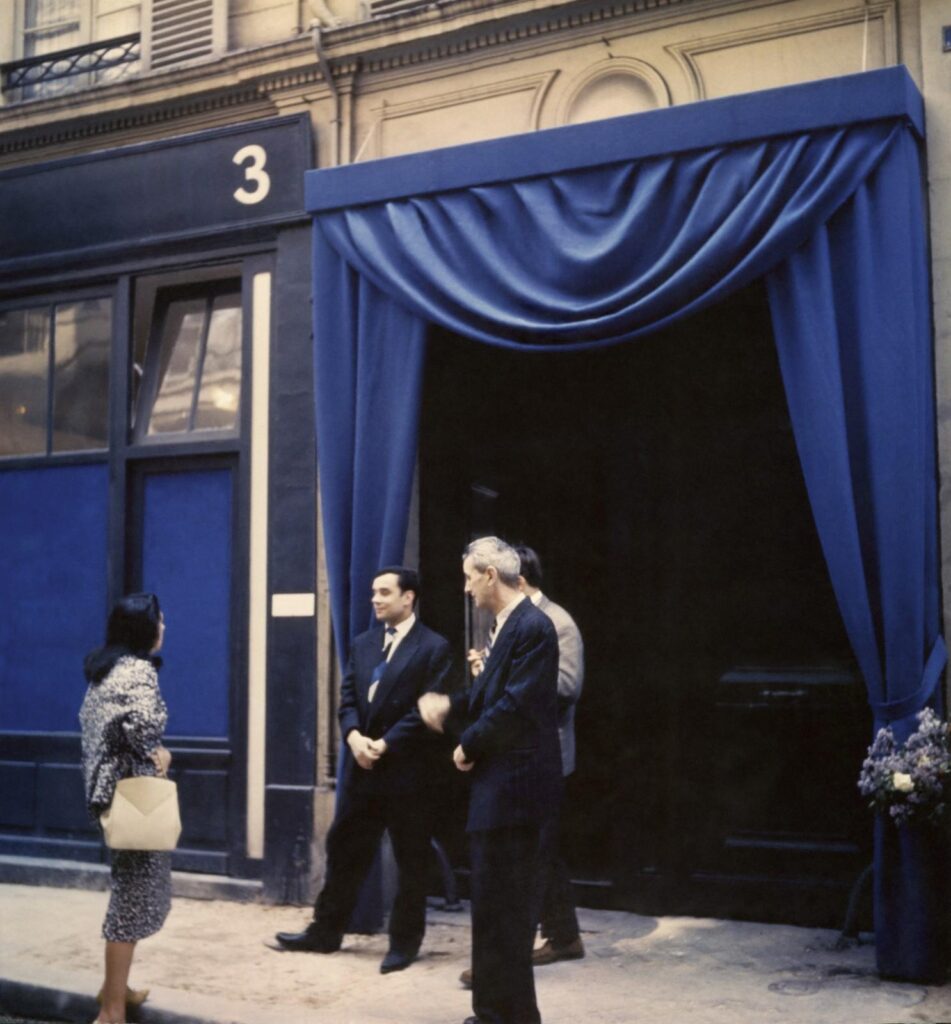
Absence in Art: Yves Klein, La spécialisation de la sensibilité à l’état de matière première en sensibilité picturale stabilisée, better known as Le Vide, 1958, Galerie Iris Clert, Paris, France. © The Estate of Yves Klein c/o ADAGP, Paris. Socks.
Seen together, Cage and Klein seem to speak from the same delicate edge of modern art. In one, there is no music, but there is sound. In the other, there is no object, but there is response. Both artists step back, and the viewer or listener steps forward. They seem to whisper: art is not only what the artist makes; it is also what happens when you are there. The work is completed inside your attention.
This is why these works can feel irritating at first. Someone might say, “This is nonsense.” But if we stay with that irritation a little longer, a more unsettling question appears: is there really nothing here, or are we simply, perhaps for the first time, left alone with our own attention?
In a time filled with screens, alerts, and constant background noise, Cage and Klein feel strangely contemporary. They do not ask us to consume more. They ask us to notice more. Maybe what we call “nothing” is a fullness we have not yet learned to recognize. And perhaps art is not always about adding something to the world. Sometimes it is about stepping back, staying silent, and leaving a space open for us to enter. The void, then, is not as empty as it seems. Perhaps it is waiting to be understood, not as a lack, but as a space that asks for our attention. When art appears to give us nothing, is it really empty, or is it inviting us to complete it by listening, looking, and being there?
DailyArt Magazine needs your support. Every contribution, however big or small, is very valuable for our future. Thanks to it, we will be able to sustain and grow the Magazine. Thank you for your help!

Tunacan Tuna is a culture writer and journalist exploring art history, museums, cultural heritage, cultural memory, and the ways people connect with places, objects, and stories.

Sliman Mansour, one of the leading figures in Palestinian art, died yesterday at the age of 79. Mansour’s practice was profoundly intertwined...
Martha Teverson 25 August 2026
There is a particular vertigo in crouching down to look at something the size of a fingernail. Since 2006, Slinkachu has built an entire career...
Errika Gerakiti 3 August 2026
Few would claim real shock at the loss of an artist a month shy of turning 89. And then David Hockney passed away on June 11. Born in 1937, the lad...
MJ Rivera 22 June 2026
Between marquee art fairs, auction-house madness, downtown openings, uptown previews, long-awaited gallery and museum exhibitions, and the artsy...
MJ Rivera 28 May 2026