Committed to expanding the boundaries of American art history, the American Folk Art Museum has played a key role in bringing self-taught artists into focus. With works spanning four centuries, from traditional folk art to contemporary Outsider Art, the museum celebrates creative expression of individuals often outside the system of formal artistic training. Its collection offers a nuanced view of national identity, faith, ingenuity, and community.
1. An Historic Event by Patrick J. Sullivan
Austin Losada, Art Bridges Fellow
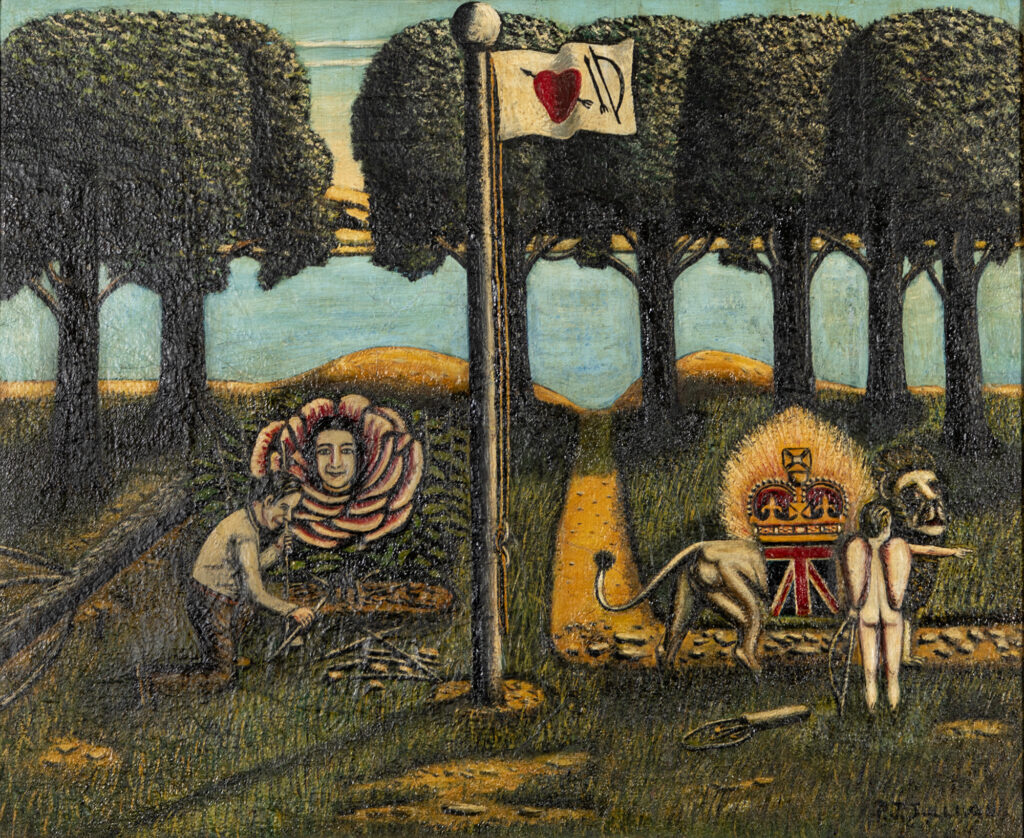
When I first arrived at the Museum three years ago, we had just received a gift that included two paintings by Patrick J. Sullivan (1894–1967). What incredible luck. Scholars believe that Sullivan completed only fifteen works on canvas during his life. He painted sparingly, but meticulously, and for someone with so few works under their belt, he had an unusually defined personal style. He described his paintings as “parables in picture form” (AMAZING), and accompanying each work was a “theme” that described the work’s meaning and symbols. In this painting, Sullivan takes up a contemporaneous event: King Edward VIII’s abdication in order to marry American socialite Wallis Simpson.
The painted subject and symbolic elements are interesting, for sure. But what really draws me to the work is Sullivan’s mastery over compositional balance and formal effects, the latter of which is really hard to capture on camera. Sullivan’s canvases are thick, textured affairs. His occupation as a house painter provided him with material knowledge of commercial paint that informed his artistic approach. He successively layered paint and, in some areas, sanded it down to create rough, bumpy, and confrontational surfaces. It is a delight to sit with in person.
2. Untitled (Lee in a Large Hate) by Lee Godie
Lisa Machi Ortiz, Assistant Registrar & Collections Database Manager
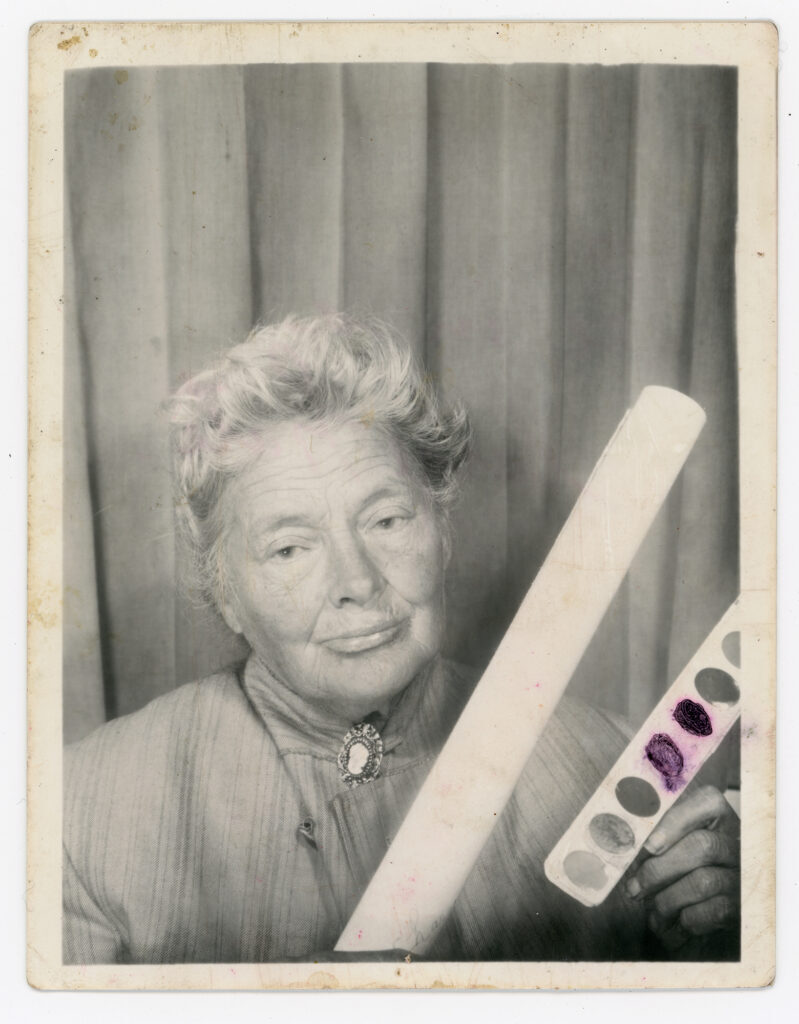
Lee Godie (1908–1994) was famous for selling her works on the steps of the Art Institute of Chicago as a French Impressionist, marketing herself as “Lee Godie—Artist.” This work stands out among her other self-portraits taken in a photo booth machine, as she has not applied additional makeup or accessories. She presents herself straight forward to the camera with her palette, declaring herself as Artist.
3. Scottie’s Art Gallery, No. 2 by Scottie Wilson
Natalie Beall, Senior Educator and Manager of Student Engagement
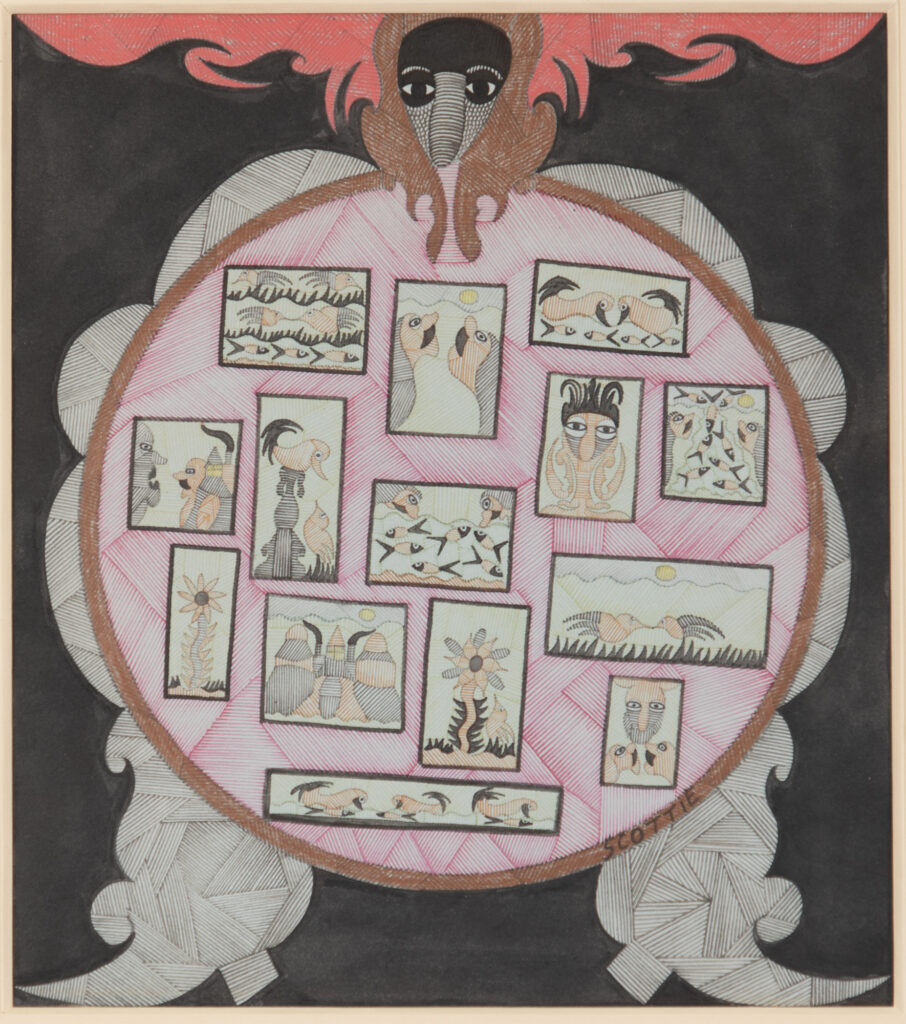
Scottie Wilson‘s (1891–1972) drawings have always appealed to me for their distinctive style and inventive subject matter. His mask-like faces, animal groupings, and invented plant forms seem to belong to their own world, and his seductive use of cross-hatching and near-symmetry pulls me in every time. I think of this piece as a map to Wilson’s artistic world, where the main figure (presumably the artist himself) displays a mini-exhibition containing the various motifs in his work. Since Wilson often staged his own shows and worked outside of the gallery system, the creation of a self-determined art gallery is even more fitting.
4. Sunday Go to Meetin’ by Joe Coleman
Anna Karayorgi, Shop Administration and Merchandise Specialist
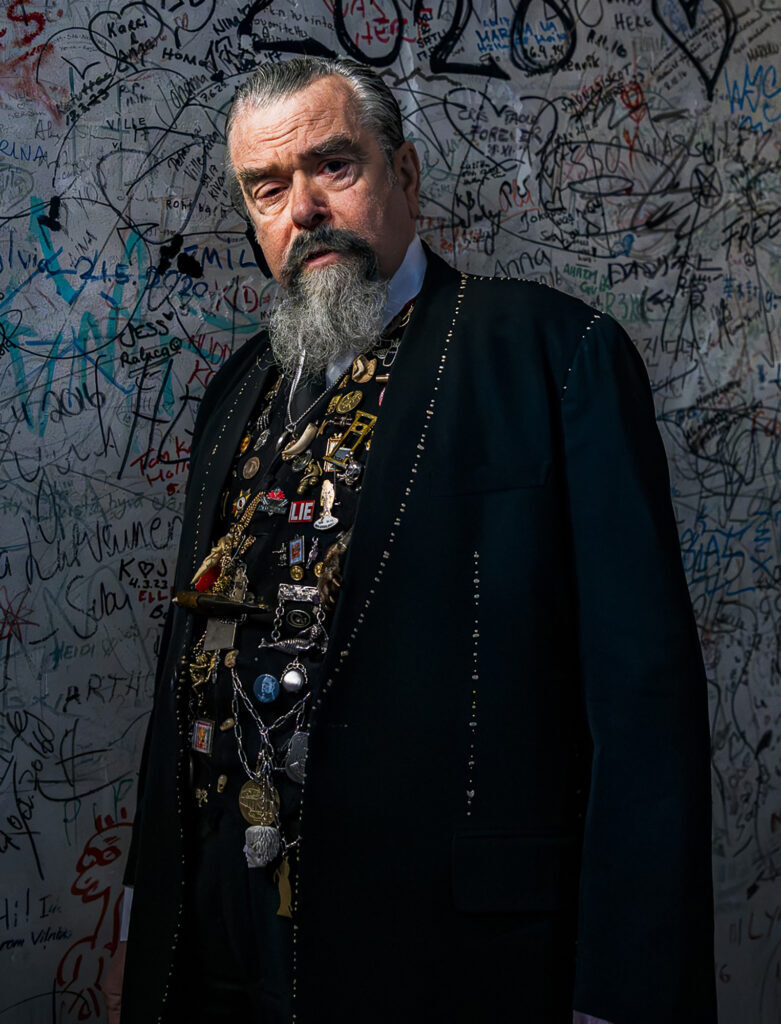
I chose Joe Coleman’s (b. 1955) “Sunday Go to Meetin’.” I love that Joe Coleman’s “Sunday Go to Meetin'” presents the practice of collecting as a work of visual art in itself. Looking at it reminds me of looking through an I Spy book, and it also makes me consider my own charm collection as something more meaningful. I also find the use of clothing as a canvas fun, accessible, and relatable.
5. Hamburgers, Heels, and High Couture by Nicole Appel
Tess Wagman, Social Media and Communications Manager
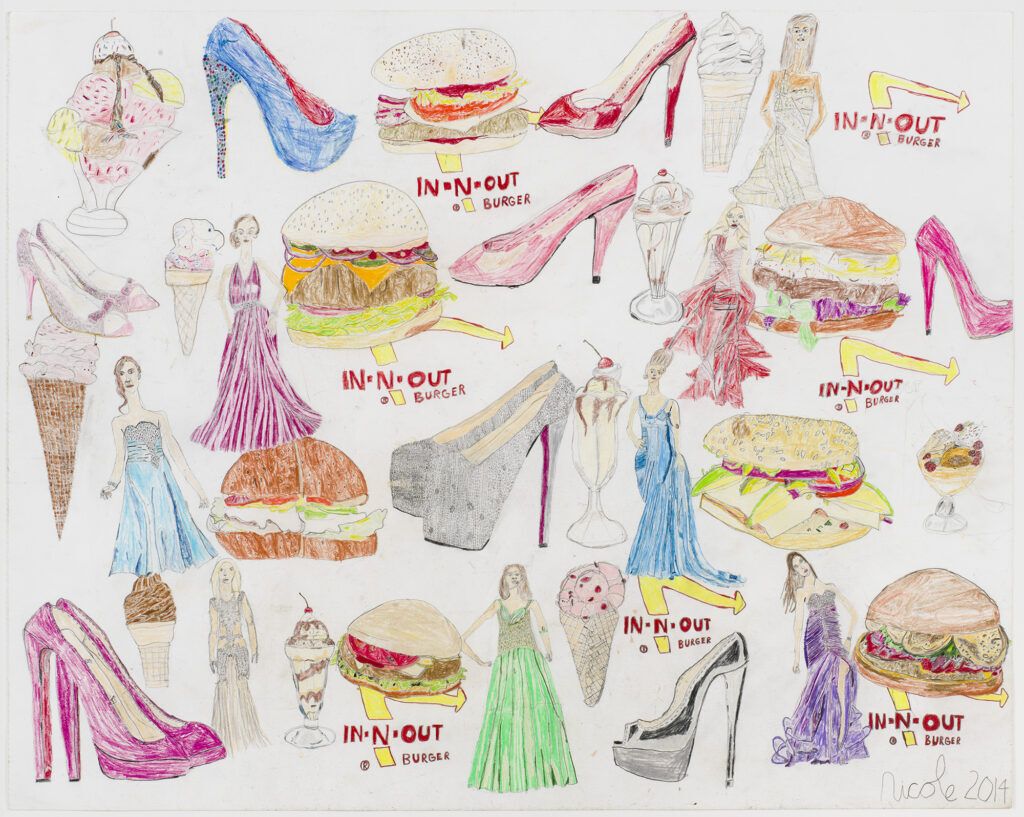
I love the world that Nicole Appel (b. 1990) creates in this drawing. The arrow of the In-N-Out sign becomes a kind of map, guiding the eye through a landscape of burgers, sundaes, and dresses. The longer you look, the more surprising combinations emerge: pink heels perched atop a strawberry cone, or a blue dress melting into a chocolate swirl. Every form is given the same level of detail and care.
Self-Made: A Century of Inventing Artists
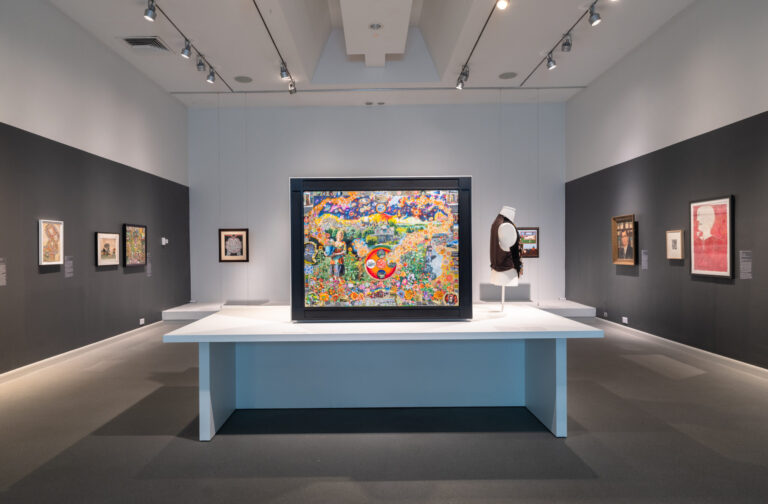
All of the selections featured in the article come from the American Folk Art Museum’s Self-Made: A Century of Inventing Artists, currently on view through September 13, with free admission.
Self-Made: A Century of Inventing Artists takes a critical look at the historical definition of the “self-taught artist” in the United States from the early 20th century to today. The exhibition examines how artists without academic training have depicted, conceptualized, and identified themselves on their own terms. In doing so, it challenges long-standing and reductive narratives that have cast these artmakers as amateurs or isolated geniuses working outside of time, lineage, influence, or artistic networks.
The 60 artists featured in the exhibition largely worked outside conventional systems of art schools, galleries, museums, and peer exchange. Their practices are rooted in diverse sites of learning, from professional expertise to community-based traditions. Drawn primarily from the American Folk Art Museum’s collection, the exhibition brings together outstanding examples of paintings, sculptures, photographs, videos, and artists’ notebooks by key national and international figures, including many recent or rarely seen acquisitions.