



10 Radiant Summer Paintings by Vincent van Gogh
The luminous color of Van Gogh’s mature style took shape in Paris, where he spent two years living with his brother Theo among the avant-garde.
MJ Rivera 29 July 2026
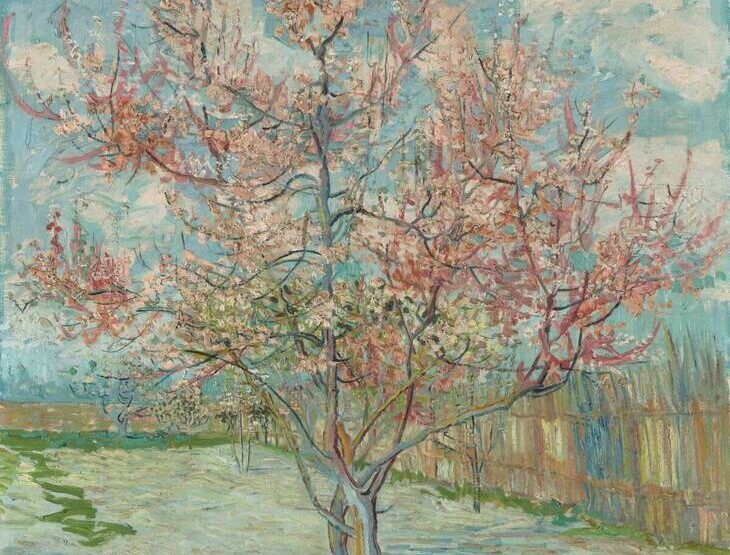
Vincent van Gogh, Pink Peach Trees (Souvenir de Mauve), 1888, Kröller-Müller Museum, Otterlo, Netherlands. Detail.
Spring blossoms held a special power for Vincent van Gogh and inspired paintings of remarkable beauty, often concealing the difficulties he faced while creating them. His career as an artist, although lasting barely a decade before his tragic death, produced an extraordinary body of work. Spring may be an overused symbol of renewal, but it endures for a reason. In his flowers, blooming orchards, and delicate branches, Van Gogh reminds us that the darkness of winter eventually yields to the radiance of spring.
During the 2020 COVID-19 pandemic lockdowns, British artist David Hockney expressed a similar sentiment in a statement that resonated widely: “Do remember they can’t cancel the spring.” This March equinox marks the beginning of spring. Here are 10 paintings by Vincent van Gogh celebrating the season—and affirming that today, spring is not cancelled either.
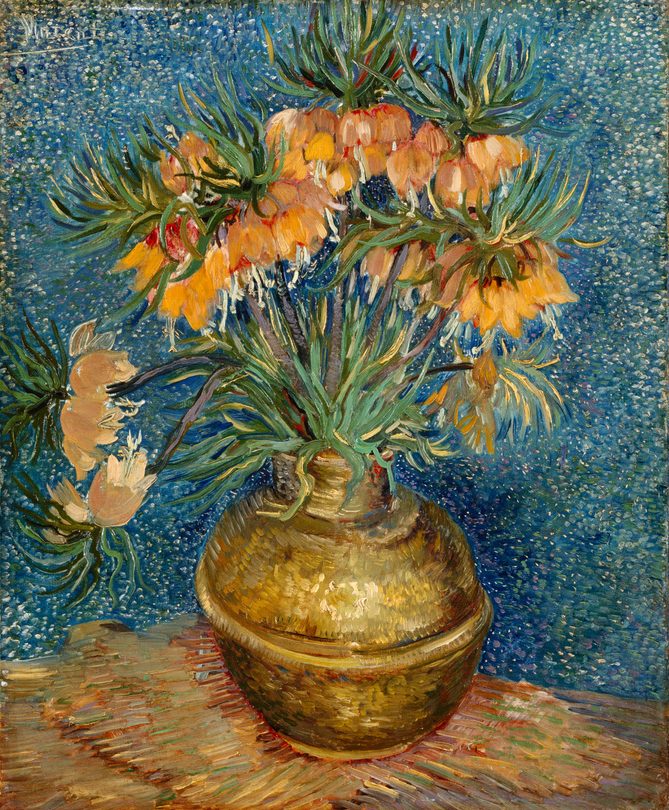
Vincent van Gogh, Imperial Fritillaries in a Copper Vase, 1887, Musée d’Orsay, Paris, France. © RMN-Grand Palais (Musée d’Orsay) / Hervé Lewandowski.
The two years Van Gogh spent in Paris were a major turning point in his brief, brilliant career. He moved there in 1886 to live with his art-dealer brother, Theo, and immerse himself in the Parisian avant-garde. This bouquet captures the shift from the darker Dutch-style tonality of his early palette to the colorful pictures we know today.
These are imperial fritillaries, spring-blooming flowers with bulbs that produce several tall stems of hanging orange-red blossoms (ideal for studies in color theory). Van Gogh learned to place complementary colors side by side to heighten intensity and luminosity. The canvas also reflects Neo-Impressionist ideas such as Pointillism, though Vincent used such effects more freely rather than methodically following the technique.
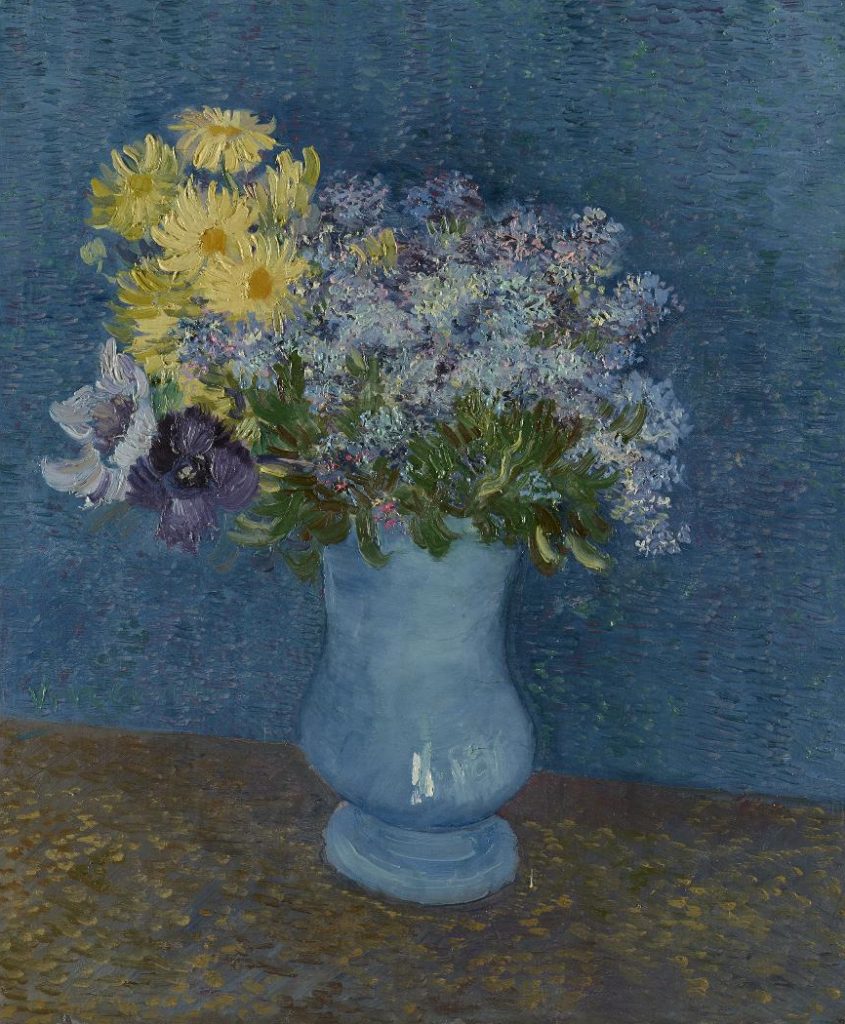
Vincent van Gogh, Bouquet of Flowers in a Blue Vase, 1887, Musée d’Art et d’Histoire, Geneva, Switzerland.
Like Imperial Fritillaries in a Copper Vase, this painting belongs to a group of more than 30 still-life studies Van Gogh made while living in Paris (March 1886–February 1888). Using inexpensive market flowers, he experimented with brighter palettes and more expressive brushwork under the influence of Impressionism and Neo-Impressionism.
In practical terms, painting flowers also often served as a substitute for figure models, which Van Gogh could rarely afford. He wrote to his sister Willemien about painting “almost nothing but flowers” during that period. This still life features lilacs, anemones, and daisies, flowers primarily associated with spring in European horticulture.
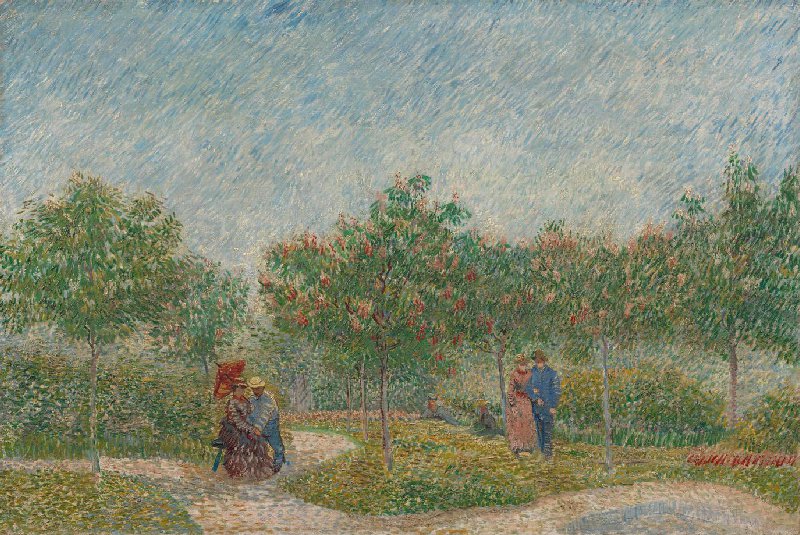
Vincent van Gogh, Garden with Courting Couples: Square Saint-Pierre, 1887, Van Gogh Museum, Amsterdam, Netherlands.
Scenes like this were a favorite subject for Impressionist painters, who often depicted modern life. This one is set in a public garden at the foot of the hill where Sacré-Coeur now rises in Montmartre, the Paris neighborhood where Van Gogh lived.
He continued to explore contemporary ideas about the use of color, particularly those advanced by Georges Seurat and Paul Signac. For Van Gogh, mastering color theory was essential, and he translated those ideas by setting complementary colors—greens against reds and yellows against blues—side by side, using short strokes and layered touches of paint. The result is a vibrant scene, with a painted surface that shimmers with light and anticipates the bold colors and lively brushwork of his later masterpieces.
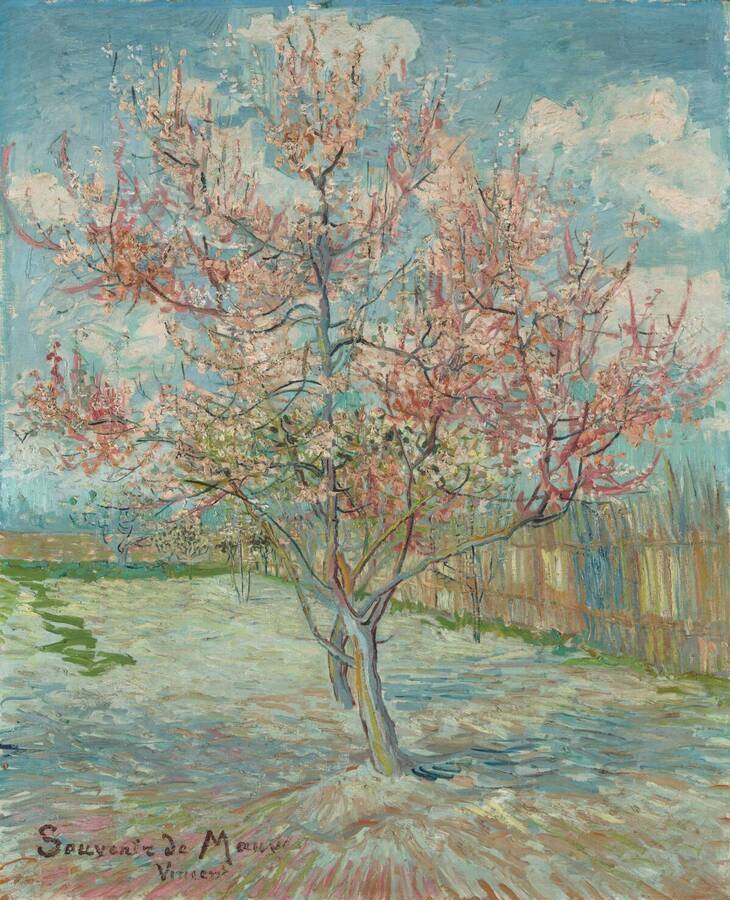
Vincent van Gogh, Pink Peach Trees (Souvenir de Mauve), 1888, Kröller-Müller Museum, Otterlo, Netherlands.
Looking to build a new artistic career in the south of France, Vincent van Gogh moved to Arles in February 1888. He arrived in cold, frosty weather, but the fruit orchards surrounding the city soon burst into bloom. He enthusiastically painted dozens of fruit trees, including peach, pear, plum, and apricot. Van Gogh worked rapidly outdoors in a flattened style influenced by Japanese woodblock prints, a major inspiration in his career.
During this productive springtime in Provençe, he focused on emphasizing the contrast between the blossoms and the sky, a color relationship he discussed in letters to his friend, artist Émile Bernard, and to his brother Theo. Van Gogh inscribed this painting in memory of Anton Mauve, his cousin-in-law and one of his earliest mentors.
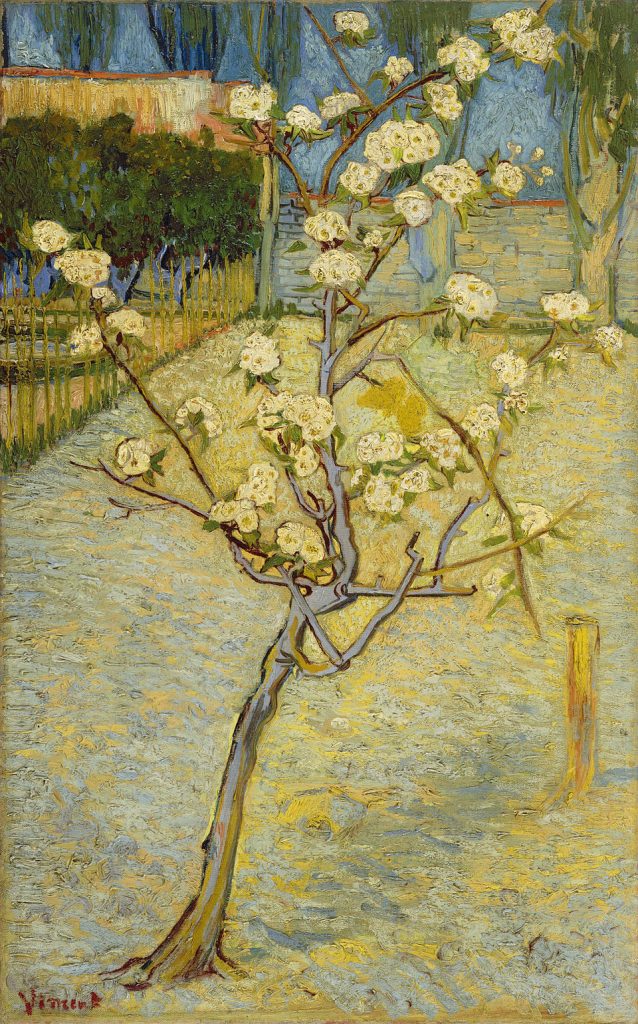
Vincent van Gogh, Small Pear Tree in Blossom, 1888, Van Gogh Museum, Amsterdam, Netherlands.
This delicate flowering tree belongs to the same artistic flurry that followed Van Gogh’s arrival in Arles. He moved there seeking conditions he believed would help his development and hoping to establish a community of artists, extending a fateful invitation to Paul Gauguin. The move was artistically productive, as Vincent produced numerous works in just over a year, including some of the most celebrated paintings of his career.
This canvas was very special to the Van Gogh family. His sister-in-law, Jo van Gogh-Bonger, wrote to Vincent that her newborn was fascinated by this painting, which hung above their bed.
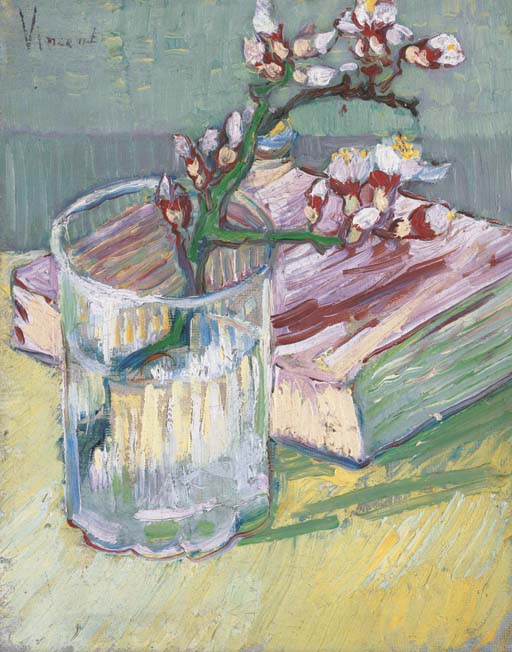
Vincent van Gogh, Blossoming Almond Branch in a Glass with a Book, 1888, private collection. Christie’s.
This work is also part of the intense experimentation that followed Van Gogh’s departure from Paris in search of brighter sunlight and a quieter working environment. Van Gogh painted many variations on this theme, from expansive orchards in bloom to small studies like this one—an intimate still life that celebrates color and the simple beauty of a sprig. The almond tree is one of the first to blossom in spring, often while winter still lingers.
Van Gogh gifted this painting to his sister, Willemien, for her 26th birthday. He would later return to the subject in one of his most celebrated masterpieces, Almond Blossom.
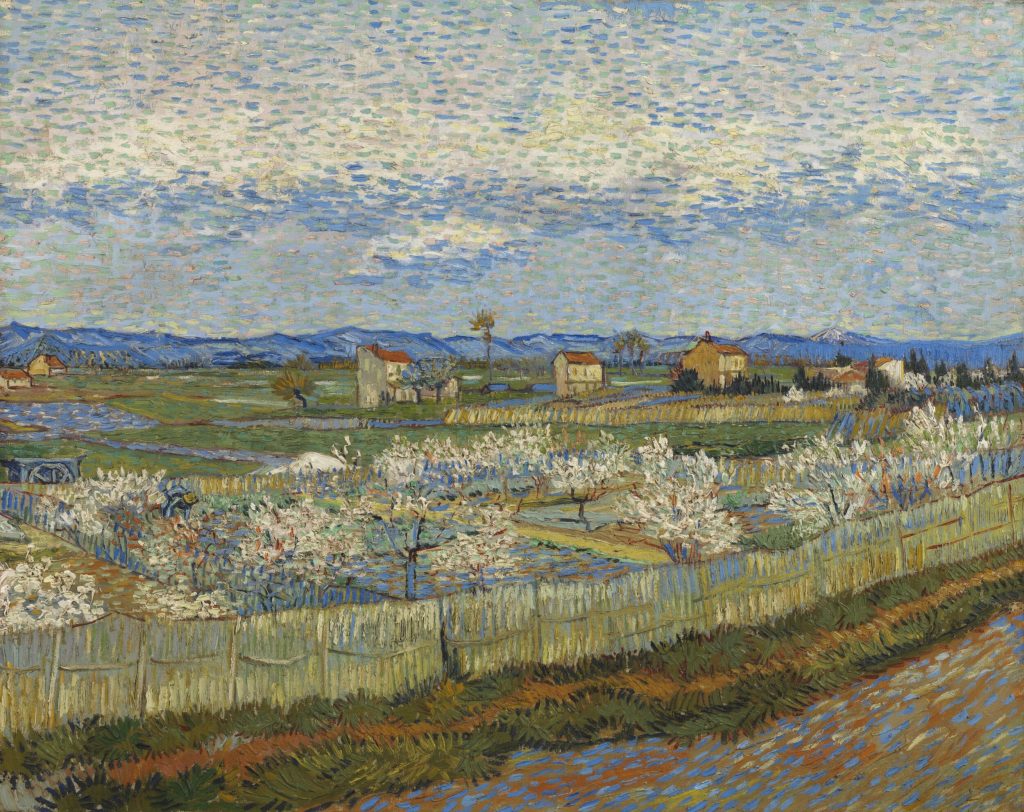
Vincent van Gogh, Peach Trees in Blossom, 1889, Courtauld Gallery, London, UK.
Van Gogh painted a series of landscapes just before voluntarily entering the Saint-Paul de Mausole asylum in Saint-Rémy in May 1889, following a severe bout of mental instability. This painting juxtaposes the paper-like flowering peach trees against the ridges of the limestone hills south of Arles, recalling the Japanese prints he so avidly collected.
The horizontal depth of the composition reflects his interest in agricultural vistas, a distinctive feature of his native Dutch landscape painting. Given his profound love of nature, Van Gogh might have sympathized with 21st-century climate activists who have used this and other famous paintings to highlight environmental crises.
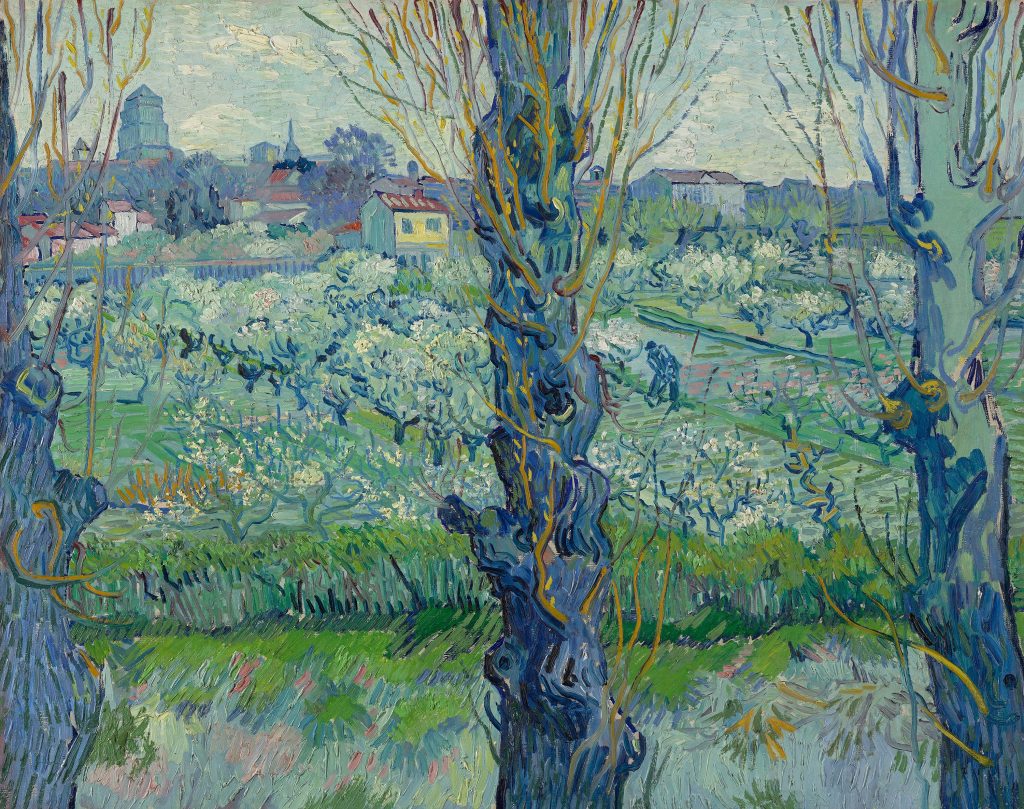
Vincent van Gogh, View of Arles, Flowering Orchards, 1889, Neue Pinakothek, Munich, Germany.
The three bristly tree trunks that lead this composition make it one of Van Gogh’s most unique paintings of blossoming orchards. He was inspired by the use of foreground elements to animate landscape scenes in Japanese prints.
Vincent translated that compositional rhythm by cutting off the trees, likely poplars, at the edges of the canvas. This framing guides the eye past the trees to the blossoming orchard in the middle, and then towards the distant town of Arles. Behind the sprouting trunks, the rows of flowering trees are painted in softer, lighter colors, establishing depth. It is considered a synthesis of Van Gogh’s exceptional originality and skill, with his brother Theo writing: “I like it enormously. That truly is nature.”
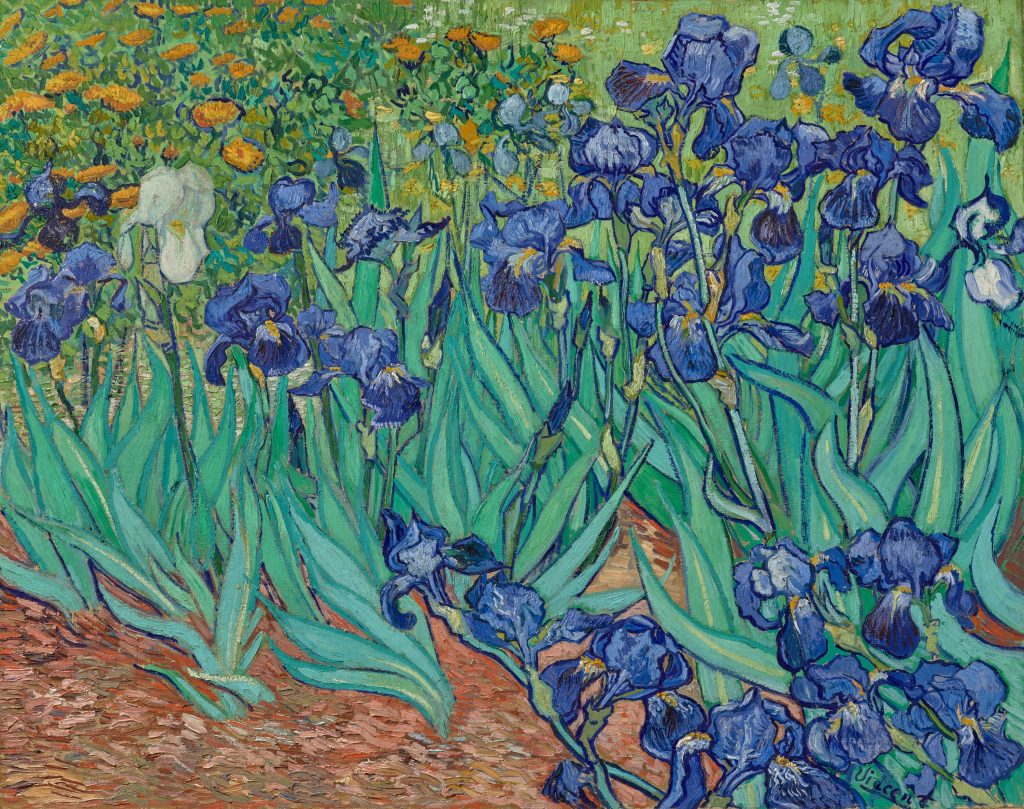
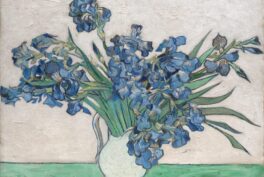
Vincent van Gogh, Irises, 1889, J. Paul Getty Museum, Los Angeles, CA, USA.
One of the first canvases painted during his year-long stay at Saint Rémy, Irises is widely considered one of Van Gogh’s most compelling works. Amid severe mental health struggles, Van Gogh drew inspiration from the bearded irises wildly flourishing in the asylum’s enclosed garden that spring. He painted each iris with lively, rhythmic brushstrokes, composing the scene without a horizon and bringing the flowers close, filling nearly the entire picture plane.
As beautiful as they are today, scientific analysis has revealed that the irises no longer appear as the artist intended. Van Gogh mixed red and blue to produce bright tones of violet, but the pigment has faded with light exposure, and now we see the irises as predominantly blue.
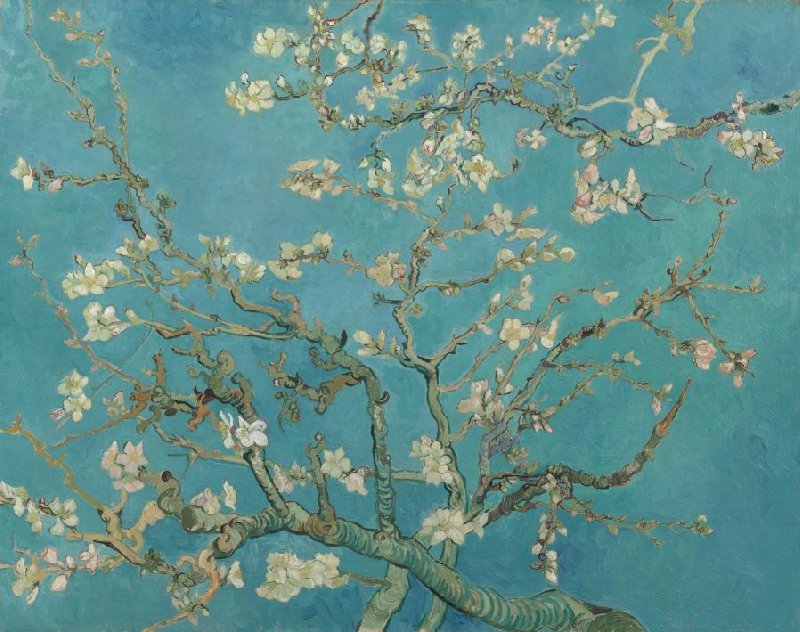
Vincent van Gogh, Almond Blossom, 1890, Van Gogh Museum, Amsterdam, Netherlands.
Created while Van Gogh was living at the asylum in Saint-Rémy, this is one of his most famous paintings. The influence of Japanese prints is evident in the unusual cropping and perspective, showing the blossoming branches close-up and from below against a clear blue sky. Vincent wrote to his brother Theo that his mental condition affected him while completing the work, though he described it as “perhaps the most patiently worked, best thing I had done.”
One of the first trees to bloom in spring, the almond signals the arrival of the season and its promise. The symbolism was intentional, as Van Gogh created this painting to celebrate the birth of his nephew and namesake, who was born on January 31, 1890. His nephew, Vincent Willem, would later help establish the Van Gogh Museum in Amsterdam in 1973.
P.S. If you’re a fan of Vincent van Gogh, we’ve prepared something special for you—a Vincent van Gogh Notebook filled with his beautiful masterpieces!
DailyArt Magazine needs your support. Every contribution, however big or small, is very valuable for our future. Thanks to it, we will be able to sustain and grow the Magazine. Thank you for your help!
Rivera is a New York City–based journalist with more than two decades of experience, known for thriving in a media capital that tests endurance as much as talent. Reporting has taken her from the World Cup to the Louvre. Her wide-ranging interests in art history have been shaped by years of independent study and research in New York’s major museums and many leading art institutions around the world.

Univ. of New Orleans, Fine Arts and History; Fine Artist, Professional Graphic Designer, Art Historian, Historian, Musician, worked at the New Orleans Museum of Art and MS Museum of Art; learning enthusiast!
The luminous color of Van Gogh’s mature style took shape in Paris, where he spent two years living with his brother Theo among the avant-garde.
MJ Rivera 29 July 2026
Vincent van Gogh is often celebrated for his expressive self-portraits, but his landscapes are equally powerful. He created some of his most vivid...
Anastasia Manioudaki, 19 January 2026
Paul Cézanne (1839–1906) was one of the most influential and greatest of the Post-Impressionist painters. Here is a list of ten different...
Sam Malone 30 December 2025
Vincent van Gogh remains one of the most influential figures in the history of Western art. His life, marked by intense emotions, personal struggles,...
Jimena Aullet 22 June 2026


