



10 Paintings You Need to See at the Cassirer Exhibition in Berlin
If impressionist masterpieces make your heart beat, then you need to visit Berlin this summer. The Alte Nationalgalerie on Museum Island recently...
Kate Wojtczak 8 June 2026
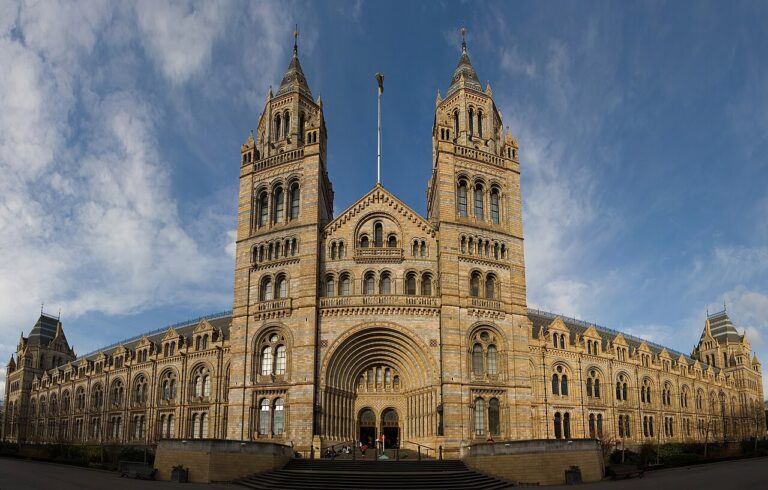
Panoramic view of the Natural History Museum, London, UK. Photograph by Diliff via Wikimedia Commons (CC-BY-SA-3.0)
Looming over South Kensington like a grand cathedral or a royal residence, the Natural History Museum in London honors science and human curiosity with a majestic, awe-inspiring sanctuary devoted to the natural world.
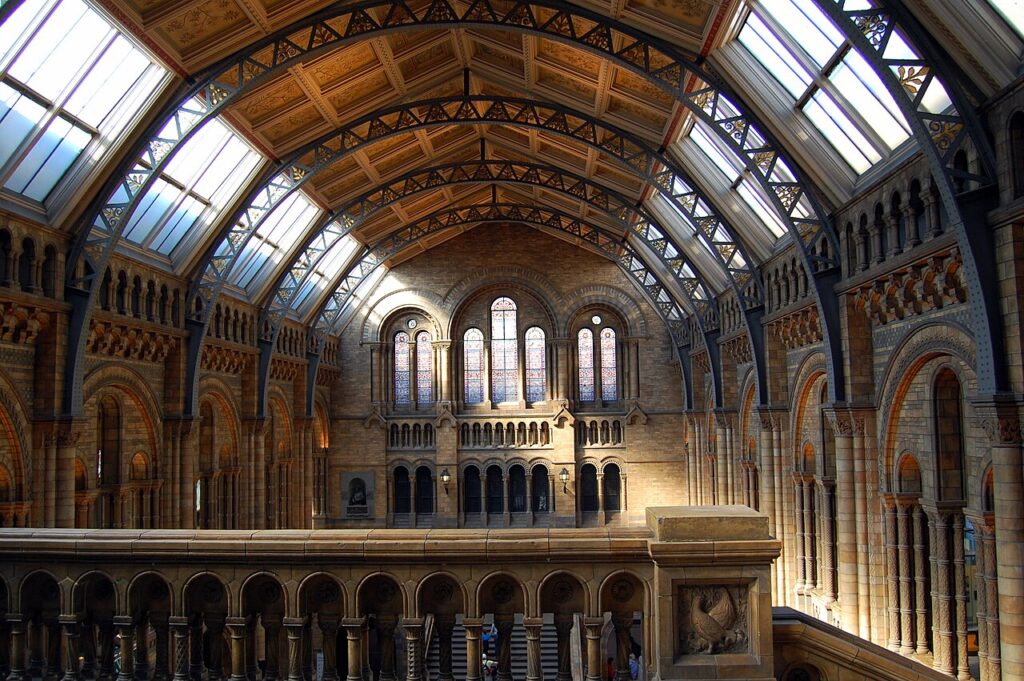
Central Hall, Natural History Museum, London, UK. Photograph by Minn Pongpaibul via Wikimedia Commons (CC-BY-SA-4.0).
Britain’s expanding natural history collections had outgrown their cramped quarters at the British Museum, prompting Victorian naturalist Richard Owen to champion the creation of a dedicated museum for natural history. Owen envisioned the institution as a “cathedral to nature,” and architect Alfred Waterhouse brought that vision to life. Designed in a distinctive blend of Gothic Revival and 12th-century Romanesque styles, the structure features soaring rounded arches, intricate relief panels, and towers that evoke the silhouette of a medieval European cathedral.
Waterhouse chose terracotta throughout the building because the material was more resistant to the harsh climate and pollution of Victorian London. It also proved well suited to the elaborate decorative work that became one of the building’s defining features.
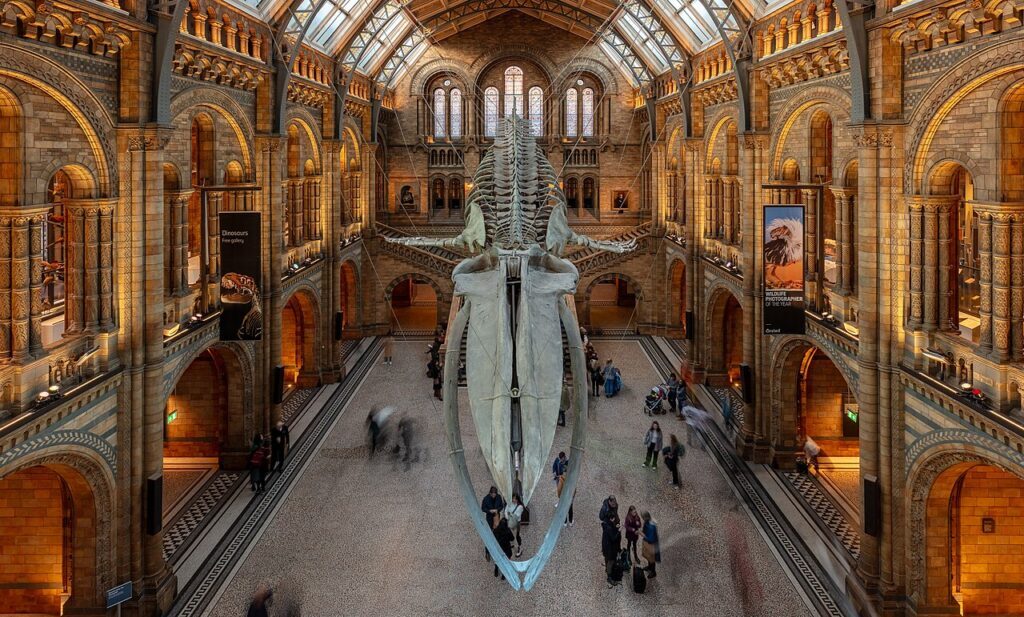
Interior of the Natural History Museum, London, UK. Photograph by Diego Delso via Wikimedia Commons (CC-BY-SA).
Serving as the grand central nave of the museum, the Hintze Hall greets visitors with a soaring ceiling adorned with 162 hand-painted and gilded botanical panels depicting plants valued for their economic, medicinal, and horticultural importance in Victorian Britain. Suspended dramatically overhead, “Hope,” an approximately 83-foot-long (25 m) blue whale skeleton, serves as a powerful symbol of the museum’s message of conservation and humanity’s responsibility to protect biodiversity.
Flanking the main hall, stone archways lead into side bays not unlike chapel niches, creating a cathedral-like arrangement around the central hall. At the head of the central staircase, a marble statue of Charles Darwin overlooks Hintze Hall.
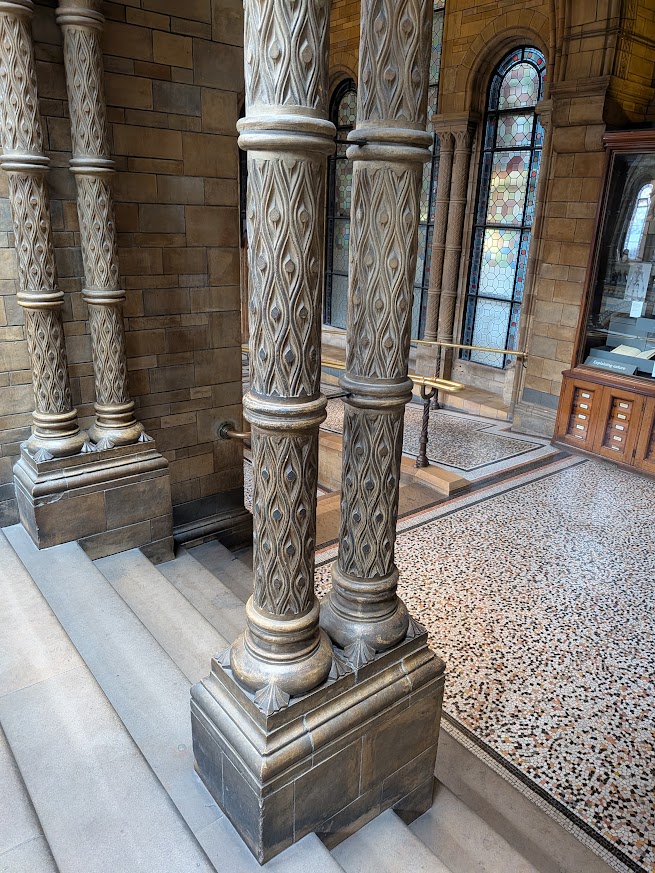
Details of interior, Natural History Museum, London, UK. Photograph by Maya M. Tola.
The building captures Victorian scientific enthusiasm, reflecting an era when art, architecture, and scientific discovery were deeply intertwined. Throughout the building, intricate foliage motifs, delicate fern patterns, and animal forms are incorporated into structural columns and archways.
This terracotta ornamentation is not merely decorative. The reliefs function almost like a visual textbook, turning the building itself into a celebration of the natural world. Terracotta gargoyles and reliefs take the form of extinct creatures such as pterosaurs and palaeotherium, an extinct relative of modern horses and tapirs, alongside living animals including lions and wolves, transforming familiar architectural ornament into a menagerie of the natural world. Waterhouse deliberately separated extinct and living species, placing extinct creatures on the east wing and living species on the west.
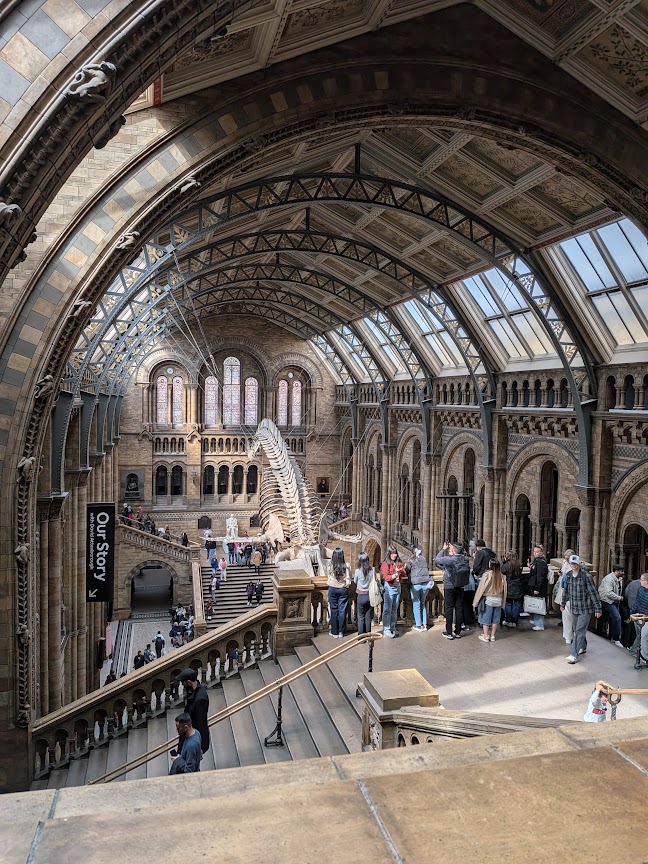
View of interior, Natural History Museum, London, UK. Photograph by Maya M. Tola.
Tucked into the upper floors, the Minerals Gallery preserves its original oak display cases, maintaining the atmosphere of a classic Victorian cabinet of curiosities. High ceilings, ironwork, and extensive glazing help bring natural light into the galleries. When the museum opened in 1881, gas and electric lighting were still limited and largely untrusted in gallery settings, making Waterhouse’s use of natural light especially important.
Within the museum’s modern wings lies the spirit of the Darwin Centre, where the Cocoon houses around 20 million entomology and botany specimens. The museum also holds specimens collected by Charles Darwin during his voyage aboard HMS Beagle. Many of these historic specimens remain valuable to modern scientific research, providing researchers with evidence for studying biodiversity, evolution, and environmental change over time.
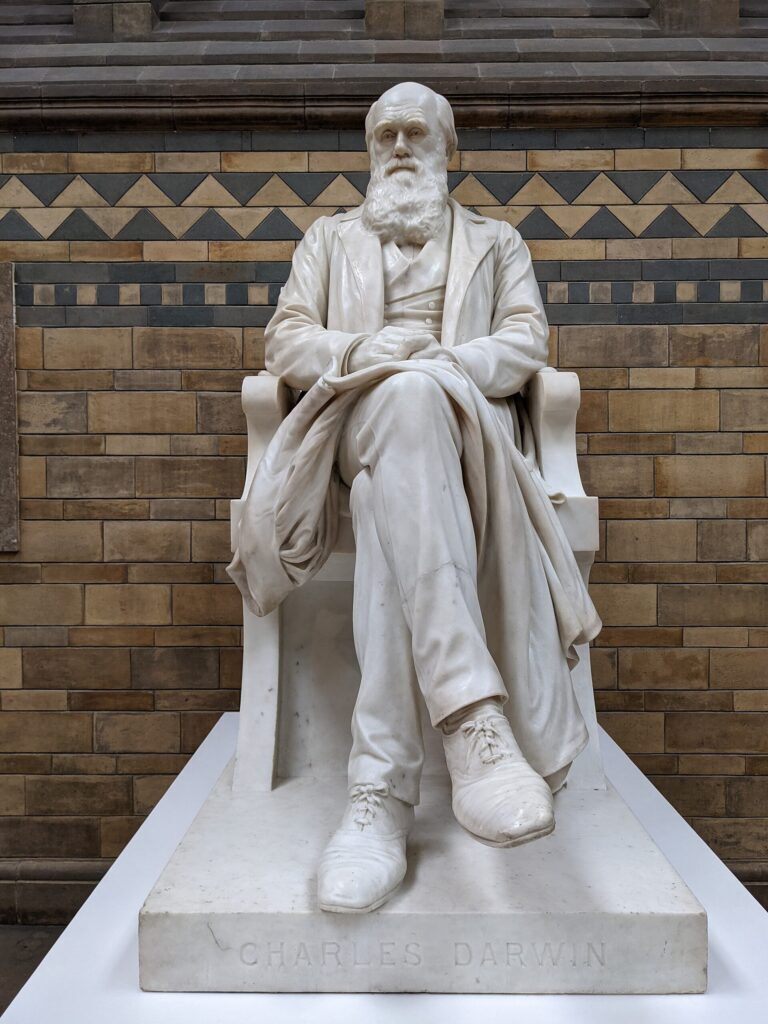
Sculpture of Charles Darwin, Natural History Museum, London, UK. Photograph by Slaia via Wikimedia Commons (CC-BY-SA-4.0).
The Natural History Museum is an exceptional example of how a 19th-century public building could transform scientific discovery into architecture. It created a space where our knowledge about the about the natural world could be presented with both grandeur and accessibility. Today, it remains one of London’s most enduring cultural icons, inviting millions of visitors each year to step beneath its arches and marvel at the complex history of our living world.
DailyArt Magazine needs your support. Every contribution, however big or small, is very valuable for our future. Thanks to it, we will be able to sustain and grow the Magazine. Thank you for your help!

Maya Tola is a Dallas-based attorney, with a zest for art history. A time traveler at heart, Maya often finds herself consumed in the contemplation of life in antiquity. She has been sharing her infectious enthusiasm for art and history since 2018 through her posts and articles for the DailyArt App and DailyArt Magazine. When she's not working or writing, you'll find Maya obsessing over plants, animals, and food (in no particular order).


Chris Dobson was born in Preston, UK. He likes to play chess, visit museums and model for art classes in Amsterdam. He can be followed on Instagram @litterarum_magister.
If impressionist masterpieces make your heart beat, then you need to visit Berlin this summer. The Alte Nationalgalerie on Museum Island recently...
Kate Wojtczak 8 June 2026
With the collection spanning more than 7,000 artworks, the American Folk Art Museum, located in Manhattan, New York, celebrates some of the most...
Szymon Jocek 21 May 2026
Our first guide, presenting 15 masterpieces of European Painting, barely scratched the surface of the vast collection held at the Metropolitan Museum...
MJ Rivera 20 April 2026
How does anyone begin to navigate 5,000 years of global art without feeling instantly overwhelmed? Do not despair—DailyArt Magazine has you...
MJ Rivera 9 March 2026