

Chola Bronzes: Devotion in Metal
The bronze sculptures of the Chola period are among the most refined and enduring achievements of Indian statuary. Created between the 9th and 13th...
Maya M. Tola 12 June 2025
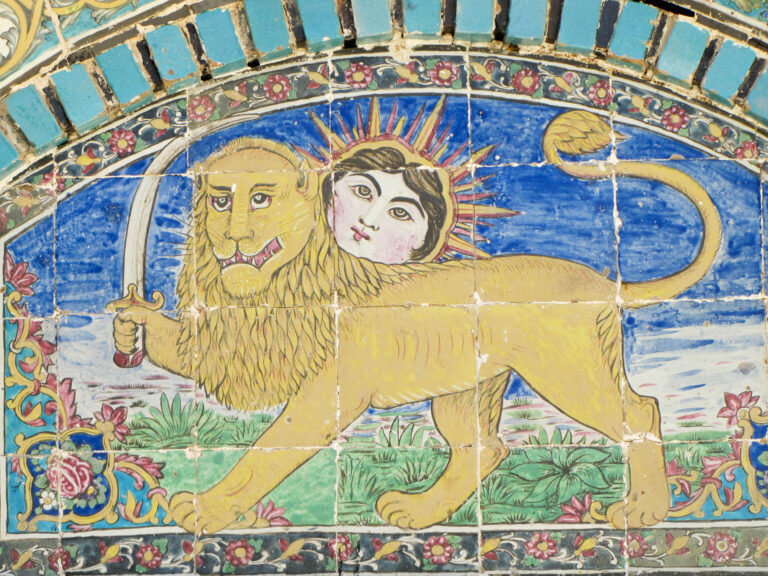
Decorated tiles in Takyeh Moaven-ol-Molk, Kermanshah, Iran. Photograph by Coffeetalkh via Wikimedia Commons (GFDL).
The Lion and Sun motif is a widely recognizable symbol associated with Iran. While both lion and solar imagery were present in the art and mythology of ancient Persia, the combined motif emerged in the medieval Islamic period and evolved over centuries into a major symbol of kingship and identity in the Near East.
From its medieval origins to its use on modern state banners, the emblem reflects a long process of reinterpretation in the broader Near East region, with each era reshaping its meaning to reflect changing political, religious, and cultural realities.
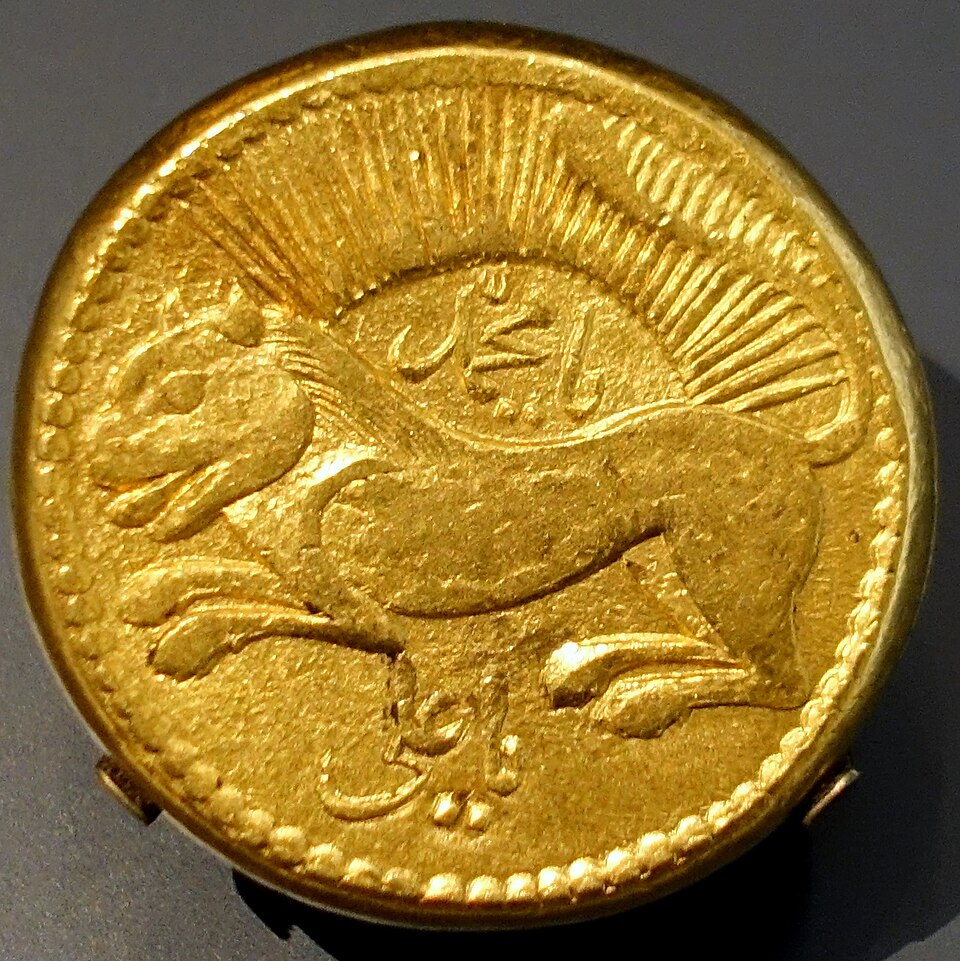
Lion and Sun coin, 19th century, Aga Khan Museum, Toronto, Canada. Photograph by Daderot via Wikimedia Commons (public domain).
The significance of the sun in ancient Iranian belief is closely connected to the broader Indo-Iranian religious tradition. An important figure in this tradition was Mithra, a deity associated with light, covenants, justice, and cosmic order.
Solar imagery played a powerful symbolic role in Indo-Iranian religion and later Zoroastrian traditions. The sun represented illumination, truth, and divine oversight of the world that made solar imagery a natural symbol of royal legitimacy and divine favor.
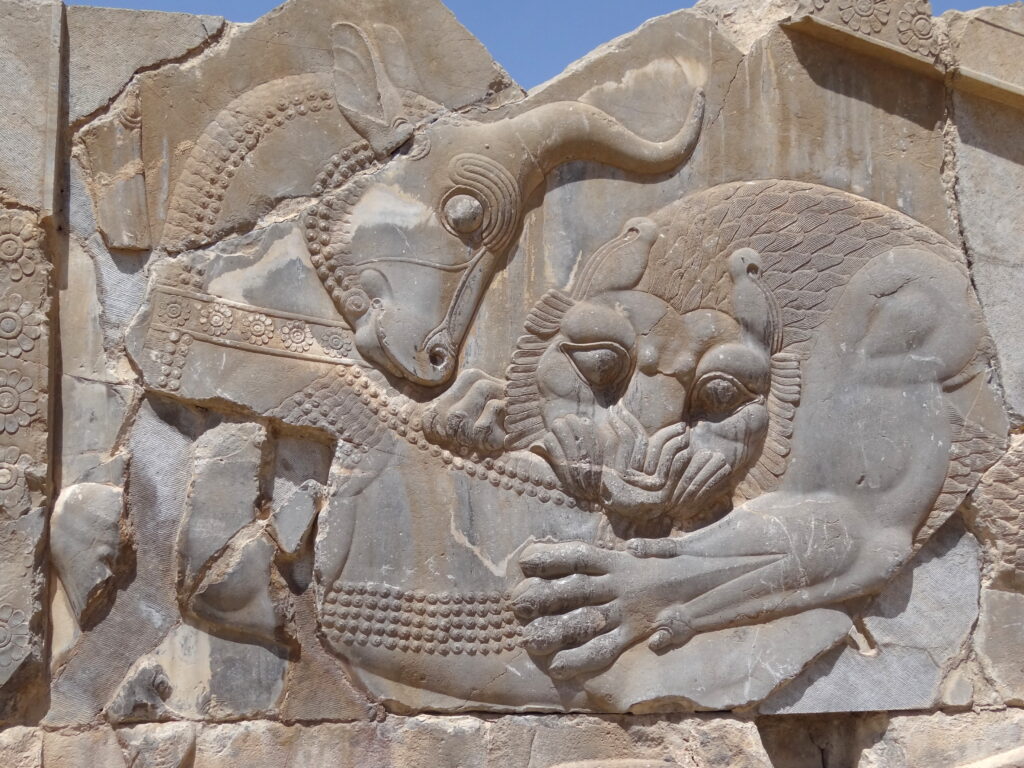
Lion Attacking Bull, 4th century BCE, Persepolis, Iran. Photograph by Adam Jones via Wikimedia Commons (CC BY-SA 2.0).
The lion has long served as a symbol of strength and royal authority across the ancient Near East, including Iran. Lions appear prominently in the art of the Achaemenid Empire, particularly in the monumental reliefs at Persepolis. These scenes often depict lions attacking bulls, imagery that many historians interpret as representing cosmic struggle, seasonal renewal, or royal dominance.
Over time, the lion became widely associated with courage, guardianship, and sovereign power. This symbolism later made the lion an ideal figure for royal and national emblems.
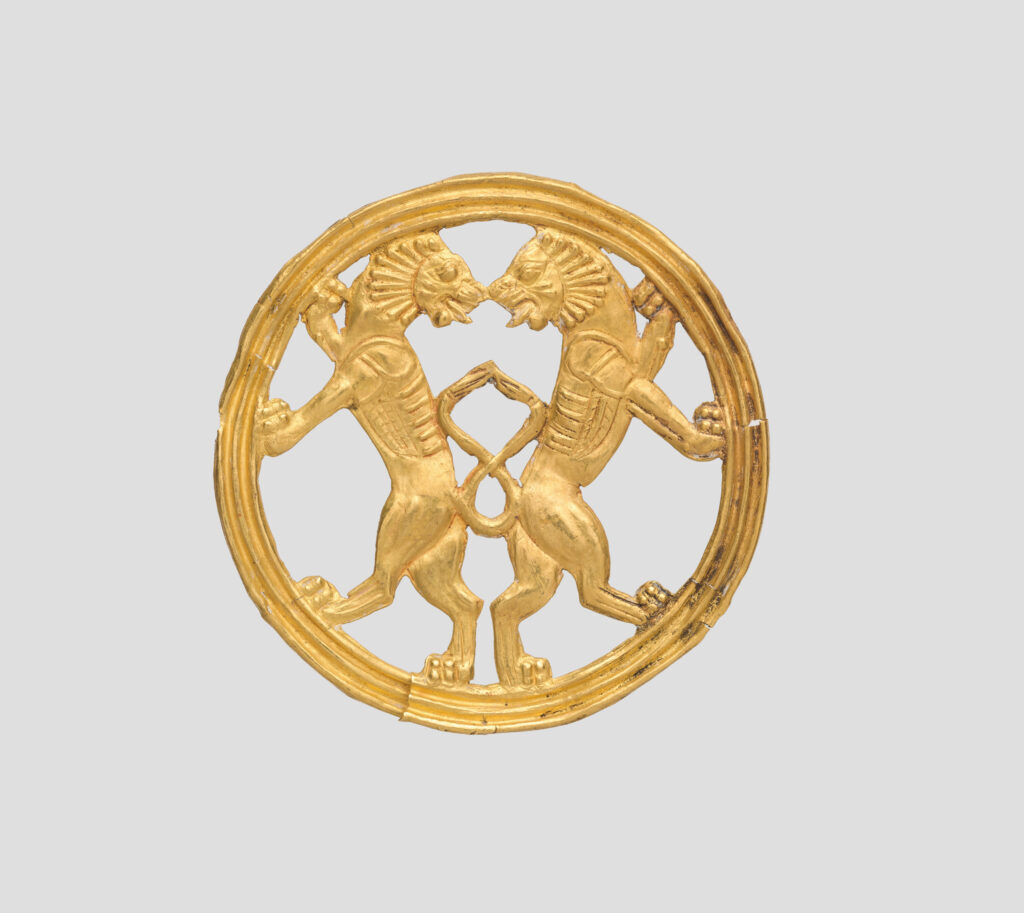
Ornament with back-to-back lions, Achaemenid period, ca. 6th–4th century BCE, Metropolitan Museum of Art, New York City, NY, USA.
While lions and solar imagery appear frequently in ancient Near Eastern art, the combined motif did not likely originate within Persian state symbolism. An early simultaneous manifestation is found on the cylinder seal of King Sausetar of Mitanni, which was a kingdom in northern Mesopotamia covering parts of modern Syria, Turkey, and Iraq, dated to approximately 1450 BC.
Although this artifact depicts lions alongside solar disks, it represents a regional symbolic connection rather than the specific Iranian emblem of a lion with a sun rising behind it. While the configuration is not the same as the recognizable Iranian form, it serves as a powerful example of the deep-rooted importance and symbolic weight of these icons across the region.
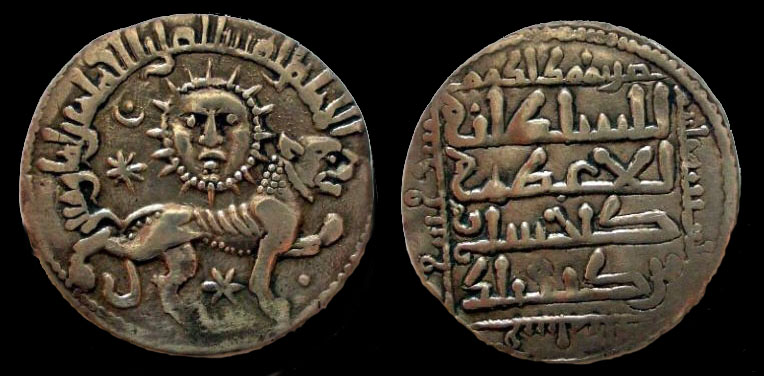
Kaykhusraw II dirham, 1240–1241. Photograph by Kafka Liz via Wikimedia Commons (public domain).
The recognizable Lion and Sun motif first appears clearly in the medieval Islamic period. One of the earliest well-known examples is found on coins issued in the 13th century by Kaykhusraw II, ruler of the Sultanate of Rum. Although the Seljuks were Turkic in origin, their court operated within the broader Persianate cultural world, where Persian artistic and symbolic traditions strongly influenced royal imagery.
Most historians interpret the early Lion and Sun design through medieval astrology. The lion represented the zodiac sign Leo, while the sun symbolized cosmic authority and kingship. In astrological belief, the sun was especially powerful when in Leo, making the pairing a natural symbol of royal strength. From these origins, the motif spread across the Persianate world through architecture, textiles, manuscripts, and coinage.
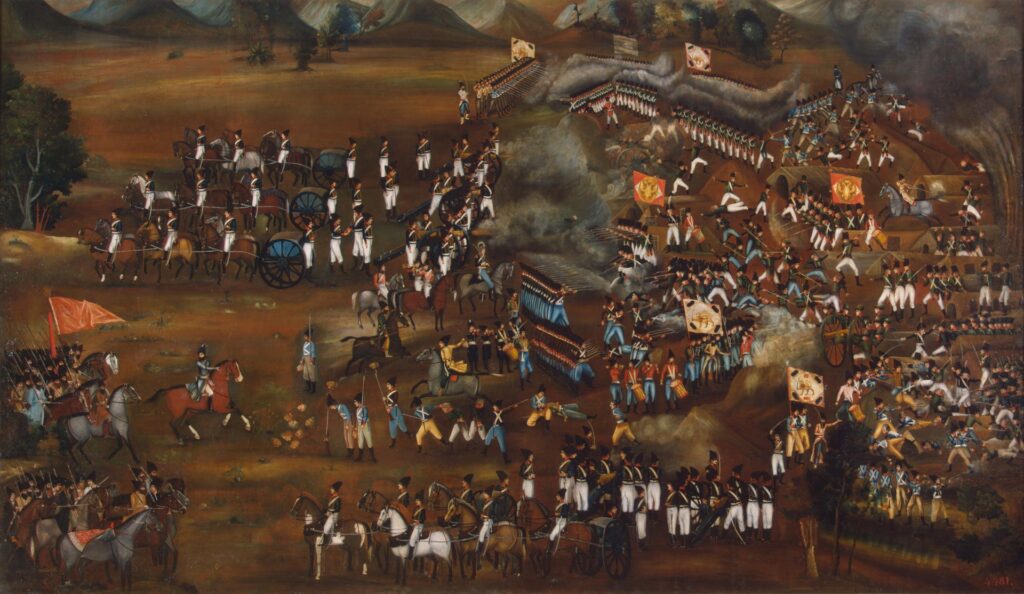
Battle Between Persians and Russians, ca. 1815–1816, Hermitage Museum, St. Petersburg, Russia.
The Safavid Dynasty played a significant role in embedding the symbol within Iranian political culture, and the Lion and Sun appeared frequently in Safavid banners and artistic works. They established Twelver Shiʿism as the state religion, and during this period the lion increasingly became associated with Ali ibn Abi Talib, who was traditionally known as Asadullah, meaning “the Lion of God.” This association gave the symbol a strong religious dimension. The lion could simultaneously represent royal authority and Imam Ali, while the sun symbolized divine light, glory, or cosmic guidance.
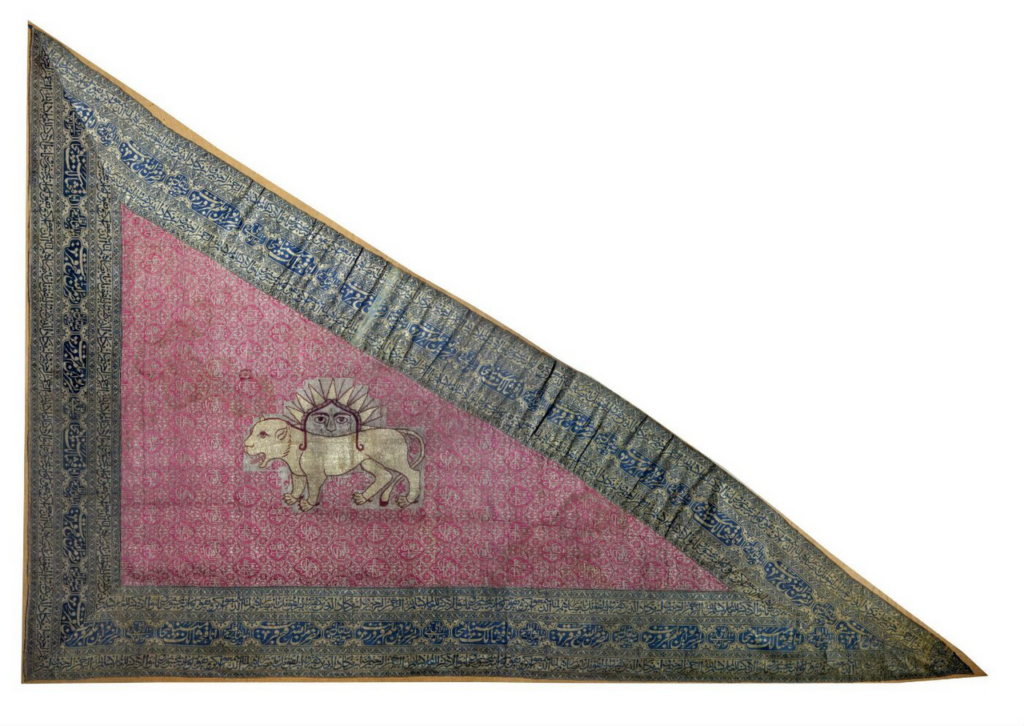
Triangular silk flag of Iran, Qajar Dynasty, mid-19th Century. Photograph via Wikimedia Commons (public domain).
The emblem reached its most recognizable and standardized form during the Qajar Dynasty (1794–1925). During the 19th century, the design was formally institutionalized across state symbols, appearing on coins, official seals, government buildings, and military banners.
To reinforce the state’s military and religious identity, the lion was typically shown holding a curved sword known as the Zulfiqar. This was the legendary blade of Imam Ali, and its inclusion served to link the Iranian state with the Shiʿi values of justice and divine protection.
A royal crown was added above the motif, visually linking divine favor with the authority of the monarchy. This transition moved the symbol beyond a simple royal badge, turning it into a representative icon for the entire country. By the time of the Persian Constitutional Revolution in 1906, the Lion and Sun had become firmly established as Iran’s official state emblem and appeared prominently in the center of the tricolor national flag.
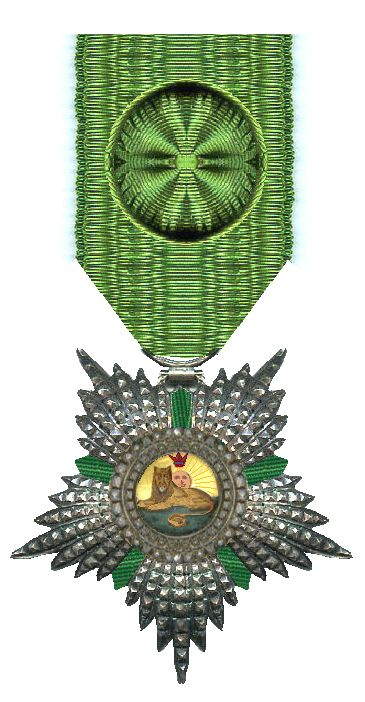
The Imperial Order of the Lion and the Sun. Photograph by Robert Prummel via Wikimedia Commons (CC BY-SA 3.0).
The Pahlavi Dynasty (1925 to 1979) maintained the Lion and Sun as the official national emblem. However, its interpretation shifted toward a more secular and nationalistic meaning. The Pahlavi government emphasized the symbol’s connection to Iran’s ancient imperial heritage rather than its religious symbolism. The crown above the emblem was redesigned to reflect the Pahlavi monarchy, but the central imagery remained unchanged.
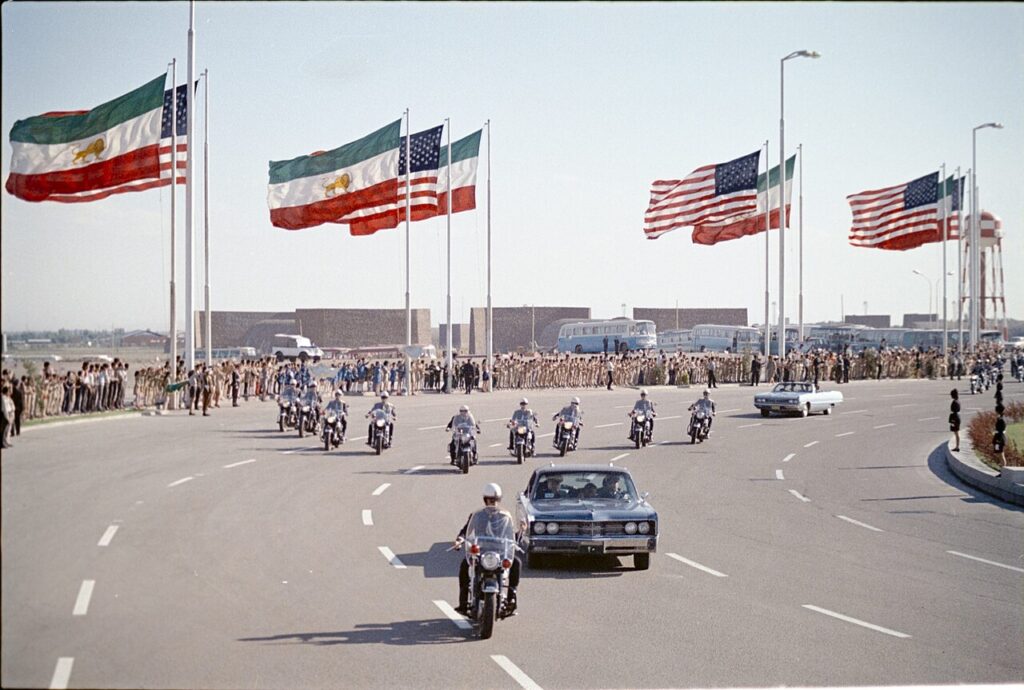
Motorcade carrying U.S. President Richard Nixon during official visit to Tehran, Iran, May 1972. Wikimedia Commons (public domain).
The official status of the Lion and Sun ended following the Iranian Revolution. The new government of the Islamic Republic of Iran removed the emblem from the national flag and replaced it with the stylized calligraphic symbol that now forms the modern coat of arms of the Islamic Republic.
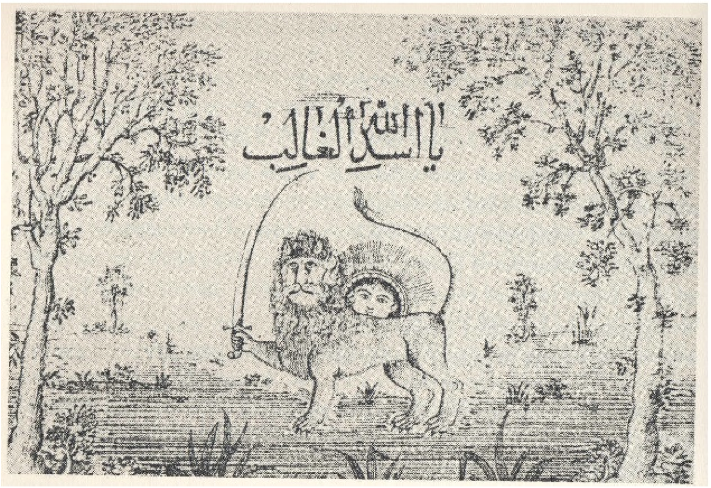
Logo of Akhbardar al Khalafah-I newspaper, Feb 5, 1851. Photograph via Wikimedia Commons.
The Lion and Sun symbol associated with Iran has evolved over the ages and has absorbed influences from the complex and long history of the greater Near East. Its symbolism has developed at different pivotal moments from medieval astrology, Shiʿi religious tradition, royal authority, and eventually national identity. Even after its removal following the Iranian Revolution, the emblem continues to hold cultural significance and remains a powerful reminder of Iran’s layered historical traditions and evolving identity.
Get your daily dose of art
Click and follow us on Google News to stay updated all the time

DailyArt Magazine needs your support. Every contribution, however big or small, is very valuable for our future. Thanks to it, we will be able to sustain and grow the Magazine. Thank you for your help!

Maya Tola is a Dallas-based attorney, with a zest for art history. A time traveler at heart, Maya often finds herself consumed in the contemplation of life in antiquity. She has been sharing her infectious enthusiasm for art and history since 2018 through her posts and articles for the DailyArt App and DailyArt Magazine. When she's not working or writing, you'll find Maya obsessing over plants, animals, and food (in no particular order).

Leigh is a writer, reader, art lover, radio nerd and herbalist based in Nashville, TN.
The bronze sculptures of the Chola period are among the most refined and enduring achievements of Indian statuary. Created between the 9th and 13th...
Maya M. Tola 12 June 2025
The Red Fort, or Lal Qila, stands as a commanding symbol of India’s rich cultural and political heritage. Commissioned by Mughal Emperor Shah...
Maya M. Tola 23 June 2025
The 2025 Lunar New Year, begins on January 29th. This is the Year of the Wood Snake, sixth animal of the Chinese zodiac, known for wisdom and intuition. Let us take a look at some of the East Asian art history that celebrates this awesome animal!
Candy Bedworth 28 January 2025
The lotus, a flower revered across many Asian cultures, holds a cherished place in Hindu art and spirituality. Found abundantly in sculptures,...
Maya M. Tola 14 March 2025


.jpg)


