
10 Women of Pop Art You Should Know
Pop Art is one of the most iconic movements in history, and its influence continues today. While often dominated by male artists, several women...
Errika Gerakiti 26 January 2026
11 May 2026 min Read
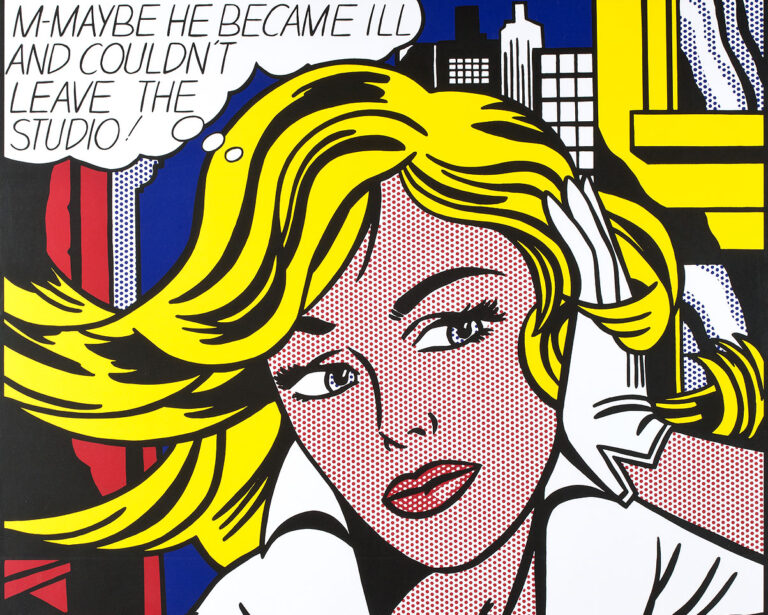
Roy Lichtenstein, M-Maybe, 1965, Museum Ludwig, Cologne, Germany. ArtInfo. Detail.
Roy Lichtenstein’s art dominated the 20th century with comic-book-style imagery, a lot of melodrama, and exaggerated Ben-Day dots that mimicked mass-produced commercial printing. But was this a purely ironic commentary on popular culture, or did Lichtenstein want to express more about the nature of fine art itself?
Here are some of the key ideas, tensions, and representations behind Lichtenstein’s art.
The course of art history is never linear. When manifestations of a new artistic movement burst onto gallery walls, they always tend to drag art out of its ivory tower and shake predefined conceptions.
Think of the time right before the master of Pop Art—Roy Lichtenstein—imposed tension between high art and low culture, reverence and ridicule. Abstract Expressionism was so comfortably occupying the aesthetic taste of mid-20th-century America that it seemed almost invincible. People indulged in existential paintings by near-mythic artists such as Mark Rothko, Jackson Pollock, and others. Their canvases became battlegrounds of the psyche, with gestures turning into truths and paint playing loud emotions.
And then Look Mickey, it’s Lichtenstein!
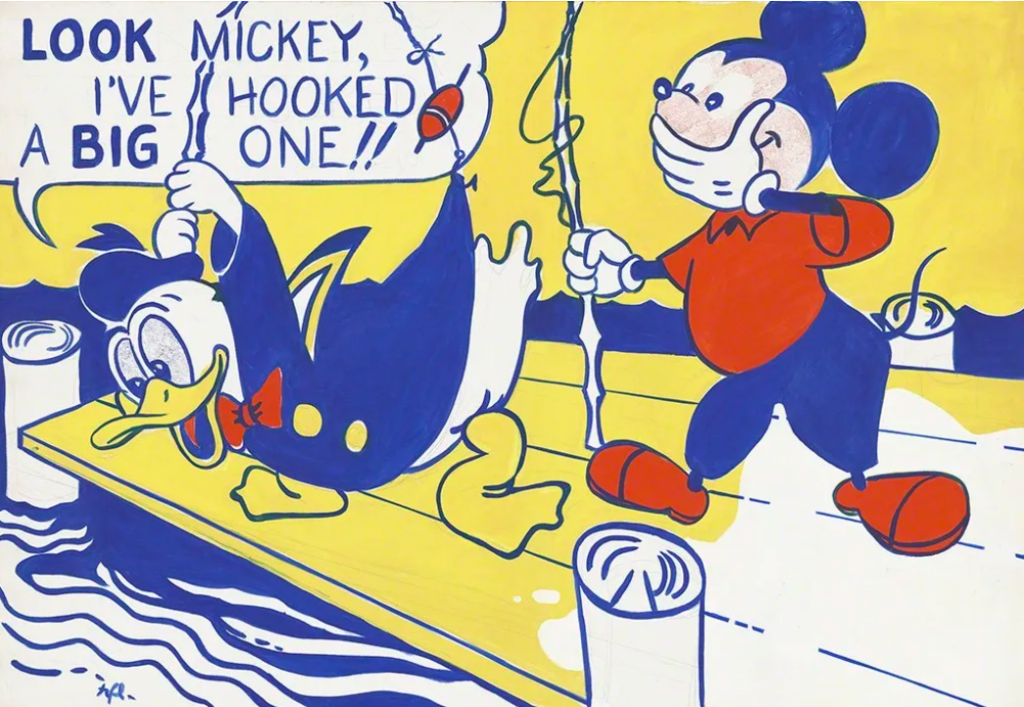
Roy Lichtenstein, Look Mickey, 1961, National Gallery of Art, Washington, DC, USA. Museum’s website.
Born in 1923 in New York City, Lichtenstein did not begin his career as a rebel against the art world. He developed his manner gradually. What’s interesting is that he never really mentioned any early artistic streaks in his family that would have driven his later pursuits. Yet, he was not unfamiliar with art. Even though there were no art classes at his primary school or at the private academy he attended for secondary education, Lichtenstein began drawing and painting in oils at home as a hobby. As a jazz fan, he attended concerts at clubs on 52nd Street and at the Apollo Theater in Harlem. He drew inspiration from these experiences and created portraits of musicians.
Officially, his journey toward self-discovery and the visual arts began at Ohio State University. Even though Lichtenstein was introduced to a rather traditional academic approach, his artistic signature inherited a perceptual unity that the lecturer Hoyt L. Sherman instilled in him there.
The most lasting effect on Lichtenstein’s Pop painting stemmed from two foundational ideas that Sherman conveyed to his students. First was the transition from vision to an image that focuses not on feeling, but on structured composition. Second, everything centered on the purely optical experience, in which the beholder grasped an existing image by copying it, stripping it of as much meaning as possible.
There’s a moment of ostensible hesitation when people stand right in front of Lichtenstein’s work. Is it really art? Is the drama sincere? Are we supposed to feel or experience anything? Is it just crafted for the eye, or is there something beneath the regimented dots and comic-book melodrama? The longer one’s look lingers, the more deceptive the surface becomes.
Back in the 1960s, this sharpening of perception collided with a culture that was already saturated with images. Television flickered in living rooms. Advertisements dictated brand-centered narratives and shaped lifestyle trends. It was the “Golden Age” and the “Creative Revolution” in America. Comic books and iconic superheroes became a significant cultural phenomenon, exploring themes of moral backlash, political turbulence, and social issues.
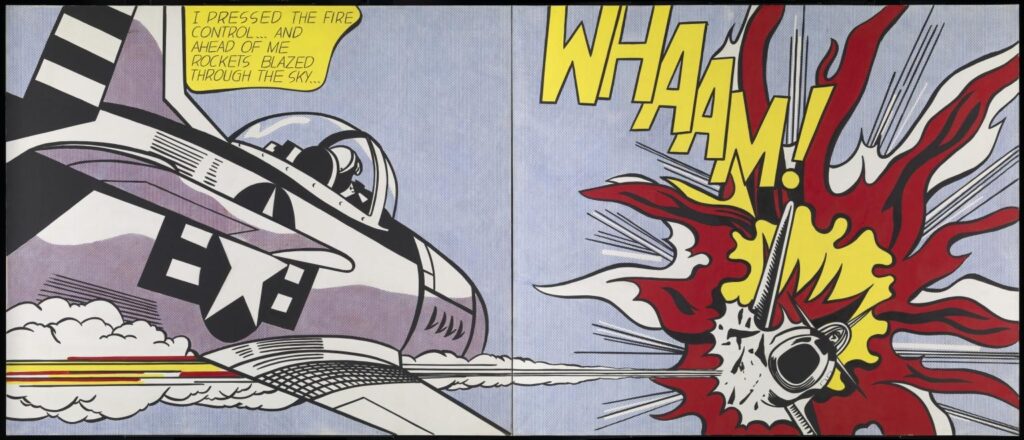
Roy Lichtenstein, Whaam!, 1963, Tate Modern, London, UK. © Estate of Roy Lichtenstein. Museum’s website.
Lichtenstein did not turn away from this. He embraced the entire visual avalanche. Speech bubbles, blonde women frozen mid-sob, “WHAAM!” rendered in letters, and Ben-Day dots—the industrial printing technique used in comics—were all masterfully done. Lichtenstein turned images intended for fast, disposable consumption into a conceptual trap.
At first glance, it feels like an acknowledgment of pop culture, but in fact, it exposes the absurdity of artistic originality. The irony is delicious: mechanical reproduction is mimicked through manual labor.
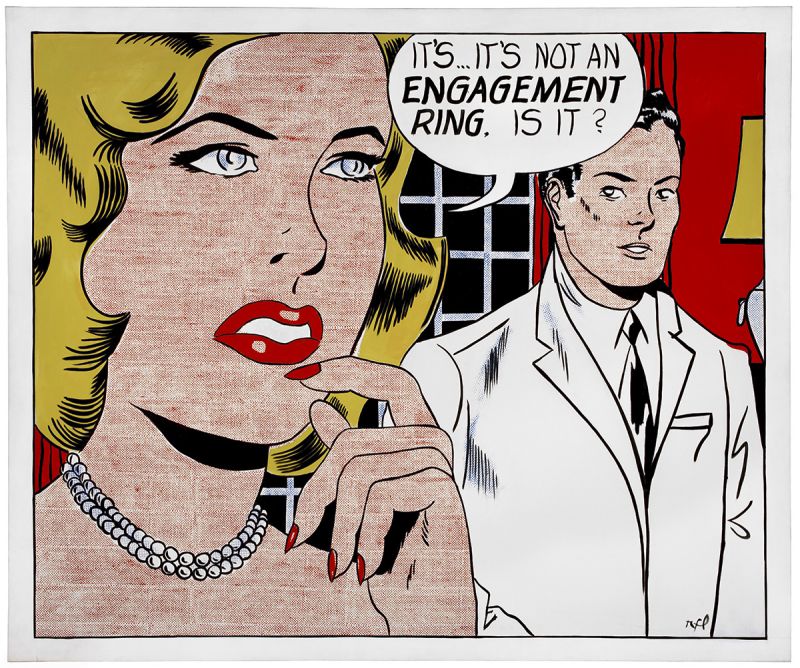
Roy Lichtenstein, The Engagement Ring, 1961. Roy Lichtenstein: A Catalogue Raisonné.
February 1962, at the Leo Castelli Gallery in New York, was a day to remember. It was Lichtenstein’s first solo exhibition, revealing bold and unapologetic paintings, including The Kiss (1961), Washing Machine (1961), Turkey (1961), The Refrigerator (1962), Blam (1962), The Grip (1962), The Engagement Ring (1961), and Laughing Cat (1961).
The event caused outrage, which only amplified the spectacle. Some critics dismissed the exhibited work as a gimmick; others called it pure plagiarism, borrowing directly from comic artists. Life magazine even ran a photo essay in 1964, asking, “Is He the Worst Artist in the US?”1 Nevertheless, was it the imagery that disturbed viewers? Not at all. It was the collapse of the hierarchy in which a visual language once found only in comic books now hung on gallery walls, making the place a significant part of popular culture.
Still, the one-man show was a success, selling out to influential collectors even before its official opening.
Stripping drama of its authenticity is a secret code that Lichtenstein often employed in his art. In doing so, he questioned whether emotions in mass media, movies, comics, and ads were genuine or simply fabricated. He offered emotional detachment, and when his Pop Art stormed the gallery, it was loud.
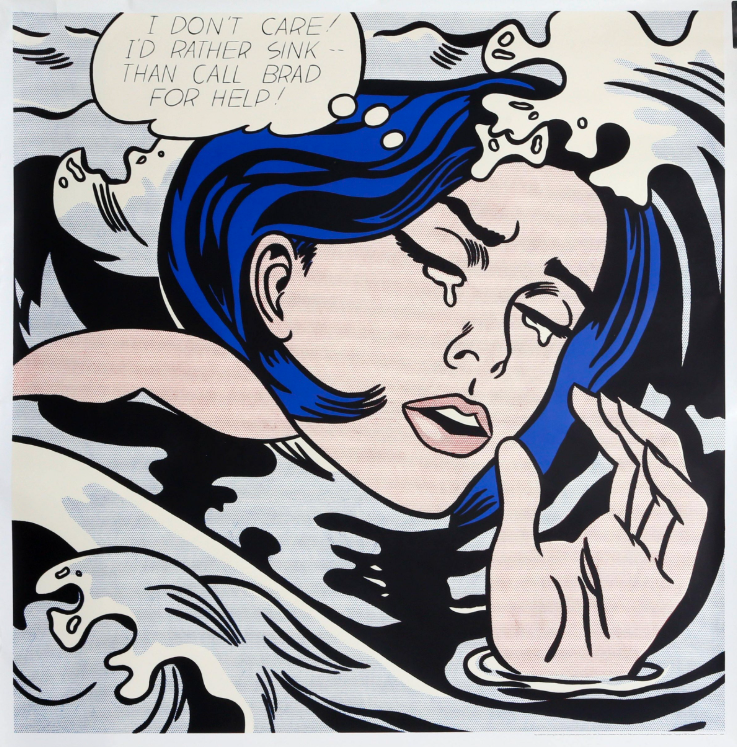
Roy Lichtenstein, Drowning Girl, 1963, Museum of Modern Art, New York City, NY, USA. Museum’s website.
What’s really tempting is to perceive Pop Art as playful, colorful, sarcastic, and sometimes even funny. In Lichtenstein’s artistic world, however, the irony and humor are structural and reframed. Take his iconic representations of the crying woman—Crying Girl (1963), Drowning Girl (1963), or Hopeless (1963). There’s a highlighted melodrama in each of them, accompanied by text that solidifies it further—”I don’t care! I’d rather sink than call Brad for help!”
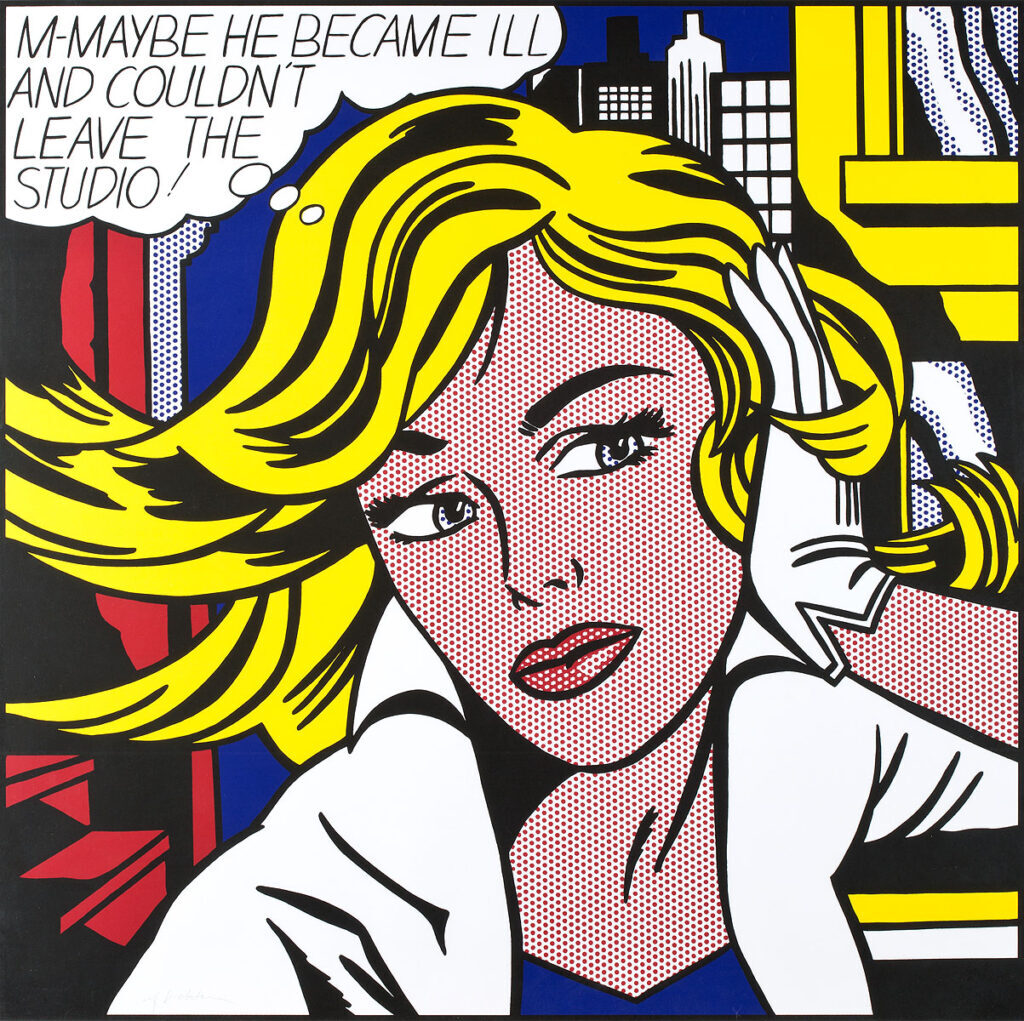
Roy Lichtenstein, M-Maybe, 1965, Museum Ludwig, Cologne, Germany. ArtInfo.
But who is Brad, and where is he? The observer never gets a clear answer because the narrative is cut off. This ambiguity is something of a trademark for Lichtenstein, who often selected and cropped panels from war and romance comics, transforming them into self-contained images and visual statements without sequential context. Looking at his paintings, the viewer becomes a participant in the tension created.
In the years that followed, Lichtenstein explored art history itself, reinterpreting the entire canon. He applied his distinct style and visual language of mass reproduction to the most respected movements in Western art. In his Haystack series (1969), Lichtenstein recreated Claude Monet’s Impressionist works by borrowing their atmospheric subjects and translating them into mechanical Ben-Day dots and sharp, assertive outlines. The initially delicate brushwork became graphic and structured.
Similarly, Lichtenstein questioned the canonical status of Picasso‘s work and Cubism. In Woman with Flowered Hat (1963), he referenced Picasso’s Dora Maar au Chat (1939), but did so in his own Pop idiom—Ben-Day dots, thick black contours, flat colors, and an almost industrial aesthetic.
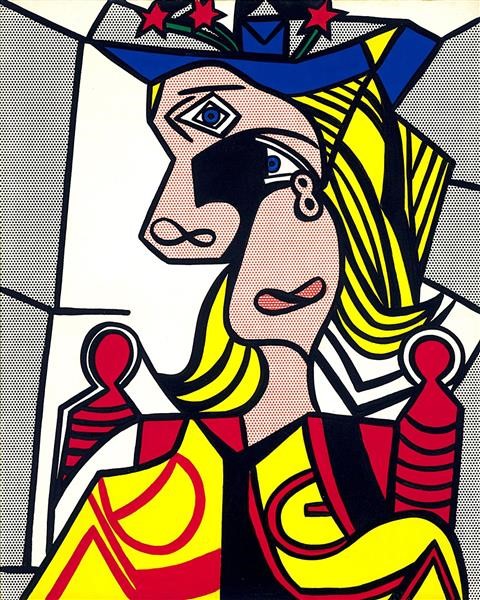
Roy Lichtenstein, Woman with Flowered Hat, 1963, Metropolitan Museum of Art, New York City, NY, USA. WikiArt.
Ultimately, through calculated emotional detachment, sharp stylization, and comics translated onto canvases, Lichtenstein proved that nothing is immune to reproduction and that there’s always room for reinterpretation.
“Is He the Worst Artist in the US?,” Life, Jan. 31, 1964, cited in Robert Rosenblum, “Roy Lichtenstein: Past, Present, Future,” in Roy Lichtenstein, Tate Gallery, Liverpool 1993, p. 10.
Get your daily dose of art
Click and follow us on Google News to stay updated all the time

DailyArt Magazine needs your support. Every contribution, however big or small, is very valuable for our future. Thanks to it, we will be able to sustain and grow the Magazine. Thank you for your help!

I'm an art historian and creative writer with a deep interest in 20th-century European avant-garde movements, modern and contemporary art, and the intersections of art with pop culture. I write about both under-recognized artists and iconic figures, exploring Surrealism, Мodernism, and broader artistic trends.

Coffee-fueled writer, artist, and daydreamer.
Pop Art is one of the most iconic movements in history, and its influence continues today. While often dominated by male artists, several women...
Errika Gerakiti 26 January 2026
Tom Wesselmann rose to prominence during the Pop Art movement, though he rejected the label himself. While many Pop artists used familiar objects to...
Errika Gerakiti 14 August 2025
Keith Haring’s Once Upon a Time mural is a 4-walled orgiastic display of penises, eager orifices, splashing ejaculate, and extended tongues tangled...
Theodore Carter 15 June 2025
Keith Haring and Grace Jones did more than just collaborate—they created a cultural earthquake. Their partnership was bold, vibrant, and...
Sabrina Phillips, Szymon Jocek 24 October 2025