The Model of the Hour
At the age of 20, Miller began what was to be a stellar, albeit relatively brief, fashion modeling career. Her looks, with a slim silhouette and short-cropped hair, embodied the androgynous look that was much sought after in the fashion of the 1920s. Miller was photographed by all the most famous names in fashion photography, particularly pioneering photographer Edward Steichen, and featured in everything—from the front cover of Vogue magazine to controversial ads about menstrual hygiene.
Yet you would be short-sighted to think of Miller as just a model. Even in those early days, her fascination with life behind the camera was clear to see, adding many self-portraits to the collections of her early photographs.
A Surrealist Twist
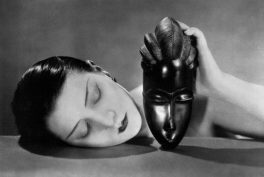
The exhibition sheds light on the more artistic (and experimental) side of Miller’s career. In the late 1920s, she traveled to Paris to meet Surrealist artist Man Ray (the story goes that she announced herself to him as his student, and he agreed). This led to a fruitful artistic collaboration as well as a passionate love story. The two worked together, pushing boundaries and fully embracing photography as an art form. To their efforts is also credited a new photographic technique, known as solarization, where a photo is re-exposed to light in the development stage, creating a hazy halo across the image that is well-suited to Surrealist art.
In 1932, Miller left Paris (and Man Ray) and returned to the United States. There, she was featured in photographic exhibitions, consolidating her name as a photographer in her own right. However, in 1934, she married Egyptian businessman Aziz Eloui Bey. For a while, she moved to Cairo and abandoned professional photography (though still taking some striking images of life in Egypt). This more tranquil lifestyle was not to last very long. Only a few years later, she left Cairo, met British artist and art collector Roland Penrose, and moved to London with him.
World War II
While in London, Miller’s life, like everyone else’s, was forever turned upside down by the outbreak of World War II. As a photographer, Miller had the urge to do her part and document the years that followed. The photographs she took during that time are perhaps the most striking and hard-hitting part of the exhibition.
From the very beginning, Miller intended to be a reporter at the heart of the conflict. Yet, as an American in London, she was not allowed to accompany the British Army on the field. Instead, she became the lead photographer for Vogue in the UK. Magazines had a crucial role in wartime efforts, both keeping morale up and encouraging people to do their part. She was also best placed to document for Vogue the aftermath of the Blitz (the Nazi bombing of the UK in 1940–1941). Miller’s photography was at the heart of it all.
In 1942, she managed to get accredited as a war correspondent for the US Army and, following D-Day (1944), she began documenting life in newly-liberated towns and cities in Europe. This included traveling to Nazi concentration camps and documenting for posterity the atrocities that were laid bare there.
Life After the War
After the war, Miller returned to the UK with Penrose, whom she married a few years later. In 1947, the couple had their only child, Antony. Yet, Miller was forever scarred by what she witnessed during the war, so much so that she almost abandoned photography altogether.
At the time of her death in 1977, little was known of the full extent of her work. It is only a few years later, thanks to the efforts of her son, that the magnitude and majesty of her collection came to light. Miller’s talent is now showcased in this detailed, rich, and thoroughly enjoyable exhibition.
Lee Miller is on at Tate Britain, London, UK, until February 15, 2026.