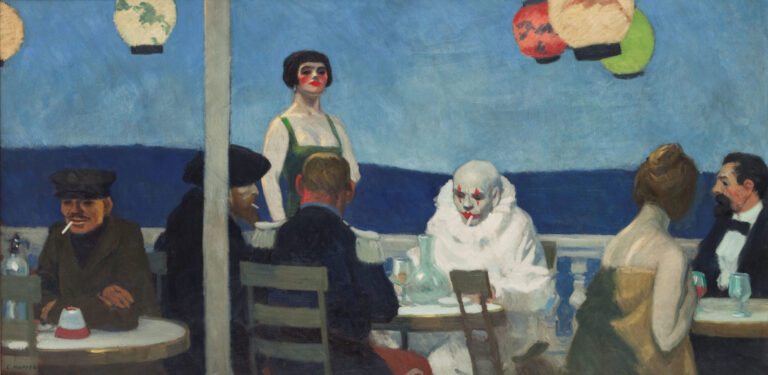
Loneliness in the crowd. We’re at a café somewhere in France. Seven people sat at the tables: a powdered prostitute, a clown with white make-up, a military man in epaulettes, a bearded bohemian and a pair of slumming aristocrats who avoid any interaction. Each of these people is feigning public detachment, floundering in private sorrow.
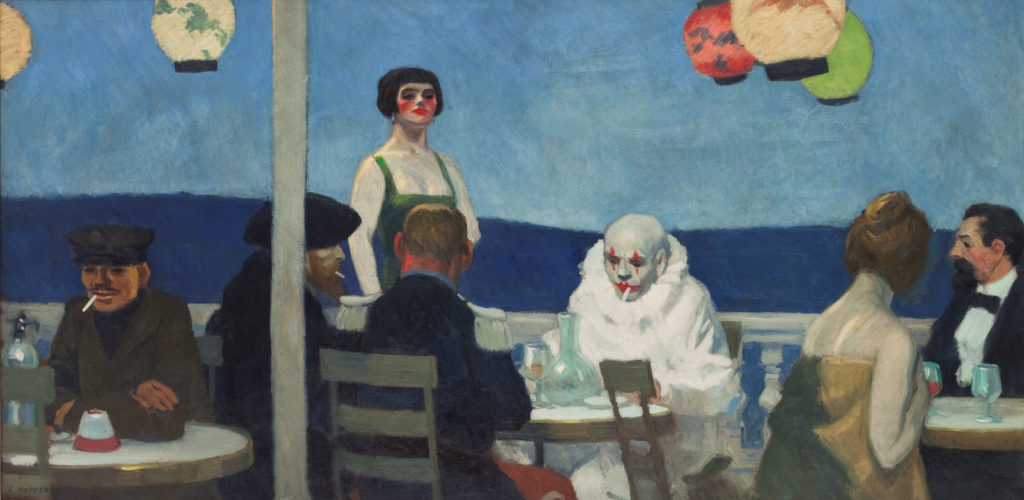
It’s an ambitious but inert picture, so heavy-handed in its allegory of detachement. The lack of connection is not however right into the viewer’s face, as it might have been done by an ironist or an expressionist. It just is everywhere. Hopper is a painter without any sense of humour, he paints without wit, without self-awareness. His clown just couldn’t be happy. We may have to accept the fact that Hopper painted the sad clown smoking a cigarette in a café because he felt it to be a poignant scene.
Soir Bleu is a vivid and monumental work painted in New York in 1914, almost four years after Hopper’s last travel to Paris. He created this allegory of melancholy from reminiscences and the huge scale of the painting is proof of how strong an impression Parisian life had made on the young Hopper. The painting is a synthesis of many trends in French art of the end of the nineteenth century, especially in its focus on café and street culture popularized by Edgar Degas and Henri de Toulouse-Lautrec, both artists Hopper deeply admired.
Not long after its completion, he showed it along a painting of a New York street. Critics were generally positive about the New York painting, but they were less enthusiastic about Soir Bleu. This was the reason why Hopper rolled the painting up and put it in storage. It wasn’t seen again until long after his death. After Soir Bleu, Hopper focused almost exclusively on American subjects.
Find out more:
[easyazon_image align=”none” height=”110″ identifier=”379134613X” locale=”US” src=”https://www.dailyartmagazine.com/wp-content/uploads/2018/10/51CUtG5mnOL.SL110.jpg” tag=”dailyartdaily-20″ width=”75″] [easyazon_image align=”none” height=”110″ identifier=”1935202871″ locale=”US” src=”https://www.dailyartmagazine.com/wp-content/uploads/2018/10/51Jh1YwVWPL.SL110.jpg” tag=”dailyartdaily-20″ width=”95″] [easyazon_image align=”none” height=”110″ identifier=”B01E9EHUXW” locale=”US” src=”https://www.dailyartmagazine.com/wp-content/uploads/2018/10/518Zh0AYD3L.SL110.jpg” tag=”dailyartdaily-20″ width=”73″]