
5 Beautiful Diagrams That Visualize Art History
Art history is a field that explains pictures using words. A few people have tried the opposite. Some sketch the landscape of art by hand, shaped by...
Guest Author 27 August 2026
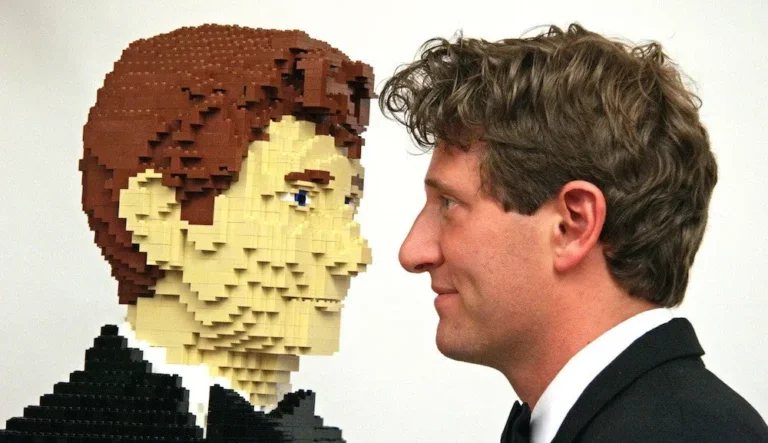
Nathan Sawaya with one of his sculptures. Carnegie Museums.
Lego springs to mind as one of the key toys of many people’s childhoods. Whether building houses, spacecraft, or just stepping on that elusive piece, most people have some kind of experience with the little plastic building blocks. For some, however, it became a means of artistic expression.
Nathan Sawaya takes building with Legos to a whole new level. He left his job as a New York corporate lawyer in 2001 to become a full-time Lego artist in Los Angeles. “When I was a lawyer, I quickly came to realize I was more comfortable sitting on the floor creating sculptures than I was sitting in a boardroom negotiating contracts. My own personal conflicts and fears, coupled with a deep desire for overall happiness, paved the way to becoming a full-time working artist,” commented Sawaya on this not so easy transition with doubts from friends and family. He would come home from work and use art as a way to unwind, gravitating more and more to using Legos. It was a natural move for him, as he said that he “sees the world in rectangles.”

The Lego Company was created in Denmark in 1932. The word “Lego” comes from the Danish words “leg godt,” meaning “play well.” Sawaya definitely plays well with his medium. He specializes in larger-scale pieces, ranging from a 20 ft (6 meter) dinosaur made of 80,000 Legos to poignant recreations of famous paintings by Monet and Munch. Sculptures are first sketched on brick paper or rendering software before dealing with the physics for more complicated pieces. His works are a mix of Pop Art, Surrealism, and Pointillism.

Since 2007, Sawaya’s exhibition Art of the Brick has traveled the world. His unique approach to sculpture has inspired kids of all ages to create their own Lego pieces that transcends the little plastic bricks as much as the exhibited works are. Sawaya’s sculptures are especially thought-provoking. He shows people in a state of transition or metamorphosis–exploring and questioning themselves and their lives in powerful themes such as grief and doubt.

A key piece in the exhibition is Yellow, a life-sized self-portrait of the artist exposing and sharing himself with the world. It is a powerful example of the vulnerability and rawness in his work. The figure is not only tearing itself apart but building anew as well.

Along those lines, Sawaya made several figures that manipulated colors in a visually striking but also visceral way. Metamorphosis shows a swimmer surrounded by waves of water. There is a great sense of movement brought forward from the plastic. Beside the statue are the artist’s words: “Swim against the current. Follow your path. Find the courage within.”

Another emotionally gripping piece is My Boy, with a father holding his son in his arms.

Working on his projects, sometimes for months and up to 12 hours a day, puts Sawaya in a trance. To him, Legos are accessible and mighty tools able to contain something inspirational within. Anyone can go home and start building with them. As intense as his creative routines can be, he says, “My worst day as an artist is still better than my best day as a lawyer.”
My favorite and most resonating statement of his is “art makes better humans; art is necessary in understanding the world, and art makes people happy. Undeniably, art is not optional.” A sentiment that all of us here can relate to.
DailyArt Magazine needs your support. Every contribution, however big or small, is very valuable for our future. Thanks to it, we will be able to sustain and grow the Magazine. Thank you for your help!

Giotto's weeping angels started my love affair with art history. Seattle, WA based.

Art history is a field that explains pictures using words. A few people have tried the opposite. Some sketch the landscape of art by hand, shaped by...
Guest Author 27 August 2026
Did you know that some of the most admired painters’ pigments in art history are also among the most toxic? The pursuit of beauty has sometimes...
Celia Leiva Otto 4 June 2026
Legend has it that in 1672, two important Dutch statesmen and brothers, Johan and Cornelis de Witt, were murdered, mutilated, and eaten by an angry...
Nicole Ganbold 6 October 2025
Controversial and challenging Madonnas from across art history. Ten eccentric and thought-provoking paintings. Take a look!
Candy Bedworth 28 April 2025