
Masterpiece Story: Girl in a Picture Frame by Rembrandt
The girl leans out of the painting as if she intends to cross the boundary between art and reality—she touches the frame and looks directly at the...
The Royal Castle in Warsaw 26 March 2026

Buddha dated 338, Asian Art Museum, San Francisco, CA, USA. Detail. Museum’s website.
Buddha dated 338 is a masterpiece of Buddhist art and Chinese art with deep historical significance. It exemplifies the early blending of Indian Buddhist traditions with Chinese artistic styles, reflecting both spiritual and cultural exchange.
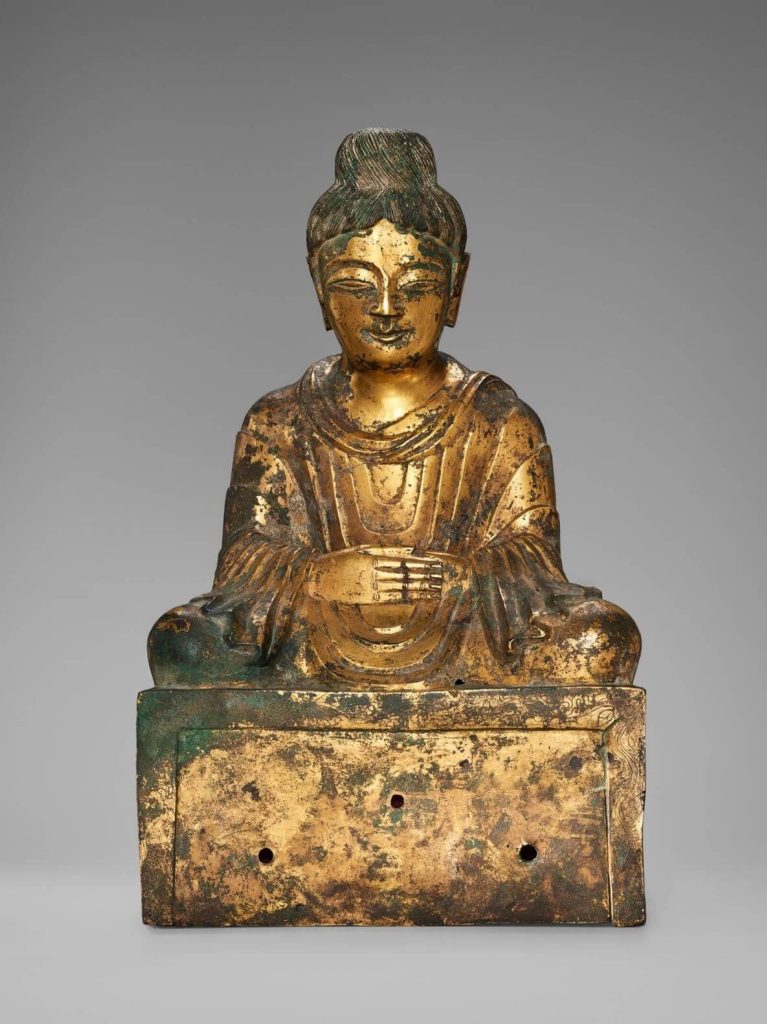
Buddha dated 338, Asian Art Museum, San Francisco, CA, USA. Museum’s website.
Buddhism arrived in China from India around the 1st century BCE. However, it did not achieve widespread popularity for another three centuries until around 220 CE with the political collapse of the Han Dynasty. Buddhism gained popularity because it addressed the tumultuous period of instability and suffering with the promise of salvation and enlightenment.
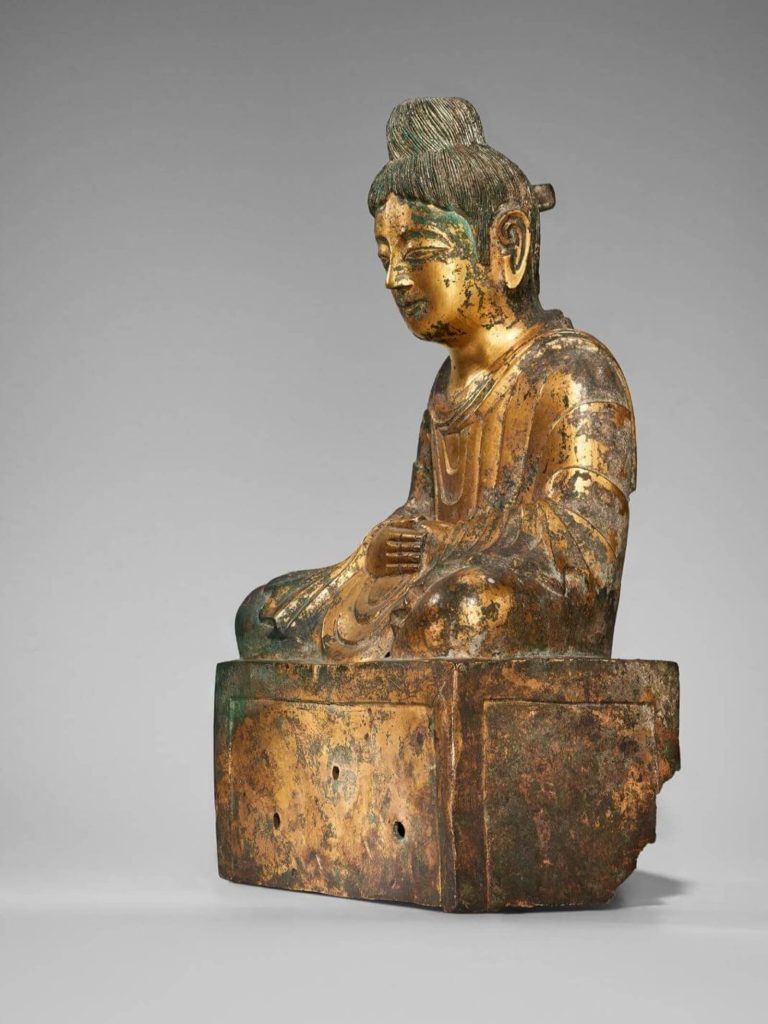
Buddha dated 338, Asian Art Museum, San Francisco, CA, USA. Museum’s website.
As a philosophical religion, Buddhism appealed to a wide range of socioeconomic devotees. Devotional objects representing the Buddha and bodhisattvas quickly entered many households, ranging from rural peasants to the urban elites.
For almost 2,000 years, Chinese artists have been creating countless Buddhist works, including images of the Buddha. However, the chronology of Chinese Buddhist art is sometimes difficult to determine due to the lack of dated works. Nevertheless, several important works are dated and help establish a timeline. Buddha dated 338 is one such work. It is a masterpiece of both Buddhist art and Chinese art with deep historical significance.
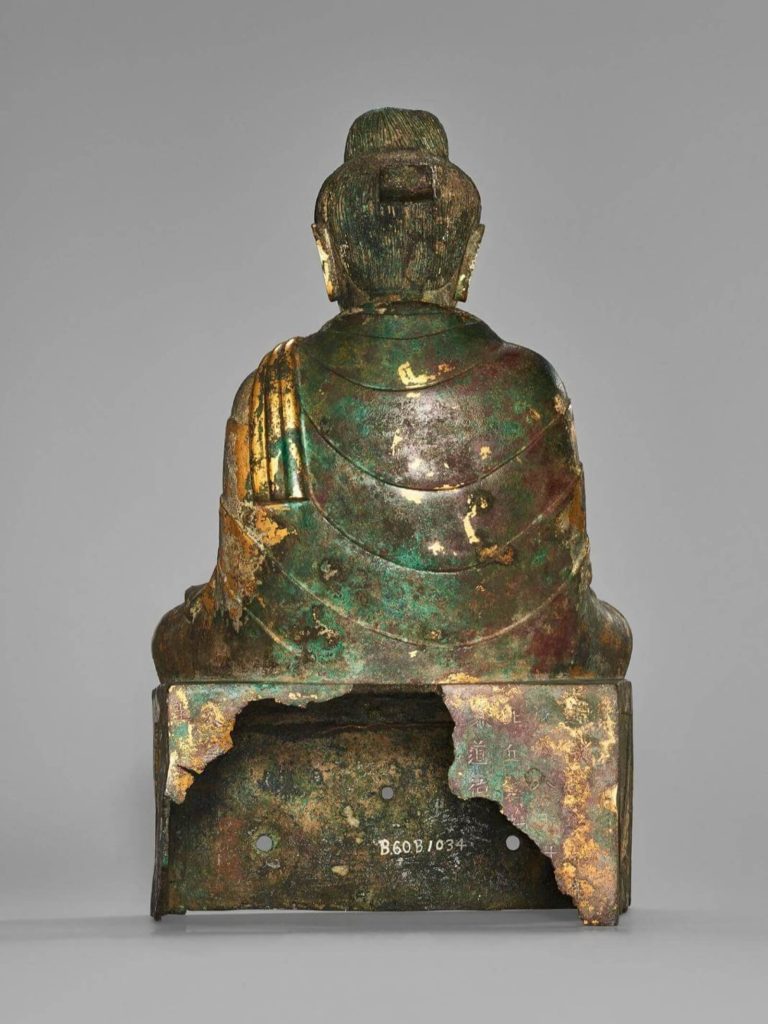
Buddha dated 338, Asian Art Museum, San Francisco, CA, USA. Museum’s website.
The sculpture was created in 338 CE in Hebei Province during the Later Zhao dynasty (319–351). It is the earliest known dated Chinese Buddha statue; as such, it sets the official dated beginning of a long tradition of Chinese Buddhist sculpture.
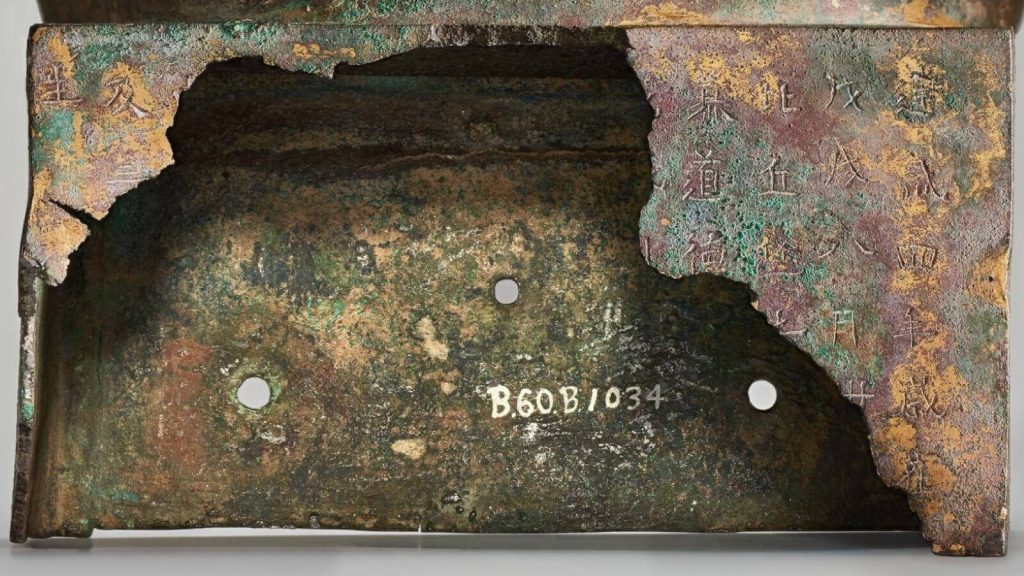
Buddha dated 338, Asian Art Museum, San Francisco, CA, USA. Detail. Museum’s website.
Buddha dated 338 is a figural seated statue of Shakyamuni, the historical Buddha. It measures 16 in. tall (40 cm) from the topknot down to the rectangular base. It was created from a base of leaded bronze covered with a thin layer of gold. An early Chinese Buddhist text stated that the Buddha was golden and radiated light. Therefore, gilt bronze was a natural choice as a medium. The mercury gilding supplied the reflective radiance while the bronze prevented prohibitively expensive solid-gold manufacturing.
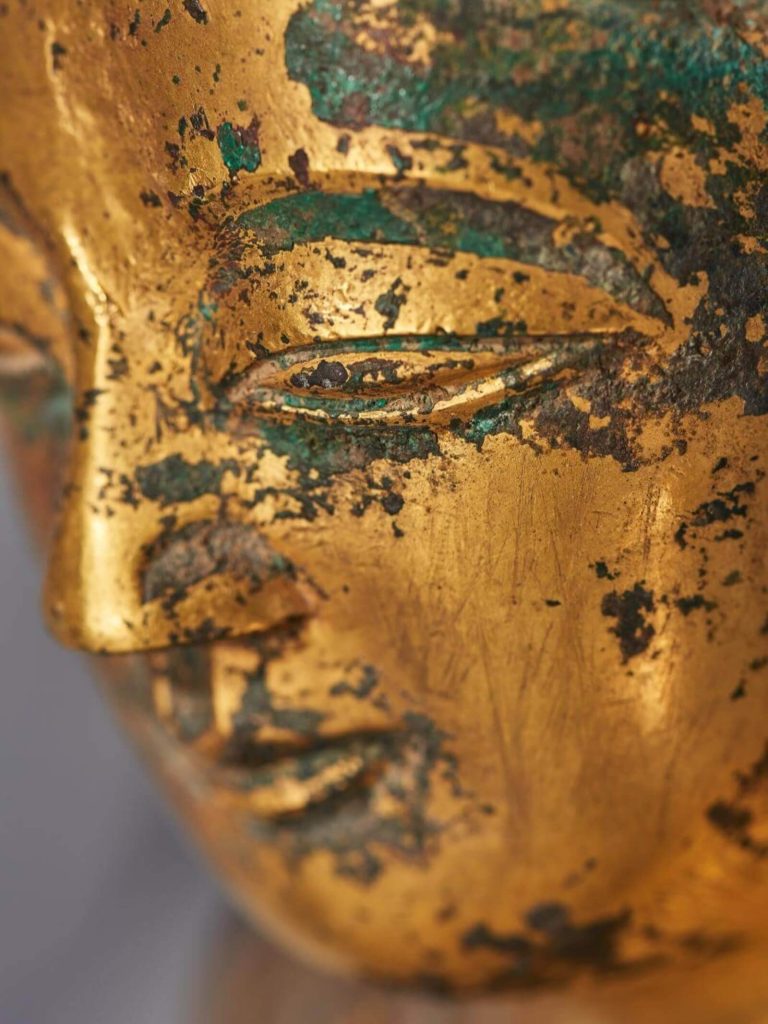
Buddha dated 338, Asian Art Museum, San Francisco, CA, USA. Detail. Museum’s website.
One of the most identifiable markers of the Buddha is his ushnisha, which is a protuberance on top of his head. Many Chinese Buddhist texts say that it represents the “crown” of the Buddha for achieving Enlightenment as the King of the Dharma. Earlier statues from India depict the ushnisha as a fleshy knob. Later Chinese interpretations, such as this Buddha, use a hair topknot which aligns closer to a Chinese aesthetic for a Chinese devotee.
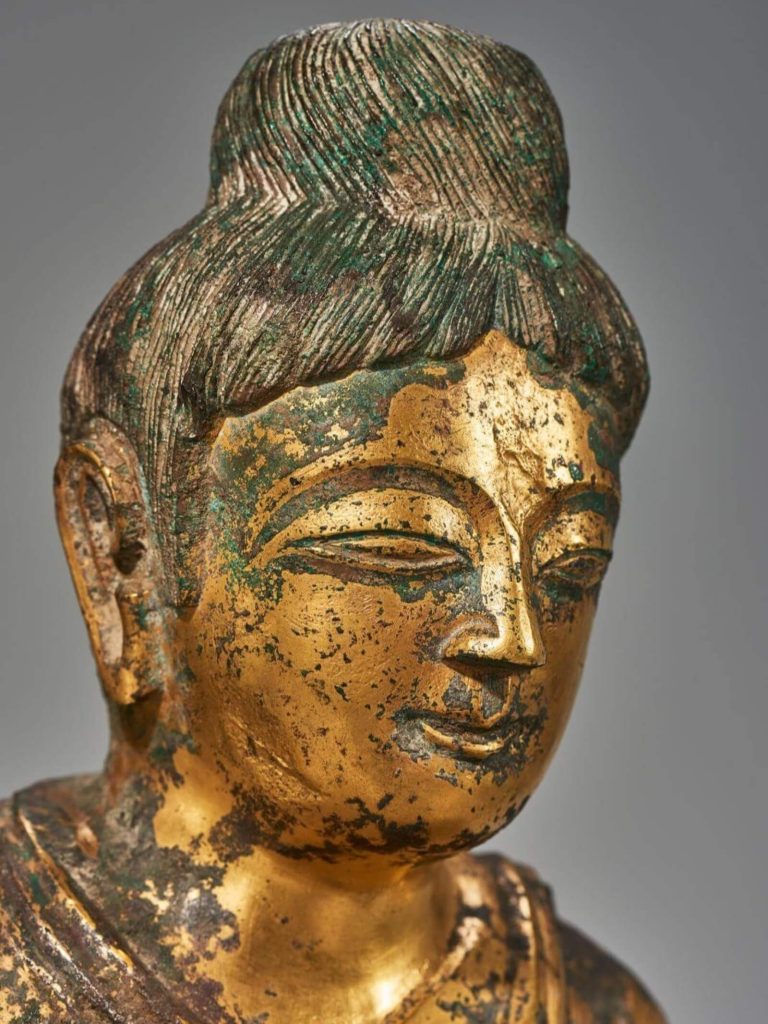
Buddha dated 338, Asian Art Museum, San Francisco, CA, USA. Detail. Museum’s website.
As Buddhism spread across different countries and cultures, images of the Buddha adapted to local aesthetic tastes. The face of the Buddha conforms closely to Chinese ideals. The face is round with large, wide, almond-shaped eyes. It has strong eyebrows and a defined nose. Unlike Indian prototypes that frequently possessed a mustache, Chinese ideals preferred a clean-shaven and smiling face. Therefore, this Buddha statue has a more Chinese, smooth, and happy appearance.

Buddha dated 338, Asian Art Museum, San Francisco, CA, USA. Detail. Museum’s website.
The robe of the Buddha drapes elegantly from his shoulders in concentric folds. The regularity and consistency of the folds create a harmonious pattern that implies balance and fluidity. It is not a naturalistic depiction of real-world fabric, but a supernatural or ethereal depiction of spiritual shrouding. This fabric style is heavily influenced by Gandhara, which was an ancient Indo-Aryan civilization in the area of northwestern Pakistan and eastern Afghanistan. This vital trading partner was one of the early entry points of Buddhism into China, and with it, some of its aesthetic art influence.
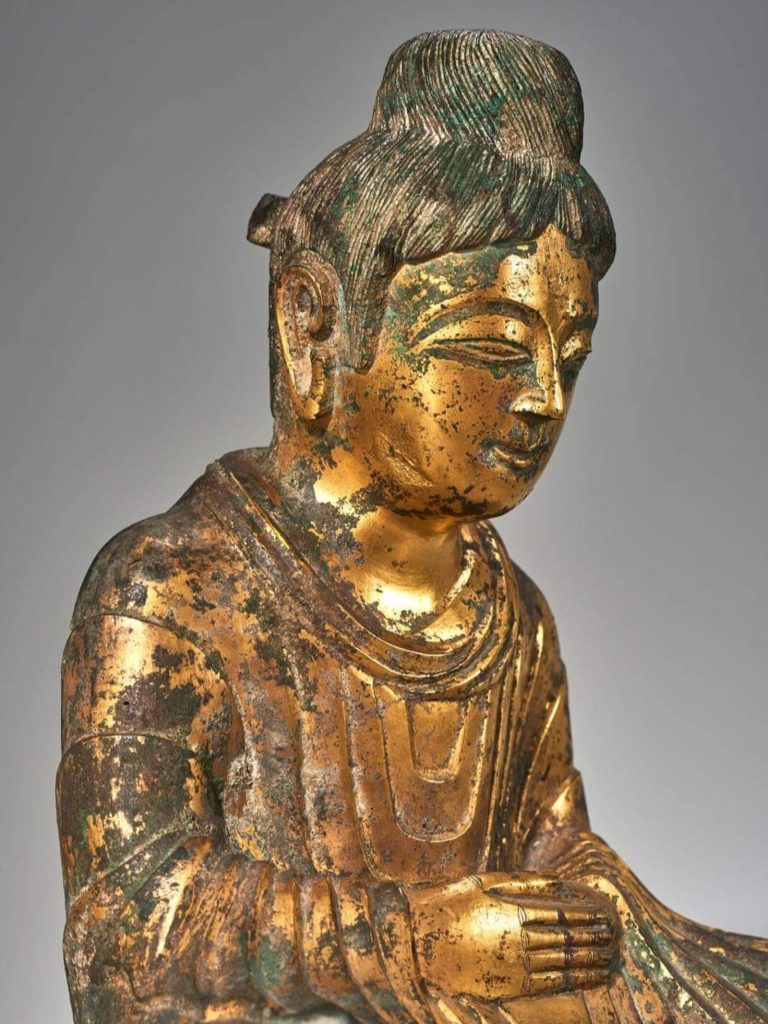
Buddha dated 338, Asian Art Museum, San Francisco, CA, USA. Detail. Museum’s website.
The positioning of the Buddha’s hands has long played a vital role in the diffusion and interpretation of Buddhist art. In Buddha dated 338, the Buddha folds his hands across his stomach.
Some scholars believe that the artist misrepresented the dhyana mudra (meditation gesture), which normally presents the palms facing upward and the thumbs elevated and barely touching each other. These same scholars believe the artist was either misinformed or ignorant of Buddhist gestures since Buddhism was still fairly new to China.
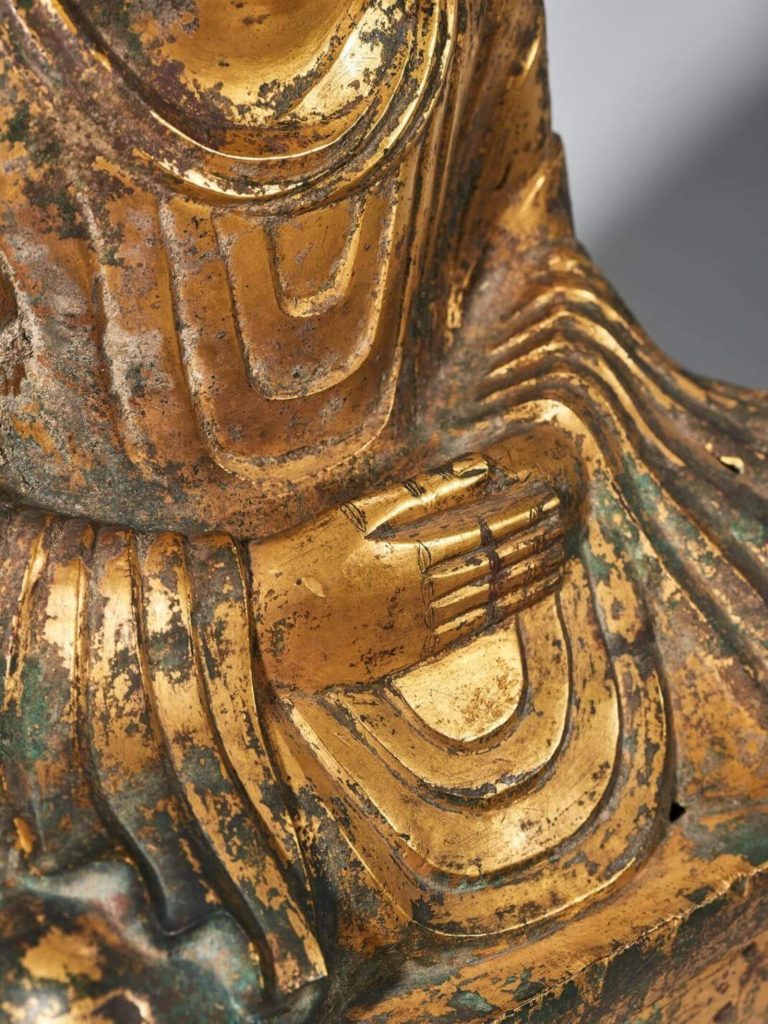
Buddha dated 338, Asian Art Museum, San Francisco, CA, USA. Detail. Museum’s website.
However, other scholars believe this Buddha’s hand gesture is perfectly intentional. With his palms facing his body, and overlapping across his stomach, it creates the formal Chinese gesture of reverence. Therefore, like possessing a topknot and excluding a mustache, this Buddha is assimilating Chinese aesthetic and culture.
The Buddha sits on a box-like rectangular base. It appears to be void of decoration, but it has three substantial holes in the front panel. Why are there holes in the base?
Missing attachments once adorned the front facade. Scholars believe that a pair of lion ornaments was inserted in the left and right holes, while a lotus motif filled the central hole. The lions represented regality, strength, and power. They also symbolized the Buddha’s teachings as they are frequently referred to as the “Lion’s Roar.” The lost lotus represented Enlightenment, and along with the lion, is one of Buddhism’s most powerful symbols.
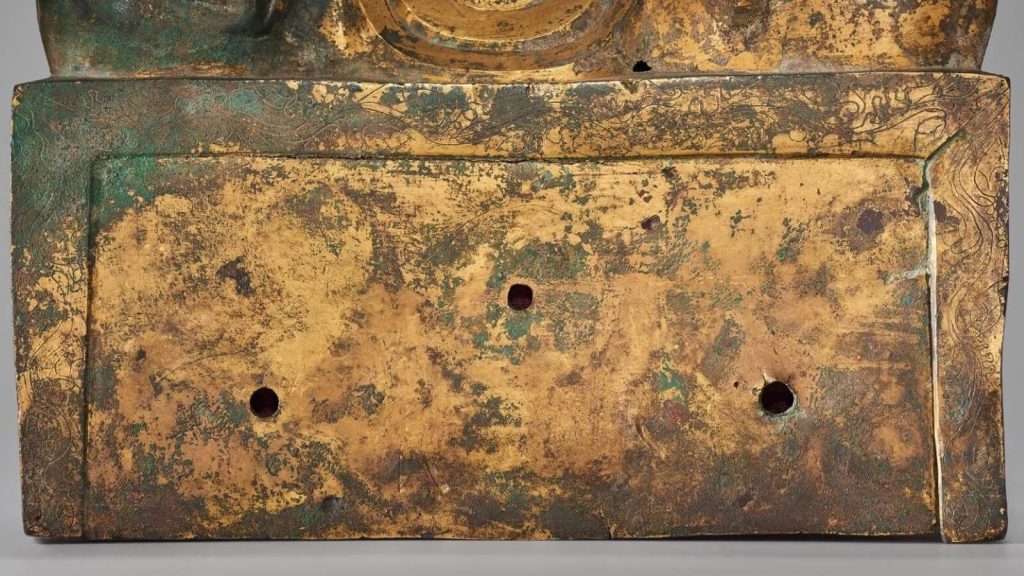
Buddha dated 338, Asian Art Museum, San Francisco, CA, USA. Detail. Museum’s website.
At over 1,600 years old, this figure of Buddha lacks many of its original features that have perished over time. On top of the topknot is a deep shaft that once allowed an inserted canopy to rise from the top of the head. This canopy would have represented royalty and symbolized auspiciousness.
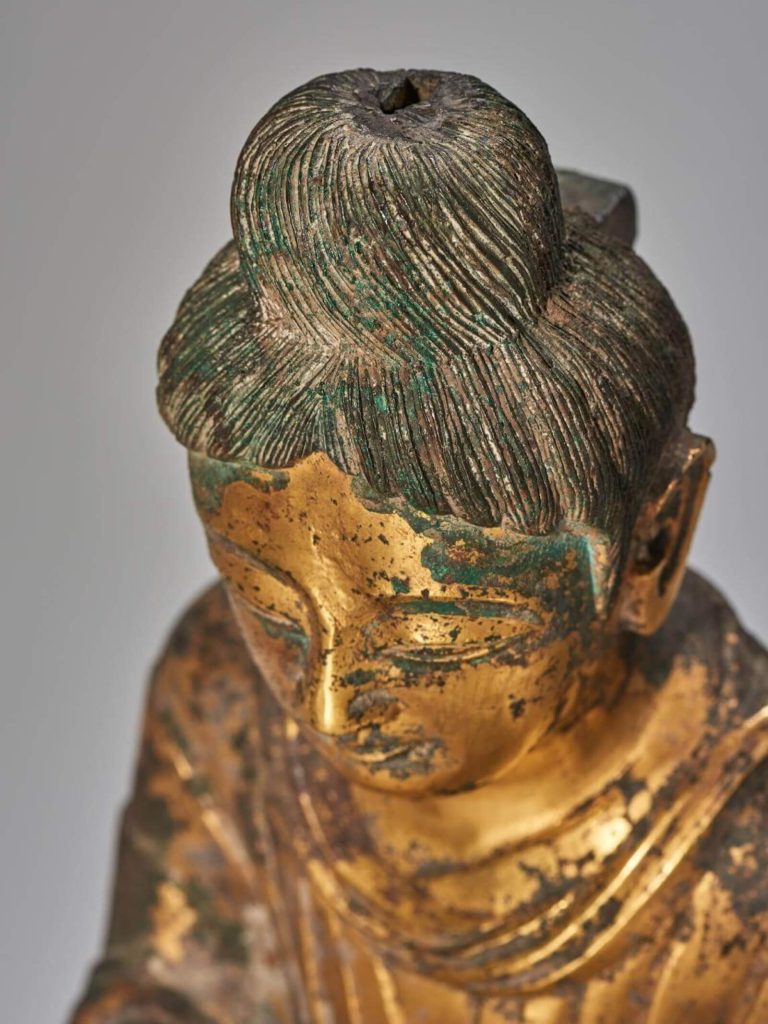
Buddha dated 338, Asian Art Museum, San Francisco, CA, USA. Detail. Museum’s website.
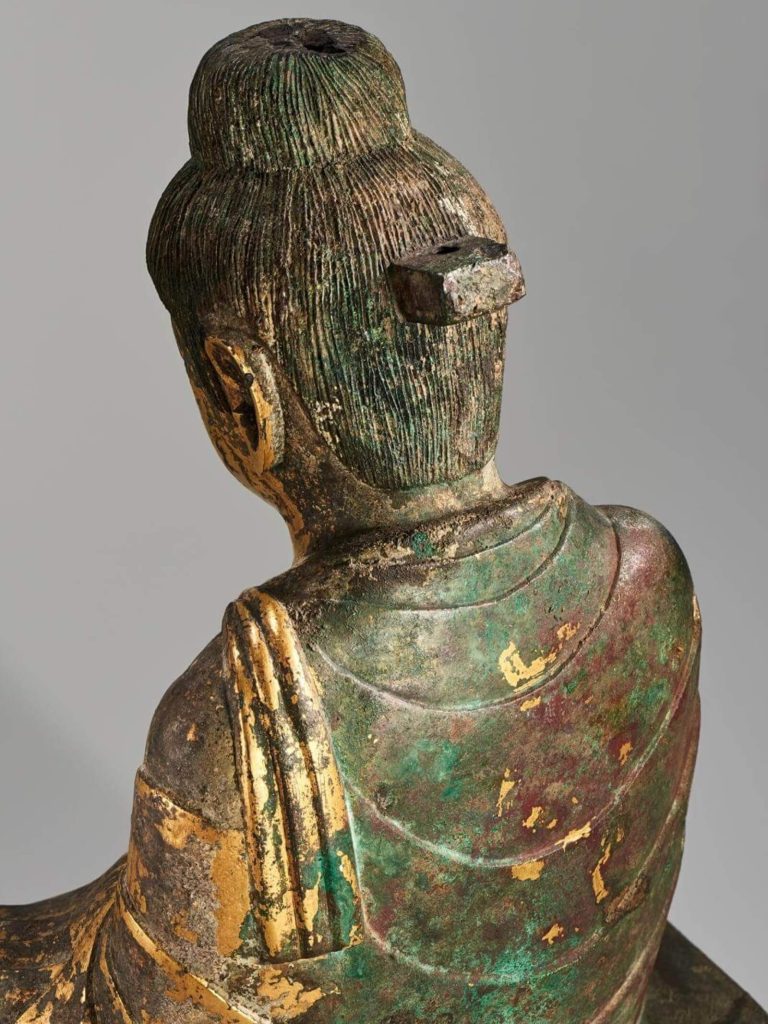
Buddha dated 338, Asian Art Museum, San Francisco, CA, USA. Detail. Museum’s website.


Detail of the top of the Buddha, highlighting the deep shaft on the topknot that once supported a ceremonial canopy.
Detail of the back of the Buddha, showing the square protrusion that once held a halo and hints at its original altar-like base
A square protrusion on the back of the head would have once held a halo, which represented the Enlightenment. Furthermore, the square base would have been attached to table-like legs to form an altar. Therefore, while the statue still maintains a beautiful presence, its original presentation would have been even more magnificent.
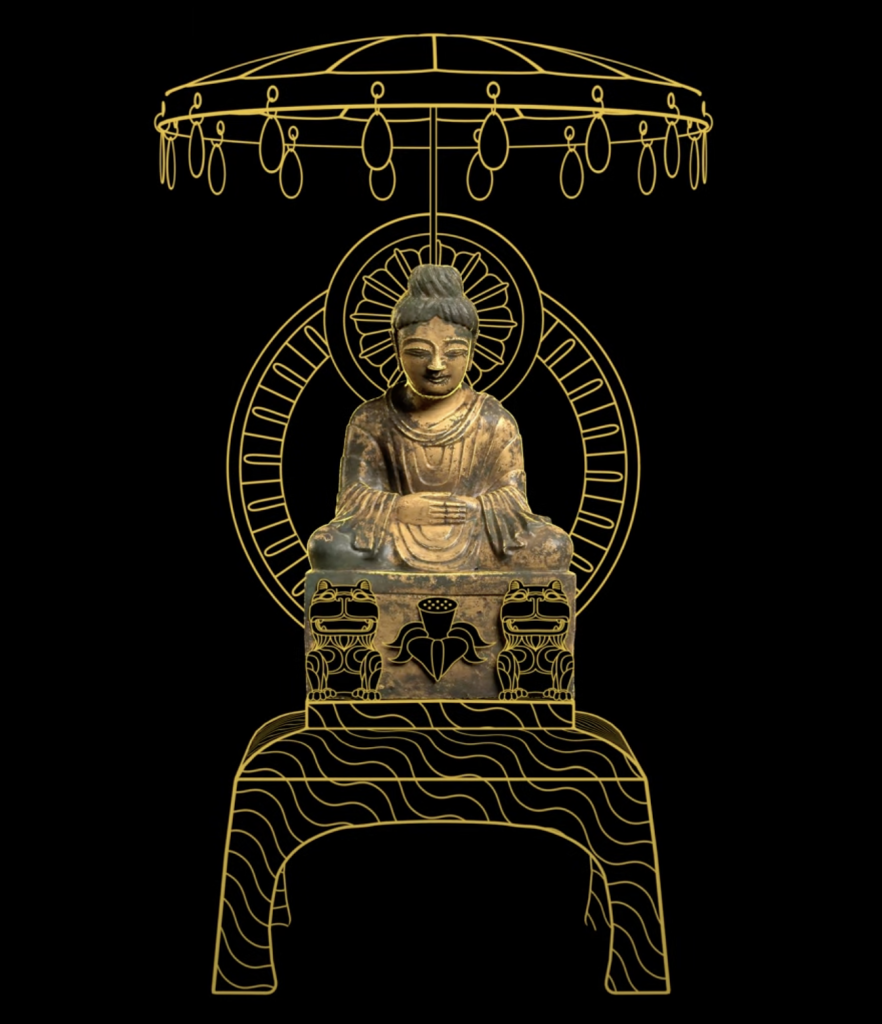
Display reconstruction of the Buddha dated 338, Asian Art Museum, San Francisco, CA, USA. YouTube.
However, the reduced version of today aligns more closely with today’s minimalist aesthetic. Perhaps the original version of the Chinese Buddha statue would have been too fussy and too ornate?
“Buddha Dated 338”, Asian Art Museum Online Collection. Retrieved 27 November 2025.
“Buddha Dated 338”, Asian Art Museum YouTube channel, August 2020.
Helen Gardner, Fred S. Kleiner, and Christin J. Mamiya: Gardner’s Art Through the Ages, 12th ed., Thomson Wadsworth, Belmont, CA, USA, 2005.
Get your daily dose of art
Click and follow us on Google News to stay updated all the time

DailyArt Magazine needs your support. Every contribution, however big or small, is very valuable for our future. Thanks to it, we will be able to sustain and grow the Magazine. Thank you for your help!

James W. Singer is an art historian and fine art photographer. He earned a Bachelor of Arts in Art History from the University of Florida. He later moved to Paris, France. He currently writes “Masterpiece” articles for DailyArt Magazine.

As an educator, writer, and neurodivergent creative, I enjoy learning and sharing through nature, the arts and novel experiences.
The girl leans out of the painting as if she intends to cross the boundary between art and reality—she touches the frame and looks directly at the...
The Royal Castle in Warsaw 26 March 2026
With sweet putti, handsome gods, beautiful nymphs, vibrant colors, and elaborate compositions, The Setting of the Sun is a testimony to François...
James W Singer 8 February 2026
Among the Sierra Nevada, California, by Albert Bierstadt, is a majestic mountainous landscape filled with wild beauty and blissful idealism. Its...
James W Singer 25 January 2026
The Cardsharps is an early masterpiece of Baroque art by Caravaggio that explores the revolutionary theme of crooked card playing. Let’s delve...
James W Singer 11 January 2026