


Masterpiece Story: The Setting of the Sun by François Boucher
With sweet putti, handsome gods, beautiful nymphs, vibrant colors, and elaborate compositions, The Setting of the Sun is a testimony to François...
James W Singer 8 February 2026

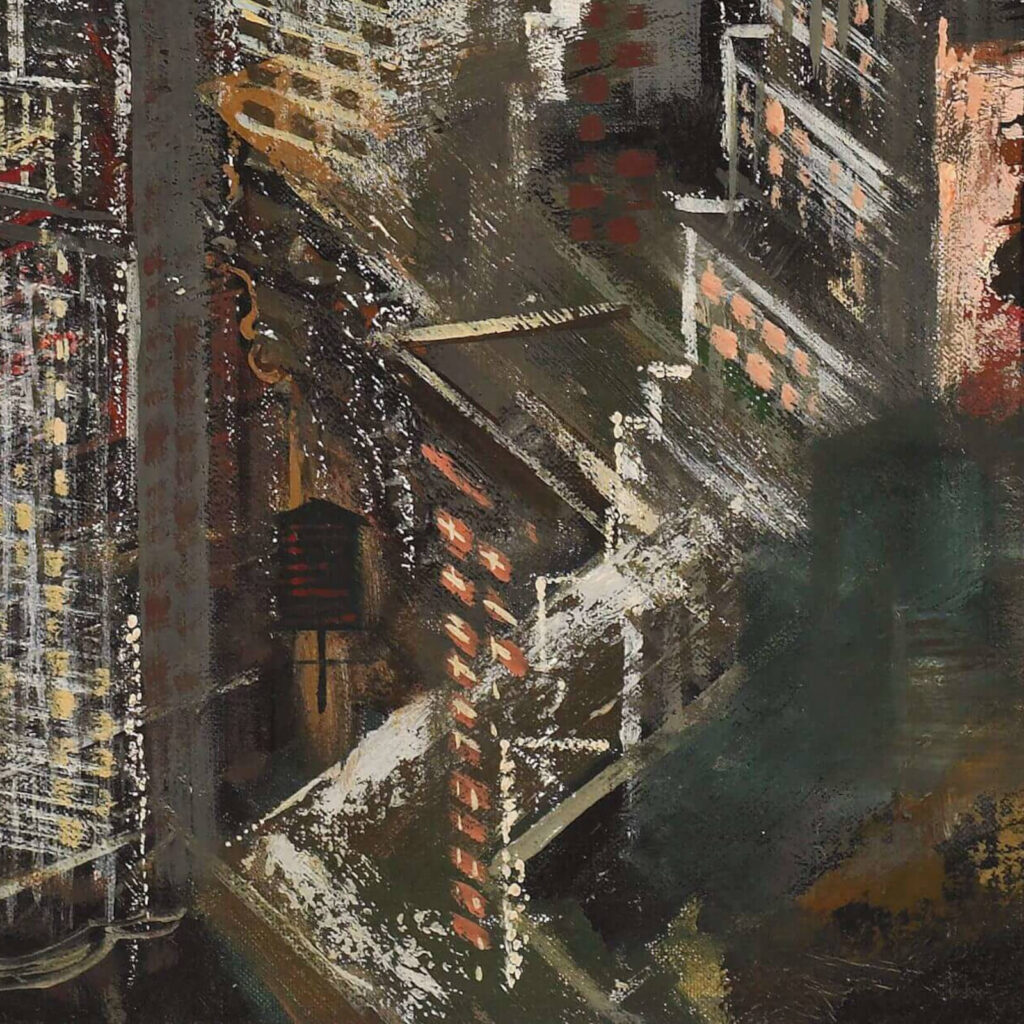
George Grosz, Manhattan, 1946, Harn Museum of Art, Gainesville, FL, USA. Detail.
Manhattan is a masterpiece by George Grosz that expresses the grandeur and struggle of 1940s New York City.

George Grosz, Manhattan, 1946, Harn Museum of Art, Gainesville, FL, USA. Detail.
George Grosz (1893–1959) was a German-American artist who is most famous for his satirical paintings of Berlin society during the Weimar Republic (1918–1933). In 1932, escaping the incoming Nazi dictatorship, he left Germany and moved to the United States where he gained American citizenship. Grosz shifted his artistic focus from German society to American landscapes. He began to embrace Abstract art through his many depictions of New York City. Manhattan is a masterpiece by George Grosz that expresses the grandeur and struggle of 1940s New York City.

George Grosz, Manhattan, 1946, Harn Museum of Art, Gainesville, FL, USA. Detail.
Manhattan is an oil painting on a wooden panel. It measures 61 by 50.08 cm (24 by 20 in). It depicts the sprawling cityscape of New York City punctuated by the Empire State Building in the mid-left and the Chrysler Building in the far-right.

George Grosz, Manhattan, 1946, Harn Museum of Art, Gainesville, FL, USA. Detail.
Smoke, steam, and soot rise throughout the scene to create foggy, dirty clouds in the sky. The cityscape is a jostling cacophony of white lines, yellow windows, and gray walls. The scene pulsates with energy.

George Grosz, Manhattan, 1946, Harn Museum of Art, Gainesville, FL, USA. Detail.
The scene is captured in a loose form of abstraction. Grosz did not paint New York City with an optically perfect perspective. It is not depicted as visual reality. No viewer could confuse Grosz’s vision with a photograph. The painting presents transparent buildings, layered colors, blurred edges, and distorted angles. Manhattan captures the dynamic essence and energy of the city through an abstracted interpretation.

George Grosz, Manhattan, 1946, Harn Museum of Art, Gainesville, FL, USA. Detail.
George Grosz was not a believer in pure capitalism. He had followed the Communist Party in the 1920s with its foundations of Marxism and class struggle. Therefore, when he arrived in the United States in 1932, he was both awed and disgusted by American capitalism. By 1946, when Manhattan was created, the United States was a powerhouse of industrial manufacturing, scientific advancement, and economic prosperity.

George Grosz, Manhattan, 1946, Harn Museum of Art, Gainesville, FL, USA. Detail.
New York City, where Grosz continued to live, was a major center of wealth and opportunity. However, it was also a metropolis of poor and overworked employees. Manhattan reflects the great architectural achievements, such as the Empire State Building and the Chrysler Building, created by captains of industry and robber barons. The painting also reflects the unhealthy living and working conditions of the urban poor. Great clouds of smoke and soot pollute the air. Burnt oil particulates burn and clog the lungs. Manhattan celebrates economic prosperity but at the expense of social health. Manhattan is class wealth, but it is also class struggle.
George Grosz, Manhattan, 1946, Harn Museum of Art, Gainesville, FL, USA. Detail.
“10 Things to Know About George Grosz.” Stories, Christie’s, 9 January 2020.
Bjorn, Heather. “Harn Intern Spotlight: Lee LaPlaca.” Harn Museum of Art, February 19, 2024.
Gardner, Helen, Fred S. Kleiner, and Christin J. Mamiya. Gardner’s Art Through the Ages. 12th ed. Belmont, CA, USA: Thomson Wadsworth, 2005.
“Manhattan.” Collection. Harn Museum of Art, Gainesville, USA. Retrieved 2 May 2024.
“New York Harbor.” Collection. Metropolitan Museum of Art, NYC, USA. Retrieved 2 May 2024.
Get your daily dose of art
Click and follow us on Google News to stay updated all the time

DailyArt Magazine needs your support. Every contribution, however big or small, is very valuable for our future. Thanks to it, we will be able to sustain and grow the Magazine. Thank you for your help!

James W. Singer is an art historian and fine art photographer. He earned a Bachelor of Arts in Art History from the University of Florida. He later moved to Paris, France. He currently writes “Masterpiece” articles for DailyArt Magazine.

With sweet putti, handsome gods, beautiful nymphs, vibrant colors, and elaborate compositions, The Setting of the Sun is a testimony to François...
James W Singer 8 February 2026
Among the Sierra Nevada, California, by Albert Bierstadt, is a majestic mountainous landscape filled with wild beauty and blissful idealism. Its...
James W Singer 25 January 2026
The Cardsharps is an early masterpiece of Baroque art by Caravaggio that explores the revolutionary theme of crooked card playing. Let’s delve...
James W Singer 11 January 2026
As Europe burned during WWII, Wassily Kandinsky, who had fled Nazi Germany in 1933, lived as a recluse in his Neuilly-sur-Seine apartment. In that...
Javier Abel Miguel 8 January 2026