Summary
- Golding Constable’s Kitchen Garden depicts an ordinary family scene blending nostalgia and observation, reflecting his personal loss and deep knowledge of rural life.
- Bow Fell, Cumberland shows Constable’s discomfort with rugged landscapes, focusing on an expressive sky and capturing what he actually saw rather than an idealized scene.
- View Toward the Rectory, East Bergholt shows a late summer sunrise rendered in intense colors, reflecting Constable’s feelings toward Maria Bicknell.
- Boat Building near Flatford Mill depicts a working countryside with rough brushwork, emphasizing rural labor within a vibrant landscape.
- The White Horse is one of Constable’s large-scale landscapes, aimed at making an impact on viewers while retaining naturalism and emphasizing ordinary rural life.
- Chain Pier, Brighton shows Constable experimenting with seaside landscapes, moving beyond rural nostalgia.
- Cloud Study records outdoor sky conditions through careful meteorological observation, using clouds to generate the viewer’s empathy.
- Hadleigh Castle combines naturalism with a Romantic mood, often linked to Constable’s grief after the death of his wife, Maria.
- Salisbury Cathedral from the Meadows reflects Constable’s late Romantic vision, expressing his spiritual beliefs and sense of the divine in nature.
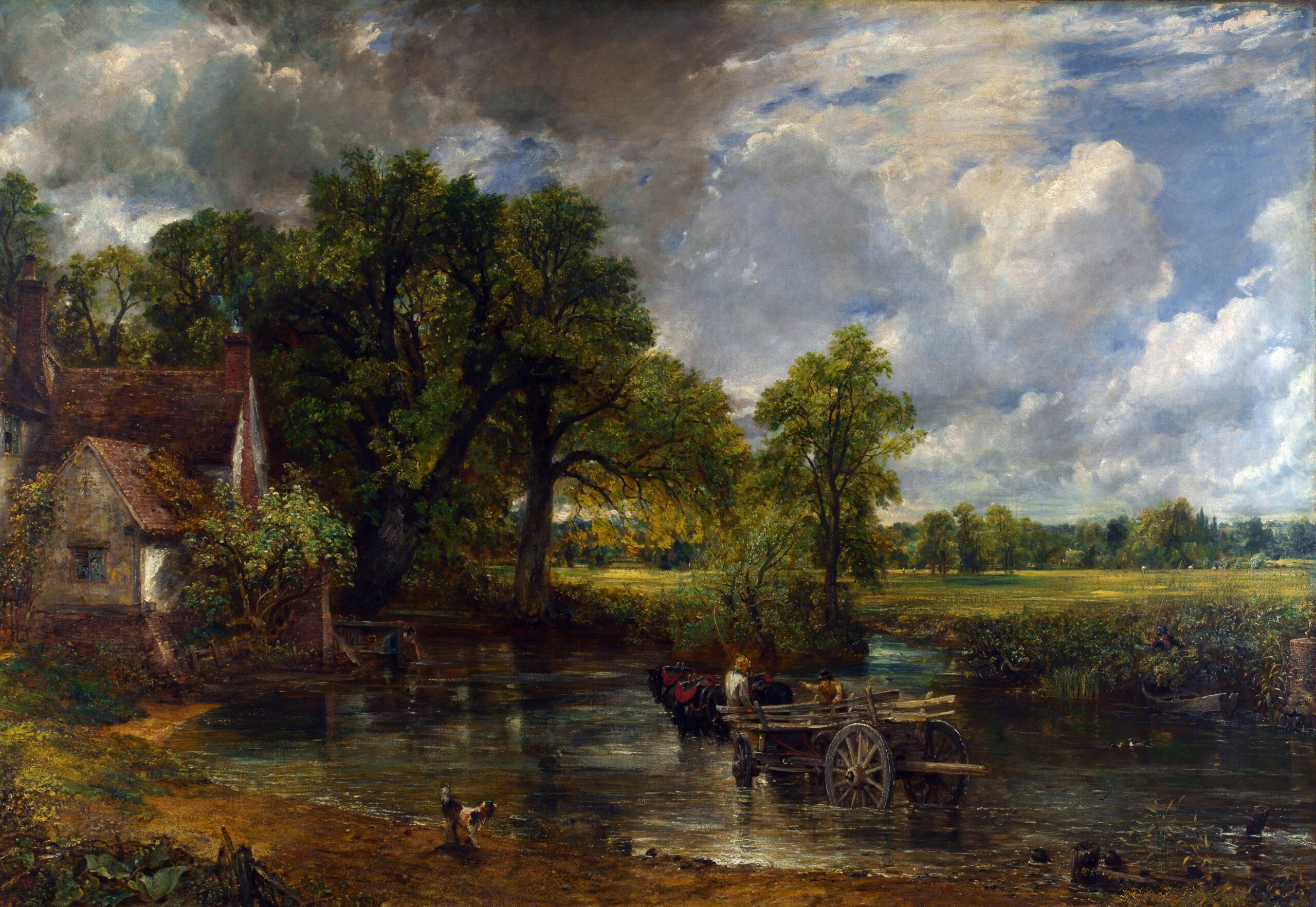
- In The Hay Wain, Constable depicts everyday rural life with vivid color and texture, making the ordinary seem strikingly alive in a way that was radical for its time.
The Country Boy
John Constable (1776–1837) was the second son of a mill owner from Suffolk, a rural farming county in the east of England. His roots were, both during and after his lifetime, the defining fact about him. He was a provincial, country boy, originally destined like many second sons for a career as a clergyman. Although he defied these expectations by becoming an artist, in every other respect, he remained close to his origins.
Like many other would-be artists, Constable went to London to train at the Royal Academy, but it took him a long time to get there, in 1799, aged 22. His elder brother had shown no aptitude for business and Constable was obliged to work at the mill until finally persuading his father to allow him to paint. Equally, unlike most students, he did not immediately stay in the capital seeking out patrons and commissions. Instead, he returned home and dedicated himself to representing the countryside he had known all his life.
1. Constable Country
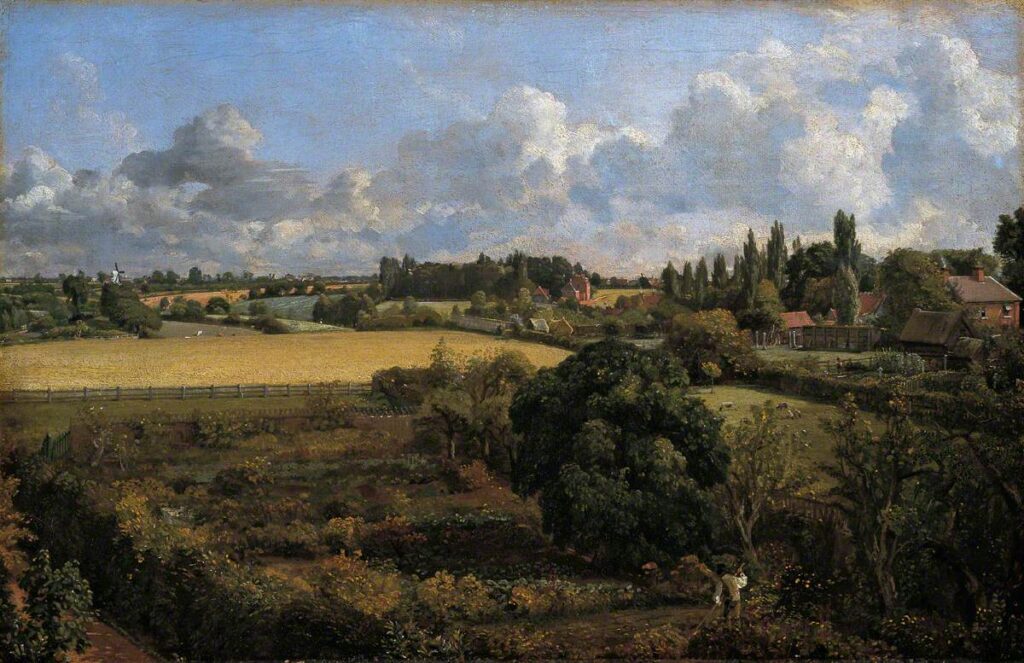
John Constable, Golding Constable’s Kitchen Garden, c. 1815, Christchurch Mansion, Ipswich, UK.
In 1815, Constable painted a pair of pictures of the family garden at his childhood home in East Bergholt: Golding Constable’s Kitchen Garden and Flower Garden. Observed reality and nostalgia are combined as he mourned the recent death of his mother, and in retrospect, the works were even more poignant. Within a year, his father, Golding, was also dead and the house was sold. It is the ordinariness of these paintings that stands out. They are like photos from a family album, painted from the upper windows of the house.
Constable’s origins have also impacted the way recent art historians have viewed his work. For many, he comes from a landowning class, incapable of empathizing with the rural poor, or with viewing the landscape through a realist lens. The truth is, Constable’s family was comfortable rather than wealthy, and their money came from hard work. His father was a self-made man who had built up his own business. Constable himself was acutely aware of the agricultural year, of the importance of weather, and of the precarious uncertainty which all farmers live with. It was the basis of nearly all his art.
2. The Reluctant Tourist
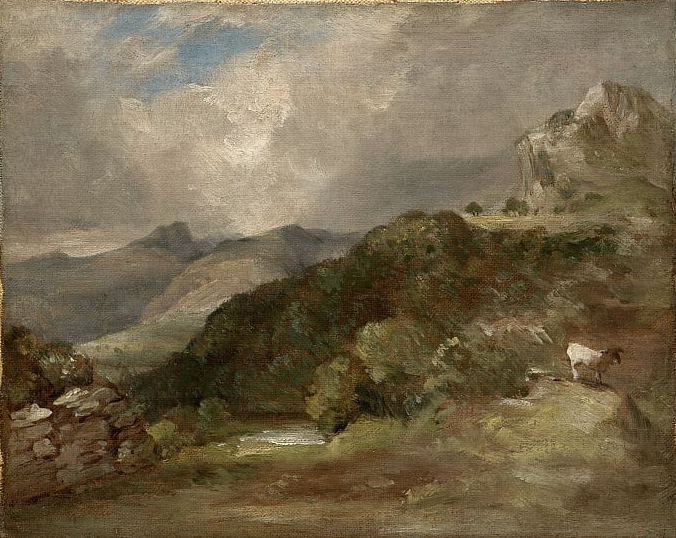
John Constable, Bow Fell, Cumberland, 1807, Clark Art Institute, Williamstown, MA, USA.
For landscape painters at the start of the 19th century, there was a recognized tourist trail of locations that were deemed worthy of recording. With Europe off limits because of the Napoleonic Wars, the Welsh Mountains and the Lake District provided dramatic scenery. Craggy backgrounds, mixed countryside framed by trees, picturesque cottages or ruins, and foreground interest in the form of figures and animals was an established formula.
In 1806, Constable visited the Lake District, just as J. M. W. Turner and Thomas Girtin had done, and his first Royal Academy exhibits to get noticed were painted there, including Bow Fell, Cumberland. However, he seems strangely uncomfortable with this wild, rugged landscape, and his friend and biographer Charles Leslie later wrote: “the solitude of mountains oppressed his spirits.” Almost half of Bow Fell, Cumberland is given over to sky, which seems painted with much more energy than the scrubby, undifferentiated countryside. Rough brushstrokes and a muddy palette suggest Constable is trying to express what he sees rather than attempting a perfected interpretation of a beautiful scene.
3. Landscape and Emotion
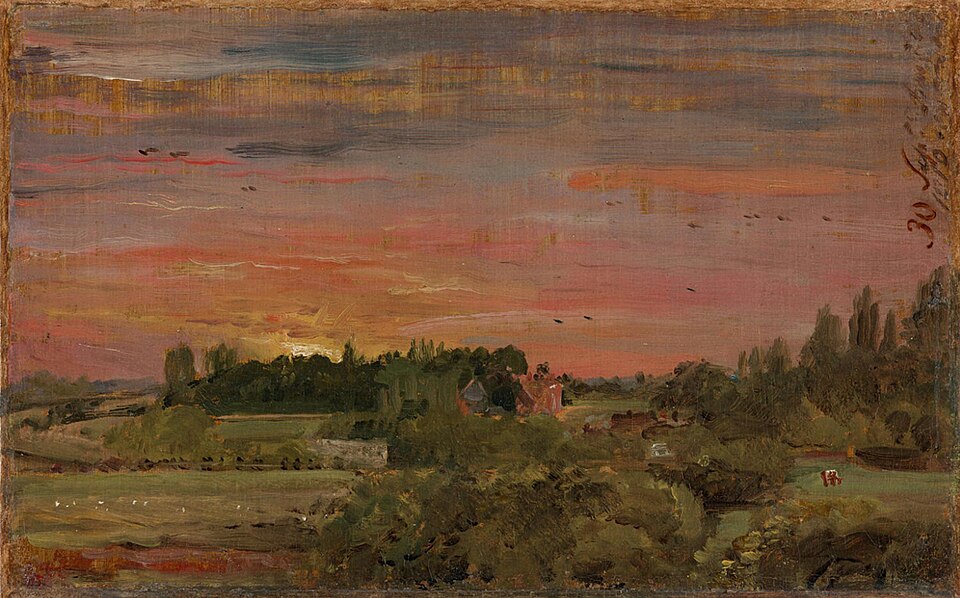
John Constable, View Toward the Rectory, East Bergholt, 1810, Philadelphia Museum of Art, PA, USA.
Constable believed in the power of landscape to inspire emotion and connection. View Toward the Rectory, East Bergholt was one of many oil sketches he painted, often working outside (although here, like in Kitchen Garden, he is looking through a window). His aim was to recreate the intimate, immediate experience that he felt in front of the scene. Many of these sketches are precisely dated—this is marked on the right “30 Sept 1810”—a late summer sunrise rendered with startlingly intense colors.
The rectory of the title belonged to the grandfather of his future wife, Maria Bicknell. They had first met in 1809 but because of Constable’s limited prospects, her family refused to allow the marriage, and their courtship eventually lasted seven years. The little sketch feels as if Constable is flinging his heart out across the fields toward Maria. The pinks and reds are not simply a naturalist evocation of the sunrise, but an expression of the artist’s own deep emotion.
4. The Realist
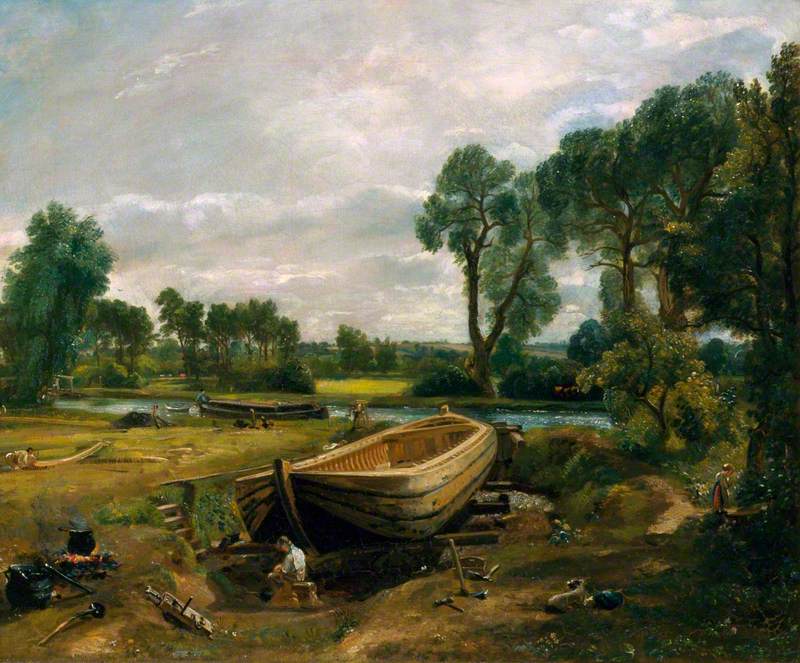
John Constable, Boat Building near Flatford Mill, 1815, Victoria and Albert Museum, London, UK.
Constable’s countryside was always a working one. He painted harvesters and horses, watermills and canals, and even two men shovelling manure into a cart from a large dung heap. His Boat Building near Flatford Mill is dominated by the huge hull of a barge, which looms over the working figure in front of it. The foreground is scattered with tools and equipment and the whole picture is alive with figures and details, painted roughly with a few brushstrokes so that they only slowly become apparent.
Boat Building was painted outdoors, a pretty radical move in itself. Like much of Constable’s work from this period, the sappy, green landscape seems full of life and movement, of “tremulous vibration,” as Charles Leslie described it. Look closely and the canvas is dotted with small white brushstrokes that create glinting highlights on leaves, water, and figures.
The sunshine and scudding clouds of the sky, which are reflected in the sparkling line of water across the center of the canvas, the yellow-ish green glow of the distant field, and the strong verticals of the trees all tend to draw the viewer away from the realism of the subject. Once you focus on it, however, this is as much an image of rural labor as later paintings of field workers by Jean-François Millet.
5. Size Matters
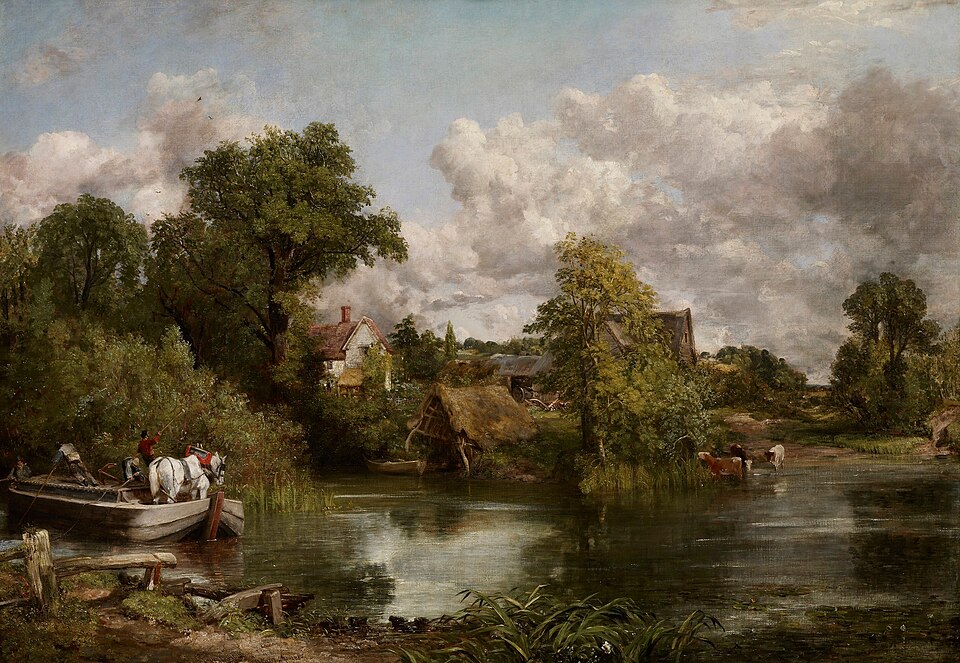
John Constable, The White Horse, 1819, Frick Collection, New York City, NY, USA.
Constable was trying to make a living in an under-appreciated art genre and a crowded market. In 1819, he came up with a radical way to get his work noticed by producing The White Horse, the first of a series of “six footers.” These canvases were far larger than other similar landscapes, more on the scale of classical works by artists like Claude Lorrain. They served the dual purpose of making an impact on the crowded walls of the Royal Academy and of restating Constable’s belief in the importance of the rural life he was portraying.
The canvases were laboriously worked up from small outdoor sketches, which Constable then reconstructed into a full-scale studio sketch of the finished work. Details were added, compositions manipulated, colors heightened. It was a careful balancing act, as Constable tried to produce something that would be acceptable to contemporary taste and, at the same time, retain the naturalism he personally prized.
There is an apparently unstructured complexity to The White Horse. The subject is relegated to the extreme left but is being taken across the canvas, and we follow its journey through a triptych which includes Willy Lott’s cottage (from The Hay Wain) in the center and the drinking cows on the right. Light and shade balance and unify; small, warm dashes of red and brown do the same, but at its heart, this is a painting of nothing more than a patch of water and an ordinary day.
6. The Proto-Impressionist
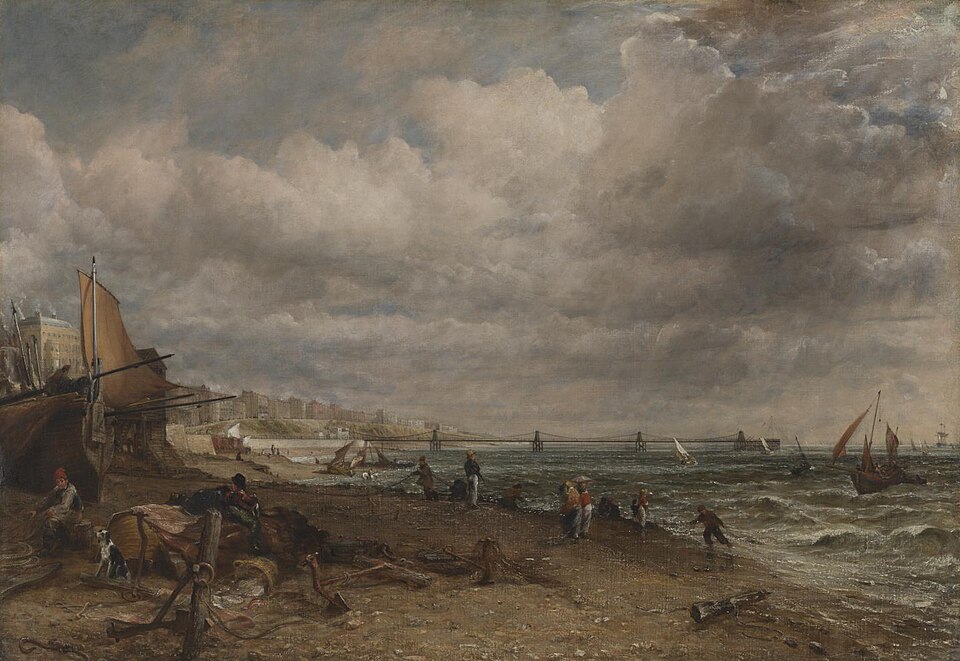
John Constable, Chain Pier, Brighton, 1826–1827, Tate Britain, London, UK.
The success of The White Horse, which Constable sold for 100 guineas and which earned him belated recognition as an Associate of the Royal Academy, gave him the confidence and the platform to become more experimental. He was now living in Hampstead, then a village to the north of London, and he broadened his subjects to include Hampstead Heath and other places he visited, like Brighton. Royal Suspension Chain Pier, built only in 1823, was state of the art technology in a fashionable resort, which also attracted Turner. It is a world away from rural nostalgia.
Constable’s blowy beach scenes, like those of fellow British landscapists David Cox and Richard Parkes Bonington, seem to foreshadow the work of later 19th-century French artists like Eugène Boudin. He was appreciated more widely in France after The Hay Wain was exhibited, and won a medal at the Salon there in 1824. Eugène Delacroix was so struck by its brightness and veracity that he re-painted the landscape of his Massacre of Chios.
7. Skying

John Constable, Cloud Study, 1822, Courtauld Gallery, London, UK.
Constable became increasingly fascinated by clouds and during the 1820s painted large numbers of sketches entirely, or virtually entirely, of the sky. These were worked outdoors, usually in oils on paper, and frequently recorded details of times and weather conditions. This study, for instance, has “Sepr.21.1822. Looking South, brisk wind to east, warm and fresh. 3 o’cl. afternoon” written on the back. The work has clearly been abandoned, perhaps because the wind was too brisk, and the middle bank of dark blue cloud has not been worked through.
There were conflicting motivations here. Constable was interested in new scientific ideas about meteorology and his “skying,” as he called these studies, can be seen as a kind of cataloguing, a systematic recording of conditions which he could then retrieve for use in studio paintings. Equally, however, he viewed the sky as “the chief organ of sentiment,” a way of generating empathy with the viewer, and as such, arguably the most important part of the overall image.
8. The Romantic
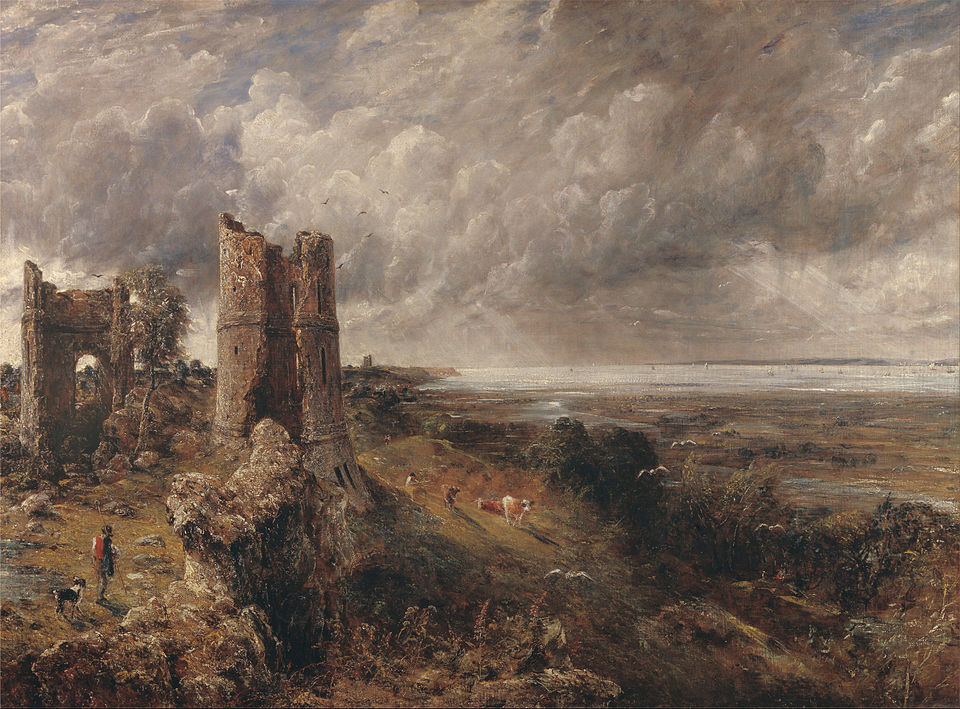
John Constable, Hadleigh Castle, 1829, Yale Center for British Art, New Haven, CT, USA.
Hadleigh Castle is perhaps the least characteristic of all Constable’s works. A lowering, moody sky with silhouetted birds wheeling above the ruins is a quintessentially Romantic evocation of nature. Traditionally, the painting has been explained in biographical terms. Maria had died in 1828, leaving him a widower with seven children, and Constable wore mourning for the rest of his life. It is not difficult to see the lone walker staring at the ruins and the emptiness beyond as representative of his state of mind.
However, Constable had sketched the castle as early as 1814 and the full title of the painting when exhibited at the Royal Academy was Hadleigh Castle, The Mouth of the Thames—Morning After a Stormy Night, suggesting that he was as interested in observed naturalism as ever. Turbulent clouds, fractured, impasto brushwork, and a cooler palette were increasingly common in his later work.
9. Nature and Religion
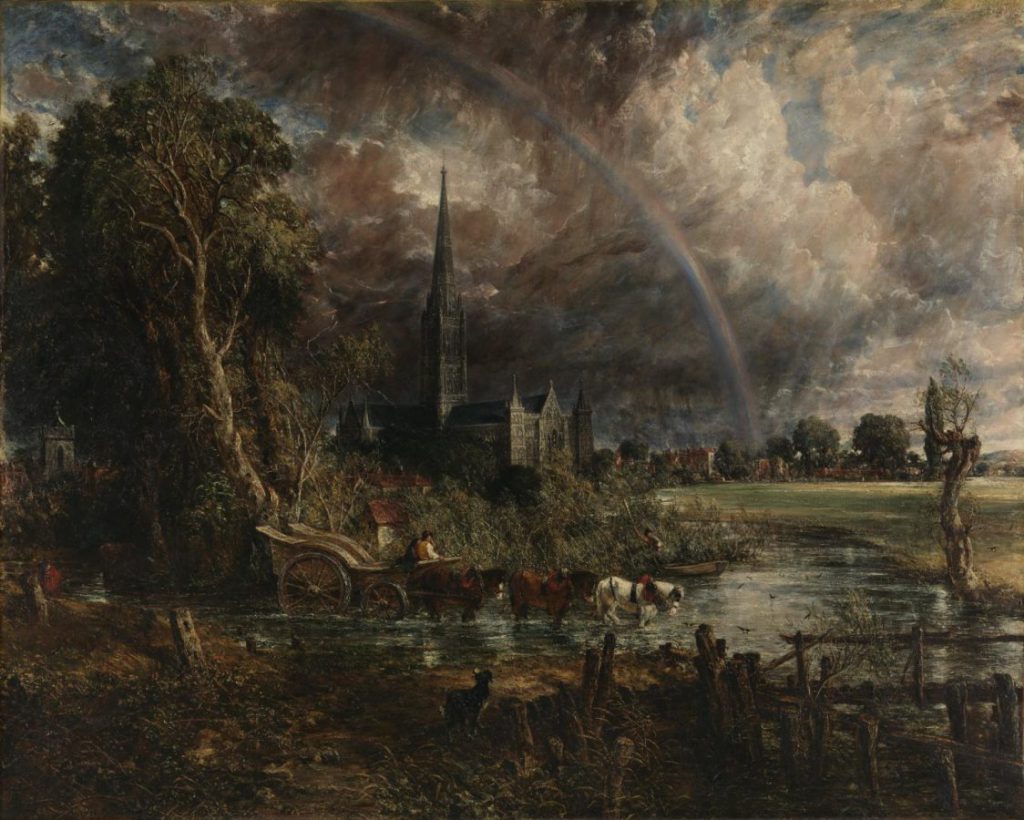
John Constable, Salisbury Cathedral from the Meadows, 1831, Tate Britain, London, UK.
Constable was a deeply religious man who believed that nature was a manifestation of the divine. His interest in the sky takes on an added resonance when one imagines him looking up to heaven, and on a more mundane level, in the background of most of his paintings, you will find a church as a gentle reminder of God’s presence. Constable was a lifelong friend of John Fisher, nephew of the Bishop of Salisbury, frequently visiting the cathedral and painting it.
Salisbury Cathedral from the Meadows epitomizes Constable’s late, more Romantic vision. The simple naturalism of Boat Building near Flatford Mill has been replaced by a swelling intensity: the mounded clouds have an almost weighty solidity, the wood on the left is a tangled mass of brushstrokes. There is symbolism everywhere—the rainbow, the circle of light atop the spire, the sprouting stump on the right—which has led commentators to suggest this is a painting about Constable’s conservative worries over contemporary politics.
Equally, however, it is a kind of “greatest hits” revisiting of his career: The Hay Wain-like cart, the dog in the foreground, the white horse. Little wonder he described it as “the full impression of the compass of my art.”
10. The Hay Wain Revisited
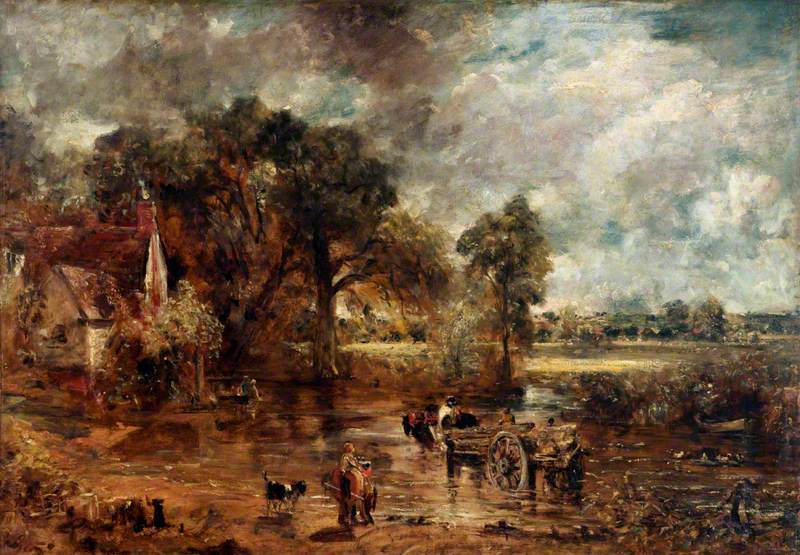
John Constable, The Hay Wain (full-scale oil sketch), 1821, Victoria and Albert Museum, London, UK.
To understand how radical Constable seemed to his contemporaries, you have to somehow wind back the clock to a world before Impressionism, when finish and restraint in art were considered essential—a world where a horse and cart were simply a mundane necessity. The Hay Wain sketch has a looseness, which to our eyes looks much as the finished painting appeared to 1820s viewers; it was even described as “blotchy.”
The final canvas (see the cover image), however, has added color and light, a zinging brightness and rippling, textured surface which seemed more alive, more full of nature, than other landscapes of the time. More than that, he chose a subject that had no grandeur, no classical allusions or sublime aspirations, no drama or excitement. John Constable painted everyday life and made it seem real. It was a simple thing but it was radical.




_-_Maria_Bicknell,_Mrs_John_Constable_-_N02655_-_National_Gallery.jpg#/media/File:John_Constable_(1776-1837)_-_Maria_Bicknell,_Mrs_John_Constable_-_N02655_-_National_Gallery.jpg)


_-_Hampstead_Heath_-_PD.207-1948_-_Fitzwilliam_Museum.jpg#/media/File:John_Constable_(1776-1837)_-_Hampstead_Heath_-_PD.207-1948_-_Fitzwilliam_Museum.jpg)
#/media/File:Joseph_Mallord_William_Turner_(1775-1851)_-_The_Chain_Pier,_Brighton_-_N02064_-_National_Gallery.jpg)

#/media/File:Archdeacon_John_Fisher_by_John_Constable_1816.jpeg)
