
William H. Johnson in 10 Artworks—From Post-Impressionism to Folk Art
William H. Johnson’s paintings show a breadth of styles ranging from realism to Post-Impressionism, and later a folk art aesthetic that would...
Theodore Carter 12 February 2026
13 November 2025 min Read
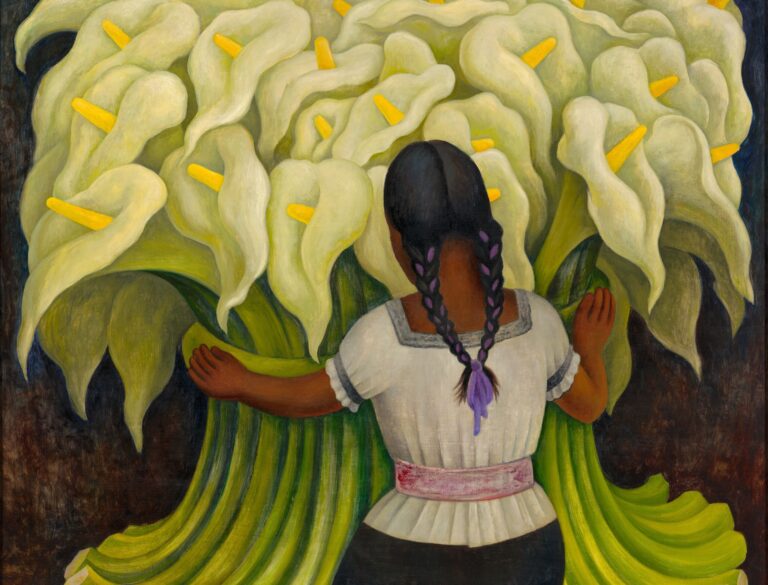
Diego Rivera, The Flower Vendor (Girl with Lilies), 1941, Norton Simon Museum, Pasadena, CA, USA. Museum’s website. Detail.
Diego Rivera (1886–1957) was more than just a painter—he was a storyteller, a historian, and a revolutionary with a brush. His murals burst with life, history, and political energy, capturing the struggles and triumphs of the people. Whether celebrating labor, challenging power, or embracing Mexican identity, his art remains as relevant today as it was in his time. Here, we explore five of Diego Rivera’s most iconic paintings that define his legacy.
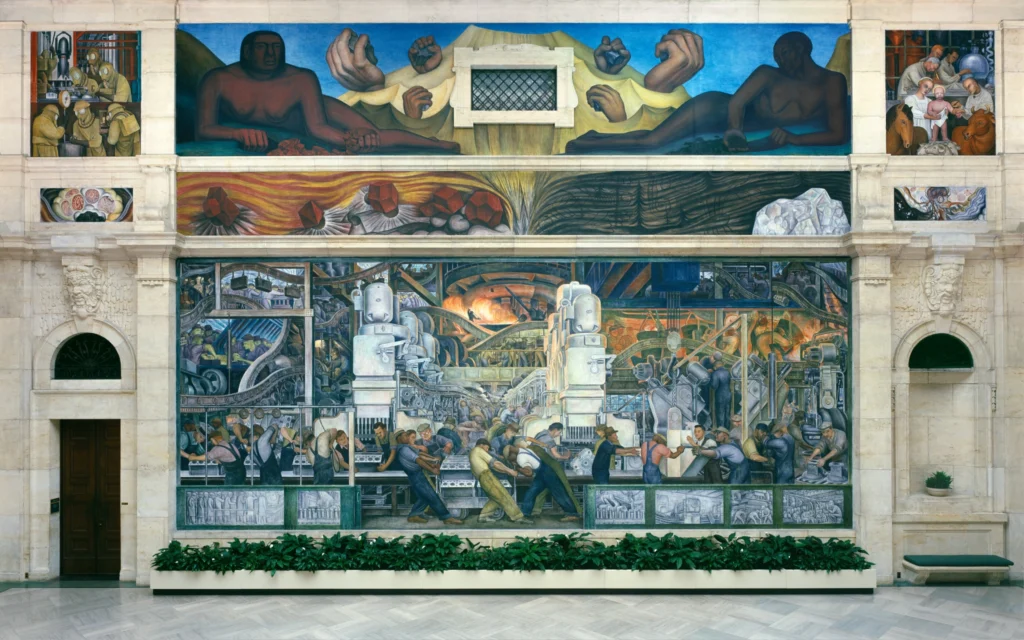
Diego Rivera, Detroit Industry Murals (north wall), 1932–1933, Detroit Institute of Arts, Detroit, MI, USA. Museum’s website.
Located in the Detroit Institute of Arts, this mural series is a grand tribute to industrial workers and their role in modern civilization. Rivera’s work was inspired by Detroit’s booming automobile industry. He created a dynamic, mechanized world where human figures and machines become one. The murals depict workers in Ford factories, laboring under the might of modern technology, their effort fueling progress. Rivera’s bold lines and monumental composition transform the industrial process into a work of art, reminding us of the power of the working class.
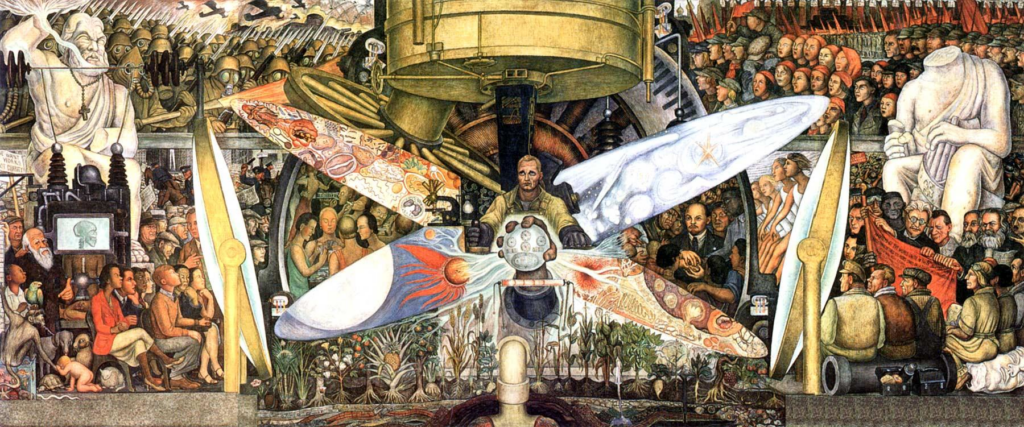
Diego Rivera, Man, Controller of the Universe, 1934, Palacio de Bellas Artes, Mexico City, Mexico. Photograph by Gumr51 via Wikimedia Commons (CC BY-SA 3.0).
Initially commissioned for the Rockefeller Center in New York, this mural (original title Man at the Crossroads) became one of Diego Rivera’s most controversial paintings. When the Rockefellers objected to including Lenin in the work, Rivera refused to alter his vision. The mural was destroyed, but he recreated it in Mexico City’s Palacio de Bellas Artes. The composition is a vibrant clash of ideologies, placing humanity at the center of opposing forces—capitalism and socialism. Science, industry, and revolution swirl around a single figure controlling the universe, embodying Rivera’s unshakable belief in the power of progress and human agency.
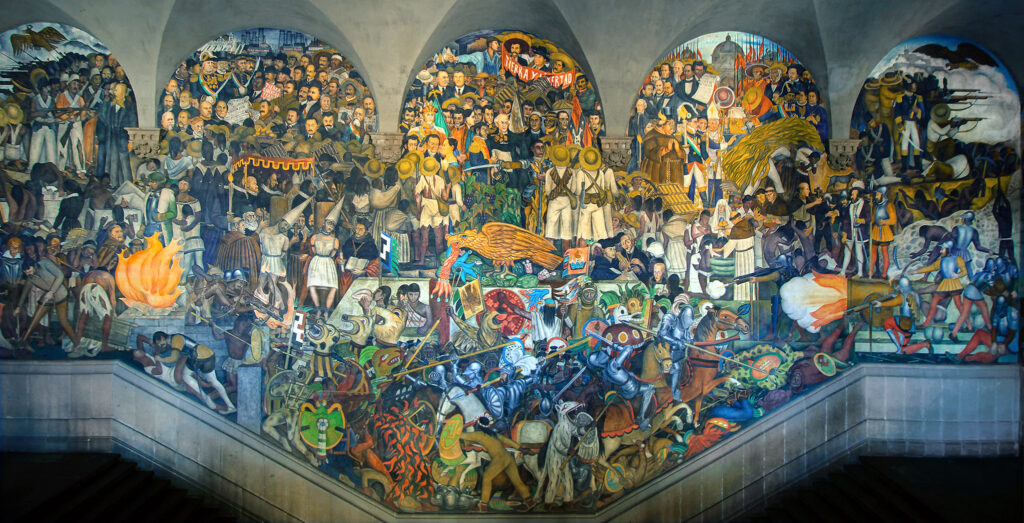
Diego Rivera, From the Conquest to 1930, The History of Mexico murals, 1929–1935, National Palace, Mexico City, Mexico, Smarthistory.
Spanning the walls of Mexico’s National Palace, this mural is a sweeping visual history of Mexico, from its pre-Columbian roots to the Mexican Revolution. Rivera masterfully intertwines the brutality of Spanish conquest, the resilience of indigenous culture, and the rise of revolutionary figures like Emiliano Zapata. Every inch of the mural is packed with symbolic imagery, making it a living, breathing textbook of Mexican identity. His vibrant palette and dynamic storytelling bring history to life, cementing his role as Mexico’s artistic chronicler.
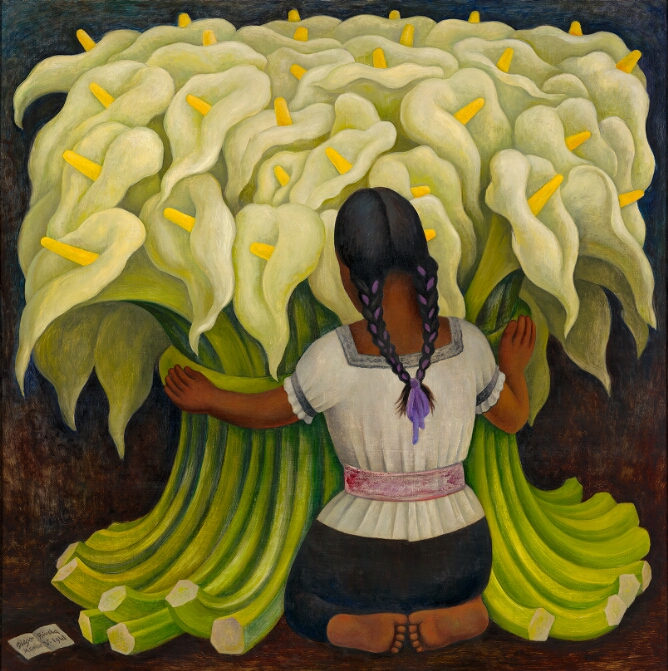
Diego Rivera, The Flower Vendor (Girl with Lilies), 1941, Norton Simon Museum, Pasadena, CA, USA. Museum’s website.
While Diego Rivera is best known for his grand murals, his smaller paintings also carry profound meaning. The Flower Vendor presents a young girl kneeling beside an oversized bouquet of white lilies, their petals bursting outward like fireworks. The contrast between her humble posture and the overwhelming beauty of the flowers speaks to Rivera’s deep appreciation for the dignity of labor. This painting proves Rivera’s ability to elevate everyday people to the level of icons, capturing their struggles and grace with equal measure.
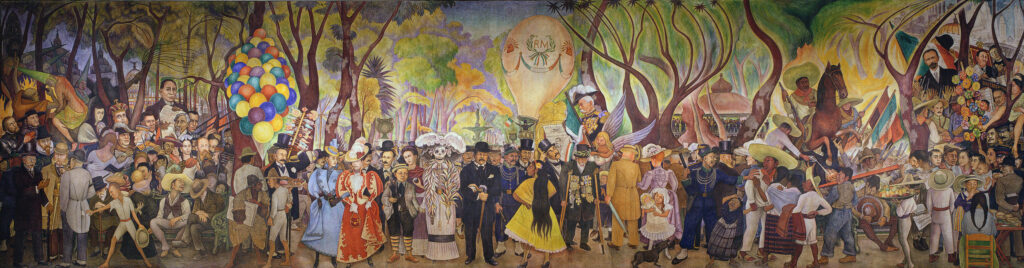
Diego Rivera, Dream of a Sunday Afternoon in Alameda Central Park, 1946–1947, Museo Mural Diego Rivera, Mexico City, Mexico. Sotheby’s.
Diego Rivera’s Dream of a Sunday Afternoon is a surreal and whimsical journey through Mexican history. The mural features a parade of historical figures, including Rivera as a child and Frida Kahlo. It also shows the elegantly dressed La Catrina, a skeletal figure symbolizing death and the passage of time. By blending the past with the present in a dreamlike composition, Rivera offers a poignant reflection on Mexican identity, class struggle, and cultural heritage. Today, this masterpiece is preserved in the Museo Mural Diego Rivera, a testament to his genius.
Diego Rivera was a force of nature. His murals weren’t just paintings; they were battles fought on walls, demanding attention and sparking dialogue. Through his vibrant depictions of workers, revolutionaries, and everyday people, he reshaped how art could serve history, politics, and culture. Whether standing before his grand murals or his intimate portraits, we are reminded of the unbreakable spirit of the people he painted. Rivera’s work continues to inspire, ensuring his vision of justice, identity, and humanity lives on in every brushstroke.
Get your daily dose of art
Click and follow us on Google News to stay updated all the time

DailyArt Magazine needs your support. Every contribution, however big or small, is very valuable for our future. Thanks to it, we will be able to sustain and grow the Magazine. Thank you for your help!

Art historian by education, data geek by trade, art and book lover by passion, based in London in love with Europe and traveling around it. You can visit my book blog here: https://bookskeptic.com/

Antonia Chela is an avid art history fan, always seeking to know more about the wonderful world of art! She is a student of museum studies, and she is interested in learning about all aspects of the art world, current, past and future.
William H. Johnson’s paintings show a breadth of styles ranging from realism to Post-Impressionism, and later a folk art aesthetic that would...
Theodore Carter 12 February 2026
For many of us, the word “pirate” evokes images of an era full of gallant white-sailed ships, skull and crossbones flags, red bandanas, gold...
Theodore Carter 4 December 2025
In the midst of the Jim Crow era, Marian Anderson’s undeniable voice rocketed her to stardom and made her the subject of several enduring works of...
Theodore Carter 20 October 2025
John Singer Sargent’s flattering, flashy images of late Victorian and Edwardian high society are justifiably famous. They made him rich but...
Catriona Miller 3 February 2026