5 Works by Matisse to See in Chicago This Spring
Are you a lover of Matisse’s work? You cannot miss the new exhibition Matisse’s Jazz: Rhythms in Color at the Art Institute of Chicago! The show...
Aniela Rybak-Vaganay 23 March 2026
27 April 2026 min Read
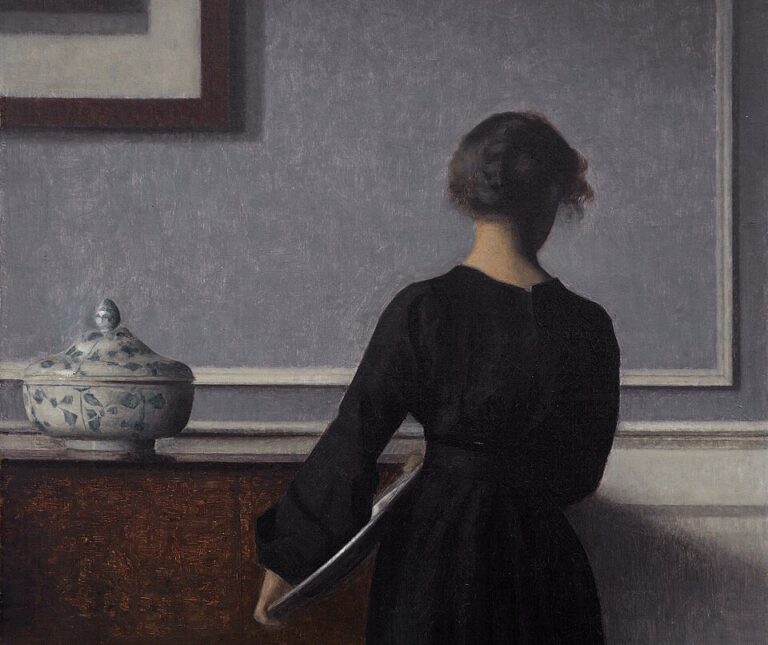
Vilhelm Hammershøi, Interior with Young Woman Seen from the Back, 1904, Randers Museum of Art, Randers, Denmark. Detail.
Vilhelm Hammershøi is enjoying a renaissance at present. In 2023, Interior. The Music Room, Strandgade 30, sold for $9.1 million, a new record for a Danish artist. 2026–2027 sees a major European-US travelling exhibition, Hammershøi. The Eye That Listens. Henrik Wivel’s comprehensive study of his life and career, Vilhelm Hammershøi—Painting as Poetry, could not come at a better time. Hammershøi is often reduced to a painter of evocative but deceptively simple interiors. Over nearly three hundred beautifully illustrated and well-researched pages, Wivel proves that he is a great deal more.
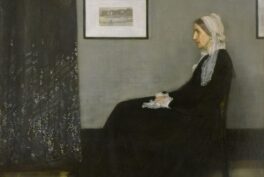
Vilhelm Hammershoi—Painting as Poetry is not primarily a biography, but the book starts with a biographical section and includes a useful timeline at the end, which establishes the character, chronology, and close personal ties of Vilhelm Hammershøi, the man. His mother and siblings were a constant throughout his life, and featured regularly in his work. A small, Whistlerian portrait of his mother was a typically understated tribute to a woman who devoted herself to supporting her artist son.
Hammershøi himself was taciturn, often to the point of rudeness. His meeting with Austrian poet Rainer Maria Rilke floundered in the face of the artist’s introversion, was not helped by a language barrier, and his slight hearing impairment. Similarly, London’s National Gallery might have more than one work had Hammershøi’s 1910 meeting with the then-director, Charles Holdroyd, gone better. Painting as Poetry is peppered with such examples of Vilhelm Hammershøi’s awkwardness. He was frequently described as “neurasthenic” and hypersensitive, characteristics then seen as conducive to creativity.
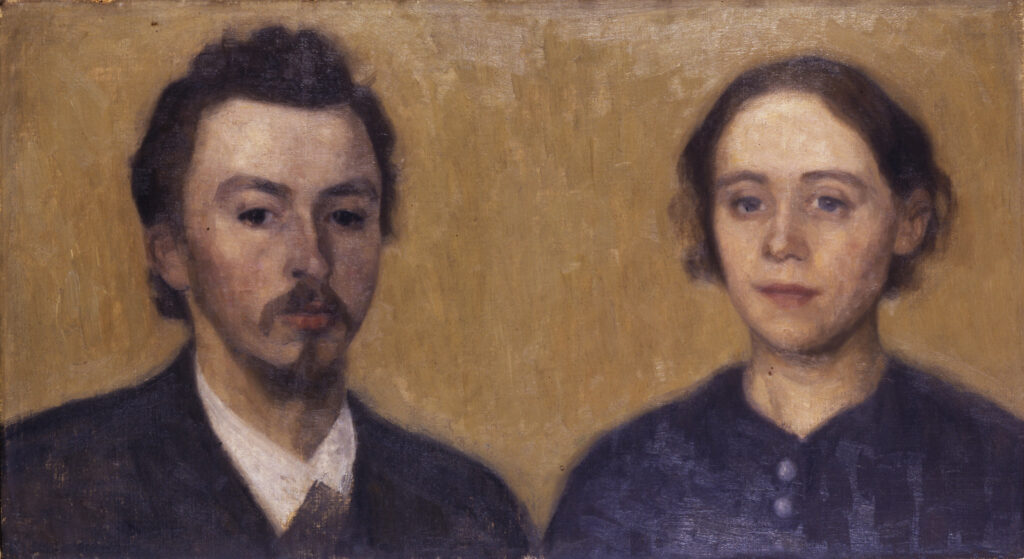
Vilhelm Hammershøi, Double Portrait of the Artist and His Wife, 1892, The David Collection, Copenhagen, Denmark.
Ida Ilsted and Hammershøi married in 1891, largely to help her escape a family home devastated by her mother’s mental illness. Their life together was later dogged by Ida’s own mental health problems, compounded perhaps by the couple’s inability to conceive. Nonetheless, they were a close couple. Their successive homes were a major subject of Vilhelm’s work, and Ida became a constant, though anonymized, presence in many of his interiors, rarely seen from the front and never aging.
Hammershøi’s portraits were largely confined to those of friends and family and are notable for their distance. Even in the joint portrait of himself and Ida, painted shortly after their marriage, he chose to depict them separated and outward facing: two individuals rather than a couple. Wivel likens this to Egyptian portraiture, but also points out the subtle inward twist, the point of contact at the bottom center, an implied heart shape between the figures. Elsewhere, figures actively avoid our gaze and are shown engaged in tasks. Helene Schjerfbeck is referenced, but I am also reminded of Gwen John‘s self-contained female figures.
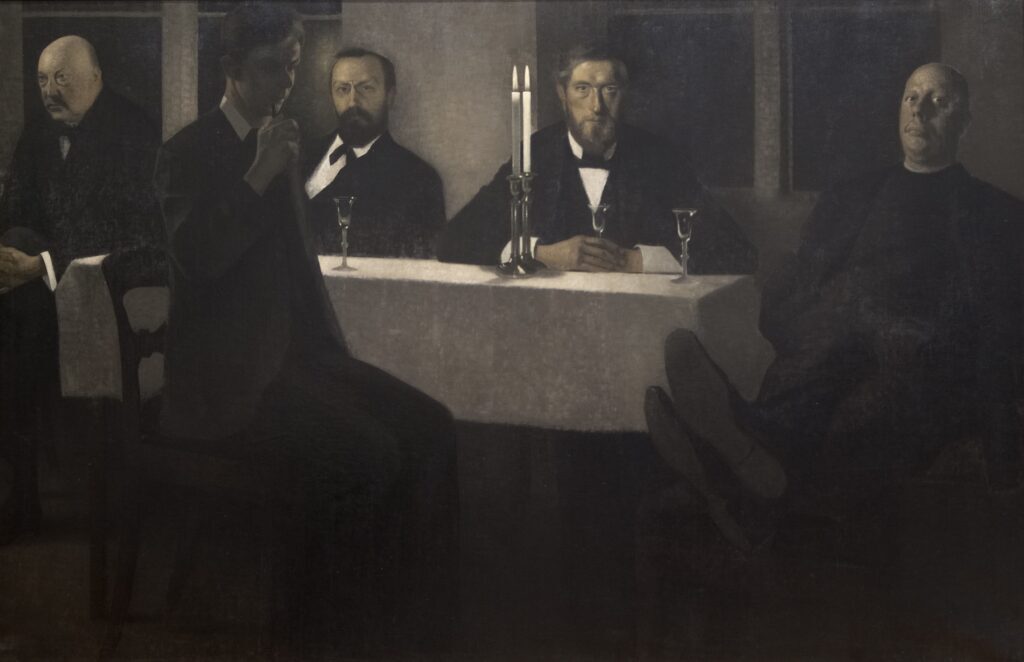
Vilhelm Hammershøi, Five Portraits, 1901, Thiel Gallery, Stockholm, Sweden.
The group portrait of five friends (including two painters, an architect, an art historian, and Hammershøi’s brother, Sven) maintains that same separation, but in the context of a dinner table. It seems oddly reminiscent of the Last Supper, but without a familiar narrative to help us read the scene. A meal without food, a social gathering without any sociability. It is especially stark when contrasted with the camaraderie and collectivity of near-contemporary works by Skagen artists.
The center of the work is in fact the two candles, their flames solidly intense, rather than any of the men. The strongly highlighted patches of white cloth create a distorting abstraction, so that we see objects and spaces before we see people. The viewer is given physical likenesses but a sense that the inner thoughts and emotions of these figures must remain in the shadows, and that, despite their friendship, each individual’s personal life remains closed off.
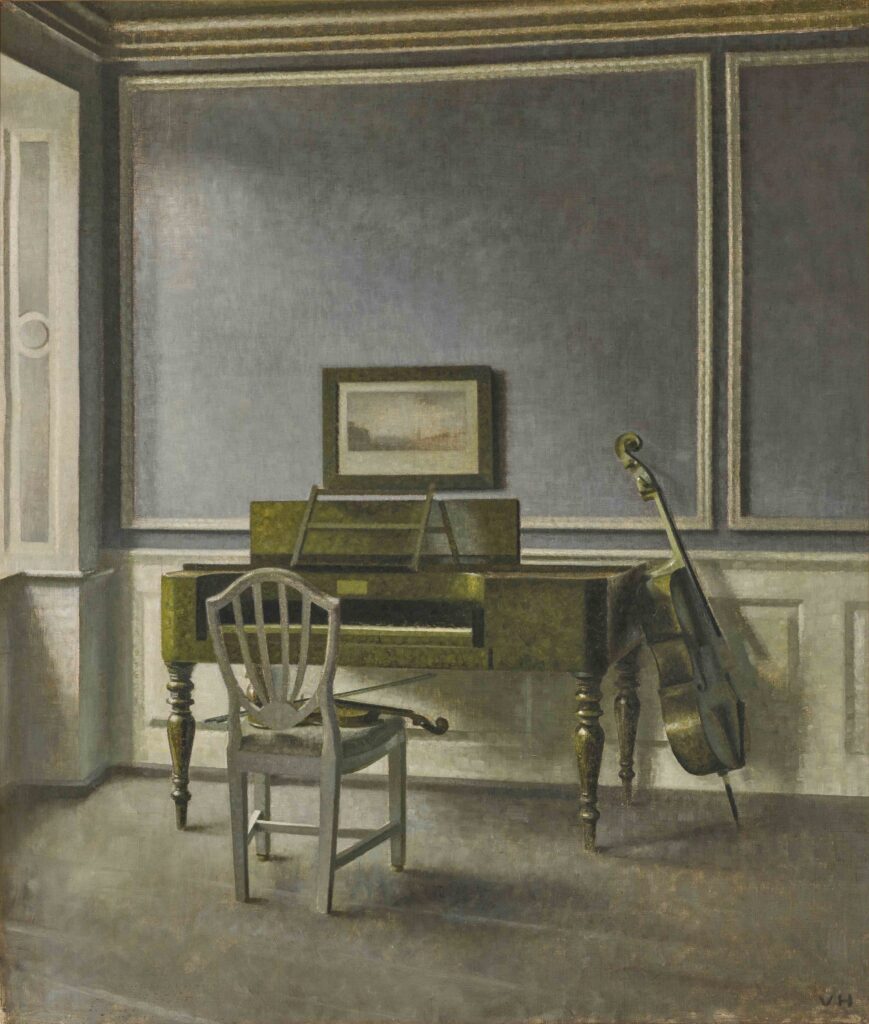
Vilhelm Hammershøi, Interior. The Music Room, Strandgade 30, 1907, Art Institute of Chicago, Chicago, IL, USA.
The gentle softness of Hammershøi’s work makes it difficult to appreciate the contemporary view that he was radical. However, in 1885, Portrait of a Young Woman (The Artist’s Sister Anna Hammershøi) failed to gain an Academy distinction, prompting protests. And three years later, his works, including Young Girl Sewing, were rejected by the Copenhagen Salon. From then on, Hammershøi was a leading member of the Danish avant-garde.
Wivel starts Vilhelm Hammershoi—Painting as Poetry with a reference to Joris-Karl Huysmans’ À rebours, the bible of fin de siecle decadence. It seems an odd choice: Hammershøi’s stark, elegiac minimalism seems the very opposite of the excess and emotionality which the term decadence conjures. However, Wivel’s argument compellingly situates Hammershøi at the cutting edge of 1890s art. He is a world-creator, hermetically sealing and manipulating his interiors and the objectified figures within them, to produce works of emotional weight and metaphysical meaning. Both Huysmans’ protagonist and Hammershøi were escaping reality.
Equally, Hammershøi’s empathy with Whistler’s aestheticism is explored. They never met, although the Dane tried to engineer an encounter. Limited tonality, flattened picture space, and interest in Japanese design were shared by both men. More importantly, they both approached painting as pictorial music, reducing narrative and subject in favor of mood-creation. Many of Hammershøi’s interiors involve implicit creativity: musical instruments, sewing, imagination-generating reading, and, on several occasions, his own easel.
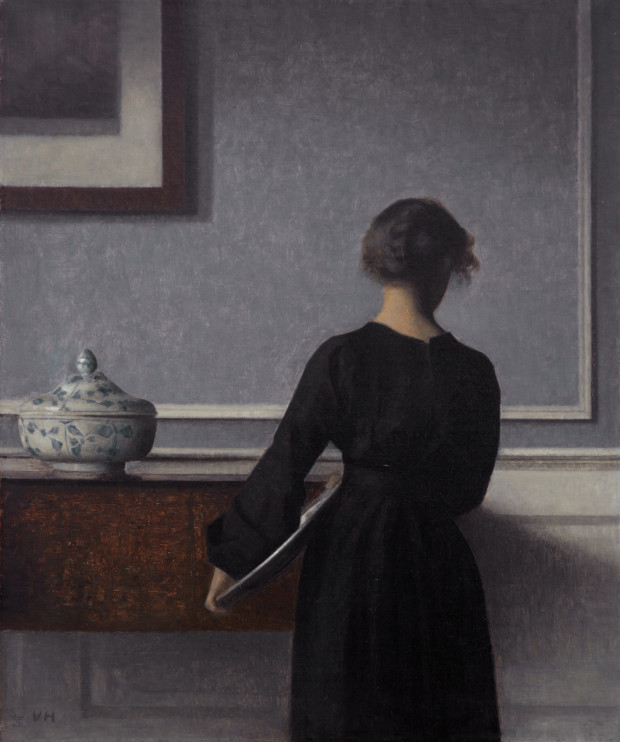
Vilhelm Hammershøi, Interior with Young Woman Seen from the Back, 1904, Randers Museum of Art, Randers, Denmark.
Following a thematic structure, the large central section of Painting as Poetry deals with Vilhelm Hammershøi’s interiors, which represent not only the majority of his work, but the paintings for which he was, and is, most famous. The interiors were deeply personal, belonging to the series of apartments in which he and Ida lived, and also highly constructed. In effect, Hammershøi treated his home as a stage set for his paintings, moving furniture and objects as required and posing his wife in a succession of anonymous, back-viewed roles. His interiors are often compared to those of Johannes Vermeer with their posed serenity, but Hammershøi’s works have none of the narrative drive. As Wivel puts it, we are caught between “a yearning for eternity and an acute sense of transience.” Uncertainty is everywhere.
There is deliberately little reference to an external world. Windows, mostly off-canvas, create gentle diffuse light. Doors open onto other rooms, often in complex arrangements that create a dreamlike sense of being unable to escape. Walls, as in Interior with Young Woman Seen from the Back, create claustrophobic barriers. Interior of Courtyard, Strandgade 30, takes this to an almost surreal extreme. We seem suspended in a hall of mirrors from which there is no way out, no ground, no sky, little sense even of what is up and down. Glass reflects opaquely. An open window across the courtyard hints at unresolved action.
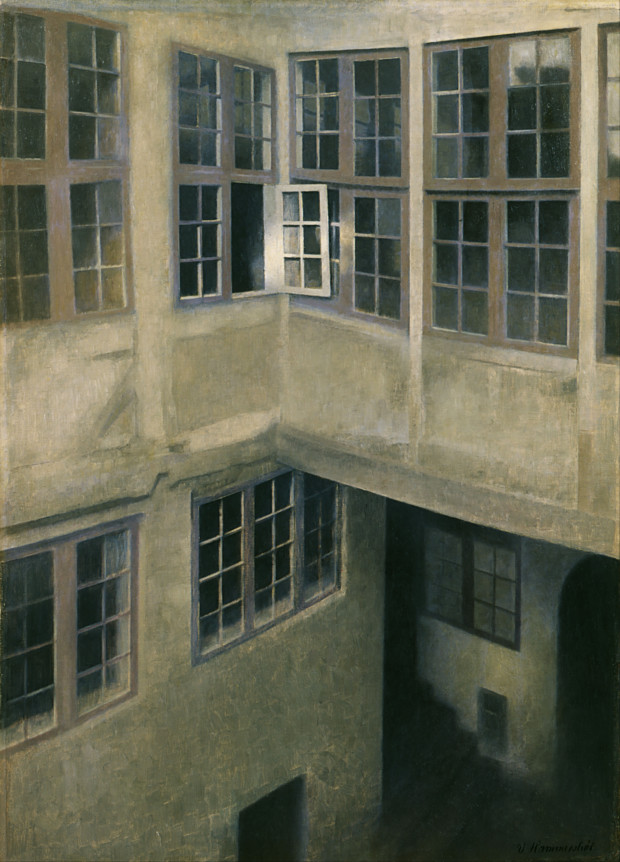
Vilhelm Hammershøi, Interior of Courtyard, Strandgade 30, 1899, Toledo Museum of Art, Toledo, OH, USA.
In a 1907 interview, Hammershøi summed up the requirements of painting: fewer colors, line, and light. Certainly, his work seems characterized by an almost monochromatic palette, but, as is often the case with Hammershøi, this is an oversimplification. He underpainted in red to create an inner warmth, and created his greys from a complex range of colors: Wivel describes “ivory white, red-brown, violet, cold blue, dusty green, ash, soot-black, and gold.”
Line is everywhere, creating what Hammershøi described as “the architectural stance of the picture.” He styled his homes and sought out subjects—cityscapes, masted ships, flat countryside, and straight roads—which could achieve that linearity. By dividing the picture space into verticals and horizontals, Hammershøi created a flattening effect, but also placed an emphasis on the space between the lines, reinforcing the isolation of individual objects. Wivel links this not just to the fashion for Japanese art, but more interestingly to the Buddhist concept of Ma (interval). There is a solidity to the space in Hammershøi’s work. It has purpose, presence, and meaning.
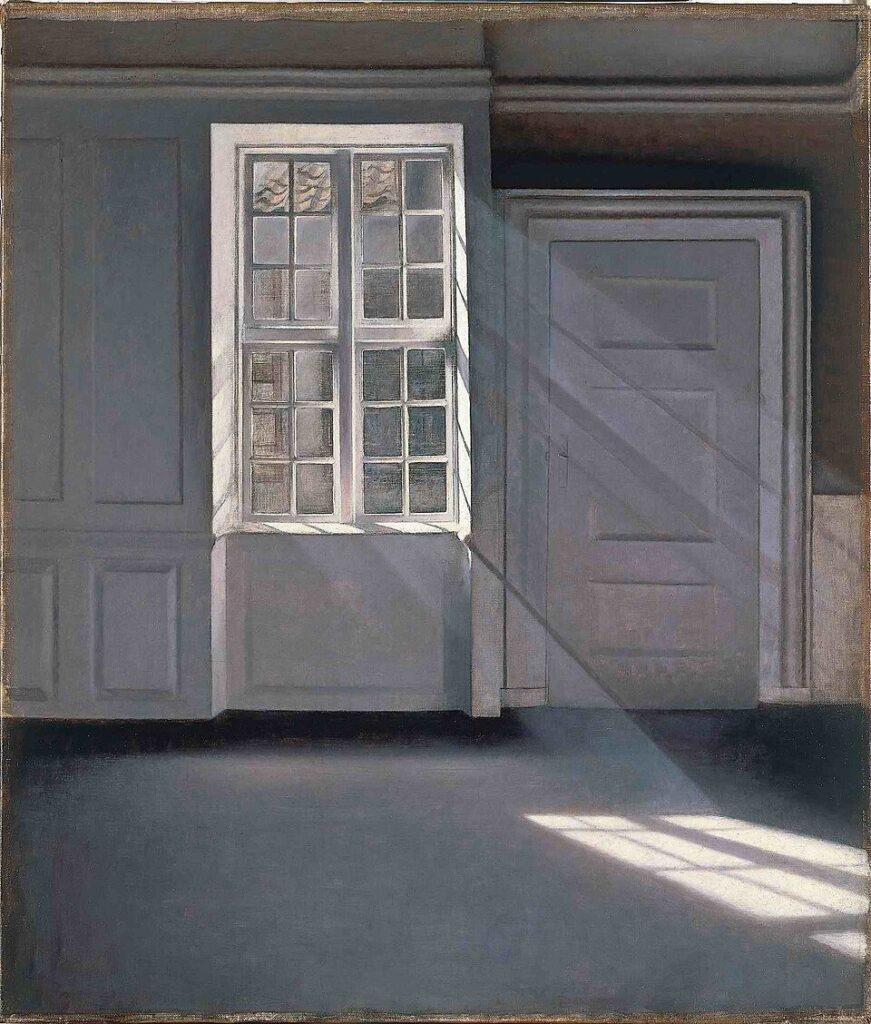
Vilhelm Hammershøi, Sunbeams or Sunlight. Dust Motes Dancing in the Sunbeams. Strandgade 30, 1900, Ordrupgaard, Copenhagen, Denmark.
The third necessity of painting was light, but again, it is elusive. Despite occasionally using candlelight or daylight coming through windows, Hammershøi rarely depicts a light source. Even in his landscapes, the sun is usually obscured behind overcast skies. Light is always present, however, creating shadows and reflections, contouring form, and most importantly, forming a tangible atmosphere. Through barely visible brushwork, Hammershøi manufactures a slight haze, an almost audible buzz which both softens and enlivens everything within the paintings.
Sunbeams or Sunlight is a rare exception, partly because of its poetic title, not chosen by the artist, mainly because light itself is the subject. Rather as Anna Ancher would do with strong colors and visible brushwork, Hammershøi here, albeit more subtly, puts light center-stage. The room is neither empty, still, nor mournful because of the sun.
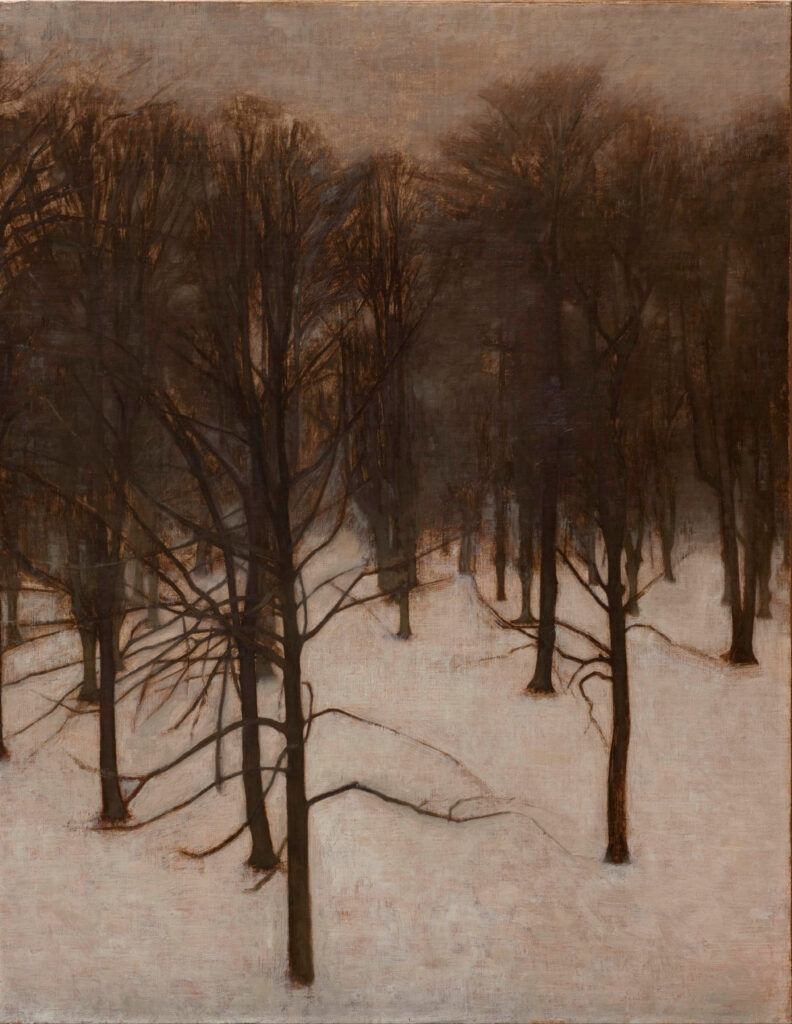
Vilhelm Hammershøi, Søndermarken Park in Winter, 1895–1896, Hirschsprung Collection, Copenhagen, Denmark
The dominance of interiors in Hammershøi’s work creates a false impression of a man who rarely left the confines of his apartment. In fact, he travelled widely and painted a significant number of landscapes and cityscapes. Some, like Søndermarken Park in Winter, were clearly painted from the inside—the high viewpoint suggests the artist is at an upper-storey window. Others exploited photography. Vilhelm Hammershøi—Painting as Poetry contrasts a photograph of Christians Kirke, probably taken by the artist himself, with his painting of the same subject, identical apart from the removal of people. His rural landscapes, some of his most innovative works, were based on plein air sketches, but these were heavily reworked in the studio.
Emptiness and stasis are the constants in all these scenes. The public park is silent and still. Boats sit with bare masts, hemmed in by docks as if they will never be able to set sail. On a trip to London, Hammershøi painted Montague Street, described by his wife in a letter as “a very lively thoroughfare… where many carriages pass by.” His painting is completely empty. Occasionally, in rural works like Landscape, from Lejre, life and movement creep in, both in increased color and in the presence of clouds.
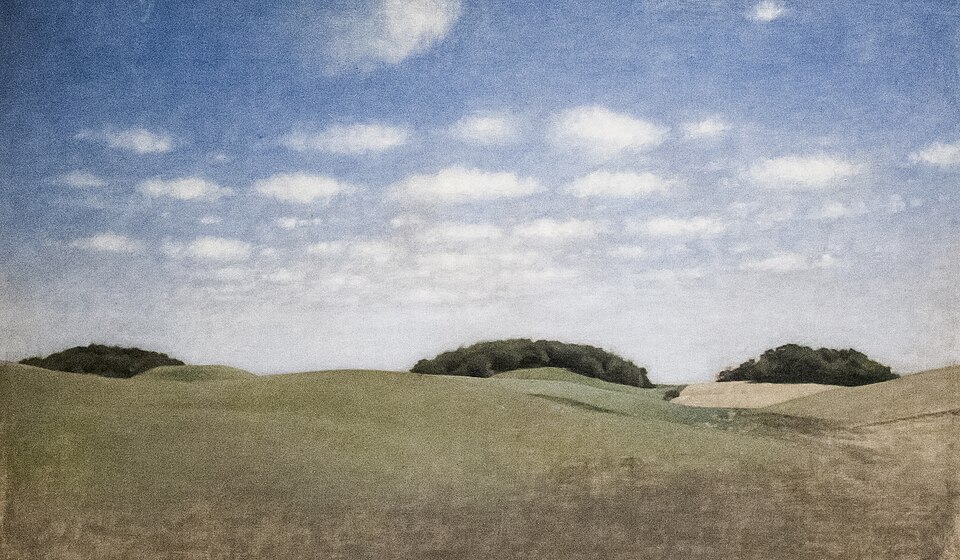
Vilhelm Hammershøi, Landscape, from Lejre, 1905, Nationalmuseum, Stockholm, Sweden.
Henrik Wivel has a lifetime of research on Vilhelm Hammershøi and his contemporaries, and it shows. Painting as Poetry is a definitive work, nearly 300 pages, not just covering the artist’s career but situating him in a world of European symbolism and the 1900s avant-garde, which includes writers like Henrik Ibsen and artists like Edvard Munch. You can delve deep into this intellectual milieu, or you can revel in the beautiful illustrations. The text remains highly accessible, and there is an excellent index, bibliography, and biographical timeline. Most importantly, however, the book opens Hammershøi up as a painter of more than evocative interiors. The more you look and read, the more you want to know.
Vilhelm Hammershøi—Painting as Poetry, by Henrik Wivel, is published by Strandberg Publishing and distributed internationally by Thames & Hudson.
Hammershøi, The Eye That Listens is at Thyssen-Bornemisza Museum, Madrid, Spain, until May 31, 2026, and travels to Kunsthaus Zürich, Switzerland, July 3–October 25, 2026, and the Art Institute of Chicago in 2027.
Get your daily dose of art
Click and follow us on Google News to stay updated all the time

DailyArt Magazine needs your support. Every contribution, however big or small, is very valuable for our future. Thanks to it, we will be able to sustain and grow the Magazine. Thank you for your help!

Catriona Miller is an art historian and freelance writer on art. Having studied at Oxford and St Andrews, she is currently researching issues of nationalism and identity in British landscape painting. She has taught art history and lectures on art history and art appreciation.

Univ. of New Orleans, Fine Arts and History; Fine Artist, Professional Graphic Designer, Art Historian, Historian, Musician, worked at the New Orleans Museum of Art and MS Museum of Art; learning enthusiast!
Are you a lover of Matisse’s work? You cannot miss the new exhibition Matisse’s Jazz: Rhythms in Color at the Art Institute of Chicago! The show...
Aniela Rybak-Vaganay 23 March 2026
A sumptuous new book takes us on a fascinating tour of domestic house cats in art. Taking in over 200 paintings, sculptures, and popular culture images, Cat is a must-read for feline fans!
Candy Bedworth 12 March 2026
Thomas Gainsborough assembled a veritable army of portraits of “the great and the good” in Georgian Britain. And the new exhibition at the Frick...
MJ Rivera 5 March 2026
Strange Beauties is a once in a generation retrospective on Gwen John, one of the most significant painters of the twentieth century.
Candy Bedworth 9 March 2026