
5 Works by Matisse to See in Chicago This Spring
Are you a lover of Matisse’s work? You cannot miss the new exhibition Matisse’s Jazz: Rhythms in Color at the Art Institute of Chicago! The show...
Aniela Rybak-Vaganay 23 March 2026
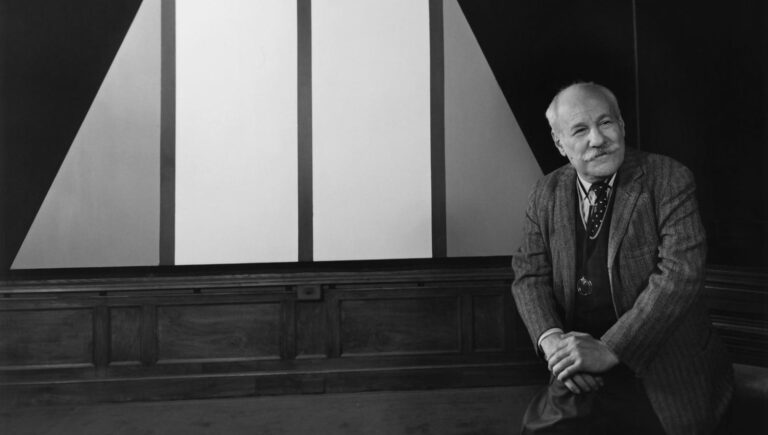
Yousuf Karsh, Barnett Newman, 1969. Artist’s website. Detail.
It is hard to believe, but Amy Newman’s new book, Barnett Newman: Here, is the first extensive biography of the artist (the matching last names are coincidental). The author had access to never-before-published sources, which allowed her to write this carefully researched account. The biographer argues that it was precisely storytelling that played a key role in his life and career.
Barnett Newman was born in 1905 in New York City. He was a son of Jewish immigrants from Poland, an aspect of his life that is key to his biographer. Amy Newman dedicates a significant portion of her book to the painter’s Jewish upbringing. She dives deeply into the Newman family history and their connection with religion.
For instance, Newman places a great deal of importance on the artist’s Bar Mitzvah, one of the most important ceremonies in Judaism: a moment of coming-of-age, when a 13-year-old boy reads from the Torah in front of the whole community for the first time. The writer even suggests that the passage Newman read was so significant for him that it inspired the titles for many of his paintings.
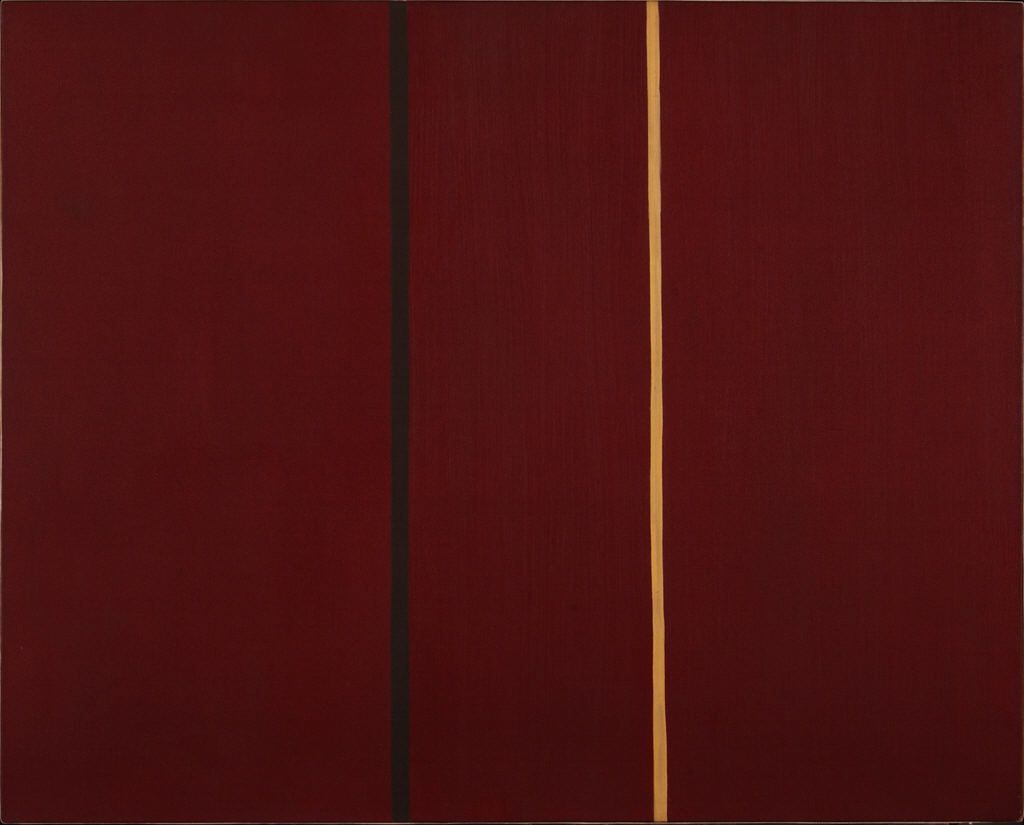
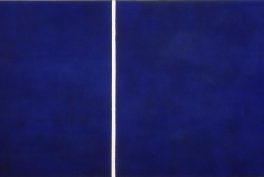
Barnett Newman, Covenant, 1949, Hirshhorn Museum and Sculpture Garden, Washington, DC, USA.
The emphasis on religion provides a fresh, new angle when it comes to interpreting Barnett Newman’s art. Previously, scholars would rather focus on discussing the philosophical aspects of his work, particularly in relation to the concept of the sublime. I believe Amy Newman brings something new to the scholarship, something that might even inspire other researchers, who will also look at one’s art from an unexpected perspective.
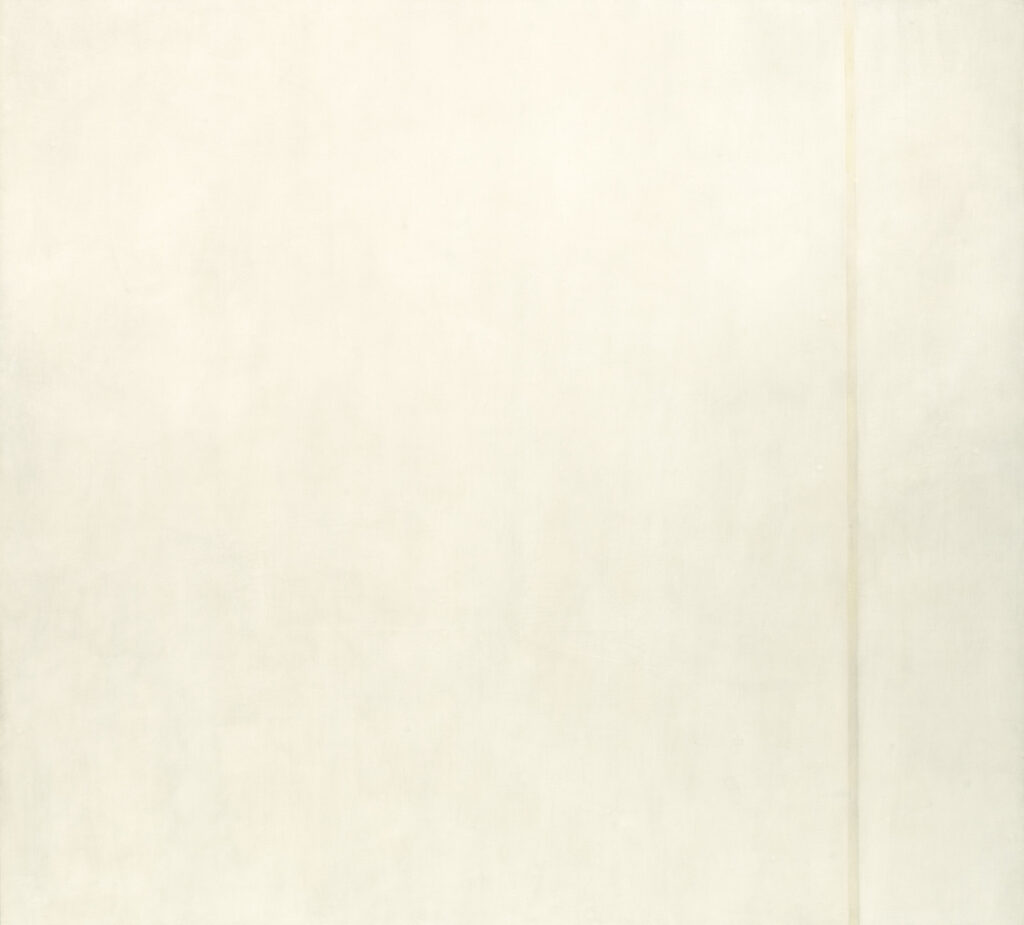
Barnett Newman, The Voice, 1950, Museum of Modern Art, New York City, NY, USA.
In the introduction, Amy Newman sets the tone for the biography by explaining that Newman’s art was inherently connected with his identity.
Everything about those paintings—the way they could be discussed, described, handled, and sold—and especially the man who made them, was to be expertly fit, sometimes shoe-horned to his specifications.
Barnett Newman: Here
The biographer encourages us to look at Newman’s art with his identity in mind. She challenges the purist look of abstract art. Where other scholars would encourage us to look solely at the shape and form, Amy Newman is telling the reader to look deeper into the painter’s life to understand his work. In this way, she places him in the tradition of artists such as Andy Warhol or Joseph Kosuth, for whom the myth of their person sometimes preceded their artistic practice.
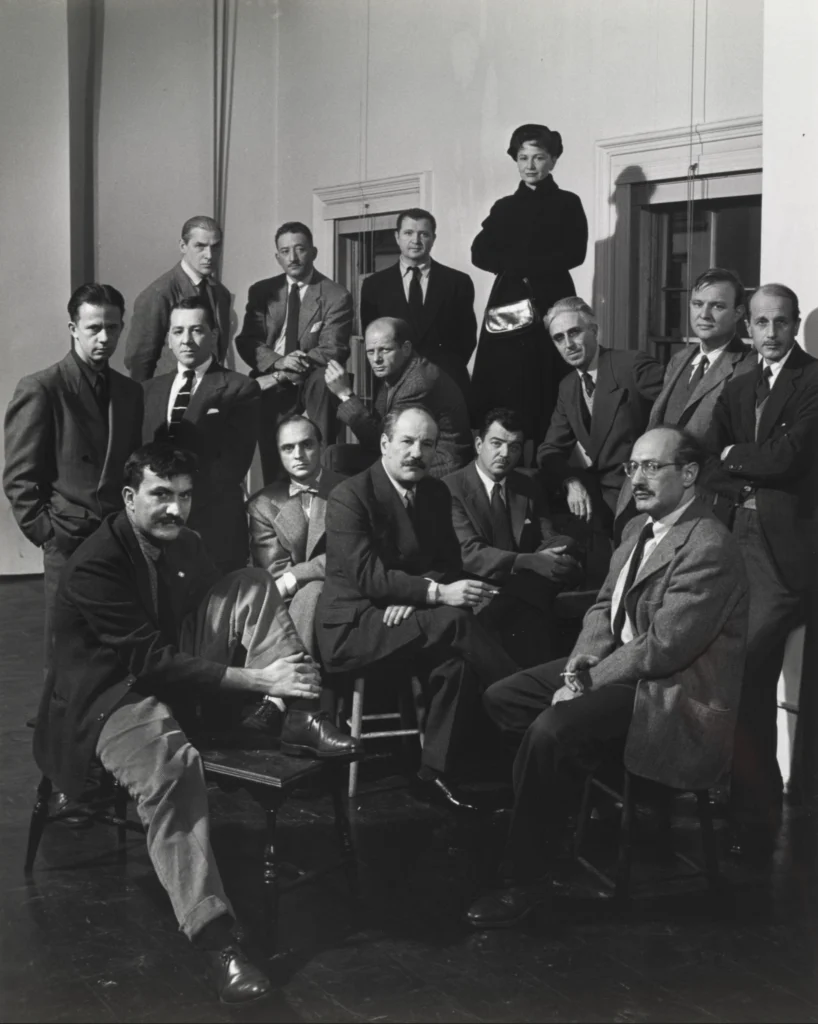
Nina Leen, The Irascibles, 1950. Hedda Sterne Foundation.
This results in numerous fascinating stories, such as the one of the Irascibles. In 1950, Nina Lee took one of the most iconic photographs connected to the history of American art, which was published in Life magazine. In the picture, we see 15 artists (unsurprisingly, only one woman—Hedda Sterne). We can spot, for example, Jackson Pollock sulking, Mark Rothko in his clear glasses, and serious Willem de Kooning. However, we cannot avoid noticing the one prominent figure in the center—Barnett Newman. There is no doubt who is the star of the show. As the biographer notes:
Only Barney seems unaffected by the stress of the photo shoot. He is completely poised, relaxed yet imposing, his face perfectly bisected by shadow, his beautiful hand, as always, holding a cigarette, artfully lit and in dramatic relief against his dark suit. He is not simply at the center of the photograph; he is the physical and psychological weight in an intentionally dissonant ensemble.
Barnett Newman: Here
Why were these artists photographed in the first place? Editors at Life wanted to publish the story about the painters protesting against an exhibition titled American Painting Today—1950 that was to be organized at the Metropolitan Museum of Art. The painters did not agree with the museum’s selection of modern painting; they found it too conservative. To bring the matter into the public eye, they published an open letter in The New York Times. The media coverage not only brought awareness to the problem but, more importantly, made the Abstract Expressionist movement more popular.
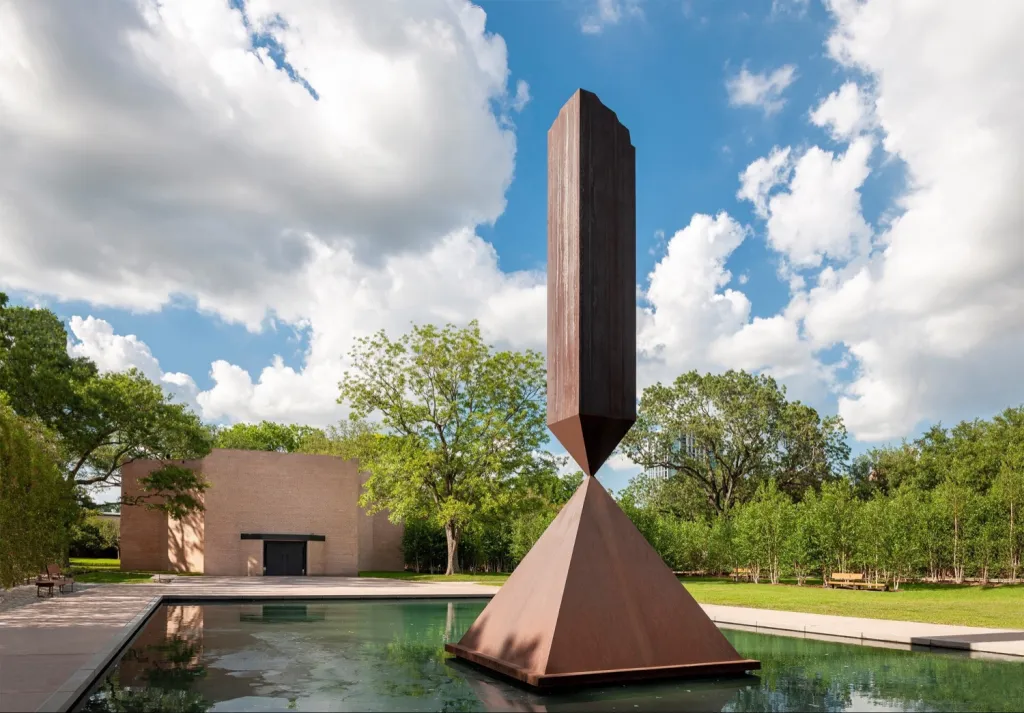
Barnett Newman, Broken Obelisk, 1963–1967, Rothko Chapel, Houston, TX, USA. ArtNews.
Amy Newman’s biography is definitely an important cornerstone in the scholarship on Barnett Newman. What is more, her own research might be only the beginning of a new study on the artist. If you love abstract painting, the New York art scene of the mid-20th century, and great stories that shaped the Abstract Expressionist movement, this book is for you!
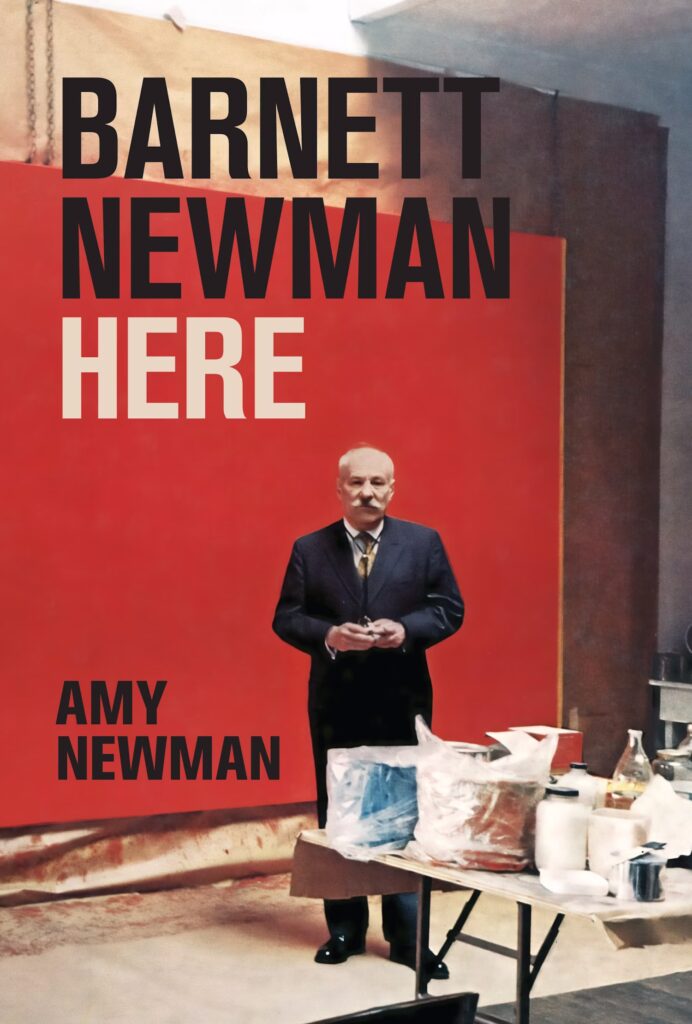
Book cover of Amy Newmann, Barnett Newman: Here, 2025, Princeton University Press. Publisher’s website.
Barnett Newman: Here was published by Princeton University Press in October 2025 and is available through the publisher’s website.
Get your daily dose of art
Click and follow us on Google News to stay updated all the time

DailyArt Magazine needs your support. Every contribution, however big or small, is very valuable for our future. Thanks to it, we will be able to sustain and grow the Magazine. Thank you for your help!

Art historian living in Chicago. Passionate about women artists and abstract art.

As an educator, writer, and neurodivergent creative, I enjoy learning and sharing through nature, the arts and novel experiences.
Are you a lover of Matisse’s work? You cannot miss the new exhibition Matisse’s Jazz: Rhythms in Color at the Art Institute of Chicago! The show...
Aniela Rybak-Vaganay 23 March 2026
A sumptuous new book takes us on a fascinating tour of domestic house cats in art. Taking in over 200 paintings, sculptures, and popular culture images, Cat is a must-read for feline fans!
Candy Bedworth 12 March 2026
Thomas Gainsborough assembled a veritable army of portraits of “the great and the good” in Georgian Britain. And the new exhibition at the Frick...
MJ Rivera 5 March 2026
Strange Beauties is a once in a generation retrospective on Gwen John, one of the most significant painters of the twentieth century.
Candy Bedworth 9 March 2026