

Józef Chełmoński in 10 Paintings: Capturing the Spirit of Rural Life
Józef Chełmoński masterfully portrayed life in the Polish countryside. His paintings reveal a subtle connection between human and nature,...
Kinga Dobosz 8 October 2026
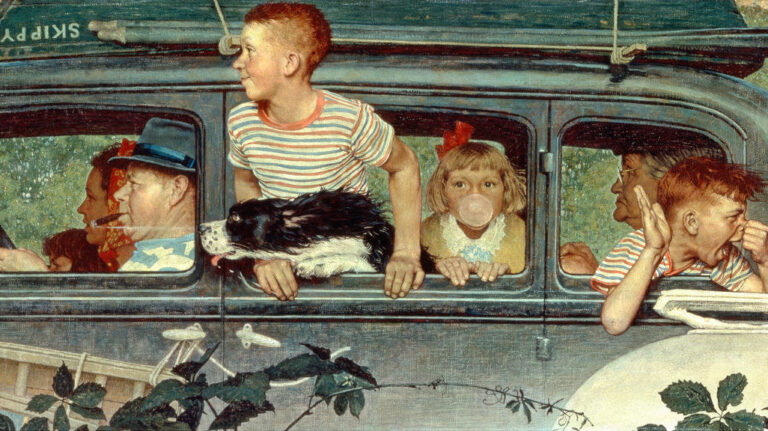
Norman Rockwell, Coming and Going, 1947, Norman Rockwell Museum, Stockbridge, MA, USA, Detail.
Norman Rockwell’s illustrations helped define a shared American identity in the 20th century. His prolific career spanned two world wars, the Civil Rights Movement, the tumult of the 1960s, and the Vietnam War. Through it all, he painted an aspirational America that portrayed a common humanity.
His success as an illustrator, his exemplary attention to craft and detail, and his narrative style led to his denigration by a post-war fine art world fleeing representational art in favor of abstraction and conceptual work. However, his powerful work endures. Rockwell’s illustrations are undoubtedly among the most recognizable and important works in American culture.
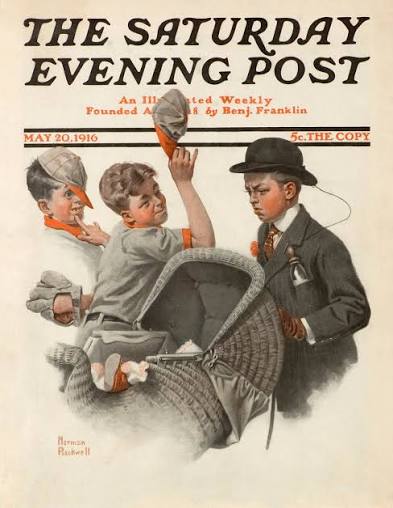
Norman Rockwell, Boy with a Baby Carriage, 1916, Norman Rockwell Museum, Stockbridge, MA, USA.
When he was 22, Norman Rockwell’s illustration Boy With a Baby Carriage landed on the cover of The Saturday Evening Post‘s May 20, 1916, issue. At the time, J.C. Leyendecker, Rockwell’s hero, had produced over 40 covers for the magazine. In his autobiography, Rockwell admitted emulating him not only as an illustrator, but in his mannerisms and walk. Both illustrators produced over 320 covers for the magazine.
Rockwell was a product of the Golden Age of Illustration, a period bridging the 19th and 20th centuries, when advances in printing technology and an appetite for printed media led to a renaissance in American illustration. While Rockwell caught the tail end of this movement, he carried on the tradition of the artists he admired, like Leyendecker, Howard Pyle, and N.C. Wyeth.
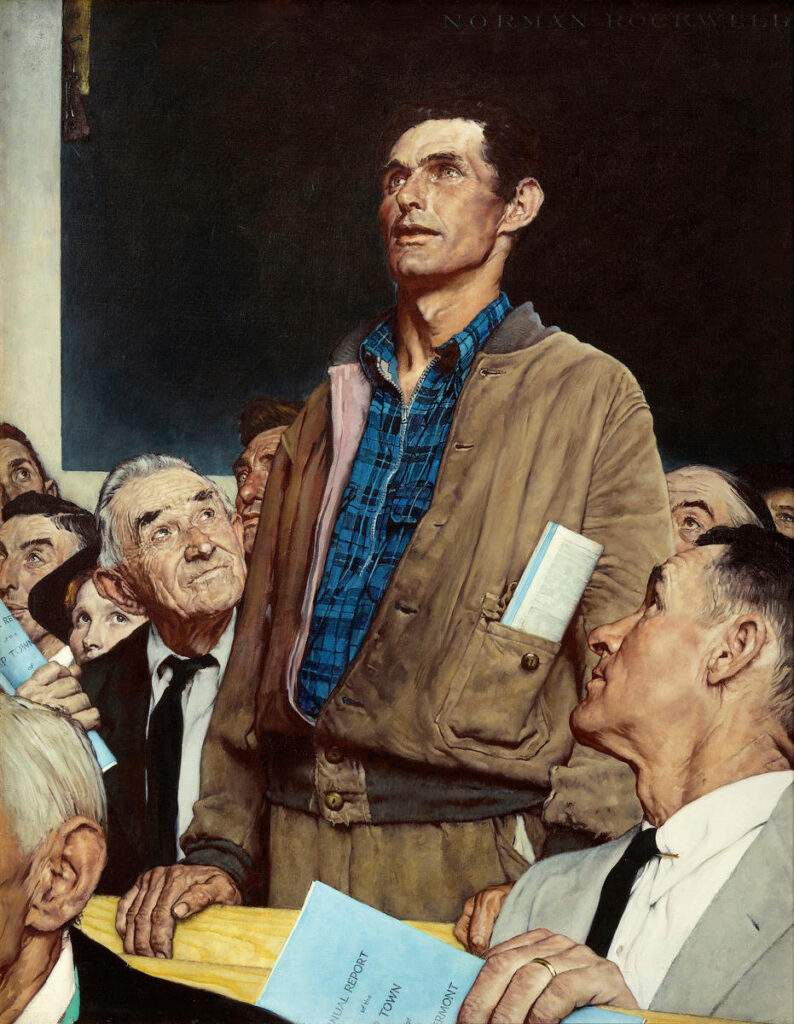
Norman Rockwell, Freedom of Speech, 1943, Norman Rockwell Museum, Stockbridge, MA, USA.
In his 1941 State of the Union speech, President Franklin Delano Roosevelt made the case for US aid to Allied forces in Europe, proclaiming that everyone should be entitled to freedom of speech, freedom of worship, freedom from want, and freedom from fear. Inspired by these stated fundamental rights, Rockwell wanted to illustrate them. For a time, the lofty aspirational nature of the project had him stymied. However, he eventually completed the four thematic paintings, and they ran, one a week, in The Saturday Evening Post in 1943. The US government also used the paintings for a massive war bond campaign.
Stephanie Plunkett, Chief Curator/Rockwell Center Director, said of Freedom of Speech, “That’s the one that gave him the realization that he had to present Roosevelt’s abstract ideals in everyday terms. It actually drew from his own attendance at an actual town meeting in Arlington, Vermont, where they were discussing a real issue, which was a school that burned down, and whether to rebuild it or not.”
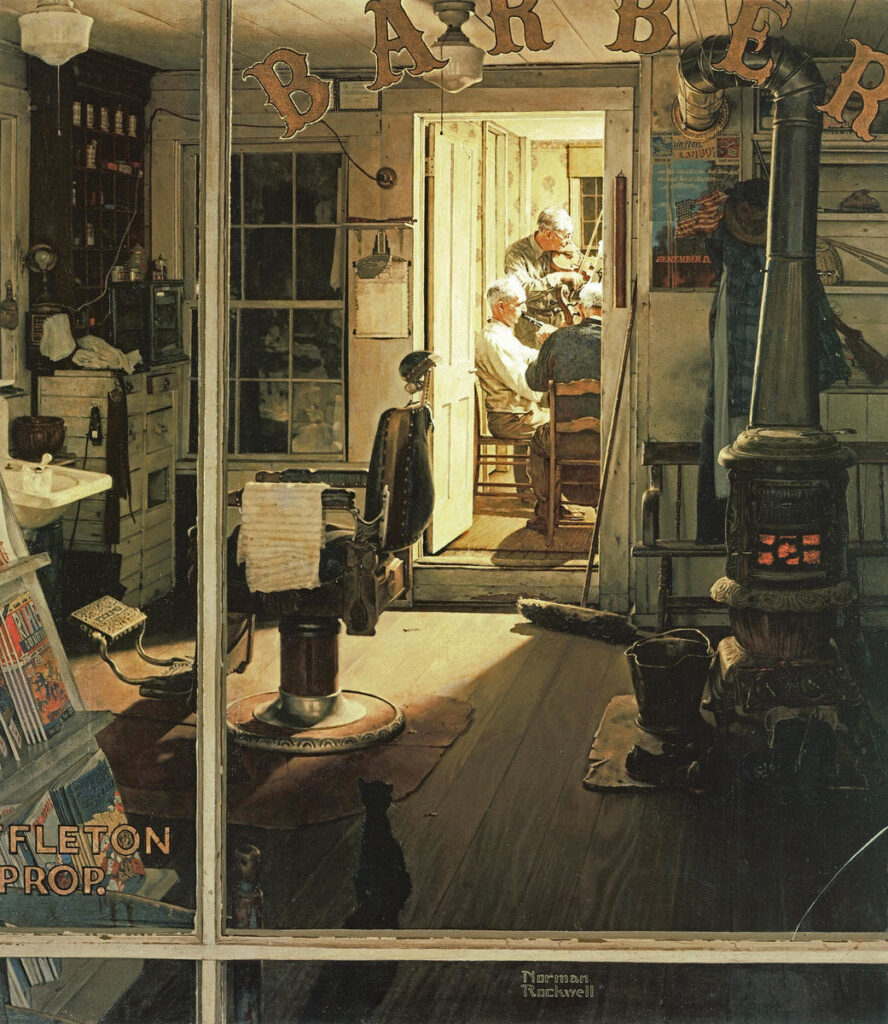
Norman Rockwell, Shuffleton’s Barbershop, 1950, Lucas Museum of Narrative Art, Los Angeles, CA, USA.
Shuffleton’s Barbershop showcases Rockwell’s mastery of detail and technique. Each expertly painted object seen through the storefront window adds to the story of the men shown in the back room as well as the wider community. Shuffleton’s Barbershop was a real place where Rockwell and his sons went to get their hair cut in Arlington, Vermont. The broom in the corner, boots warming by the freestanding stove, comic books, a poster with the American flag, and the cat looking on toward the men in the back room all add up to a well-drawn scene that gives the viewer a strong sense of place and story.
The Lucas Museum of Narrative Art, which “celebrates the power of visual storytelling,” purchased this painting in 2018. George Lucas has long been an admirer of Rockwell’s work. In 2010-2011, the Smithsonian American Art Museum borrowed work from Lucas’s collection to create the exhibit Telling Stories: Norman Rockwell from the Collections of George Lucas and Steven Spielberg. The narrative aspect of this piece is so strong that it inspired a Hallmark movie with the same title as the painting.
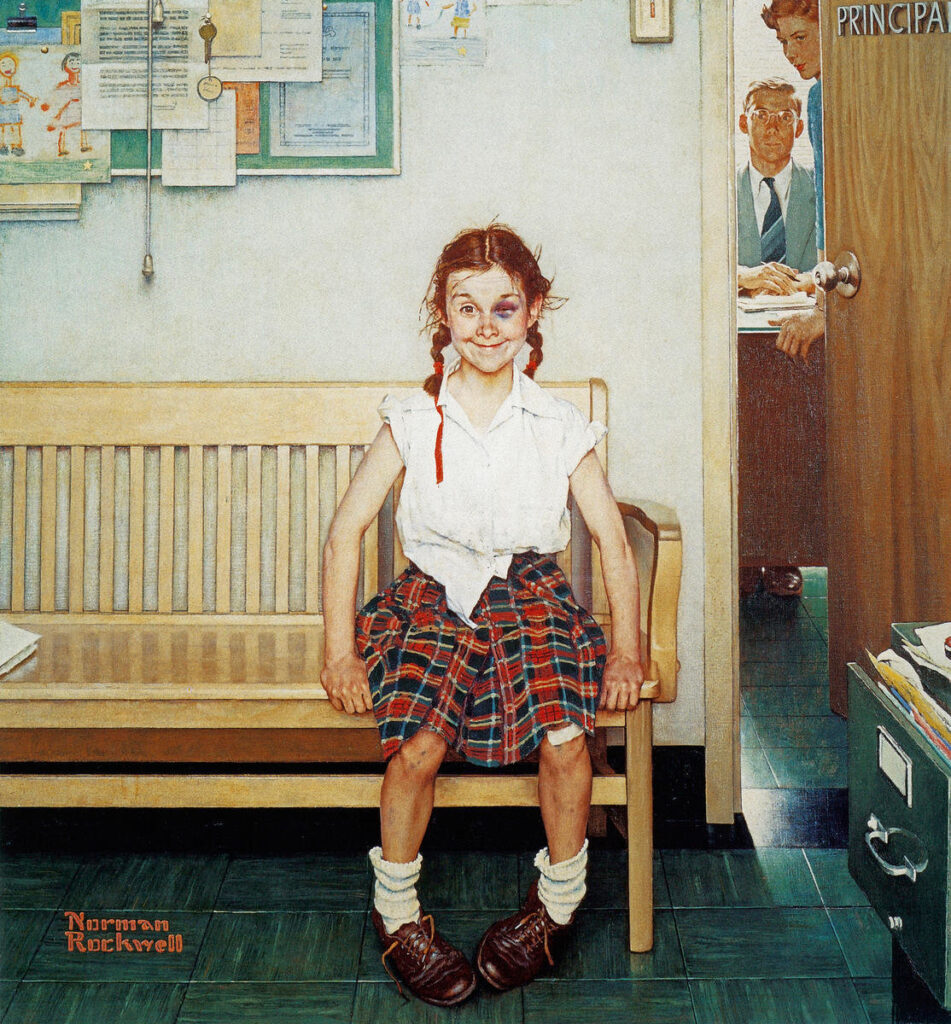
Norman Rockwell, The Young Lady with the Shiner, 1953, Wadsworth Atheneum, Hartford, CT, USA.
Rockwell once said, “The story is the first thing and the last thing.” The Young Lady with the Shiner draws a full story in a single image. The girl’s rumpled clothes, loose shoelaces, bandaged knee, scraggly hair, and black eye contrast with her impish smile. Already, the viewer knows that whatever the adults behind her plan to say, it will be of little impact.
Again, Rockwell uses details like the institutional linoleum tiles, austere “PRINCIPAL” sign in relief, and the bulletin board of certificates and student artwork to draw out a rich setting.
A local child, Mary Whalen, modeled for the painting. Dissatisfied with his early renderings of the girl’s bruise, he placed an ad in the local paper to find a model with a fresh bruise, so he could fully capture its multicolored brilliance.
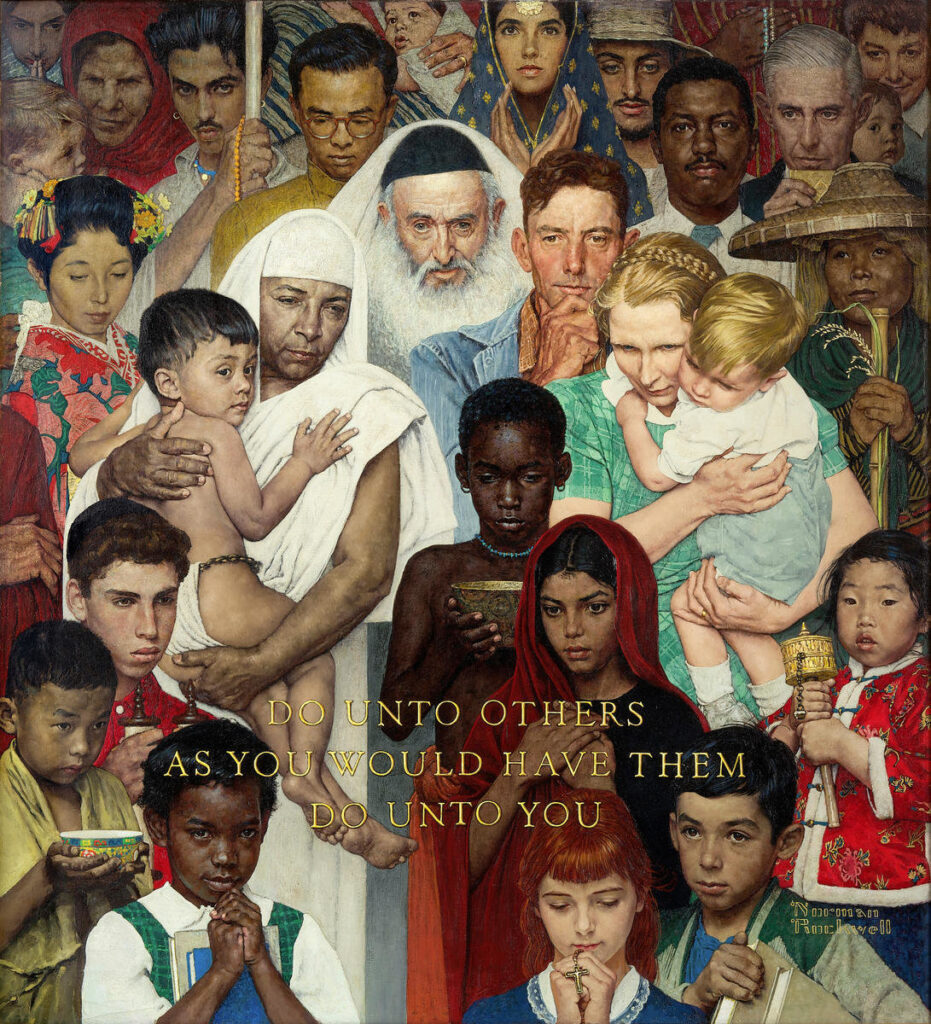
Norman Rockwell, Golden Rule, 1961, Norman Rockwell Museum, Stockbridge, MA, USA.
The Cold War gained momentum in the 1950s as Korea split in two and the Vietnam War heated up. The Soviets launched Sputnik, and the space race was on. In 1959, Fidel Castro took power in Cuba, and in 1960, 17 African countries declared independence from colonial rule. Amidst this reshaping of the world, Rockwell, who had been studying world religions, noticed a commonality across cultures: the Golden Rule.
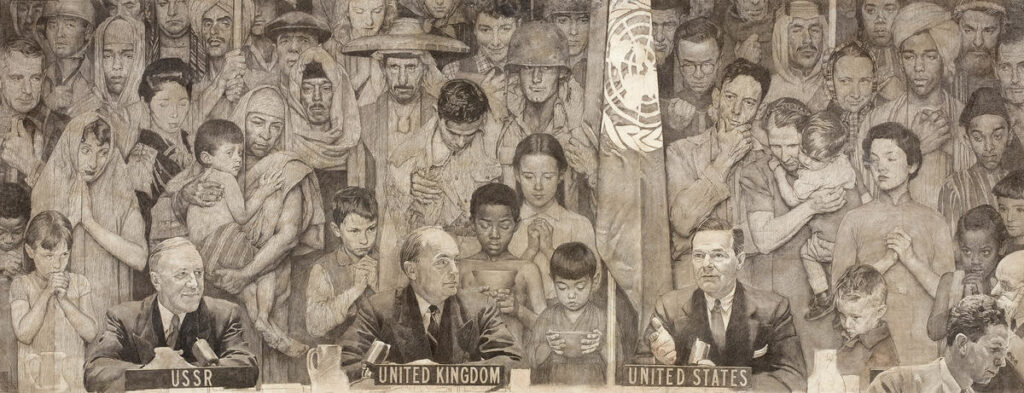
Norman Rockwell, United Nations, 1953, Norman Rockwell Museum, Stockbridge, MA, USA.
Several years earlier, Rockwell had drawn the United Nations with the intent of turning it into a painting. When conceiving of Golden Rule, he returned to this drawing and used several of the figures to compose the new piece. This complex painting served as the cover of the April 1, 1961, issue of The Saturday Evening Post. In 1985, Nancy Reagan presented a mosaic recreation of the illustration to the United Nations.
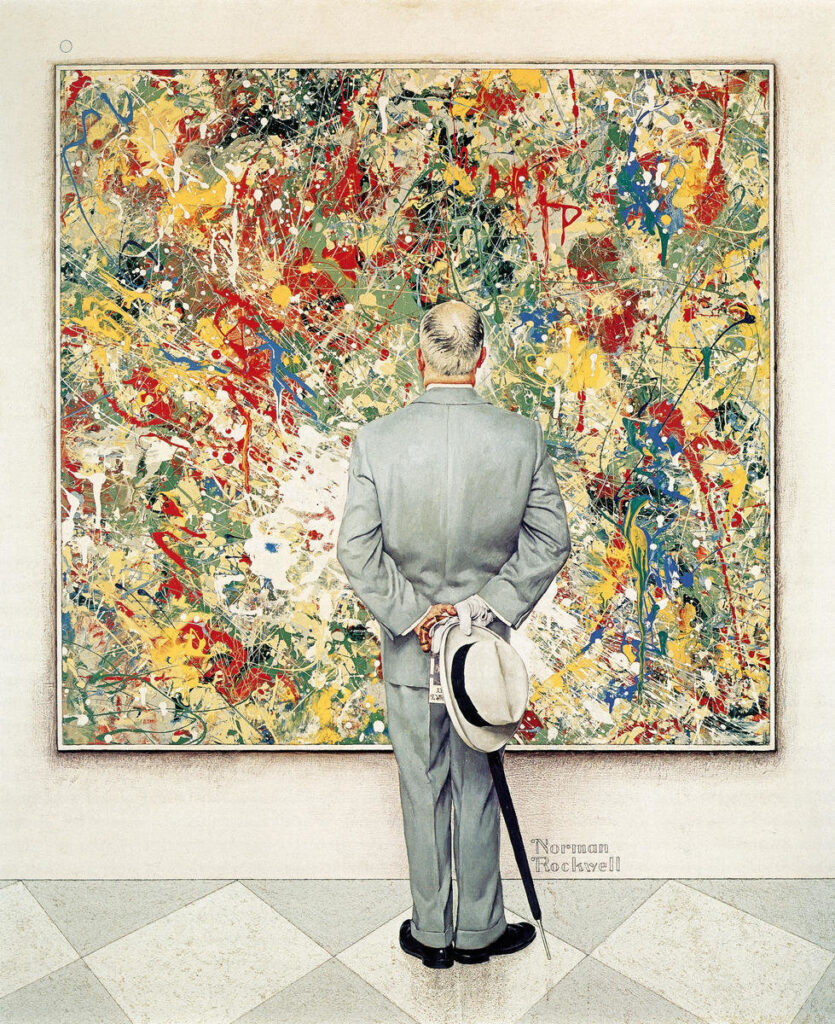
Norman Rockwell, The Connoisseur, 1961, private collection. Norman Rockwell Museum.
The end of World War II marked not only a reshaping of geopolitics, but also a drastic shift in fine art. Rockwell was born from the Golden Age of Illustration and a pedigree of American painters who valued form, a careful study of anatomy and light, and accuracy in their work. The Abstract Expressionists blew this tradition apart, tearing down convention. Behind the scenes, the United States government supported this movement, seeing in it a stark contrast to Socialist Realism.
In The Connoisseur, a conservatively dressed man studies what appears to be a Jackson Pollock action painting. Clearly, Rockwell is pondering his place in a rapidly changing art world. Rockwell himself was fascinated with modern art. He entered a section of this Pollock-like piece into competitions under pseudonyms and won awards from the Cooperstown Art League and the Berkshire Museum.
In 1980, the critic Clement Greenberg said in a Washington Post interview, “You have to put Rockwell down, down below the rank of minor artist. He chose not to be serious.” Rockwell, by simply being the nation’s most famous illustrator, had become the antithesis of postmodernist American art.
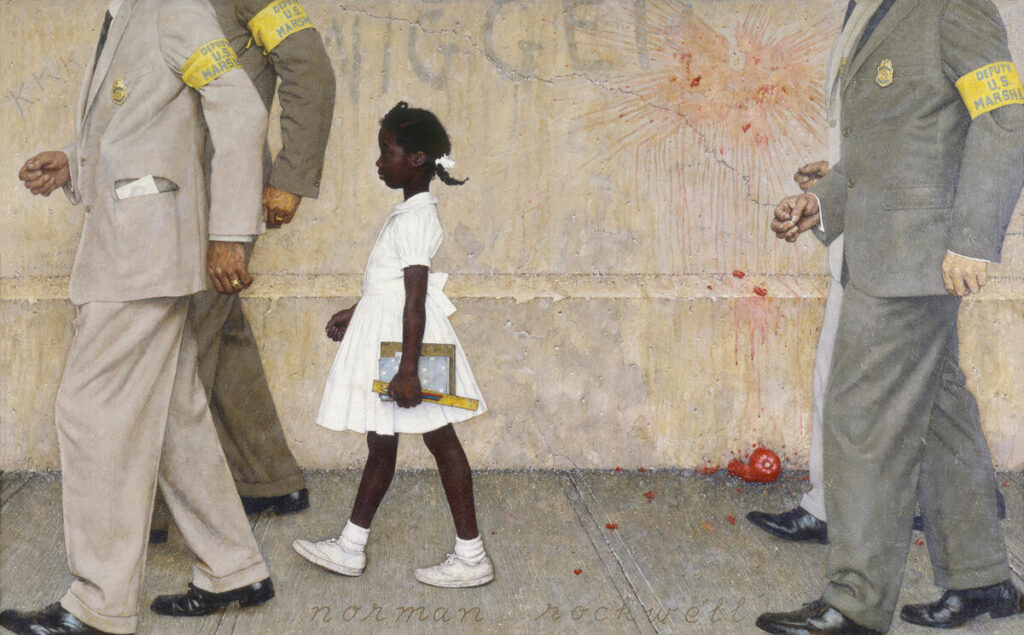
Norman Rockwell, The Problem We All Live With, 1964, Norman Rockwell Museum, Stockbridge, MA, USA.
Perhaps the most iconic painting depicting America grappling with civil rights, this painting refers to Ruby Bridges, a six-year-old girl being ushered to school by U.S. Marshals after the end of school segregation. The Saturday Evening Post limited Rockwell’s content. Illustrators were instructed only to show Black people in service roles. However, Rockwell found more freedom at Look magazine, which published this painting as a two-page spread in January 1964, roughly marking the 10th anniversary of Brown vs. Board of Education and months before the Civil Rights Act was signed into law.
Once elected president, Barack Obama hung The Problem We All Live With in the White House. Standing next to Ruby Bridges while looking at Rockwell’s painting, President Obama said, “I think it’s fair to say that if it hadn’t been for you guys, I might not be here and we wouldn’t be looking at this together.”
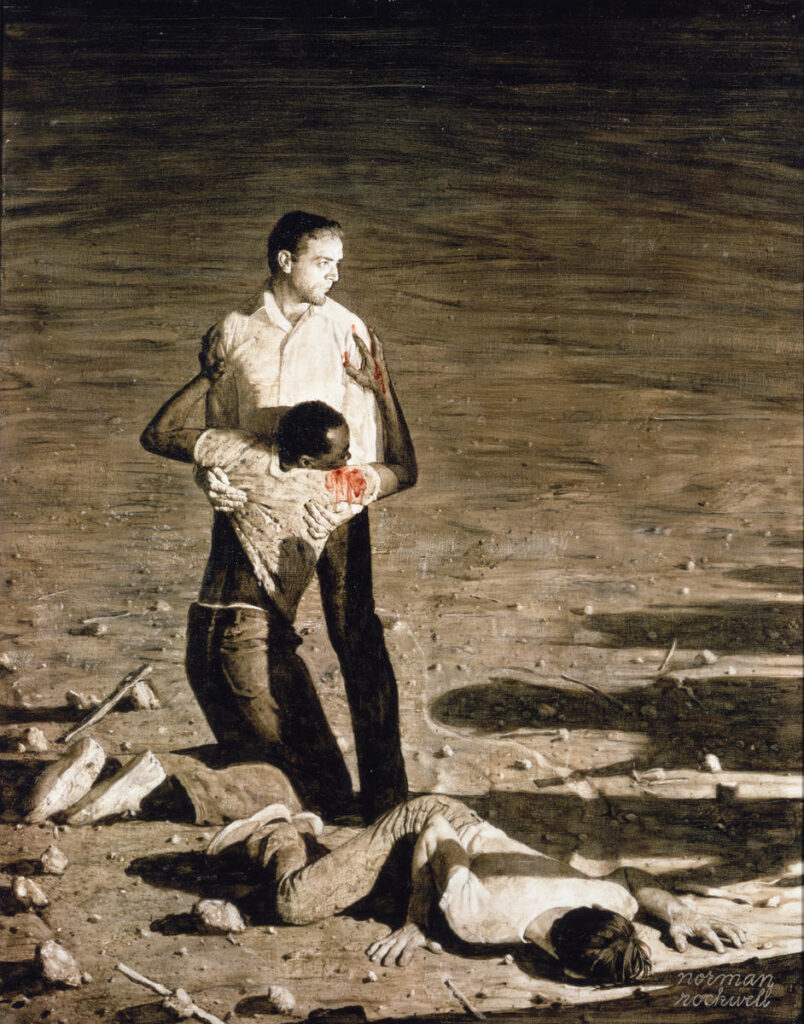
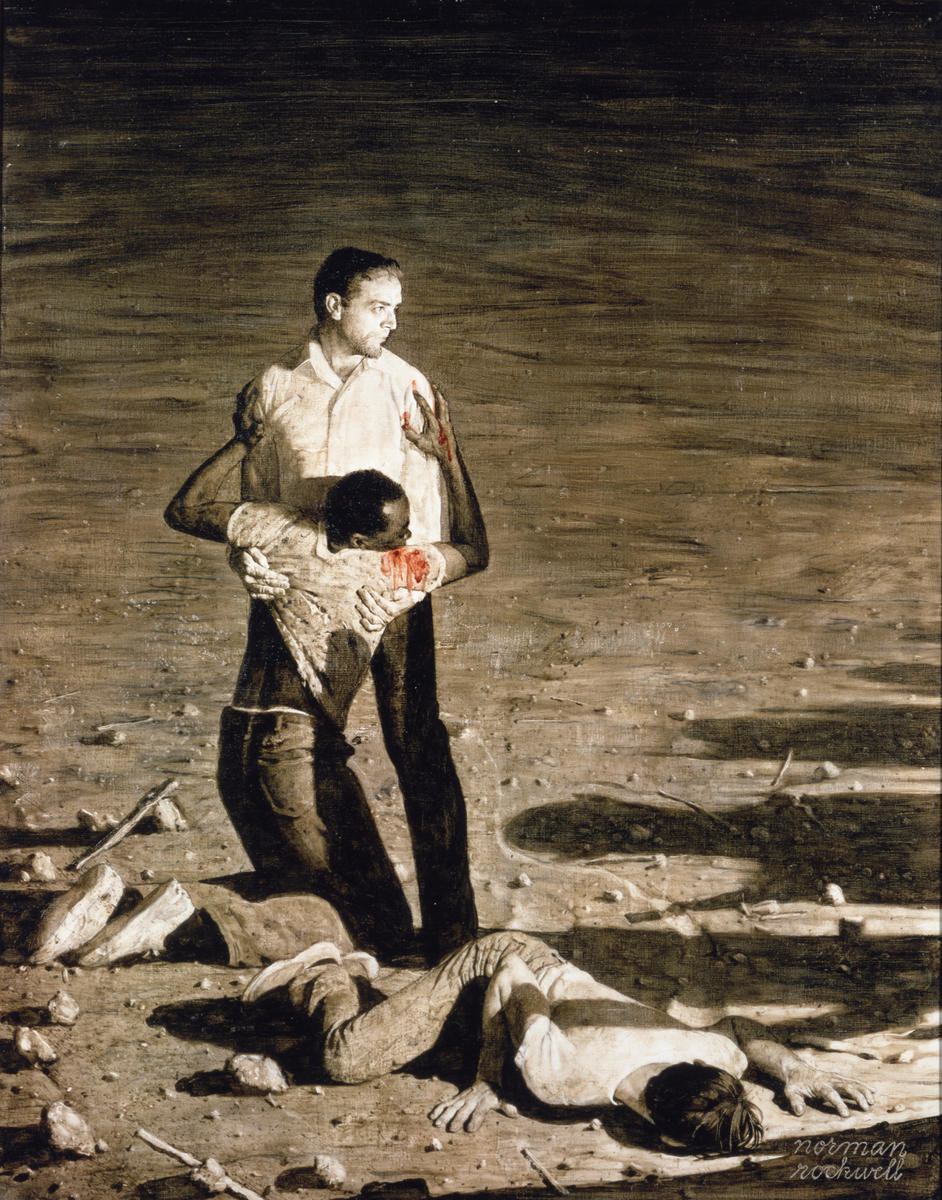
Norman Rockwell, Murder in Mississippi, 1965, Norman Rockwell Museum, Stockbridge, MA, USA. Museum’s website.
While Norman Rockwell’s work for The Saturday Evening Post often showed an idealized white American, his illustrations at Look put him at the crux of the nation’s struggle with racial violence. Murder in Mississippi accompanied a 1965 article about three civil rights activists, James Chaney, Andrew Goodman, and Michael Schwerner, who were murdered by the Ku Klux Klan in Mississippi.
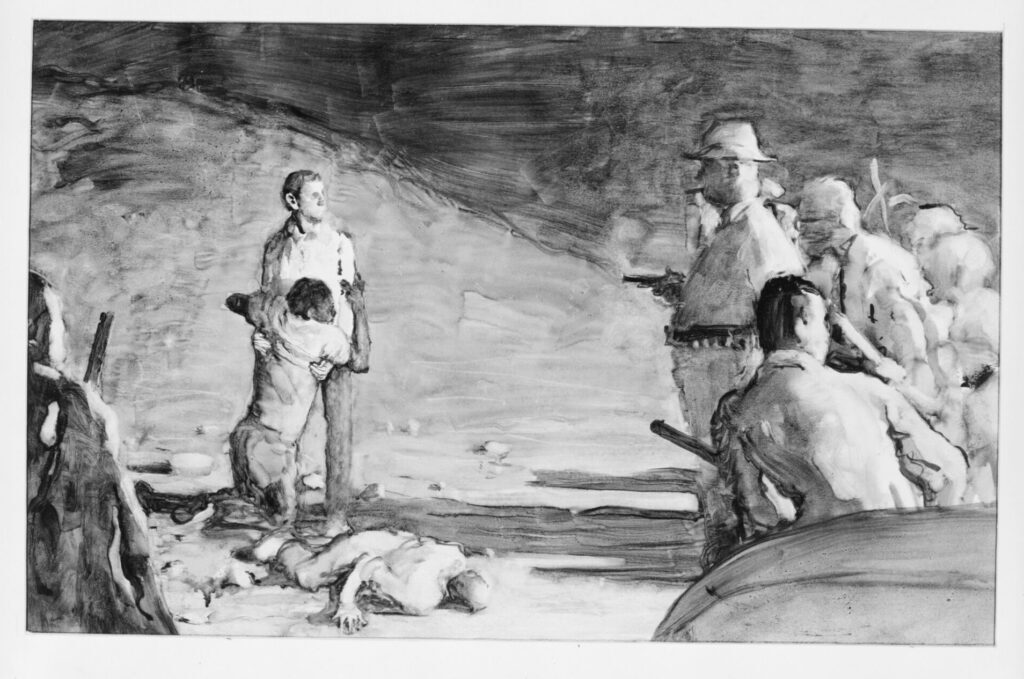
Norman Rockwell, unpublished study for Murder in Mississippi, 1965, Norman Rockwell Museum Archival Collection, Stockbridge, MA, USA. Courtesy of the Museum.
The early studies for the piece included the attacking posse on the right-hand side of the piece. The composition closely followed Francisco Goya’s masterpiece, The Third of May 1808 in Madrid. However, in the final painting, only the mob’s shadows remain, evoking a looming sense of danger. In addition, Look art director Allen Hurlburt decided not to publish Rockwell’s finished painting, but instead a more abstract, rough study. Rockwell understood the decision, stating that in the months it took him to finish the work, “all the anger that was in the sketch had gone out of it.”
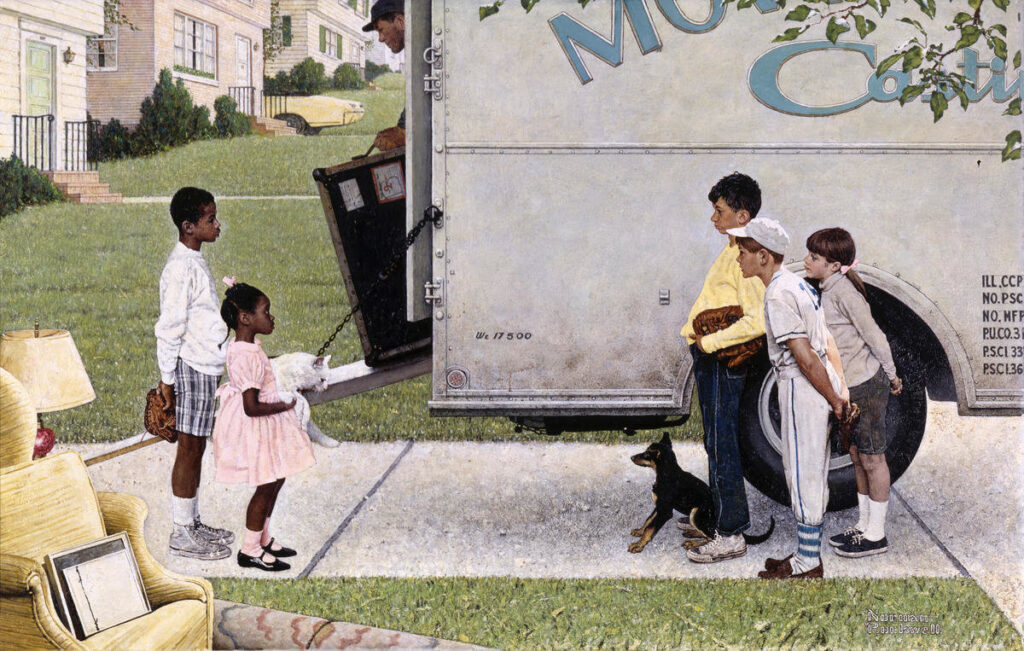
Norman Rockwell, New Kids in the Neighborhood, 1967, Norman Rockwell Museum, Stockbridge, MA, USA.
This illustration appeared in a 1967 issue of Look alongside an article about the integration of American suburbs. Again, Rockwell shows he’s a master storyteller. The image is filled with history, meaning, and anticipation. The composition of the painting, Black kids on one side, the white kids on the other, conjures up the “separate but equal” doctrine that had justified American segregation since 1896. Through their poses, each figure in the painting conveys a natural curiosity innate in all children. The boys’ baseball gear shows a common love of sport, and both groups of kids have their pets with them.
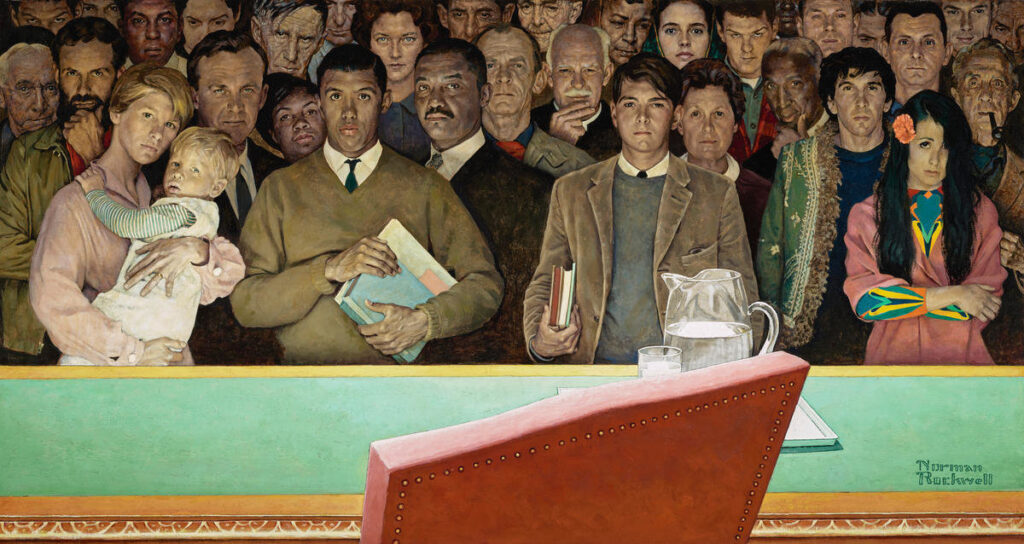
Norman Rockwell, The Right to Know, 1968, private collection. Norman Rockwell Museum.
A veteran of the Navy himself, Rockwell painted through two world wars, though his work mostly focused on the specific humanity of the soldiers, rather than the politics of the war itself. A 1919 cover for Collier’s features his painting Sailor Dreaming of Girlfriend as two sailors look over a photograph of a young woman. During World War II, Rockwell created the fictional character Willie Gillis, an Army private who appeared mostly in scenes on the home front, such as attending church or resting while on leave.
In 1966, the United States government hired Rockwell. He told the New York Times, “The Marines had me down at Quantico. I was supposed to do a poster of a Marine in Vietnam kneeling over to help a wounded villager and love shining in their eyes… I thought about it a lot, and my wife said, “You can’t do that, and you know you can’t… I don’t think they were helping the Vietnamese people lead better lives, do you?” The Right to Know appeared in a 1968 issue of Look alongside an editorial about the need for government transparency about the Vietnam War. Rockwell felt strongly enough about this issue to include himself, pipe in mouth, on the far right side of the painting, among the crowd seeking answers from the empty chair.
Norman Rockwell carried the tradition of American illustration through the 20th century, and despite changing attitudes toward fine art after World War II, he remained one of the most important 20th-century American artists. Now, attitudes about the role of illustration are shifting once again. As he prepared to open his Lucas Museum of Narrative Art, George Lucas said of illustration, “Is it fine art? It’s finer art because it’s actually telling a story.”
Rockwell told stories. Sometimes, he showed the United States at its idyllic best, while other times, he showed its complexity and hypocrisy. Stephanie Plunkett, Chief Curator/Rockwell Center Director, sums it up by saying, “At the bottom of it all, it’s really all about people. He maintained a sense of humanity throughout his career.”
DailyArt Magazine needs your support. Every contribution, however big or small, is very valuable for our future. Thanks to it, we will be able to sustain and grow the Magazine. Thank you for your help!

Theodore Carter is the author of several books including "Stealing The Scream" and "Frida Sex Dreams and Other Unnerving Disruptions". You can see his art out in the streets of Washington, DC, and on his website: https://theodorecarter.com.

Melanie is a freelance editor, proofreader, and writer within humanities fields. Follow her on Twitter @melaniesdemmer.
Józef Chełmoński masterfully portrayed life in the Polish countryside. His paintings reveal a subtle connection between human and nature,...
Kinga Dobosz 8 October 2026
From the clatter of Parisian cafés to the hushed drama of the Salon, Édouard Manet was at the epicenter of 19th-century art’s most daring...
Joanna Kaszubowska 27 April 2026
Gustave Courbet was the bad boy of 19th-century French art. A political and artistic radical, he was imprisoned after the failed 1871 Commune and...
Catriona Miller 11 May 2026
Grant Wood’s 1930 painting American Gothic helped establish the Regionalist movement and shatter the big-city monopoly on fine art. His work...
Theodore Carter 25 August 2025