Summary
- The Nāyaka-Nāyikā-Bheda tradition, rooted in Sanskrit aesthetic theory and refined in classical literary texts, provided Pahari painters with a core framework for visually expressing lovers’ emotional states and relationships.
- Pahari painting centers the nāyikā’s (heroine’s) emotions over the hero’s role, often framing this dynamic through Radha-Krishna imagery.
- The nāyikā is classified by relationship type and emotional state, with the Aṣṭa-Nāyikā system becoming a key motif in Pahari painting for expressing complex emotions through visual cues.
- Svādhīnapatikā is a heroine whose devoted lover serves her, embodying harmonious and fulfilled love.
- Utkaṇṭhitā anxiously awaits her absent lover, depicted in solitary natural settings that mirror her longing and emotional distress.
- Vāsakasajjā prepares herself and her chamber for her lover’s arrival, expressing hopeful anticipation and pre-union excitement.
- Kalahāntaritā is separated from her lover after a quarrel, shown in remorse and distress.
- Khaṇḍitā reacts in anger to her lover’s infidelity, shown confronting him in scenes of betrayal and emotional tension.
- Proṣita-patikā mourns her absent lover who has not returned from a journey, expressing sorrow and longing in separation.
- Vipralabdhā is deceived by her lover’s failure to arrive, often shown abandoning her ornaments in despair and disillusionment.
- Abhisārikā ventures through dangerous, stormy landscapes to meet her lover, symbolizing courageous and unwavering love.
- Pahari painting connects human emotion with nature, using elements like clouds, moonlight, animals, rivers, and storms as symbolic extensions of inner states.
- Pahari painting blends erotic and devotional themes, using Radha-Krishna love as a metaphor for divine union.
- The Aṣṭa-Nāyikā tradition enabled Pahari artists to turn poetic ideas into visual narratives evoking Śṛṅgāra Rasa (the aesthetic experience of love).
The Literary Foundations of Aṣṭa-Nāyikā
The tradition of categorizing lovers, known broadly as Nāyaka-Nāyikā-Bheda, occupies a central position in Indian literary and artistic traditions. Rooted in Sanskrit aesthetic theory and developed through medieval devotional and courtly literature, it provided artists with a sophisticated framework for depicting the varied emotional states of lovers. Among the regional schools of Indian painting, the Pahari school (17th–19th centuries), flourishing in the Himalayan hill states of northern India (modern-day Himachal Pradesh, Uttarakhand, and Jammu and Kashmir), produced some of the most sensitive and lyrical interpretations of these themes. The painters transformed poetic descriptions into visual narratives, creating images that express longing, union, separation, jealousy, devotion, and desire with remarkable emotional depth.
The roots of these romantic classifications can be traced to Bharata’s Nāṭyaśāstra (an ancient Indian treatise on performing arts, theater, and aesthetics written in 1st century BCE), where heroines are classified according to their emotional states and circumstances in love. Over time, Sanskrit and vernacular literary traditions developed increasingly elaborate systems of classification, categorizing women by physical and temperamental traits, their relationship to the lover, and their emotional condition.
Later texts, most notably Rasikapriyā (Beloved of the Connoisseur)–a celebrated 1591 treatise on Hindi poetics and romantic aesthetics by the scholar-poet Keshavdas—synthesized these traditions into the traditional language of North Indian devotional poetry. This text became the primary visual blueprint for Pahari painters, offering a rich framework of themes and visual formulas to represent complex emotional states.
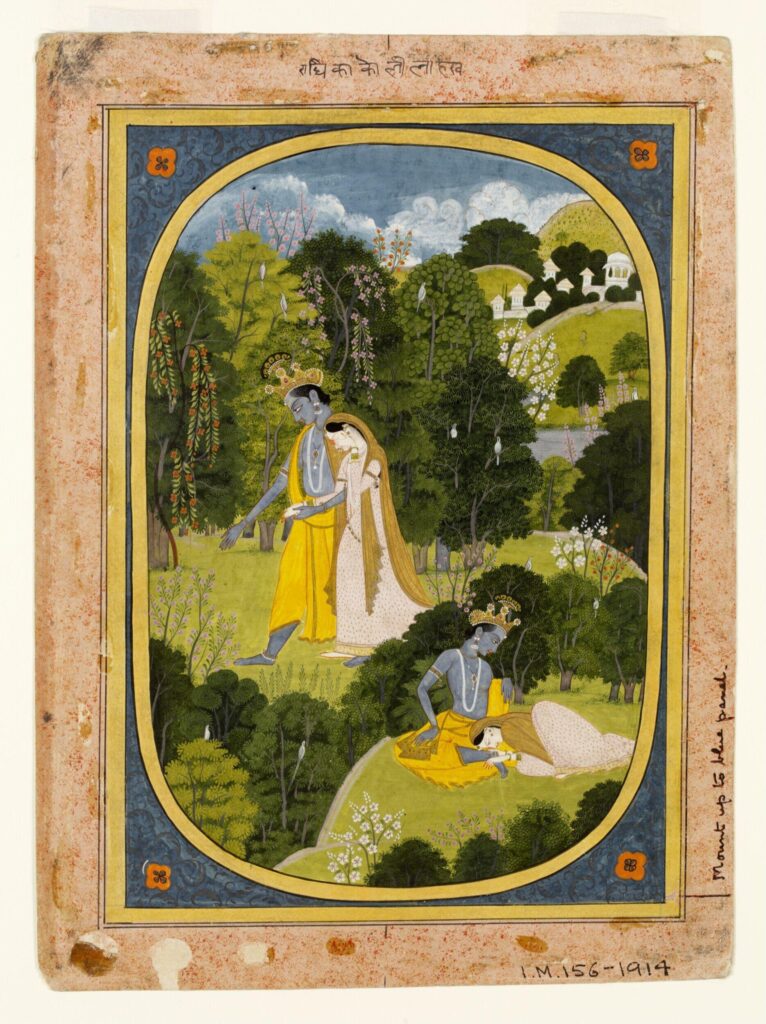
Radha and Krishna from Rasika Priya series, ca. 1820–1825, Victoria and Albert Museum, London, UK.
The Nāyikā as the Central Figure in Pahari Painting
A defining feature of Pahari painting is the prominence of the nāyikā, or heroine. While the hero appears in many compositions, he is often secondary to the emotional and psychological experience of the heroine. To be sure, classical texts like the Keshavdas’s Rasikapriyā do comprehensively classify the nāyaka (hero) based on his fidelity and behavior—ranging from the the Anukūla (the devoted, faithful lover) and Dakṣiṇa (the impartial lover) to the Śaṭha (the deceitful lover) and Dhṛṣṭa (the shameless lover).
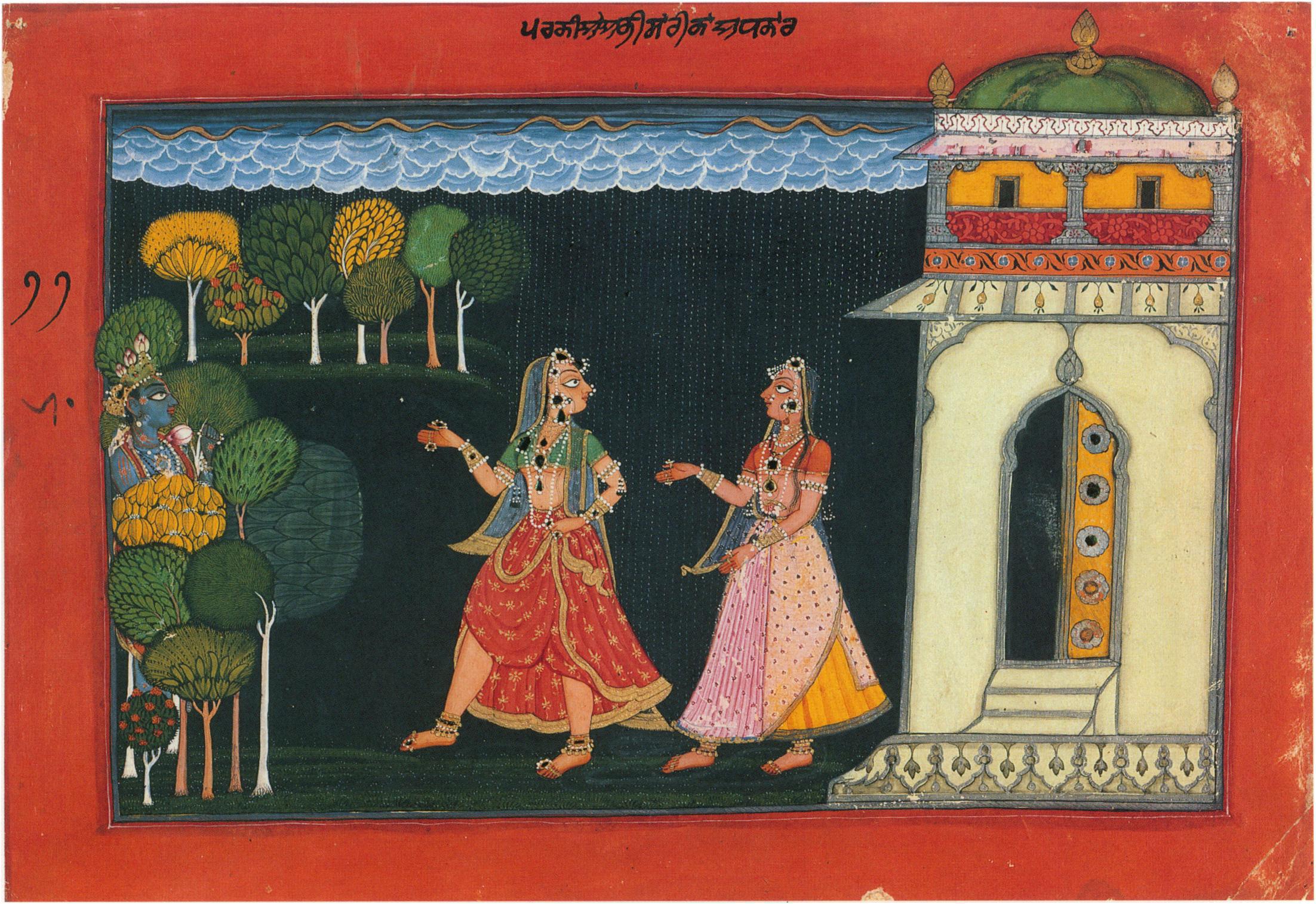
However, Pahari painters intentionally subordinated these male categories. The hero’s actions primarily serve as a catalyst; it is the nāyikā’s feelings, gestures, expressions, and surroundings that become the principal means through which the visual story unfolds. This emphasis reflects both a deep fascination with feminine emotion and the unique theological landscape of the Pahari region. In many of the most celebrated works, this dynamic is personified through the figures of Radha and Krishna, where the secular language of romantic love begins to take on a sacred dimension.
The Three Types of Heroines
To understand her emotional journey, the heroine is traditionally categorized according to her relationship status:
-
Svakīyā: The loyal, devoted wife.
-
Parakīyā: The unmarried woman, or one who belongs to another man (traditionally a favorite subject for intense, dramatic poetry).
-
Sāmānyā: A courtesan or independent woman available to various lovers.
Within the married (Svakīyā) category emerges the celebrated Aṣṭa-Nāyikā scheme, the classification of heroines according to eight emotional states. This became one of the most enduring and visually compelling subjects in Pahari painting, offering artists an opportunity to explore the subtleties of love, anticipation, jealousy, separation, disappointment, and reunion. This framework provided artists with a rich visual vocabulary, allowing complex psychological states to be conveyed through a simple gesture, posture, facial expression, architectural setting, or landscape motif.
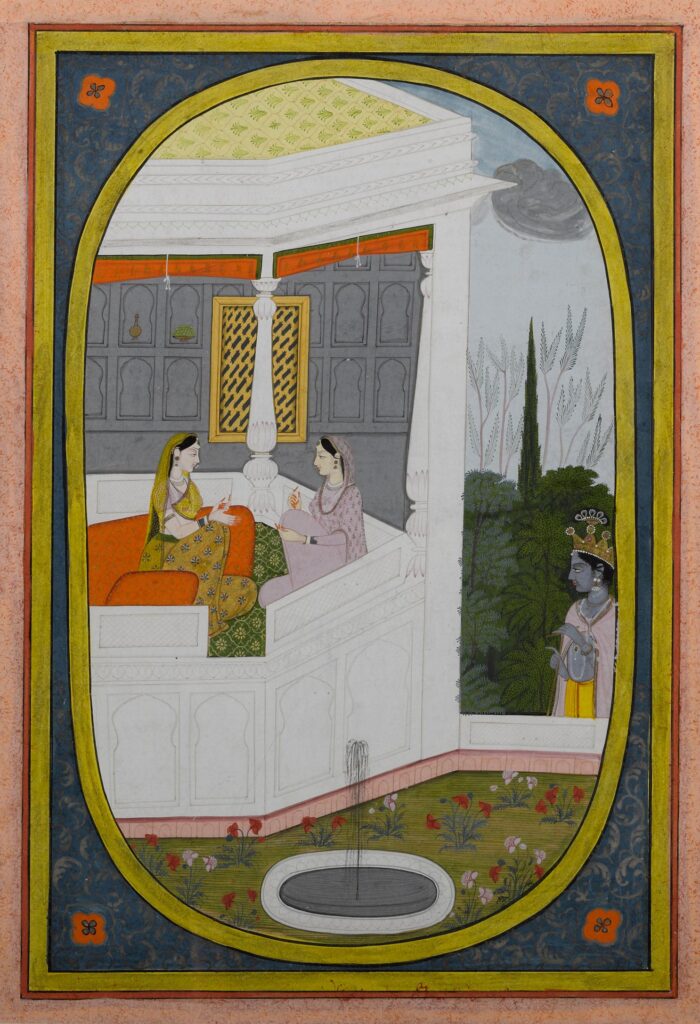
Krishna Eavesdrops on Radha and Her Confidant from a Rasikapriya series, ca. 1810. Bonhams.
The Aṣṭa-Nāyikā Tradition in Pahari Painting
1. Svādhīnapatikā: She Whose Beloved is Under Her Control
Svādhīnapatikā (also known as Svādhīna-bhartrikā) is the heroine whose beloved is entirely devoted to her. She is often shown seated gracefully on a chaukī (a low wooden platform) while her lover massages her feet, or she is shown washing her feet, painting her feet with lac dye, or applying a tilaka to her forehead. Such images symbolize harmony, mutual affection, and fulfillment in love.
He is like to the hem of her bodice, he carries out all her desires,
There is nought he will not do for her at her behest.
Keshavdas, Rasikapriyā in Karl Khandalavala, Pahari Miniature Painting, 1958.
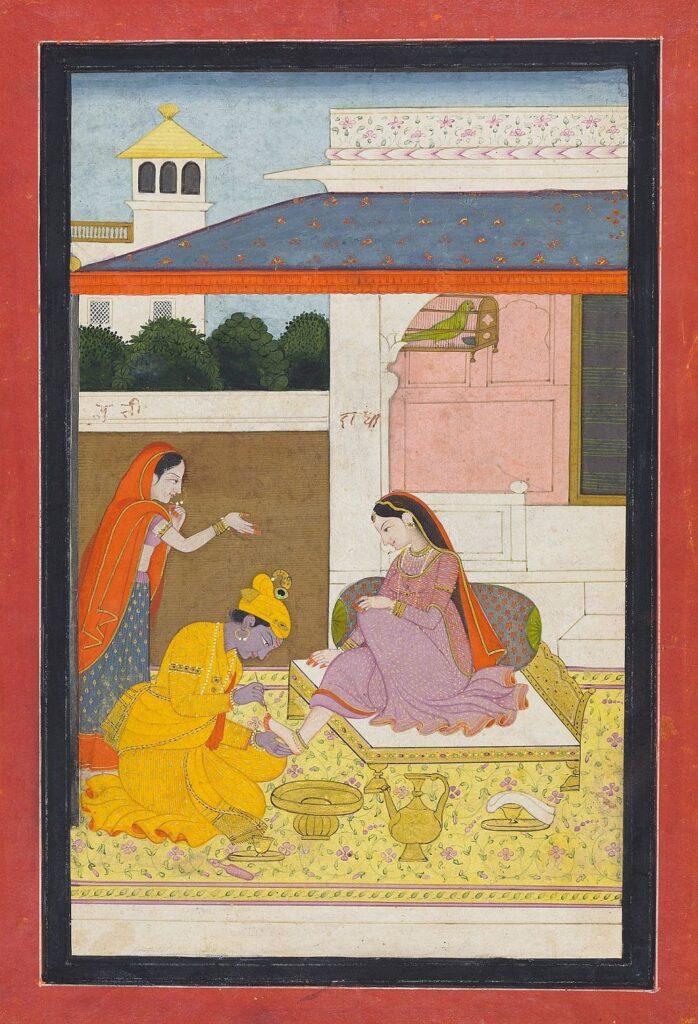
Krishna Paints Radha’s Toenails Red from a Rasikapriya series, ca. 1800, Eva and Konrad Seitz Collection. Francesca Galloway.
2. Utkaṇṭhitā: She Who is Distressed by Separation
Utkaṇṭhitā (also known as Virahotkaṇṭhitā nāyikā) is the anxious heroine yearning for her lover, who has not arrived through misadventure or involuntary absence. Pahari painters typically place her in a lonely natural setting near a forest pool, accompanied by wild animals or birds. Her posture, distant gaze, and isolation convey longing and uncertainty, making the surrounding landscape an extension of her emotional condition.
Is he delayed at home, or is he ill in body?
Or has he proved false to me?
Or does he fear this dark rain-swept night?
Keshavdas, Rasikapriyā in Karl Khandalavala, Pahari Miniature Painting, 1958.
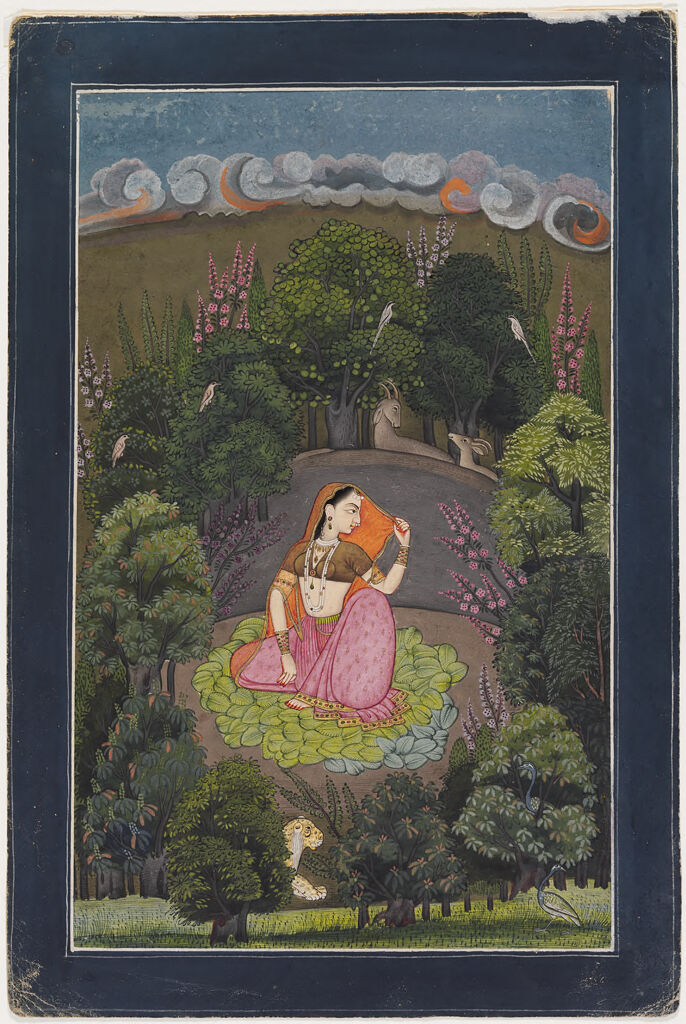
Utka Nayika from Keshavadas’s Rasikapriya, 19th century, Harvard Art Museums, Cambridge, MA, USA.
3. Vāsakasajjā: She Who Prepares for Union
Vāsakasajjā (also known as Sajjikā Nāyikā) is the heroine who decorates herself and prepares her chamber in expectation of her lover’s arrival. She is usually portrayed waiting at a doorway or with attendants arranging the bedchamber. The scene expresses hope, excitement, and emotional tension before union.
She glances anxiously at every sound she hears,
Be it the moan of the wind, or the rustle of leaves,
The twitter of a bird, or the movement of a beast.
Thus she awaits the moment of union with her Lord
Ever watching with trembling heart for his home coming.
Keshavdas, Rasikapriyā in Karl Khandalavala, Pahari Miniature Painting, 1958.
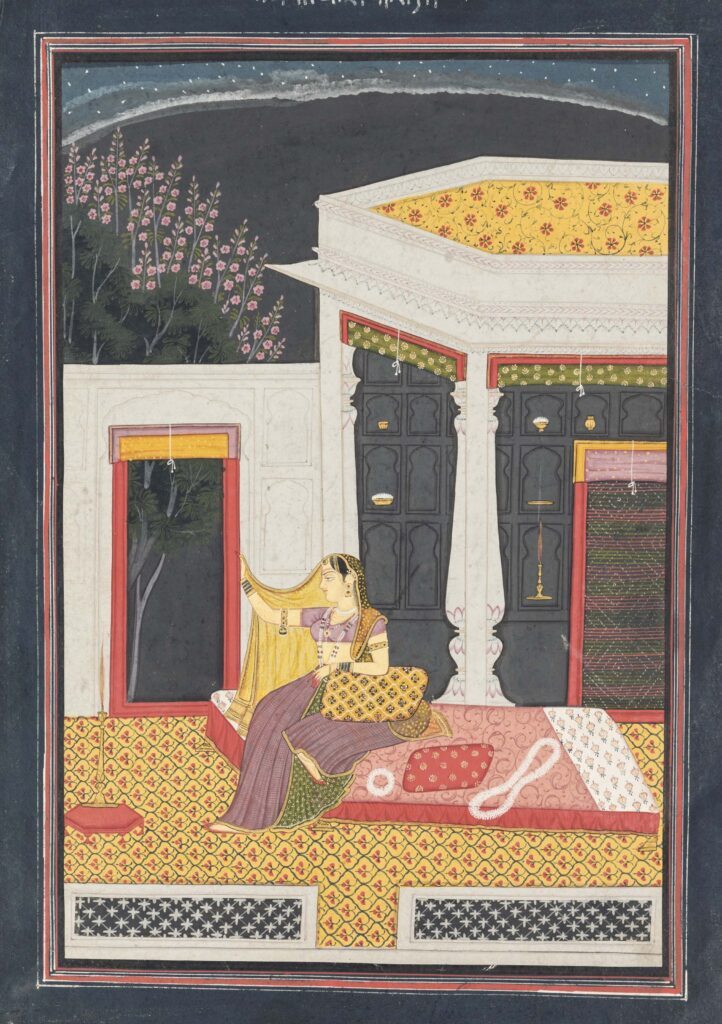
Vasakasajja Nayika from a Rasikapriya series, ca. 1770–1800. Christie’s.
4. Kalahāntaritā: She Who is Estranged After a Quarrel
Kalahāntaritā (also called Abhisandhitā) is separated from her lover because of a quarrel, brought on by her own inconsiderate or unkind attitude. The heroine regrets her harshness after driving him away. Artists depict the hero departing while the heroine remains distressed, creating a powerful visual expression of pride, remorse, and emotional conflict.
When he was speaking I would not answer, when he touched my feet I was harder than stone.
Alas! I repent too late for yielding to the dictates of my anger.
Even sandal paste, the mellifluous rays of the moon, and the soft touch of lotus petals scorch me.
I was over-harsh and Destiny hath made me suffer.
Keshavdas, Rasikapriyā in Karl Khandalavala, Pahari Miniature Painting, 1958.
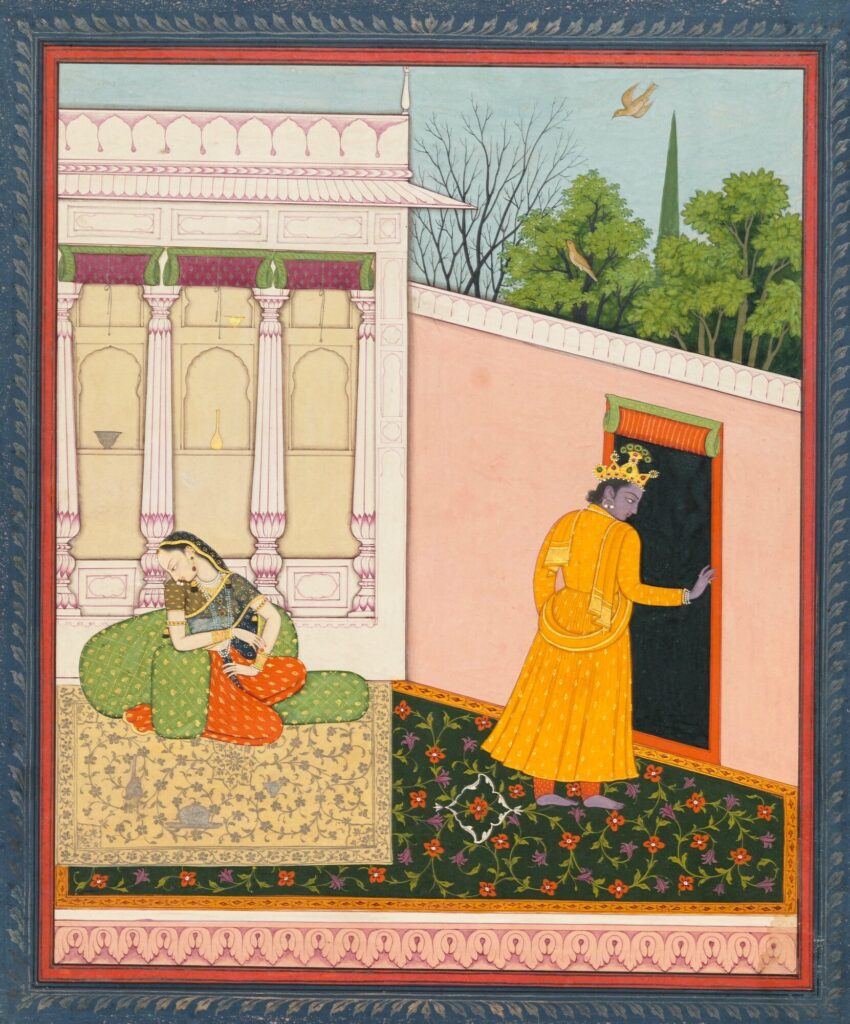
Radha Is Distraught as Krishna Walks Off Dejectedly from a Rasikapriya series, ca. 1780–1790, Eva and Konrad Seitz Collection. Francesca Galloway.
5. Khaṇḍitā: She Who is Offended by Her Lover’s Conduct
Khaṇḍitā Nāyikā is enraged because her lover has spent the night elsewhere. The heroine is shown reproaching the guilty hero, whose downcast posture contrasts with her anger. The emotional drama of betrayal and confrontation made this theme especially appealing to painters.
I have spurned you, yet you come cringing to beg forgiveness by touching my feet,
You are a wastrel who hath bad companions.
In whose homes have you tarried like an owl of evil omen to encompass their ruin,
That you come sneaking into my house after break of day?
Keshavdas, Rasikapriyā in Karl Khandalavala, Pahari Miniature Painting, 1958.
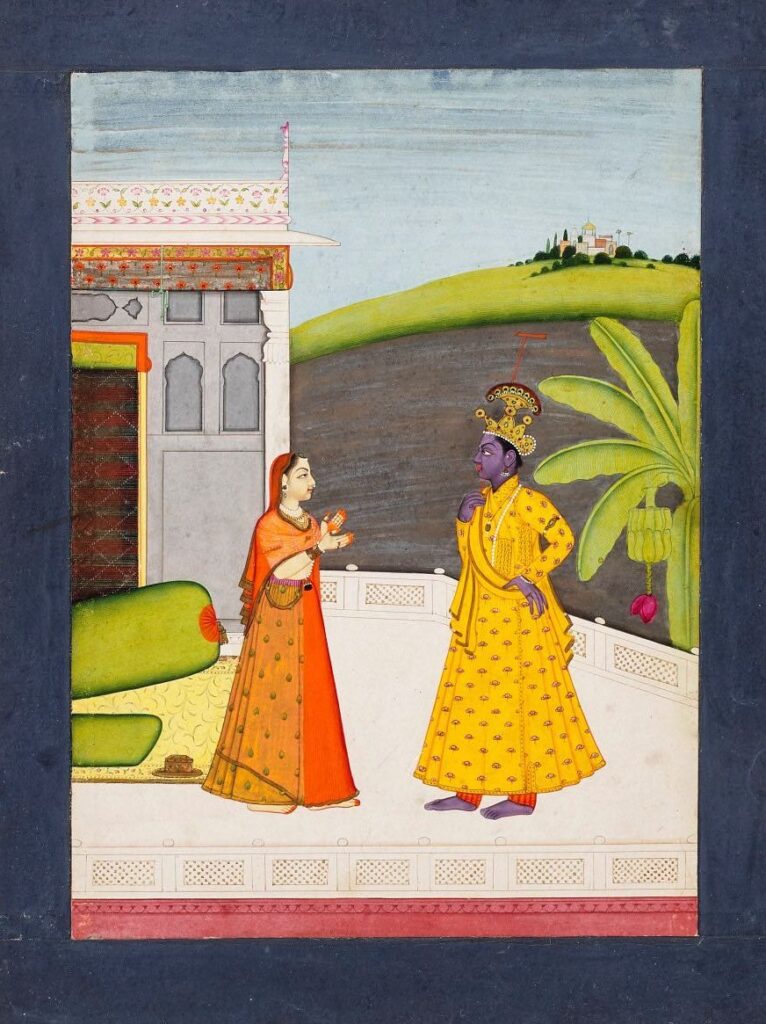
Radha Upbraids Krishna for Going with Other Women from a Rasikapriya series, ca. 1750–1760. Christie’s.
6. Proṣitapatikā: She Whose Beloved is Away
Proṣita-patikā (Proṣita-preyasī or Proṣita-bhartrikā) is the heroine whose lover has gone away on a journey. She appears sorrowful and withdrawn as the appointed day for the lover’s return has passed. She is often accompanied by sympathetic companions. Her grief reflects the pain of prolonged separation and uncertainty.
Does he know that her eyes are blinded with tears
And that she is crying out her young heart piteously,
Wondering—will he ever return.
Keshavdas, Rasikapriyā in Karl Khandalavala, Pahari Miniature Painting, 1958.
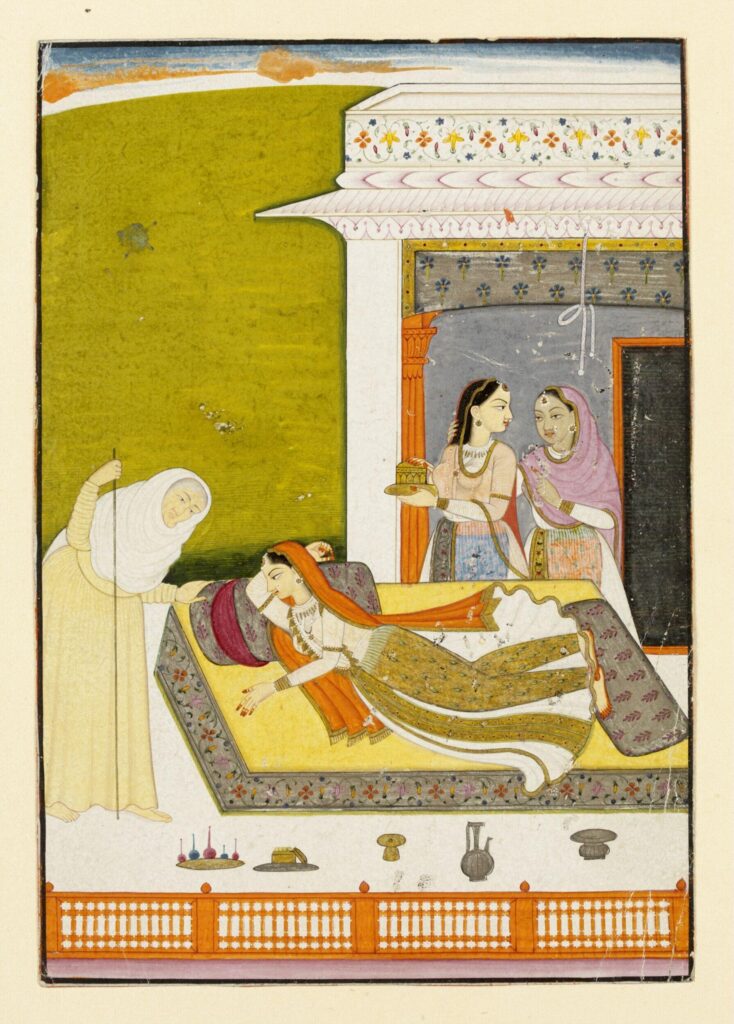
Prositapatika Nayika, ca. 1770–1780, Victoria and Albert Museum, London, UK.
7. Vipralabdhā: She Who is Deceived by Her Lover
Vipralabdhā (also called Lubdhāviprā) is deceived by her lover, who fails to appear at their appointed meeting. She is often shown casting away her ornaments in despair. The discarded jewelry becomes a visual metaphor for emotional disillusionment and shattered expectations.
Every gem studded ornament she wears, sears her delicate skin like a branding iron,
And even flowers pierce her like an arrow.
She breaks her garlands and deeply sighing casts off her beauteous jewels.
Keshavdas, Rasikapriyā in Karl Khandalavala, Pahari Miniature Painting, 1958.
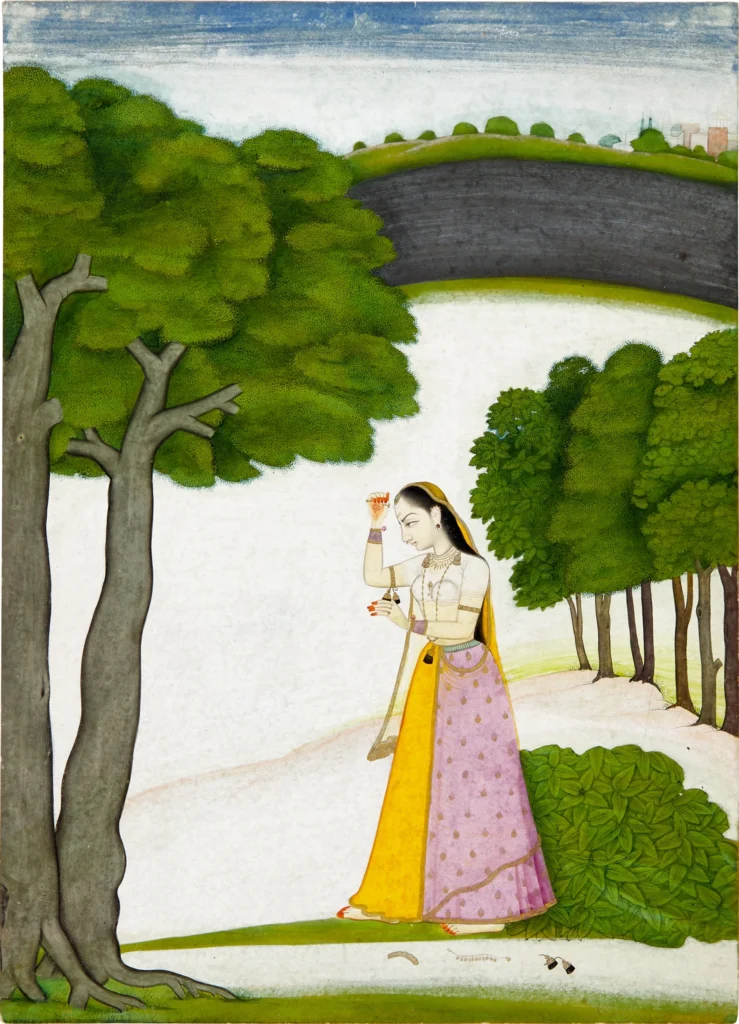
Vipralabdha Nayika, from a Nayak-Nayika series, ca. 1750. Sotheby’s.
8. Abhisārikā: She Who Ventures Out to Meet Her Beloved
The most dramatic and visually compelling heroine is Abhisārikā. Defying darkness, storms, snakes, and social restrictions, she ventures alone to meet her beloved. Pahari painters delighted in depicting turbulent skies, flashes of lightning, winding paths, and threatening creatures surrounding the determined heroine. Her courage and passion transform her into a symbol of unwavering love and spiritual devotion.
Dark is the night and the heavens rent by thunder,
Torrents of rain have made the road impassable,
Yet like a flare she passes, no goblin host can deter her
On Love’s way unending.
Keshavdas, Rasikapriyā in Karl Khandalavala, Pahari Miniature Painting, 1958.
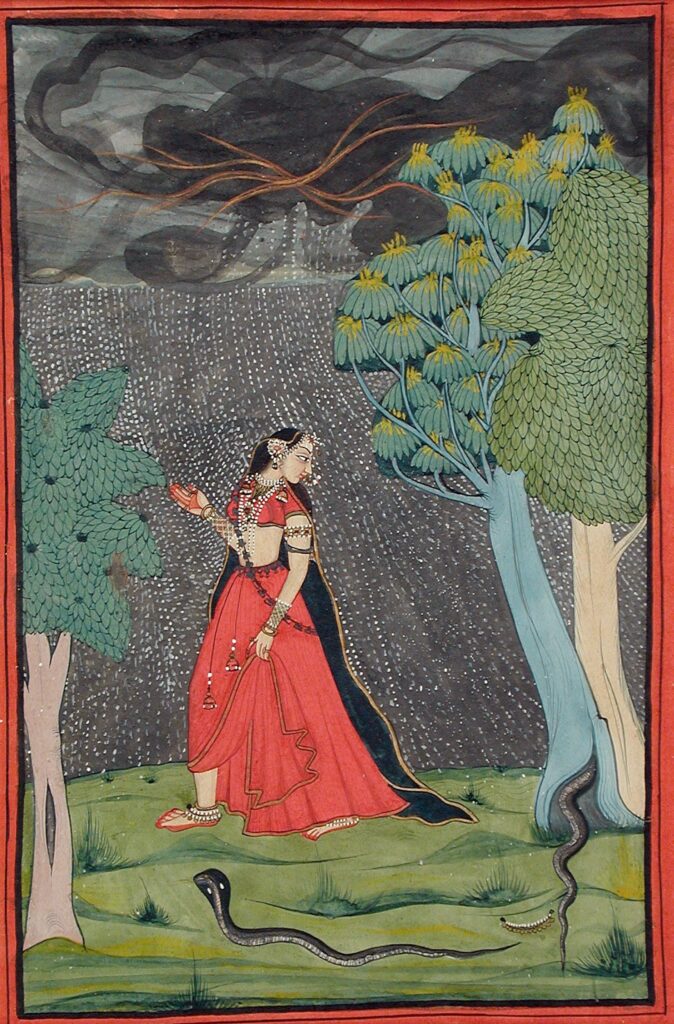
Eager Heroine on Her Way to Meet Her Lover out of Love from a Nayika series, ca. 1770–1833, Los Angeles County Museum of Art, Los Angeles, USA.
Nature as Emotional Symbolism in Pahari Painting
A major achievement of Pahari painting lies in its integration of human emotion with nature. Clouds, rivers, forests, flowering trees, peacocks, cranes, deer, moonlight, lightning, and rain are never merely decorative; they function as visual metaphors that reflect the emotional states of the protagonists.
|
Natural Element |
Aesthetic and Psychological Meaning |
| Monsoon Clouds | Signify deep longing and anticipation. |
| Moonlight | Evokes romance and the intimacy of union. |
| Peacocks | Suggest the arrival of the monsoon, awakening desire. |
| Deer | Reflect sensitivity, gentleness, and vulnerability. |
| Rivers | Symbolize physical separation and the flow of time. |
| Storms & Lightning | Embody intense emotional turmoil and dangerous passion. |
Nature thus becomes an active participant in the narrative rather than a passive backdrop, echoing the heroine’s inner world and intensifying the emotional atmosphere of the scene.
The Sacred and the Secular in Pahari Painting
One of the most distinctive aspects of Pahari painting is the fluid fusion of erotic sentiment (śṛṅgāra) with devotional spirituality (bhakti). Through the lens of Vaishnava devotionalism, the romance between Radha and Krishna transcends mere human desire to become a profound metaphor for the divine.
Under this framework, the emotional states of the nāyikās acquire deeper metaphysical significance. Radha’s intense longing for Krishna is interpreted as the human soul’s yearning for union with God, while their ultimate union (saṃyoga) symbolizes spiritual fulfillment. Consequently, separation (viraha) ceases to be just a romantic tragedy; it becomes an instrument of devotional intensity, rendering love itself as a path to spiritual transcendence. This synthesis of romance and devotion imparts to Pahari painting its uniquely poetic, emotional, and spiritual character.
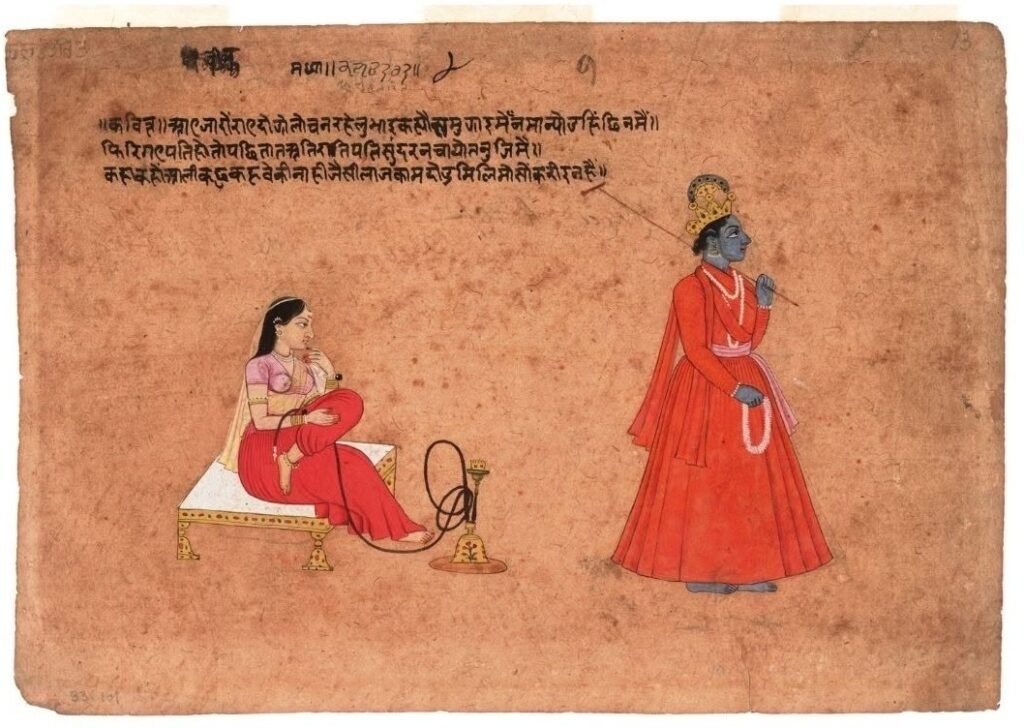
Madhya-Kalhantarita Nayika, mid-18th century CE, D.J. Tata Collection, Chhatrapati Shivaji Maharaj Vastu Sangrahalaya (CSMVS), Mumbai, India. Facebook.
Beyond the Canvas: The Legacy of the Nāyikā
The Aṣṭa-Nāyikā tradition provided Pahari artists with a highly sophisticated visual language for exploring the complexities of human emotion. Drawing upon Sanskrit poetics, Hindi court literature, and Bhakti philosophy, painters successfully transformed rigid poetic categories into deeply evocative pictorial narratives.
Pahari artists translated literary emotion into visual form through graceful and flowing lines, delicate facial expressions, expressive gestures, elegant female figures, lyrical landscapes, subtle color harmonies, seasonal symbolism, and psychological realism. Their ultimate aim was not naturalistic representation but the evocation of rasa—particularly Śṛṅgāra Rasa, the aesthetic experience of love. The enduring appeal of these paintings lies in their unique ability to unite literary imagination, emotional depth, spiritual symbolism, and artistic refinement, making them among the most profound expressions of Indian visual culture.