

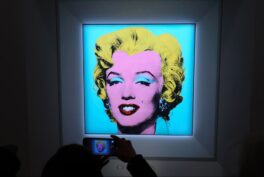
Andy Warhol in 10 Artworks: A Pride Month Look at Pop Art’s Queer Icon
For anyone still asking for receipts on Andy Warhol’s influence, Shot Sage Blue Marilyn came with a $195-million one. In May of 2022,...
MJ Rivera 22 June 2026
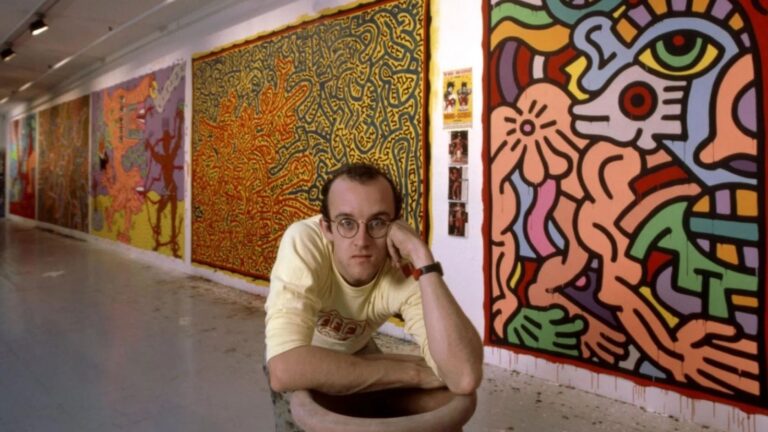
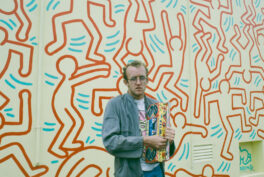
Photograph of Keith Haring in front of his paintings, c. 1985. Independent. Detail.
With his bold, energetic style, Keith Haring went from drawing in public spaces to becoming a household name of international exhibitions. But Haring didn’t just stick to traditional art spaces; he brought his work into the real world, creating animations for Times Square, designing sets for clubs and theatres, and even working with brands like Swatch and Absolut Vodka. Keith Haring also painted murals on city walls around the world.
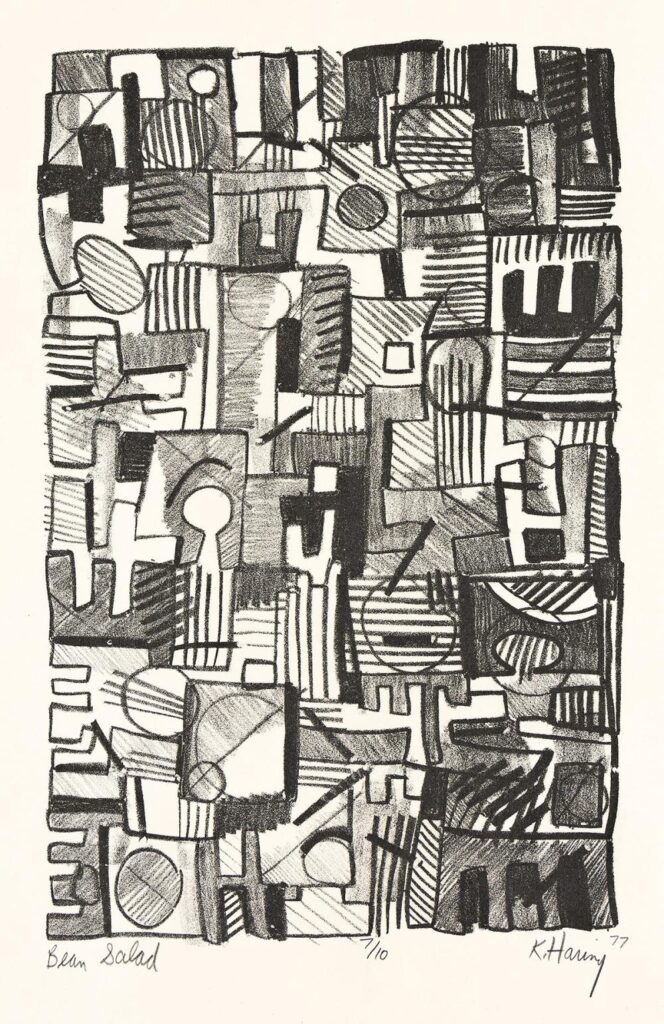
Keith Haring, Bean Salad, 1977, Swann Auction Galleries, New York City, NY, USA. Source.
From a young age, Keith Haring was passionate about drawing. He learned how to create cartoons from his father that were equally inspired by popular culture around him like Dr. Seuss and Walt Disney. After high school in 1976, Haring went to the Ivy School of Professional Art in Pittsburgh, but he quickly realized he didn’t want to become a commercial artist making ads and logos.
After leaving school, he moved to New York City and enrolled in the School of Visual Arts. New York was full of exciting new art, especially in the streets and subway stations, where artists were creating something different from art in museums and galleries. Haring became friends with Jean-Michel Basquiat and Kenny Scharf and became involved in the city’s energetic art scene. He started taking part in art shows and performances at places like Club 57, where young artists shared their ideas in creative and unusual ways.
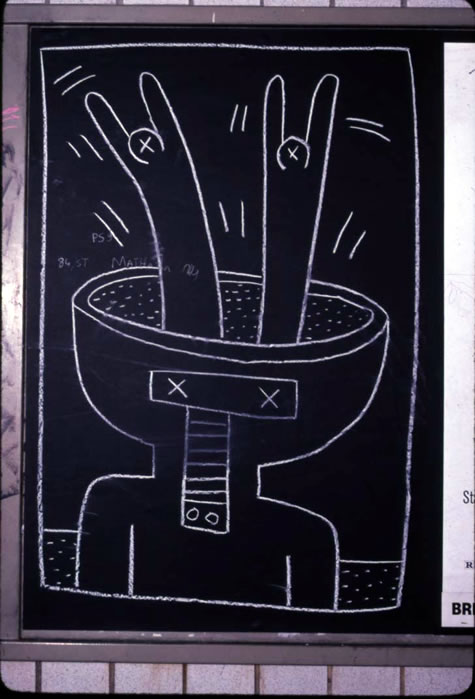
Keith Haring, Untitled, 1982, New York, NY, USA. Photograph by Ivan Dalla Tana via The Keith Haring Foundation.
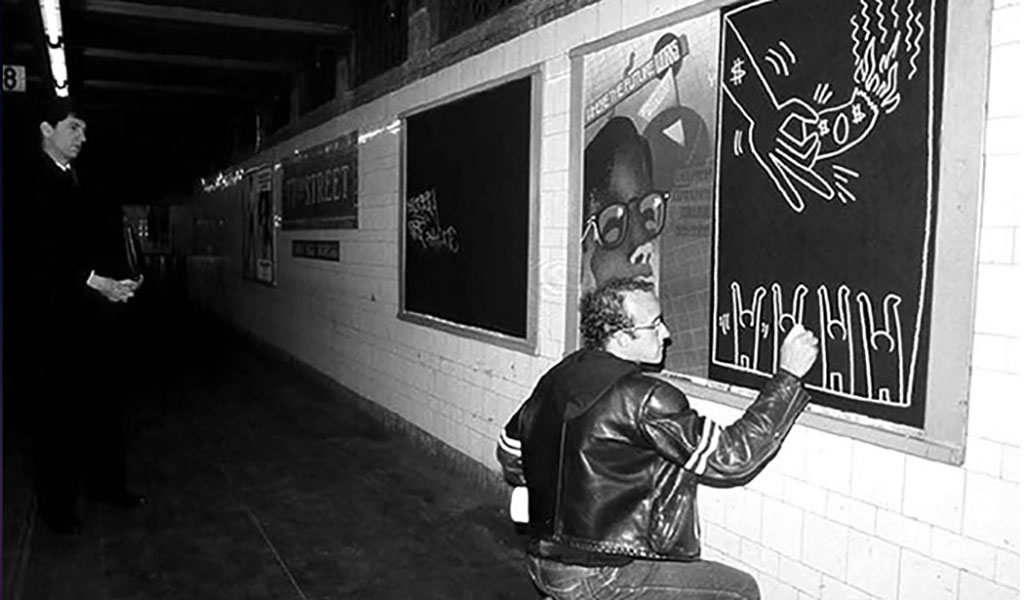
Photograph of Keith Haring, 1984, New York, NY, USA. Antiques Roadshow PBS.


Keith Haring made numerous drawings in white chalk upon these blank paper panels throughout the New York subway system.
Haring described the subway as his “laboratory” for working out his ideas and engaging with New York commuters.
In the early 1980s, Haring started drawing with white chalk on empty black advertising panels in the New York subway system. Between 1980 and 1985, he made hundreds of these bold, fast sketches using simple, moving lines. People riding the train began to notice, and many would stop just to watch him work or talk to him while he drew. For Haring, the subway wasn’t just a place to pass through. He described it as a “laboratory” where he could test out his ideas and share them with everyone. Still, police viewed it as vandalism, and Haring was arrested on several occasions because of it.
All kinds of people would stop and look at the huge drawing, and many were eager to comment on their feelings toward it. This was the first time I realized how many people could enjoy art if they were given the chance. These were not the people I saw in the museums or in the galleries, but a cross-section of humanity that cut across all boundaries.
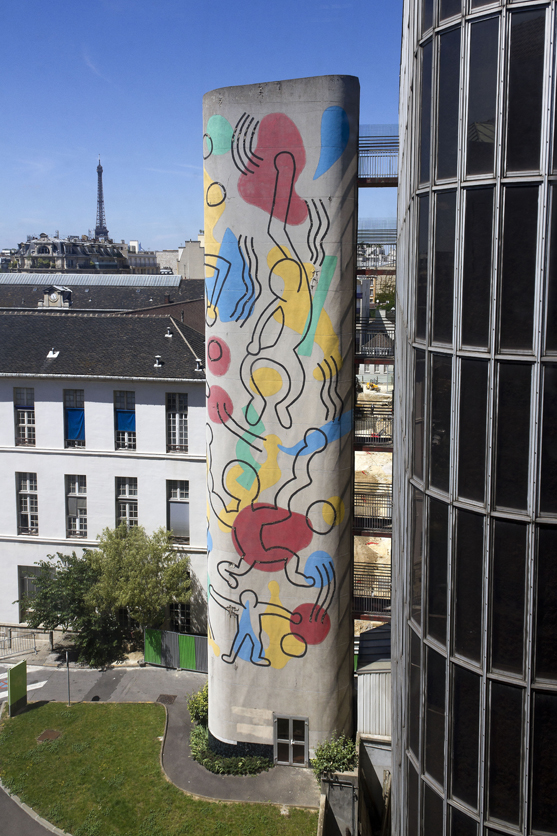
Keith Haring, Tower mural at the Necker Children’s Hospital, 1987, Paris, France. Photograph by J.P. Humbert via noirmontartprodction.
Keith Haring loved working with children and organizations that empowered young people. He painted in children’s hospitals around the world, including the famous Necker Children’s Hospital in Paris. Haring admired children because they are creative, funny, open-minded, and not afraid to express themselves. He believed art should bring people together, so he encouraged young people to create art as a team. In 1986, he worked with 900 kids to paint a huge mural celebrating the centenary of the Statue of Liberty. The project was presented in Battery Park City, New York.
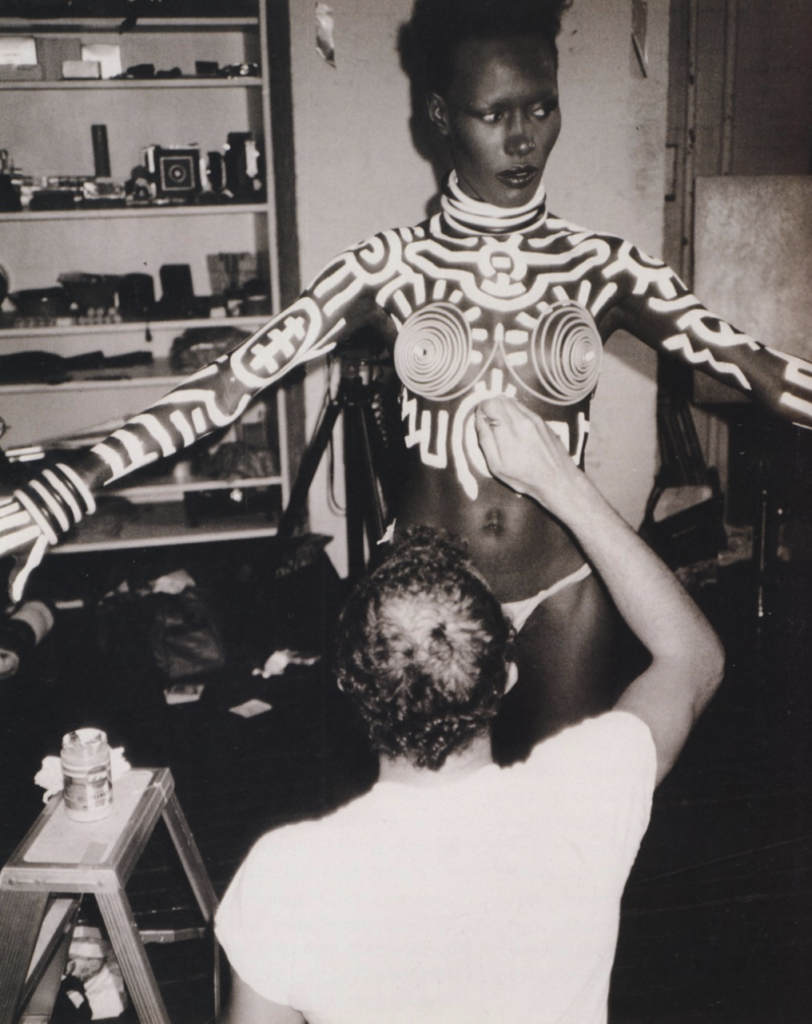
Grace Jones body-painted by Keith Haring, 1984, New York City, NY, USA. Photograph by Tseng Kwong Chi/Muna Tseng Dance Projects. Art Sheep.
While living in New York’s East Village, Keith Haring became part of a huge underground art scene filled with creative people, musicians, and performers. Haring and Madonna became close friends, and when she invited him to her wedding, he brought Andy Warhol. With growing popularity, he started working with fashion designers and musicians such as Vivienne Westwood and Malcolm McLaren. One of his most unique collaborations was with Grace Jones, whose body he painted with his bold graffiti-style art for live performances. He also appeared in her music video for the song “I’m Not Perfect (But I’m Perfect for You)”.
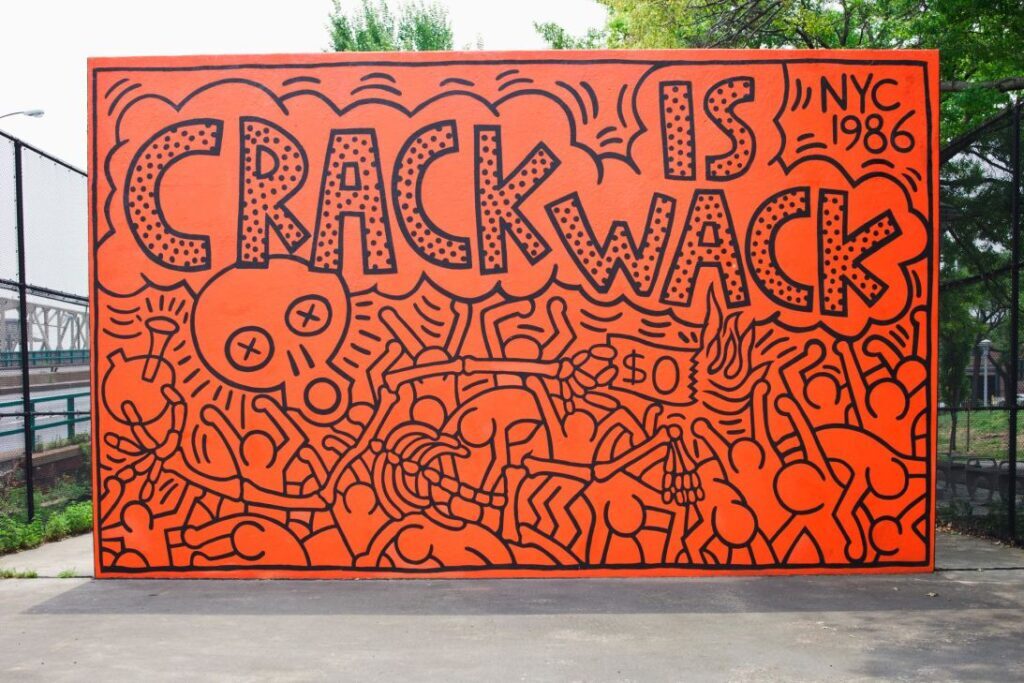
Keith Haring, Crack is Wack, 1986, New York City, NY, USA. CNN.
Besides being remembered as a remarkable artist, Haring was also a prominent activist. His art spoke about real-world problems such as Apartheid, drug abuse, and the AIDS epidemic. As an openly gay artist, Keith Haring also created artworks about the struggles faced by the LGBTQ community and supported equal rights for everyone.
Despite looking fun and energetic from the outside, many of Haring’s artworks were about serious topics affecting people all around the world. Haring often used short, powerful slogans to catch people’s attention. One of his most famous works was the Crack is Wack mural in East Harlem, which warned people about the dangers of cocaine. He painted it large enough for drivers passing by to easily see and remember its message.
Keith Haring used his artworks to spread awareness about AIDS and teach people about the disease at a time when many people were afraid to talk about it. In 1988, Haring learned that he had AIDS himself, but instead of staying silent, he worked even harder to help others understand the importance of education and support. A year later, he created the Keith Haring Foundation to raise money for AIDS research, charities, and programs that helped people in need. Sadly, Haring died from AIDS-related complications on February 16, 1990, when he was only 31 years old. Even after his death, the foundation continues to carry his message and support the causes he cared about most.
DailyArt Magazine needs your support. Every contribution, however big or small, is very valuable for our future. Thanks to it, we will be able to sustain and grow the Magazine. Thank you for your help!

History of art graduate and enthusiastic appreciator of anything art and culture-related. Currently very interested in Catalan Modernism and Postmodernism, Surrealist artist-designer Elsa Schiaparelli, and 15th-century Florentine art.

For anyone still asking for receipts on Andy Warhol’s influence, Shot Sage Blue Marilyn came with a $195-million one. In May of 2022,...
MJ Rivera 22 June 2026
Roy Lichtenstein’s art dominated the 20th century with comic-book-style imagery, a lot of melodrama, and exaggerated Ben-Day dots that mimicked...
Katie Mikova 11 May 2026
Pop Art is one of the most iconic movements in history, and its influence continues today. While often dominated by male artists, several women...
Errika Gerakiti 26 January 2026
Tom Wesselmann rose to prominence during the Pop Art movement, though he rejected the label himself. While many Pop artists used familiar objects to...
Errika Gerakiti 14 August 2025