
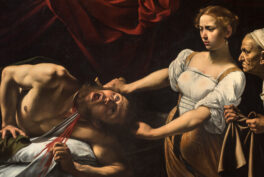
Masterpiece Story: Judith and Holofernes by Caravaggio
Judith and Holofernes is a Caravaggio masterpiece that captures Biblical murder and drama. Rarely has death been captured so intensely and violently...
James W Singer 13 September 2026
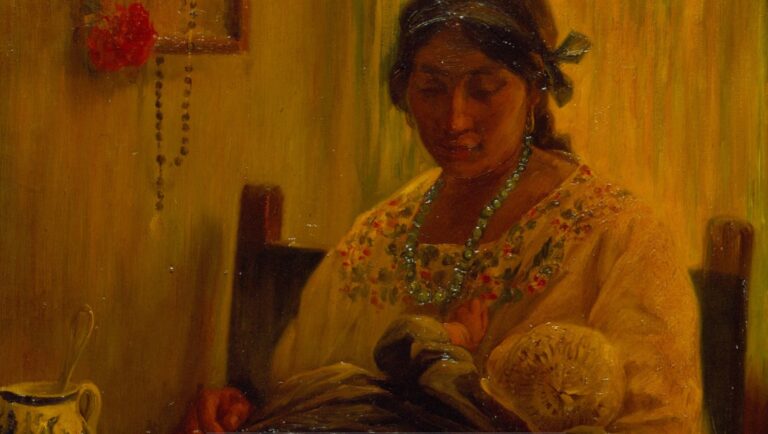
Germán Gedovius, La Tehuana, ca. 1917, Museo Nacional de Arte, Mexico City, Mexico. Detail.
Around 1917, the Mexican painter Germán Gedovius created La Tehuana (Woman from Tehuantepec), a warm and intimate moment between a mother and her child. This is one of hundreds of paintings depicting motherhood. So, let us discover what makes this painting unique.
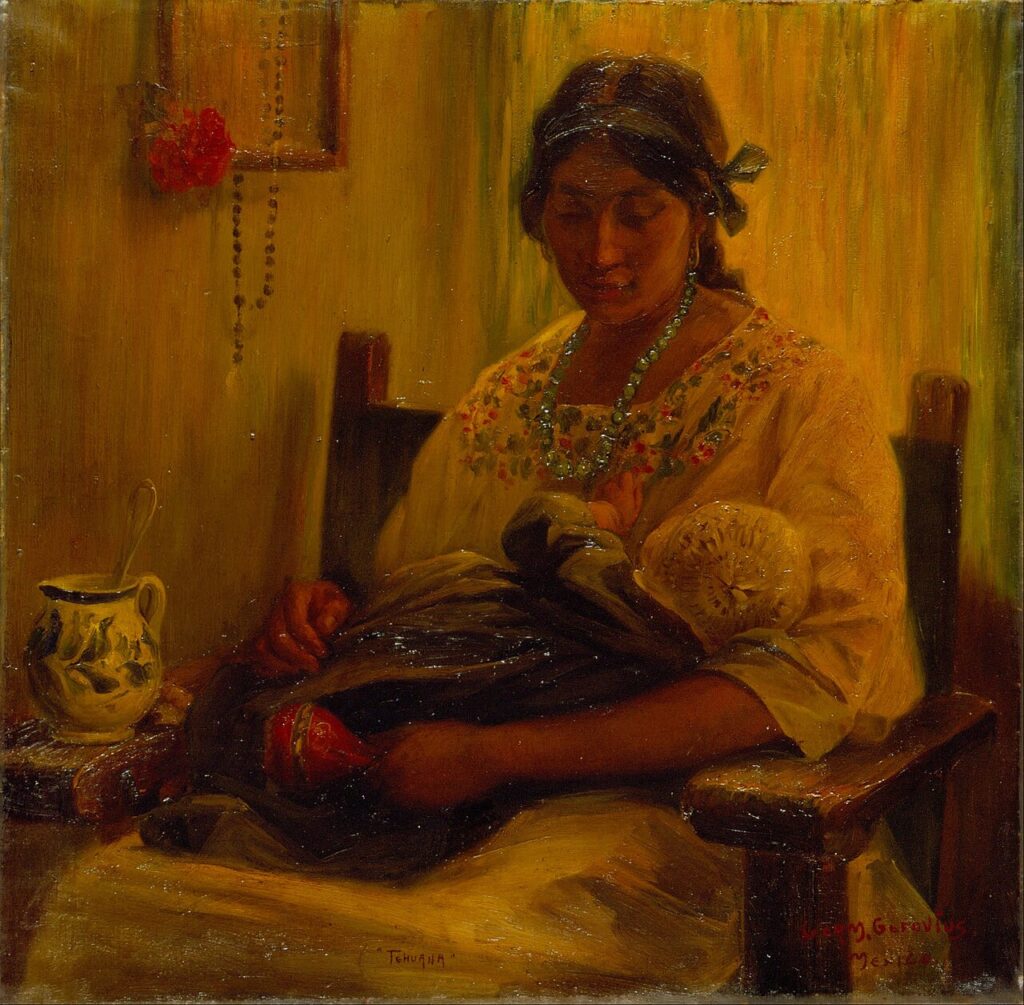
Germán Gedovius, La Tehuana, ca. 1917, Museo Nacional de Arte, Mexico City, Mexico.
A brown-skinned woman sits in a wooden chair while she carries her child. In her left hand, she holds a rattle, but the baby seems more entertained by the huipil’s embroidery. The mother’s necklace, made of green or blue stones, matches the ribbon tied in her hair. A traditionally-made jar with a blue design sits on the armrest.
The only decoration visible in the room is a frame on the wall with no clear image. A pink flower and a rosary hang from it, which may indicate the religious theme of the unseen painting. The rest of the space is filled with broad strokes of paint in yellow, orange, red, and green tones. In fact, the entire scene is bathed with warm colors that create an intimate atmosphere.
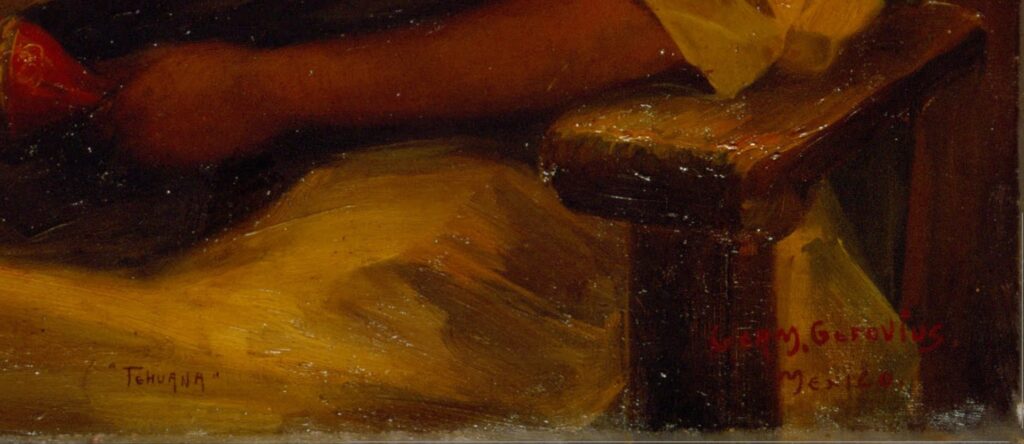
Germán Gedovius, La Tehuana, ca. 1917, Museo Nacional de Arte, Mexico City, Mexico. Detail.
In the lower middle region, Gedovius added in capital letters, “Tehuana”. To its right, he signed with the text: “Germ. Gedovius. Mexico.”
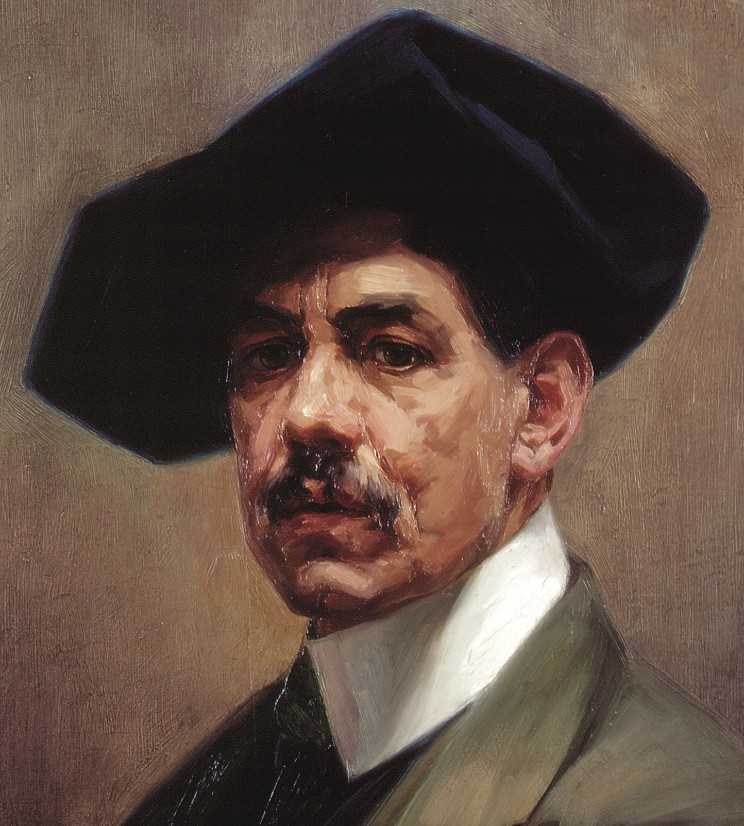
Germán Gedovius, Self-Portrait, 1907, Museo Nacional de San Carlos, Mexico City, Mexico. Detail.
Germán Gedovius Huerta (1866–1937) was born in Mexico City, Mexico, although he moved to San Luis Potosí soon afterward. In 1882, he returned to the capital to study painting at the San Carlos Academy. Years later, he went to Germany to try out treatments for his deafness and to continue his education as an artist. Contact with European art influenced his training and shaped his identity. This self-portrait, for example, shows him in a Flemish traditional attire.
Upon his return to Mexico in 1893, he became an influential artist who participated in exhibitions at the Academy and others organized by the state. He also worked as a professor at the San Carlos Academy and taught some of the greatest artists of the next generation, namely, Diego Rivera, Ángel Zárraga, and María Izquierdo.
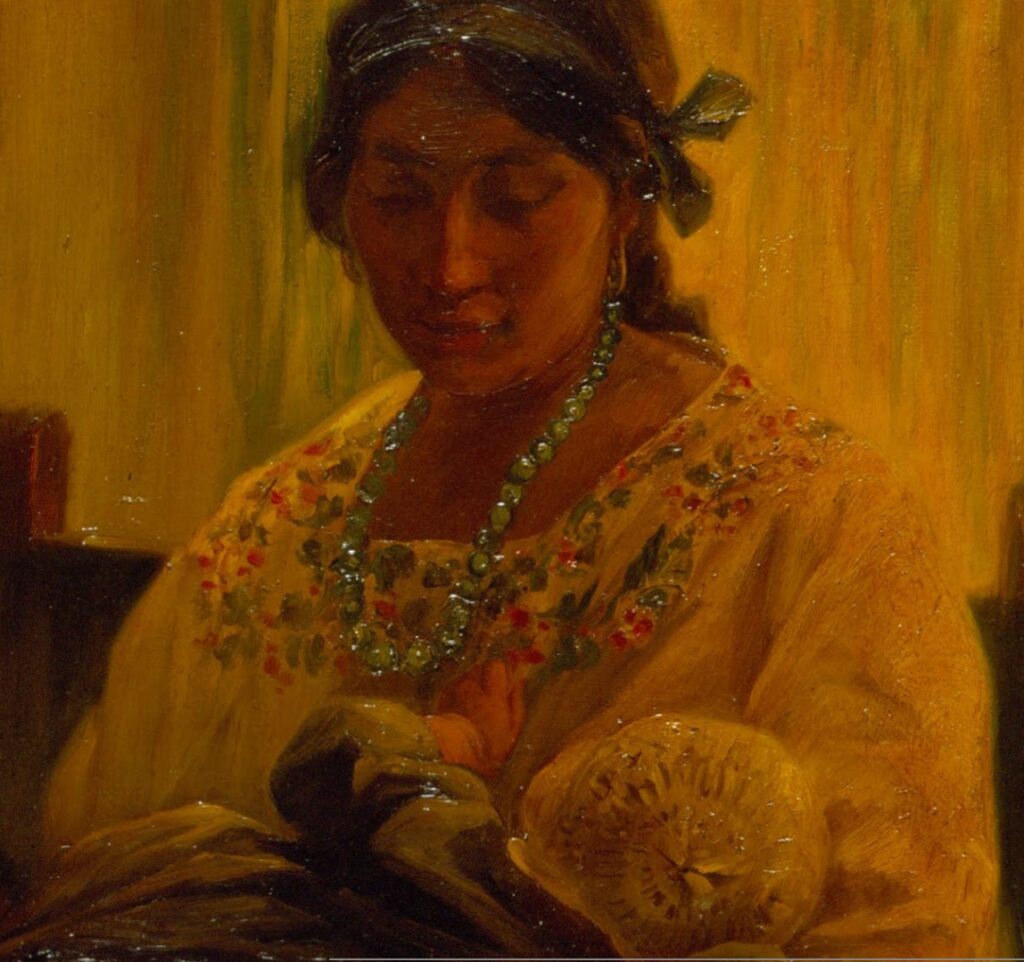
Germán Gedovius, La Tehuana, ca. 1917, Museo Nacional de Arte, Mexico City, Mexico. Detail.
In 19th-century Mexico, mothers were seen as the main educators of morals. Later on, in the revolutionary and post-revolutionary Mexico of the 20th century, images of mothers became a pillar of the government’s nationalistic narrative. Artists created dozens of paintings, murals, sculptures, and monuments that cemented the importance of these women. There was a clear link to the Catholic faith of the majority of Mexicans, in which these works of art recalled the theme of the Virgin Mary and Child. But this is not just any mother. This is a mother from the Tehuantepec region.
Germán Gedovius’ painting forms part of a long tradition of Tehuan women in Mexican art history. Here are three examples from the 20th century:
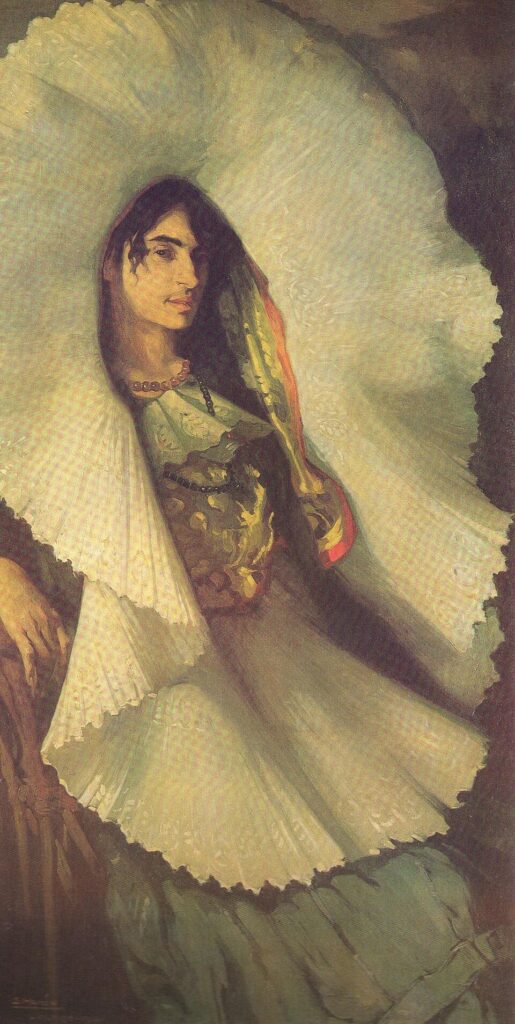
Saturnino Herrán, La Tehuana, 1914, Aguascalientes Museum, Aguascalientes, Mexico.
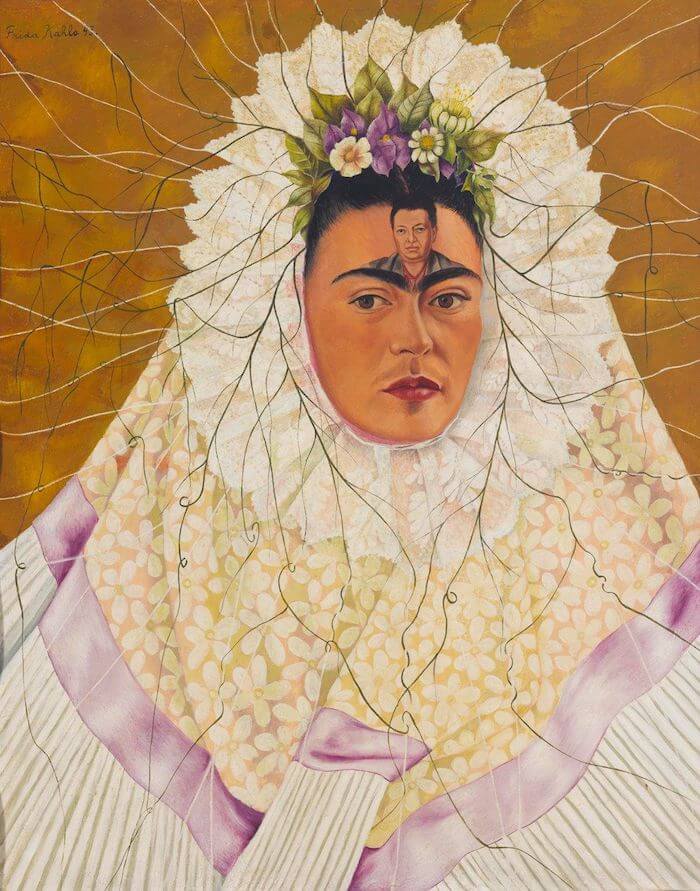
Frida Kahlo, Self-Portrait as a Tehuana, 1943, Gelman Santander Collection.
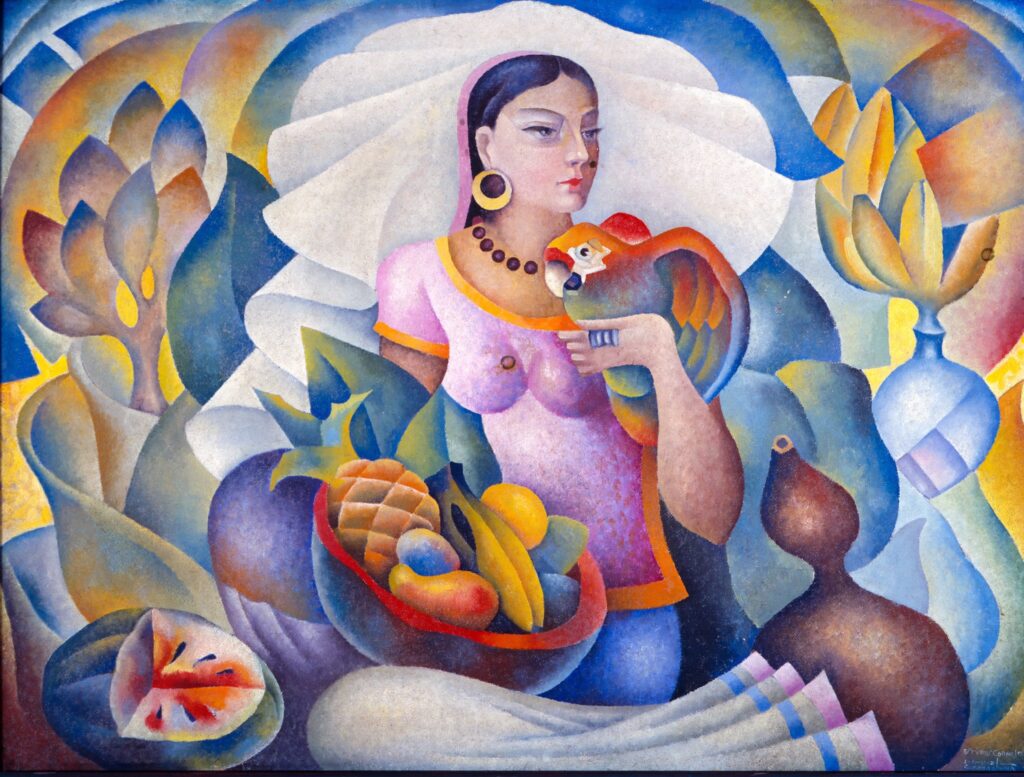
Jorge González Camarena, The Parrot, 1927, Museo Nacional de Arte, Mexico City, Mexico.


One of the most attractive aspects of the Tehuan attire was the headdress, also called the “resplandor” (glow or radiance). Herrán makes it the painting’s protagonist by covering most of the canvas with it.
It is important to note that this is not an actual Tehuan woman. The model for Herrán’s painting is his own wife, Rosario Arellano. This detail evidences that far from depicting the reality of Tehuan women, these paintings are meant to represent an idea.
Here is another example. Frida Kahlo painted herself in a couple of self-portraits and posed for photographs wearing the traditional Tehuan female attire. It mattered little if she had any actual tie to the indigenous community.
Camarena’s The Parrot highlights the exotic nature of the representations of Tehuan women. The artist surrounded her with colorful geometric trees and fruits, while a parrot stands on her hand. In a way, these representations remind us of the orientalist paintings of women from the Middle East done by European artists in the 19th century.
There is a fundamental difference in Gedovius’ work, though. Unlike the previous examples, the woman in his painting does not wear the traditional resplendor (type of headdress) that is so striking and appealing to viewers. Rather, he positions her in a domestic scene. There is no one there to impress, no one there to pose. She is simply enjoying some quiet and private time with her baby.
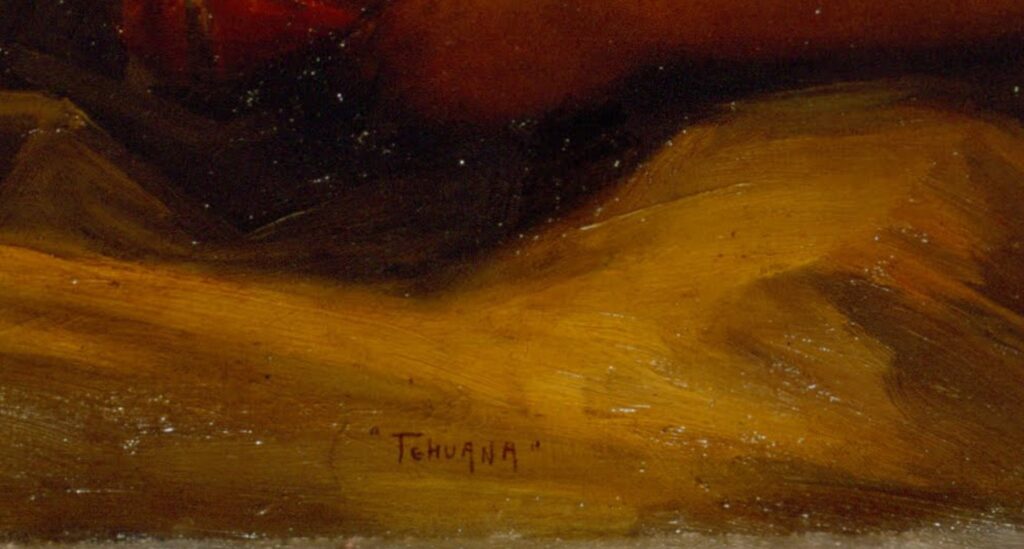
Germán Gedovius, La Tehuana, ca. 1917, Museo Nacional de Arte, Mexico City, Mexico. Detail.
Gedovius chose to clarify to the viewer that the woman in the painting is a “Tehuana.” But why? This could have been any indigenous mother and her child. Why would he remark on her specific identity?
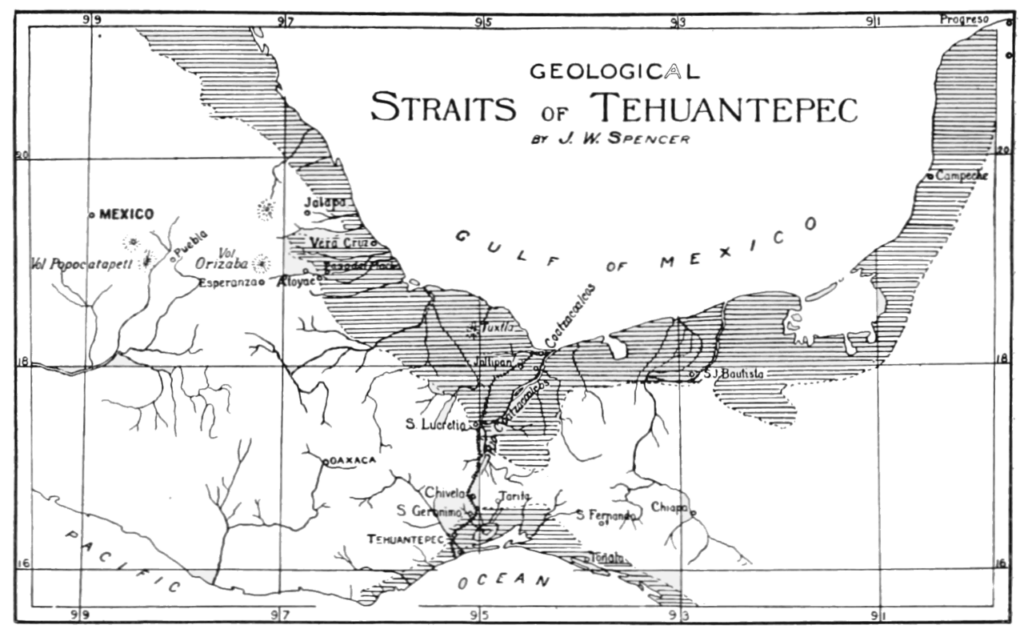
Topography of the Isthmus of Tehuantepec, 1898. Internet Archive.
As the narrowest part of the country, the Isthmus of Tehuantepec served as a connecting region between the Pacific and Atlantic oceans, ideal for commerce. Culturally and politically, the indigenous communities (mainly Zapotec) preserved their traditions despite colonization. In the 20th century, the state used them as a tool to spread a narrative where indigenous communities played a fundamental role in Mexico’s national identity.
The image of Tehuan women was particularly exoticized and exploited, seeing as the local gender dynamics were unusual. The population of Tehuantepec was disproportionately female-dominated, due to men leaving the region for economic and social reasons, pushing women to traditionally male-dominated areas. There are accounts as far as the 17th century that detail the participation of Tehuan women in rebellions against Spanish dominance.
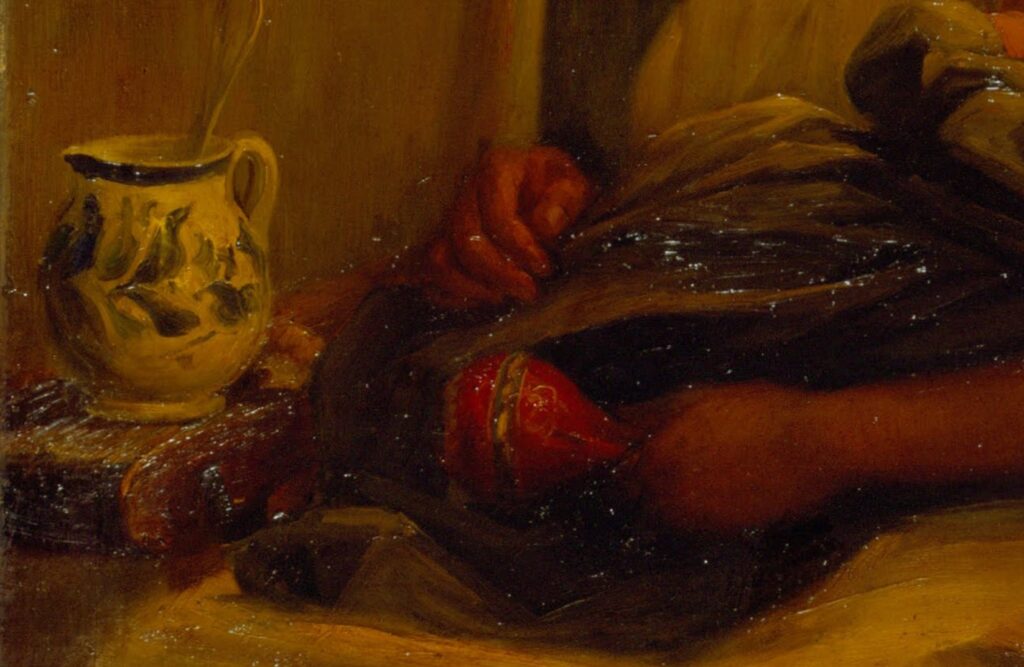
Germán Gedovius, La Tehuana, ca. 1917, Museo Nacional de Arte, Mexico City, Mexico. Detail.
Gedovius did not include the most appealing parts of the Tehuan women’s attire in his painting, but added elements that speak about the mixed-race nature of this family. The objects around (jar, rattle, chair, and necklace) are not completely indigenous. They all have foreign influence.
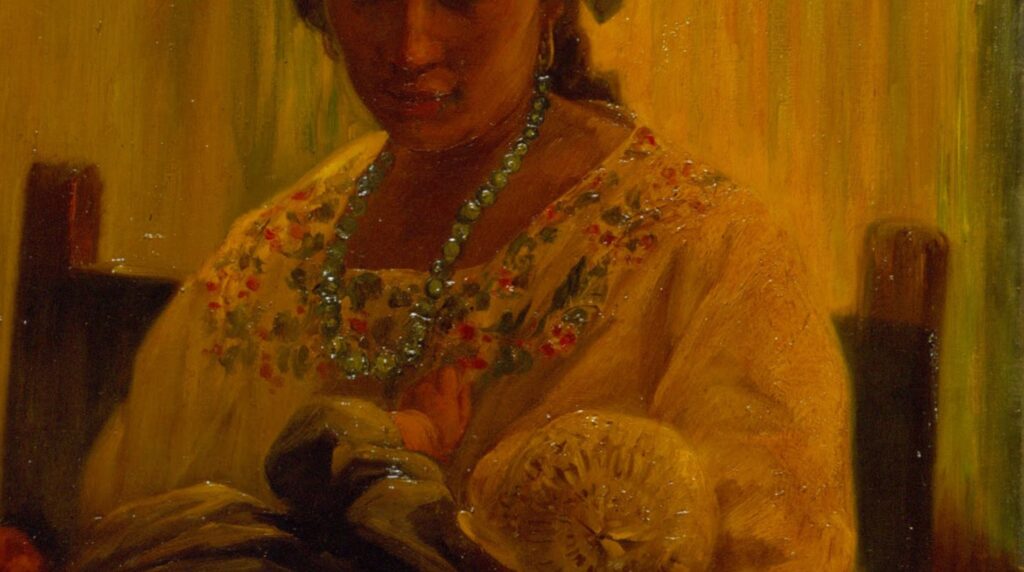
Germán Gedovius, La Tehuana, ca. 1917, Museo Nacional de Arte, Mexico City, Mexico. Detail.
Gedovius placed a rosary to remind the audience of the Catholic faith adopted from the Spanish colonizers. It represents a testimony to the mixing of costumes that make up the identity of all Mexicans, according to the state’s narrative promoted in the 20th century.
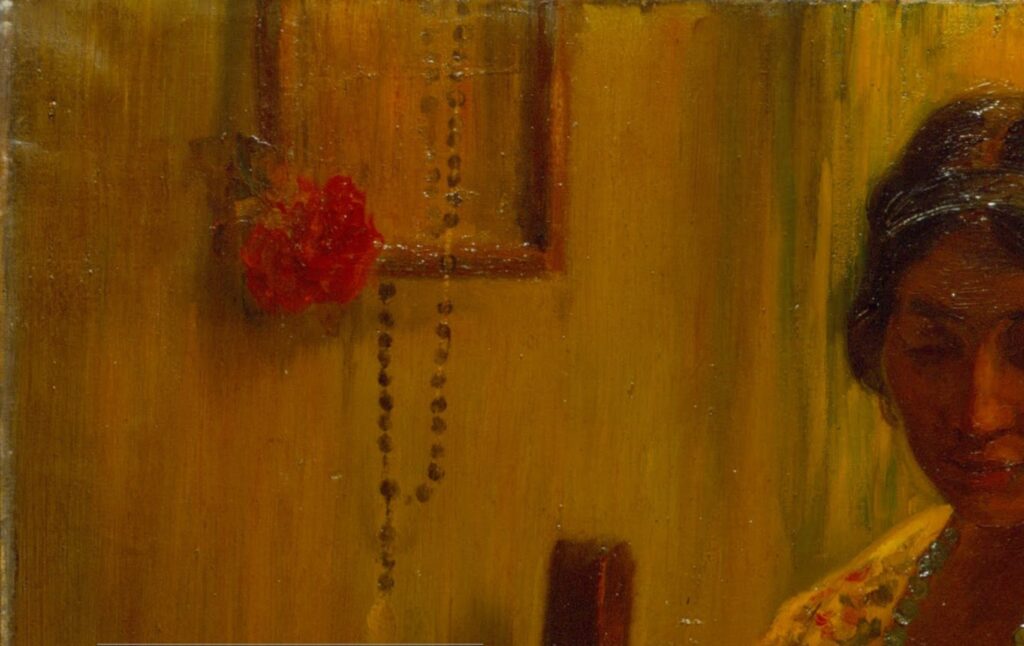
Germán Gedovius, La Tehuana, ca. 1917, Museo Nacional de Arte, Mexico City, Mexico. Detail.
This painting is more than a heartwarming image of a mother and child. Behind it are centuries-long politics, gender issues, and artistic traditions.
Today, this masterpiece belongs to the Museo Nacional de Arte (MUNAL) in Mexico City, Mexico. It is currently part of the temporary exhibition Disputar la mirada: Imaginarios visuales de las mujeres indígenas (Dispute the stare. Imaginary Visual of Indigenous Women), on view until July 5, 2026.
Germán Gedovius, 1867–1937, Colección Blaisten.
Hacienda es Patrimonio Cultural: La maternidad en el arte, 2022, YouTube.
MUNALmx: Plátícame una obra. Germán Gedovius. Tehuana, ca. 1917, 2012, YouTube.
Alexa Matta Abbud: Tehuanismo: la invención del imaginario de las mujeres de Tehuantepec, 2021, Designio, 3(2), 86–106, Dialnet.
Angélica Velázquez Guadarrama: La pintura costumbrista mexicana: notas de modernidad y nacionalismo, 2012, Caiana. Revista de Historia del Arte y Cultura Visual del Centro Argentino de Investigadores de Arte (CAIA). N° 3.
Francie Chassen-López: THE TRAJE DE TEHUANA AS NATIONAL ICON: Gender, Ethnicity, and Fashion in Mexico, 2014, ProQuest.
Howard Campbell and Susanne Green: Tehuanismo: la invención del imaginario de las mujeres de Tehuantepec. Estudios sobre las culturas contemporáneas, Época II, Vol. V, N. 9, Colima, 1999, UNAM.
DailyArt Magazine needs your support. Every contribution, however big or small, is very valuable for our future. Thanks to it, we will be able to sustain and grow the Magazine. Thank you for your help!

An International Relations graduate and an art lover. I prefer art prior to the 20th century, in general. I'm interested in art from Mexico and by female artists.

Univ. of New Orleans, Fine Arts and History; Fine Artist, Professional Graphic Designer, Art Historian, Historian, Musician, worked at the New Orleans Museum of Art and MS Museum of Art; learning enthusiast!
Judith and Holofernes is a Caravaggio masterpiece that captures Biblical murder and drama. Rarely has death been captured so intensely and violently...
James W Singer 13 September 2026
Explore an astonishing 1915 nude self portrait by American modernist painter Florine Stettheimer.
Candy Bedworth 21 September 2026
Winslow Homer (1836–1910) was one of the leading American Realist painters. His painting The Veteran in a New Field is a masterpiece of late...
James W Singer 30 August 2026
At first glance, A Goldsmith in His Shop (1449) appears to depict an ordinary visit to a jeweller. Yet Petrus Christus transformed an ordinary...
Shivani Gupta 23 August 2026