


Masterpiece Series: Kitchen Table Series by Carrie Mae Weems
Artist Carrie Mae Weems was born in Portland, Oregon, USA. Now in her seventies, she is still actively working, and is considered one of America’s...
Candy Bedworth 1 February 2026
Alex Webb, San Ysidro, California, 1979, 1979, Howard Greenberg Gallery, New York City, NY, USA.
The act of leaving and going somewhere else has always been a major element of humanity. Spanning over a hundred years, the 10 photographs on this list are proof that immigration has always been a tumultuous effort. Borders are rendered abstract in these photographic compositions, and the attempts to dehumanize the people caught in time are mostly relegated to the contexts of the frames. Some photographers chose to expose the inhumane, administrative debacles that nation-states impose on those venturing to better ways of living. Other photographs simply display the essential humanity of the migrant experience.
People are always on the move, whether the powerful arrive to conquer or the less fortunate flee to find a better way of life, it’s as human as making art. Migration is an endeavor both dangerous and courageous. The stakes are always high. Immigrants often find themselves in precarious circumstances, navigating not only the hardships of travel but also the harms inflicted on them by the countries involved. Many times, immigrants escape the brutality of one country only to face the treachery of another. Photography is perhaps the best medium for capturing the conditions of immigration.
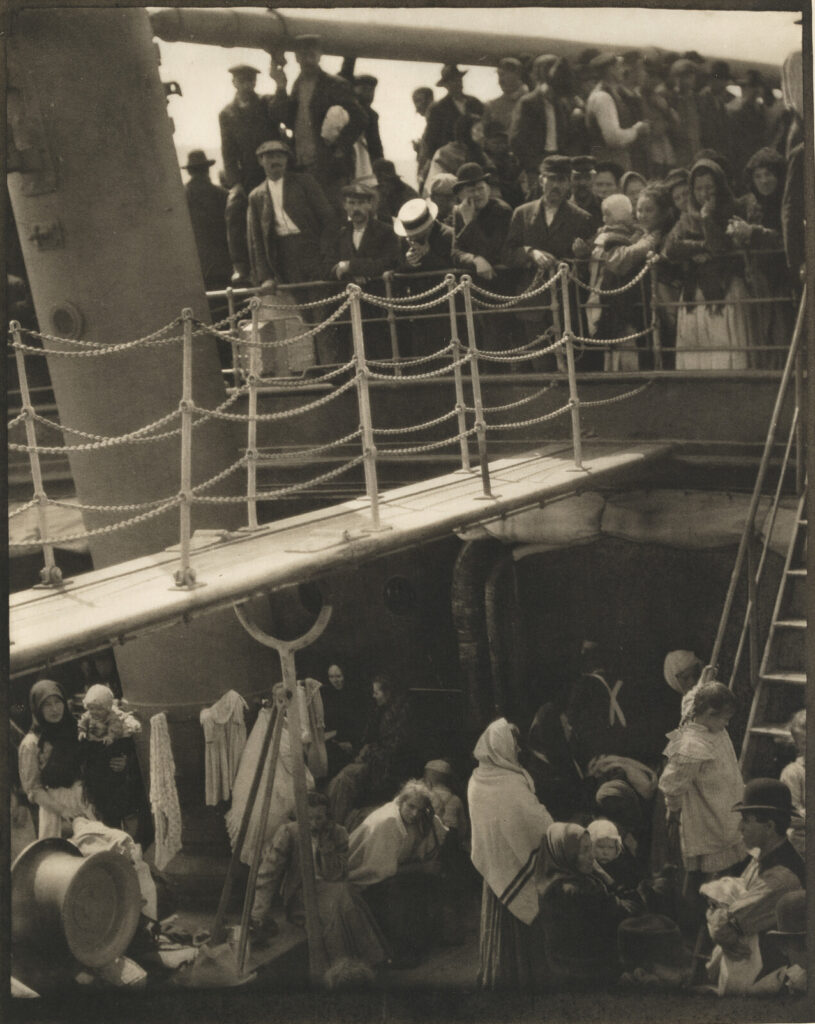
Alfred Stieglitz, The Steerage, 1907, Whitney Museum, New York City, NY, USA.
Alfred Stieglitz is one of the most influential photographers who ever lived. Published in 1911 along with a Picasso drawing, The Steerage is a candid shot of people on a vessel. At this time in his career, Stieglitz was inspired by the Cubist painters, of whom this photograph owes so much of its appeal. This mass gathering of people on a ship is an aesthetic representation of Modernism in its disparate depths and myriad forms. At the same time, it is a brilliantly arresting image of people on the move, with personal belongings in tow, leaving one place to stay in another.
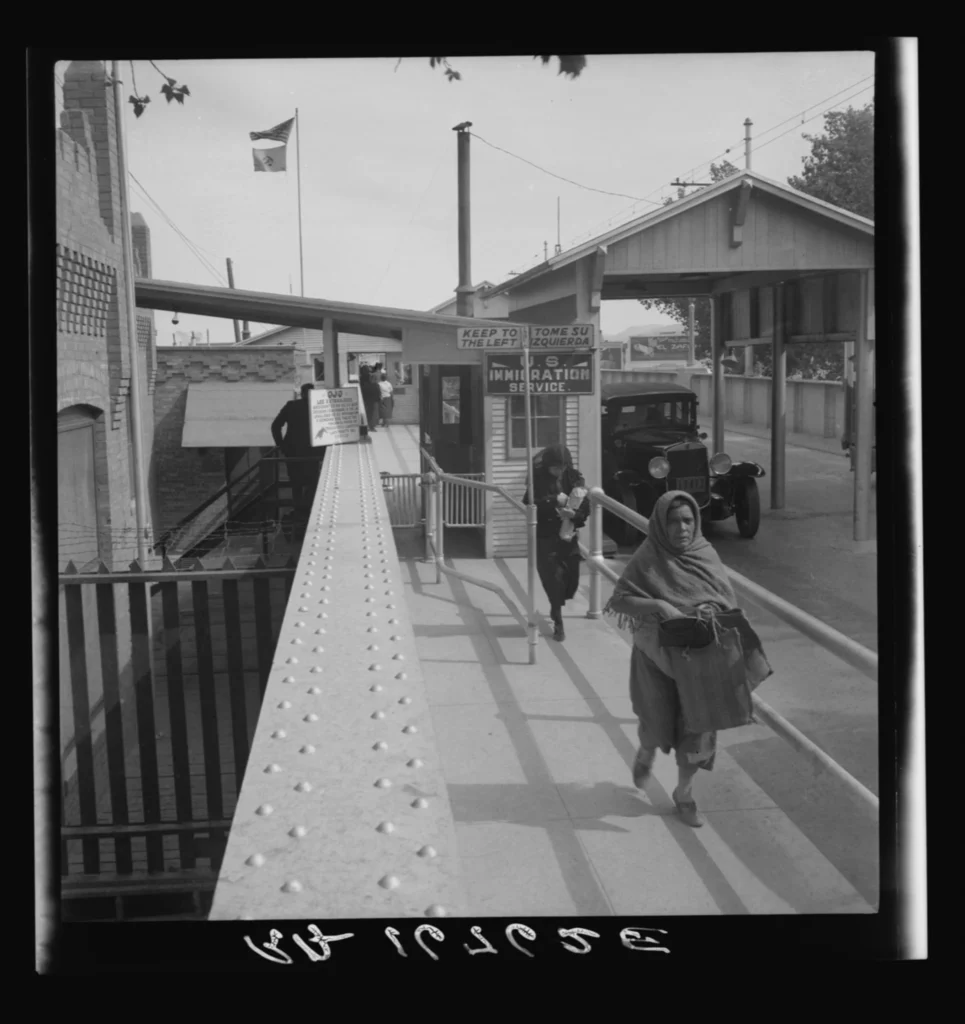
Dorothea Lange, Crossing the International Bridge Between Juarez, Mexico, and El Paso, Texas, 1937, Library of Congress, Washington, DC, USA.
One of the great documentarians of the strife of American life, Dorothea Lange, depicts the famous crossing on the southern border between El Paso, Texas, and Juarez, Mexico. A “U.S. Immigration Service” sign hangs near the road as two women walk onto the American side of the border. Their body movements look as if they are moving hastily, perhaps eager to get across. Each woman looks to be organizing her things with her hands, as they were likely inspected by border officials. Lange took photographs for the Farm Security Administration, which helped to facilitate transnational labor between Mexico and the United States. The women in this photo were likely on their way to work in El Paso.
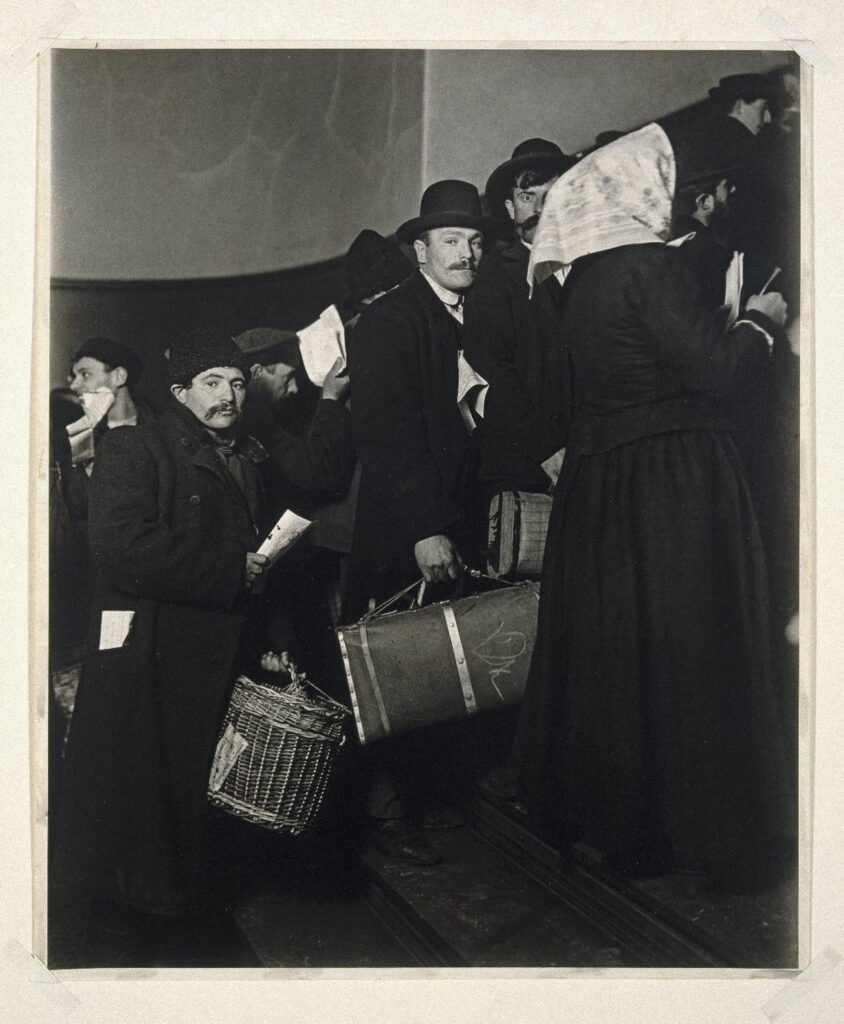
Lewis Hine, Climbing into the Promised Land, Ellis Island, 1905, Brooklyn Museum, New York City, NY, USA.
This photograph by Lewis Hine was taken in 1905 at Ellis Island. In the early 20th century, the New York harbor island hosted millions of immigrants as they went through inspection and processing before beginning their new lives in the United States. Hine ventured to the island to catch the humanity on display in migrant families and individuals, pushing back on the belief that they were noxious foreigners.
Two men look uncertainly at the camera as they carry suitcases. They are surrounded by people, possibly feeling a similar sense of apprehension. This photograph is a perfect encapsulation of the anxiety and unease of the migrant experience. The immigrants in this picture are at the height of the stressful yet potentially liberating transition process, waiting and hoping to start anew in a different place.
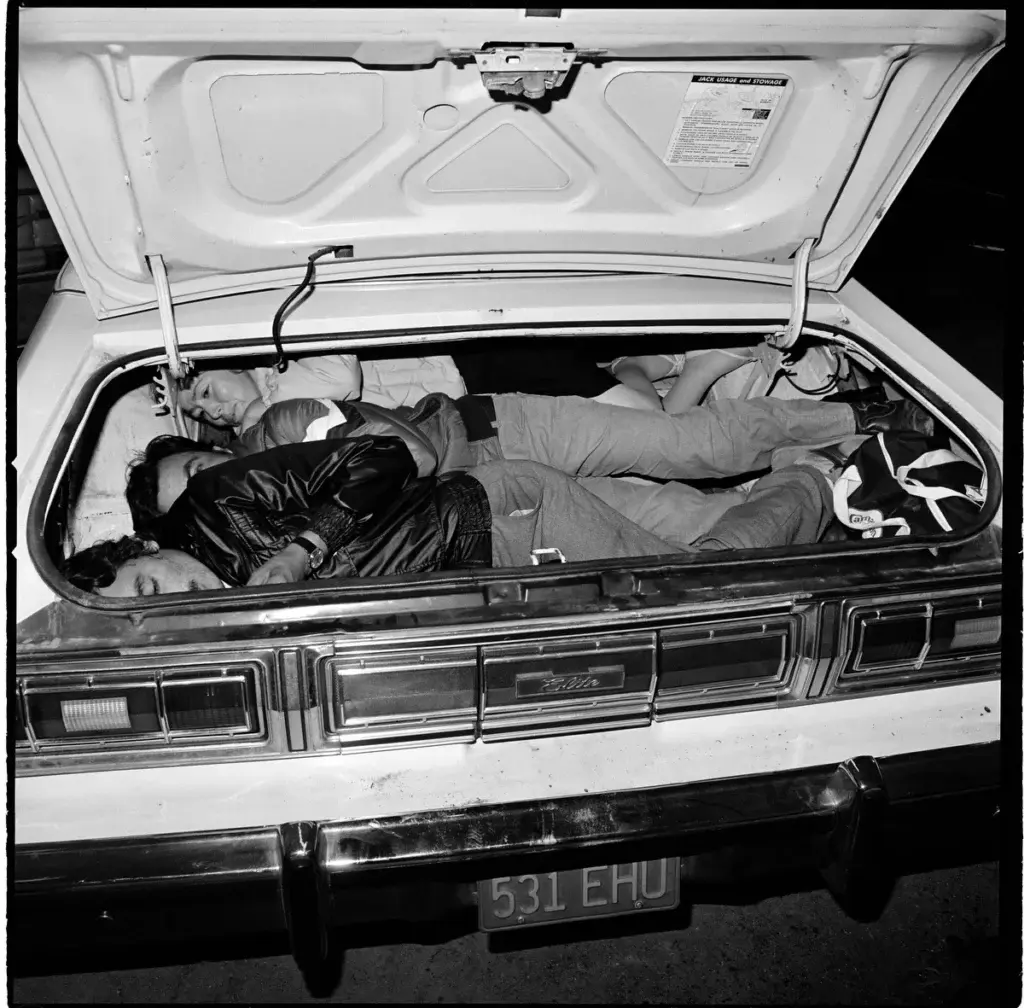
Ken Light, 8/2/1985, Brown Field Station, San Ysidro, California, 1985, San Francisco Museum of Modern Art, San Francisco, CA, USA. Artsy.
This photograph from the 1980s reveals the lengths people will go to find a better life. Photographer Ken Light traveled to the United States–Mexico border with his camera, following patrols. He took pictures as officers arrested migrants. Migrations to the U.S. from the southern border have been increasing immensely since the 1970s. Light was allowed access at a time that would now be considered unthinkable. He witnessed violence and beatings of immigrants at the hands of border patrol officials.
Light, ever the sympathetic artist, kept his camera lens focused on the people attempting to cross the border, recording the challenges and risks of the migrant experience in his photographs. These pictures still resonate deeply today.
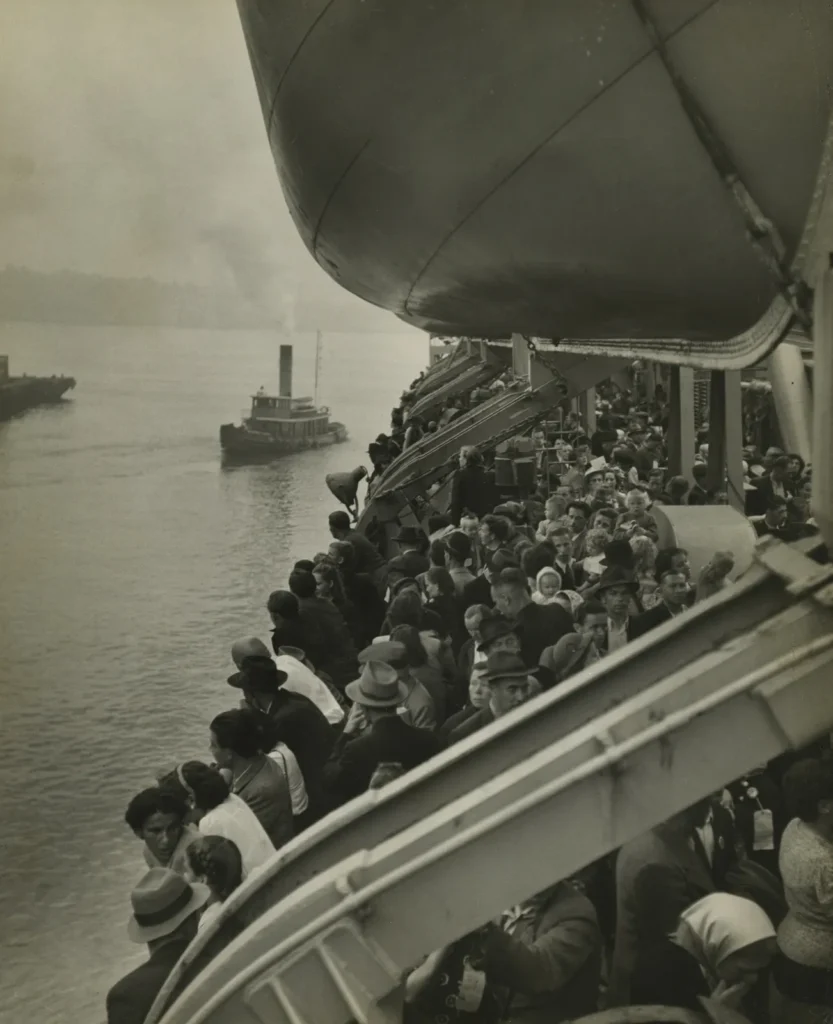
Ernst Haas, Last Displaced Person Boat (View of Immigrant Ship in New York Harbor, Bound for Ellis Island), 1951, Howard Greenberg Gallery, New York City, NY, USA.
One of the great immigration photographs of the 20th century, the migrant experience is poignantly rendered in this angle taken by Ernst Haas. Snapped for This Week magazine, Haas depicts the USS General R. M. Blatchford full of European migrants. The title invokes the incalculable number of people displaced by World War II. The postwar period of the late 1940s and early 1950s was another significant chapter of migrant influx to Ellis Island and the United States.
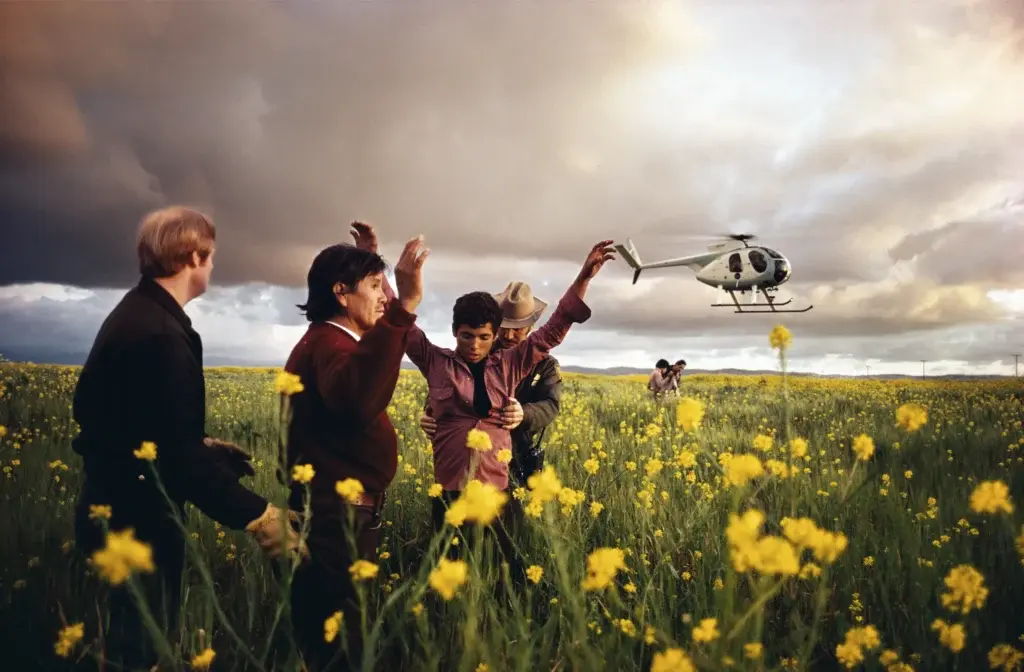
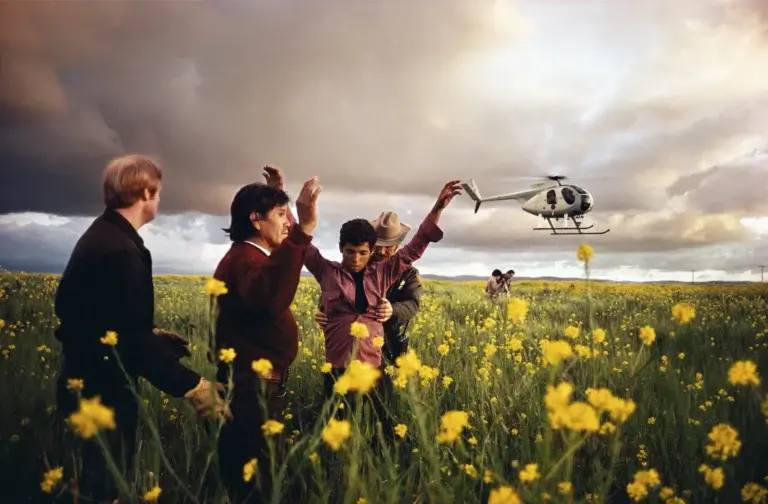
Alex Webb, San Ysidro, California, 1979, 1979, Howard Greenberg Gallery, New York City, NY, USA.
This photograph by Alex Webb shows the great lengths that countries will go to “protect” their borders. Taken in 1979, Webb’s picture portrays two Mexican immigrants apprehended by American border patrol officers. Though no firearms can be seen pointing at them, the two men hold their hands up in surrender. One of them is frisked before possibly being handcuffed. In the background, two other men can be seen under a helicopter. The men were probably spotted by border patrol in the helicopter.
The commotion of this scene is contrasted by its colorful location; a field of yellow wildflowers sprout in the foreground and background. Vivid clouds dominate the sky above. Nature works in this composition to both emphasize the drama on display and being removed from it.
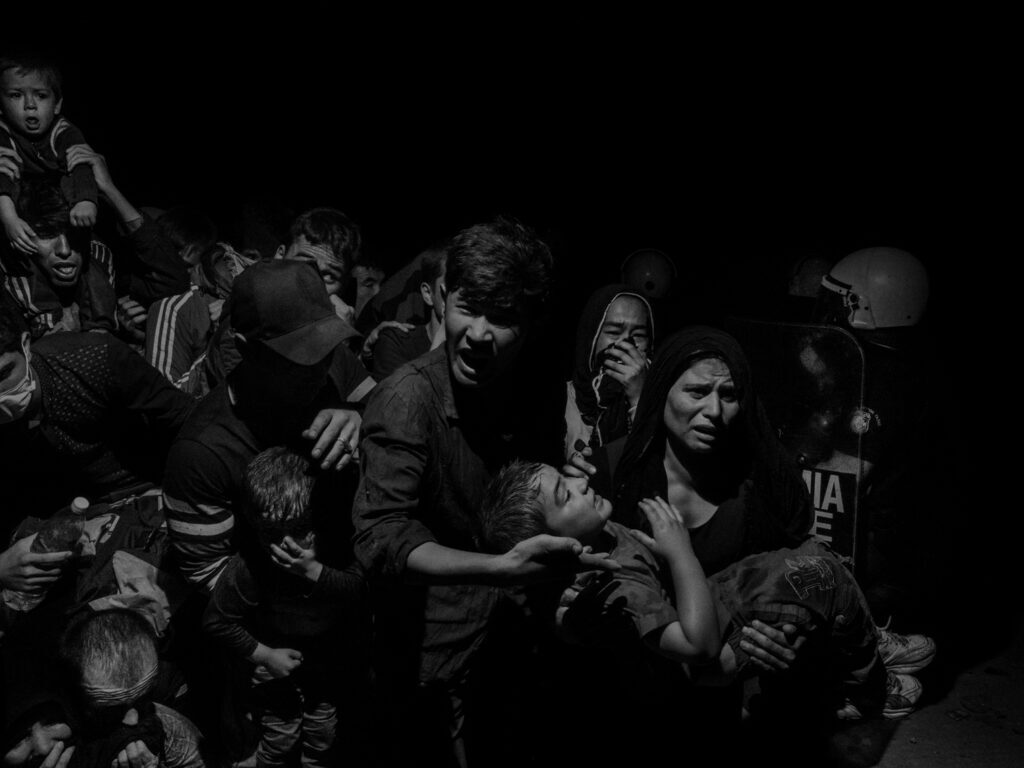
Alex Majoli, Scene #60410, Lesbos, Greece, 2015, Howard Greenberg Gallery, New York City, NY, USA.
Perhaps the most painful photograph on this list, photojournalist Alex Majoli’s 2015 depiction of Syrian refugees arriving in Lesbos, Greece, is one of the most striking examples of the migrant experience in the 21st century. The image displays the suffering of refugees as they face harsh conditions in Lesbos after fleeing their war-torn country.
Majoli captured the moment in his signature black-and-white. A young man in the center of the frame screams in torment as a woman next to him holds a child in her arms. They are surrounded by people covering their faces while riot police, in the shadowy background, block them with shields. The composition is reminiscent of Baroque-style paintings.
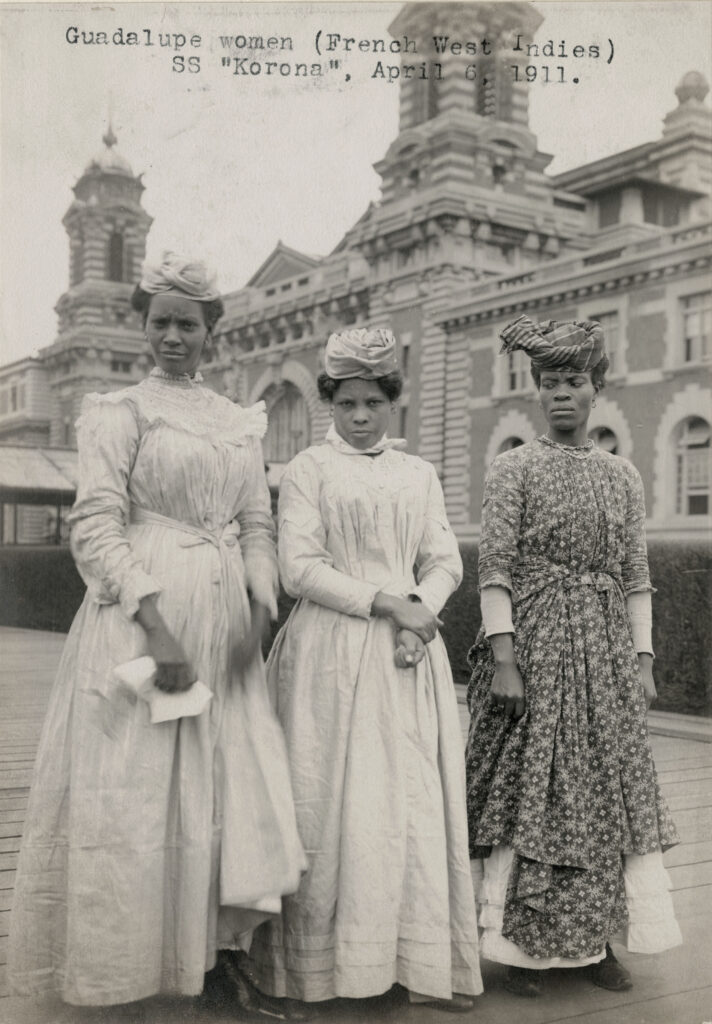
Augustus F. Sherman, Guadeloupe Women II, 1911. Let Me Get There.
In 1911, the American photographer Augustus F. Sherman, known for his portraits from Ellis Island, where he worked as a clerk, documented the arrival of “Guadeloupe Women.” These women were labeled as “non-immigrant aliens” journeying through Ellis Island to work as domestic servants in wealthy French Canadian households. Though they were contracted laborers and their travel coordinated by French Guadeloupe, Canada, and the U.S., these women still had to endure the arduous process of immigration inspection in North America.
This photograph by Sherman was likely intended to highlight the “exoticism” of the women, emphasizing their contrast among other immigrants at Ellis Island. However, their humanity, strength, and determination are still on full display.
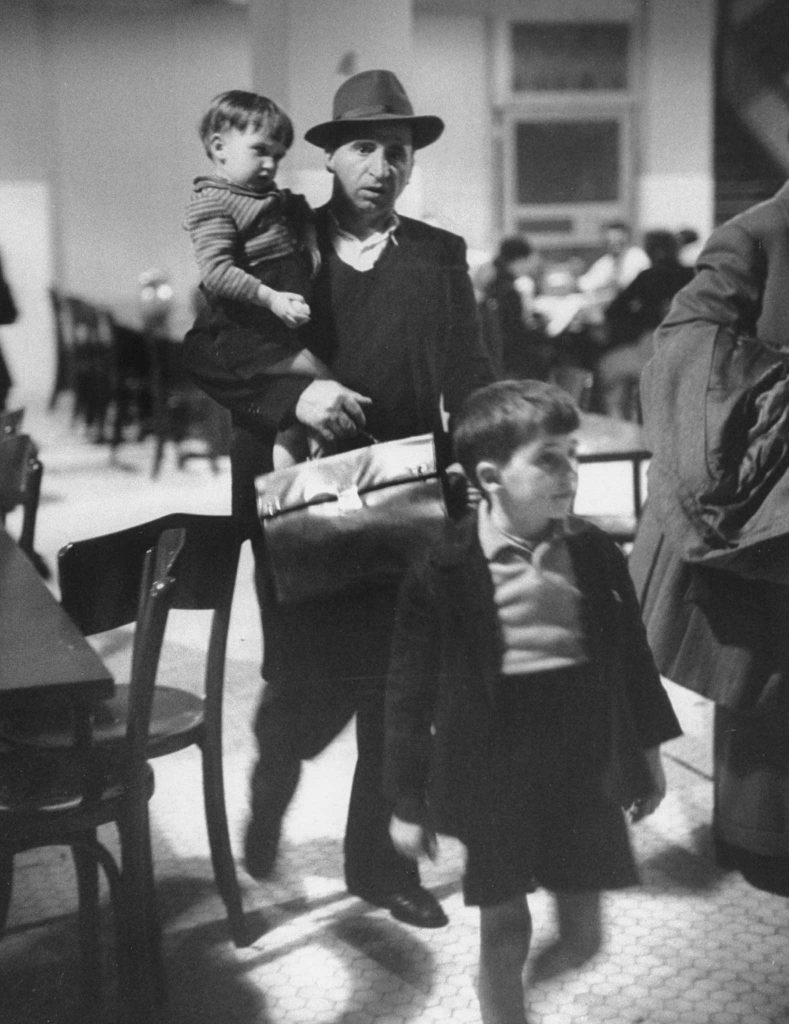
Alfred Eisenstaedt, Antonio Magnani Coped with His Children and Fat Briefcase Holding His Entry Papers, Ellis Island from Life, November 13, 1950.
It was difficult deciding on which of Alfred Eisenstaedt’s many iconic Life magazine photographs to put on this list. This one strikes a particular chord. The title featuring the name of its main subject suggests that Eisenstaedt not only photographed but conversed with immigrants at Ellis Island in 1950. The man, Antonio Magnani, has his children with him. He holds one child in his arm and a briefcase with his entry papers. This appears to be all he has. There’s no telling what they were fleeing from, why it was so important for them to migrate to the United States. The dynamism of the photograph hints at the necessity to find a better life in America.
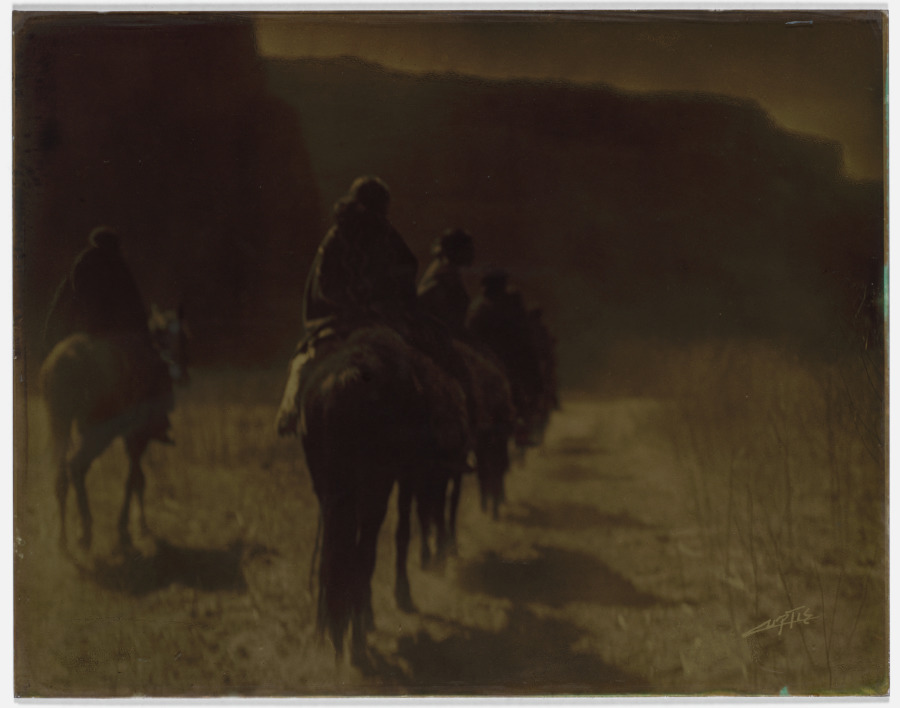
Edward S. Curtis, The Vanishing Race, 1904, Cleveland Museum of Art, Cleveland, OH
This photo by Edward S. Curtis is a stunning piece of early 20th-century photography. The famous work was made in orotone, a process involving a glass plate and a gelatin base that gives the printed positive a magnificent golden-toned brilliance. This scene captures the Navajo tribe riding into a distant canyon, each of their shadows cast on the trail below them. Curtis wrote that this showed “that the Indians as a race, already shorn in their tribal strength and stripped of their primitive dress, are passing into the darkness of an unknown future.” This photograph epitomizes the unwelcome and forced migrant experience of Native Americans.
DailyArt Magazine needs your support. Every contribution, however big or small, is very valuable for our future. Thanks to it, we will be able to sustain and grow the Magazine. Thank you for your help!

A writer devoted to the arts with a Master's degree in English and a specialization in film studies/history. Ars longa, vita brevis.
Artist Carrie Mae Weems was born in Portland, Oregon, USA. Now in her seventies, she is still actively working, and is considered one of America’s...
Candy Bedworth 1 February 2026
Tadeusz Rolke, hailed as an icon and legend of Polish photojournalism, died in his native Warsaw in July 2025, at the age of 96. He dedicated his...
Guest Author 6 October 2025
Salvador Dalí and Philippe Halsman’s 37-year collaboration challenged viewers and revealed connections between the traditionally realistic medium...
Theodore Carter 24 October 2025
Helmut Newton is considered one of the most important fashion photographers of all time. He often surprised and divided audiences by blending...
Nikolina Konjevod 7 July 2025