

Discovering the Netherlands with James McNeill Whistler
American artist James Abbott McNeill Whistler trained in Paris, lived in London, and fled to Venice after his infamous libel trial. He is much less...
Catriona Miller 16 October 2026
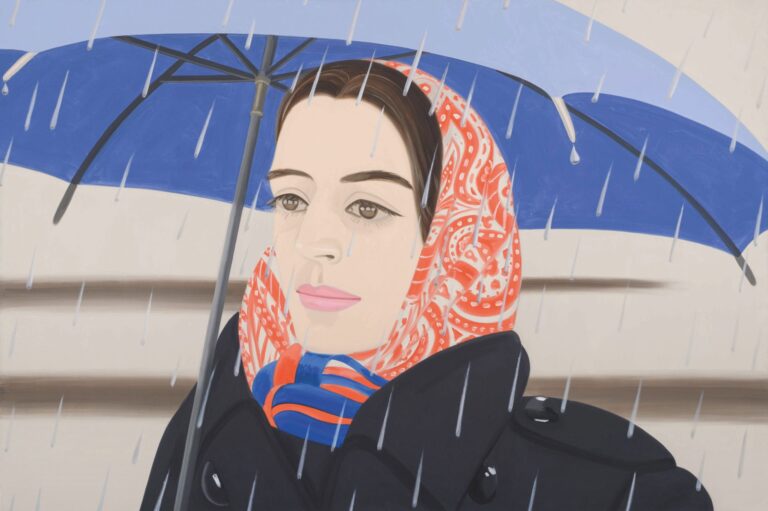
Alex Katz, Blue Umbrella, 1979, Brooklyn Museum, New York City, NY, USA.
Fall can be one of the most beautiful and atmospheric seasons. Some of us wait all year long to stay at home, cozy up on the sofa, read, or have a movie marathon while it is dark and pouring rain outside. However, if for any reason you have to leave your warm home, brace yourself by admiring these wonderful umbrellas in art!
The umbrella as we know it today has not been around for very long. For many centuries, it was used solely to protect from the sun, not the rain. In Western history, one of the first mentions of an umbrella as a shield from the rain (and used by women!) appears in the Dictionarium Anglo-Britannicum, a dictionary created by John Kersey in 1708.
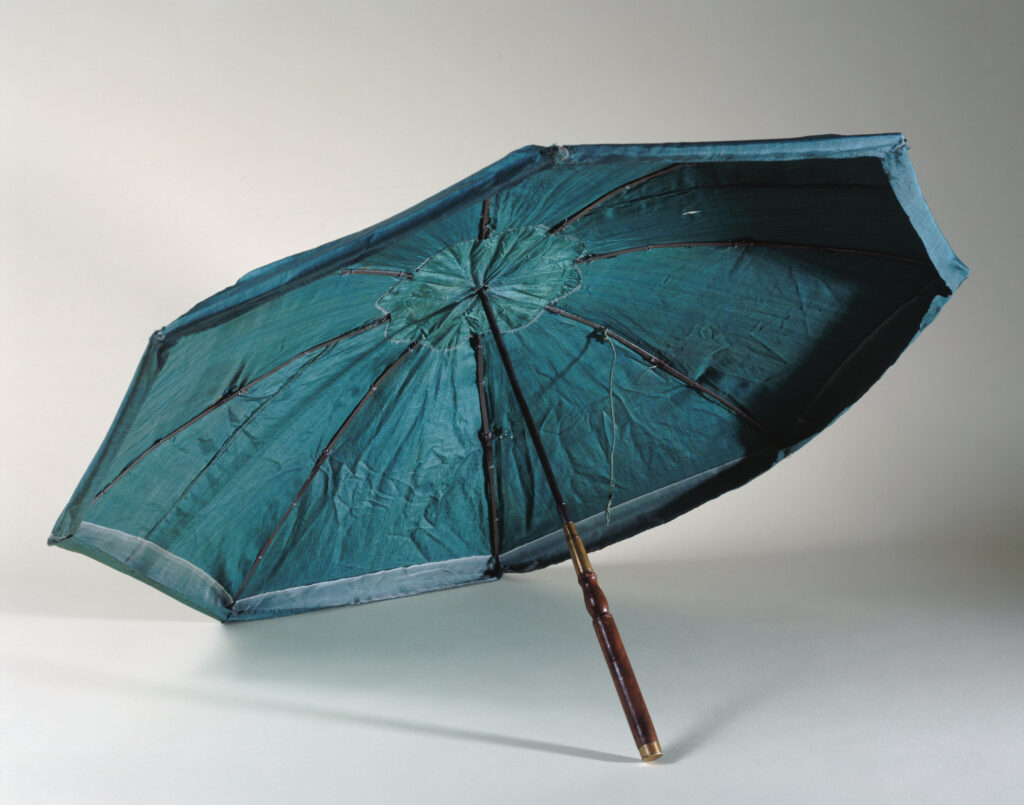
Marius-system umbrella, after 1715, Palais Galliera, Paris, France.
The first lightweight umbrella, resembling the one we use today, was invented in 1710 in Paris by Jean Marius. Afterwards, the maker was granted a five-year royal monopoly on the product. After 1715, when anyone could manufacture umbrellas, they entered everyday use and fashion in France. As a matter of fact, the inhabitants of other countries took a bit longer to adopt the new invention. Apparently, they only became popular in the United Kingdom at the very end of the 18th century. Let us see how umbrellas were used in art!
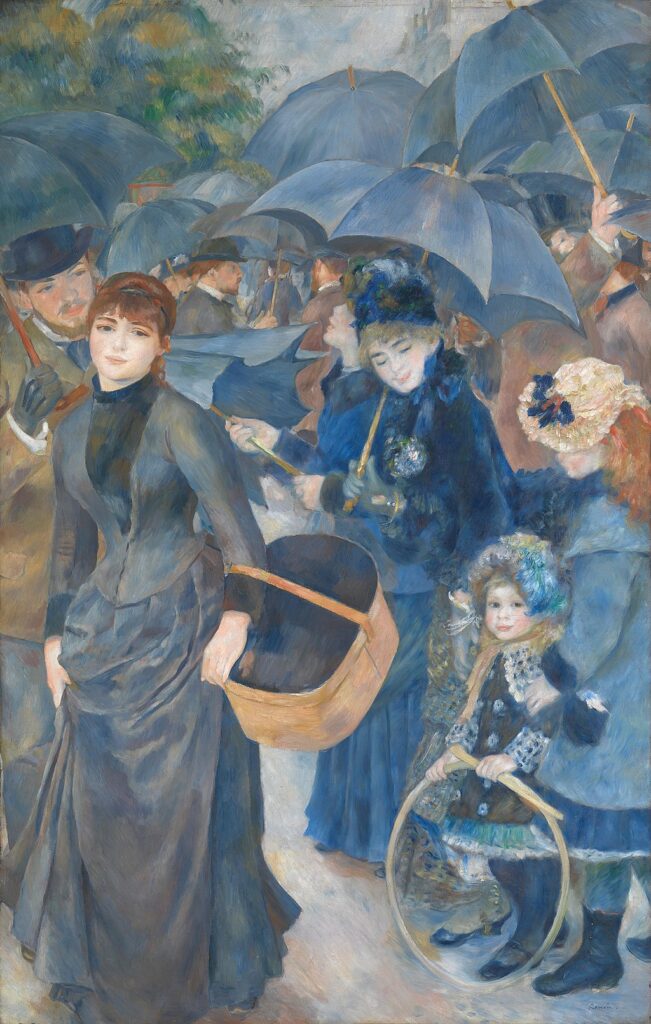
Pierre-Auguste Renoir, The Umbrellas, c. 1880–1886, National Gallery, London, UK.
The Umbrellas by Pierre-Auguste Renoir is one of the most famous paintings in which we can spot not one, not two, but at least nine umbrellas. Renoir painted a large crowd of people who are clearly very busy getting to where they need to be.
The artist worked on the painting in two stages between 1881 and 1886. Let’s look closely at the figures in the foreground. We can notice several stylistic differences between the three women portrayed on the right—who were painted in a very Impressionistic manner— and the lady who is looking straight at the viewer. What is more, they are even dressed in very dissimilar ways. Even in the 19th century, fashion was changing all the time!
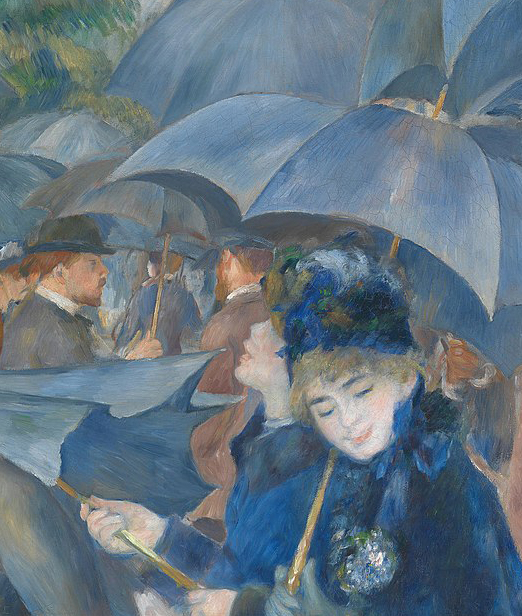
Pierre-Auguste Renoir, The Umbrellas, c. 1880–1886, National Gallery, London, UK. Detail.
My favorite character in the painting is the woman positioned almost in the middle of the composition. She is looking up toward the sky, as if she were checking whether it was still raining. Renoir perfectly captured her gesture of partially closing the umbrella.
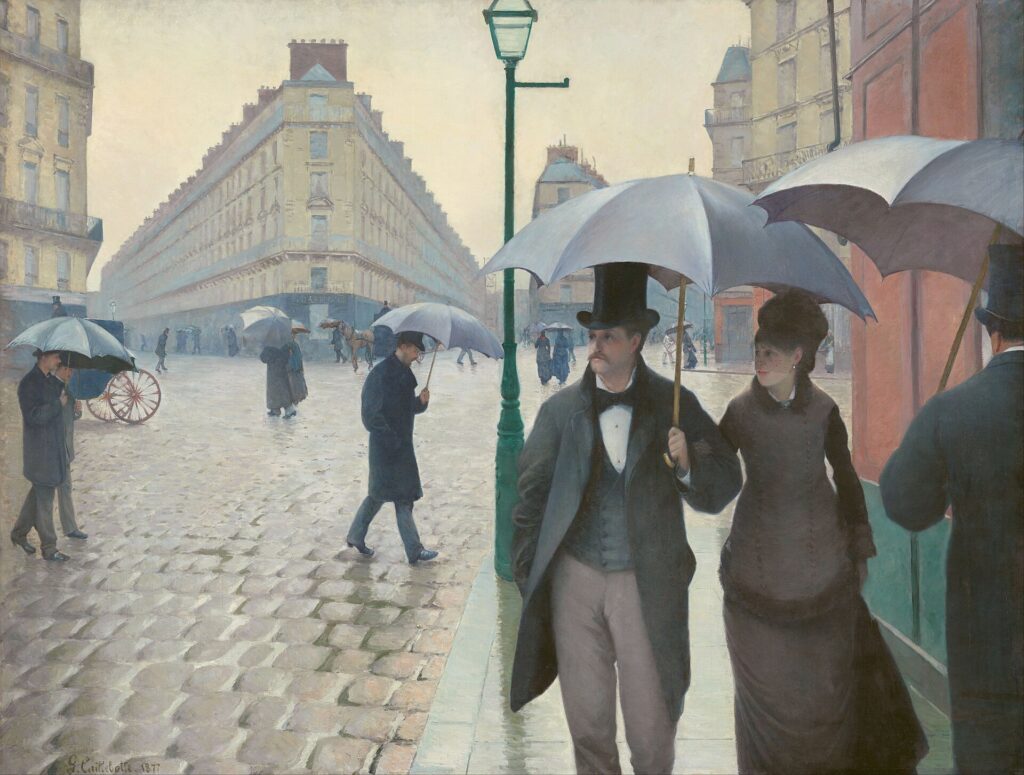
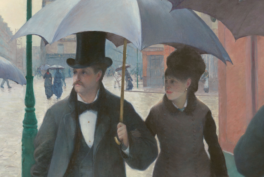
Gustave Caillebotte, Paris Street; Rainy Day, 1877, Art Institute of Chicago, Chicago, IL, USA.
Paris Street, Rainy Day (1877) by Gustave Caillebotte is one of the gems of the Art Institute of Chicago. We are looking at a couple strolling along a large Parisian boulevard on a rainy day. Both of them are dressed in very elegant clothing, and the umbrella that the man is holding not only protects them from the weather but is also a chic accessory, carried with care.
Funnily enough, as in many artworks featuring umbrellas, we do not actually see the rain falling from the sky. We can imagine the weather because all the figures are reacting to it, but it is not directly represented in the composition. This is the beauty of painting!
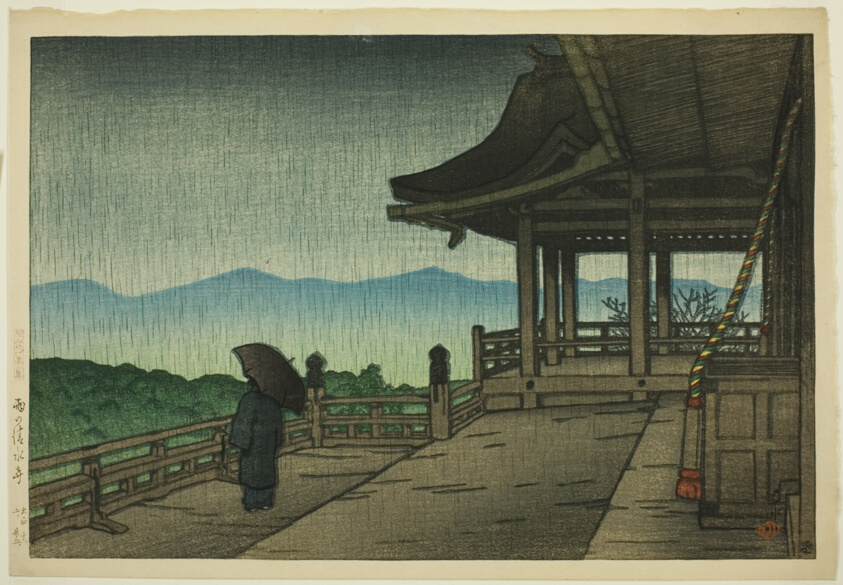
Hasui Kawase, Kiyomizu Temple in Rain, 1921, Art Institute of Chicago, Chicago, IL, USA.
Let us travel outside Europe and look at umbrellas in the art of Japan with Hasui Kawase’s Kiyomizu Temple in Rain from the series Souvenirs of Travel, Second Series (1921). The print is an excellent representation of how it might feel to be looking at the mountains from a beautiful temple in the rain. The artist effortlessly captured the meditative atmosphere. The figure stands under their umbrella in the rain, even though they could probably take shelter under the building’s roof. However, the experience would not be the same then.
In the print, Kawase used a warm, earth-toned color palette that enhances the natural world. Indeed, the human figure is very small, but it fits perfectly into the composition.
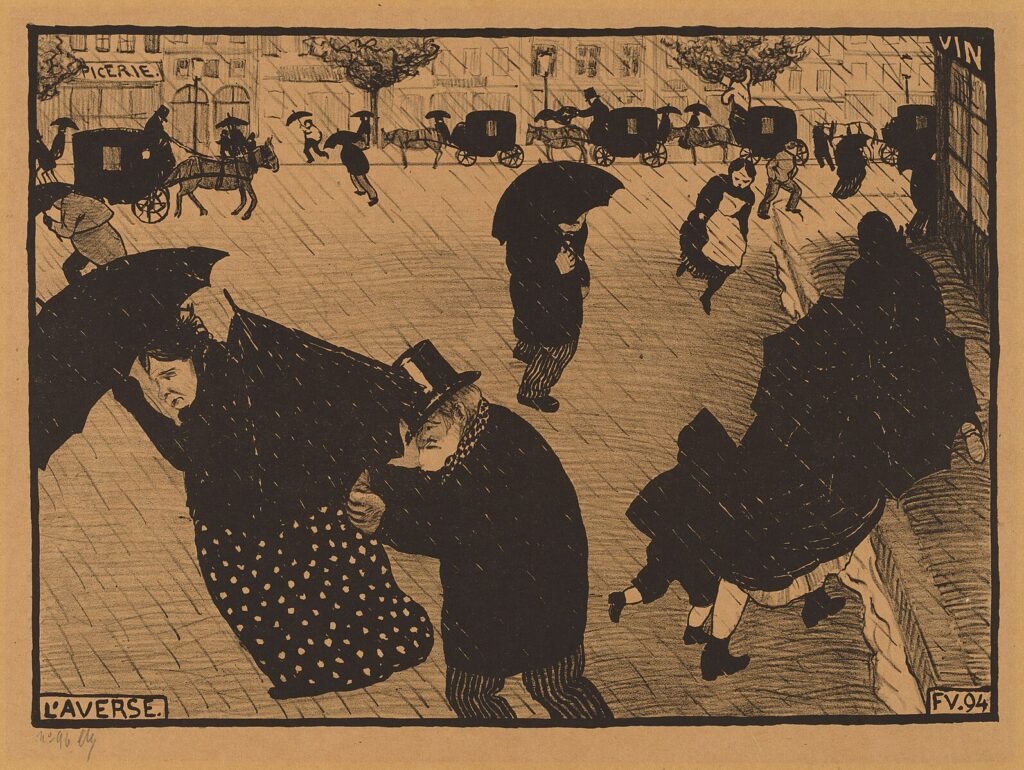
Félix Vallotton, The Shower, 1894, National Gallery of Art, Washington, DC, USA.
Coming back to France, it seems that artists really enjoy representing umbrellas in art—let’s look at The Shower by Félix Vallotton (1894). In this print, there is absolutely no doubt that it is raining. People are rushing to go inside, holding their umbrellas very tightly. Vallotton made a very interesting compositional choice by rendering some of the figures in angled postures, which correspond with the diagonal strokes that represent the titular shower. What a brilliant way to depict bad weather.
On the right side of the print, we can notice a group of three people who almost merge into one shape. Using only three figures, the artist represented a crowd that remains well protected when it stays together. Thankfully, they have at least one umbrella to share.
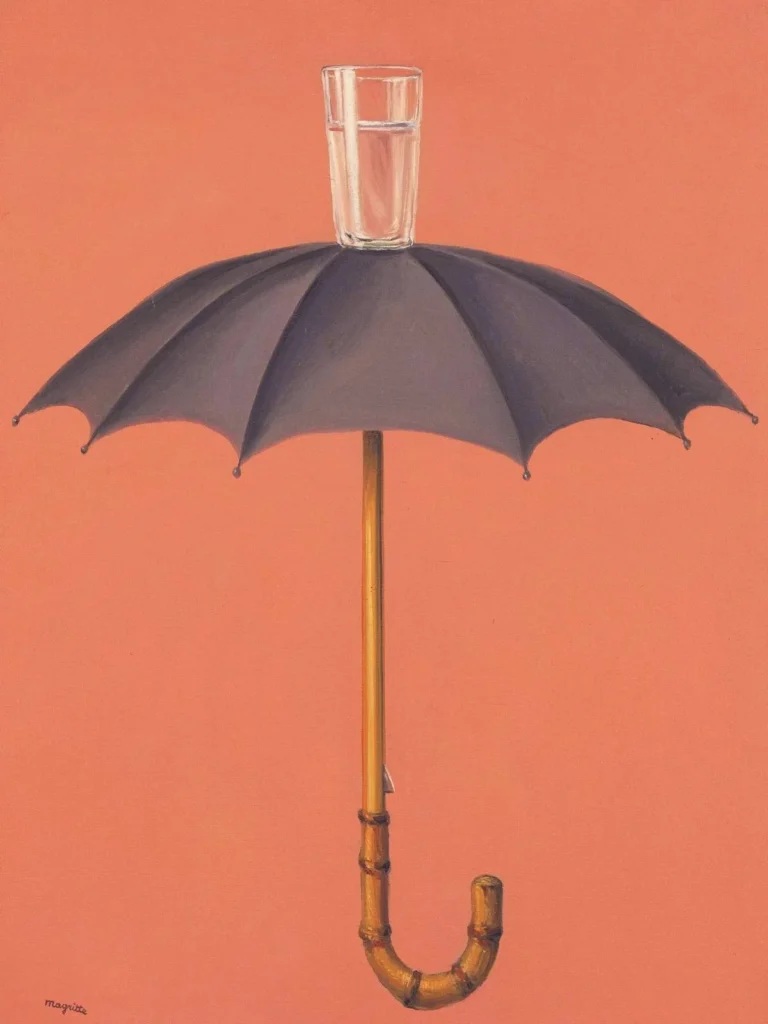
René Magritte, Les vacances de Hegel, 1958, Pompidou Center, Paris, France.
René Magritte is one of the masters of Surrealist riddles. One example is the painting titled Les vacances de Hegel (Hegel’s holidays). What was he trying to tell us?
Magritte painted a large black umbrella and placed a glass of water on top of it. When working on this painting, the artist had a goal not to represent a glass of water indifferently, or in other words, to depict it creatively. He then decided to pair it with an umbrella, emphasizing the object’s function, or rather, the fact that it is not fulfilling its purpose. He thought that Hegel would be a fan of his work; hence, he named the painting after him.
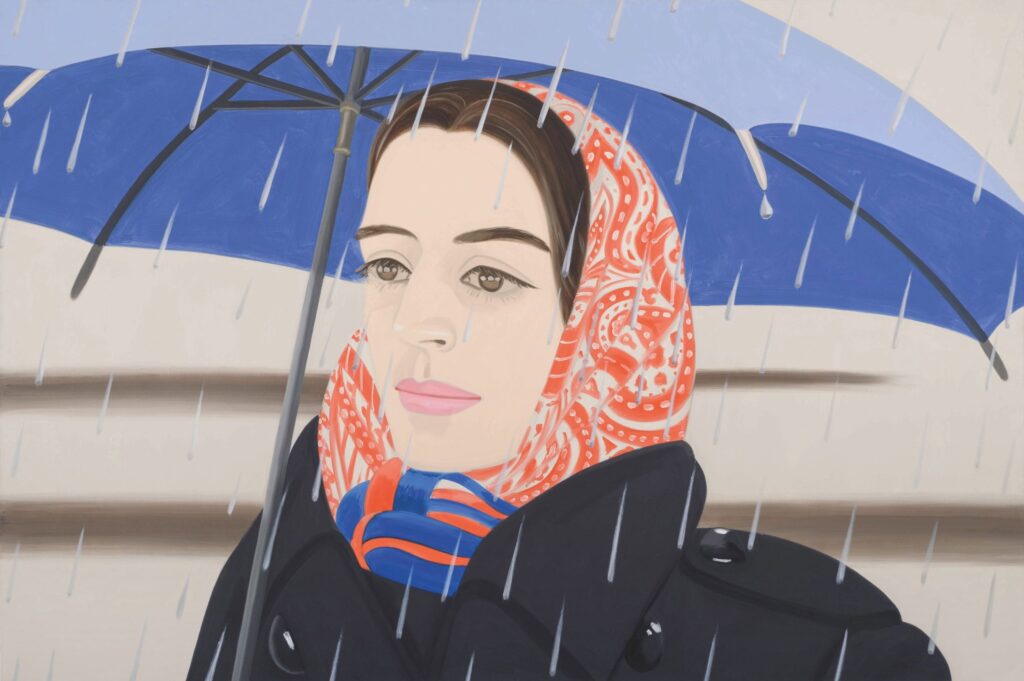
Alex Katz, Blue Umbrella, 1979, Brooklyn Museum, New York, NY, USA. Artsy.
Blue Umbrella (1979) is one of my personal favorite paintings. It is a portrait of Ada Katz painted by her husband, Alex Katz. Ada looks as chic as any New Yorker on a rainy day; she is wearing a black coat and a colorful headscarf matching her large blue umbrella. Ada and Alex have been married for almost 70 years, and he has probably painted her hundreds of times.
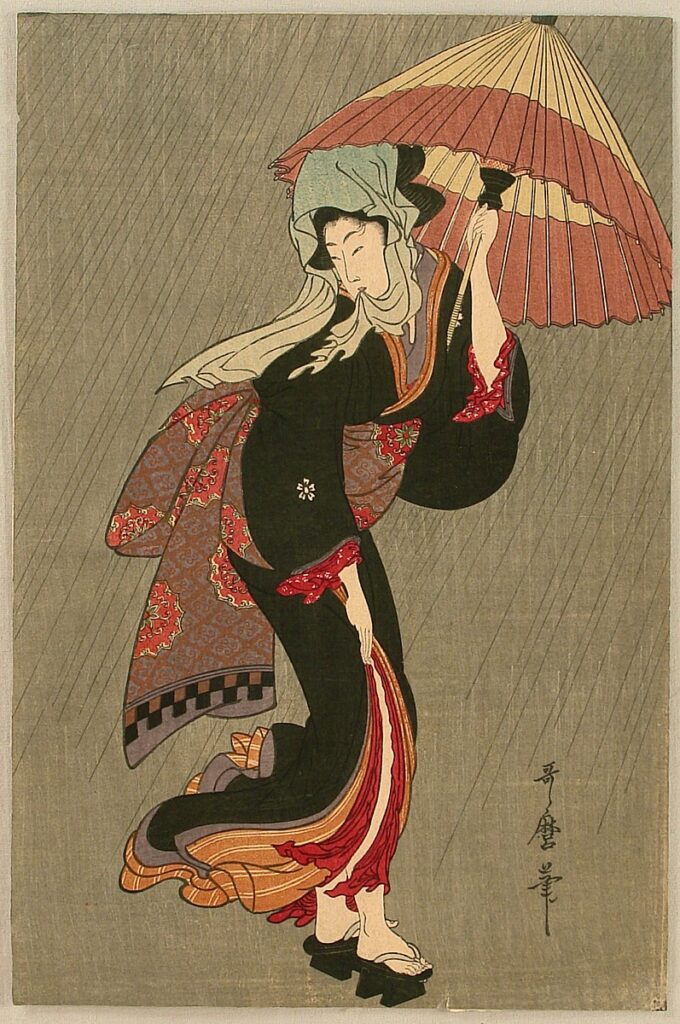
Kitagawa Utamaro, Beauty in the Rain, 19th century, University of Illinois Urbana-Champaign, Urbana-Champaign, IL, USA.
The painting is actually inspired by Japanese woodblock prints, just like the one by Hasui. Katz was particularly fond of the work of Kitagawa Utamaro and his depictions of women hiding under umbrellas. The flatness of shapes and lack of depth in Blue Umbrella are likely influenced by Japanese art, but that is not the only influence. Katz’s style can be described as Pop Art, a movement in which artists focused more on colors and shapes rather than on perspective.
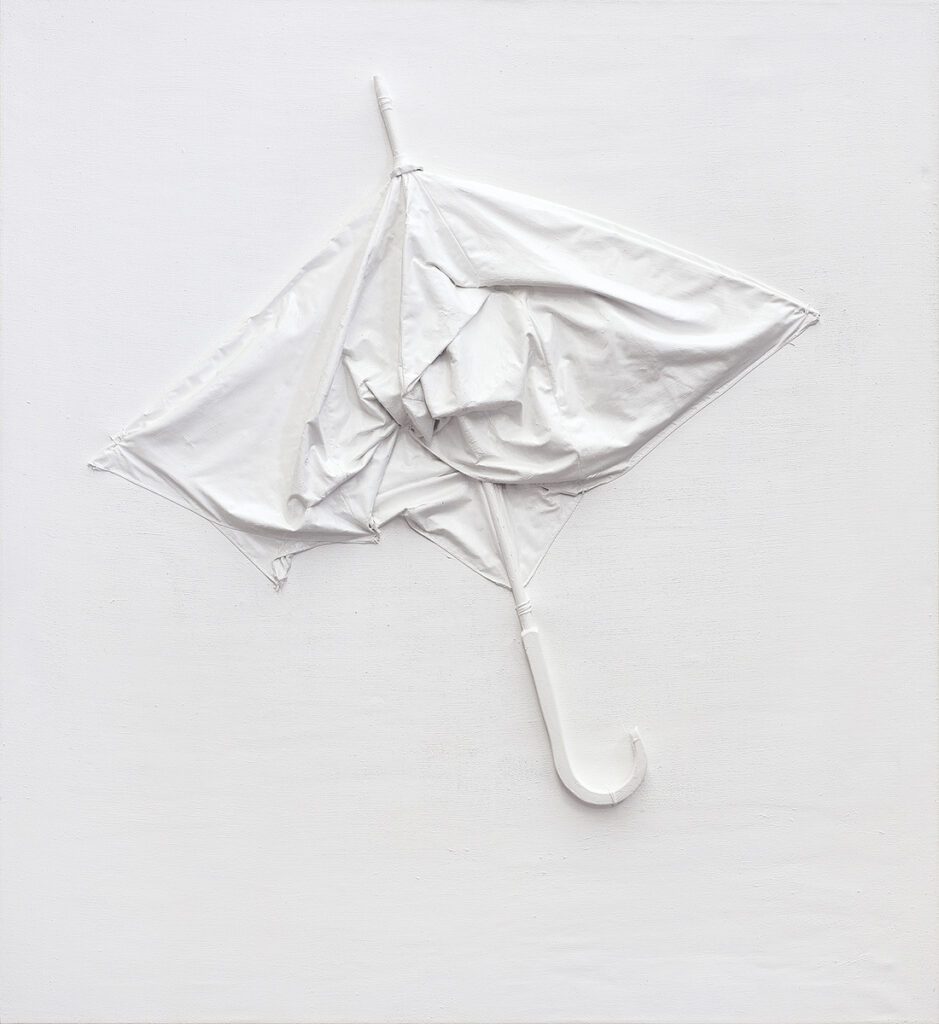
Tadeusz Kantor, Multipart 12, 1970, private collection. Art Info.
Is this a painting or a sculpture? It is an assemblage by Tadeusz Kantor. The artist took a real umbrella, mounted it on a canvas, and painted the entire artwork white. Kantor created multiple works in the series, and they were all showcased in the same exhibition. The pieces were then sold to various people under one condition: the collectors could do anything to the canvas—write on it, attach new objects, draw—but they were not allowed to paint an actual painting on it. By changing the canvases, the owners became co-authors of the work. This led to a second exhibition, where the altered works were presented. This is where the title Multipart comes from; all the works had multiple parts and authors.
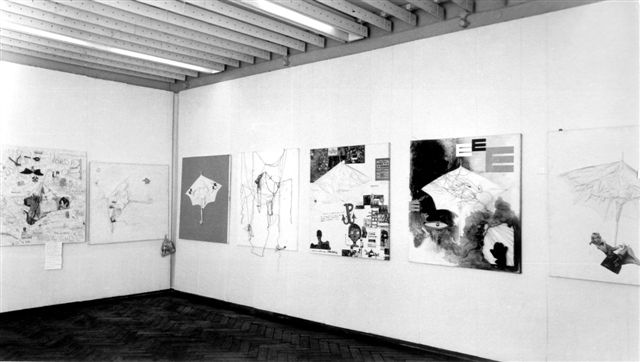
Exhibition view of Tadeusz Kantor, Multipart, 1971, Galeria Foksal, Warsaw, Poland. Photograph by P. Barącz. Cricoteka.
Which umbrella in art was your favorite? Let us know, and try to stay dry in this fall weather!
DailyArt Magazine needs your support. Every contribution, however big or small, is very valuable for our future. Thanks to it, we will be able to sustain and grow the Magazine. Thank you for your help!

Art historian living in Chicago. Passionate about women artists and abstract art.

An admirer of antiquity, art, and architecture. An avid reader and amateur photographer. Always curious, always on an adventure.
American artist James Abbott McNeill Whistler trained in Paris, lived in London, and fled to Venice after his infamous libel trial. He is much less...
Catriona Miller 16 October 2026
The gavel falls, and the Sotheby’s auction room in New York explodes into applause. Gustav Klimt’s Portrait of Elisabeth Lederer has just shaken...
Javier Abel Miguel 11 June 2026
Three figures hover in the air, their bodies angled downward as they descend upon a limp man below. His arms stretch outward, his body slack, as if...
Frank Schildiner 28 May 2026
Every Old Master canvas speaks in two registers at once: one for the eye, one for those who know how to read the flowers. Artists used flower...
Errika Gerakiti 18 May 2026