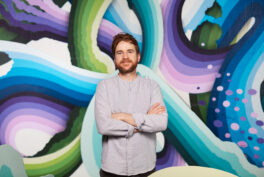
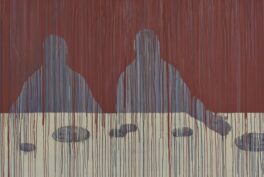
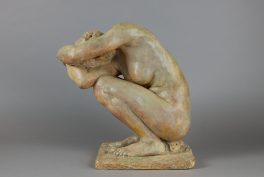
Maria Gvardeitseva explores identity, memory, loss, and feminism through the mediums of performance, sculpture, and video. Her works are completely immersive, very personal, and yet also political. And not without a certain dark humor! She was born in Minsk, Belarus, but fled the dictatorship in 2016, settling first in Latvia. Themes of displacement, exile, heritage, and belonging call to us from within her multilayered work.
Taking the baton from feminist artists like Marina Abramović and Ana Mendieta, Gvardeitseva is seizing her moment. She formally renounced her Belarusian identity in 2022 and currently lives in London. She has studios in London and Jūrmala, Latvia, and is part of the artists’ collective Rethinking Eastern Europe.

Maria Gvardeitseva, The Adoration of the Mystic Goat, 2024. Courtesy of the artist.
Candy Bedworth: What brought you to the UK and in particular to the city of London?
Maria Gvardeitseva: I moved to London to study at Goldsmiths, University of London, where I pursued a master’s degree in Art and Politics. During my time there, I realized I wanted to stay and continue developing my artistic practice. I live and work here, finding the city an inspiring place for my work.
CB: How do you see the British landscape (physical, political, and cultural) affecting your work or contributing to it?
MG: The British landscape deeply stimulates my critical thinking. Coming from a totalitarian regime, having been born in the Soviet Union and spending most of my adult life in Belarus, I find the openness of political debate in the UK incredibly engaging. It’s not just about how democracy and monarchy work, but also how they don’t, and observing that complexity is intellectually enriching.
London, in particular, offers a cultural density unlike anywhere else I’ve lived. It’s a place where I constantly encounter high-calibre creative expression—opera, theatre, performance, hybrid forms, which feed into my practice and keep me creatively alert. It’s an environment that provokes and nurtures at the same time.
I greatly admire Grayson Perry—my understanding of the British class structure and the cultural-political landscape has been significantly shaped by his work. I am currently reading his book Playing to the Gallery.
One experience that left a lasting impression on me was related to spatial and infrastructural inequality in London. When I studied at Goldsmiths in South East London, I was surprised to discover how public transport access reflected the class system. Unlike many cities with radial transport models, in London, ease of access to central areas often correlates with economic privilege. For instance, white-collar commuters from Surrey enjoy high-speed trains into the city, while areas like New Cross, where Goldsmiths is based, lack such connectivity. For someone like me, who has lived in various cities around the world, this class-based spatial discrimination was a stark revelation—and it has certainly influenced the way I think about access, visibility, and privilege in my work.

Maria Gvardeitseva, Bitter Herbs, 2023. Courtesy of the artist.
CB: What was your journey into art?
MG: My journey with art has two distinct phases. Until the age of 17, I dreamed of becoming an artist. I had a scholarship offer from the Academy of Fine Arts in Wrocław, Poland, where I was focused on graphic arts. But due to economic reasons—my parents couldn’t support me financially, and I had no idea how I would make a living as an artist—I turned to working with text. I earned a master’s in communications and spent many years working in the communications industry.
CB: And then?
MG: The second chapter of my artistic life began about eight years ago, when I visited the Venice Biennale. That was the moment when everything shifted. I was deeply exposed to installation art for the first time, and the experience was nothing short of shocking, in the best way possible. I remember every installation vividly. One in particular moved me so deeply that I returned to it six or seven times, whispering about dead poets and overwhelmed by a sense of awe. I felt like I had come home. Everything made sense. I didn’t need to explain anything, I just understood. And the only question I had was: Why did I spend so many years doing anything else?

Maria Gvardeitseva, The Adoration of the Mystic Goat, My Orthodoxy, 2024. Courtesy of the artist.
CB: Walk me through one of your own works—your favourite perhaps? What was the inspiration?
MG: All of my works are dear to me, but let’s talk about one of the latest, the installation The Adoration of the Mystic Goat. This piece delves into themes of identity and memory, particularly reflecting on my experiences as a migrant who relinquished my Belarusian citizenship and who is used to feeling like a stranger everywhere.
The installation is an homage to the Ghent Altarpiece, and I have a deep affinity for working with altarpiece formats. I used vintage windows fitted with mirrors and incorporated my photo archive. I based the work on the “big eight” identities (Ability, Age, Ethnicity, Gender, Race, Religion, Sexual Orientation, and Socioeconomic Status), deconstructing them within this piece.
The title references the Belarusian ritual of Koliada, where, during carolling, there’s a tradition involving a song about the “falling goat” who needs offerings to rise again. For me, this symbolizes my Belarusian identity—alive and full of strength, but requiring effort to stand. The work includes a video performance, and I chose mirrors to represent how our identities are like windows—we look into others and see reflections of ourselves.
I’m pleased with how it turned out; it closely follows the retable format. I’m fascinated by the idea of retables—pilgrims returning from crusades, bringing back various cultural artefacts, often repurposed into religious icons. These pilgrims were mostly outsiders, never fully reintegrating into their homelands. I find parallels with contemporary experiences of displacement. As Umberto Eco suggested, we might be living in a new Middle Ages, making it compelling to work with such historical formats.

Maria Gvardeitseva, The Adoration of the Mystic Goat, part of My Adams, 2024. Courtesy of the artist.
CB: What are you working on right now?
MG: I’m currently preparing a new exhibition that opens in September 2025, at Aorta Gallery in Pisa, Italy. It’s a sculptural installation titled Ex Contactu: Relics of Pain, Love and Joy. The project is about how we come into contact with our body, truly, with either pain or love. Ex contactu is a concept in Catholic relic culture, where sacredness is transmitted through physical touch. I ask: What if the body itself is sacred? What if touch, whether through pain, joy, or tenderness, makes it so? The sculptures are made from Himalayan pink salt—which is fragile, fragmentary, and dissolvable—echoing the way we experience the body through sensation and memory.
The exhibition is also a meditation on the female body as relic, as witness, as medium. Catholicism venerates female saints like Veronica Giuliani or Thérèse of Lisieux by preserving their pain—fragments of their bodies, their suffering, their mysticism. But it also fetishizes them: storing breasts, hearts, tongues, and hair in reliquaries. These women are both invisible and hyper-visible. Sacred and eroticized. Broken and worshipped. Through this show, I ask how a woman’s body can reclaim its agency. I want to return the female body to itself. To give it back its symbolic and emotional weight, not as an abstraction, but as a relic, as an archive, as a holy vessel.
CB: Who or what inspires you?
MG: I am inspired, above all, by life itself. I find joy in observing the pulsation of life, in recognizing it everywhere. I often think of myself as something of a forest creature. My connection to the forest is vital for me; it’s where I draw the most energy. A simple walk through the woods, lying in the grass or on moss, even in winter, is my way of restoring myself.
Nature, plants, trees, the living landscape, they all have an endless capacity to inspire me. But inspiration also comes from everywhere: exhibitions, performances, and everyday encounters. My phone is 95% filled with photographs of artworks I have seen, and somehow my memory retains every exhibition I’ve ever visited. Those visual impressions layer themselves inside me and never really fade.
Opera is another deep source of inspiration. I love opera as a genre because it feels like the ultimate form of artistic freedom—a synthetic art form where music, visuals, storytelling, and emotion intertwine.
Everything I read or watch influences my artistic practice. I always keep notes from books on my phone, quotes, fragments, thoughts, and I often return to them. Usually, each new project is preceded by five months to a year of reading and thinking. That research phase is essential for me.
Ultimately, I believe the role of an artist is to see the connections between things, between people, between events. To perceive the invisible threads that link everything together. For me, recognizing these paradoxical and unexpected connections is a profound source of creative energy.

Maria Gvardeitseva, Anatomy of Citizenship, performance, 2023. Courtesy of the artist.
CB: Recommend something to us—a novel, film, or podcast.
MG: I live surrounded by books and texts. One I’d love to recommend is The World of the Shining Prince by Ivan Morris. It’s a brilliant monograph about the Heian period in Japan (794–1185), centred in what is now Kyoto. This was a society where capital punishment was absent, and officials were selected based on their ability to elegantly layer 11 kimonos and compose poetry. Aristocratic women, in particular, had significant freedoms; they could choose their partners and inherit property. This period also gave us The Tale of Genji, considered the world’s first novel, written by a woman, Murasaki Shikibu.
Another book I’d recommend is Reading Sessions by Serbian author Goran Petrović. It’s a gentle, magical novel, free of cruelty or violence, that imagines what it would be like to live inside the pages of a book, inside literary landscapes. A quiet masterpiece for anyone who’s ever dreamed of disappearing into fiction.
As for films, I’d recommend The Color of Pomegranates by Sergei Parajanov. All his films are visual masterpieces, rich in imagery and symbolism.
CB: Who or what are your conscious, deliberate influences?
MG: Among visual artists, I would name Anselm Kiefer. I still remember the overwhelming emotion I felt when I saw his exhibition in the State Hermitage, dedicated to Velimir Khlebnikov. I couldn’t leave the gallery for hours—I was completely shaken by the power of his work. That show was a turning point for me, one of the moments that slowly but surely brought me back to art.
I would also name Marina Abramović. Her performances move me to my core. In April 2025, I attended Vexations at Southbank, produced by the Marina Abramović Institute and performed by Igor Levit. It was one of the most extraordinary performance experiences I’ve ever had. The trance-like atmosphere, the staging, the music—it was unforgettable. I’m convinced it will become part of art history.

Maria Gvardeitsa, Price-less, performance, 2023, Riga, Latvia. Courtesy of the artist.
CB: Who do you feel are the interesting new artists to watch out for today?
MG: Lily McMenamy or Camille Bokhobza, depending on which name she’s using, is an artist I find wildly compelling. Her performance piece, A Hole Is a Hole is bold, theatrical, unapologetically centered around the vagina, and full of biting irony. She makes fun of everything, including herself, and that’s something I truly admire.
Pavel Otdelnov is an artist whose work I follow with great interest. What resonates with me is how his practice embodies catastrophe, whether it’s the collapse of the Soviet Union, ecological disaster, or the trauma of war. His work feels like a quiet, persistent processing of shared historical breakdowns.
Ebony Russell, an Australian ceramicist, uses a piping technique borrowed from cake decoration to create delicate, sugar-like porcelain sculptures. Her work is rich, ornamental, and unexpected. I think she’s an artist poised for wide recognition.
And finally, Aliaksandr Adamau, a Belarusian artist whose humor and depth resonate with me. I own a piece of his that reimagines Michelangelo’s Pietà, but instead of the Virgin Mary, it’s Buddha holding the body of Christ. It’s absurd, bold, and full of layered meaning. I deeply admire that kind of playful seriousness.

Marina Gvardeitseva, Bedtime Stories Fading Away, 2024. Courtesy of the artist.
CB: What is the best piece of advice you have ever had with regard to your art?
MG: I came to art after 16 years in consulting and agency work. I know what it means to hit KPIs (Key Performance Indicators), to perform, to deliver. But the art world doesn’t follow that logic. It’s not linear or goal-driven. Trying to measure artistic progress with business tools can lead you nowhere. For a while, I had this internal metric—I kept comparing my “artist age” to my biological age, as if I needed to catch up. And then a well-known gallerist and advisor said to me, quite bluntly, “You need to get off your own back.” That changed everything.
Being an artist is difficult. It’s stressful. Often financially precarious. The only sustainable fuel is joy: the joy of making, of following intuitive ideas that strike like lightning. If you’re constantly judging yourself, you cut yourself off from the very reason you do it in the first place. Art demands presence, not KPIs.

Maria Gvardeitseva, Men in Suits, performance, 2024. Courtesy of the artist.
CB: What do you want the viewer to see or feel when they engage with your work?
MG: I want them to return to raw emotion. It doesn’t matter if the feeling is pleasant or painful—I just want it to be real. We live in a world full of systems and templates: social, economic, governmental. Everything is designed to regulate how we think, act, and consume. Art, to me, is the last stronghold of freedom. I hope my work can create space for someone to feel something unfiltered. I want them to feel alive. That’s all.
CB: What was the best thing about your arts education at Goldsmiths?
MG: The best part was the way it completely changed my mindset. I read more during that time than I had in years. I honestly didn’t think it was possible to shift so profoundly at the age of 40, but that’s exactly what happened. I chose my own path through the programme and spent months immersed in material about war, violence, and human suffering. I cried more during those months than ever before in my life. And that’s probably the best thing that happened to me.

Maria Gvardeitseva, Bitter Herbs: Bilunai Lithunia, 2023. Courtesy of the artist.
CB: What is the best thing about being an artist? And the worst?
MG: The best thing about being an artist is that moment when everything flows, when you feel energy rushing through you, a connection to something bigger. That joy, creativity, and sense of time stopping—it’s extraordinary. Nothing compares to it. The worst? Without question: the money. Art is one of the most paradoxical spheres—it’s seen as privileged, yet it’s almost impossible to make a living from it. That contradiction can be deeply frustrating.
If I weren’t an artist… well, I’ve reinvented myself so many times already. I’ve had other careers. But I think this artist’s identity is my favourite so far. Still, I don’t limit myself to art; I have a lot of interests. If I had to choose another path, I’d probably become an obstetrician. I think there’s nothing more miraculous than witnessing birth. What could be more powerful than that?
CB: Can you make a living from your craft?
MG: At this stage in my career, I wouldn’t say that my artistic practice fully sustains me financially, though I’m steadily moving in that direction. I know that around 85% of artists with a master’s degree earn so little from their practice that they can’t even afford their supplies. Thankfully, I’m not quite in that category, but I’m also far from the blue-chip art world. I invest and work as a co-founder in another business venture to support my practice. That additional income gives me the freedom to create on my terms.

Maria Gvardeitseva, Drygva, Breathe In, Breathe Out, 2022. Artist’s website.
CB: Your Instagram account perplexed me, to be honest. The art pieces are incredible—poignant, personal, yet also political. Expertly exploring the generational and individual trauma of war and exile. And yet a lot of your feed shows you on exclusive and expensive trips: top-notch resorts in Thailand and Monaco, private helicopters in Dubai, yachts in Sicily. It looks like a Vogue shoot. I must admit to being surprised by the juxtaposition of these two very different worlds.
MG: Thank you—I was genuinely touched by how you described my work. And I was equally intrigued by the worldview implied in your question. It reflects a paradigm I’ve encountered many times: that a wealthy, attractive woman must be a passive object in a patriarchal world. That she cannot possibly be a subject with agency, intellect, or political intention. The mention of a “Vogue shoot” made me smile. It suggests that curated beauty, pleasure, or visibility must be signs of vanity or submission to the male gaze. But whose gaze are we talking about? Are we sure it’s not the female gaze? Or simply my own?
I carry many identities—artist, mother of four children, migrant, performer. And yes, one of them is the identity of a beautiful woman. And yes, she requires effort. She ages. She changes. But she’s mine. And no, I don’t apologize for her. Nor do I owe the performance of pain or asceticism to validate the seriousness of my art. Who said artists must be poor, invisible, and shrouded in black to be taken seriously? For me, art is the last stronghold of freedom. And the most radical form of expression I know is to live fully, without permission, and on my terms.

Maria Gvardeitseva, The Adoration of the Mystic Goat, part of My Orthodoxy, 2024. Courtesy of the artist.
CB: What would success look like to you?
MG: Success, for me, means having exactly as many artistic spaces to realize my ideas as I have ideas to realize. And I have an incredible number of them. So success, to me, is measured by access to spaces where my work can truly unfold.
CB: What are you most proud of in your life and your work so far?
MG: I’m proud that, at 43, I’ve managed to keep my sensitivity intact. That I’m still open to new things. That my nervous system, despite everything it’s been through, has remained flexible enough to allow for change, for growth, for softness. That I can still live with an open heart. That, more than anything, is what I’m proud of. The rest, honestly, is dust.