
Is This Van Gogh’s One True Love? Sketches of Sien
Vincent van Gogh produced dozens of sketches of his live-in lover Clasina Maria Hoornick, known as Sien. Let's take a look!
Candy Bedworth 31 July 2025
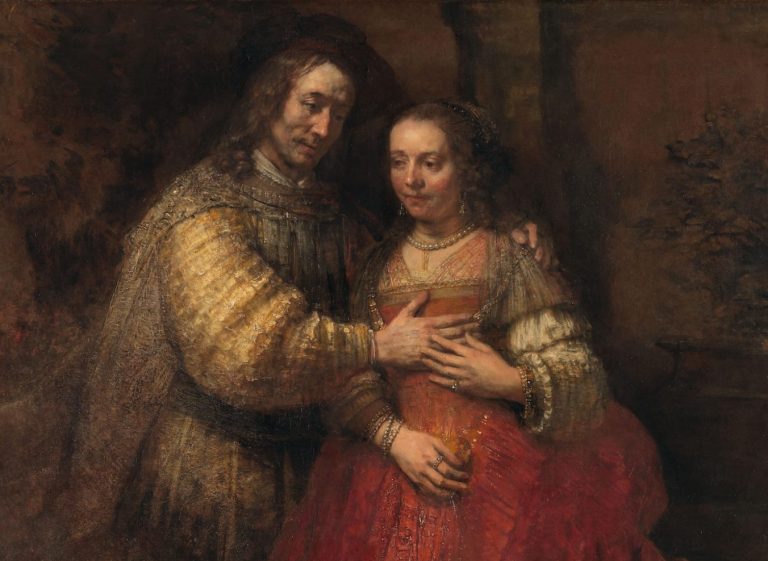
Rembrandt, Isaac and Rebecca (The Jewish Bride), c. 1665–1669, Rijksmuseum, Amsterdam, Netherlands. Detail.
Love is everywhere in 17th-century Dutch painting, but it rarely announces itself loudly. Instead, it is subtle and nuanced, seen through half-open doors and pulled-aside curtains, shown through small gestures and symbolic references, or in transactions that blur the line between affection and commerce. Here are 10 examples for Valentine’s Day.
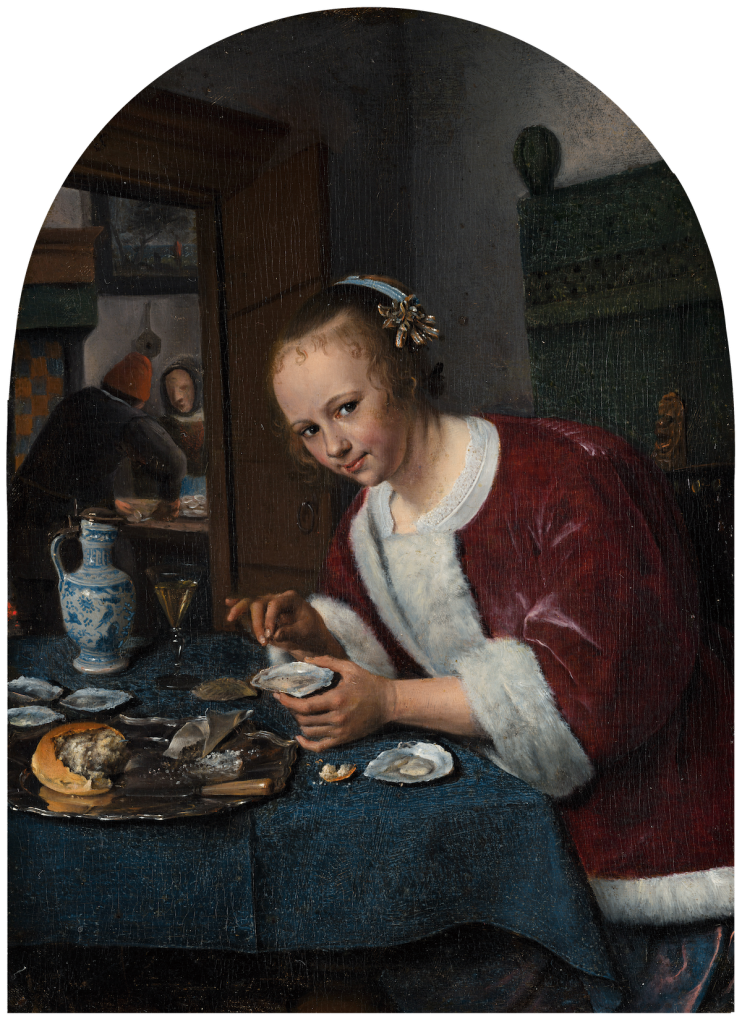
Jan Steen, Girl Eating Oysters, c. 1658–1660, Mauritshuis, The Hague, Netherlands.
The girl in the painting is playful, flirtatious, and knowingly provocative. Oysters were widely thought of as aphrodisiacs in the 17th century, making the intent of her half-smile easy to interpret. She seems to be offering us more than oysters. Her loosened clothing and informal posture signal erotic availability. Another couple through the doorway is engaged in a similar activity—he is shucking oysters for his lady-friend. And the fact that the only other piece of furniture in the room is a bed should leave no ambiguity about her intent. The painting captures love as appetite: enticing, and faintly dangerous.
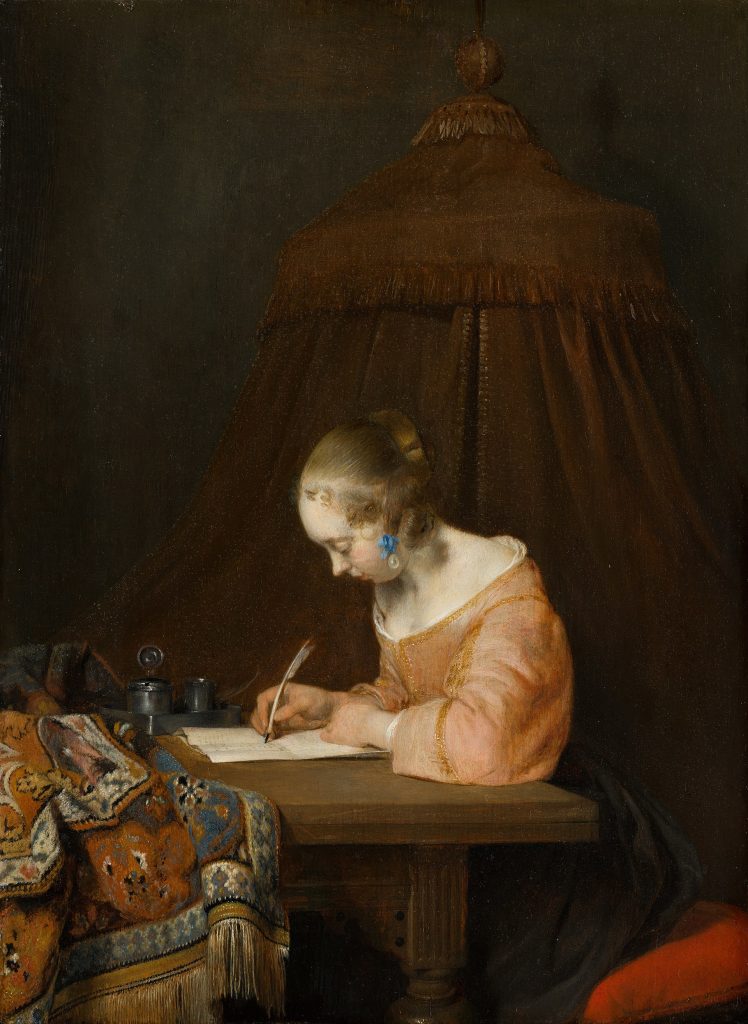
Gerard ter Borch, Woman Writing a Letter, c. 1655, Mauritshuis, The Hague, Netherlands.
The letter writer has pushed aside the rug that has served as a table covering and has set about her task with urgency. The letter serves as a voice that must travel beyond the room. The woman’s elegant posture and absorbed gaze suggest emotional investment, but we are left to guess what words she is choosing and what message she wants to convey. As in Steen’s painting, the only other item of furniture in the room is a curtained bed, opened ever so slightly, suggesting that she is trying to convey something about the intimacy she desires.
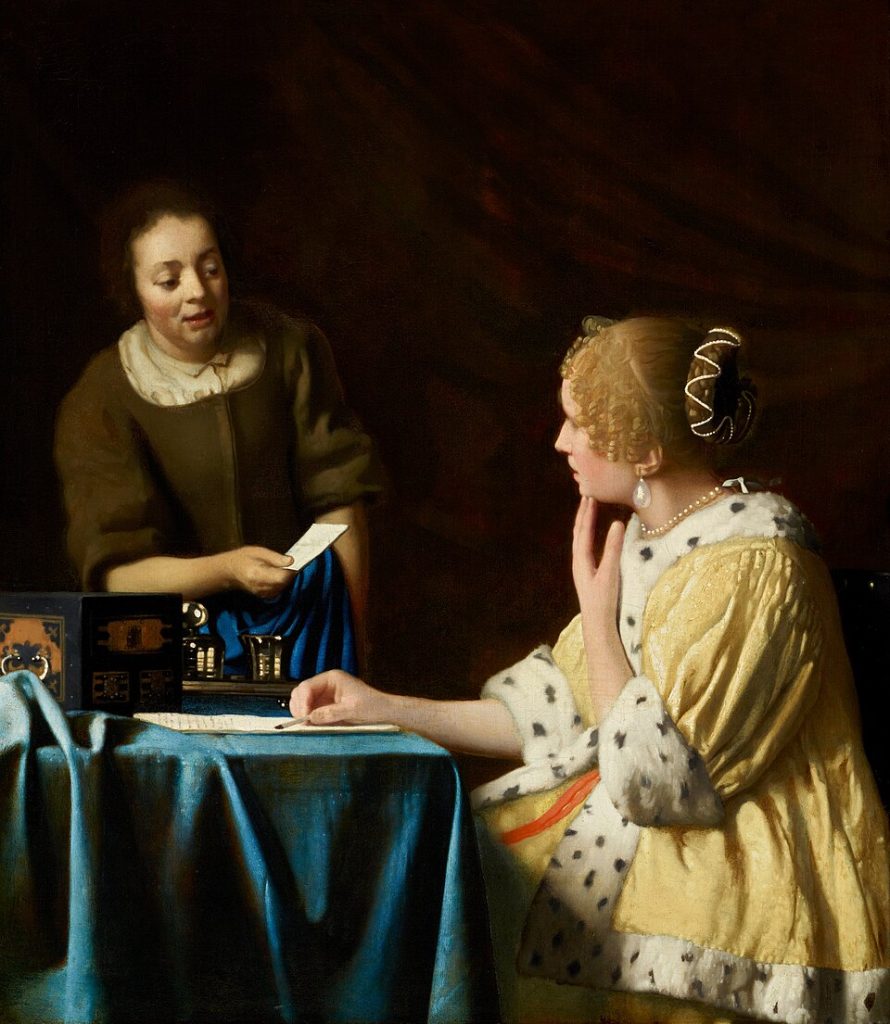
Johannes Vermeer, Mistress and Maid, c. 1664–1667, Frick Collection, New York City, NY, USA.
Here, love arrives by proxy. A maid delivers a message to her mistress, who has just been writing a letter. She sets down her quill and brings her hand to her chin, showing her surprise. Is the incoming letter from the person she is writing to? Or perhaps from a different lover? That would complicate things, wouldn’t it?! Vermeer offers no resolution, allowing love to exist as expectation rather than fulfillment.
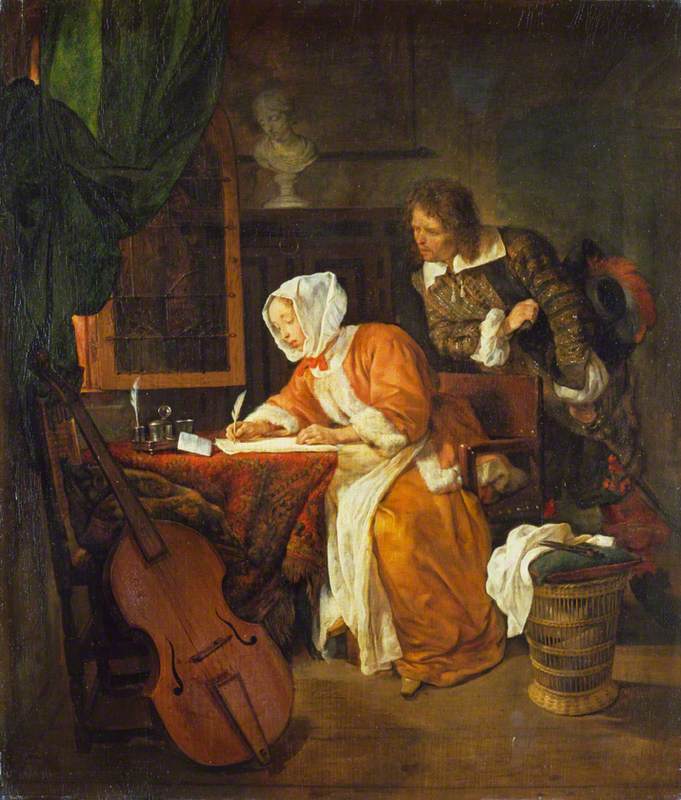
Gabriel Metsu, The Letter Writer Surprised, c. 1658–1660, the Wallace Collection, London, UK.
She is unaware of the voyeur behind her—not yet surprised, though soon she will be when he makes his presence known. The young woman has received a love letter. It sits against her writing set as she is quickly penning a reply. Absorbed in her task, she is not only neglecting the work basket at her side but is also unaware of the jealous suitor who is secretly reading the letter over her shoulder. The fact that the viola da gamba in the foreground is silent underscores the lack of harmony between the two figures in the painting. In a bit of Dutch wit, the jealous man is in fact a self-portrait of Metsu himself.
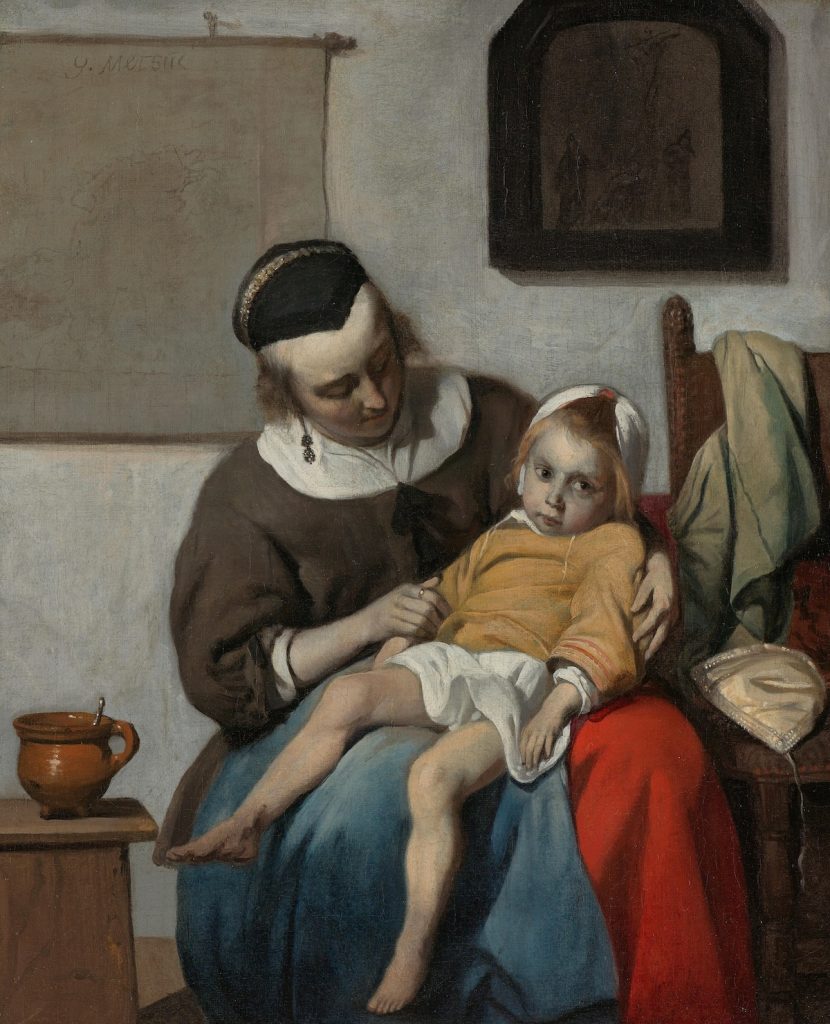
Gabriel Metsu, The Sick Child, c. 1644–1666, Rijksmuseum, Amsterdam, Netherlands.
In the 1660s, the plague ravaged Amsterdam, claiming perhaps as many as one in five lives. Around this time, Metsu painted this picture of a mother comforting her sick child. Their posture evokes the Pietà: the Virgin Mary with Jesus’ body on her lap. The painting on the wall, depicting Christ on the cross, serves as a poignant reminder of that suffering. Beside it hangs a rolled wall map, a reminder of the wide reach of death and the fragility of life during the plague years. Love here is vigilant and helpless at once, expressed through presence, responsibility, and quiet devotion.
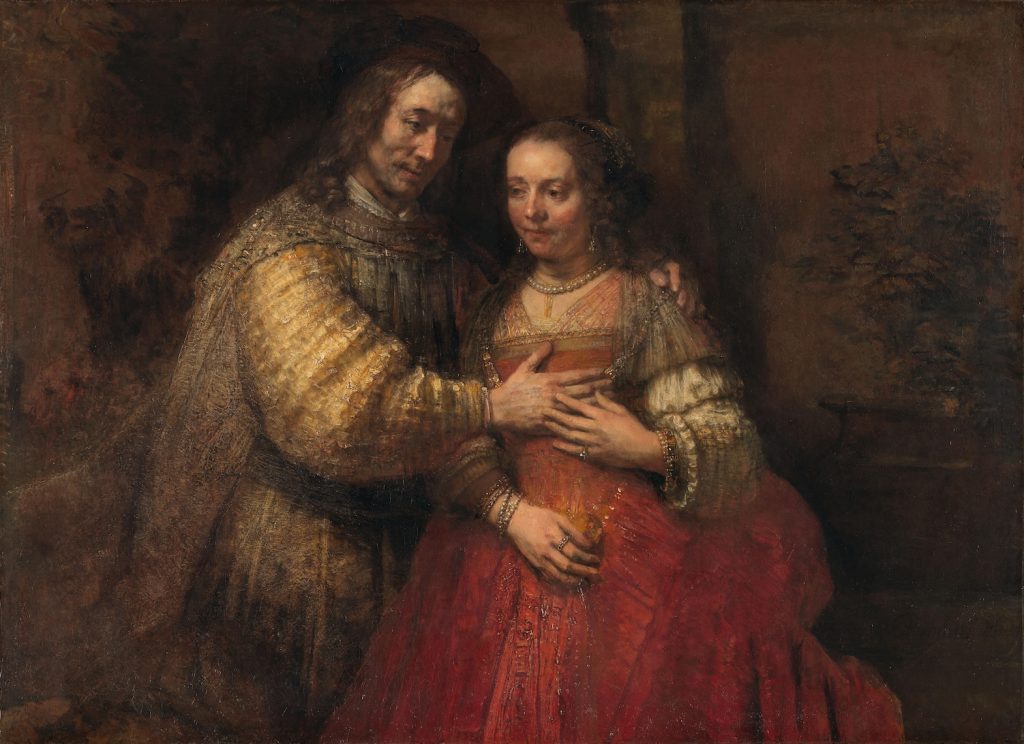
Rembrandt, Isaac and Rebecca (The Jewish Bride), c. 1665–1669, Rijksmuseum, Amsterdam, Netherlands.
The man’s gentle hand on the woman’s chest conveys tenderness without possession. It is reverent rather than erotic. Her lowered gaze and calm presence suggest trust and emotional reciprocity. There is no narrative distraction, no moralizing symbol—only the physical language of commitment. Although the title used with this iconic Dutch Golden Age painting implies a biblical scene, it really tells a story of everyday love and humanity.
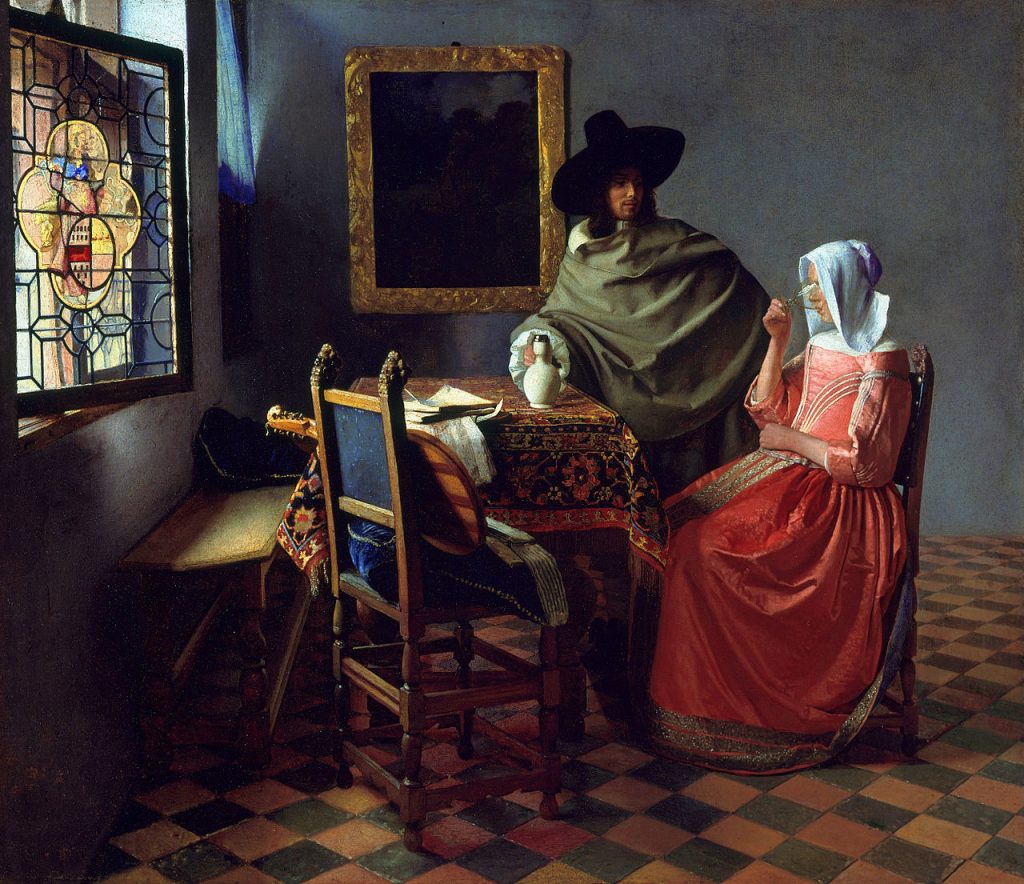
Johannes Vermeer, The Glass of Wine, 1658–1661, Gemäldegalerie, Berlin, Germany.
In The Glass of Wine, Vermeer stages love as persuasion rather than declaration. The woman in the scene is drinking her first glass of wine. Her suitor has his hand on the jug, ready to pour a quick refill. There is no glass for him—he is only trying to lessen her defenses, not have a conversation while they both enjoy a glass. Her guarded posture preserves ambiguity. A cittern sits unused on a chair, with sheet music on the table, hinting at harmony promised but not yet achieved. Love here is unresolved, hovering between invitation and resistance, between pleasure and propriety.
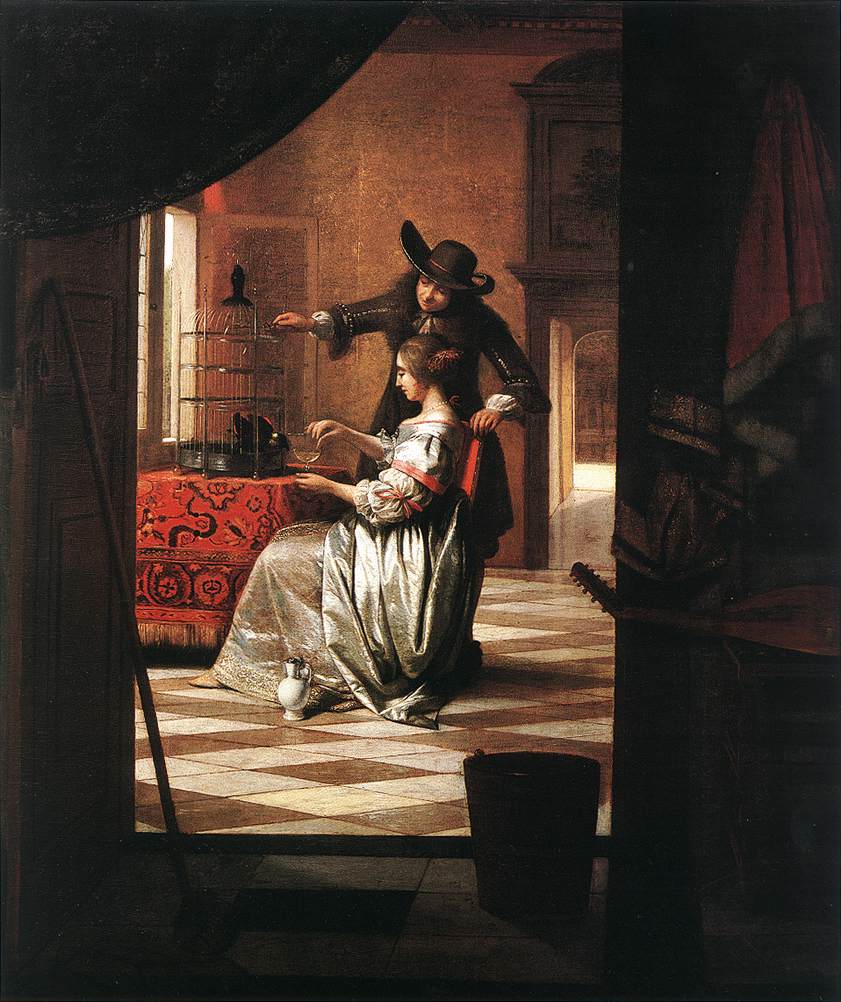
Pieter de Hooch, Couple with a Parrot, 1668, Wallraf–Richartz Museum, Cologne, Germany.
Here, we are voyeurs of a private scene. We peer through an anteroom, past a pulled-aside curtain, into a room with an elegantly clad couple. The man is opening a parrot’s cage. The woman might be trying to entice the bird out of the cage with a glass of wine, just as he wants to entice her out of any reservations she might have. There is a seemingly ever-present wine jug close by.
The parrot is an exotic bird—not native to Europe—and is used in paintings of the period to suggest something both exotic and erotic. The bird’s appearance in a Dutch painting would have carried a double entendre, as the Dutch slang word vogelen means both “birding” and “to copulate.”
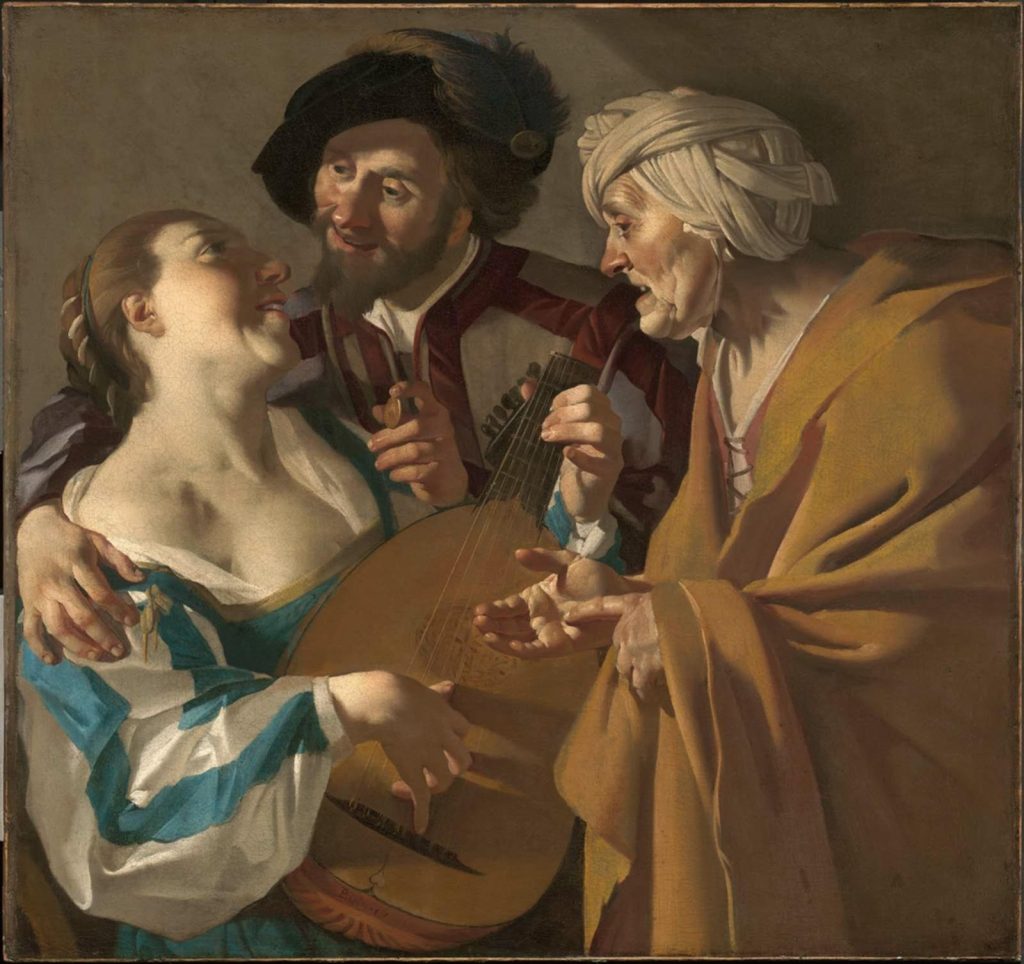
Dirck van Baburen, The Procuress, 1622, Museum of Fine Arts, Boston, MA, USA.
Van Baburen’s The Procuress is blunt and theatrical. Money changes hands. Desire has become a commodity. The woman strums a lute, suggesting the harmony of love. Other than that, there is nothing subtle here. Love here is stripped of romance and exposed as a transaction. This painting helped establish the visual template for later procuress scenes by other artists, including one by Vermeer.
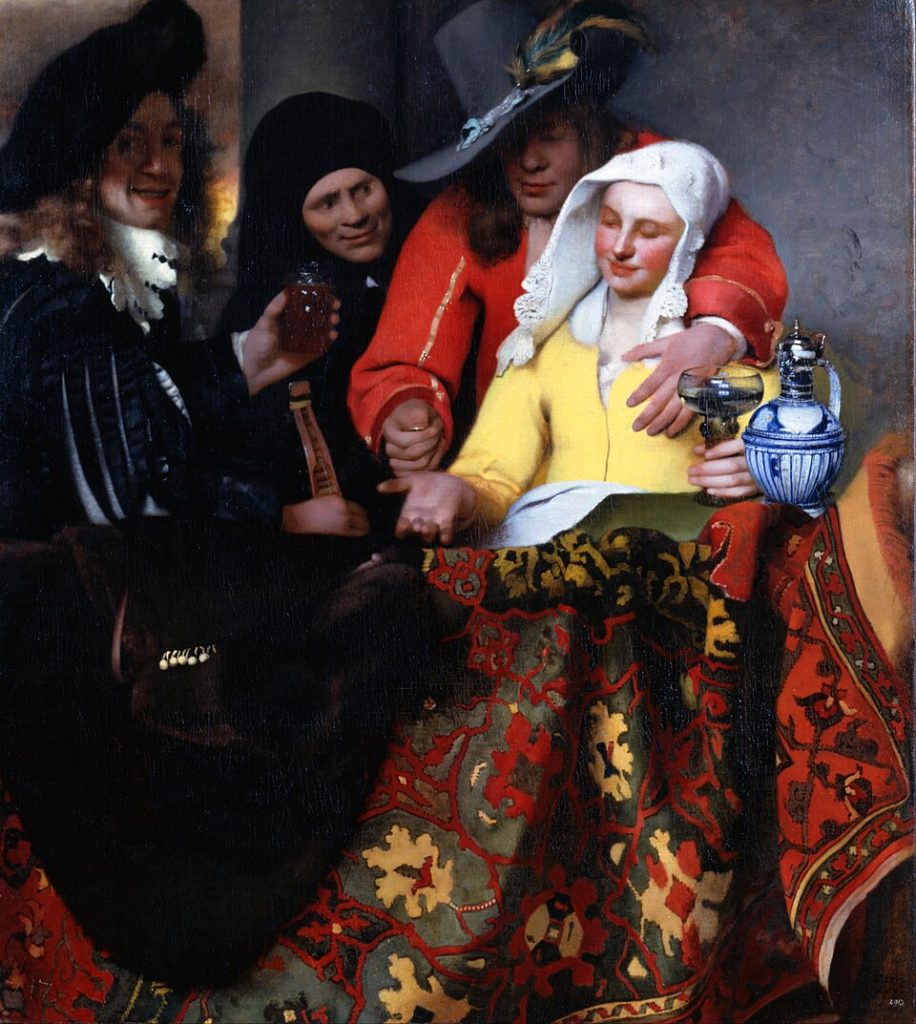
Johannes Vermeer, The Procuress, 1656, Gemäldegalerie Alte Meister, Dresden, Germany.
Vermeer was familiar with the Baburen painting—it was owned by his mother-in-law and hung in her home, where Vermeer lived with his family. Vermeer featured the Baburen image as a painting-in-the-painting in two of his own works.
In this scene, a coin is being dropped from the hand of the customer into the hand of the young woman. That transaction is the focal point of the painting. The procuress is smiling over the scene, pleased with what she has negotiated. The grinning barfly hoisting a beer and inviting us in on the party is likely a self-portrait of Vermeer himself and is the only chance we have to guess what he looked like.
These Dutch paintings invited viewers to interpret, judge, and reflect: Is love virtuous or reckless? Tender or transactional? Mutual or bought? In a society that prized moral restraint and domestic order, painters developed a subtle visual language to explore romance and love in its many forms. Love is not a single emotion, but a spectrum—ranging from playful flirtation to solemn commitment, from whispered anticipation to outright purchase. It never seems to be simple. That image of love is shown clearly in these paintings from the Dutch Golden Age, and it certainly remains a truism today.
Get your daily dose of art
Click and follow us on Google News to stay updated all the time

DailyArt Magazine needs your support. Every contribution, however big or small, is very valuable for our future. Thanks to it, we will be able to sustain and grow the Magazine. Thank you for your help!

Tom has a PhD in Physiology, is a serial entrepreneur in the life sciences, teaches biology at junior colleges in California, and is a fan of the painters of the Dutch Golden Age. He takes particular joy in finding the hints that artists leave us to help us understand the stories they are telling us. Contact him at [email protected].

An admirer of antiquity, art, and architecture. An avid reader and amateur photographer. Always curious, always on an adventure.
Vincent van Gogh produced dozens of sketches of his live-in lover Clasina Maria Hoornick, known as Sien. Let's take a look!
Candy Bedworth 31 July 2025
The American painter Georgia O’Keeffe is best known for her abstract representations of flowers and desert landscapes. American photographer Alfred...
Mary Margaret Swets, 30 March 2026
Soulmates in both life and art, Sonia and Robert Delaunay formed what is probably the most extraordinary creative partnership in art history. Cubism, colour and passion - read on!
Candy Bedworth 24 October 2025
You’ve heard of René Magritte—the Surrealist icon behind the famous pipe and bowler hat. But who was the muse who inspired much of his oeuvre?...
Natalia Iacobelli 21 November 2025