

Masterpiece Story: The Descent from the Cross by Rogier van der Weyden
The Descent from the Cross by Rogier van der Weyden is a masterpiece of Northern Renaissance art that captures a crucial moment in the Passion of...
James W Singer 5 April 2026
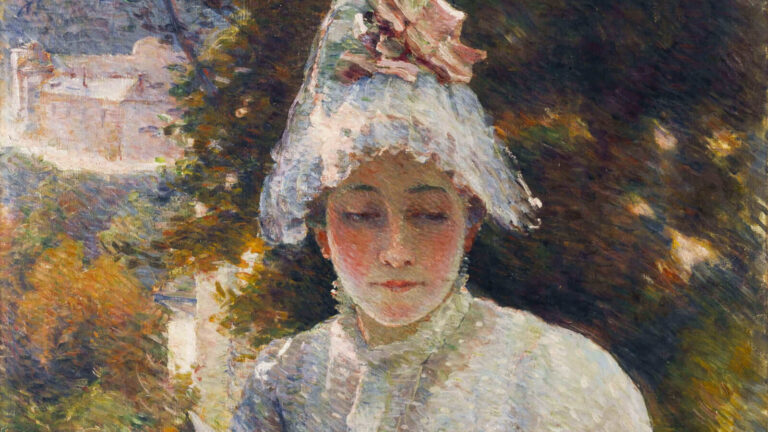
Marie Bracquemond, Afternoon Tea, ca. 1880, Petit Palais, Paris, France. Detail.
Afternoon Tea is a masterpiece by Marie Bracquemond, a female Impressionist that deserves a wider audience and more recognition.
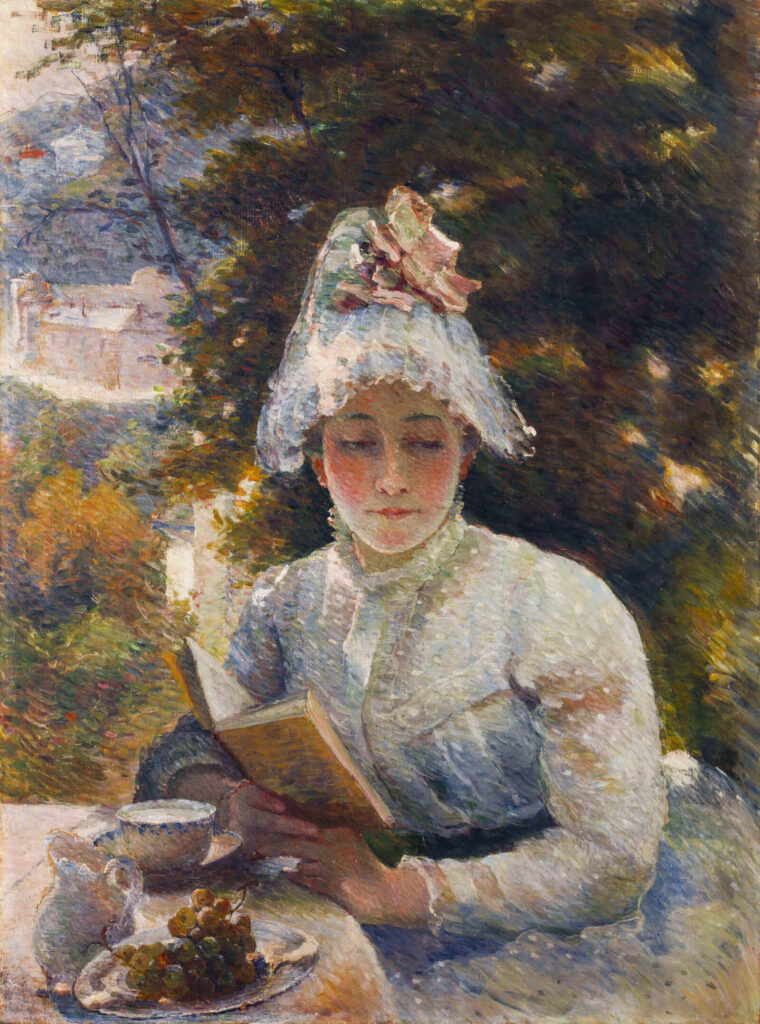
Marie Bracquemond, Afternoon Tea, ca. 1880, Petit Palais, Paris, France.
Marie Bracquemond (1841–1916) was an Impressionist painter often overlooked by art historians and rarely known by the general public. Her name does not conjure mental images like Monet and Renoir. Why? The answer is threefold.
First, Bracquemond was a female painter, and women have long been overlooked and sidelined in the male-dominated Western art world.
Secondly, she did not produce a great many works, as she painted for only about 11 years. She first displayed in 1879 at the Fourth Impressionist Exhibition, again in 1880 and 1886, but then entirely stopped painting in 1890.
Thirdly, few works of Bracquemond are owned and exhibited in public collections. Therefore, she has very little public exposure, as the majority of her works are held in private collections. Thankfully, a few masterpieces are publicly displayed and stand as bastions to Bracquemond and her underrated talent. Afternoon Tea is an excellent example, on view at the Petit Palais in Paris, France.
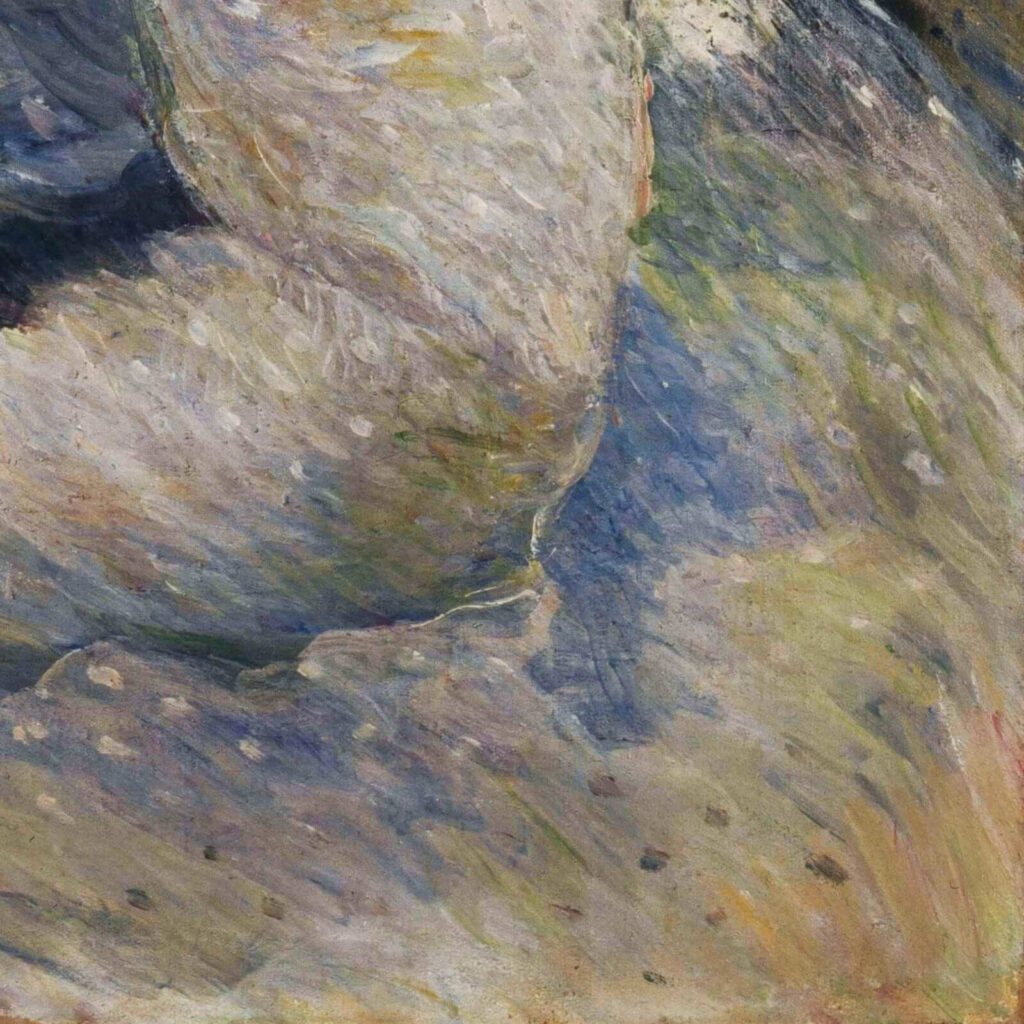
Marie Bracquemond, Afternoon Tea, ca. 1880, Petit Palais, Paris, France. Detail.
Afternoon Tea is an oil on canvas measuring 81.5 cm (32 1/16 in.) high and 61.5 cm (24 3/16 in.) wide. It presents a stylish French woman dressed in white, holding a book and sitting in a garden. Next to her is a round table set with a small service for afternoon tea, or le goûter in French—the original title of the painting. Afternoon Tea seems very aesthetically straightforward, but upon deeper examination, there are underlying psychological elements to be found.
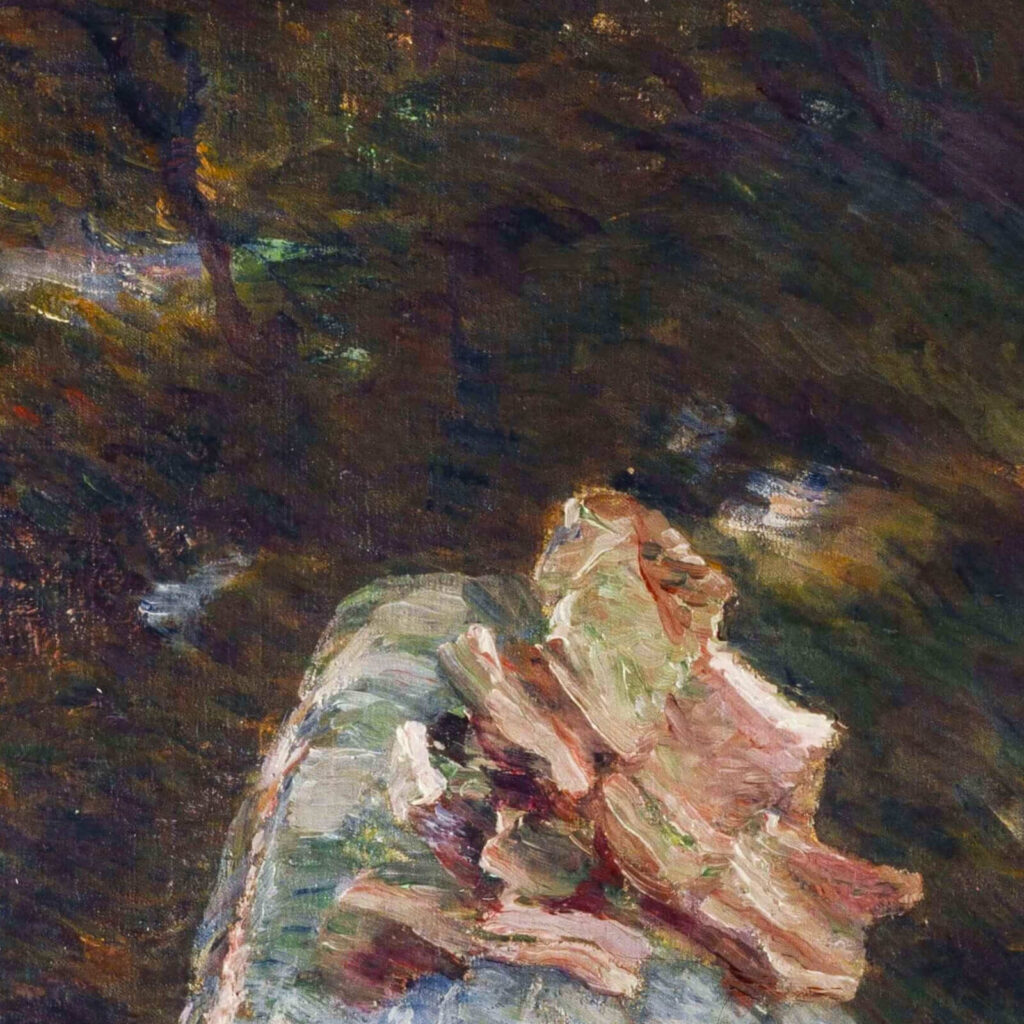
Marie Bracquemond, Afternoon Tea, ca. 1880, Petit Palais, Paris, France. Detail.
The sitter holds a book in her hands, but she is not actively reading it in the moment captured by Marie Bracquemond. The sitter has her eyes cast downward and to the right as if softly focused on something hidden in the foreground. She is deeply in thought—daydreaming, perhaps?
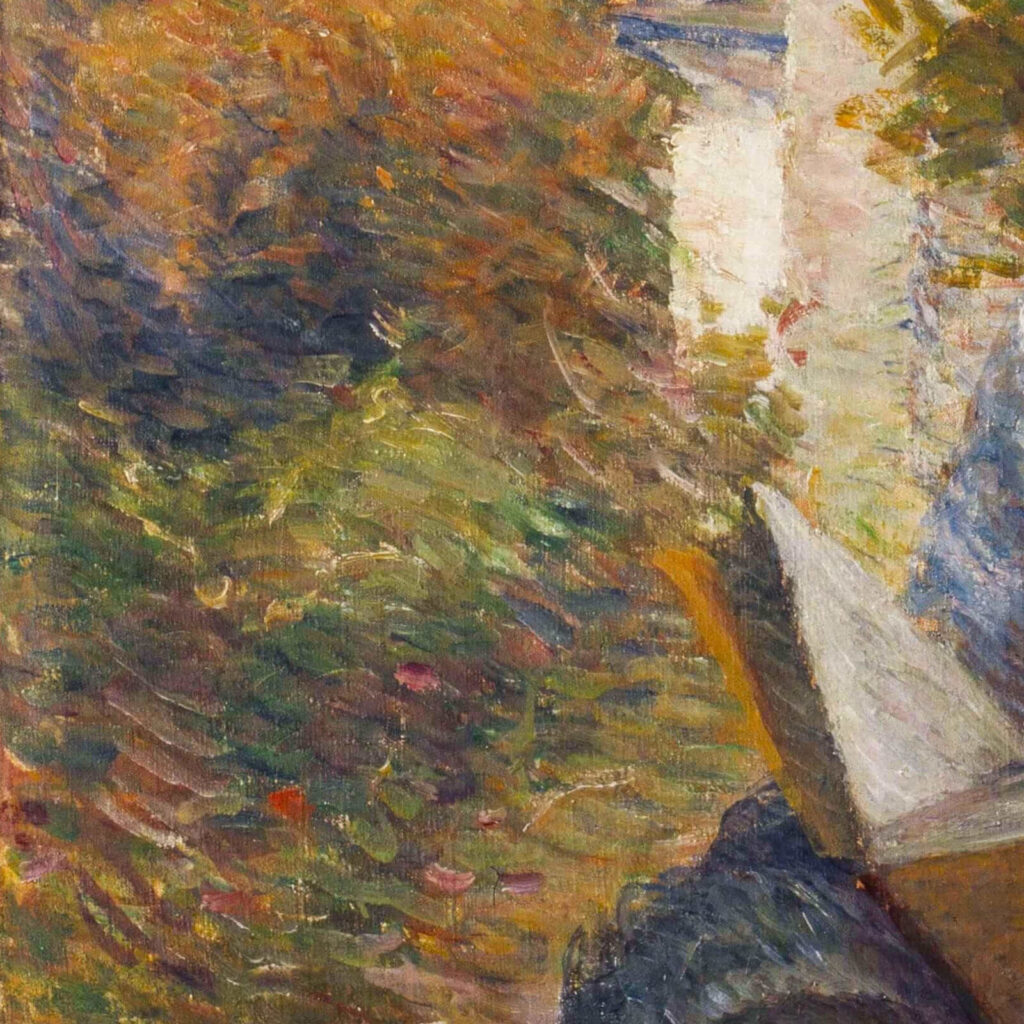
Marie Bracquemond, Afternoon Tea, ca. 1880, Petit Palais, Paris, France. Detail.
Holding a book while taking afternoon tea easily suggests that the woman is alone, since reading is primarily a solitary activity. However, the painting’s perspective is from a low angle, as if seen through the eyes of another diner at the table.
It is interesting to note that the sitter is not an unknown model, but Louise Quivoron, the sister of Marie Bracquemond. Could it be that Quivoron and Bracquemond—two sisters—are sharing an informal afternoon tea together? Perhaps so informal, so casual—as many sisters would enjoy—that Quivoron feels comfortable enough to read while in her sisters’ company?
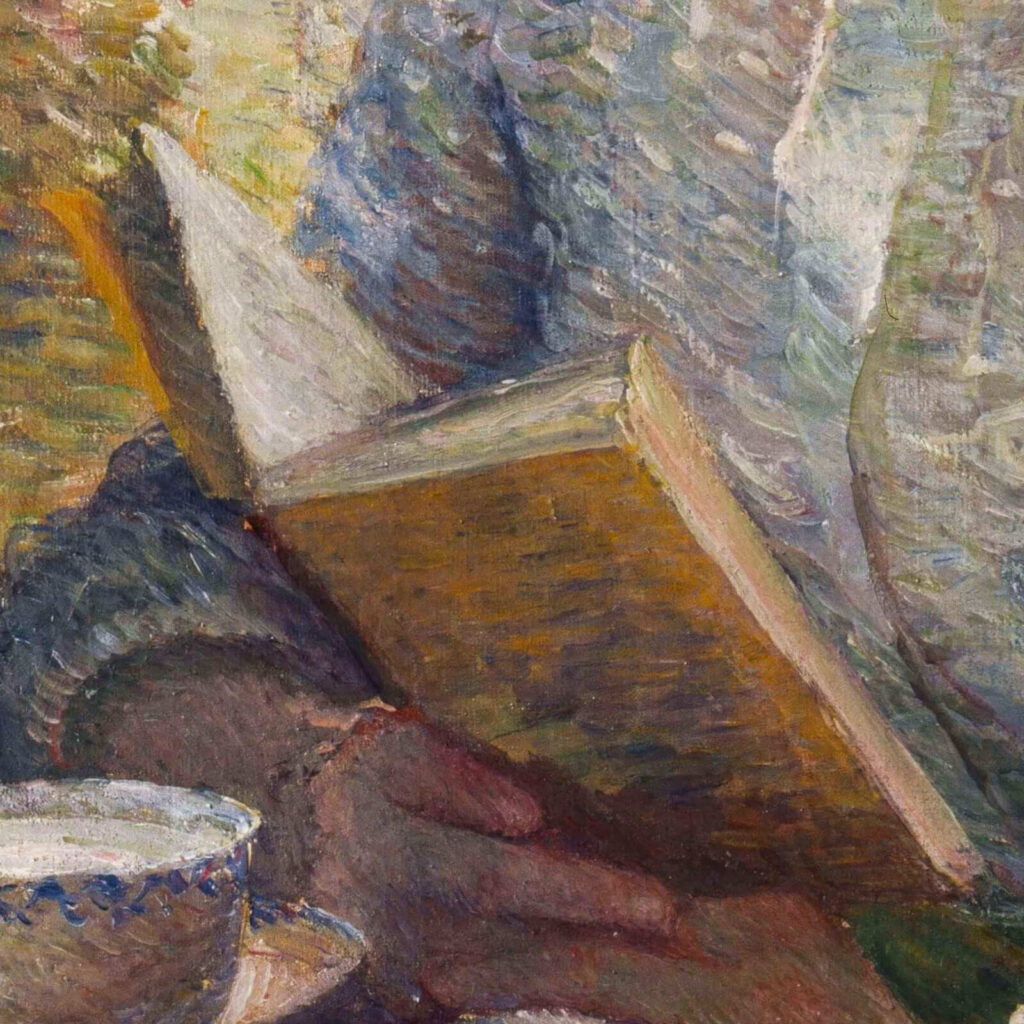
Marie Bracquemond, Afternoon Tea, ca. 1880, Petit Palais, Paris, France. Detail.
Of course, this interpretation is a real possibility because, much like in today’s 21st-century society, many family gatherings are punctuated by pauses of “phone time.” Family members occasionally check their phones for emails, chat messages, and social media updates. These pauses are not necessarily antisocial, but simply breaks between meaningful interactions. Some people, especially introverts, recharge through solitary moments, and perhaps Louise Quivoron is doing the same, attempting to read but allowing her thoughts to wander off the pages. Pause and reflection.
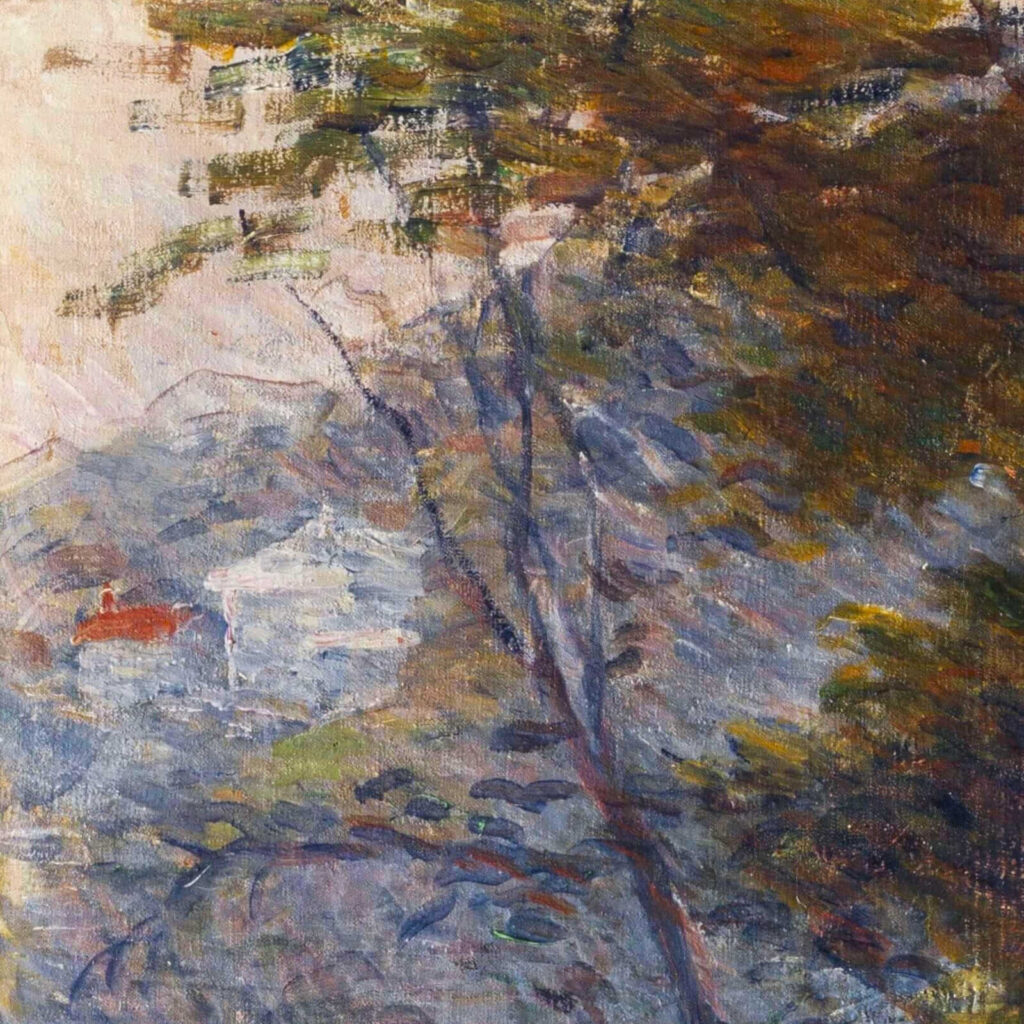
Marie Bracquemond, Afternoon Tea, ca. 1880, Petit Palais, Paris, France. Detail.
The psychological intensity of the painting is further heightened by the central focus of Quivoron’s face. It is in the middle of the composition and depicted in colors reflected by surrounding objects.
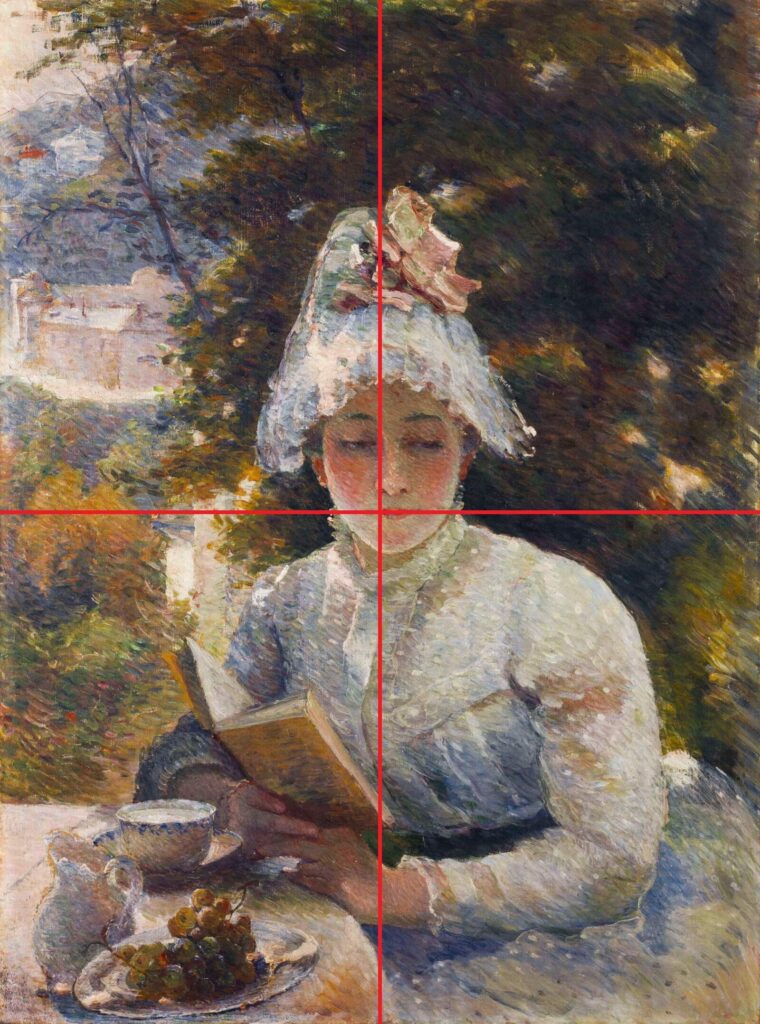
Marie Bracquemond, Afternoon Tea, ca. 1880, Petit Palais, Paris, France. Detail.
Her rouged cheeks are a dusky pink like the ribbons on her hat, the shadowy edges of the tablecloth, and the building in left edge of the painting. Her face is at the center and reflects her surroundings. Quivoron, in this quiet moment, is at the center of her private domestic world.
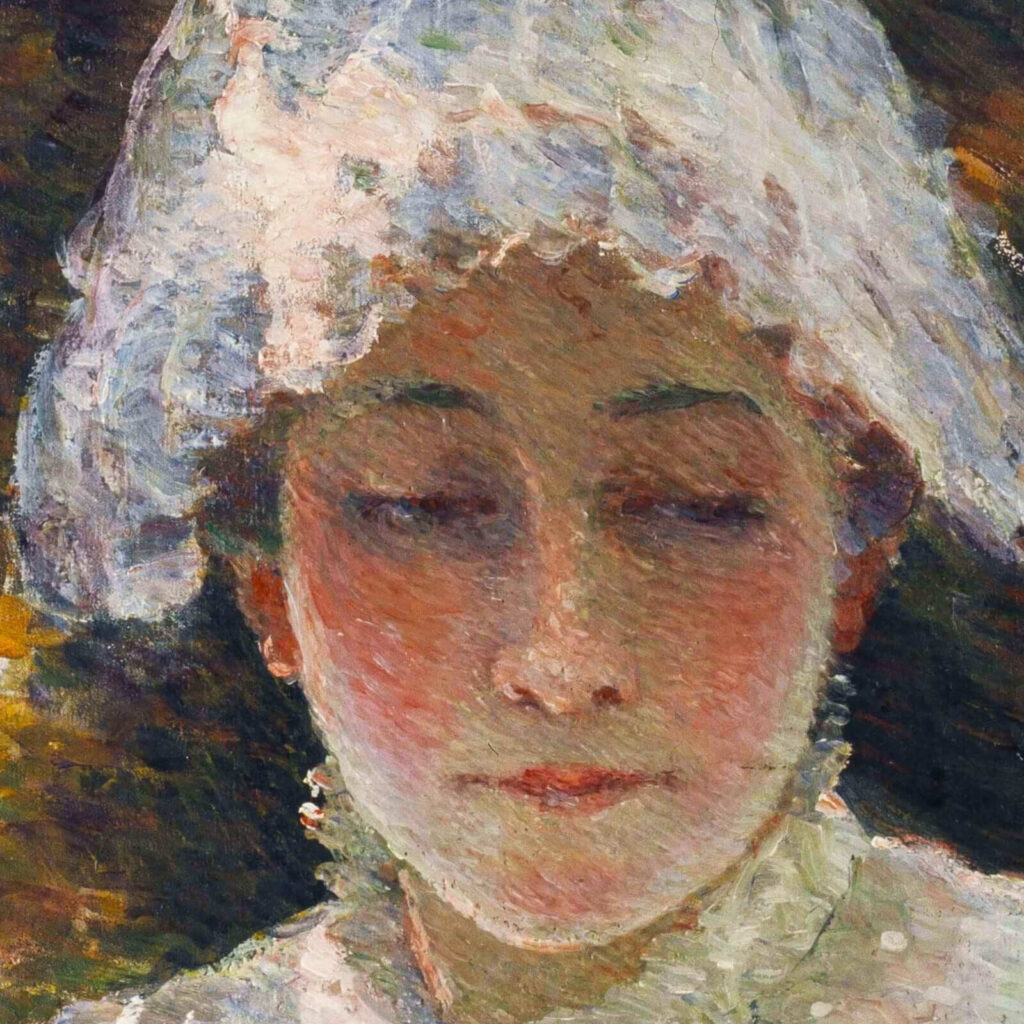
Marie Bracquemond, Afternoon Tea, ca. 1880, Petit Palais, Paris, France. Detail.
A small still life is presented in the bottom left corner of the painting atop the table. It is a set of dinnerware featuring a porcelain yellow cup-and-saucer edged in a blue ribbon pattern, a ceramic white milk jug, and a silver metal plate of green grapes. The disparities among the dinnerware’s styles and materials indicate a very informal occasion. This is a scene of a casual meal when unmatched pieces are not a concern. There is no formal guest to impress with a fine china matching set.
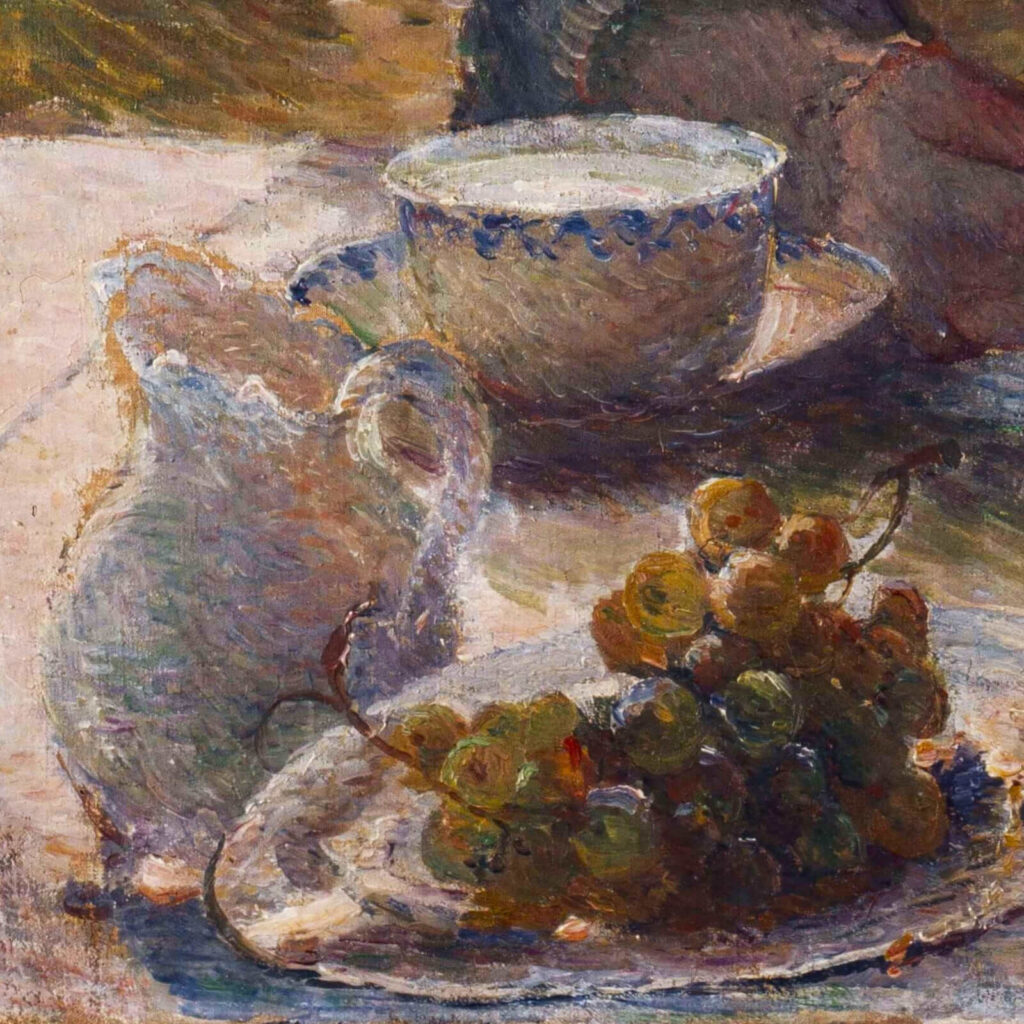
Marie Bracquemond, Afternoon Tea, ca. 1880, Petit Palais, Paris, France. Detail.
However, there is still a sense of nobility and grace that the dinnerware imparts to the scene. Who nowadays takes the effort to use a proper cup-and-saucer to take tea? To bother with a milk jug when the milk carton is so convenient and one less item to clean? Contemporary society has lost many of the refinements of the late 19th century, but perhaps the most striking is the appreciation of occasion and the sense of self-worth it imparted.
We, as modern people, often lose the sense of occasion that can make a daily activity feel worthy of a little extra effort. A quick, convenient lunch can still feel special if eaten from a proper ceramic plate with metal utensils, rather than hastily from the store packaging. Why did Quivoron use fine dinnerware for an informal garden goûter? The answer is simple: she feels that she is worth the effort. This is not performative as the scene is an introspective moment. This is genuine self-care and authenticity.
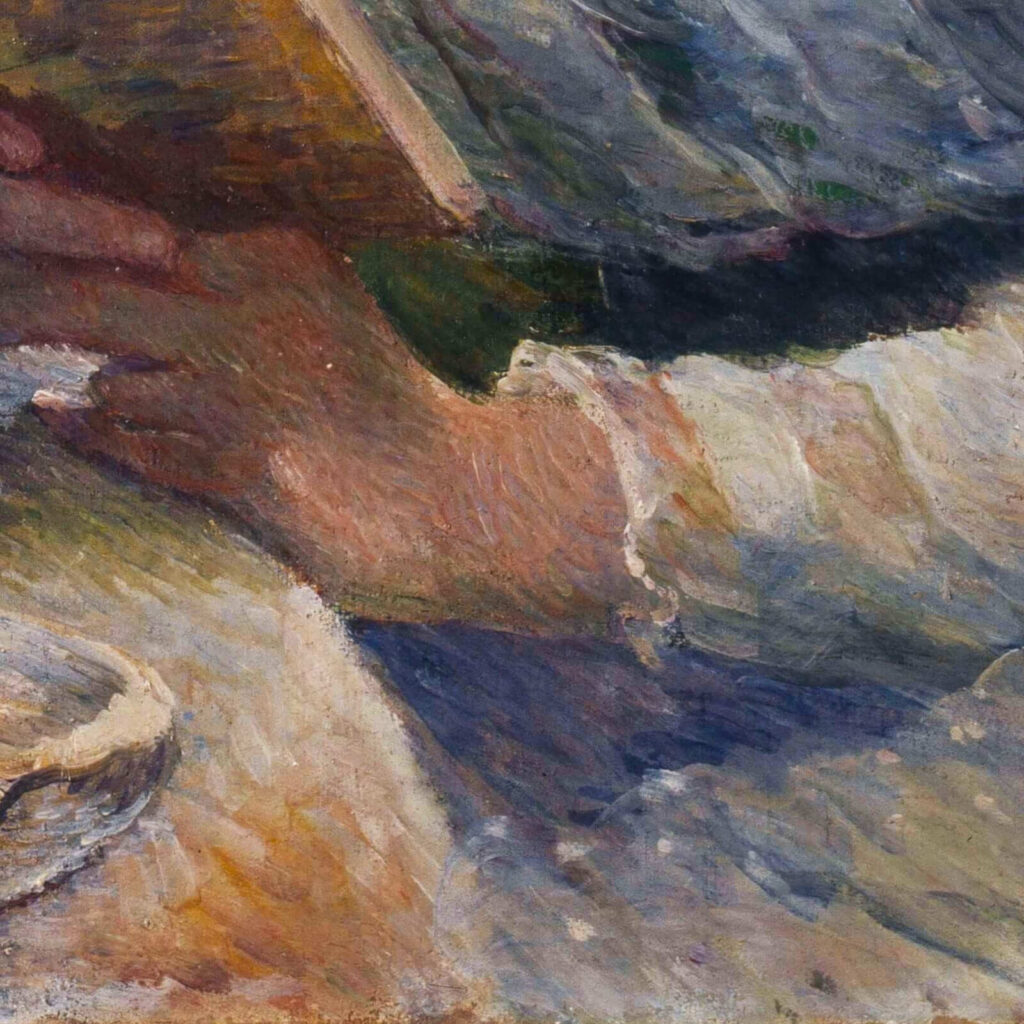
Marie Bracquemond, Afternoon Tea, ca. 1880, Petit Palais, Paris, France. Detail.
The painting’s background situates the garden scene. The perspective is from the Bracquemond home, Villa Brancas, in Sèvres, France. The large, farmhouse-like building in the upper left belongs to a Sèvres neighbor. Like today, Sèvres was an arboreal city in the 19th century, with many trees and gardens punctuating its cityscape. Therefore, despite the evolution of clothing fashion, Bracquemond’s Afternoon Tea could be recreated today, giving it a timeless quality of simple pleasures spanning the centuries. Simplicity is the ultimate sophistication.
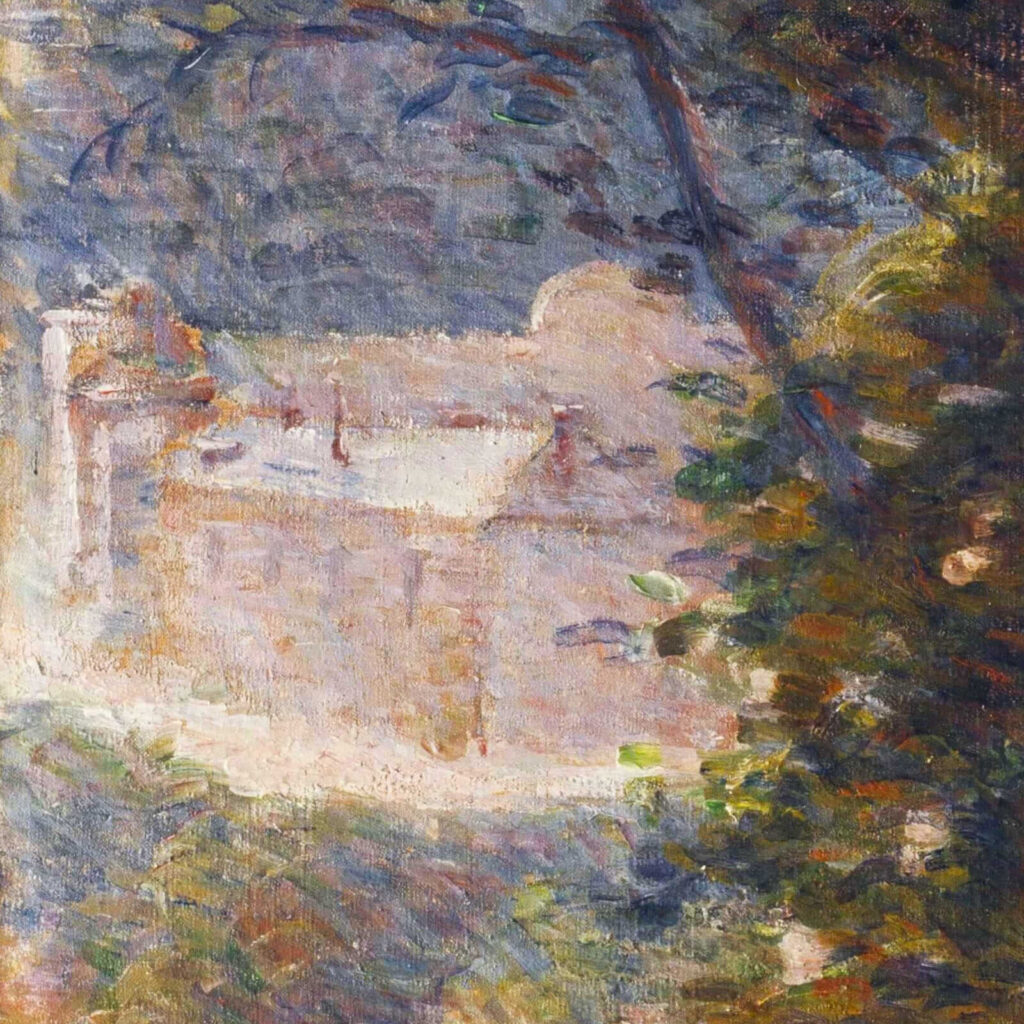
Marie Bracquemond, Afternoon Tea, ca. 1880, Petit Palais, Paris, France. Detail.
P.S. If you are interested in getting to know Impressionism a little bit better, be sure to check out our French Impressionism Mega Online Course.
Le goûter, Petit Palais Online Collection, Paris, France. Retrieved Oct 23, 2025.
Jordi Vigué, Great Women Masters of Art, New York, NY, USA: Watson-Guptill Publications, 2003.
Get your daily dose of art
Click and follow us on Google News to stay updated all the time

DailyArt Magazine needs your support. Every contribution, however big or small, is very valuable for our future. Thanks to it, we will be able to sustain and grow the Magazine. Thank you for your help!

James W. Singer is an art historian and fine art photographer. He earned a Bachelor of Arts in Art History from the University of Florida. He later moved to Paris, France. He currently writes “Masterpiece” articles for DailyArt Magazine.

An admirer of antiquity, art, and architecture. An avid reader and amateur photographer. Always curious, always on an adventure.
The Descent from the Cross by Rogier van der Weyden is a masterpiece of Northern Renaissance art that captures a crucial moment in the Passion of...
James W Singer 5 April 2026
The girl leans out of the painting as if she intends to cross the boundary between art and reality—she touches the frame and looks directly at the...
The Royal Castle in Warsaw 26 March 2026
With sweet putti, handsome gods, beautiful nymphs, vibrant colors, and elaborate compositions, The Setting of the Sun is a testimony to François...
James W Singer 8 February 2026
Among the Sierra Nevada, California, by Albert Bierstadt, is a majestic mountainous landscape filled with wild beauty and blissful idealism. Its...
James W Singer 25 January 2026