
15 Masterpieces of European Painting You Need to See at the Met
How does anyone begin to navigate 5,000 years of global art without feeling instantly overwhelmed? Do not despair—DailyArt Magazine has you...
MJ Rivera 9 March 2026
25 December 2025 min Read

Lucas Cranach the Elder, Madonna Under the Fir Tree, 1510, Archdiocesan Museum in Wrocław, Wrocław, Poland. Detail.
Wrocław, a city in Poland known as the Meeting Place, is where art takes many forms—paintings, sculptures, historical artifacts, and bold contemporary installations. We asked local museum experts what’s truly worth seeing in the city, and their answers reveal a rich, unexpected cultural landscape. It’s a city well worth visiting. Here are the must-see artworks hidden within the city’s vast art collections.
Małgorzata Devosges-Cuber, Curator, Museum of Architecture in Wrocław, Contemporary Architecture and Art Department
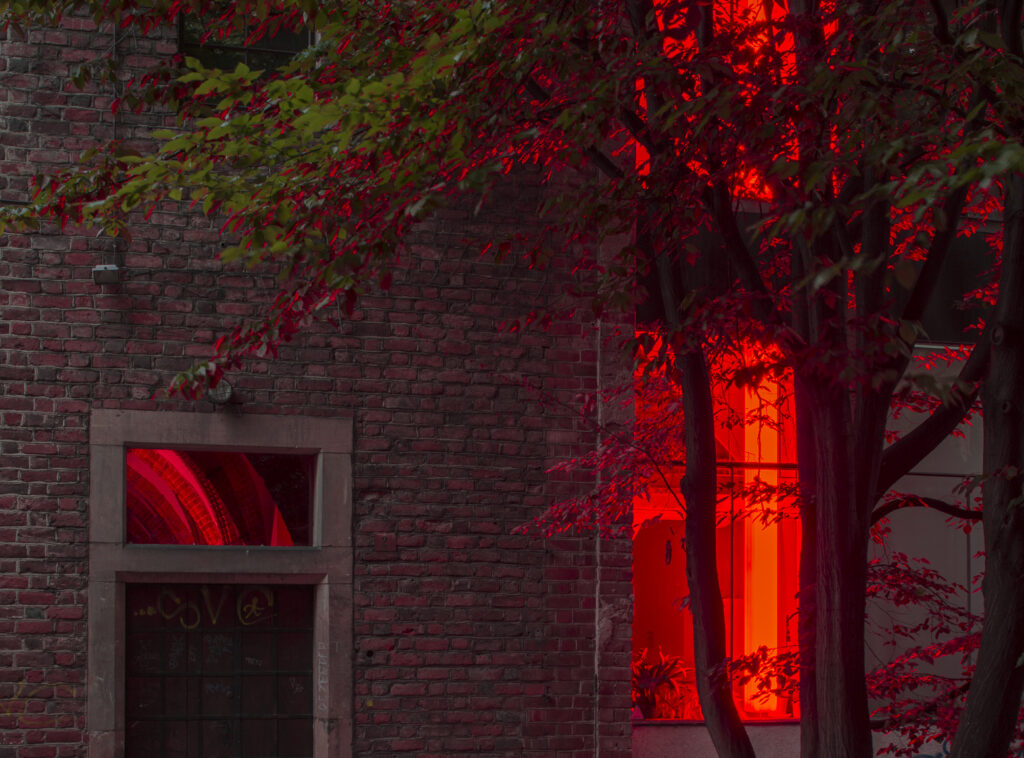
Leon Tarasewicz, Untitled/Red Light Object, 2018, Museum of Architecture in Wrocław, Wrocław, Poland. Photograph by Peter Kreibich.
The red light painting-object is a site-specific work by one of Poland’s most renowned contemporary artists, Leon Tarasewicz. In his work, Tarasewicz consistently pushes beyond the traditional understanding of painting, using not only paint but also concrete, acrylic plasters, mirrors, and colorful light. Yet he remains fundamentally a painter. Color, light, and texture remain the key materials in shaping the reality of the image, adaptable to changing locations and spaces.
This piece hails from a period when light-based installations were his primary form of artistic expression. The red light object exemplifies minimalist painting with light itself—a color embedded within the simplest geometric forms. It is unique because it is permanently installed inside one of the stairwells of the Museum of Architecture, while also being visible from the outside to passersby walking through Słowacki Park in Wrocław.
Jerzy Kosałka, Freelancer, Kosałka’s Gallery
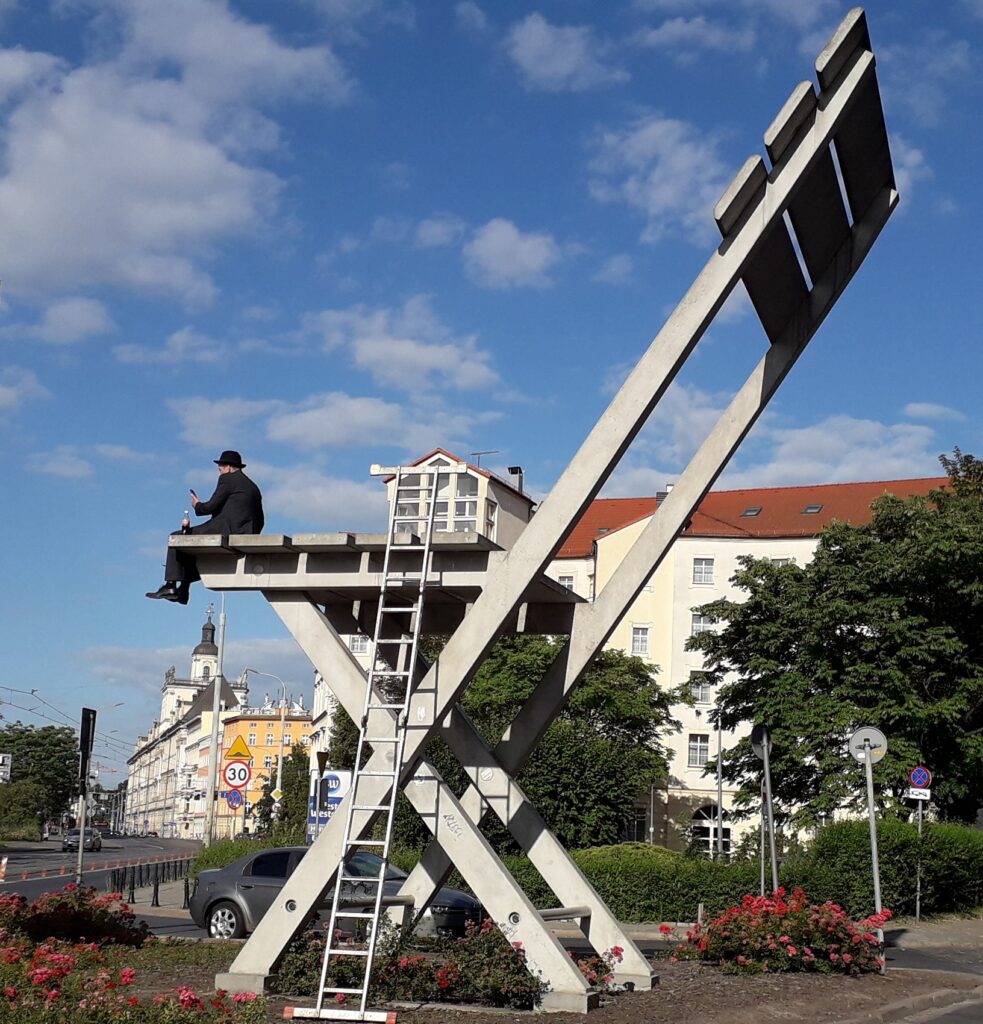
Jerzy Kosałka, Kantor’s Chair (Appropriation via Adverse Possession), 2020, Wrocław, Poland.
At the 1970 Wrocław Art Symposium, the renowned Polish artist Tadeusz Kantor (1915–1990) proposed a nine-meter concrete chair as a quasi-surreal monument to be built in the city. Installed posthumously in 2011, it became the subject of Jerzy Kosałka’s 2020 intervention.
Referencing the Polish Civil Code on adverse possession, which grants ownership after 20 years of continuous use, Kosałka symbolically condensed the term to 20 minutes. He climbed the chair, sat atop it while reciting the law, then affixed a plaque bearing his name directly to the seat. This act playfully merged legal parody with artistic appropriation, reinterpreting the legacy of a great modern master of Polish art. Kantor’s Chair stands on an island between Rzeźnicza and Nowy Świat streets in Wrocław, Poland.
You can view Kosałka’s intervention here.
Julita Pacana, Medical Discovery Center, Heritage Specialist at the Wroclaw Medical University
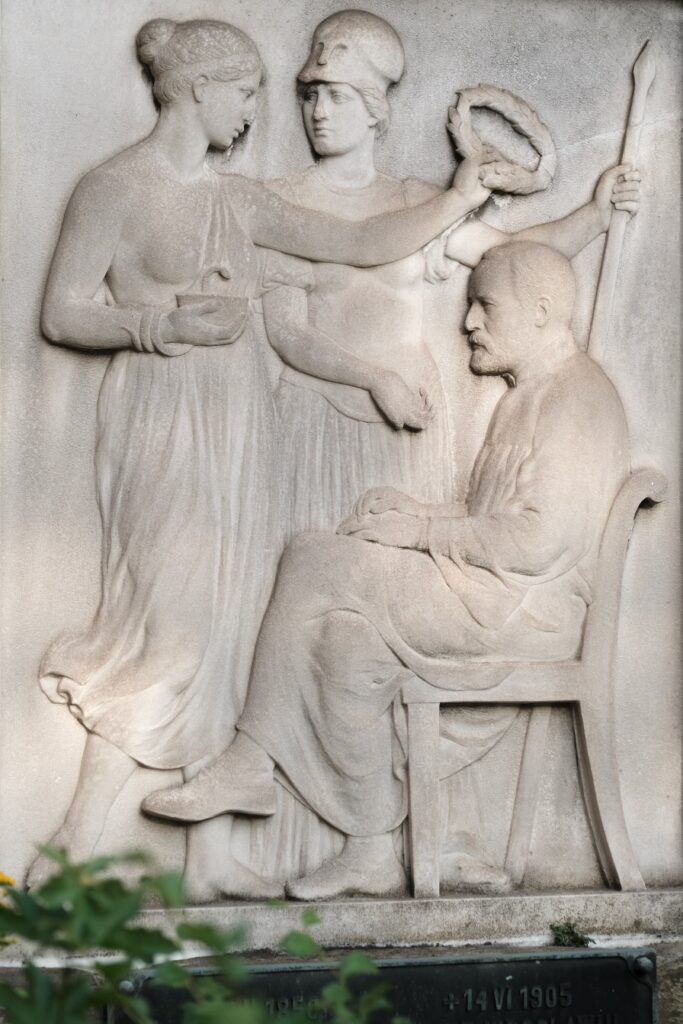
Arthur Volkmann, Monument to Jan Mikulicz-Radecki, 1909, Wroclaw Medical University, Wrocław, Poland. Photograph by Paweł Pacana.
This poetic marble monument by Arthur Volkmann honors Jan Mikulicz-Radecki—visionary surgeon, inventor of the gastroscope, and a pioneer of sterile technique. He was the first to introduce surgical gloves and masks to the operating room, transforming the safety and precision of modern medicine. The sculpture shows Mikulicz-Radecki seated in a surgical gown, receiving a laurel wreath from Athena, goddess of wisdom, and Hygieia, goddess of health.
Located beside Wrocław’s former General Surgery Clinic—where Mikulicz-Radecki once worked—the monument stands within a historic medical campus soon to house the Medical Discovery Center, an educational space dedicated to innovations that revolutionized global healthcare. Rich in allegory and sculptural finesse, the monument, unveiled in 1909, is a rare German-era survivor of WWII in Wrocław—a city that became part of Poland in 1945.
Anna Kowalów, Press Officer and Head of Marketing and Communications, National Museum in Wrocław
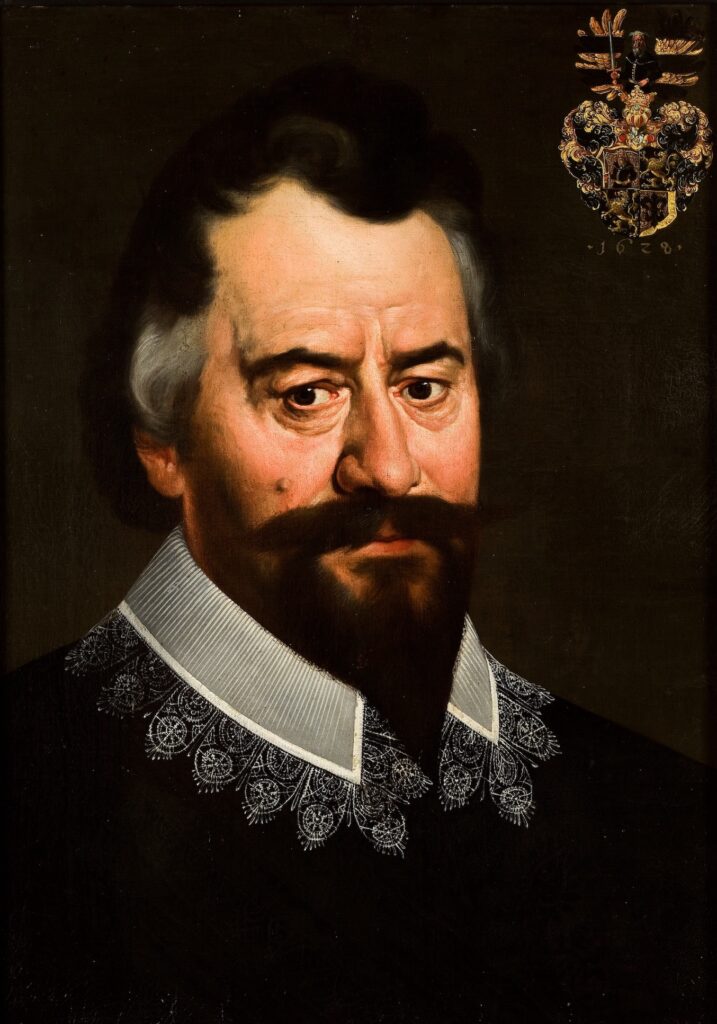
Bartholomeus Strobel, Portrait of Johann Vogt, 1628, National Museum in Wrocław, Wrocław, Poland.
The collection of the National Museum in Wrocław includes a portrait dated 1628 by Bartholomaeus Strobel (1591–c.1647) depicting Johann Vogt, a wealthy local resident. It is not clear who first noted the striking resemblance between the man from Wrocław and the famous Hollywood actor Robert De Niro. Some museum visitors commented on it and posed for selfies in front of the painting, while occasional mentions appeared in the media.
A few years ago, the “Robert De Niro” from Wrocław truly made the headlines. Speculation arose about whether the star’s ancestors might have lived in Wrocław, whether the museum had contacted De Niro, and whether he was even aware of the portrait’s existence. A photo of the painting was forwarded to the star’s agent, but the museum has not received a reply, and it is not known what De Niro’s reaction was or if he even received it. In any case, the portrait has become famous in its own right and is used by the museum in promotional campaigns.
Joanna Kachel-Szyjka, Assistant Curator in the Art Division, Museum of the Lubomirski Princes Ossolineum
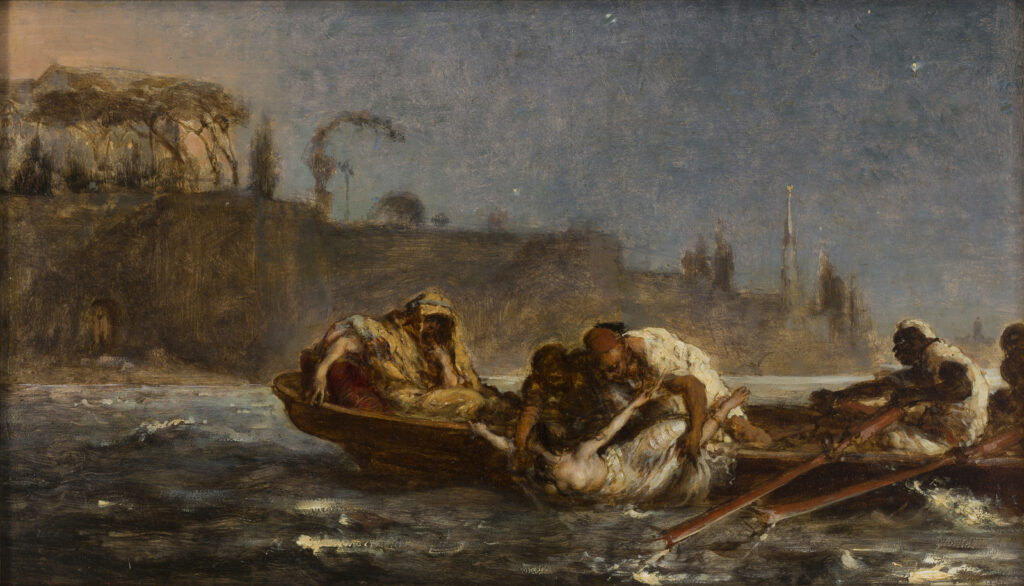
Jan Matejko, Drowned in the Bosphorus, 1872, from the collection of the Museum of the Lubomirski Princes Ossolineum, on display at the Pan Tadeusz Museum Ossolineum, Wrocław, Poland.
This painting by one of Poland’s most significant artists is quite different from his famous historical works. Created during the artist’s journey to Istanbul with his wife, Jan Matejko presents the punishment by drowning of an adulterous odalisque. The young woman’s dramatic struggle for life—clinging tightly to the boat and her executioner’s clothing—is clearly visible. In contrast, her owner remains indifferent, his face partially shadowed beneath a turban. Above the scene rises Istanbul’s skyline with a slender golden crescent-topped tower.
Eight years later, Matejko revisited the theme, which you can see at the National Museum in Wrocław. This time, however, he focused less on the landscape and more on the main figures, giving them much more identifiable features—his wife’s and his own.
Maria Kowalińska, Senior Documentalist, Museum of the University of Wrocław
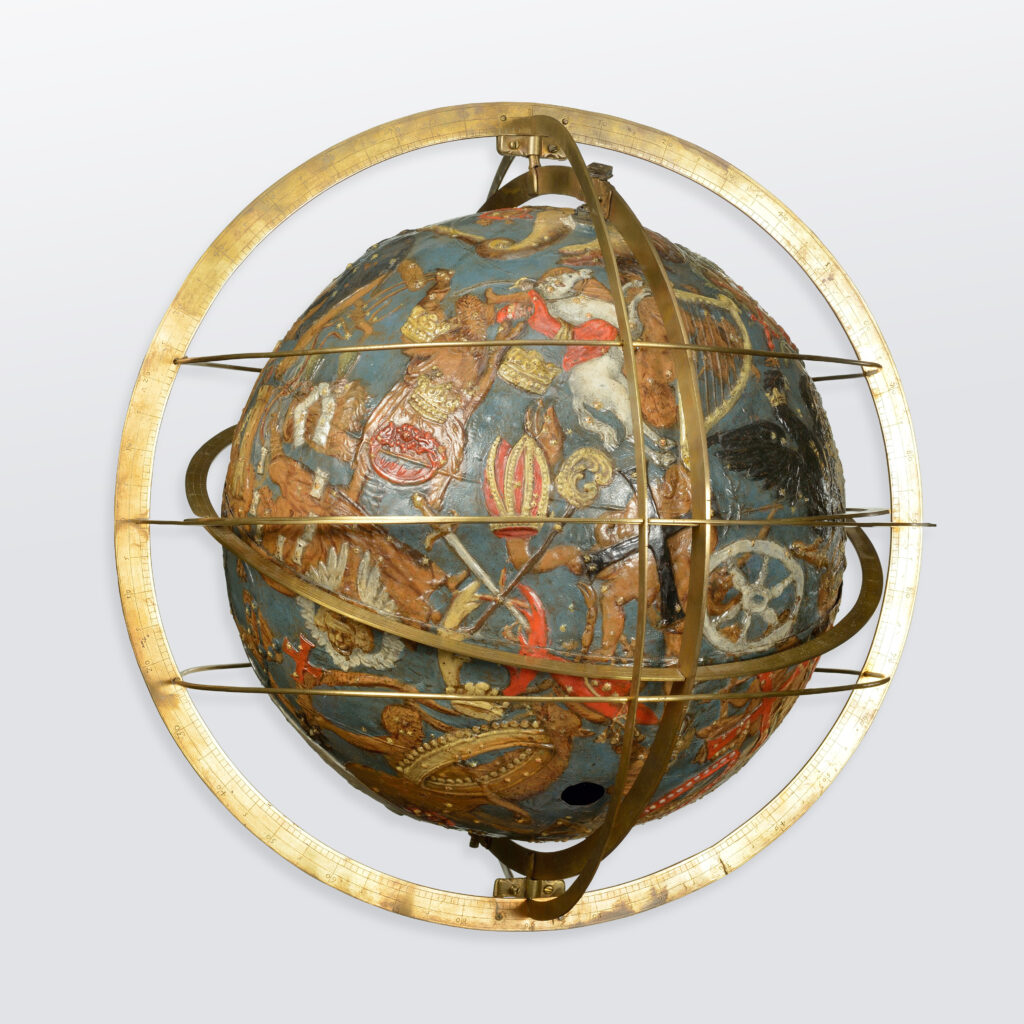
Erhard Weigel, Sky globe from the collection of the instrumentarium of the former Wrocław University Astronomical Observatory, 1699, Museum of the University of Wrocław, Wrocław, Poland. Photograph by Wojciech Małkowicz.
A sky globe is a hollow astronomical instrument that, unlike traditional celestial globes, allows viewers to observe the stars from the inside. Several openings in its southern part enable observers to look in, where stars appear from tiny holes in the shell. This creates the effect of bright dots against a dark background, much like the night sky.
Interestingly, this globe’s creator did not use the classical constellations but rearranged the stars into the coats of arms of European royal, ruling, and princely families. For example, instead of the familiar Orion, one sees the two-headed black eagle of the Austrian Habsburgs. In another part, the crossed keys of Peter—the emblem of the Papal States—are visible. The globe was created by Erhard Weigel, a renowned astronomer whose work was honored by naming a lunar crater and asteroid 9315 after him.
Joanna Bradke, Art Historian & Museum Tour Guide, Archdiocesan Museum in Wrocław
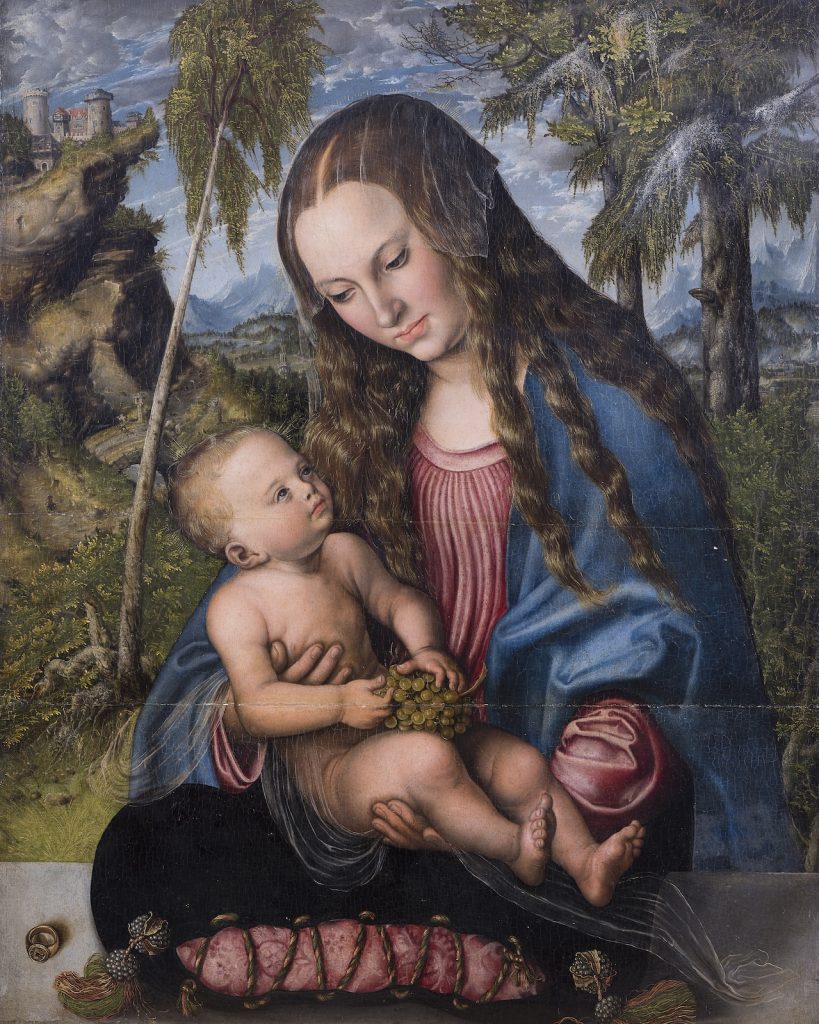
Lucas Cranach the Elder, Madonna Under the Fir Tree, 1510, Archdiocesan Museum in Wrocław, Wrocław, Poland.
Madonna Under the Fir Tree by Lucas Cranach the Elder is the most prized artwork in the Archdiocesan Museum in Wrocław. Commissioned in the early 16th century by Bishop Johann V Turzo, it is among the earliest examples of Renaissance art in the city. The painting depicts the Virgin Mary with the Christ Child, who lies on a velvet pillow and holds a bunch of grapes, set against a mountainous landscape with fir and birch trees.
Kept initially in Wrocław Cathedral, the artwork was hidden in 1943 by German authorities, first in Henryków, then in Kłodzko. After the war and the change of borders, the priest Siegfried Zimmer took the original artwork to Germany, leaving behind a copy. This duplicate was discovered in 1961, during restoration works. Years later, the original was recovered in Switzerland and finally returned to Wrocław in 2012.
Jedrzej Siuta, MD, PhD, Forensic Pathologist, Curator, Museum of Forensic Medicine in Wrocław
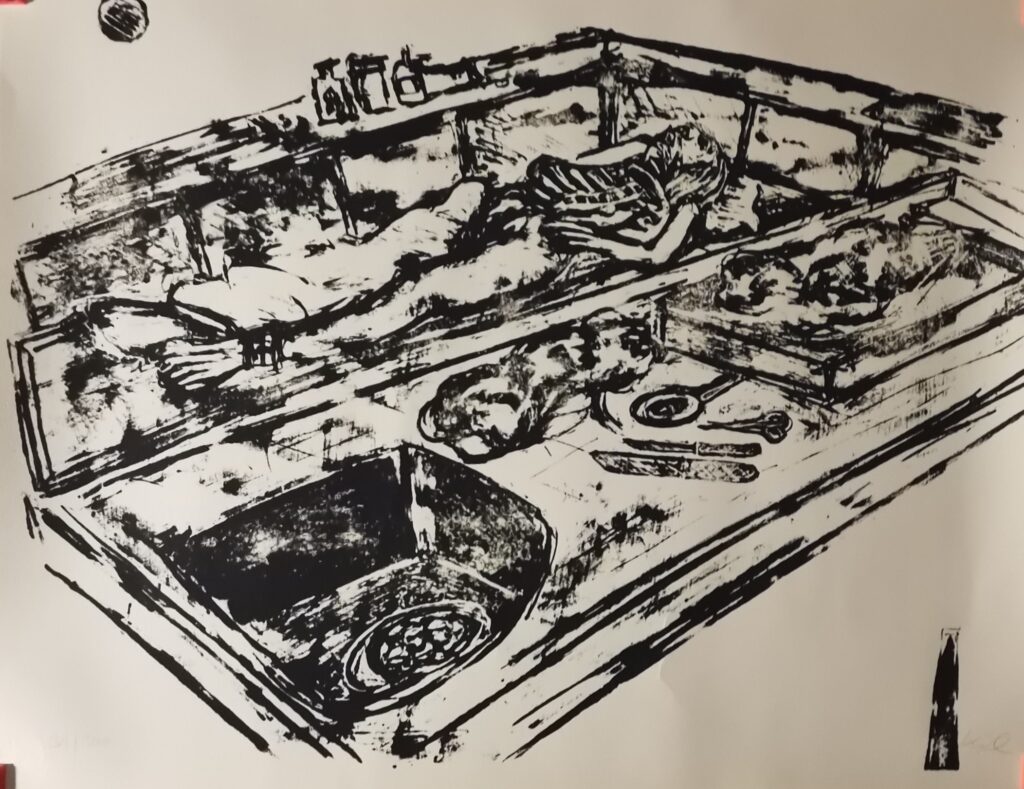
Harald Koeck, Body Without Soul—Impressions from the Autopsy Room, 1992, Museum of Forensic Medicine, Wrocław Poland.
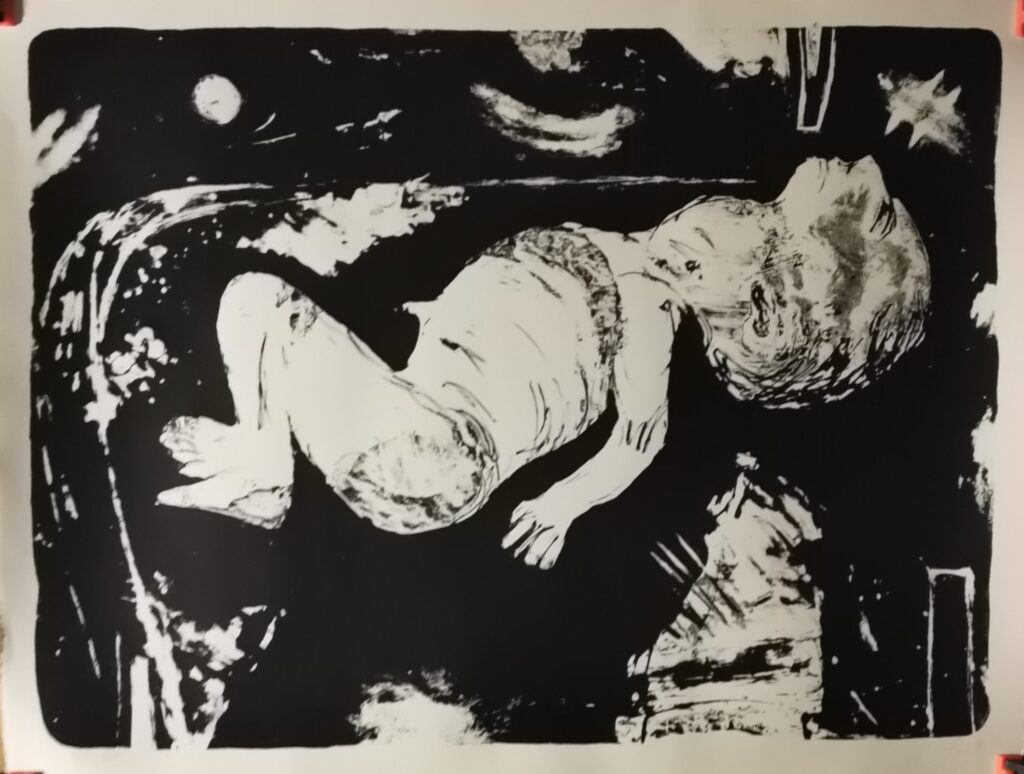
Harald Koeck, Body Without Soul—Impressions from the Autopsy Room, 1992, Museum of Forensic Medicine, Wrocław, Poland.

Harald Koeck, Body Without Soul—Impressions from the Autopsy Room, 1992, Museum of Forensic Medicine, Wrocław, Poland.
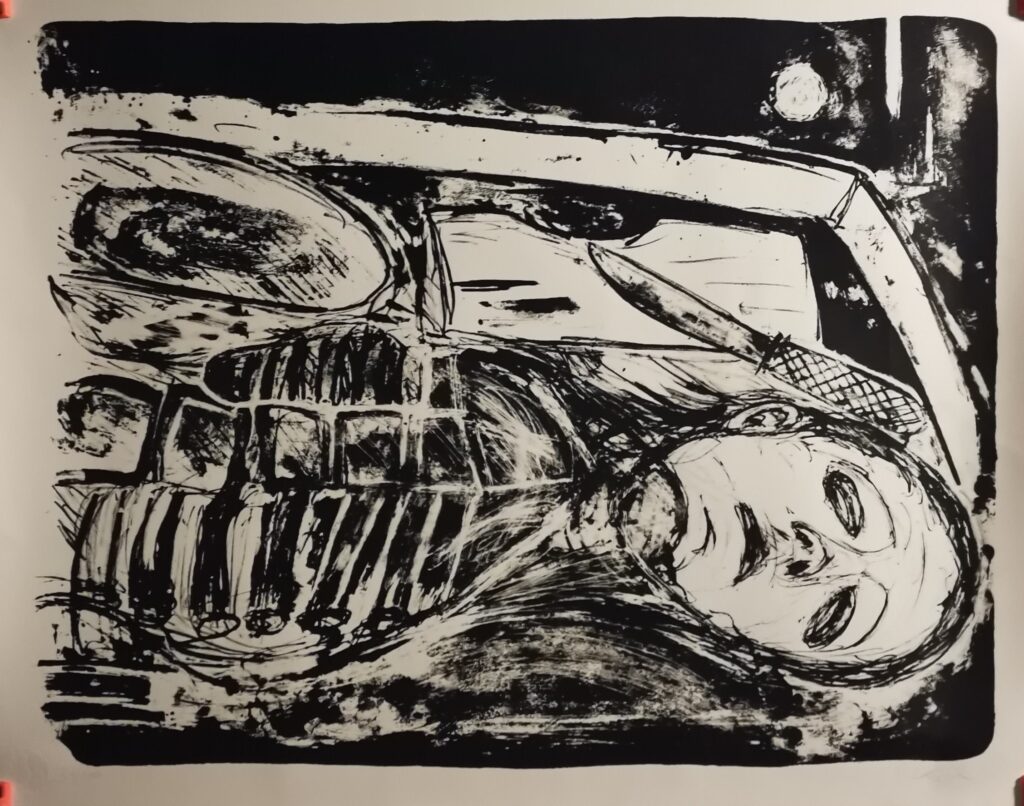
Harald Koeck, Body Without Soul—Impressions from the Autopsy Room, 1992, Museum of Forensic Medicine, Wrocław, Poland.


This four-part series offers a contemplative look at death and the human body, combining artistic expression with elements of forensic science.
Created entirely in Vienna, Koeck’s work thoughtfully invites viewers to reflect on mortality and the physical form in a measured way.
These monochrome lithographs are now part of the Forensic Medicine Museum in Wrocław, where art and medical reality come together.
Koeck’s cycle invites a thoughtful examination of death—a dialogue between the presence of the body and the absence of the soul.
In 1992, Viennese artist Harald Koeck created a black-and-white lithograph cycle titled Body Without Soul—Impressions from the Autopsy Room. This four-part series offers a contemplative look at death and the human body, combining artistic expression with elements of forensic science. Created entirely in Vienna, Koeck’s work thoughtfully invites viewers to reflect on mortality and the physical form in a measured way. These monochrome lithographs are now part of the Forensic Medicine Museum in Wrocław, where art and medical reality come together. Koeck’s cycle invites a thoughtful examination of death—a dialogue between the presence of the body and the absence of the soul.
Author’s bio:
Julita Pacana explores and preserves the heritage of Wrocław Medical University. As a heritage specialist at the Center for Medical Discoveries (COM), she collaborates with a team of experts to create inspiring projects. COM will be among Europe’s first spaces merging medical history, new technologies, and immersive storytelling to counter misinformation.
Get your daily dose of art
Click and follow us on Google News to stay updated all the time

DailyArt Magazine needs your support. Every contribution, however big or small, is very valuable for our future. Thanks to it, we will be able to sustain and grow the Magazine. Thank you for your help!

This is our guest profile for occasional authors. If you have an interesting story about art to tell, send it to our Editor-in-chief Kate at [email protected]. You might be the next here!

Coffee-fueled writer, artist, and daydreamer.
How does anyone begin to navigate 5,000 years of global art without feeling instantly overwhelmed? Do not despair—DailyArt Magazine has you...
MJ Rivera 9 March 2026
The Grand Egyptian Museum (GEM) in Cairo, Egypt, which opened its doors on November 4, 2025, represents one of the most significant milestones in the...
Maya M. Tola 12 February 2026
What makes a work of modern art stay with us long after we leave the museum? Sometimes it is a detail, sometimes a mood, sometimes a feeling that...
Gabriela Boryszewska 2 February 2026
The new European Art Gallery at the National Museum in Kraków invites visitors to embark on a captivating journey through eight centuries of...
Gabriela Boryszewska 4 December 2025