Historical Context
François Boucher (1703–1777) was one of the leading painters of mid-18th-century France. His flamboyant, colorful, and elaborate paintings encapsulate the aristocratic aesthetic and epitomize the Rococo style. Madame de Pompadour, the mistress of King Louis XV, was one of his most important and influential patrons. She provided Boucher with numerous commissions, including 12 portraits and several large interior design projects.
One of Madame de Pompadour’s most important commissions was a pair of large Boucher paintings as cartoons (full-scale visual models) for tapestries from the Royal Gobelins Manufactory. One of these cartoons was The Setting of the Sun, and it was soon recognized as one of the greatest paintings of mid-18th-century Europe.
General Composition
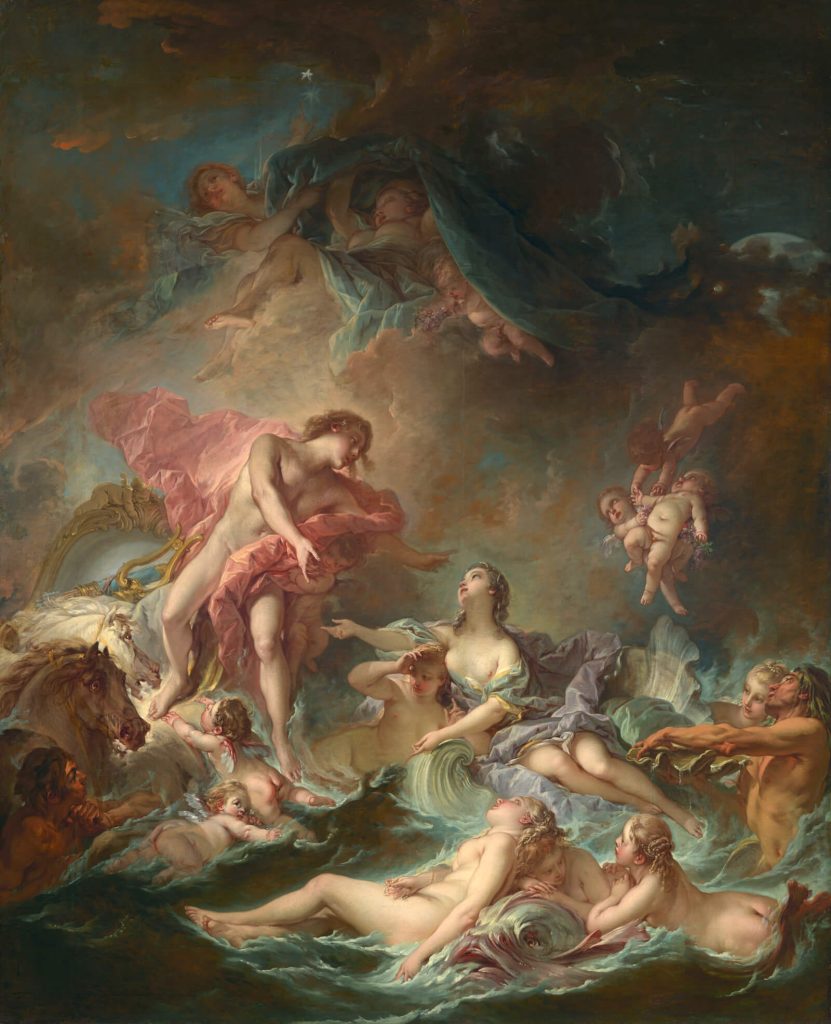
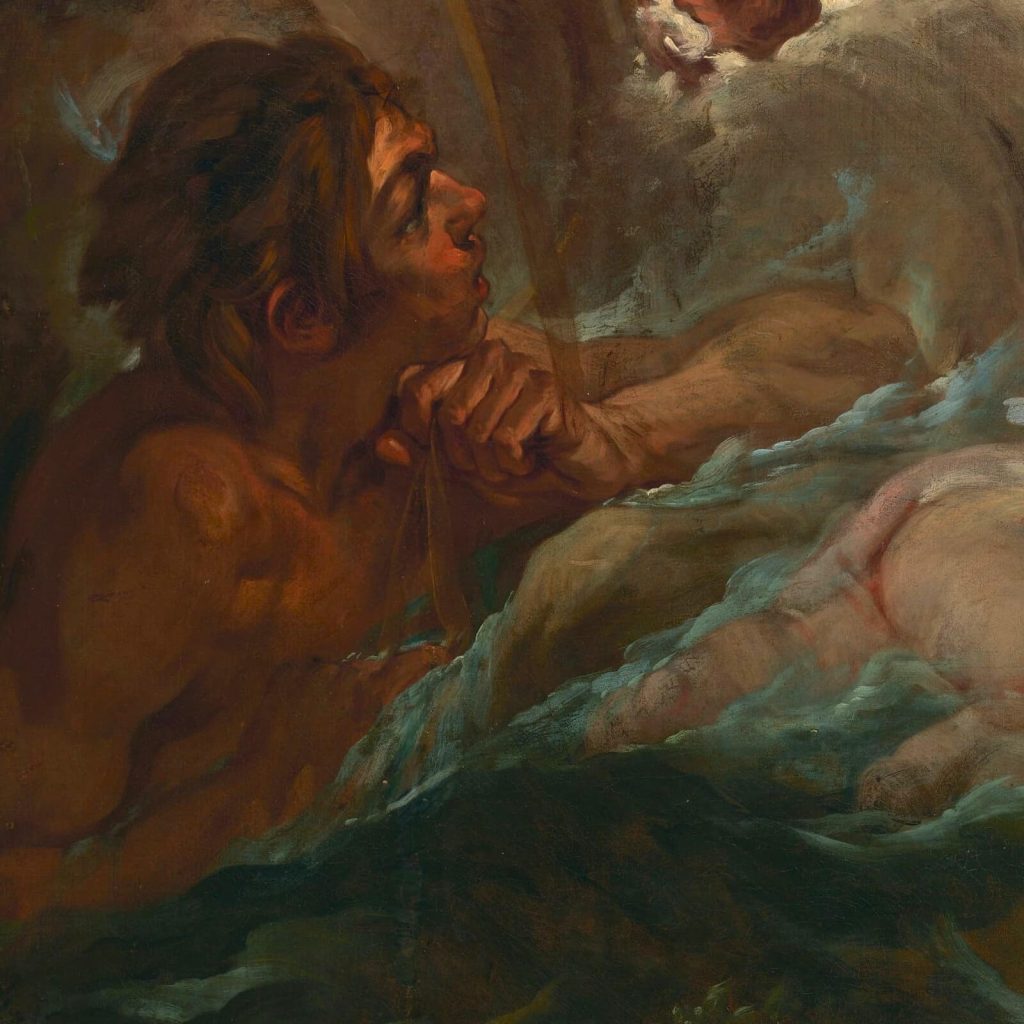
The Setting of the Sun is an oil on canvas measuring 318 x 261 cm (10 ft 5 in x 8 ft 7 in). It depicts a Greek myth as described by the famous Roman poet Ovid in his well-known narrative, Metamorphoses. Apollo, the Greek sun god, has just finished his daily work of pulling the sun with his chariot across the sky. He is now returning to the ocean, where he is greeted by his lover, Thetis, who is a sea nymph and is surrounded by her fellow watery companions. Above the lovers are two more Greek deities representing Sleep and Night.
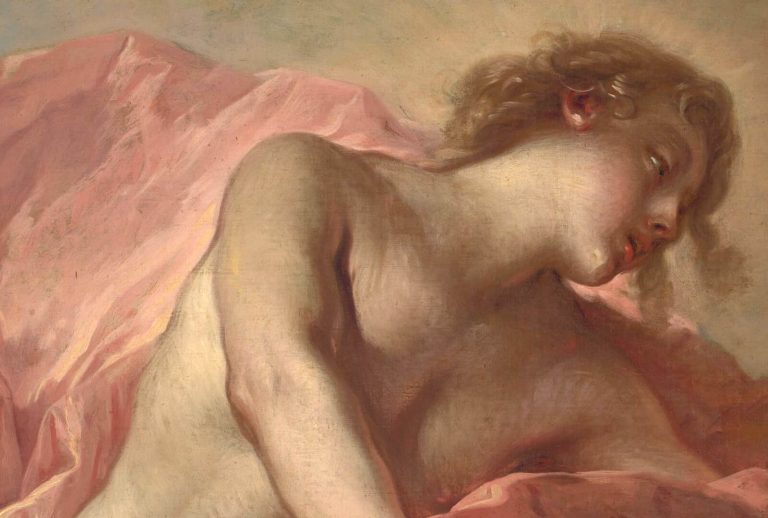
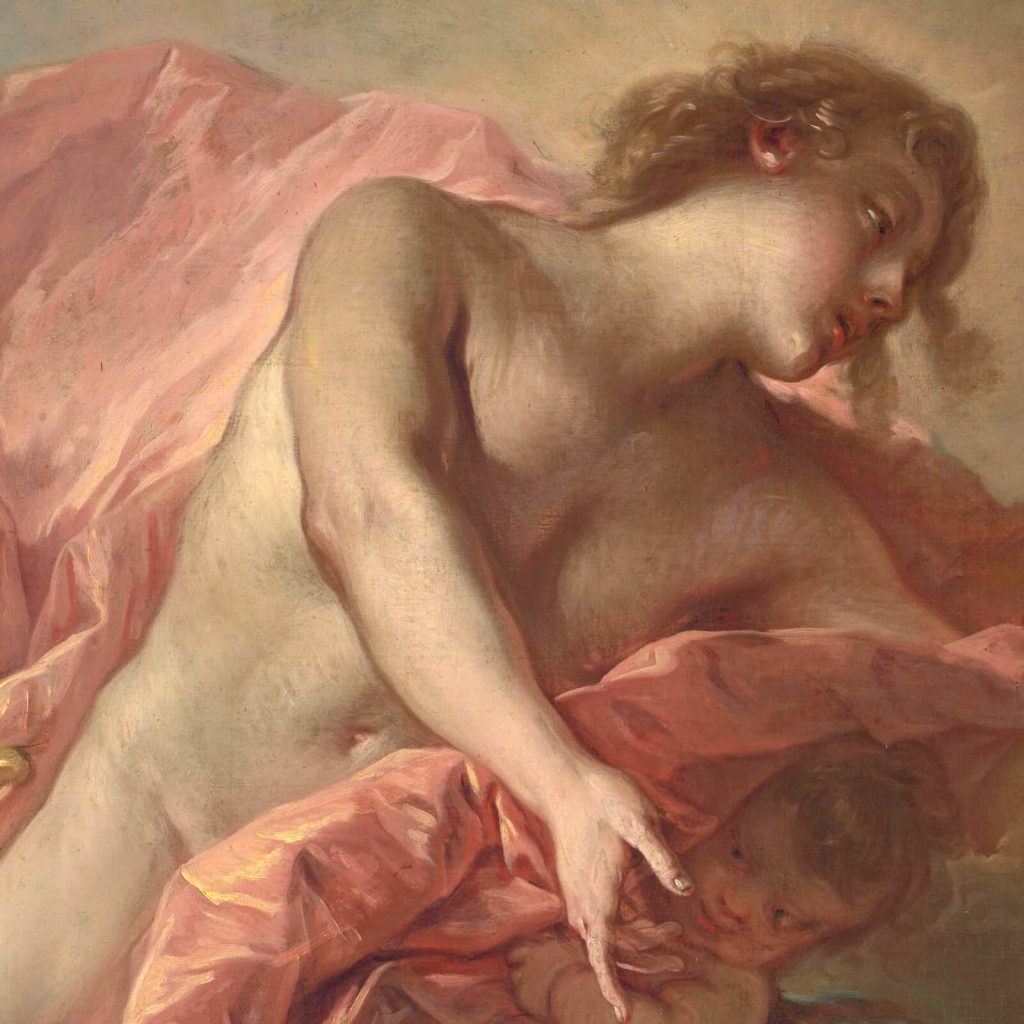
The god Apollo is the central male figure who is draped in pink fabric and stepping down from his chariot on the left. He is depicted as an elegant youth with a handsome face and muscular body. His refined features but strong form present an attractive blend of gentlemanly elegance and masculine virility. There is a hint of haughtiness tinged with sensuality in his eyes. His firm thighs and sculpted arms sway as he moves towards his beloved. He has the looks and presence of a sexy, passionate aristocrat. Would it shock the viewer to discover that Apollo is modeled after King Louis XV? No wonder he was known as one of the most handsome men in France during his prime years.
Thetis
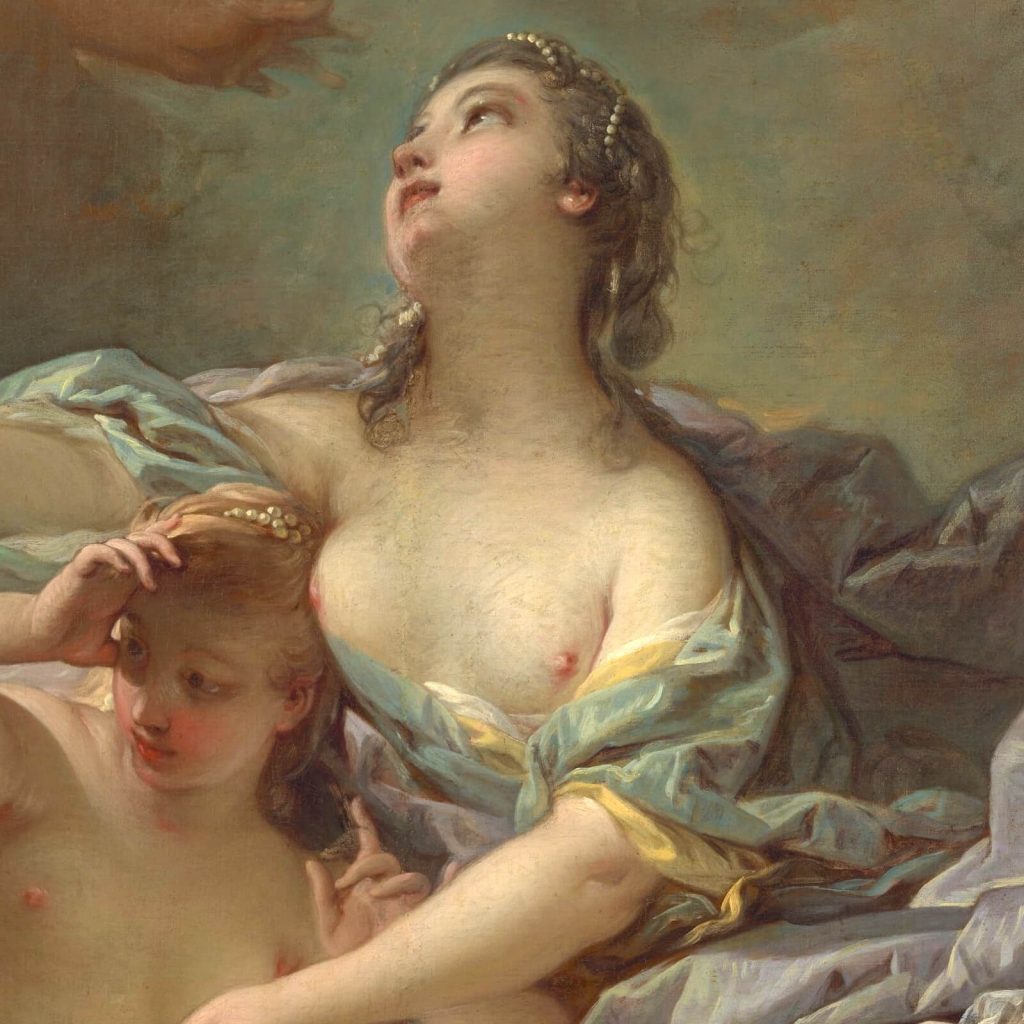
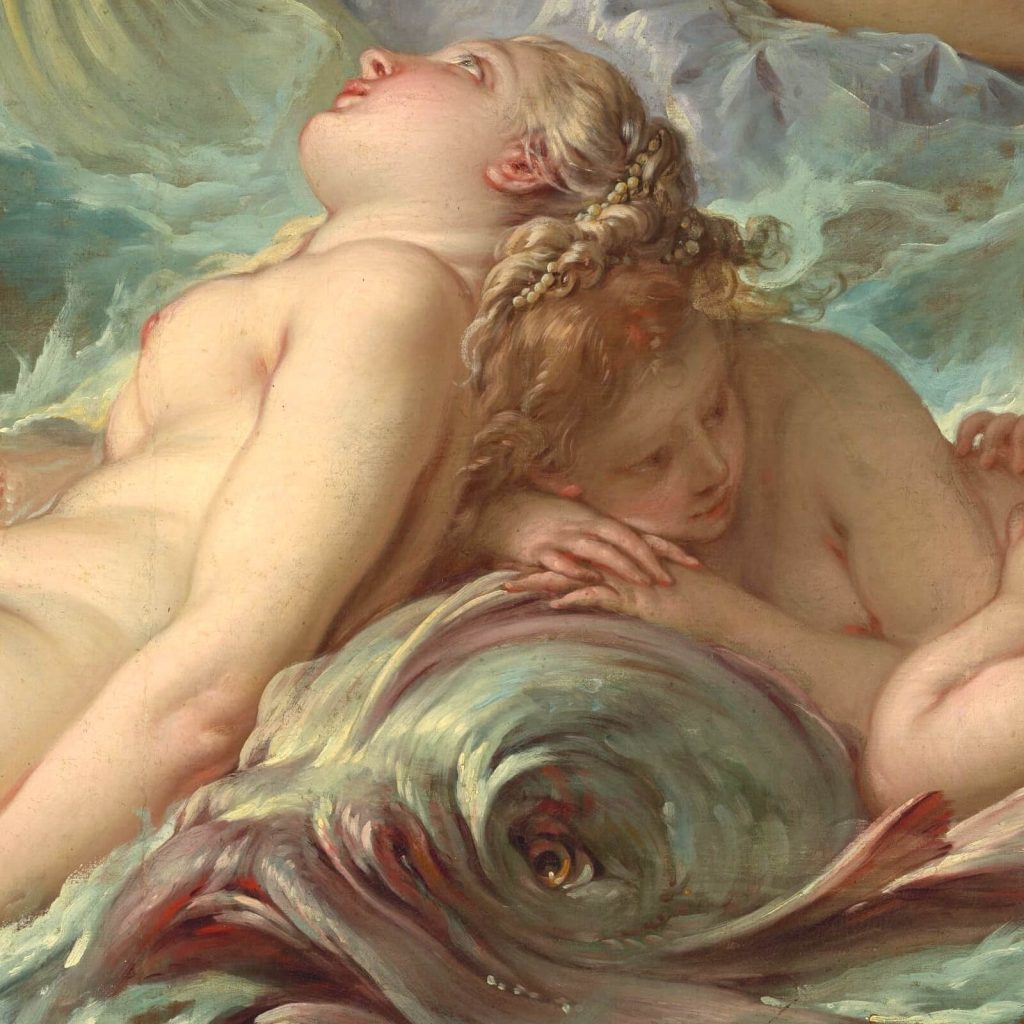
The sea nymph Thetis is the central female figure who is draped in indigo fabric and lays at the feet of Apollo. Her arms are outstretched, echoing Apollo’s embracing gesture, while her doe eyes languidly look upwards towards her solar lover. Her chest is bare, and delicate strands of pearls are wrapped and intertwined among her sea gray hair. Her soft shoulders, full bosom, round knees, and fluted calves present a voluptuous interpretation of classical ideals.
She is a beautifully animated Greek statue with charming French features. Madame de Pompadour was shockingly but appropriately the model for Thetis. Her lovely face and ravishing body complement the studly Apollo/Louis XV.
Sleep & Night
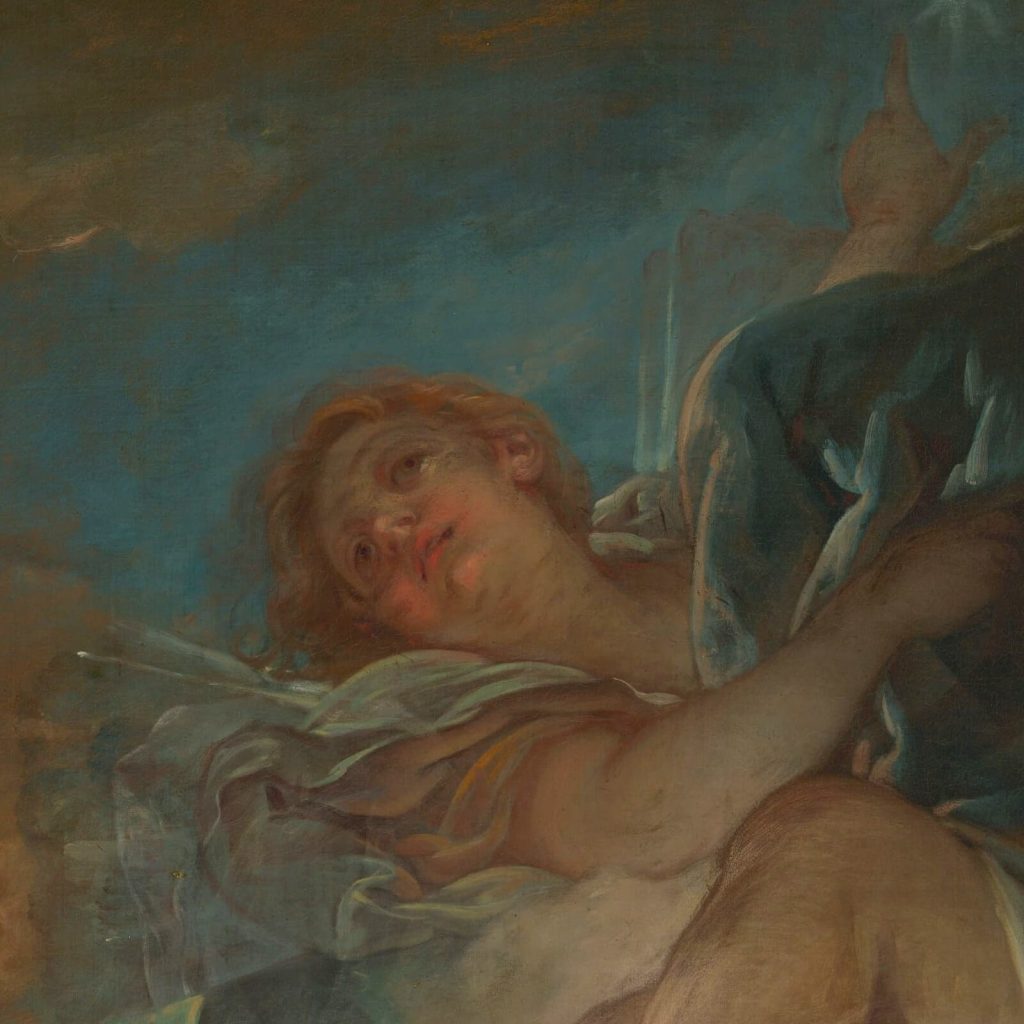
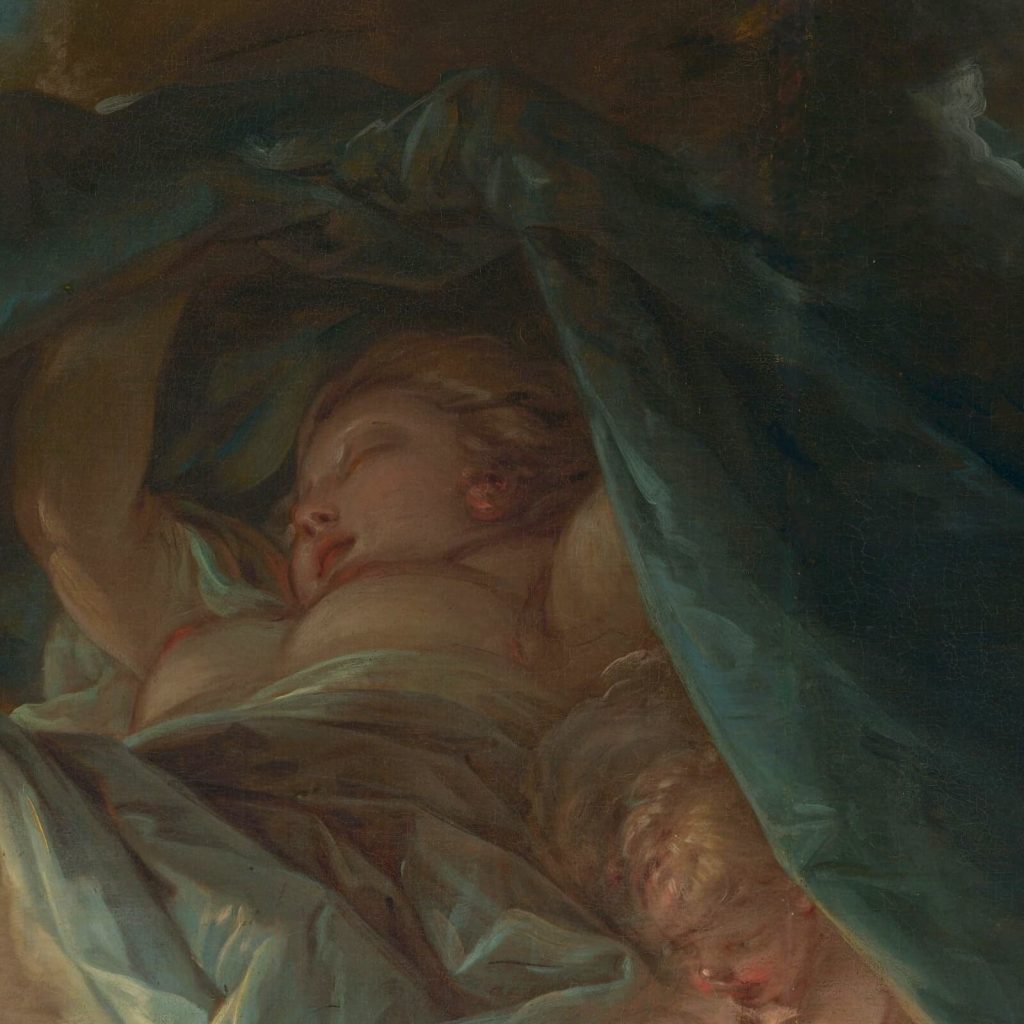
Above the divine lovers are two additional Greek deities. On the left is the male Sleep, and on the right is his mother, Night. Sleep holds in his hands a seafoam green velvet curtain that is slowly but gently enveloping Night.
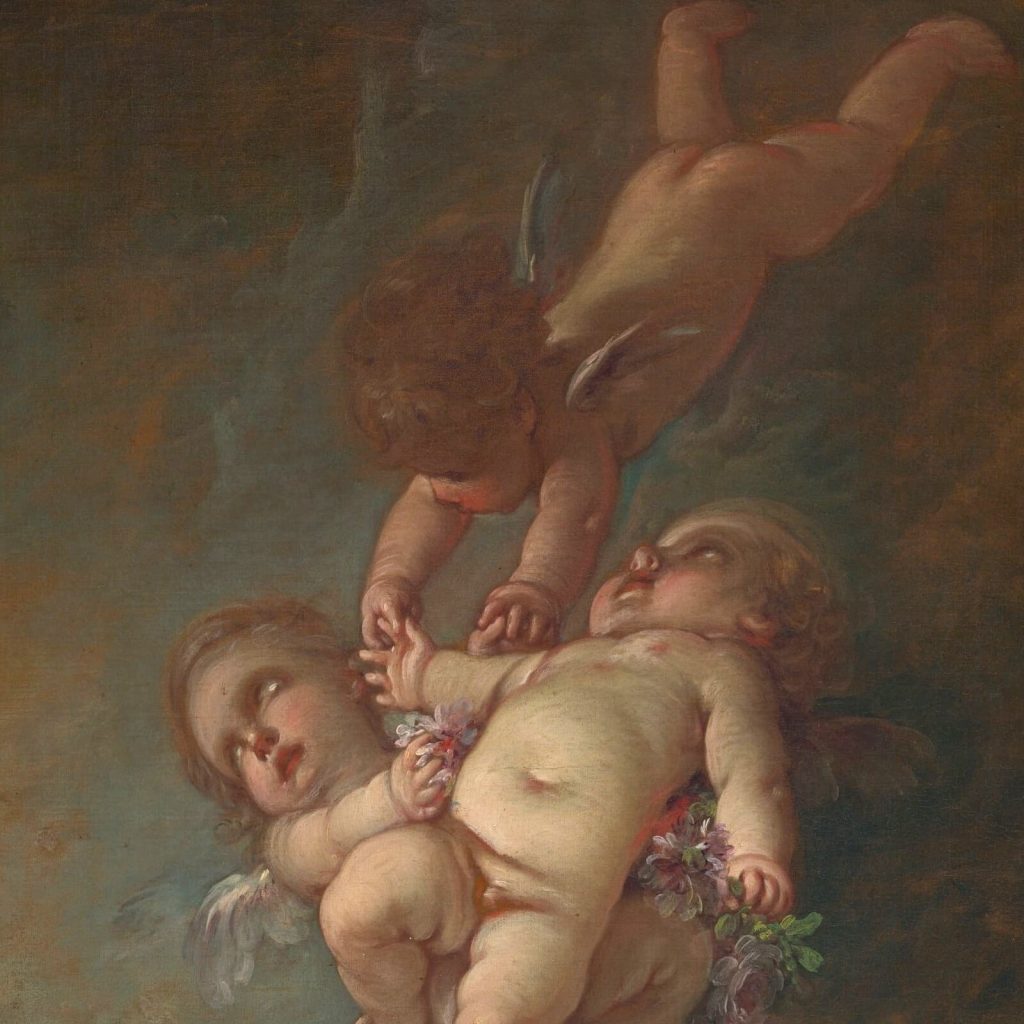
Her eyes are closed, and her arms are lifted as she grabs the curtain. A small putto (cherub) holds flowers to the right of Night, and peeks from under the sleep-inducing curtain.
Putti
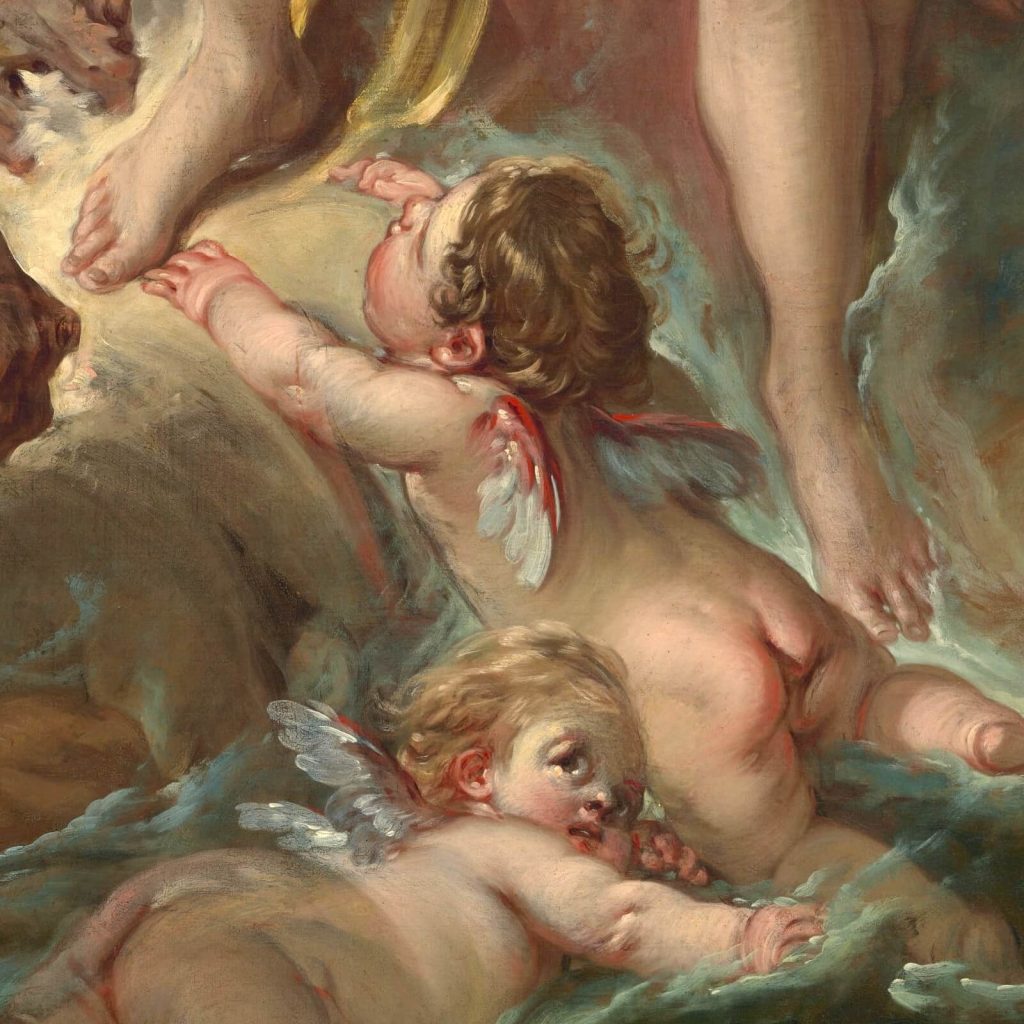
Scattered throughout the scene are putti, which are small nude winged children similar to Cupids. There is one putto beside Night, three putti cluster on the right side of the scene in the air, and two putti at the feet of Apollo in the water. Their presence adds a playful, innocent, but amorous touch to the image. They are the physical representations of love’s gentleness and the heart’s palpitations.
Many western artists for centuries, from the Renaissance through the late 19th century, used putti as allegories, symbols, or decorations in their paintings and sculptures. Rococo artists, like François Boucher, were probably the most liberal users of putti because putti so aligned with the lighthearted and amorous spirit of the mid-18th-century French aristocratic world.
Cartoons
Madame de Pompadour originally commissioned The Rising of the Sun and The Setting of the Sun as a pair of tapestries in 1752. They were to adorn the King’s Bedroom on the first floor of her newly constructed Château de Bellevue in Meudon, near Paris, France. To commission the tapestries, Pompadour instructed Boucher to create full-scale models (cartoons) for her visual approval. The cartoons would then be submitted to the Royal Gobelins Manufactory so the tapestries could be made as woven and embroidered versions of the paintings.
The vibrant colors and elaborate compositions caused the manufacturer to take three years to create the commissioned works. When presented to Madame de Pompadour in 1755, the pair was the most expensive tapestries of its era in France.
When François Boucher presented the finished painted cartoons in 1752, Madame de Pompadour was thrilled and delighted with their monumental elegance. Despite the manufactory’s need for the cartoons, the paintings were displayed in the 1753 Salon of Paris and quickly admired by a large audience. The cartoons were then afterwards returned to the manufactory, and the tapestries completed. Pompadour happily displayed the tapestries in their intended space, but she unconventionally claimed and kept the cartoons as well.
Most tapestry cartoons are destroyed after the creation of their final products, however Pompadour recognized the genius of the paintings and stated that they were works of art in themselves. She proudly displayed them on the ground floor of the same Chateau de Bellevue in the Swiss Guards’ room. Therefore, she had the same imagery twice in the same chateau, but one in oil on canvas and the other in woven and embroidered tapestry.
Ironically, the finished tapestries are lost today, and their whereabouts are unknown. Perhaps they did not survive the infamous Revolution of 1789? Thankfully, Madame de Pompadour conserved the cartoon canvas paintings, and they were successfully sold after her death and conserved by successive owners. They are a lasting testimony to one of the greatest decorative art commissions of 18th-century France.
The Setting of the Sun is visually the more interesting of the pair and is therefore easily titled as one of the greatest masterpieces of François Boucher. Showcasing his signature elements—charming putti, striking gods, graceful nymphs, vivid colors, and richly detailed compositions—The Setting of the Sun stands as a tribute to the Rococo style.