Summary
- In 15th-century Europe, societies recovered from plague, war, and religious divisions, while prosperous Flanders became a cultural center where art and architecture flourished through prestigious religious commissions.
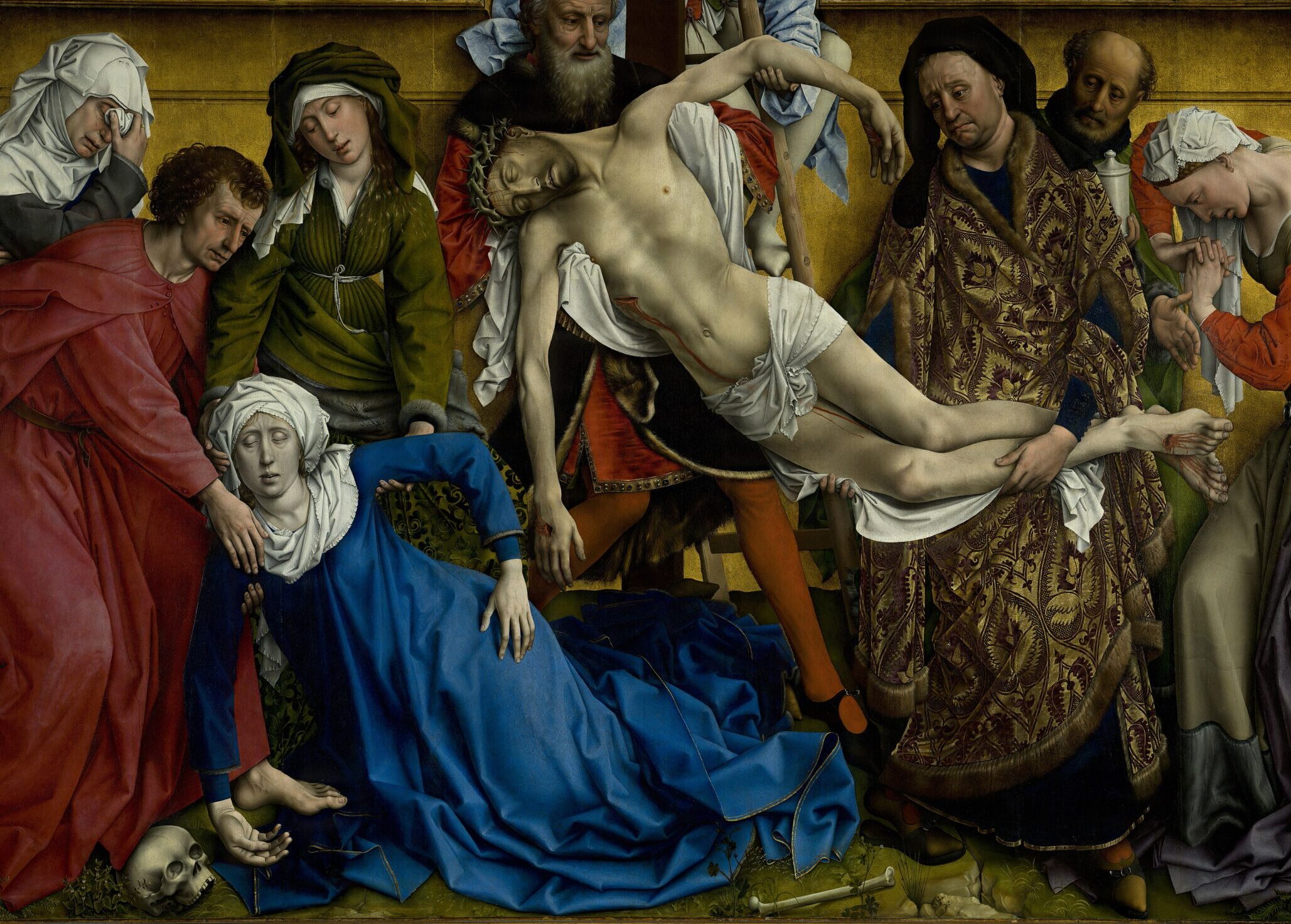
- The Descent from the Cross depicts the lowering of Christ with multiple surrounding figures showing intense emotion, demonstrating van der Weyden’s mastery of dynamic composition and realistic, deeply human expression.
- Christ occupies the center of the composition, depicted lifeless with realistic details and a striking trail of blood, highlighting van der Weyden’s skill in combining naturalism with emotional and visual impact.
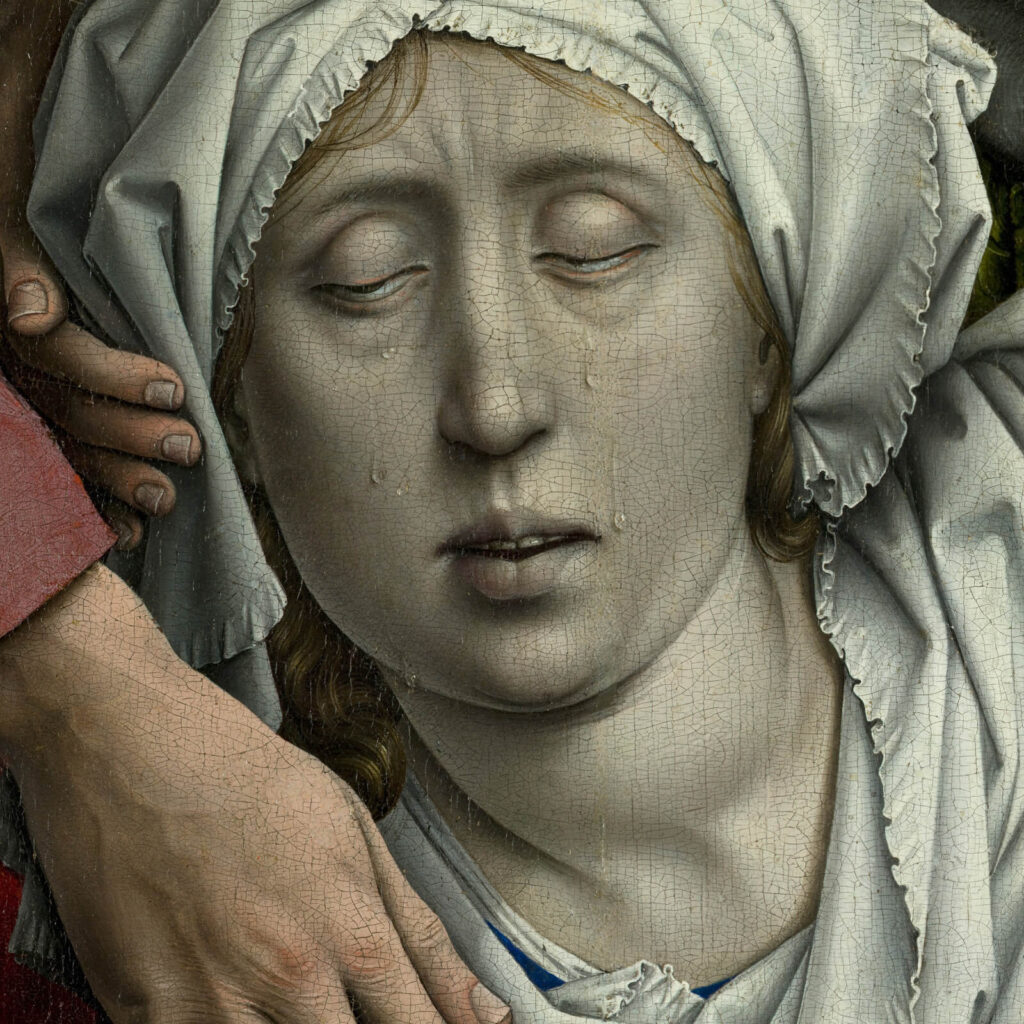
- The Virgin Mary is shown in deep mourning, her body mirroring Christ’s in posture and emotion, emphasizing her spiritual and physical connection to her son.
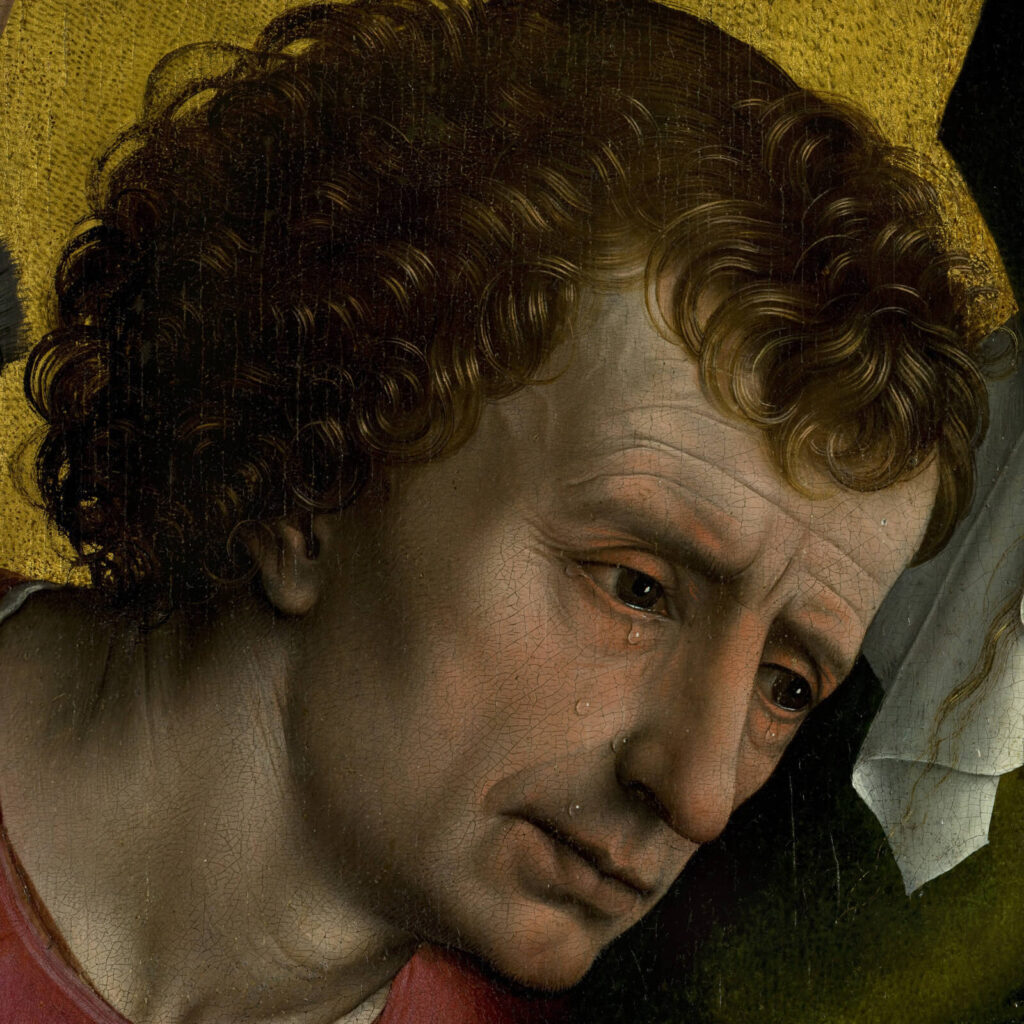
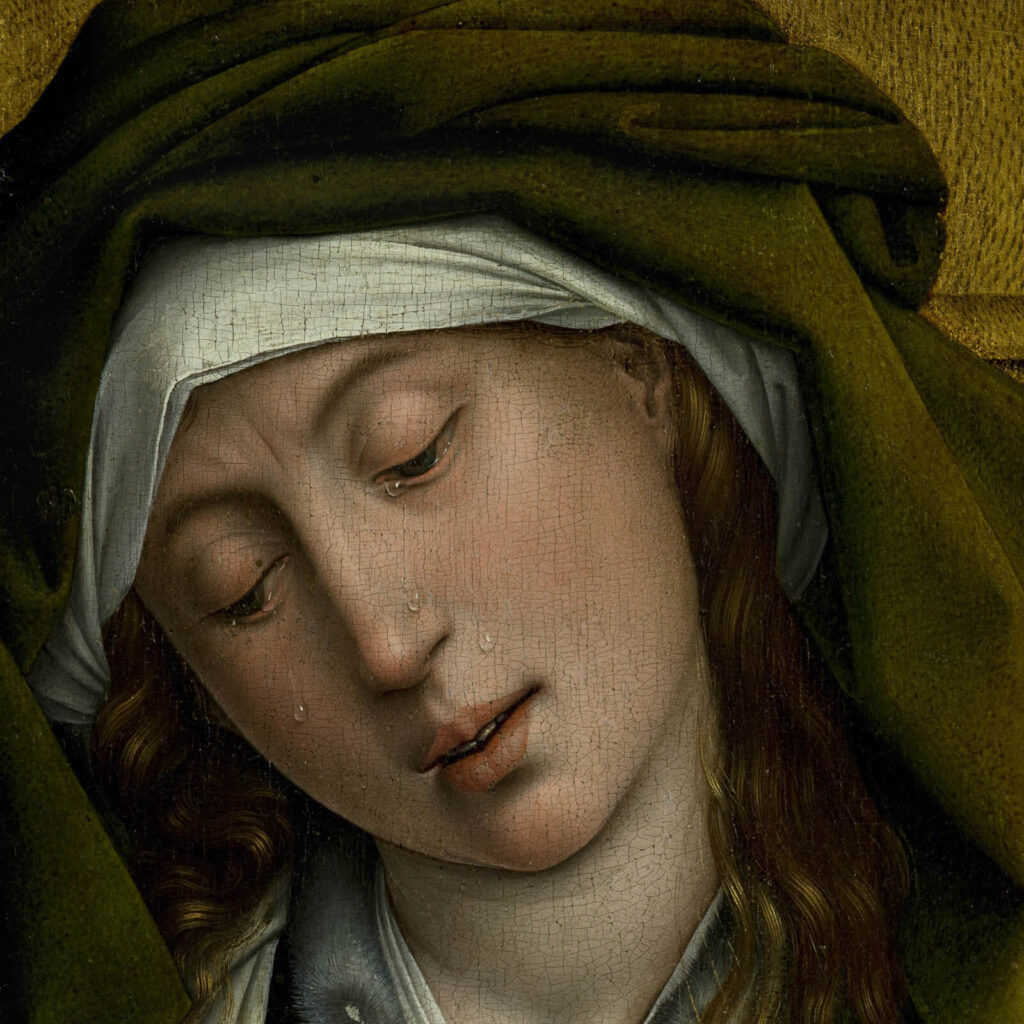
- Saint John the Evangelist supports the Virgin Mary with a sorrowful expression; Mary Salome, her half-sister, cries in sympathy, while Mary Cleophas mourns in isolation, holding a handkerchief as tears stream down her face.
- Nicodemus supports Jesus’ body using a shroud to avoid touching it directly, while an unnamed servant on the ladder holds the blood-stained nails.
- Joseph of Arimathea, a wealthy man whose rock-cut tomb was used for Jesus’ burial, mourns him and supports his legs, while his servant holds the myrrh oil.
- Mary Magdalene’s posture reflects intense emotion; her exact role in the life of Jesus remains debated.
- Van der Weyden includes a skull and thigh bone to link the crucifixion of Jesus with Adam.
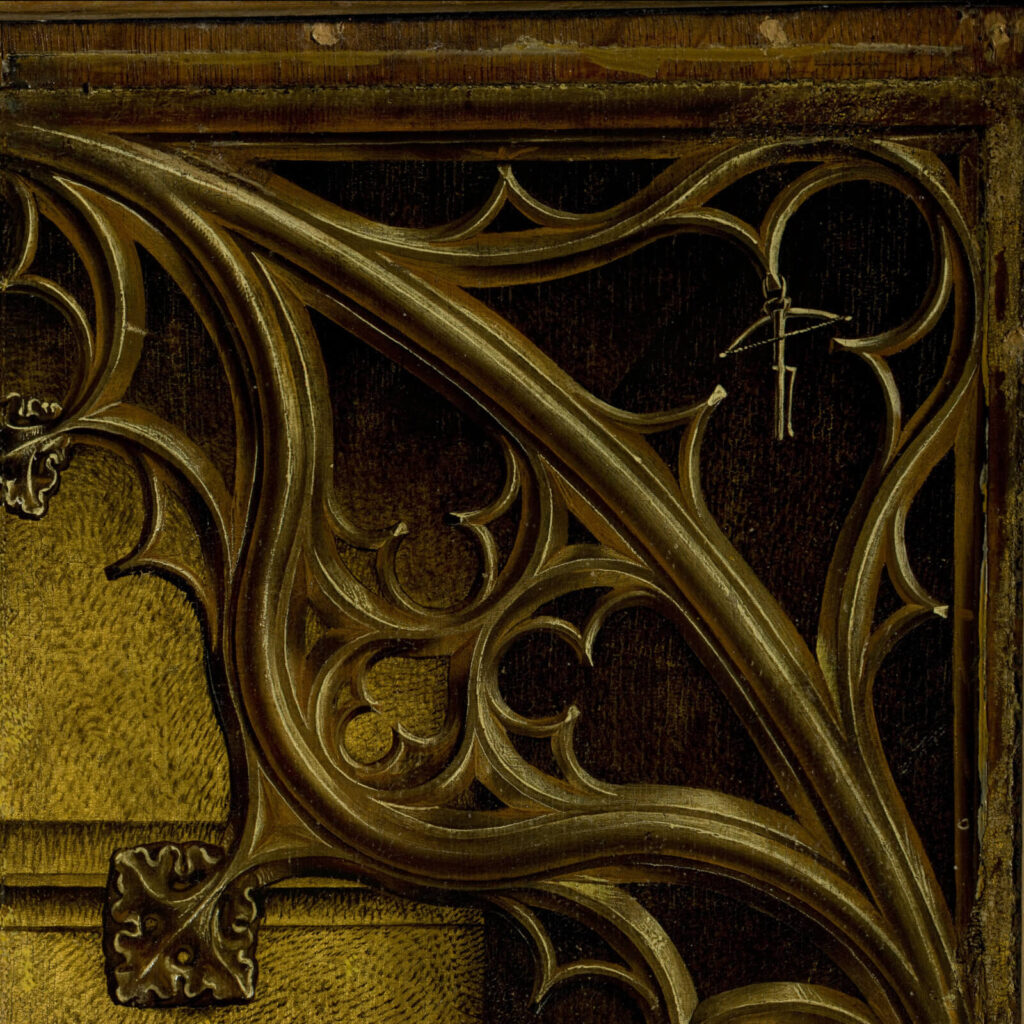
- Tracery around the panel includes tiny crossbows, referencing the commissioners, with Jesus and the Virgin’s bodies echoing the shape of a crossbow.
- The Descent from the Cross uses expressive figures and a gold background to convey intense, authentic human emotion.
Historical Background
The 15th century was a great transitional period for Europe, filled with several monumental challenges. Society was still rebuilding after the devastating epidemic of the Black Death and outbreaks from 1346 to 1353. The Catholic faith was split during the Western Schism when two popes simultaneously existed in Rome (in modern Italy) and Avignon (in modern France) from 1378 to 1417. Instability and unrest were widespread as the Hundred Years’ War raged between England and France from 1337 to 1453. The 15th century marked the gradual end of the late Medieval period and the growing beginning of the early Renaissance era.
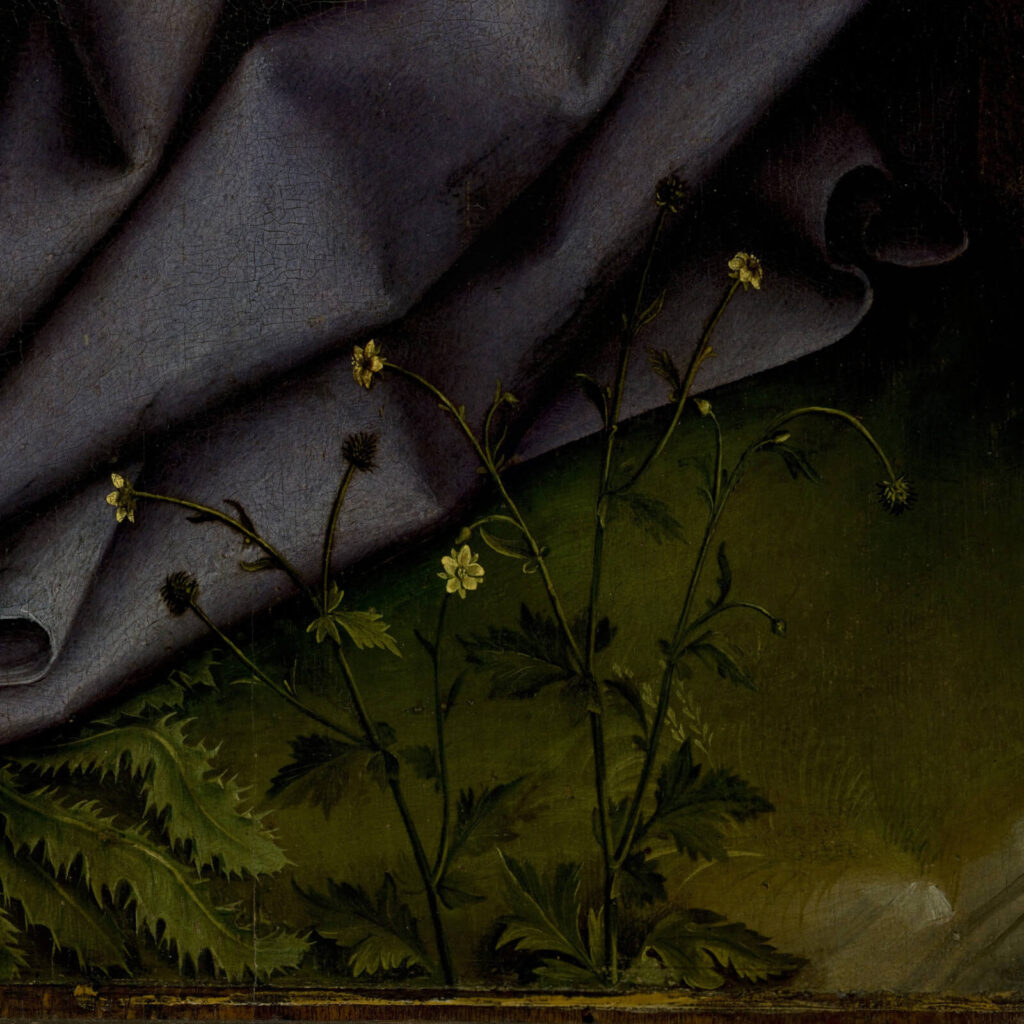
Rogier van der Weyden, The Descent from the Cross, before 1443, Museo del Prado, Madrid, Spain. Detail.
The Renaissance in Northern Europe was largely centered around Flanders, which encompasses the regions of modern Belgium, the Netherlands, Luxembourg, and parts of northern France. It was a rich and prosperous region controlled by the successively powerful dukes of Burgundy. Art and architecture flourished as people and communities sought to express their faith and prestige through costly commissions.
One of the most popular commissions of the time were triptych altars, religious three-part hinged paintings used for Christian masses and ceremonies. They were frequently used in prestigious communal churches and wealthy private homes. One such triptych image is the famous The Descent from the Cross painted by Rogier van der Weyden before 1443 (perhaps even around 1435). It was originally commissioned for the Church of Notre-Dame-hors-les-Murs (Church of Our Lady Outside the Walls) in Leuven, in modern Belgium.
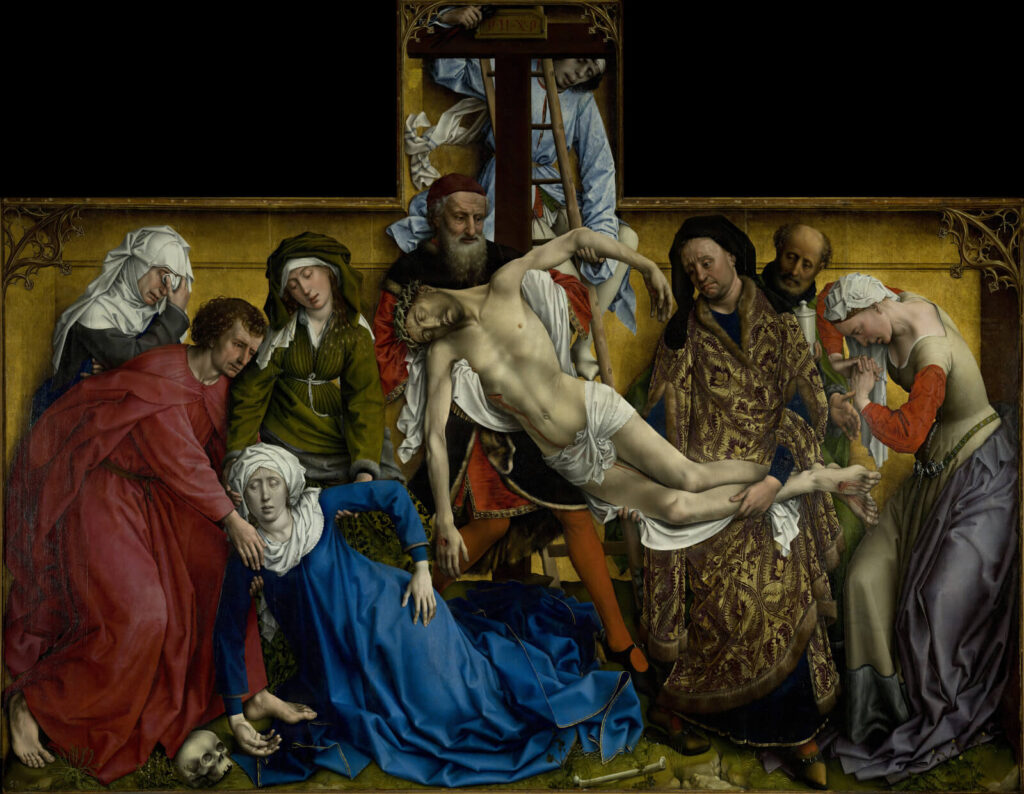
Rogier van der Weyden, The Descent from the Cross, before 1443, Museo del Prado, Madrid, Spain.
Composition
The Descent from the Cross is a large oil on wood painting measuring 2.05 m (80 1/2 in.) high by 2.59 m (102 in.) wide. It is the large central panel from a triptych altar. Unfortunately, the two smaller side panels are lost to modern viewers. The painting captures the dramatic moment when the lifeless body of the crucified Jesus is lowered from his cross. Many figures surround Jesus, who is centrally placed in the composition, with four figures to his left, two behind him, and three to his right. Each figure expresses the human drama with deep emotions and varied reactions.
Rogier van der Weyden (ca. 1400–1464), the painter, was known for his religious images filled with dynamic compositions, a style powerfully demonstrated in The Descent from the Cross. The painting is readily considered one of van der Weyden’s greatest masterpieces.
Rogier van der Weyden, The Descent from the Cross, before 1443, Museo del Prado, Madrid, Spain. Detail.
Large Scale
The figures populating the scene are large, almost lifesize, which is a great rarity in 15th-century Flemish (from Flanders) paintings. Rogier van der Weyden used such a large format to visually strike and impress the viewer with his sense of grandeur and piety. The lifesize scale makes the figures feel more neighborly, more realistic, and therefore more immediately resonating to the viewer. Anyone gazing on the Biblical scene can quickly form a reaction, a connection, or even commentary on the sorrowful event.
Rogier van der Weyden, The Descent from the Cross, before 1443, Museo del Prado, Madrid, Spain. Detail.
Jesus
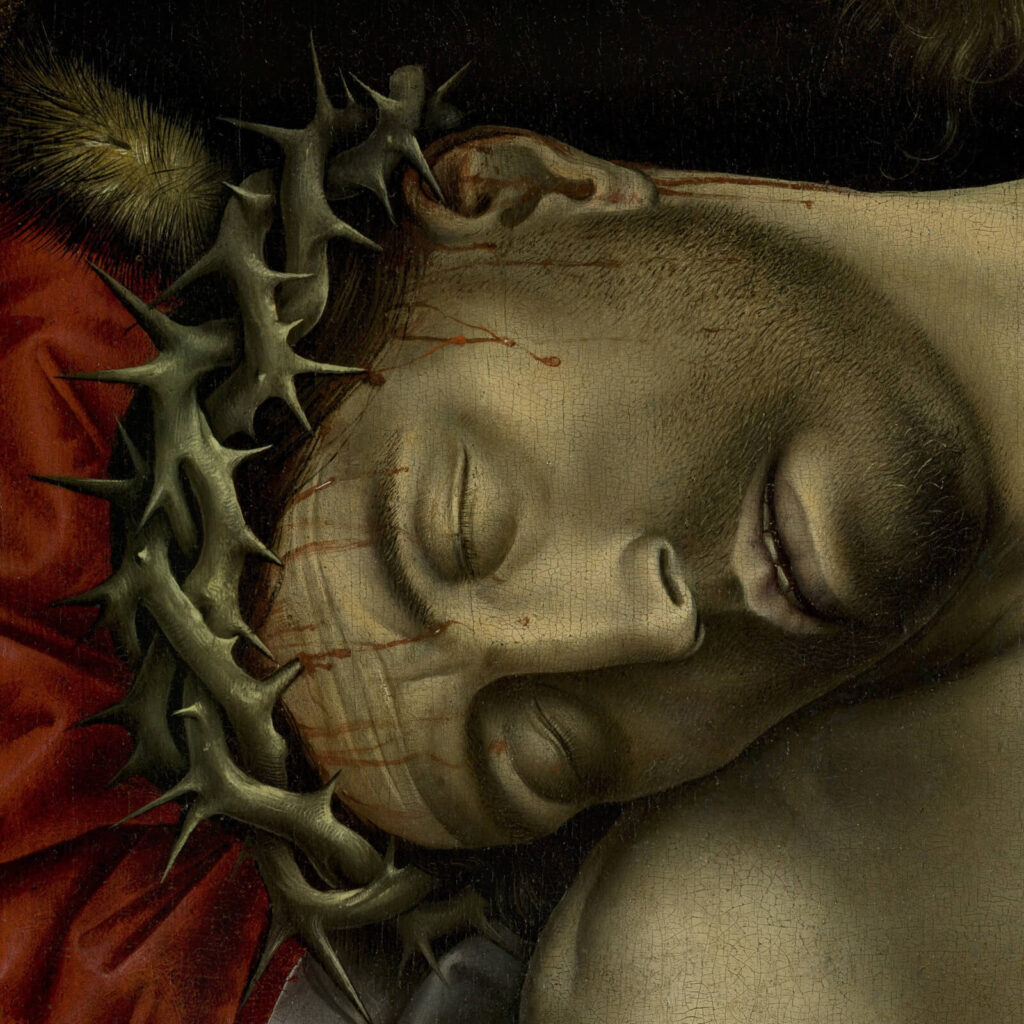
Jesus is the most important figure of The Descent from the Cross and is therefore, according to Western religious tradition, placed centrally in the composition. He is depicted as a lifeless corpse. His eyes are closed, his neck and jaw are slack, his hands are loose, and his legs bow under their natural weight. His body’s skin has taken a pale gray color, the shade of recent death as the vitality of life has faded.
Rogier van der Weyden, The Descent from the Cross, before 1443, Museo del Prado, Madrid, Spain. Detail.
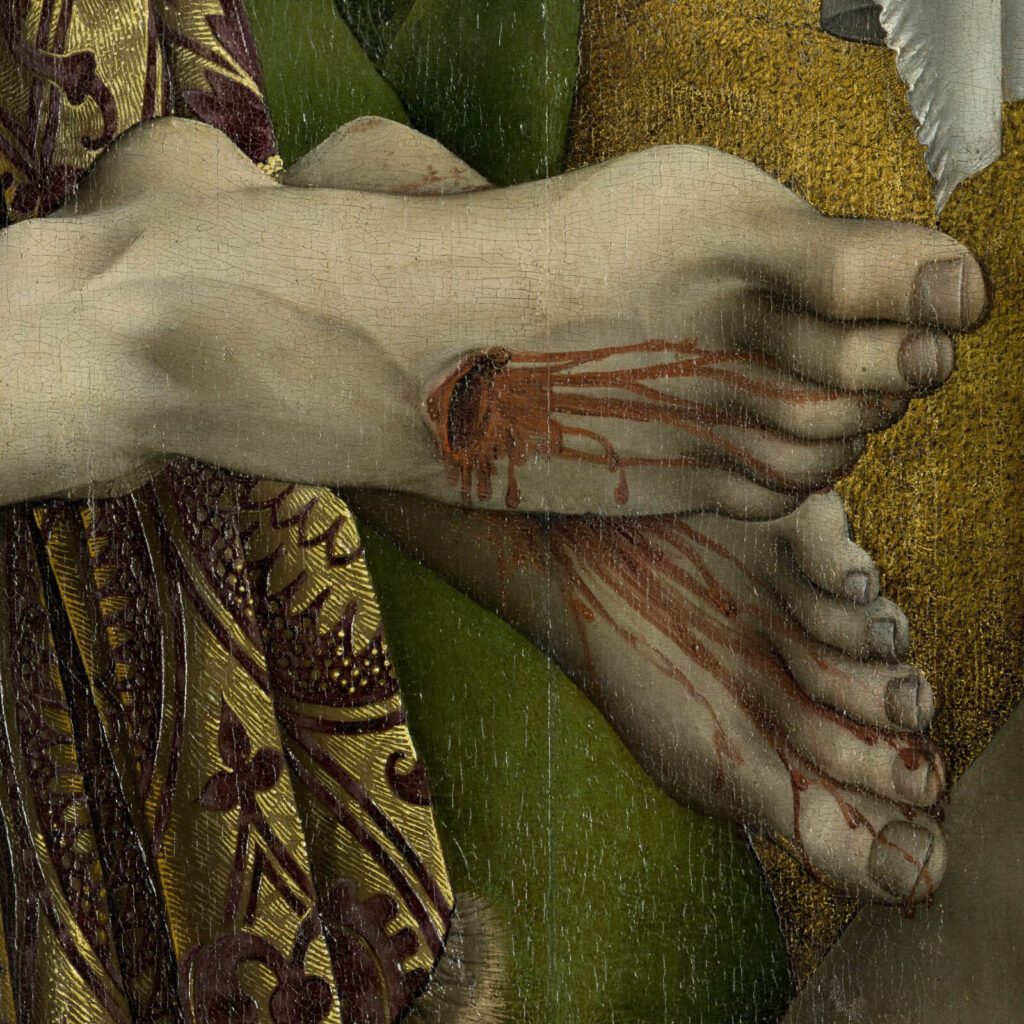
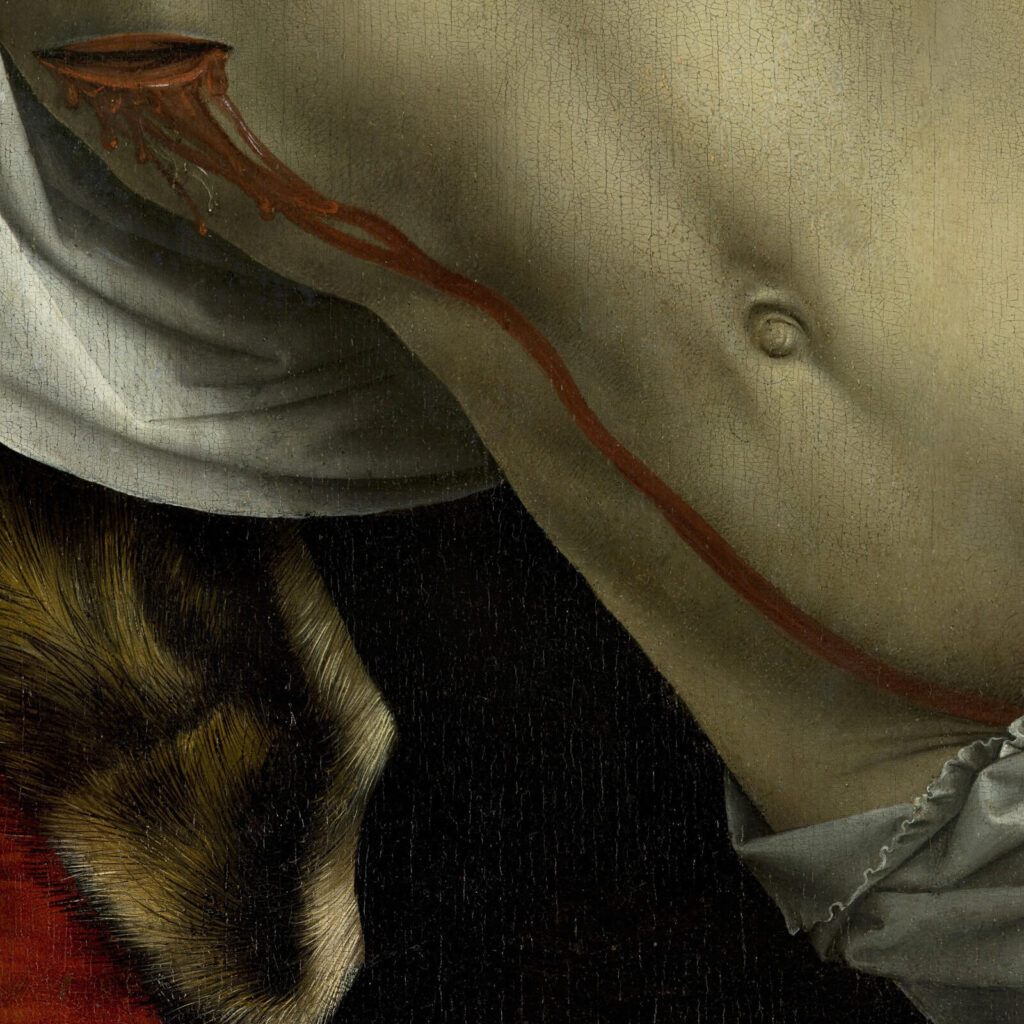
However, bright red blood dripping down his body adds an interesting contrast and reveals the proof of Jesus’s death. According to Catholic dogma, a Roman soldier, named Longinus, pierced the side of Jesus to provoke a reaction to confirm if he had already expired from the crucifixion. When Jesus did not react, he was pronounced dead and then shortly later taken down from the cross by his loved ones and followers. As blood drips from the torso wound, it trails down his abdomen, past his loin, and along his thigh.
Rogier van der Weyden, The Descent from the Cross, before 1443, Museo del Prado, Madrid, Spain. Detail.
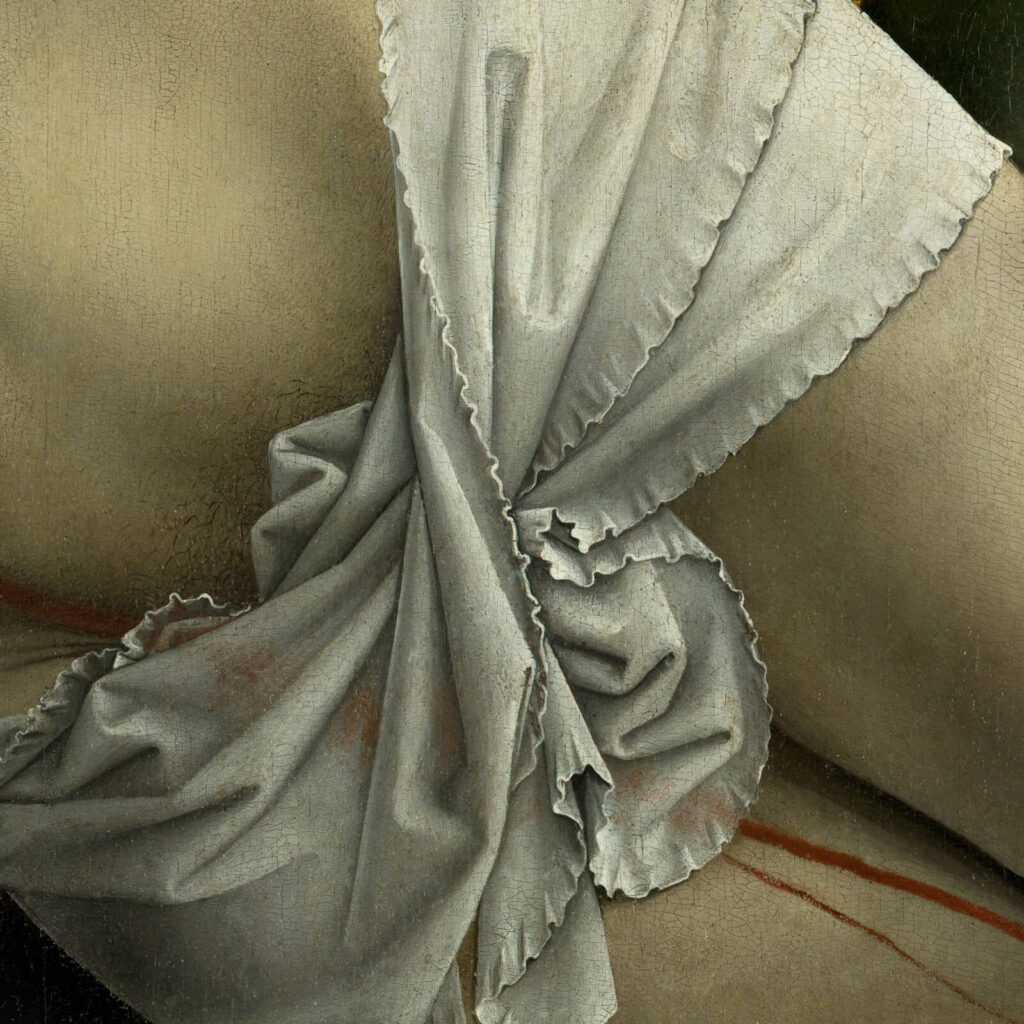
It is this distinct bloody trail that can provoke a nauseating sensation to viewers sensitive to the sight of blood. Rogier van der Weyden realistically captures the opaque nature of the red blood and the sheer transparency of the white loincloth as the fluid is artfully seen underneath the fabric’s gauzy layers. It is a particularly beautiful but morbid detail.
Rogier van der Weyden, The Descent from the Cross, before 1443, Museo del Prado, Madrid, Spain. Detail.
Virgin Mary
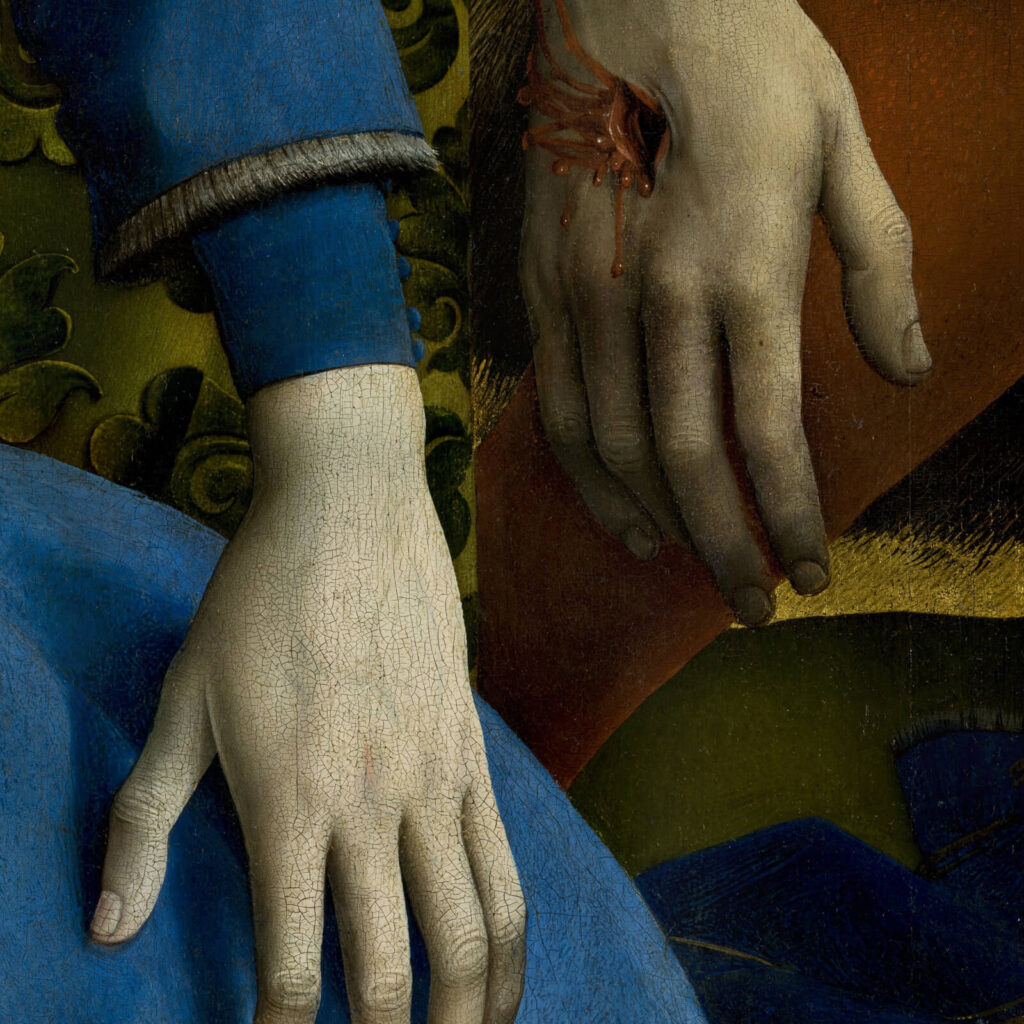
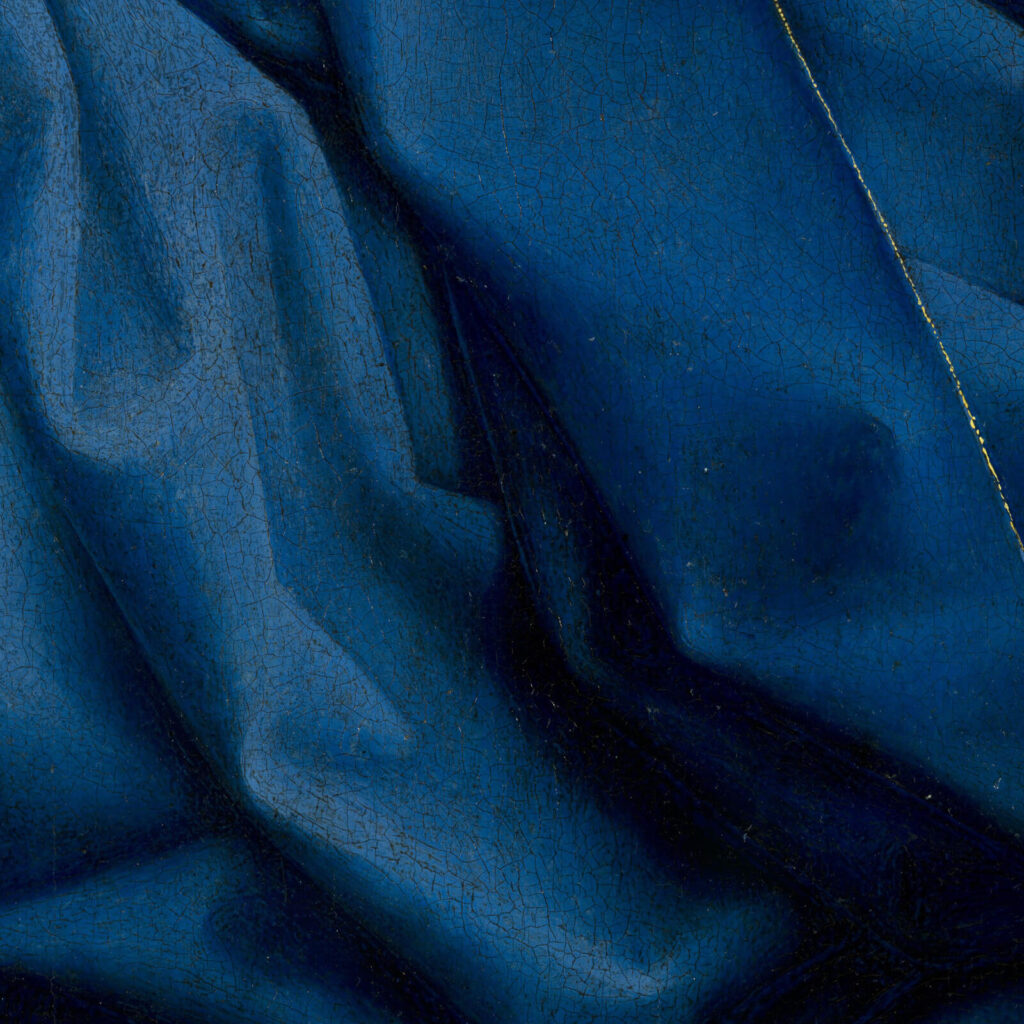
The Virgin Mary, the mother of Jesus, is depicted in a blue gown lying to the lower left of Jesus. Within Christian religious hierarchy, she is easily considered the most important figure after Jesus. Her virginal motherhood is understood as a Biblical miracle and a powerful symbol of God’s presence.
Rogier van der Weyden, The Descent from the Cross, before 1443, Museo del Prado, Madrid, Spain. Detail.
She is physically and spiritually connected to Jesus, and therefore endures the pains and griefs of a mother mourning her son. Her heart-wrenching pain shatters her composure and breaks her fortitude. She collapses into a fainting spell, with eyes shut, and arms and legs limp, as she echoes the bodily posture of Jesus. Both she and her son dynamically parallel each other in a diagonal position. Their bodies mirror and reflect the pain and sorrow of the scene.
Rogier van der Weyden, The Descent from the Cross, before 1443, Museo del Prado, Madrid, Spain. Detail.
Saint John the Evangelist
Saint John the Evangelist is the man depicted in red, grasping the left shoulder of the Virgin Mary with his two hands. His eyes are filled with sadness as tears drip down his face. Concern is written in his facial expression as he supports the bereaved mother.
Rogier van der Weyden, The Descent from the Cross, before 1443, Museo del Prado, Madrid, Spain. Detail.
Mary Salome
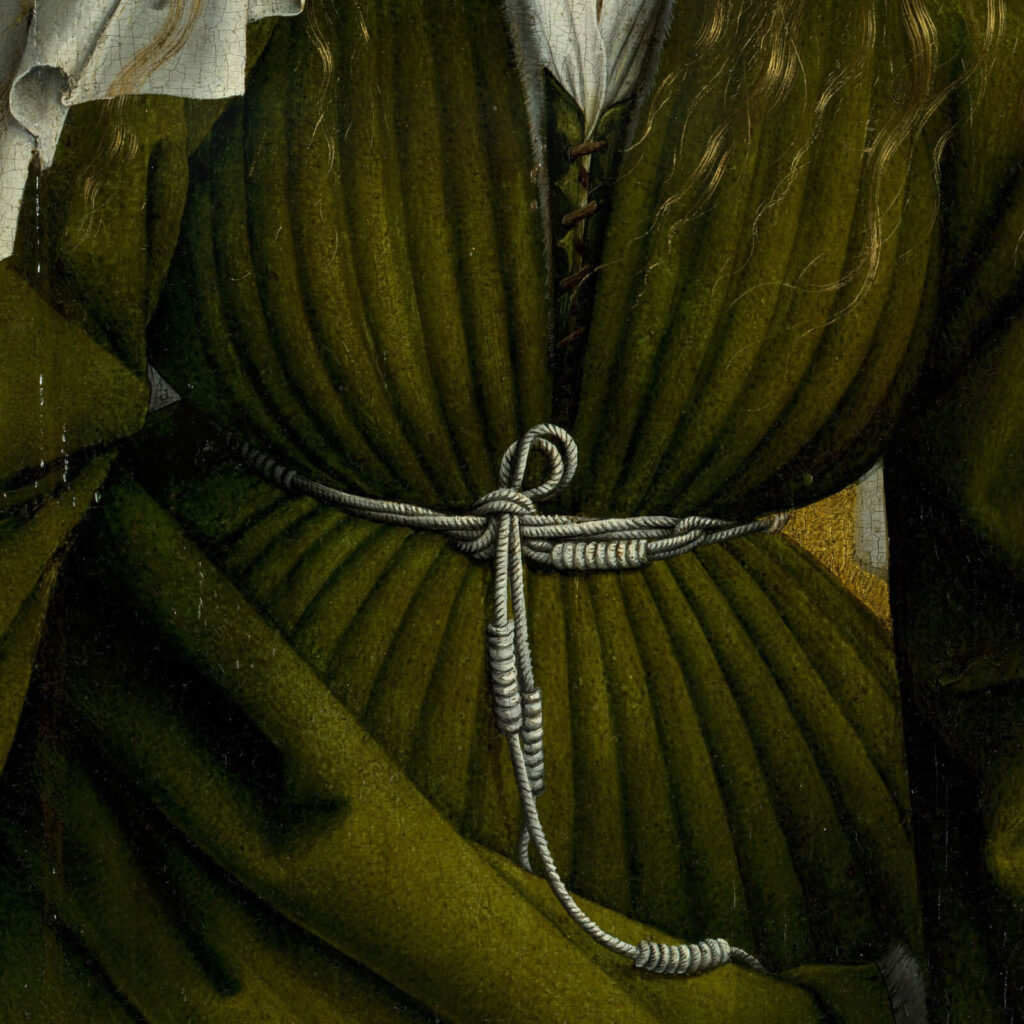
Mary Salome is the woman depicted in green supporting the right shoulder and head of the Virgin Mary. She is the Virgin’s half-sister. She is depicted as younger and more affluent than the Virgin Mary with her youthful face, long flowing blond hair, and fur-edged collar. She cries in sympathy with her half-sister and has lips slightly parted as if whispering words of condolence.
Rogier van der Weyden, The Descent from the Cross, before 1443, Museo del Prado, Madrid, Spain. Detail.
Mary Cleophas
Mary Cleophas is the woman behind Saint John the Evangelist and Mary Salome. She is depicted in a white headdress and a grey tunic. She holds a white handkerchief to her face as tears pour down her face. She is lost in grief and does not interact with the Virgin, John, or Mary Salome. She stands, cries, and feels the emotional intensity of the loss. Grief isolates her physical position.
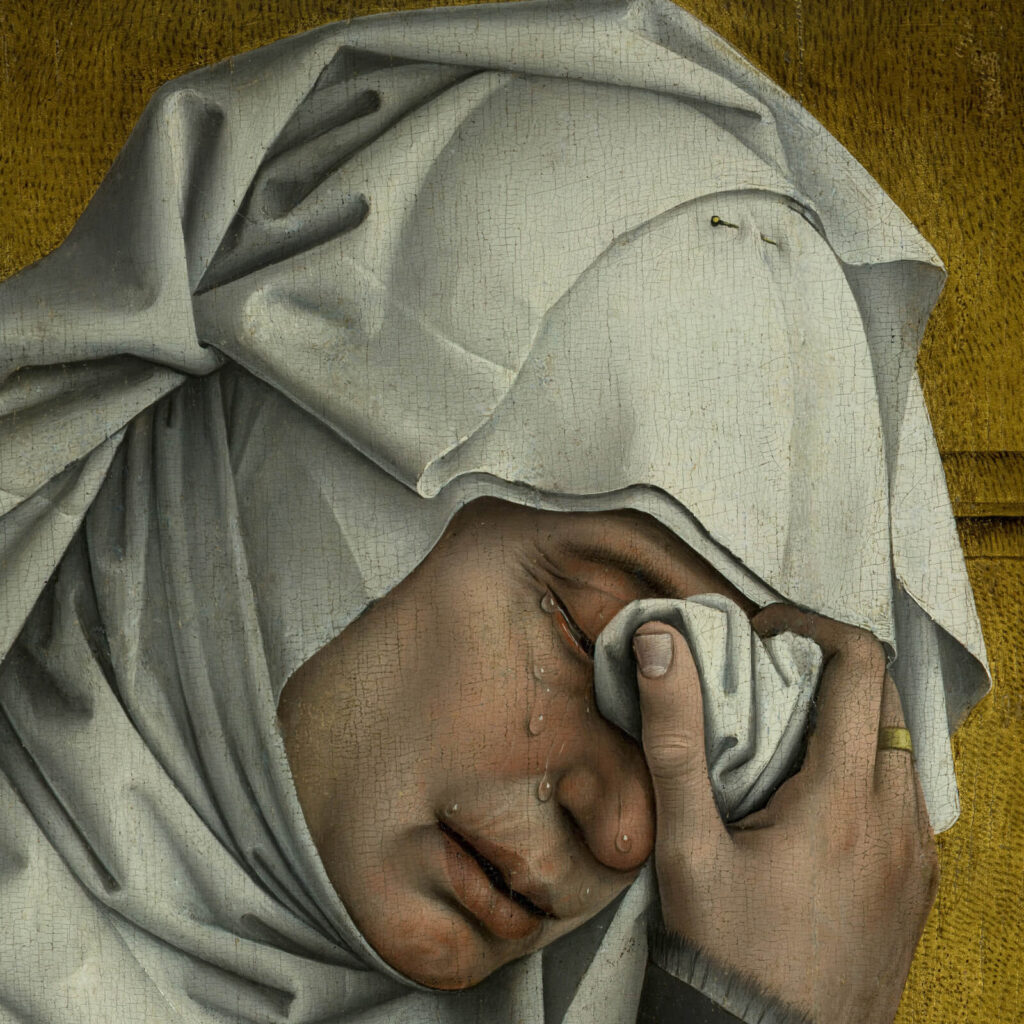
Rogier van der Weyden, The Descent from the Cross, before 1443, Museo del Prado, Madrid, Spain. Detail.
Nicodemus
Nicodemus is the bearded man behind Jesus and supporting Christ’s body. Nicodemus was a Jewish leader and a disciple of Jesus. He believes in Christ’s divinity and therefore refuses to touch the holy body by using the white shroud cloth to protect his hands. This shroud will later be venerated as the Holy Shroud and recognized by many faithful believers as the surviving Shroud of Turin preserved today in the Chapel of the Holy Shroud, Turin, Italy.
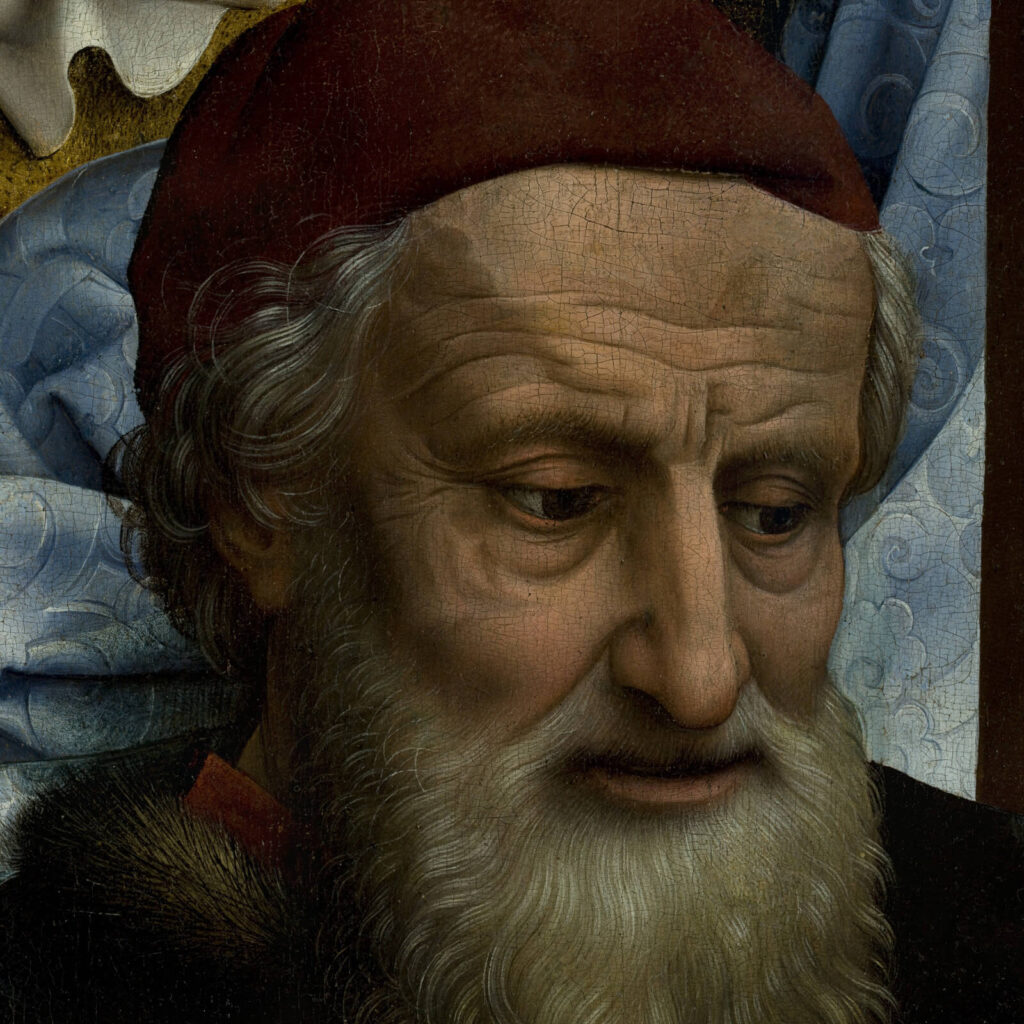
Rogier van der Weyden, The Descent from the Cross, before 1443, Museo del Prado, Madrid, Spain. Detail.
Servant of the Nails
An unnamed servant is above Nicodemus and Jesus in the uppermost portion of the painting. He is depicted as a younger man dressed in blue with slight non-European facial features hinting at an African or Arabic ethnicity. He may be the servant of Joseph of Arimathea, the elaborately dressed man to Jesus’s immediate right.
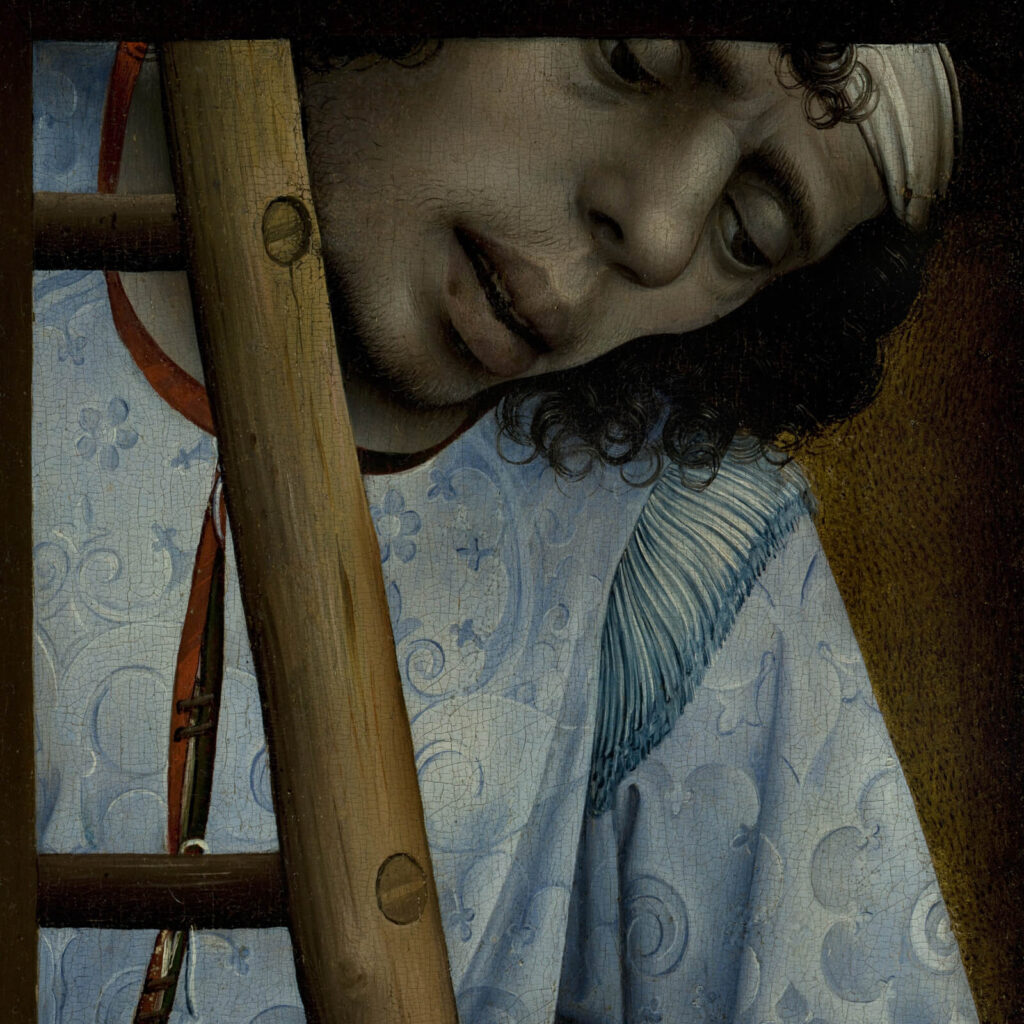
Rogier van der Weyden, The Descent from the Cross, before 1443, Museo del Prado, Madrid, Spain. Detail.
In the servant’s left hand are the two long, blood-stained iron nails just removed from Jesus’ crucified hands. He looks downward in a concentrated gaze as he holds with his right hand Christ’s right arm under the bending elbow.
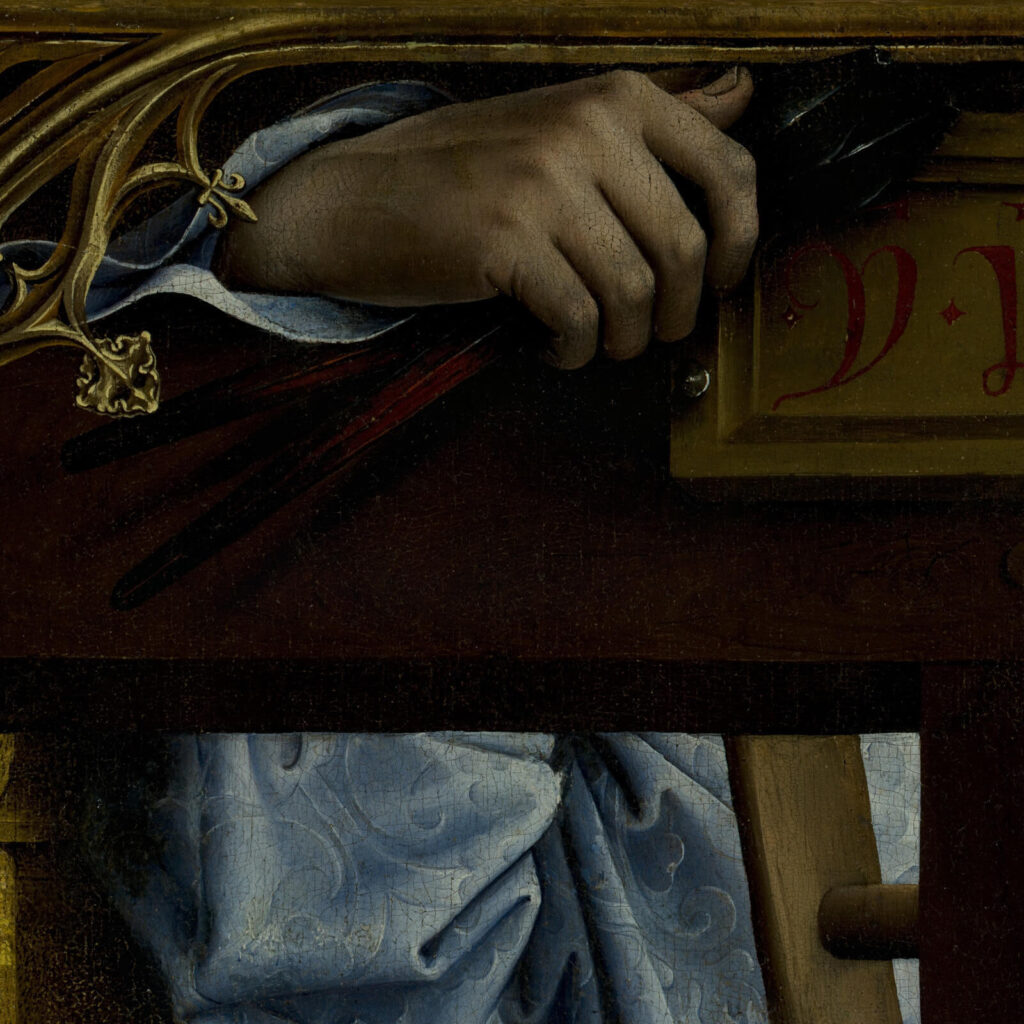
Rogier van der Weyden, The Descent from the Cross, before 1443, Museo del Prado, Madrid, Spain. Detail.
Joseph of Arimathea
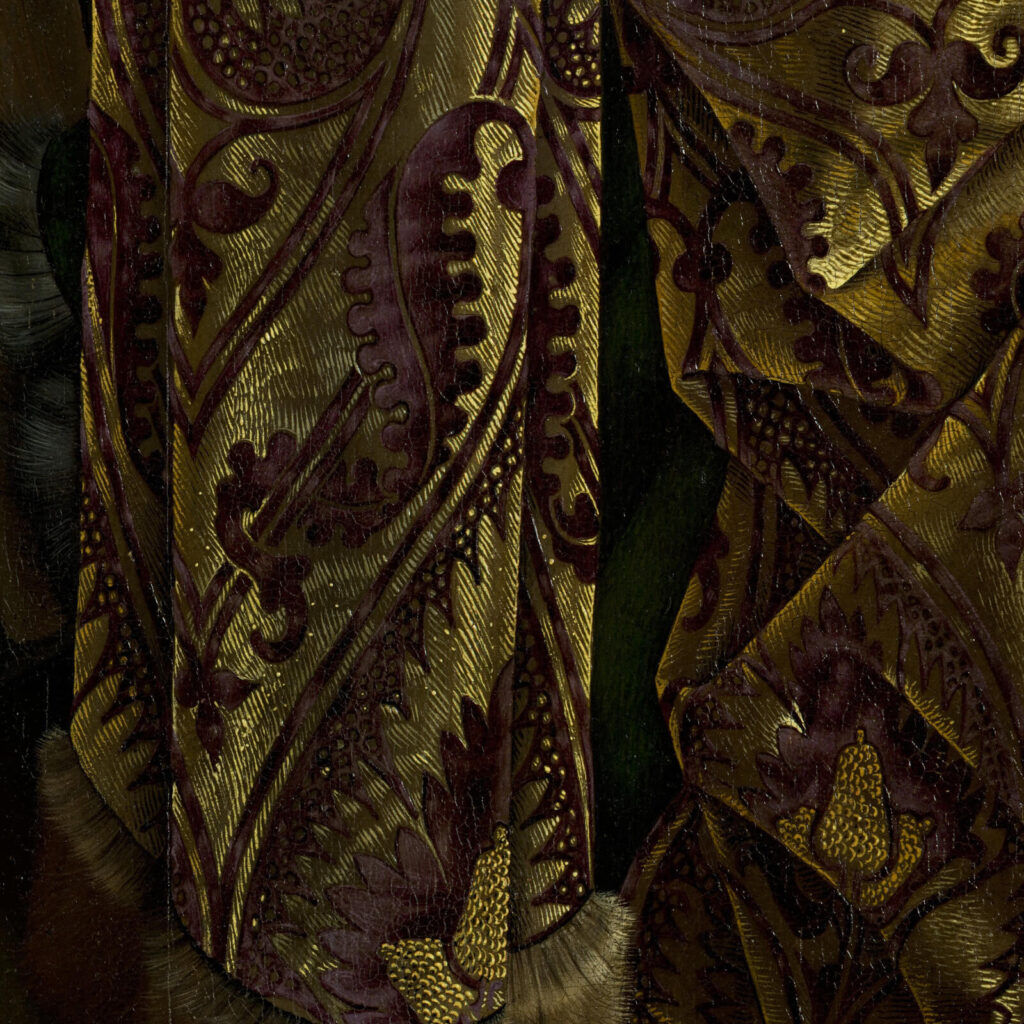
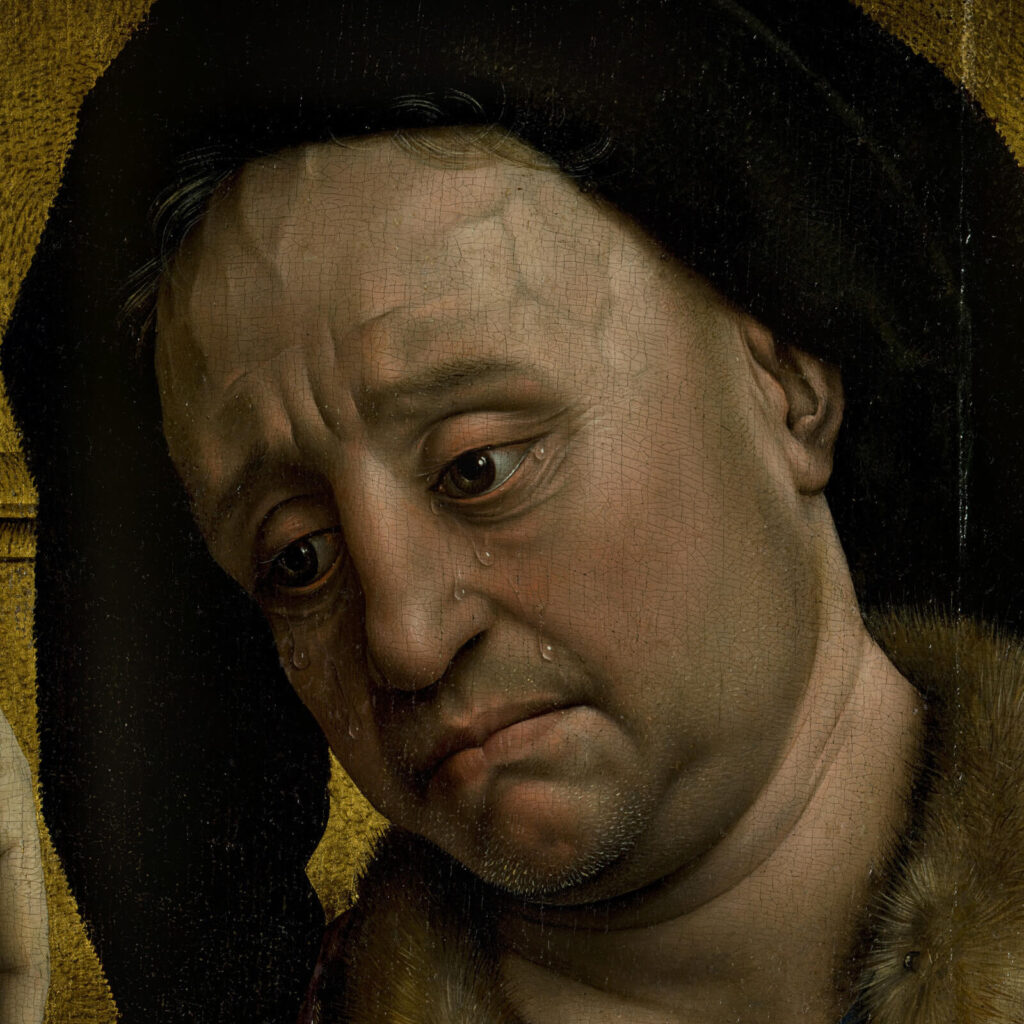
Joseph of Arimathea is the beardless and richly dressed man to the right of Jesus. He wears a black turban and a burgundy-and-gold cape edged in fur. His face is drafted with concern as furrows appear between his eyebrows, stress-induced veins radiate on his temples, while large globulous tears drip across his cheeks. His two hands support the legs of Jesus and bear the lower weight of Christ.
Joseph of Arimathea was a rich disciple of Jesus, perhaps a businessman or landowner. He originally constructed a rock-cut tomb in preparation for his future burial, like modern pre-planners who buy burial plots that may not be used for decades to come. However, Joseph donates his rock-cut tomb for the unplanned and hasty entombment of Jesus. Joseph of Arimathea sees the gesture as a final act of charity to his beloved leader and teacher. He cries over the loss of his spiritual guide.
Rogier van der Weyden, The Descent from the Cross, before 1443, Museo del Prado, Madrid, Spain. Detail.
Servant of the Oil
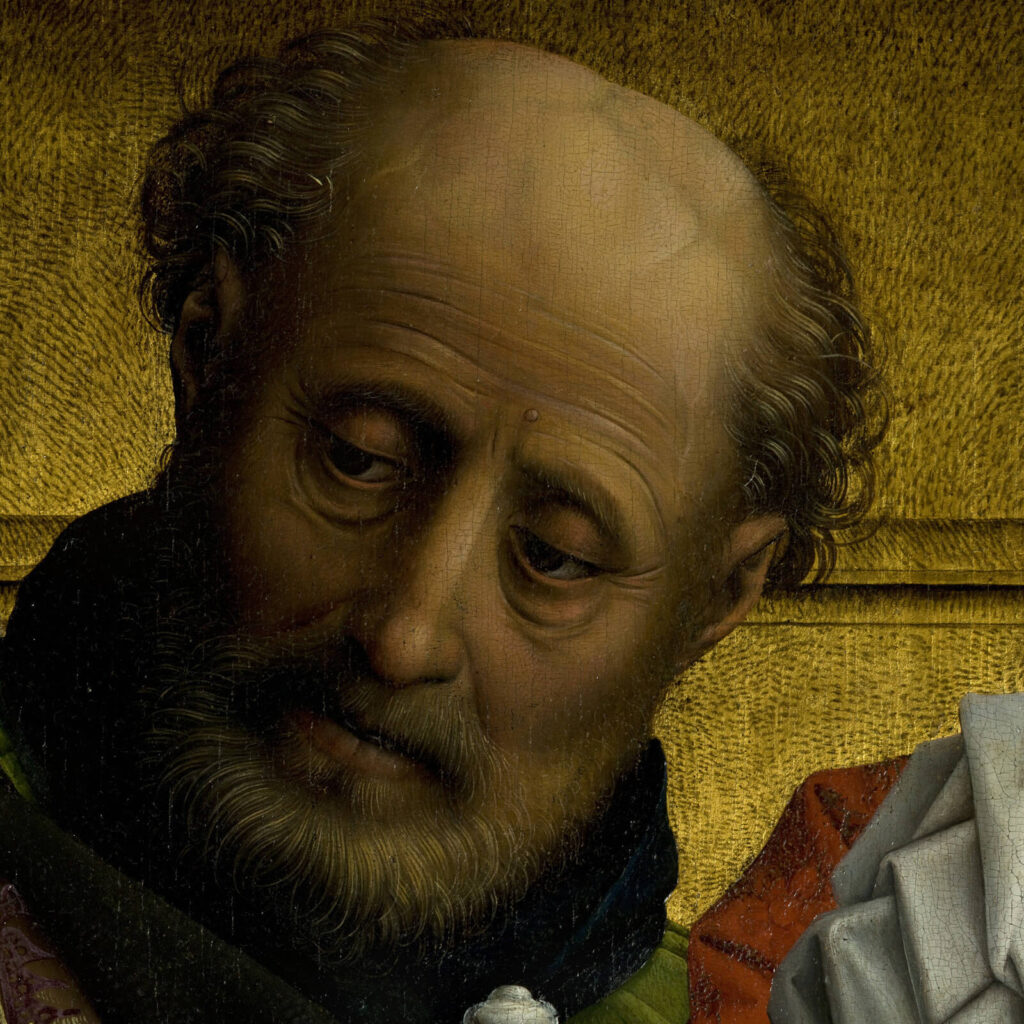
An unnamed servant stands behind Joseph of Arimathea. He is depicted as a mature man with a receding hairline. Wrinkles crease across his forehead and mark the corners of his eyes. He appears calm but leaning inwards to Joseph of Arimathea as if awaiting his employer’s commands. Art historians believe this man is the result of Rogier van der Weyden’s artistic license, as the man does not appear in the Christian Gospel or scripture. He is a figure included to hold aloft the important myrrh oil, which will be used to prepare and anoint the body of Christ before burial.
Rogier van der Weyden, The Descent from the Cross, before 1443, Museo del Prado, Madrid, Spain. Detail.
Mary Magdalene
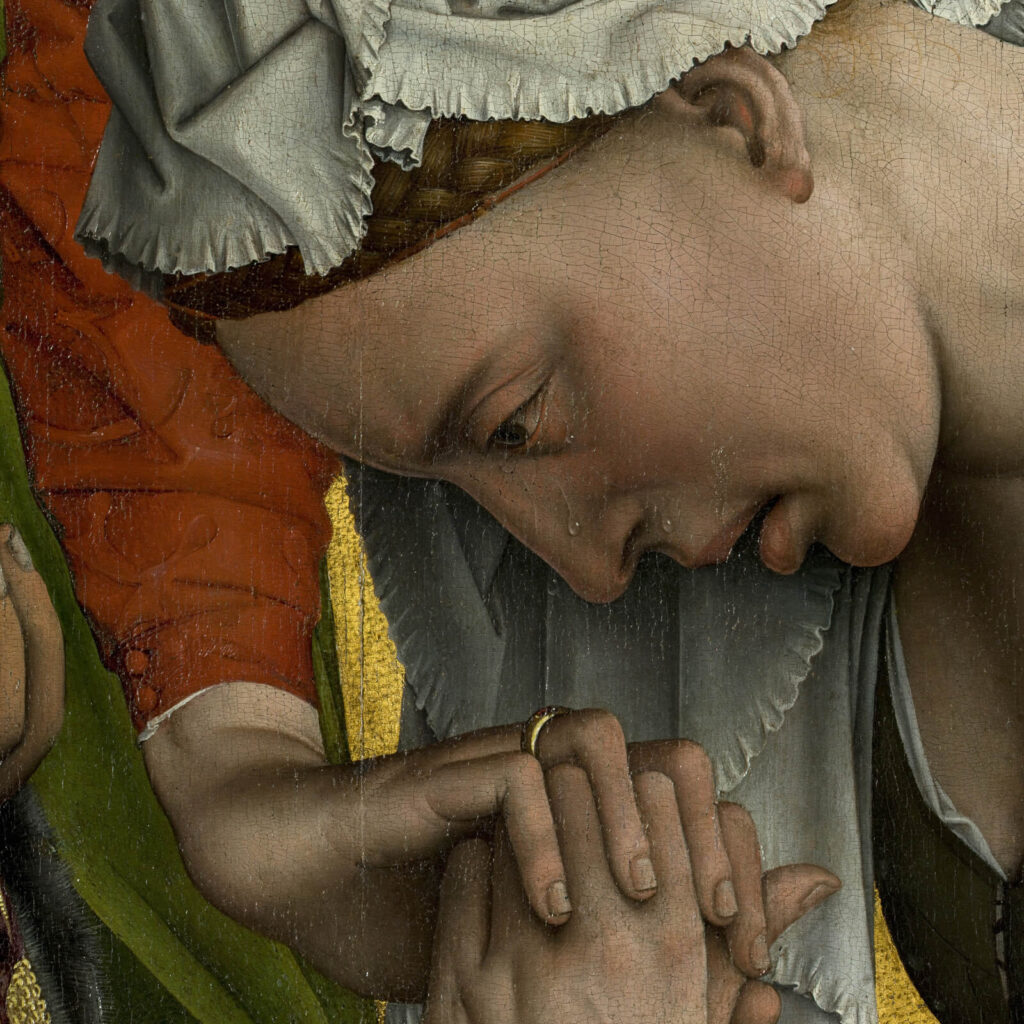
Mary Magdalene is the final figure in the composition and she is positioned on the far right of the painting. Her head is bowed and her hands are clasped in a gesture of prayer. Her knees bend and sway the dress fabric as if she is going to swoon with emotion.
Mary Magdalene’s identity and role in the Bible has been a source of great controversy, especially in the last 30 years. She has been identified with varying degrees of argument, doubt, and hope as a former prostitute, a dutiful disciple, and a faithful wife of Jesus. What was her exact role in the story of the life of Jesus? The dialogue still continues today.
Rogier van der Weyden, The Descent from the Cross, before 1443, Museo del Prado, Madrid, Spain. Detail.
Adam
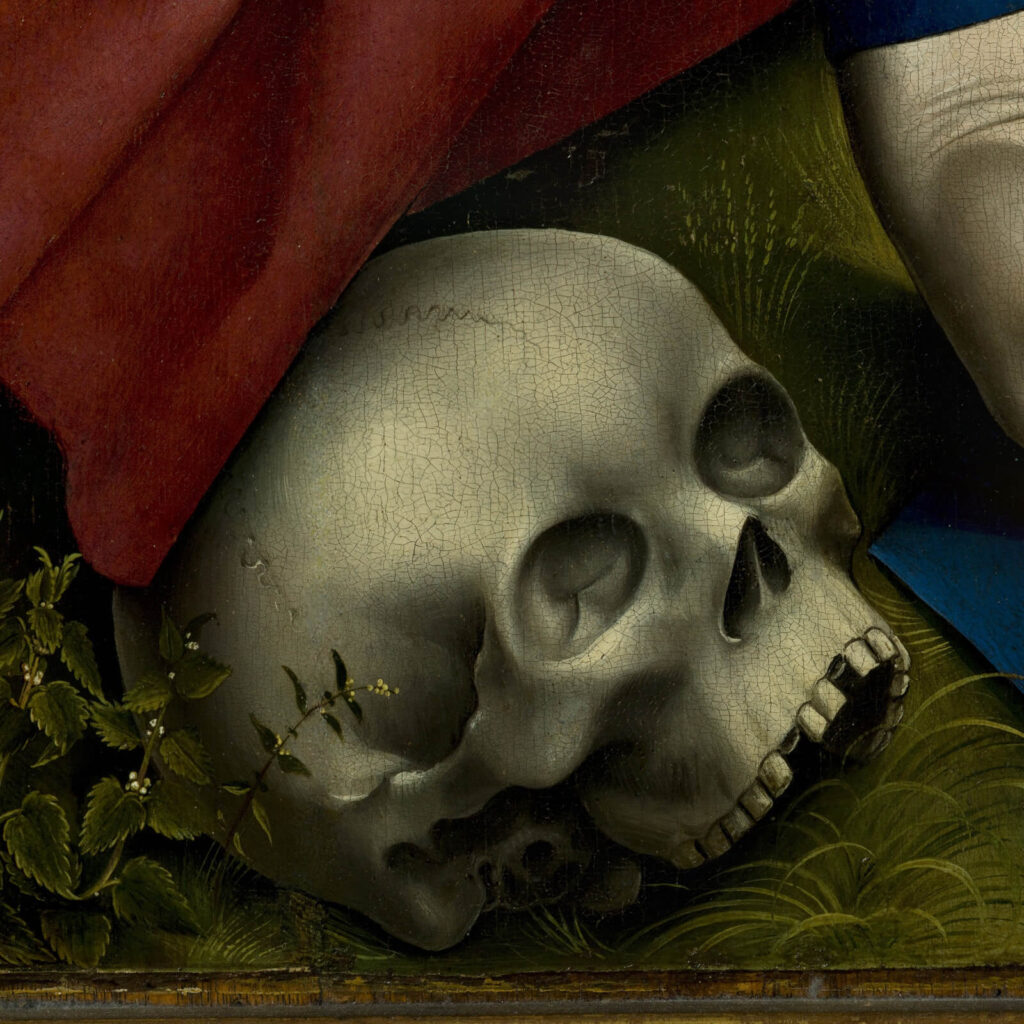
The crucifixion and death of Jesus were, according to the Bible, on the exact spot of the burial of Adam, the first man created by God. Rogier van der Weyden alludes to this illustrious burial with the exposed skull and thigh bone lying on the ground. This backward glance to Genesis, the beginning of Christianity, creates an interesting dialogue on faith over time.
Rogier van der Weyden, The Descent from the Cross, before 1443, Museo del Prado, Madrid, Spain. Detail.
Crossbows
Outlining the perimeter of the panel is delicate tracery. It adds a decorative element that nicely contrasts with the solid forms of the figures. Interestingly, the tracery also hints at the commissioners of The Descent from the Cross. A local guild of crossbowmen collected funds and paid Rogier van der Weyden to create this masterpiece. In homage to their faithful patronage, Van der Weyden included tiny crossbows in the upper-left and upper-right corners of the tracery. They are small but fascinating details that cannot be unseen once discovered.
Additionally, the artist also depicted Jesus and the Virgin Mary in prostrated positions that almost resemble crossbows. Their torsos are the crossbow central stock and their arms are the crossbow limbs. Secular patrons are intelligently alluded to by religious corporal positions. How ingenious!
Rogier van der Weyden, The Descent from the Cross, before 1443, Museo del Prado, Madrid, Spain. Detail.
Theatrical Stage
The Descent from the Cross is a masterpiece of religious imagery, of the 15th-century Flemish painting, and of Northern Renaissance art. It resembles a relief carving with a shallow theatrical stage emblazoned with a gold shrine-like background. The figures appear like painted sculptures and create maximum action within a limited range of space. Rogier van der Weyden expertly depicts psychological distress through gesturing bodies, rippling fabrics, and tearstained faces.
Rogier van der Weyden, The Descent from the Cross, before 1443, Museo del Prado, Madrid, Spain. Detail.
His human dramas feel intense but deeply authentic. The human element allows visitors of any faiths and backgrounds to appreciate this masterful work. While Christianity was the original inspiration, it is its human reaction that expands its audience. It is iconic, beautiful, and available to view at the Museo del Prado in Madrid, Spain.
Rogier van der Weyden, The Descent from the Cross, before 1443, Museo del Prado, Madrid, Spain. Detail.